
Wednesday 3 June 2020 – Year 9
It is very important that you follow the order in which I give you instructions today!
(You need to work fast as you will also complete 2 quizes…)
1.
We will start today’s lesson with a short assessment of the Holocaust Topic. So, immediately, go to Schoology and complete the quiz about “The Holocaust – an Assessment“.
IMPORTANT: Please note that you have only one attempt to complete the quiz. Also, it is a timed quiz, that expires within the next half hour!! So do it now straight away! AND: If, for some reason, you have any problem with the quiz, let me know immediately in Hangouts, or you may lose marks!!

2.
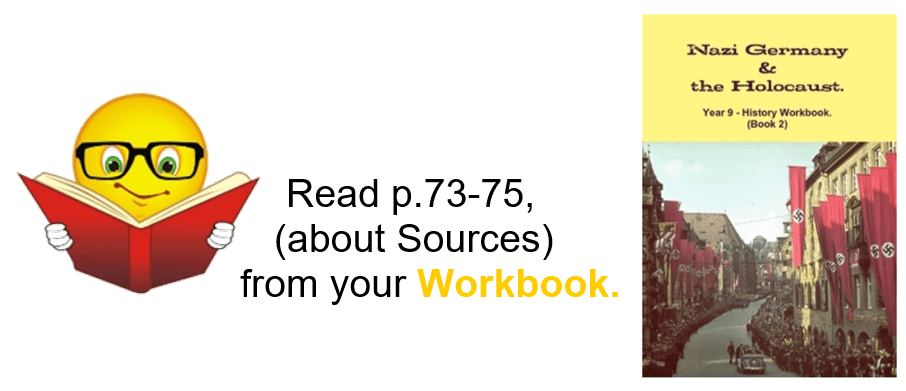
Now we are going to do the final “topic” in your History course. We are going to look at The Use of Sources in History. You will do quite a bit of reading PLUS another quiz at the end of the lesson – so make sure that you work fast! First of all, read the information on Historical Sources from p.73-75 in your Workbook.
3.
Now read the information below about “Different Types of Sources”. It comes (more or less directly!) from an excellent website on “Using Historical Sources”.
Different Types of Sources
What is a ‘source’?
“A source is something that provides information about the historical topic you are studying. They can either be written (e.g. books or websites), or non-written (e.g. photographs or artefacts). No matter what you’re doing in History, you will use sources. This could be simply learning information from a textbook or website, or actually looking at ancient artefacts made in the past. Either way, they provide information about the past and are considered ‘sources of information’.”
Two kinds of sources…
“There are two kinds of sources: primary and secondary. The main difference between a primary and a secondary source is when they were made. In order to determine whether a particular sources is a primary or secondary source, you need to discover its time of creation.”
Primary Sources…
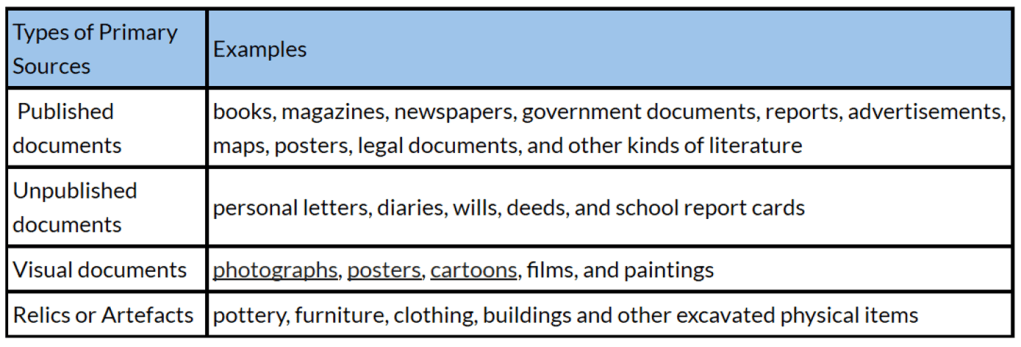
“Primary sources were made during the historical period that is being investigated. These are often the hardest to find but, as a result, are often the strongest evidence you can use…” There are many different types of primary sources:”
Secondary Sources…
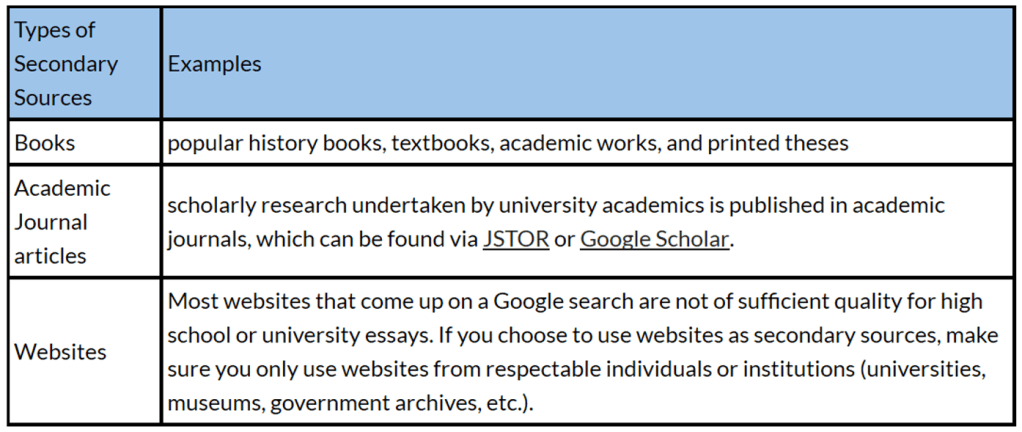
“Secondary sources were made after the time period you are investigating. As a general rule, historians value secondary sources that are created by scholars, as they are usually more reliable. However, whilst modern scholars aim to produce reliable and unbiased historical accounts, read their writings with the same critical eye as you would primary source creators. Like primary sources, secondary sources come in different types:”
4.
Watch the following video on different types of sources:

Primary and Secondary Sources. (8:42 Minutes Long)
5.

Source Attributions…
When dealing with any source, whether primary or secondary, it is important to first look at the attributes. That means the information given about the source. (Usually a short attribution at the end of a source tells your who created the source, or the origins of the source, as well as when it was created. This information is essential in order to analyse the relevance of the information given in the source.
Origins / Source Creator…
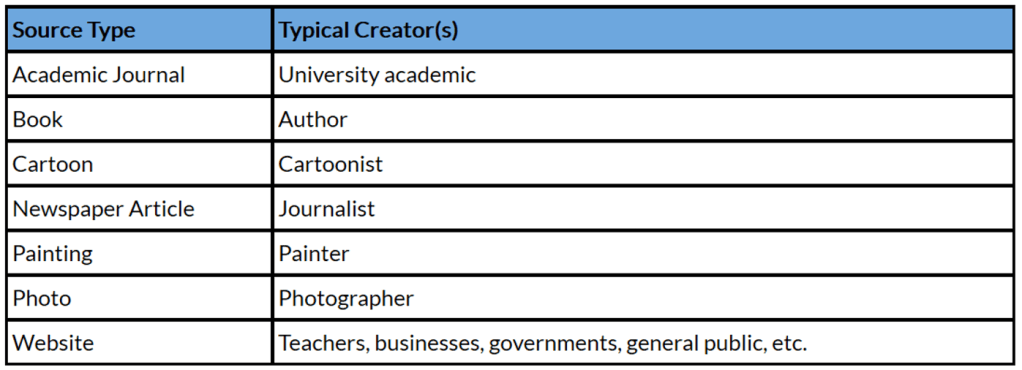
“The first step in creating an effective analysis of a source is to find out who created it. While this might sound like a simple thing to do, it can often take significant time to find out all the required information about the creator of a source. When we talk about the ‘creator’ of a source, we want to know who originally made it. Different kinds of sources usually have a particular kind of creator.” (See the examples in the table below.)
Information about the creator…
When dealing with the creator of a source, try to predict what his / her perspective may be on the events, consider “the creator’s career (university professor, soldier, etc.) as well as what experience they have on the topic (they experienced the event personally, or they study the topic professionally, etc.).” This will influence the degree to which you value the source of information.
6.
Watch the following video about the creators of sources:

The Origins of Sources. (3:44 minutes long)
7.

Time of Creation…
“When analysing a source, you need to be aware of when it was made. This will not only help you to determine whether it is a primary or a secondary source, but it will also help you in your source evaluation. The ‘time of creation’ is the date when the source was originally made. For some sources, particularly secondary sources, you can find out the exact year it was published. For primary sources, particularly from the ancient or medieval time period, you may only be able to provide the decade or century when it was created.”
8.
Finally, complete the quiz in Schoology about “Types of Sources, Origins & Time of Creation“.
IMPORTANT: Please note that you have only one attempt to complete the quiz. Also, it is a timed quiz, that expires at the end of the lesson!! So do it now straight away! AND: If, for some reason, you have any problem with the quiz, let me know immediately in Hangouts, or you may lose marks!!

9.
Send me a private message on Schoology (use the SAME mail-thread!!!) to confirm that you have completed the tasks as instructed today!


(If you want to access the information on Sources used in this lesson directly from the original website, here is the link to access it: https://www.history.org.uk/student/resource/3211/using-historical-sources .)
(WordPress advertisements may appear below.)
 Best study methods