
Wednesday 10 June 2020 – Year 9
It is very important that you follow the order in which I give you instructions today!
We are still busy with our final “topic” on The Use of Sources in History. Again, you will do quite a bit of reading, watch videos on the topic, and do an assessment quiz at the end of the lesson – so make sure that you work fast, because the quiz will expire by the end of the lesson!
You may NOT do the quiz before reading all the information and watching all the videos!

Do NOT even open the quiz before you are told to do so in the instructions below!
1.
Read all the information (below) about “Bias“, “Usefulness”, and “Reliability”. It comes (more or less directly!) from an excellent website on “Using Historical Sources”.
Bias
“As you read historical sources, particularly primary sources, you may find yourself noticing that some language used by the source’s creator is extreme or obviously one-sided.” This is also known as bias. “Bias is when the creator’s perspective is so strongly for or against something that the information in the source is clearly unbalanced or prejudiced. All sources contain some degree of bias, but it is not always possible to detect it.”
“Bias can either be extremely positive or extremely negative. If extremely positive, it is described as “pro-”, or “in favour of”, etc. If extremely negative, it is described as “anti-”, or “strongly against”, etc. If you cannot detect a bias, it is described as a “balanced” source”.”
“How do I detect bias in a source? Look for times in a source where any of the following happen:”
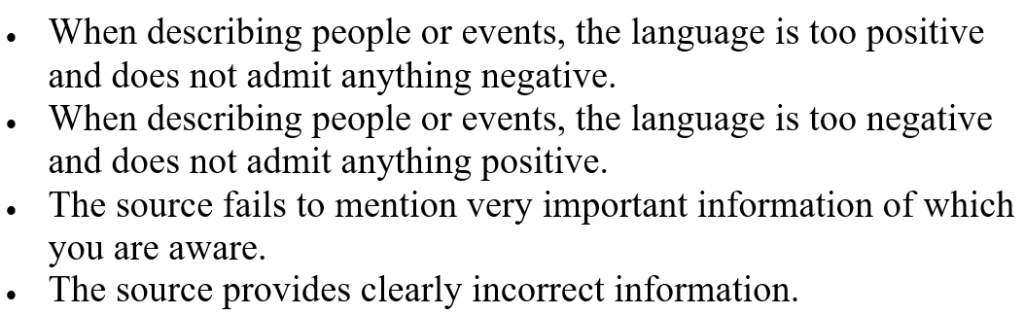
“If you noticed any of the above in your source, it indicates that the creator has a specific bias about the person or event and wants to communicate in a way that positions the audience to see things from the same perspective.”
Please note: “Bias in sources does not automatically make a source unreliable or inaccurate. Acknowledging which side the source supports simply allows us to highlight gaps in information.”
2.
Now, watch the following video that explains “How do you know if a historical source is biased?”. (5:34 minutes long)

3.

Usefulness
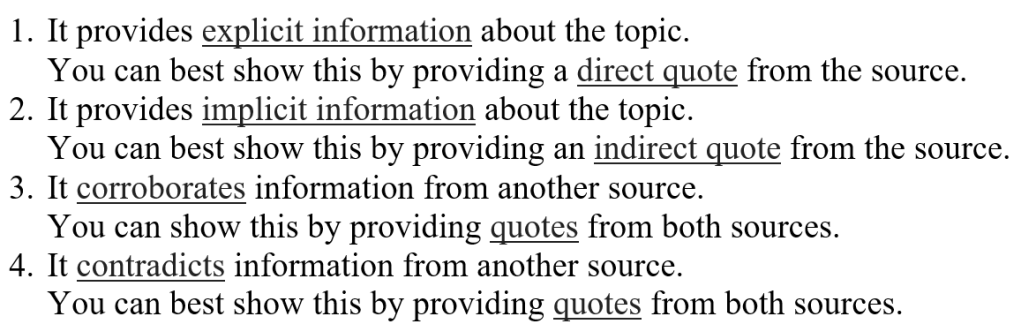
“Usefulness is a judgement about how relevant or helpful a particular source is in providing information about your topic.” Usefulness helps one to “prove that a source is valuable. The measure of a source’s usefulness is based upon the question being asked of it: If a source provides any information about the specific topic you’re investigating, it is considered to be a useful source.”
“How do I prove usefulness? Since a source’s usefulness is based primarily upon its ability to provide valuable information on your topic, there are four different ways to prove that a source is useful:”
4.
Now, watch the following video that explains “How to evaluate historical sources for usefulness”. (3:40 minutes long)

5.

Reliability
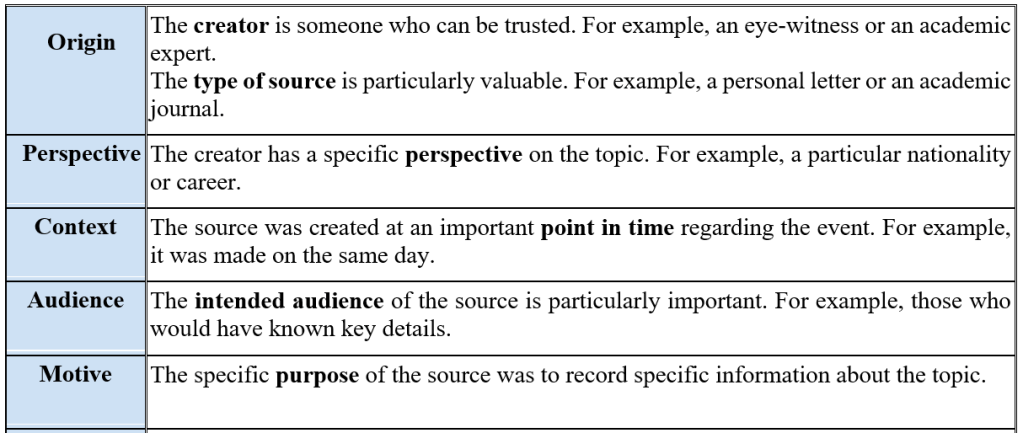
“Reliability of sources evaluates whether they are trustworthy. It is important that the sources you use… are reliable so that the quotes (evidence) you use from them can be trusted. In history, it is rare that we are completely sure that sources are 100% reliable. Therefore, when we talk about reliability of sources, we can talk in terms of ‘degrees of reliability’:”
“Extremely – Very – Somewhat – Rarely – Not very”
“For example, we can say that a source is “extremely reliable”, or “not very reliable”.”
“How do I evaluate reliability? Based upon what you discovered in your analysis of the source, you can establish reliability based upon any of the following:”
“Based upon what you discovered in your analysis of the source, you can establish its unreliability based upon any of the following:”
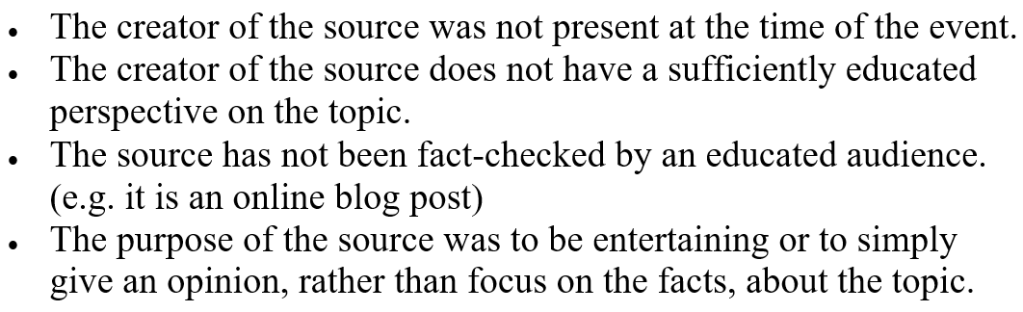
“When using information from sources to prove your own argument, you need to be able to use sources that are reliable. If you have found a source which you discover to be unreliable, the best advice would be not to use the source.”
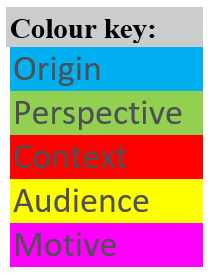
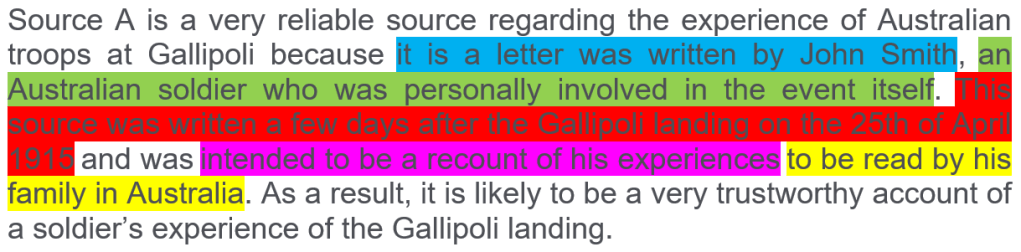
Here is an example of how to write the evaluation of reliability:
6.
Now, watch the following video that explains “What makes a source reliable?”. (5:53 minutes long)

7.
Also watch the following video that I have made for you to explain usefulness, reliability and bias in source analysis. Pay careful attention!

Usefulness, Reliability and Bias. (5:04 minutes long)
8.
Finally, complete the quiz in Schoology about “Bias“, “Reliability”, and “Usefulness”…
IMPORTANT: Please note that you have only one attempt to complete the quiz. Also, it is a timed quiz, that expires at the end of the lesson!! So, do it now straight away! AND: If, for some reason, you have any problem with the quiz, let me know immediately in Hangouts, or you may lose marks!!

9.
Send me a private message on Schoology (use the SAME mail-thread!!!) to confirm that you have completed the tasks as instructed today!


(If you want to access the information on Sources used in this lesson directly from the original website, here is the link to access it: https://www.history.org.uk/student/resource/3211/using-historical-sources .)
(WordPress advertisements may appear below.)
 Best study methods