
Year 9A & Year 9B
Today you are going to examine the Battle of Jutland as an example of Stalemate at Sea…
Follow the instructions step by step:
1.
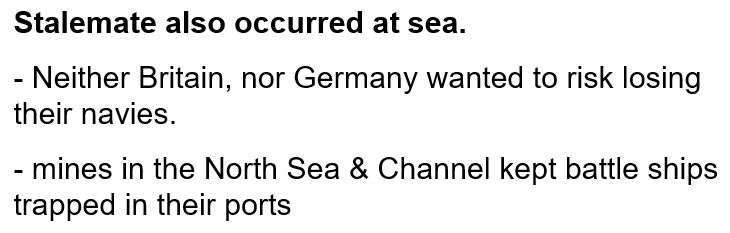
Let’s examine this in more detail!


It tells you about “Stalemate at Sea”. (You can follow the content in your Workbook on p.28.)
(1:39 minutes long)
2.

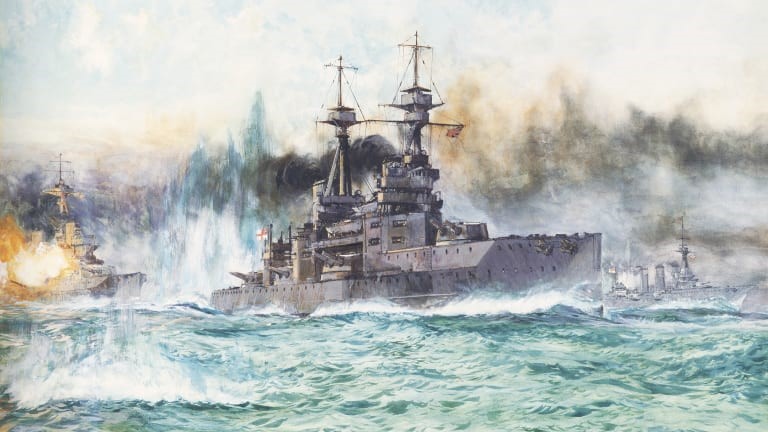

They tell you more about the Battle of Jutland.
The Battle of Jutland. (1:57 minutes long)
The Battle of Jutland pushed Britain to the limit. (3:57 minutes long)
3.

Stick the flowchart into your book and copy the missing information to show the main events of the Battle of Jutland.

4.
First…the instructions at the top of p.32.
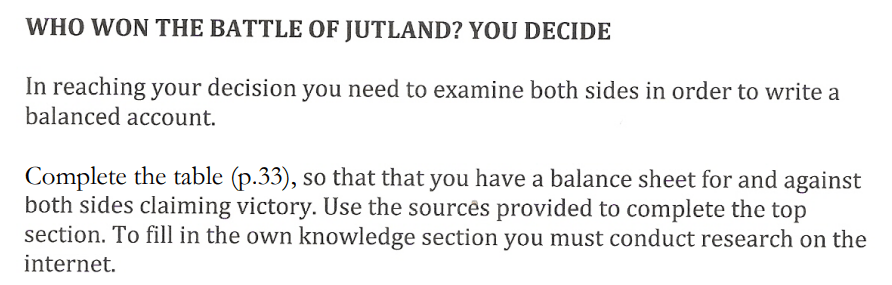
So, what have you learnt so far about the Battle of Jutland, that can be used in a debate about who won the Battle of Jutland? (Write down this “own knowledge information” on the table on p.33.)
SOLUTION:


5.
…the sources on p.32.
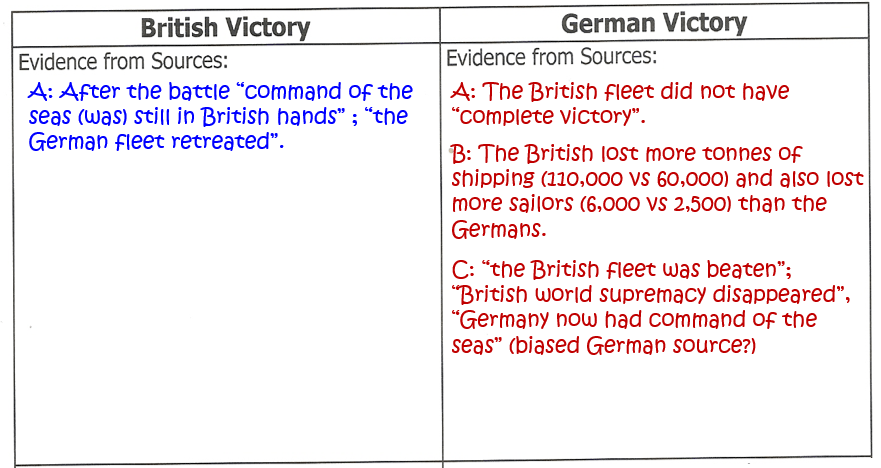
Find evidence (in the sources) that can be used in a debate about who won the Battle of Jutland? (Write down this evidence, in the form of short quotes, on the table on p.33.)
FOR EXAMPLE:
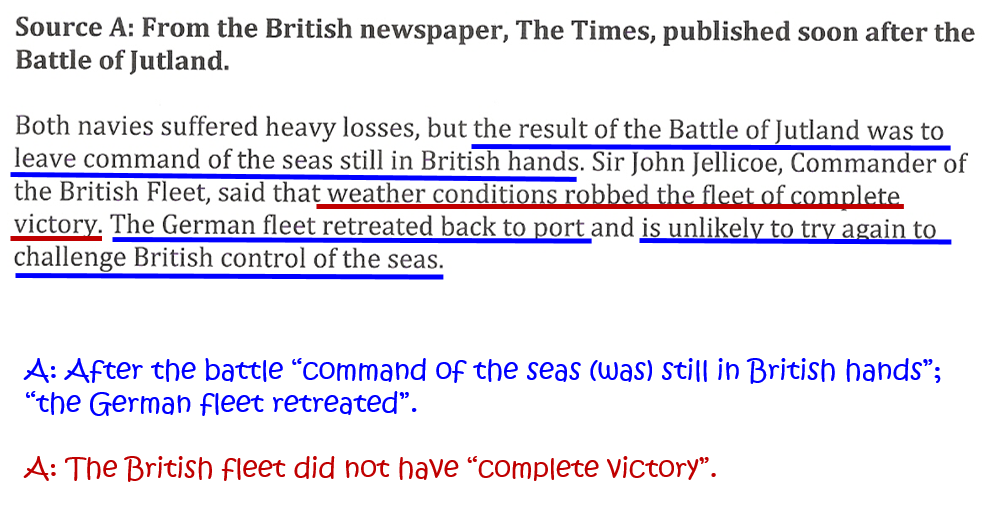
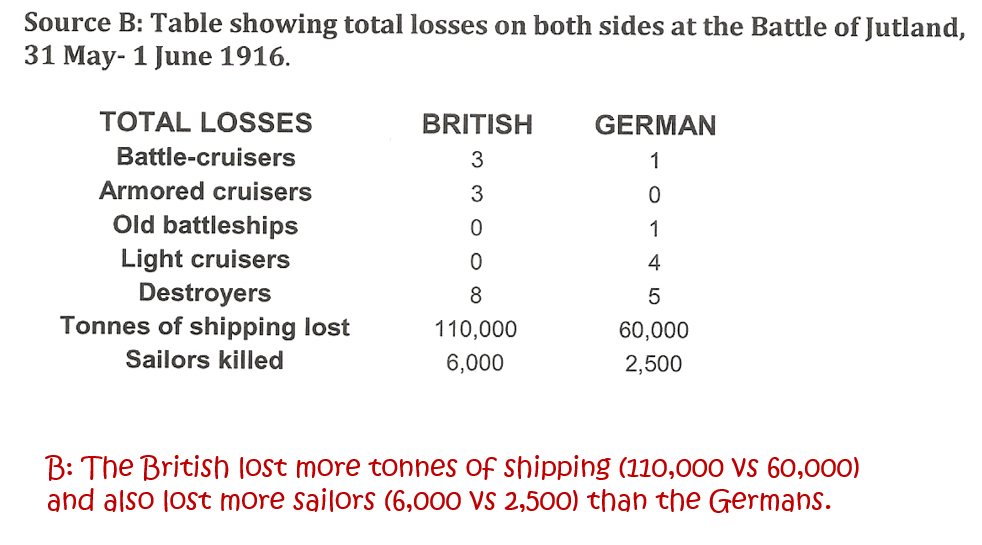
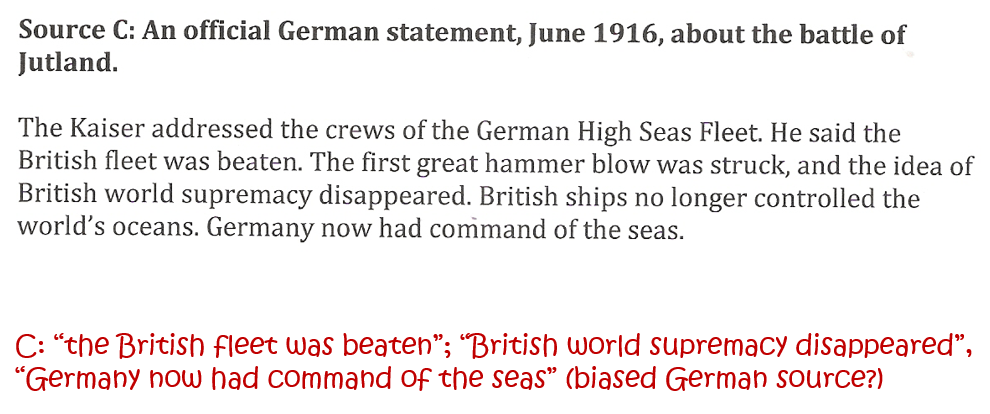
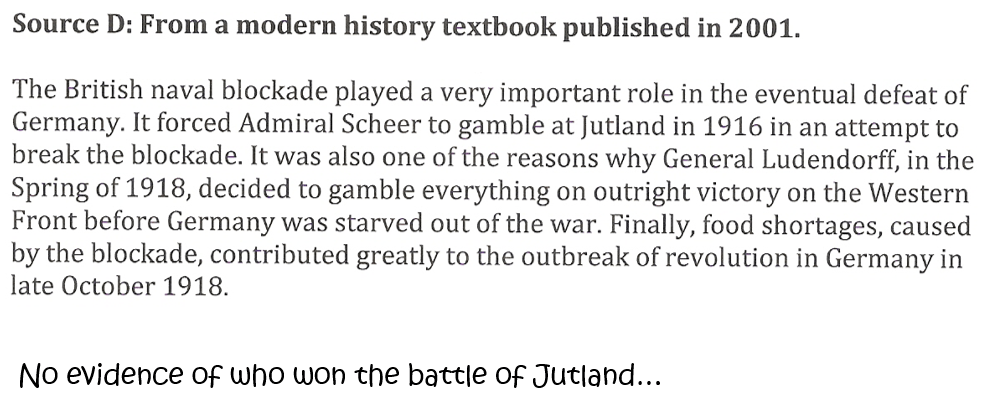
SOLUTION:
6.
Finally, do the last part of the task on “Who won the Battle of Jutland?” by completing the final box on the table (p.33).
7.

WHAT WAS THE BATTLE OF JUTLAND?
“The Battle of Jutland (31 May – 1 June 1916) was the largest naval battle of the First World War. It was the only time that the British and German fleets of ‘dreadnought’ battleships actually came to blows. The German High Seas Fleet hoped to weaken the Royal Navy by launching an ambush on the British Grand Fleet in the North Sea. German Admiral Reinhard Scheer planned to lure out both Admiral Sir David Beatty’s Battlecruiser Force and Admiral Sir John Jellicoe’s Grand Fleet. Scheer hoped to destroy Beatty’s force before Jellicoe’s arrived, but the British were warned by their codebreakers and put both forces to sea early. Jutland was a confused and bloody action involving 250 ships and around 100,000 men. Initial encounters between Beatty’s force and the German High Seas Fleet resulted in the loss of several ships. The Germans damaged Beatty’s flagship, HMS Lion, and sank HMS Indefatigable and HMS Queen Mary, both of which blew up when German shells hit their ammunition magazines. Beatty withdrew until Jellicoe arrived with the main fleet. The Germans, now outgunned, turned for home. The British lost 14 ships and over 6,000 men, but were ready for action again the next day. The Germans, who had lost 11 ships and over 2,500 men, avoided complete destruction but never again seriously challenged British control of the North Sea. Although it failed to achieve the decisive victory each side hoped for, the Battle of Jutland confirmed British naval dominance and secured its control of shipping lanes, allowing Britain to implement the blockade that would contribute to Germany’s eventual defeat in 1918.”
This account comes from the following website: https://www.iwm.org.uk/history/what-was-the-battle-of-jutland

(WordPress advertisements may appear below.)
 Best study methods