

Today you are going to revise the history of Stalin’s Russia – by means of a feature length film…!
-Part A-
In order to optimally gain from this film, it is important that you understand what is happening right from the beginning of the film. Here is some background information about the events:
Introduction: (The story is told by Stalin’s daughter, looking back at her father’s life.)
Stalin was married twice. (His first wife died at a young age.) They had a son called Jakov. Stalin deserted the boy when his wife died. He then married a woman who was much younger than himself. They had two children. Their first born was a son called Vasili and their second child was a daughter called Svetlana. In this film, Svetlana is telling the story.

- the film starts with Stalin in 1917, in Siberia (exiled)
- the tsar set political prisoners free & recruited them to fight in WW1
- however, Stalin was not “fit” for war and was thus rejected
- Stalin was known as Koba at the time

We can see Historical footage of February 1917 …
- Lenin arrives in Russia, just after this revolution (he arrives by train at the Finland station in St.Petersburg)
- Many of his supporters are there to greet him.
- Stalin is there, and also Sergei & Olga Alliluyev, and their daughter, Nadia. (Do not mistake Nadia with the person telling the story.)
The October 1917 Revolution takes place…

The next scene is in the house of Sergei and Olga Alliluyev…
- the Civil War period is shown
- Stalin is travelling on a train during the Civil War
- Nadia is also on the train, as Lenin appointed her as an assistant to Stalin

Stalin meets Voroshilov (another Bolshevik). Then, they interfere with military operations. (They made sure that “unreliable officers” were killed in an “accident” when their barge sank.)
Trotsky was Commissar of War. Stalin was Commissar of Nationalities. Their spheres of influence sometimes overlapped. This led to conflict, especially when Stalin “got rid” of these officers.
Trotsky (in charge of the military) complains to Lenin about Stalin’s interference and the deaths of the officers…

Stalin I-A. (15:12 minutes long)
-Part B-
It is in 1919, in the Kremlin, n Moscow. It is Stalin’s wedding day. (By now, Nadia was Lenin’s personal secretary.)
Spot…

- Nikolai Bukharin (He congratulates Nadia and picks her up.)
- Leon Kamenev (He also congratulates Nadia.)
- Grigorei Zinoviev (He gives her a bottle of champaign to congratulate her.)
- Stalin & Nadia (dancing in a circle) with Sergo Ordzhonikidze & his wife Zina (Zinaida)
- Lenin & his wife, Krupskaya
It is in 1922, also in the Kremlin, in Moscow.
The politburo has a meeting. They discuss the Secretariat and decide to appoint a General Secretary (one of themselves) in order to have a link between the Politburo and the Secretariat. (At the time, Nadia was pregnant with their first child.)
Stalin is at home, talking to his friend, Sergo Ordzhonikidze while Sergo’s wife, Zina, helps Nadia (who is in labour with their first child). A messenger comes and tells them that Lenin had a stroke. (Stalin’s father was made boots for a living.)
Stalin visits Lenin, who is recovering at home after the stroke. Lenin is cross with Stalin, because Stalin condoned one of his supporters punching a fellow party member.
Other scenes follow:
- Stalin, Kamenev and Zinoviev formed a trio to take leadership in the party while Lenin was ill (to prevent Trotsky from taking over).
- Stalin visits Lenin again at home… (He insults Lenin’s wife, Krupskaya, when she did not want Stalin to see Lenin, because she did not want Lenin to be upset by Stalin.)

Lenin’s death… 21 Jan.1924
Stalin I-B. (20:36 minutes long)
-Stalin I-
(Below are the scenes watched today in one video clip.)
Stalin I. (35:08 minutes long)
Finally…

Here is feedback on the 10-mark question that you answered in Lesson 9:
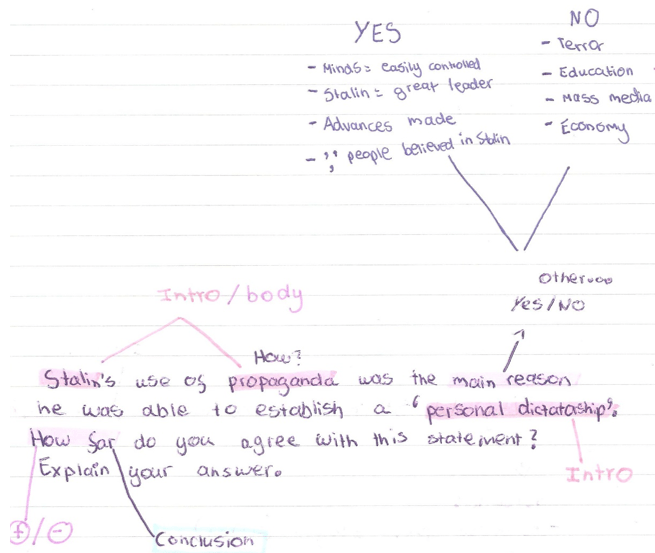
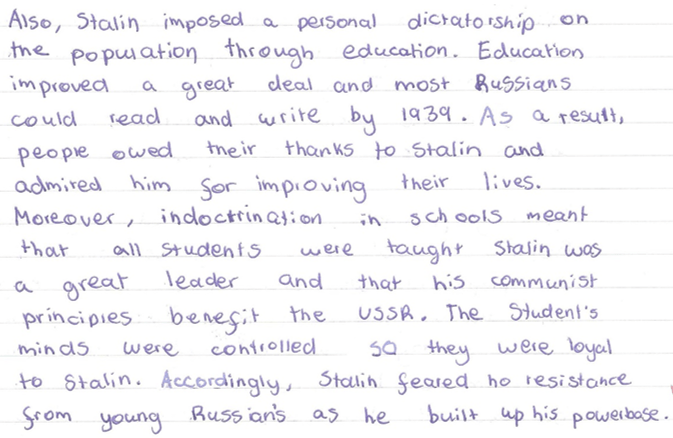
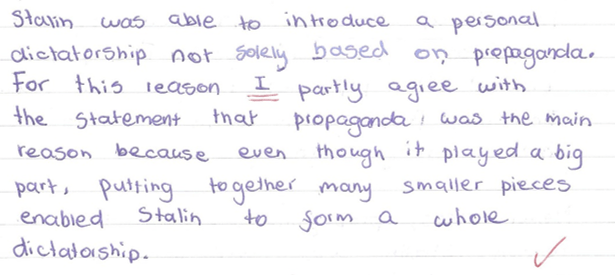
‘Stalin’s use of propaganda was the main reason he was able to establish a ‘personal dictatorship’.’ How far do you agree with this statement? Explain your answer. (10)
EXAMPLE PLAN:
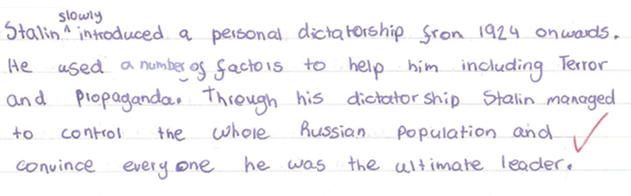
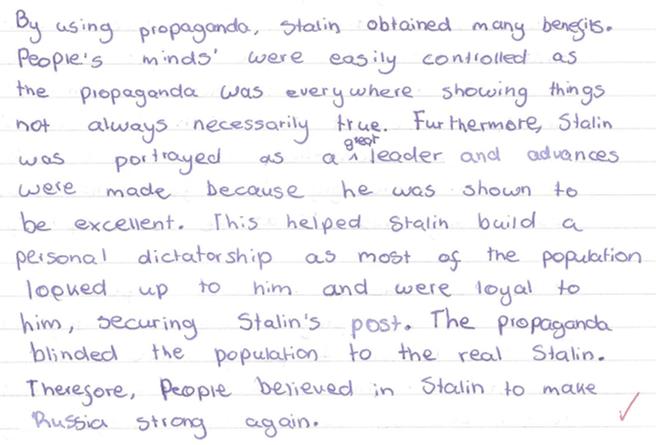
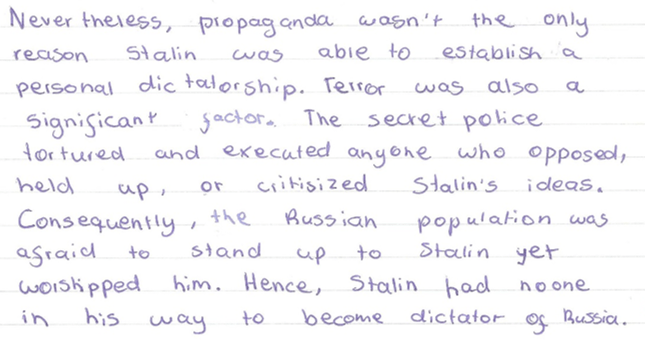
EXAMPLE ANSWER:

(WordPress advertisements may appear below.)
 Best study methods