


- to find out what an urban legend is
- to evaluate urban legend texts
- to prepare for an assessment task by selecting relevant evidence (in order to make informed judgements about the urban legends)
1.
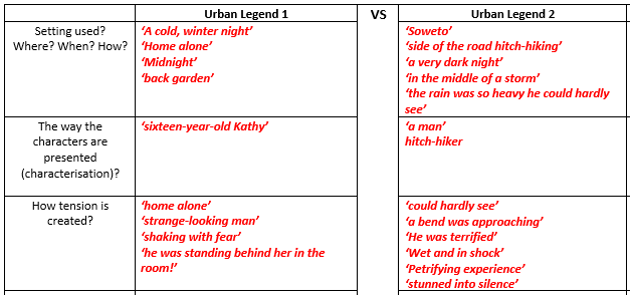
If not finished yet, complete the table by writing down your ideas about the two Urban Legends that we looked at in the previous lesson. Make sure that you support what you say with quotes from the text!
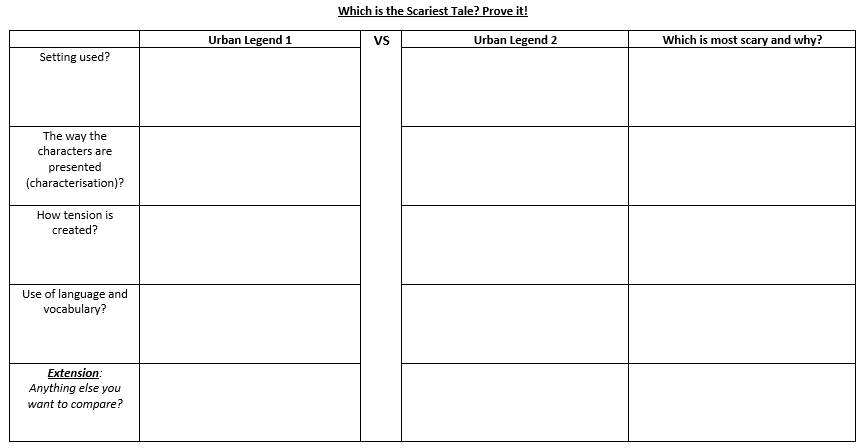
You will need this information for a discussion task in the next lesson…
SOLUTION

2.
Do you want to hear a few more Urban Legends? The video below tells more stories. Distinguish between which stories are true Urban Legends and which are simply ghost stories.

Unique Urban Legends. (9:26 minutes long)
(Start watching at 2:00 minutes)
3.
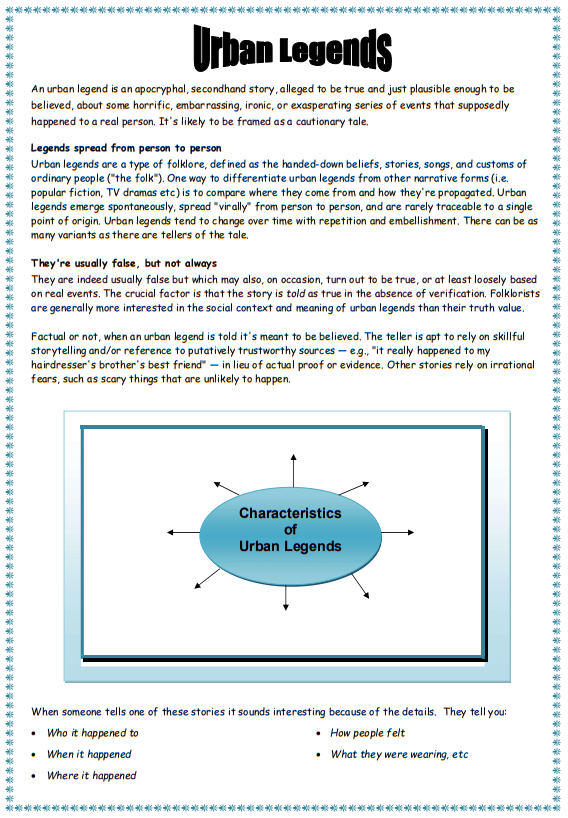
Read the information explaining characteristics of Urban Legends.
4.

Consider the following words and their meanings. Then copy them down into your books.
- alleged – “said, without proof, to have taken place”
- plausible – “seeming reasonable or probable”
- exasperating – “intensely irritating and frustrating”
- folklore – “traditional beliefs and stories of a community, passed through the generations by word of mouth”
- customs – “traditional way of behaving of a particular society or place”
- propagated – “spread and promote an idea”
- apocryphal – “of doubtful authenticity, although widely circulated as being true”
- embellishment – “a detail, especially one that is untrue, added to a statement or story to make it more interesting”
- verification – “the process of establishing the truth, accuracy, or validity of something”
- apt – “having a tendency to do something”
- putatively – “commonly accepted”
- in lieu of – “in place of”
- irrational – “not logical or reasonable”
5.
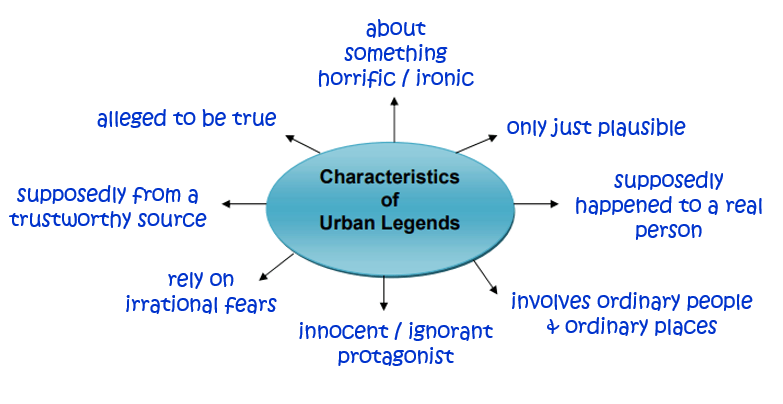
Read the information again and complete the spider diagram to show characteristics of Urban Legends.
SOLUTION

—TEXTBOOK—
You can access useful information in the Year 7 textbook!
—TEXTBOOK—
(WordPress advertisements may appear below.)
 Best study methods