
Monday 8 June 2020 – Year 9
It is very important that you follow the order in which I give you instructions today!
We are going to continue with our final “topic” on The Use of Sources in History. Again, you will do quite a bit of reading PLUS another quiz at the end of the lesson – so make sure that you work fast, because the quiz will expire by the end of the lesson!
You may NOT do the quiz before reading all the information and watching all the videos!

You will start by reading all the information (below) about “Historical Context“, “Audience“, “Purpose” and “Perspective“. It comes (more or less directly!) from an excellent website on “Using Historical Sources”.
1.
Historical Context
“When you are analyzing sources, it is important to remember that they were created at a time that is very different to our own.” This time of creation is the historical context. One needs to be aware “that the people who created sources were living at a time which may have held opinions and beliefs that are very different to what we consider ‘normal’….”
In addition, one also needs to be “aware of the important events at the time that influenced the creation of the source. Particular events often motivated people to create sources in a specific way. The creator may have specifically mentioned certain people or events, or used a certain language…”
How do we determine the historical context of a source?
Firstly, you need to know when the source was made. “Ensure that you are as precise as possible when identifying the date of creation: the century, decade, year, month and or day may help.”
“Secondly, …you need to discover where it was created.” (E.g. “a soldier wrote a letter in camp before battle, or a convict wrote a letter in a ship while in transit, or a newspaper printed a news report in a particular country town” – this “can all become important to knowing the context of the source.”)
“Thirdly, …you need to discover what significant event occurred at that time” (that may be relevant to the specific source that you are examining).
“Finally, carefully read the information in the source to identify specific language, ideas, and terminology that you need to learn more about in order to make sense of the source.”
2.
Now, watch the following video that explains “How to analyse a source’s historical context”. (5:03 minutes long)

3.

Audience
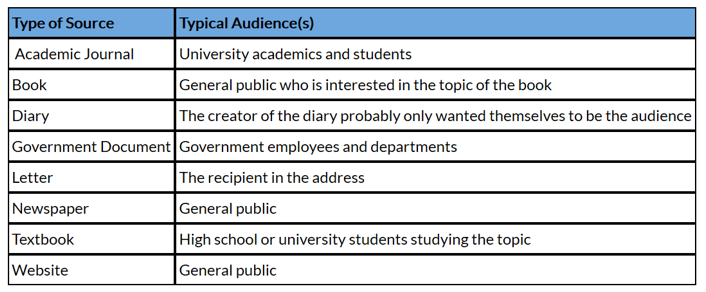
“When analysing a source, it is important to realise that all sources were created for a particular individual or group of people. Therefore, knowing about the intended audience of a source can help you in evaluating it.” The intended audience “is the person, or group of people, who were originally intended to see or use” the source.
“Based upon what you know about the time the source was created and who created it, you need to identify for whom the source was originally created… Some sources make it easy for you to discover who their intended audience was, because they may specifically address them. For example, if your source is a letter, it might simply begin with “Dear John”; in which case, John was clearly the intended audience. However, most of the time you will be required to make an informed guess regarding the original reader or viewer. These are some general guidelines that may help you discover the intended audience:”
4.

Now, watch the following video that explains “How to discover a historical source’s intended audience”. (4:40 minutes long)
5.

Purpose
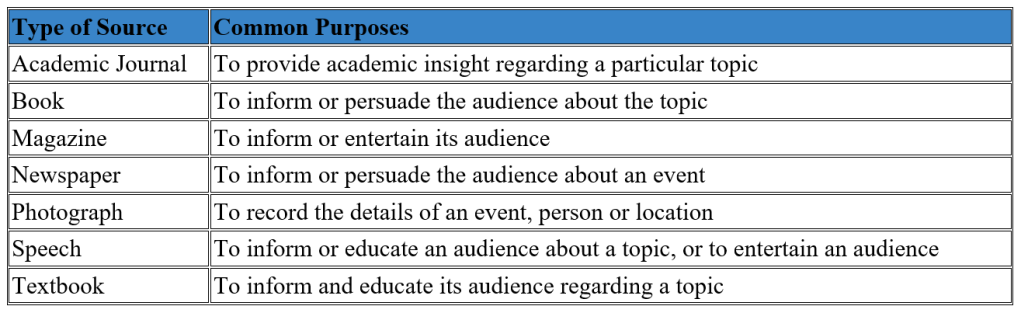
“The purpose of a source is the reason it was originally made. The creator of the source put in the time and effort to create it, and it was usually so that it could be used for something. Usually, knowing the purpose for its creation will help you evaluate its relevance and reliability to your argument.”
“How do I discover a source’s purpose? Based upon what you know about the creator and the intended audience, you can usually identify why the source was originally made. It can also be helpful to know what motivated the creator at a particular point in time.”
“This can be a simple as creating an ancient ceramic pot to store grain. Or it could be as complex as writing a 1960s pop song in order to criticise the government’s role in the Vietnam War.”
“Depending upon the type of source, there are some common purposes for their creation:”
6.

Now, watch the following video that explains “How to analyse a source’s purpose”. (6:24 minutes long)
7.

Perspective
“When analysing a source, it is (also) helpful to know the perspective of the creator, as this helps you to accurately assess its reliability and relevance. Perspective is the ‘point of view’ from which the creator of a source described historical events.”
“Every person sees and understands events differently depending on their age, gender, social position, beliefs and values. Even modern historians have their own perspectives which can influence how they interpret the past.”
For example:
“Two groups of fans at a football match will see the same game differently. Fans of the winning side will have a positive view and will usually talk about how great their team’s actions were. The fans of the losing side will be quite negative and may blame the result on referees or ‘cheating’ by the opposing team. How can two groups see the same event differently? The answer is ‘perspective’: they had a different point of view.”
“Perspective works the same in history. Two opposing sides in war, or politics, or social struggles, will see the same event differently.”
Take note that “different perspectives doesn’t necessarily mean that one side is ‘honest’ and the other is ‘lying’.” Or, that one side is “right” and the other is “wrong”. “It simply means that there are different points of view. However, if the difference in perspective causes someone to lie or have an unfair view…” it is biased. This implies that the perspective shows an unfair inclination for (or against) the events or people.
In order to determine a source’s perspective one needs to determine “who the creator was. Once you have sufficient knowledge about who made the source”, you can speculate about how they viewed the past,” by considering the following about the creator:
| nationality | e.g. American, Japanese, etc. |
| profession | e.g. university professor, soldier, etc. |
| political persuasion | e.g. conservative, Communist, etc. |
| cultural background | e.g. Egyptian, European, etc. |
| gender | e.g. male, female, etc. |
| religious beliefs | e.g. Christian, Muslim, etc. |
| educational background | e.g. what university they work for |
8.
Now, watch the following video that explains “How to determine a source’s perspective”. (5:13 minutes long)

9.
Finally, complete the quiz in Schoology about “Historical Context“, “Audience”, “Purpose” and “Perspective”…
IMPORTANT: Please note that you have only one attempt to complete the quiz. Also, it is a timed quiz, that expires at the end of the lesson!! So, do it now straight away! AND: If, for some reason, you have any problem with the quiz, let me know immediately in Hangouts, or you may lose marks!!

10.
Send me a private message on Schoology (use the SAME mail-thread!!!) to confirm that you have completed the tasks as instructed today!


(If you want to access the information on Sources used in this lesson directly from the original website, here is the link to access it: https://www.history.org.uk/student/resource/3211/using-historical-sources .)
(WordPress advertisements may appear below.)

