Today you are going to investigate the power struggle that occurred after Lenin’s death in more detail!
1.
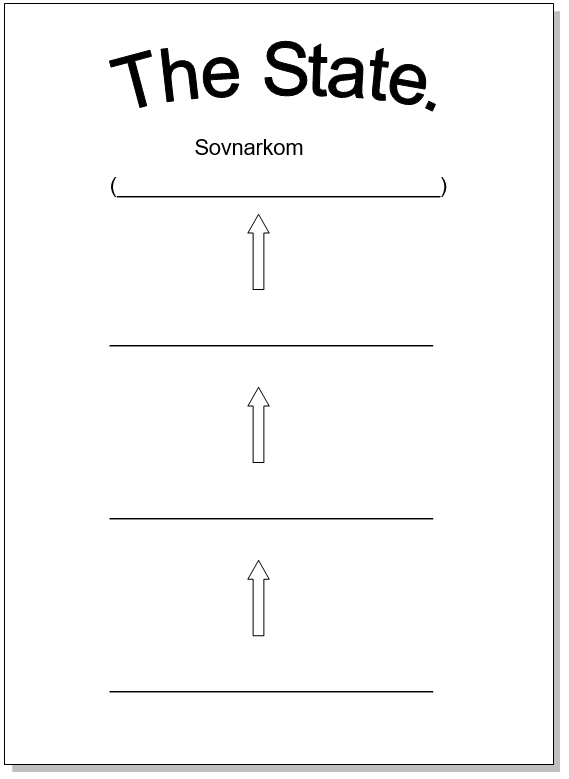
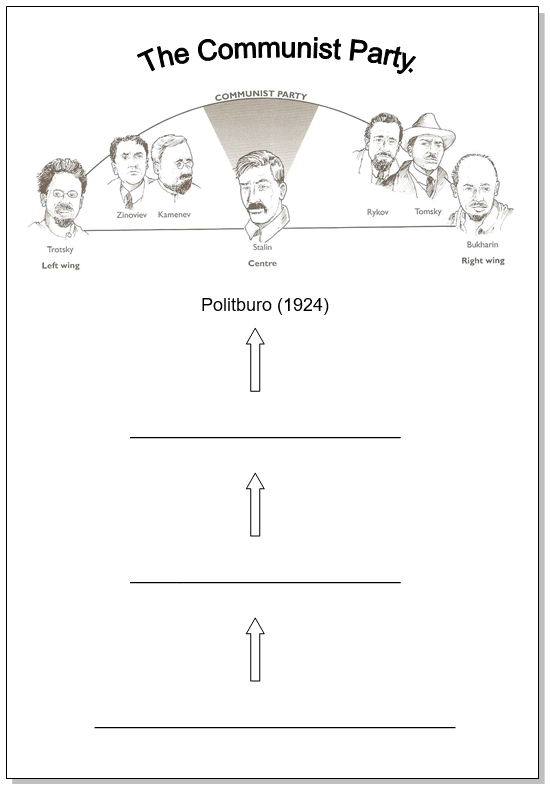
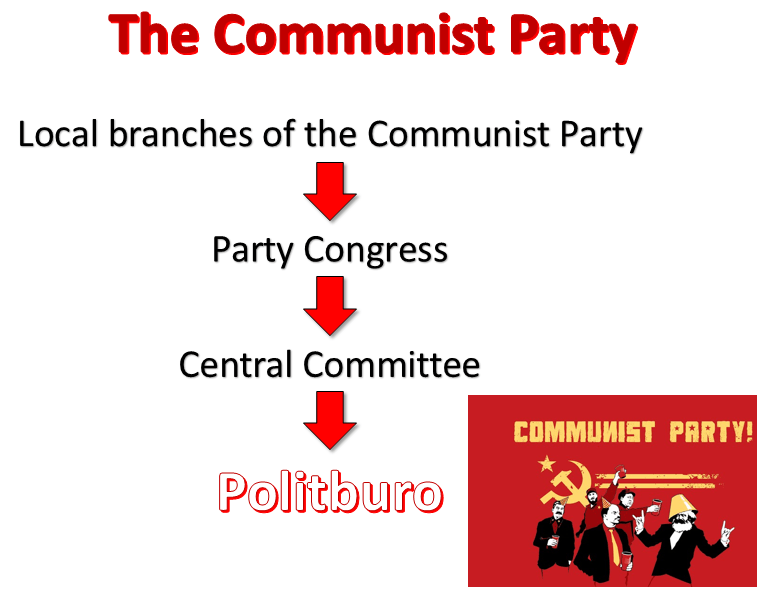
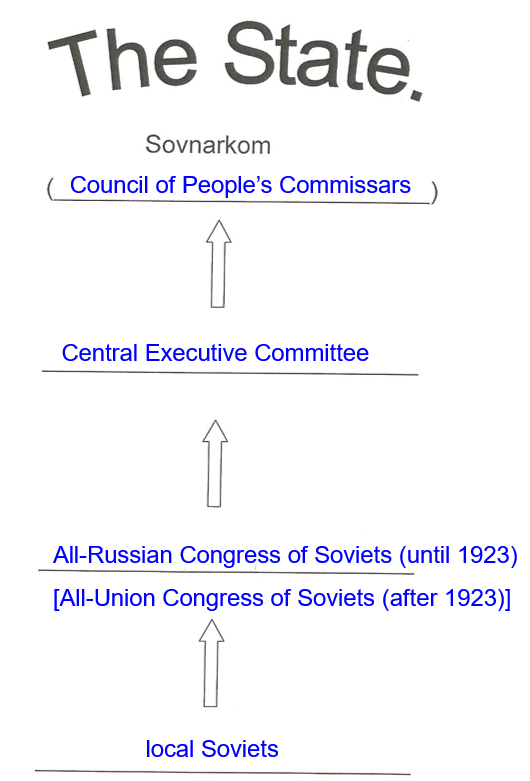
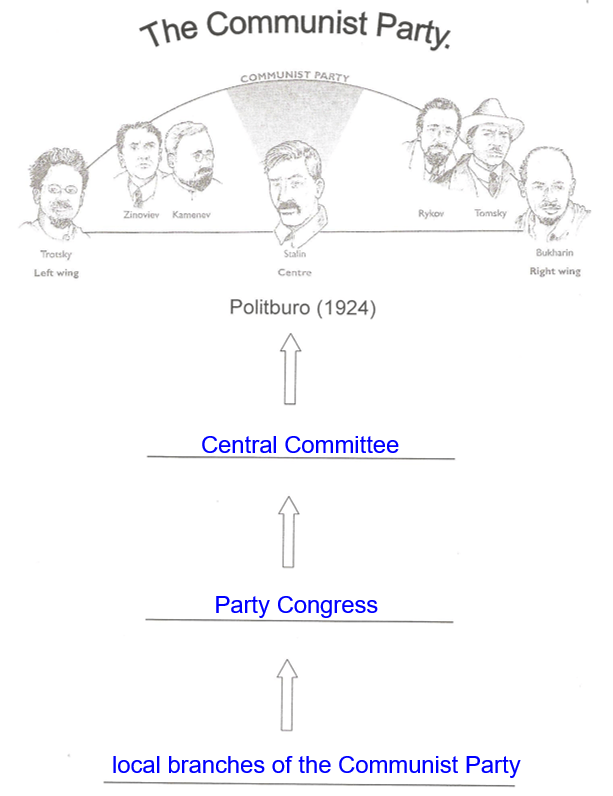
Let’s first do a little bit of revision as it is important that you know the structure of the Politburo and also that of Sovnarkom….
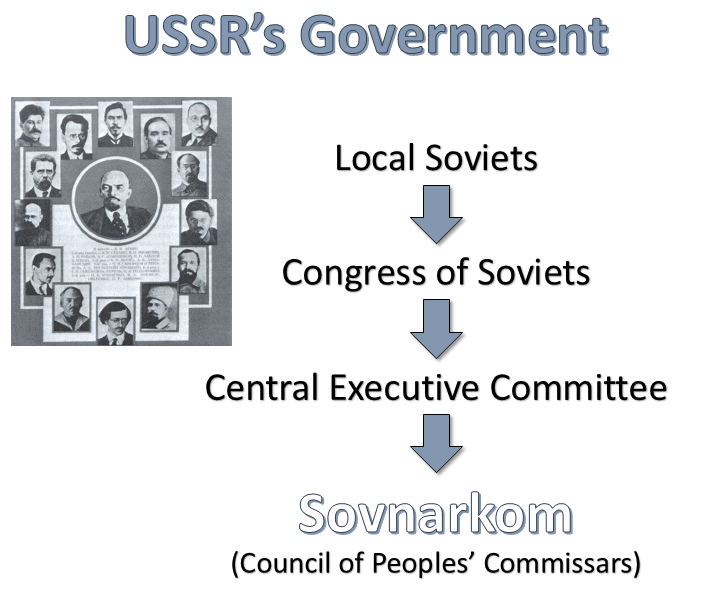
2.

…about “The State” and about “The Communist Party”:
3.
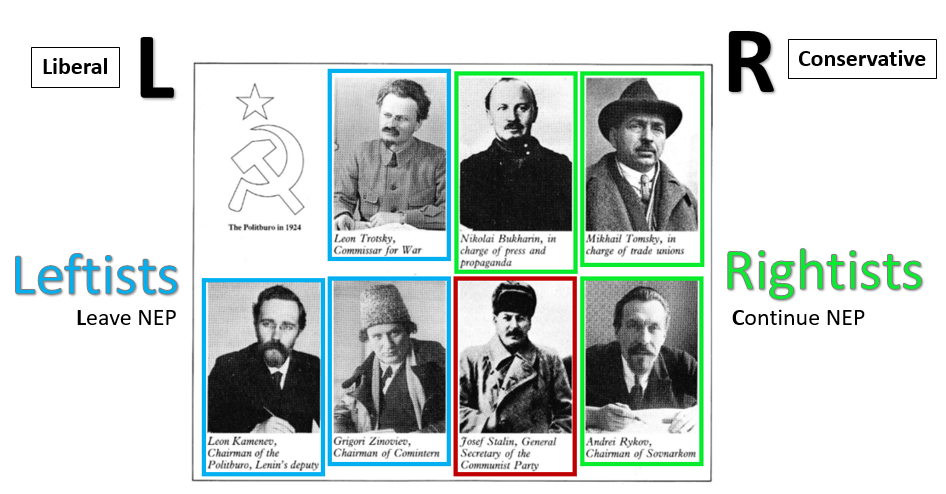
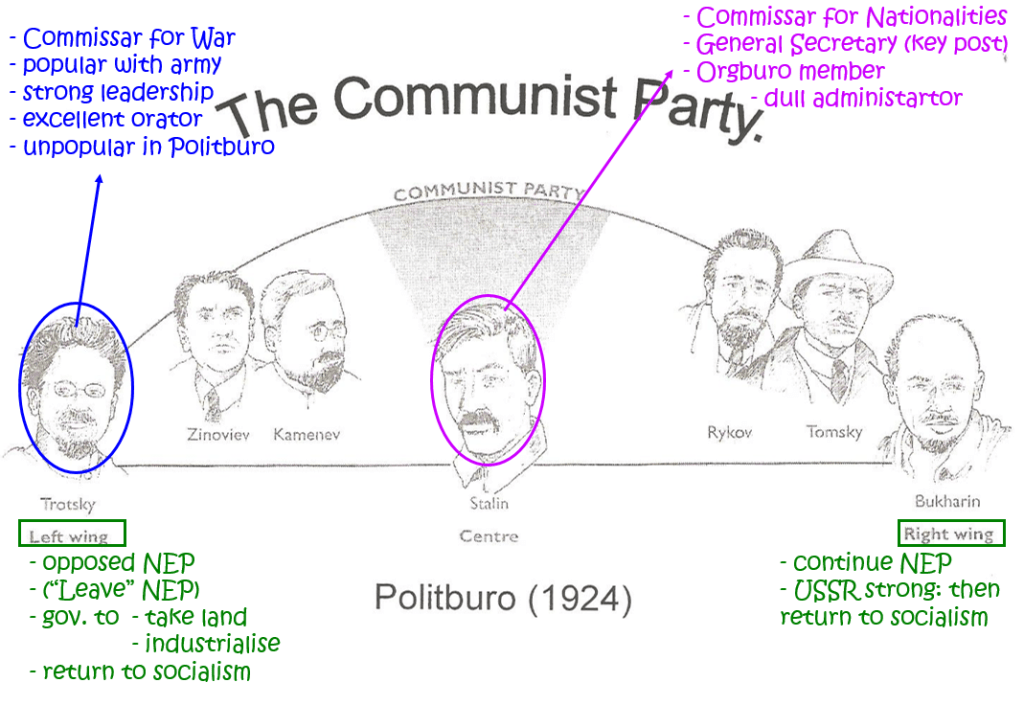
Let’s consider what the Politburo looked like in January 1924.
4.
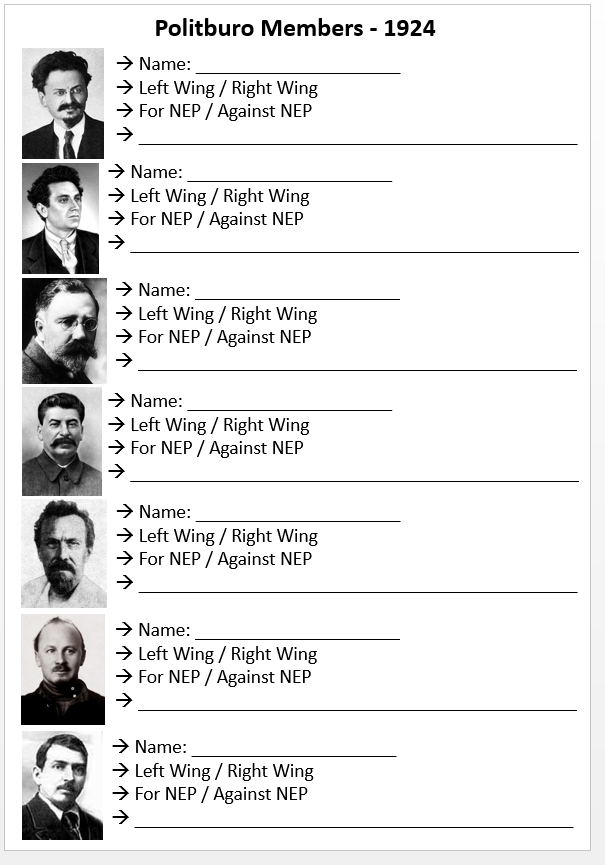
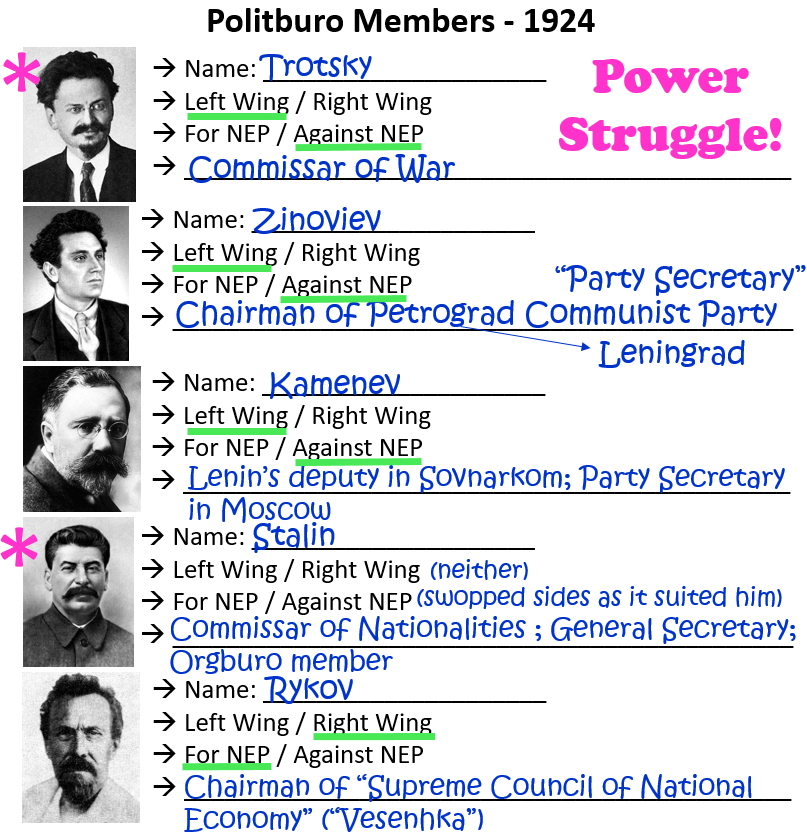
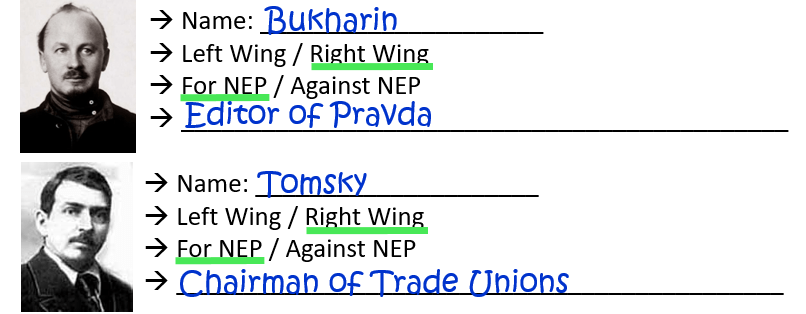
So, let’s find out a bit more about the members of the Politburo at the time of Lenin’s death.

Politburo Members. (2:01 minutes long)
5.
…about “The Politburo Members – 1924”:

6.
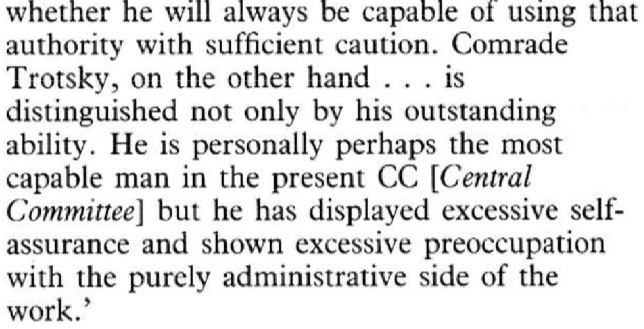
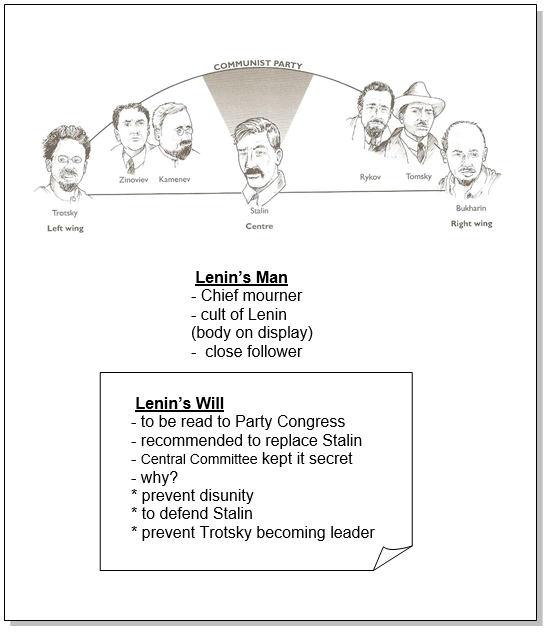
Before Lenin died, he wrote a letter, to be read to the Party Congress after his death. This letter is also known as “Lenin’s Testament”. It commented on all the potential leaders in the party.
Here is an extract that comments specifically on Trotsky and Stalin:

Ten days later Lenin added a post script to the letter:
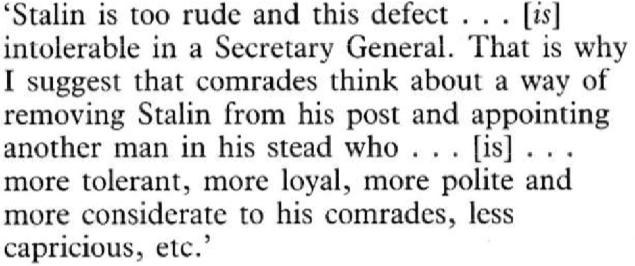
This clearly puts Stalin in a bad light – it was very unlikely that he would be chosen as Lenin’s successor!
7.
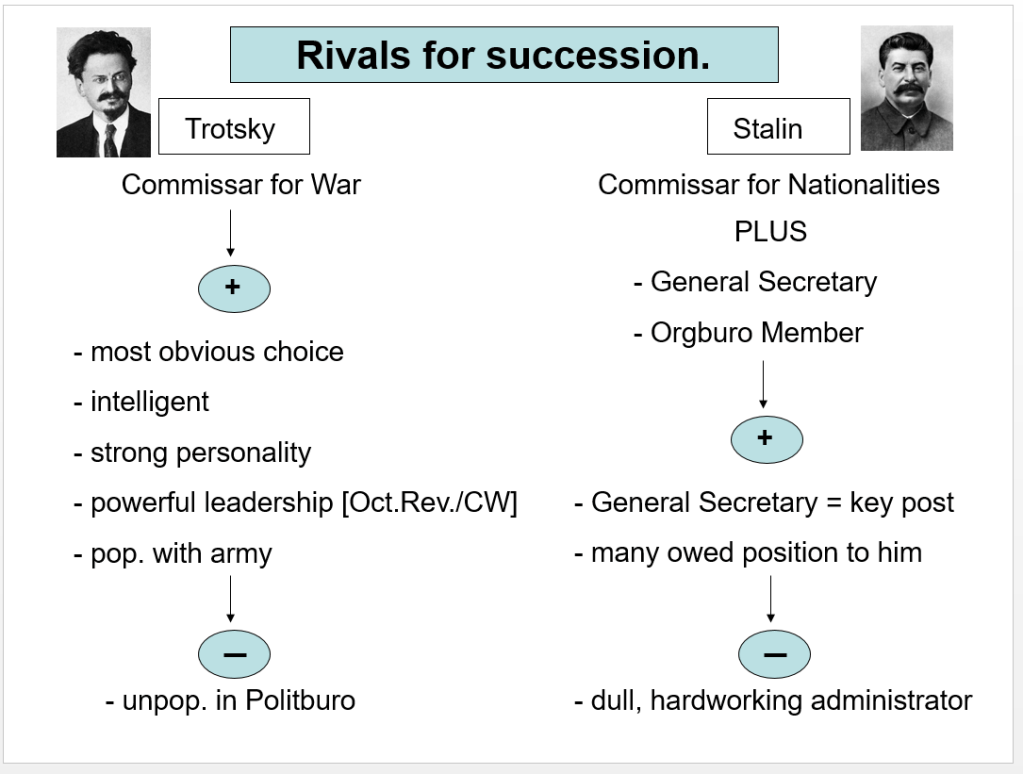
The clear rivals for succession were Trotsky and Stalin…
8.
Below is a video that repeats the information about the structures of the State and the Party, as well as the information about the rivals for succession and the members of the Politburo in 1924. Watch this if you are still unsure about these details.

Politburo in 1924. (2:51 minutes long)
9.
Here is a bit more about the advantages and the disadvantages of the two main rivals for succession:
10.
So, how did Stalin emerge as leader of the Soviet Union? Below are the key events that helped Stalin to become leader after Lenin’s death.
Key events in Stalin’s road to power:
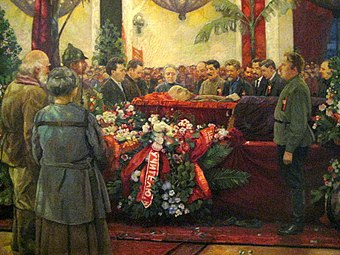
Lenin’s Funeral
Stalin cleverly made sure that Trotsky did not attend Lenin’s Funeral, by telling him the wrong date!

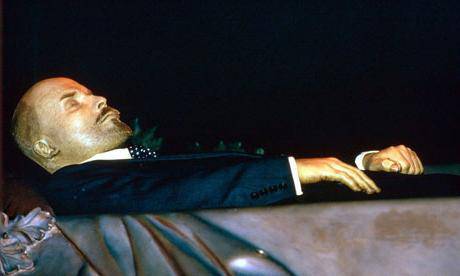
Cult of Lenin
Next, Stalin encouraged the cult (or worship) of Lenin, by (e.g.) putting his body on permanent display.
Lenin’s Testament
Lenin’s testament was meant to be read to the Party Congress, but it was decided to keep Lenin’s views on the Politburo members a secret.
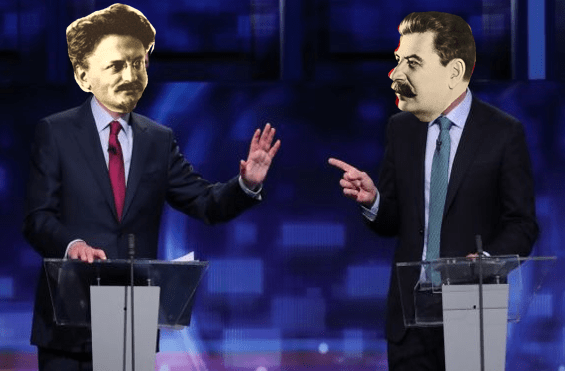
Party Debate
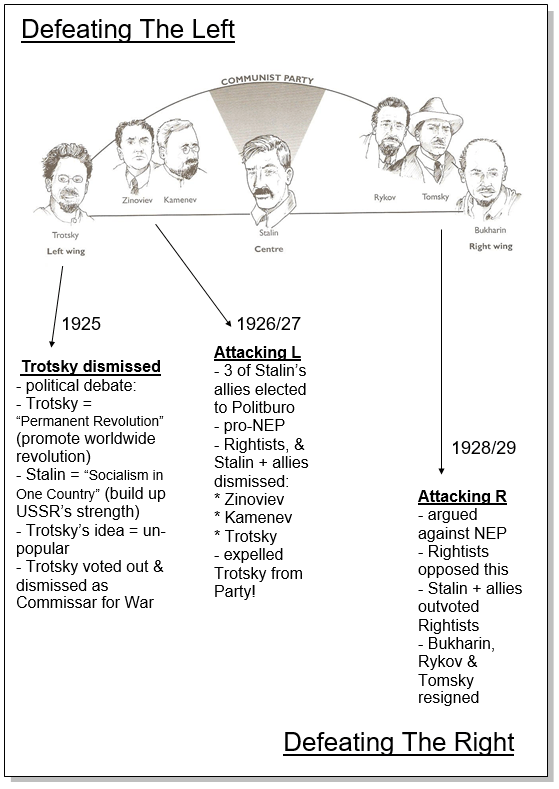
During a Party Debate Stalin proved to have a more popular idea regarding worldwide revolution than Trotsky…
Siding with RIGHT
Stalin cleverly sided with the Rightists in order to outvote the Leftists from the Politburo.
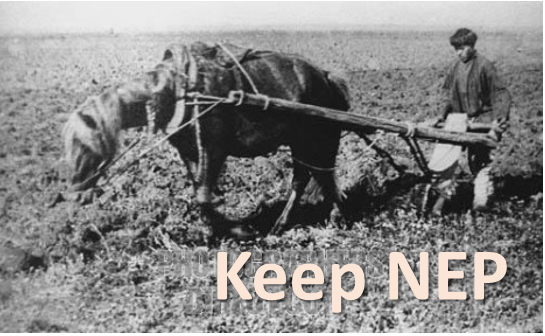
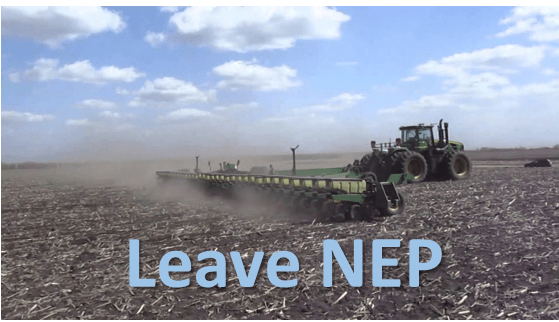
Siding with LEFT
Stalin then sided with the Leftists in order to outvote the Rightists from the Politburo.
11.
Now, let’s look at the steps Stalin took to succeed Lenin as Soviet leader…
Steps to Power. (3:21 minutes long)
12.
Finally, here is a short summary of the video. Carefully go over the information in the diagrams below:
13.

A crucial factor was the survival of Lenin’s Testament. Read the Testament to see what Lenin thought of Trotsky and of Stalin. (The sections in red are relevant to your study.)
Lenin’s Testament – 1922
“By the stability of the Central Committee, of which I spoke above, I mean measures against a split, as far as such measures can at all be taken. For, of course, the whiteguard in Russkaya Mys (it seems to have been S. S. Oldenburg) was right when, first, in the whiteguards’ game against Soviet Russia he banked on a split in our Party, and when, secondly, he banked on grave differences in our Party to cause that split.
Our Party relies on two classes and therefore its instability would be possible and its downfall inevitable if there were no agreement between those two classes. In that event, this or that measure, and generally all talk about the stability of our C.C., would be futile. No measures of any kind could prevent a split in such a case. But I hope that this is too remote a future and too improbable an event to talk about.
I have in mind stability as a guarantee against a split in the immediate future, and I intend to deal here with a few ideas concerning personal qualities.
I think that from this standpoint, the prime factors in the question of stability are such members of the C.C. as Stalin and Trotsky. I think relations between them make up the greater part of the danger of a split, which could be avoided, and this purpose, in my opinion, would be served, among other things, by increasing the number of C.C. members to 50 or 100.
Comrade Stalin, having become Secretary-General, has unlimited authority concentrated in his hands, and I am not sure whether he will always be capable of using that authority with sufficient caution. Comrade Trotsky*, on the other hand, as his struggles against the C.C. on the question of the People’s Commissariat for Communications has already proved, is distinguished not only by outstanding ability. He is personally perhaps the most capable man in the present C.C., but he has displayed excessive self-assurance and shown excessive preoccupation with the purely administrative side of the work.
These two qualities of the two outstanding leaders of the present C.C. can inadvertently lead to a split, and if our Party does not take steps to avert this, the split may come unexpectedly.
I shall not give any further appraisals of the personal qualities of other members of the C.C. I shall just recall that the October episode with Zinoviev and Kamenev was, of course, no accident, but neither can the blame for it be laid upon them personally, any more than non-Bolshevism can upon Trotsky.
Speaking of the young C.C. members, I wish to say a few words about Bukharin and Pyatakov. They are, in my opinion, the most outstanding figures (among the younger ones), and the following must be borne in mind about them: Bukharin is not only a most valuable and major theorist of the Party; he is also rightly considered the favorite of the whole Party, but his theoretical views can be classified as fully Marxist only with the great reserve, for there is something scholastic about him (he has never made a study of dialectics, and, I think, never fully appreciated it).
December 25. As for Pyatakov, he is unquestionably a man of outstanding will and outstanding ability, but shows far too much zeal for administrating and the administrative side of the work to be relied upon in a serious political matter.
Both of these remarks, of course, are made only for the present, on the assumption that both these outstanding and devoted Party workers fail to find an occasion to enhance their knowledge and amend their one-sidedness.”
– Lenin, December 1922 –
* * * * *
“Stalin is too rude and this defect, although quite tolerable in our midst and in dealing among us Communists, becomes intolerable in a Secretary-General. That is why I suggest the comrades think about a way of removing Staling from that post and appointing another man in his stead who in all other respects differs from Comrade Stalin in having only one advantage, namely, that of being more tolerant, more loyal, more polite, and more considerate to the comrades, less capricious, etc. This circumstance may appear to be a negligible detail. But I think that from the standpoint of safeguards against a split, and from the standpoint of what I wrote above about the relationship between Stalin and Trotsky, it is not a detail, or it is a detail which can assume decisive importance.”
– Lenin, January 1923 –
[Source: Lenin, Collected Works, vol. 36 (Moscow: Progress Publishers, 1966), pp. 594-596.]
http://www.historyguide.org/europe/testament.html
(WordPress advertisements may appear below.)
 Best study methods