
Let’s complete some Grammar Exercises:

Answers:

Mark your work with a pencil.


(WordPress advertisements may appear below.)
Let’s complete some Grammar Exercises:
Answers:
Mark your work with a pencil.
(WordPress advertisements may appear below.)
Let’s complete some Grammar Exercises:

Answers:
Mark your work with a pencil.


(WordPress advertisements may appear below.)
Let’s complete some Grammar Exercises:
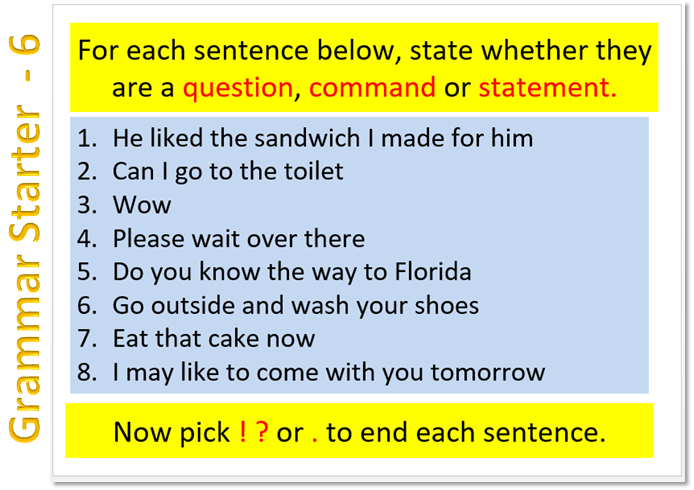
Answers:
Mark your work with a pencil.


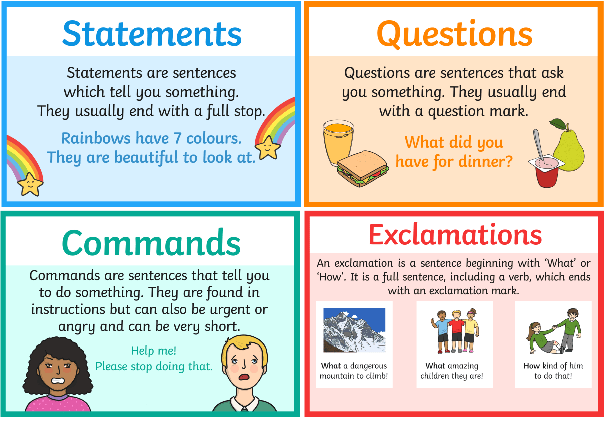
(WordPress advertisements may appear below.)
Let’s complete some Grammar Exercises:
Answers:
Mark your work with a pencil.

(WordPress advertisements may appear below.)
Let’s complete some Grammar Exercises:

Answers:
Mark your work with a pencil.


(WordPress advertisements may appear below.)
Let’s complete some Grammar Exercises:
Answers:
Mark your work with a pencil.

(WordPress advertisements may appear below.)
Let’s complete some Grammar Exercises:

Answers:
Mark your work with a pencil.


(WordPress advertisements may appear below.)
Let’s complete some Grammar Exercises:
Answers:
Mark your work with a pencil.
(WordPress advertisements may appear below.)
Today you are going to look at Paper 4 exam questions!

We will:

Your homework for today was simply to revise for your History exam…
1.
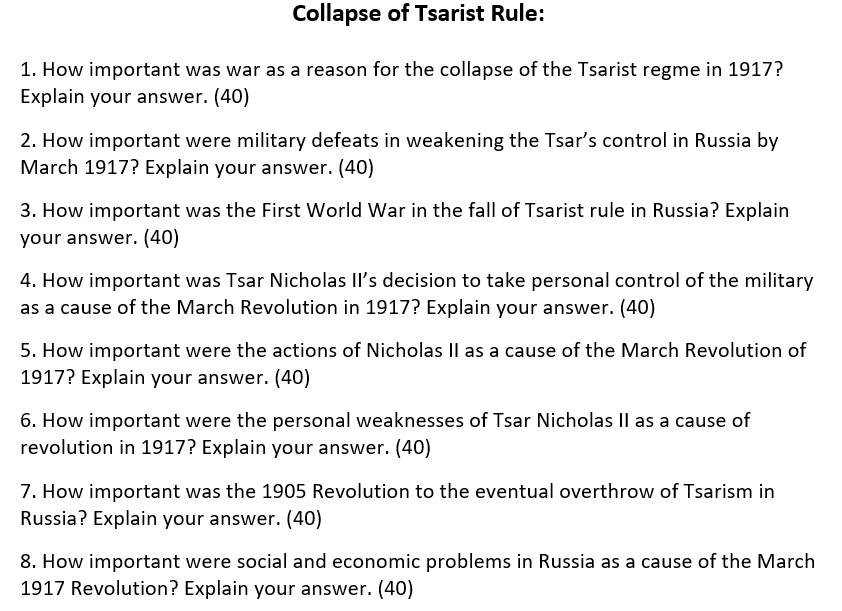
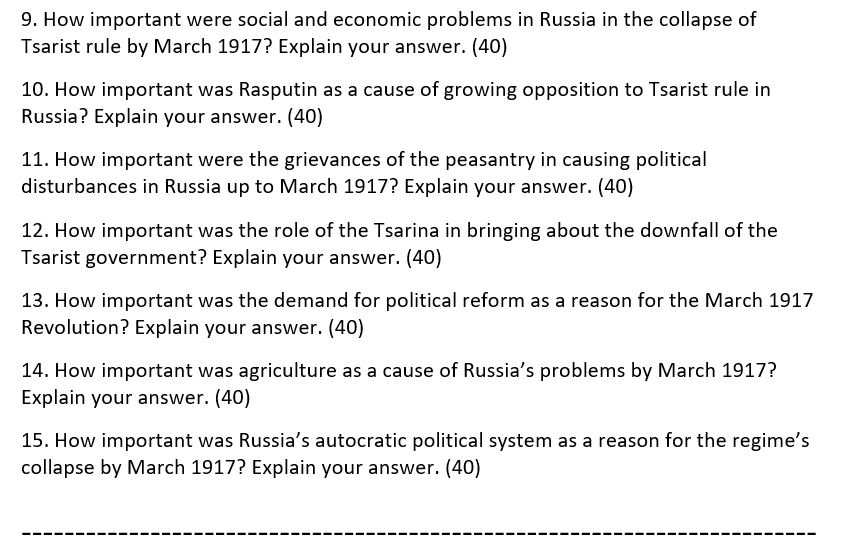
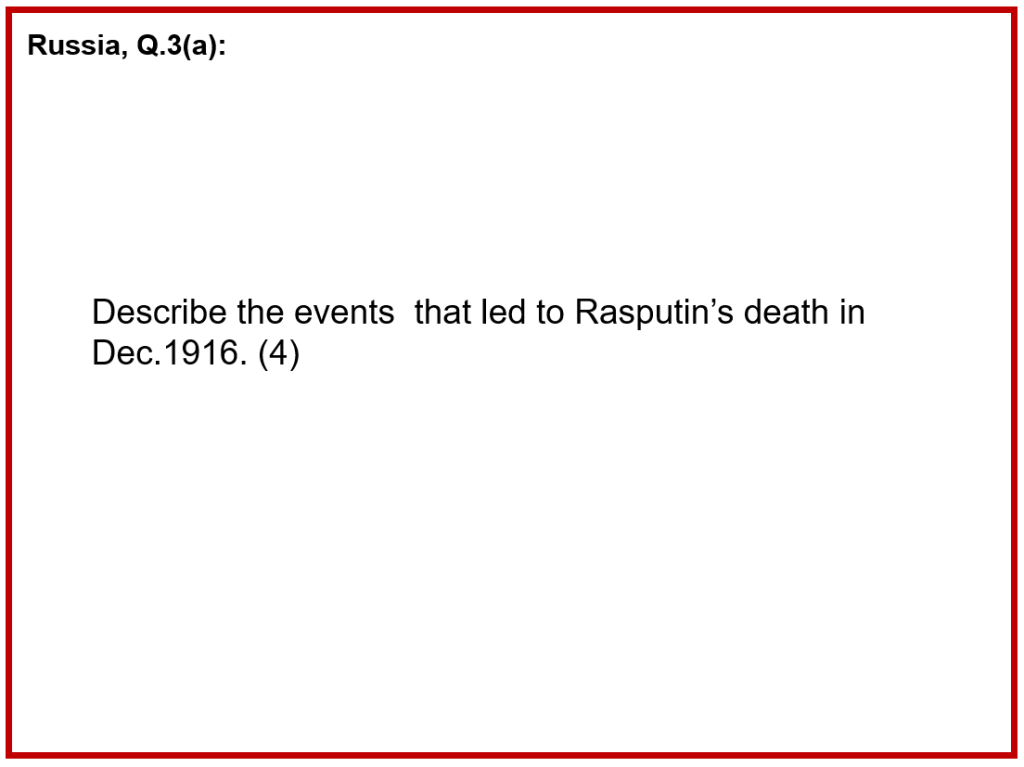
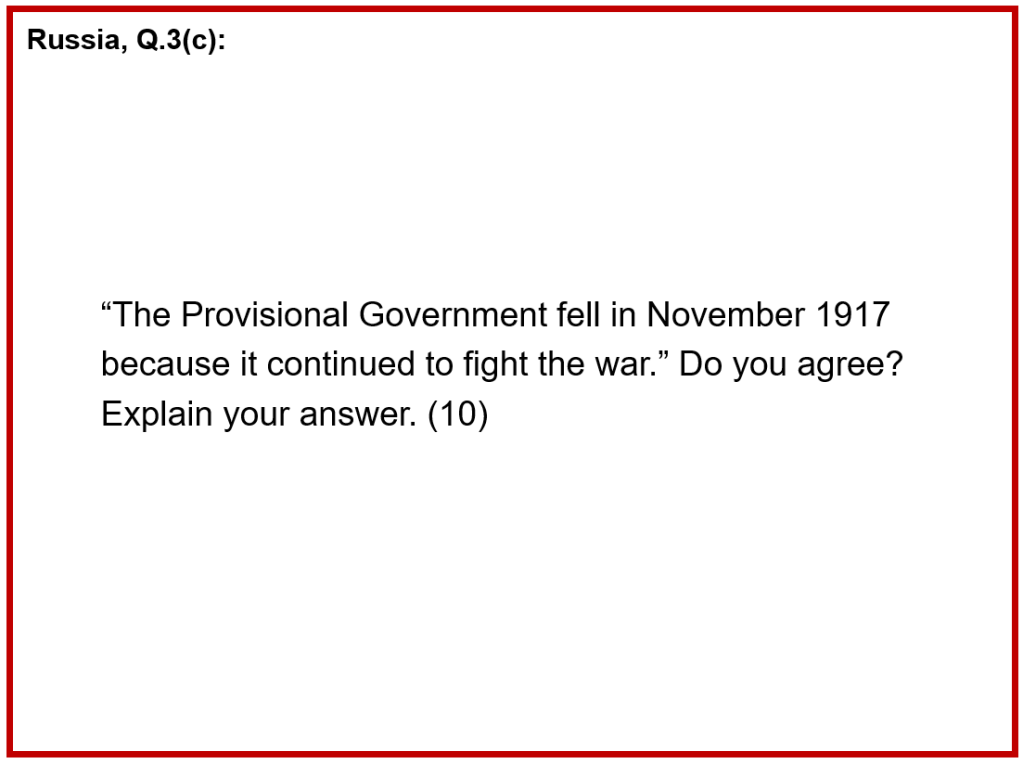
Below are typical Paper 4 exam questions. They were all taken from past papers.
Copy the questions into your book, leaving 2 lines between each question:
2.

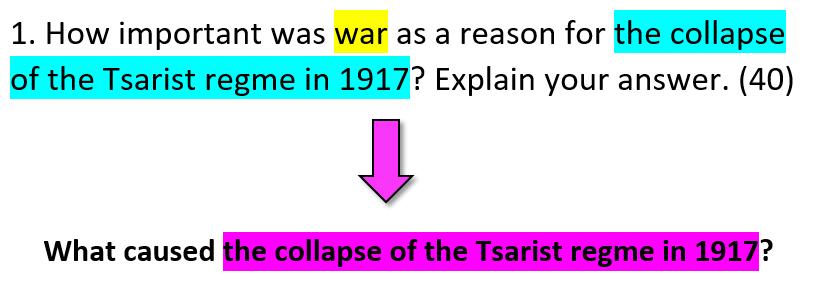
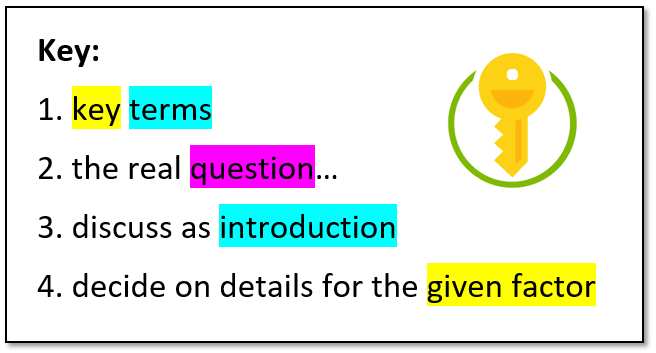
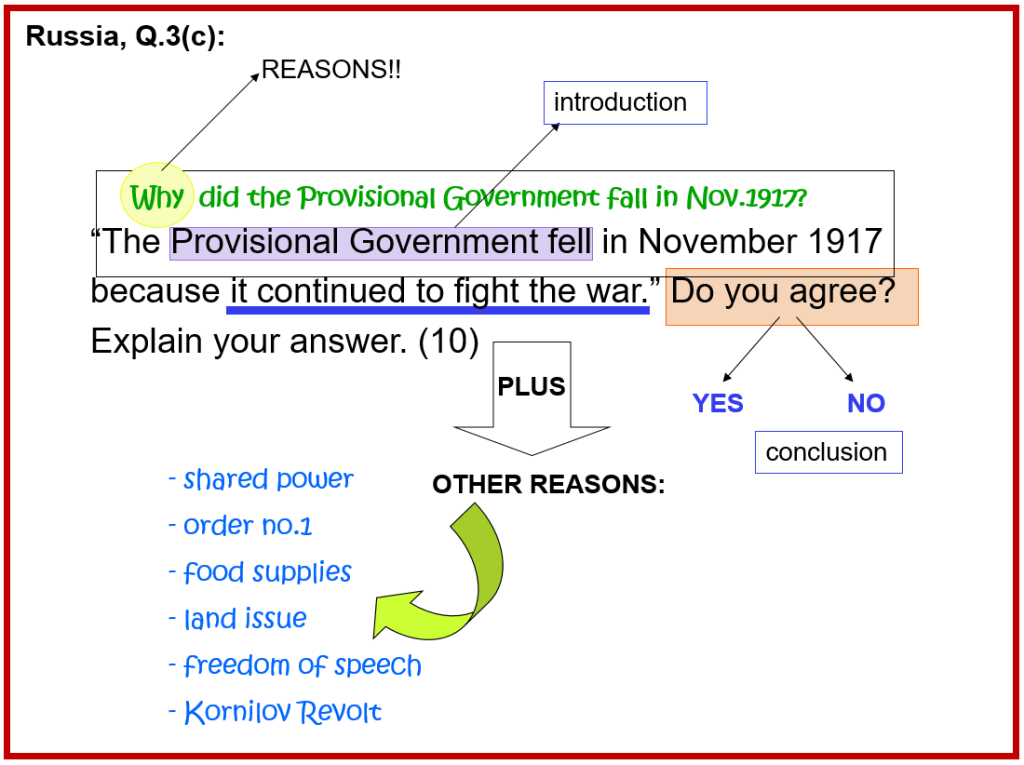
Now, analyse the first question by doing the following:
SOLUTION

3.
Now do the same for the following questions:
SOLUTIONS
Question 2
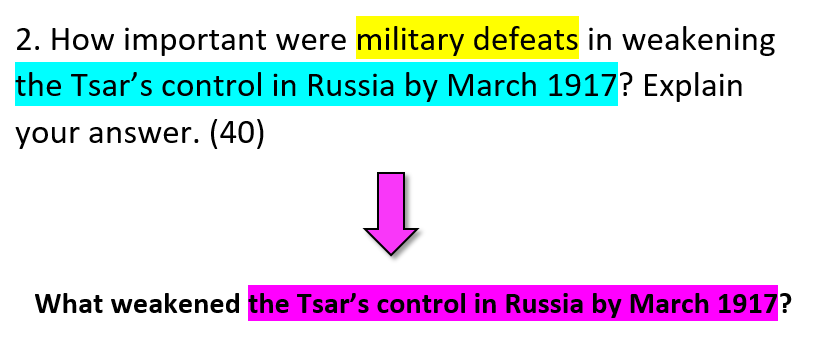
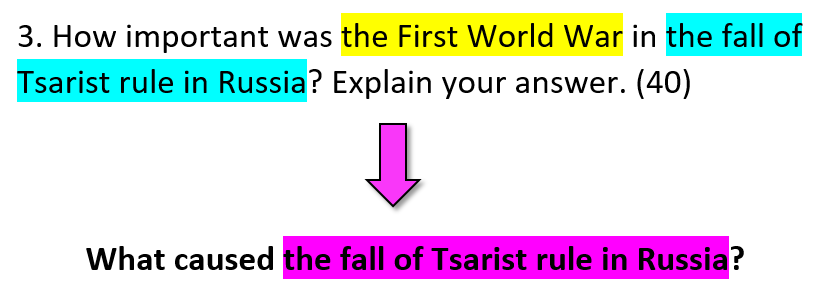
Question 3
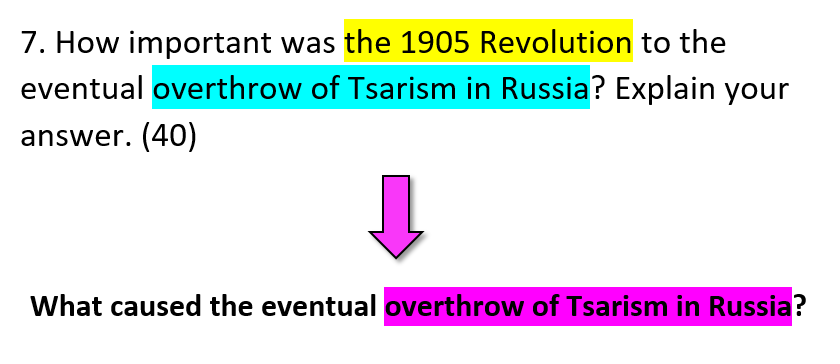
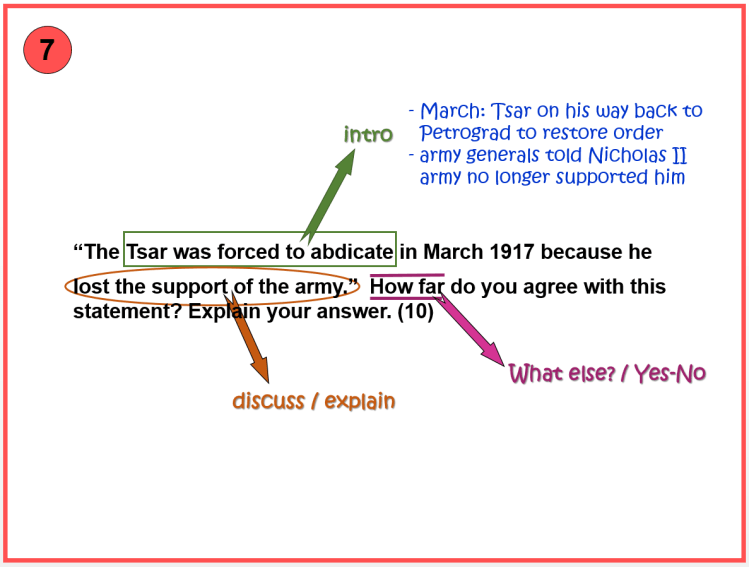
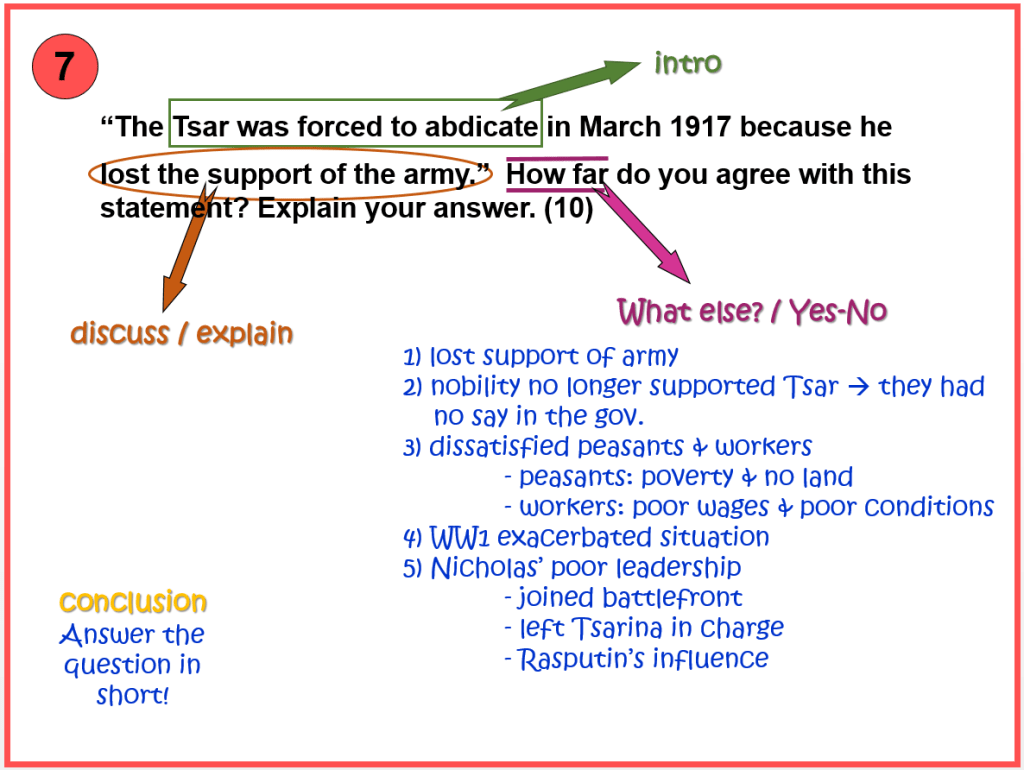
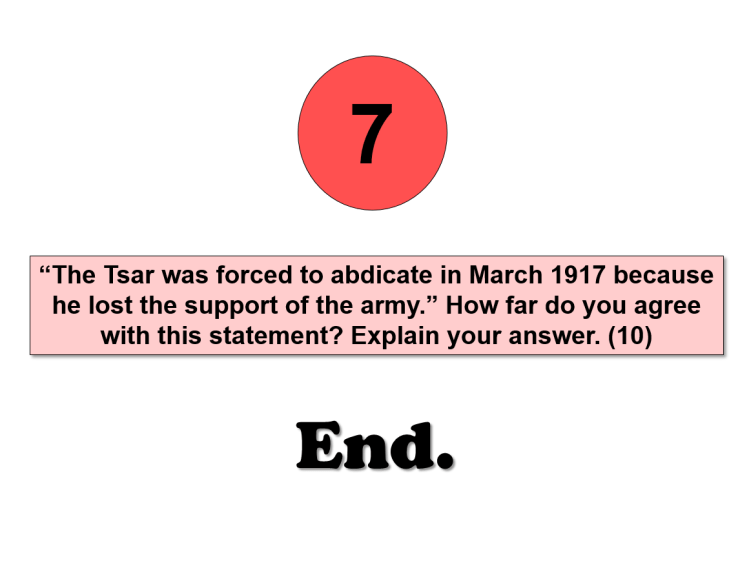
Question 7
Question 10

Question 15

4.
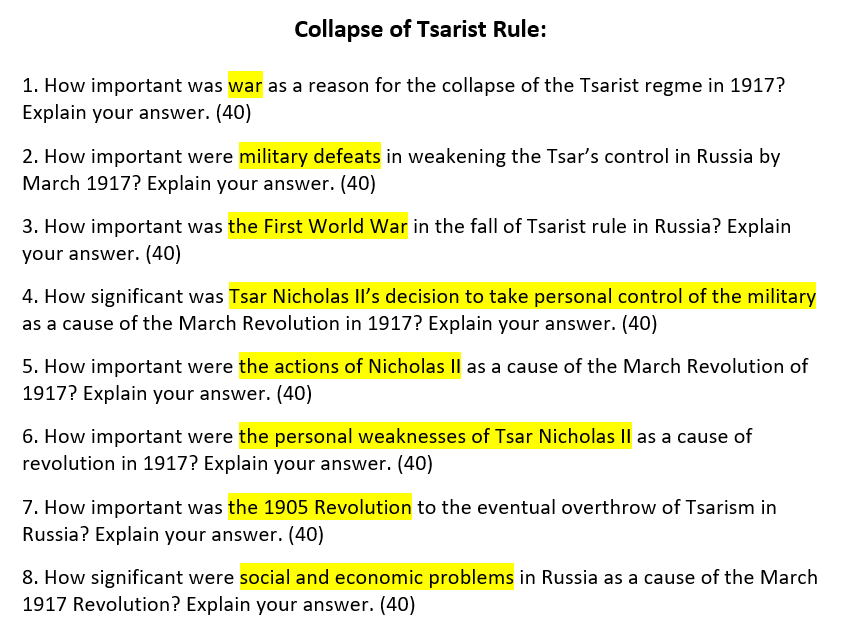
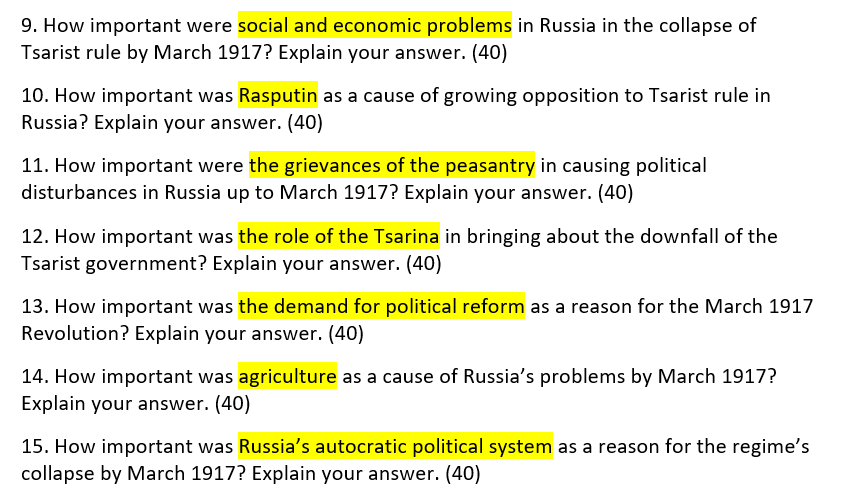
Have you noticed that all of these questions deal with the collapse of Tsarist rule?
Look at the rest of the questions to also:
SOLUTIONS
Question 4
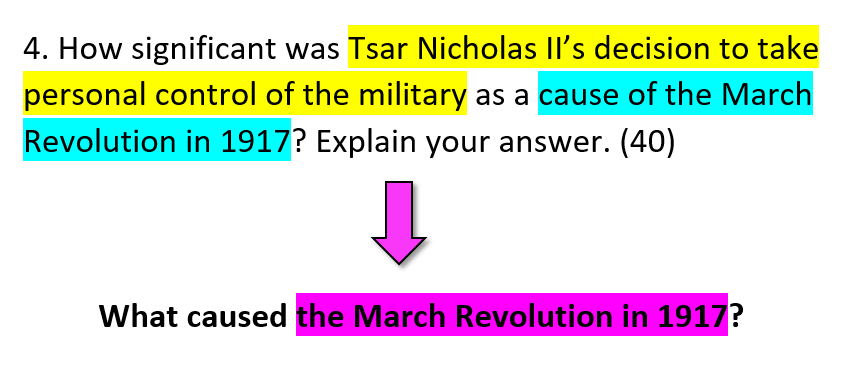
Question 5
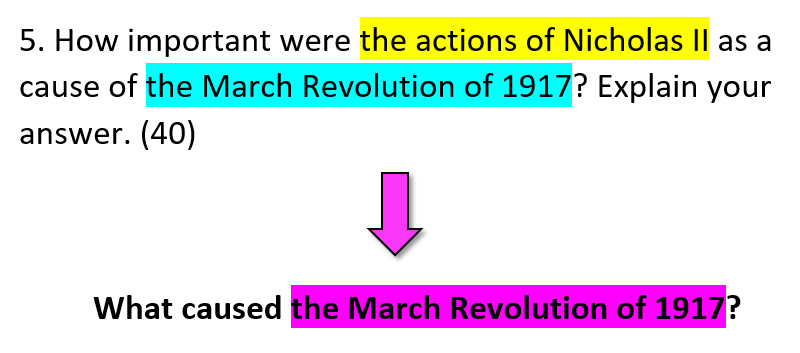
Question 6
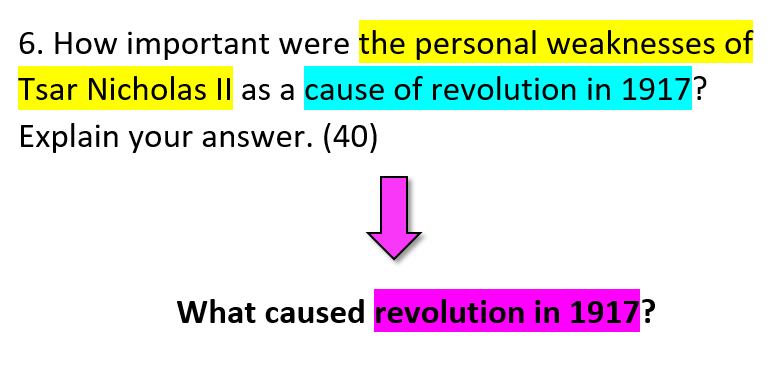
Question 8
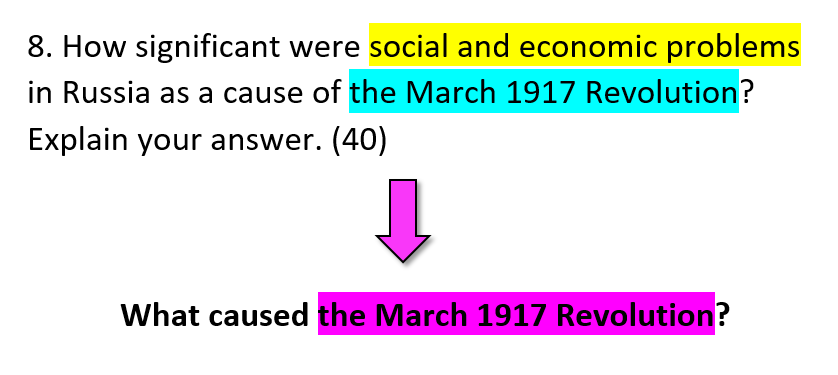
Question 9
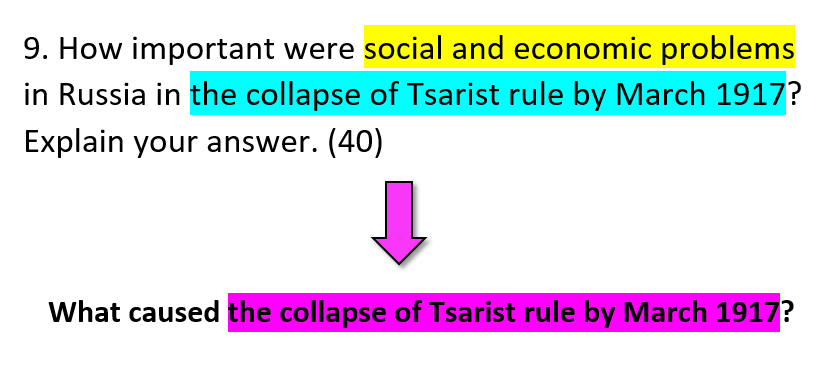
Question 11

Question 12
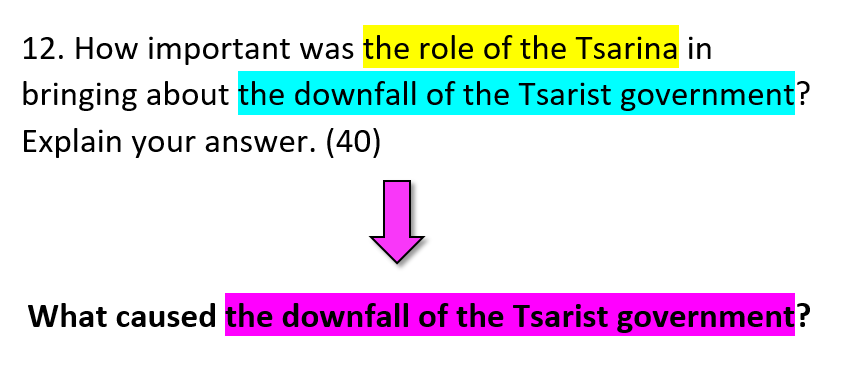
Question 13

Question 14
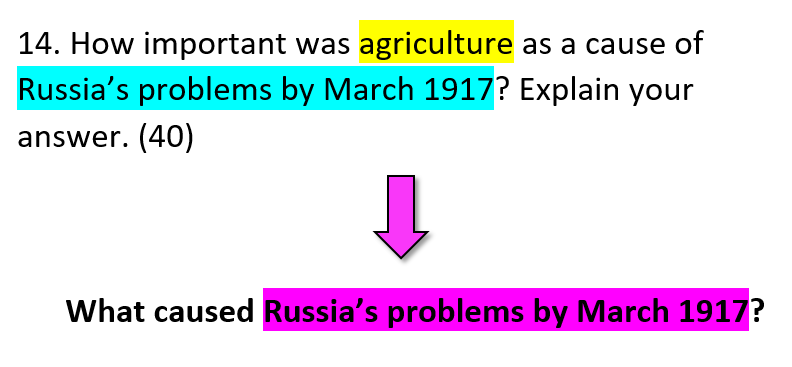
5.

So, here is how to tackle the Paper 4 essay questions:
6.
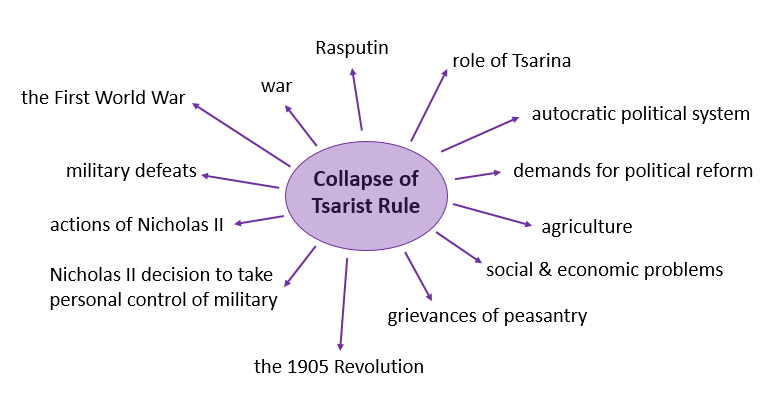
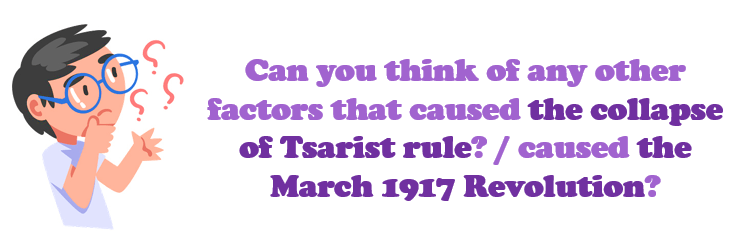
The questions above has already provided us with numerous “other factors…
7.
Here are numerous ideas…
Navigate your way through the following document to extract all the relevant information from the mark schemes for the above questions…
8.
Now, answer any one of these questions.
In the exam you will have:

Study for the Exams!!!
(WordPress advertisements may appear below.)
Today you are going to work on answering Paper 4 Exam Questions…!

Work your way through the following Paper 4 exam questions…
(These were taken from past papers.)

DEPTH STUDY C: RUSSIA, 1905–41
Tsarist Russia
Lenin’s Russia
Stalin’s Russia
(WordPress advertisements may appear below.)
Today you are going to work on answering Paper 4 Exam Questions…!
Work your way through the following Paper 4 exam questions…
(These were taken from past papers.)
DEPTH STUDY C: RUSSIA, 1905–41
2015
2016
2017
2018
2019
2020
2021
(WordPress advertisements may appear below.)
Today you are going to practise some Essay Writing!
We will:
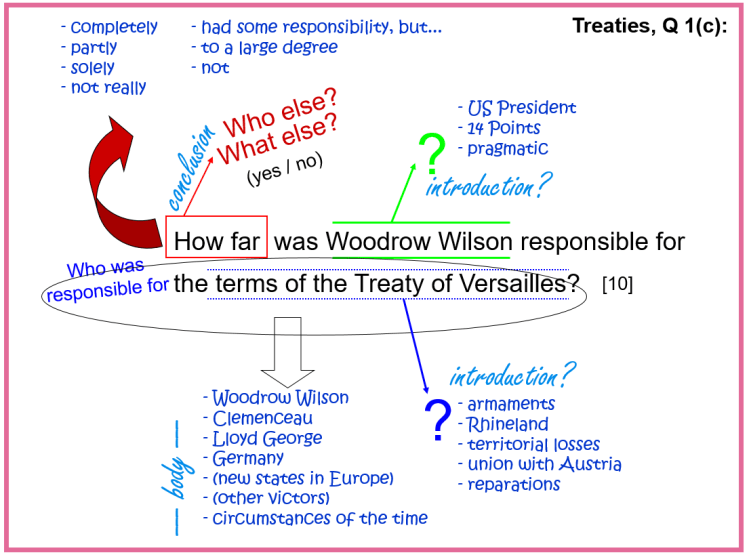
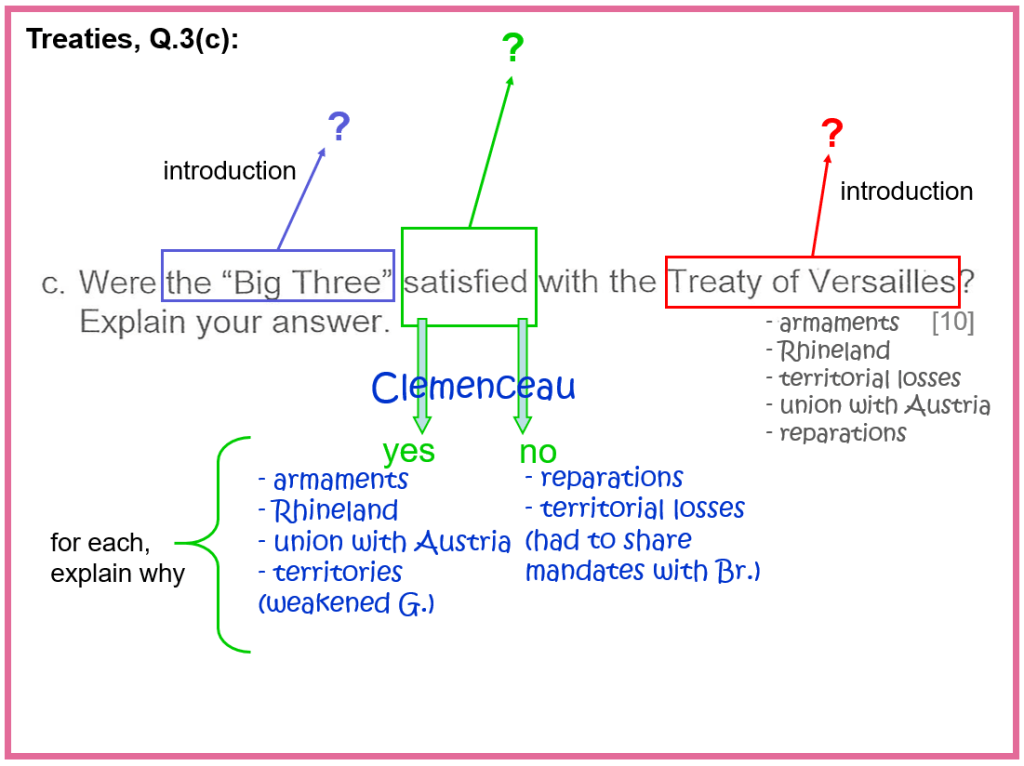
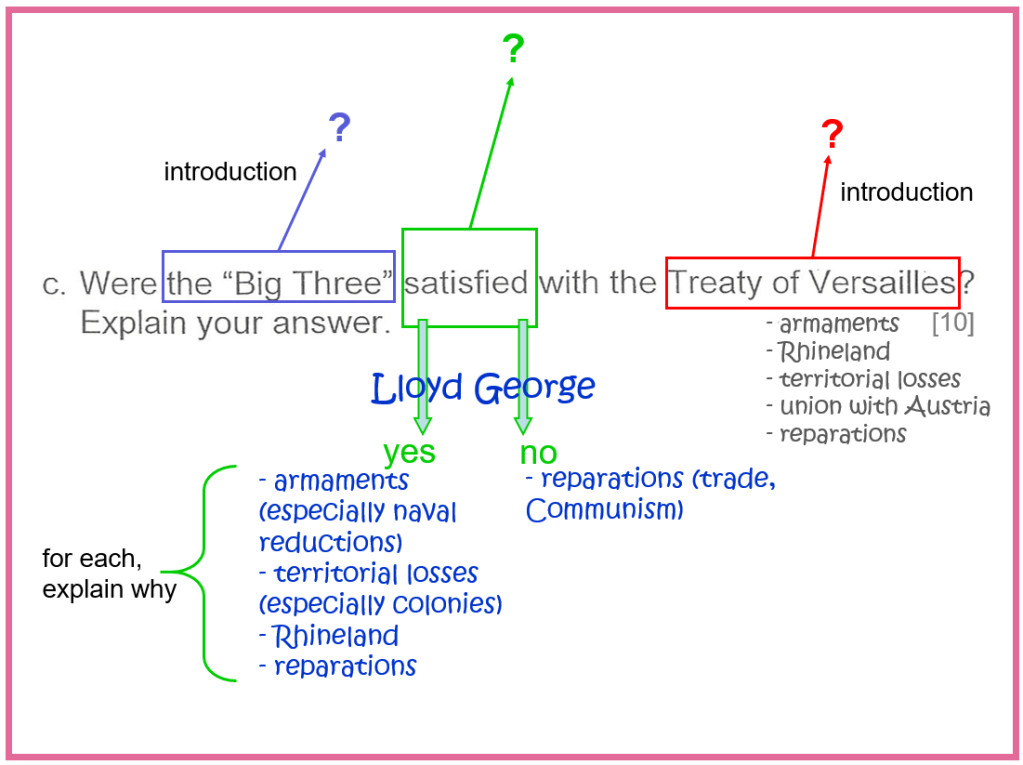
Treaties – Question 1.
Navigate you way through the slides below to see how these question could be answered:
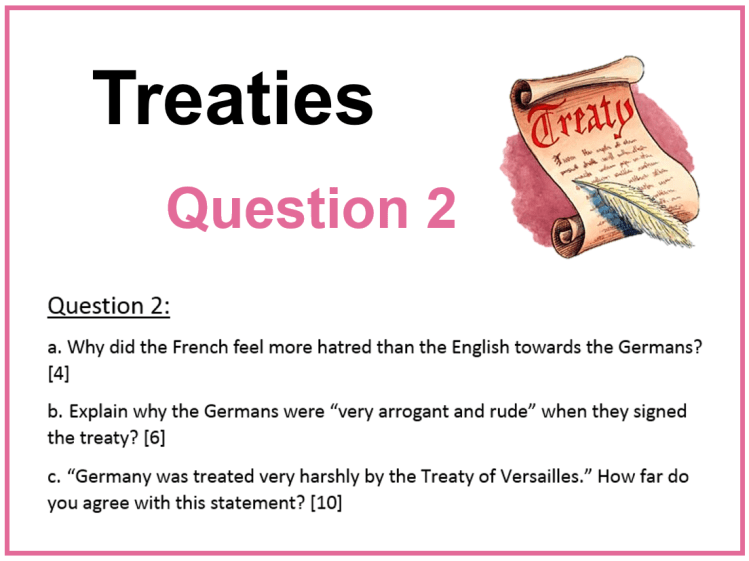
Treaties – Question 2.
Navigate you way through the slides below to see how these question could be answered:
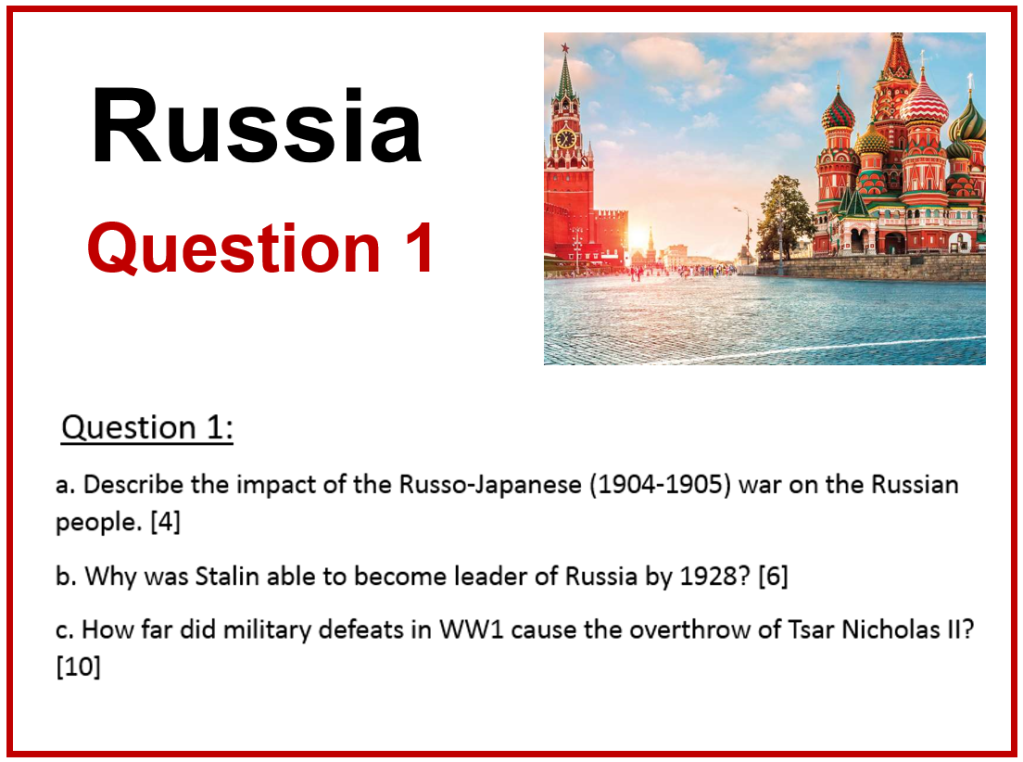
Russia – Question 1.
Navigate you way through the slides below to see how these question could be answered:
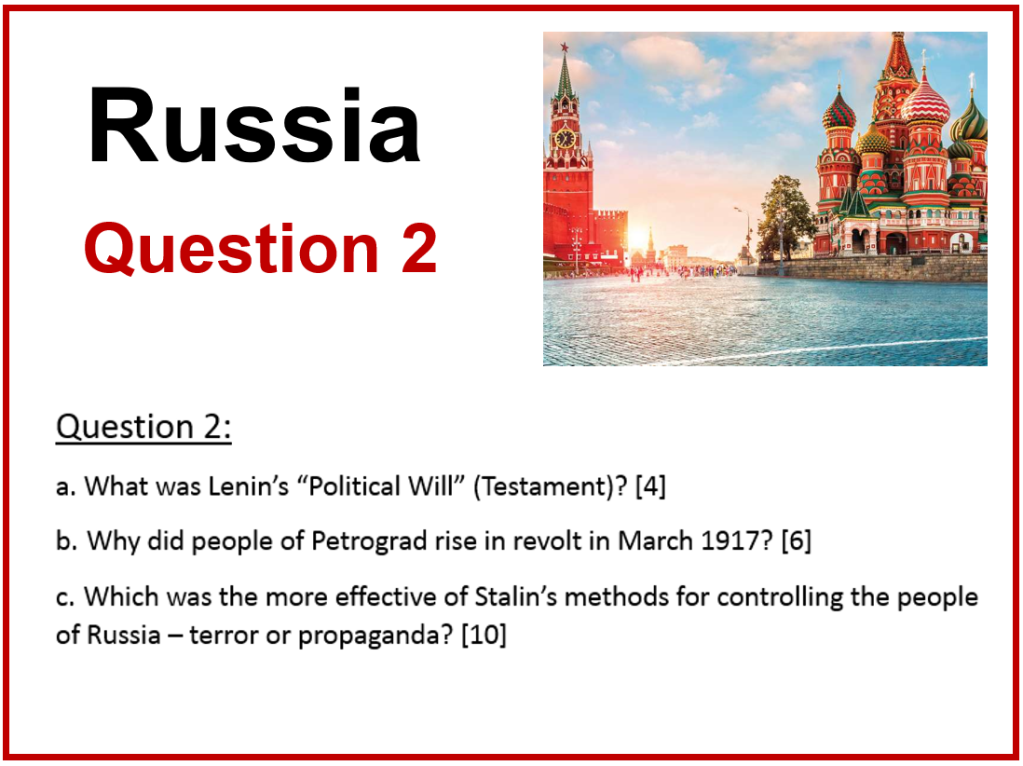
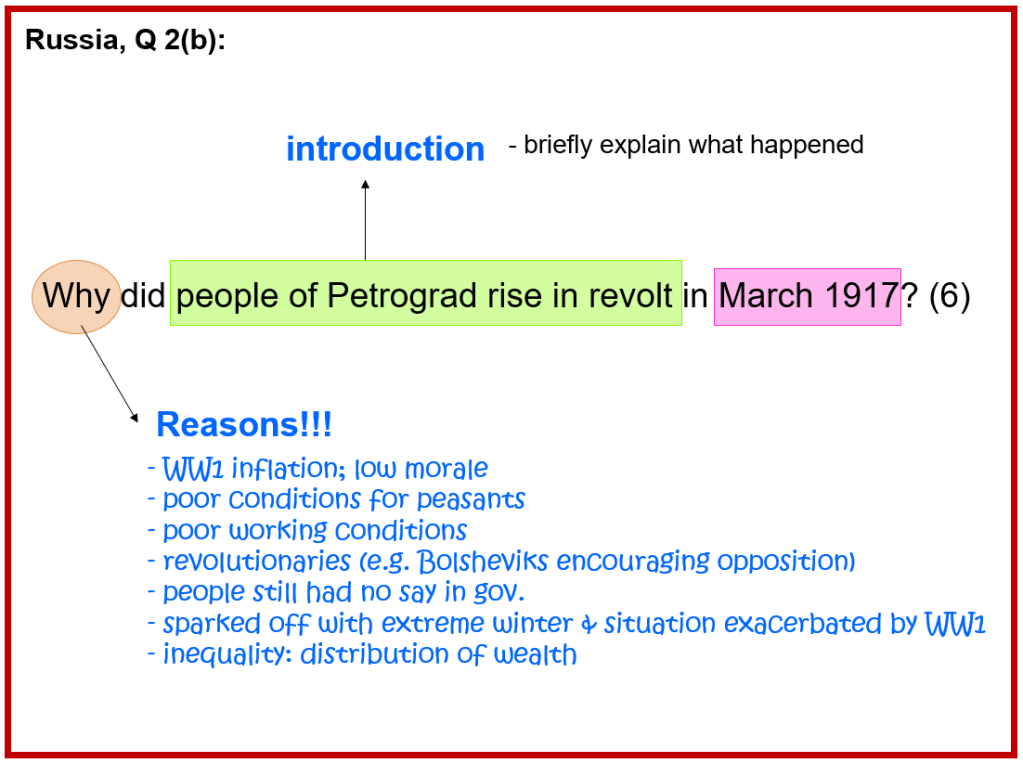
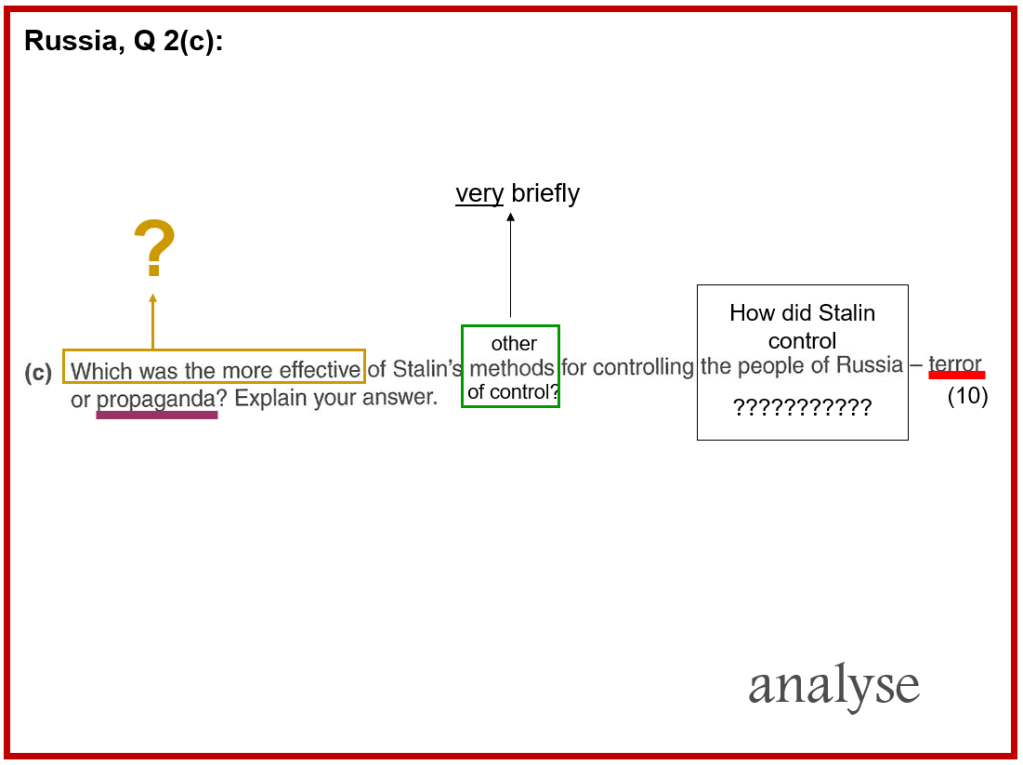
Russia – Question 2.
Navigate you way through the slides below to see how these question could be answered:
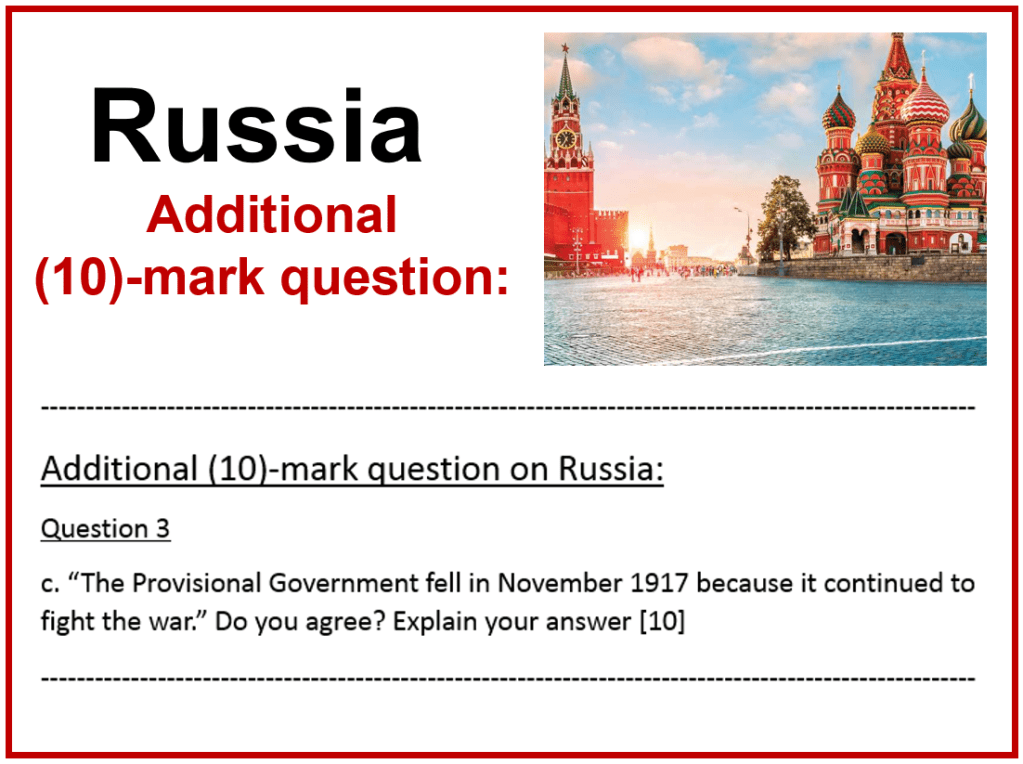
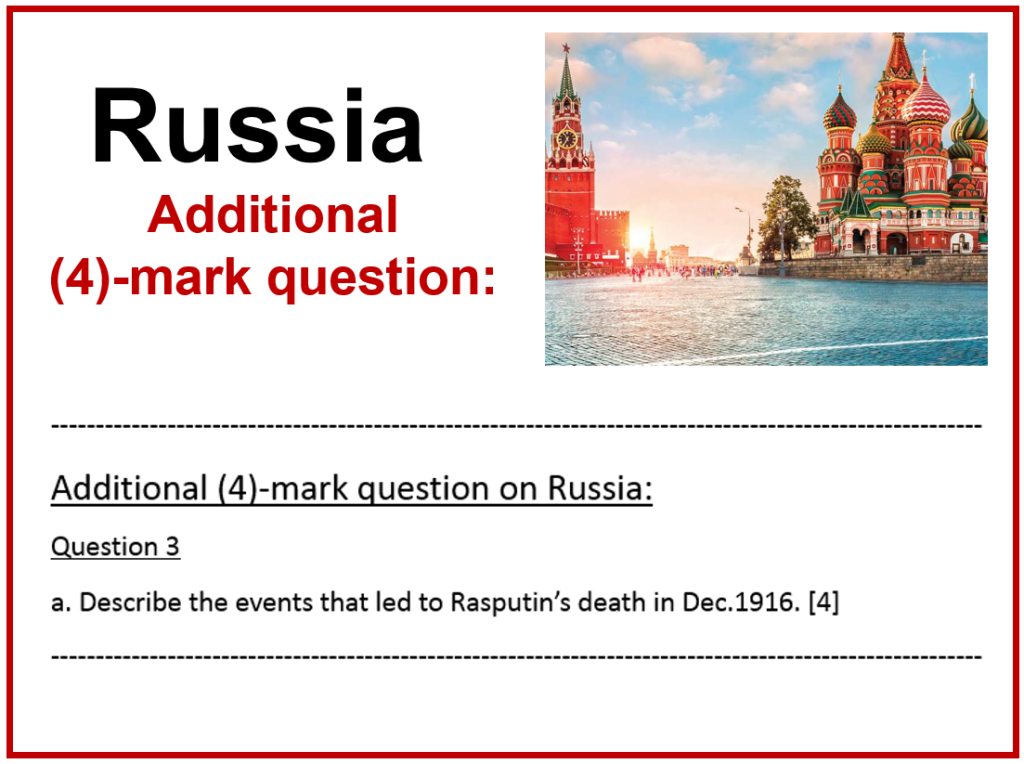
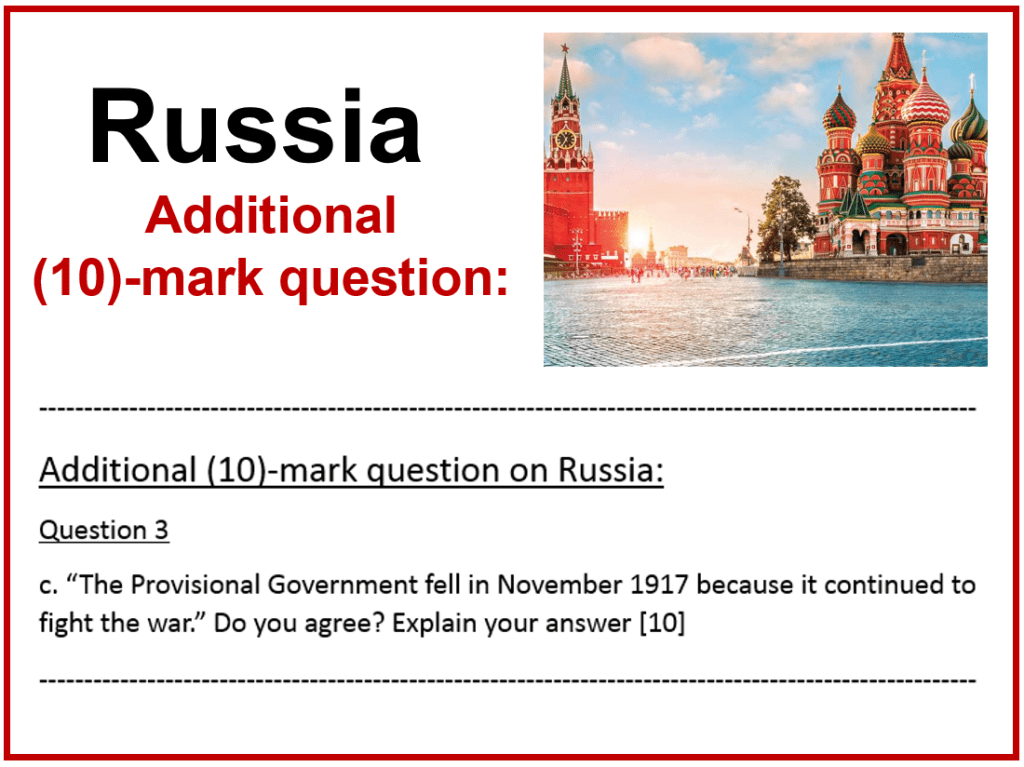
Russia – Additional Questions.
Navigate you way through the slides below to see how these question could be answered:
Treaties – Additional Questions.
Navigate you way through the slides below to see how these question could be answered:
Study & Exam Preparation:
Study for the Exams!!!
Here are more exam questions that you can use for exam preparation:

QUESTION 1
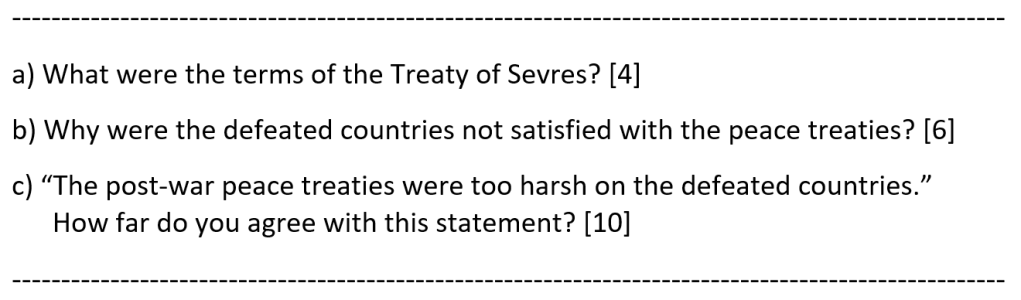
QUESTION 2
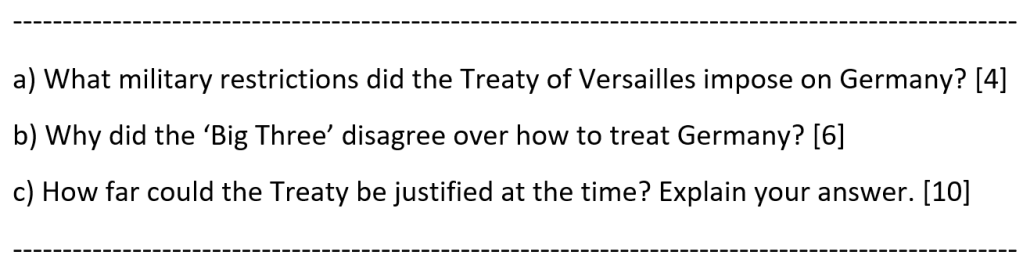
QUESTION 3
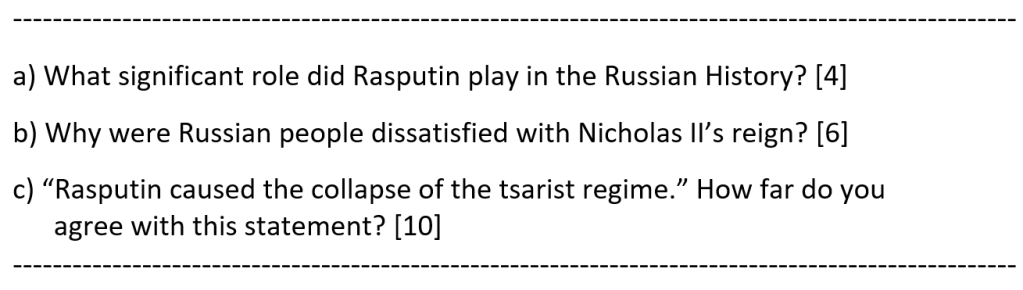
QUESTION 4
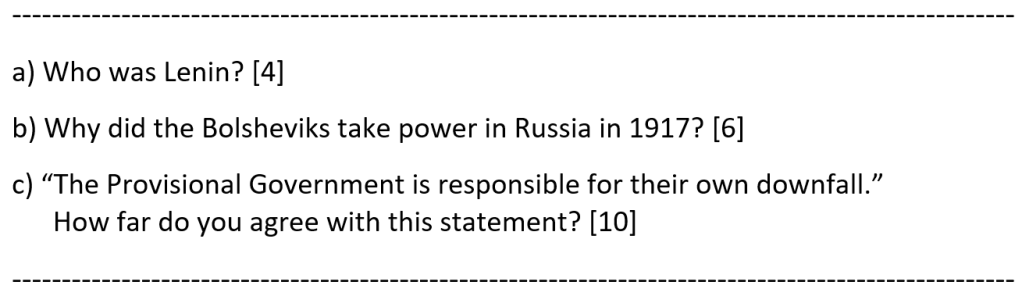
QUESTION 5
Possible reasons for Question 5 (b):
(WordPress advertisements may appear below.)


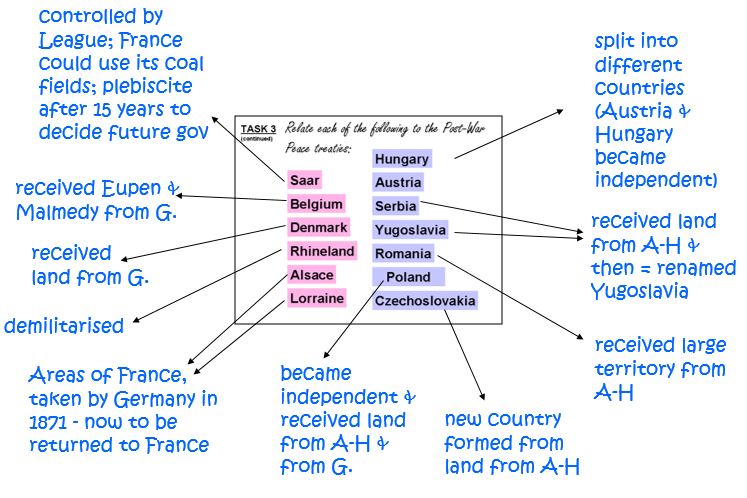
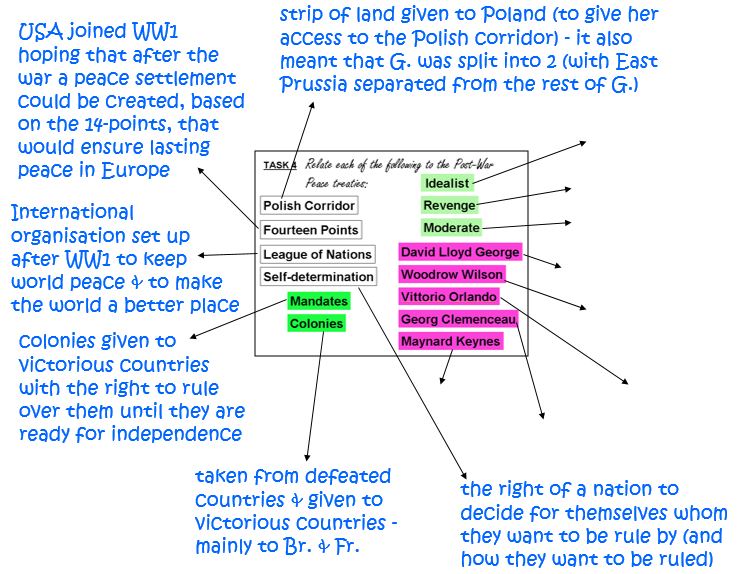
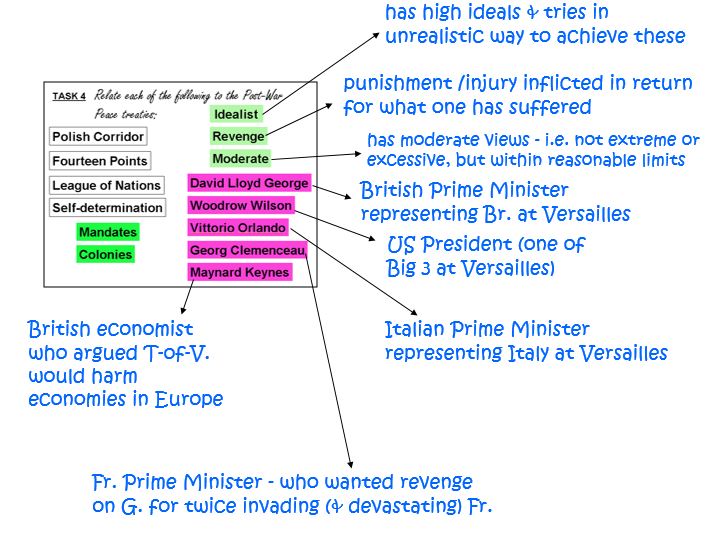
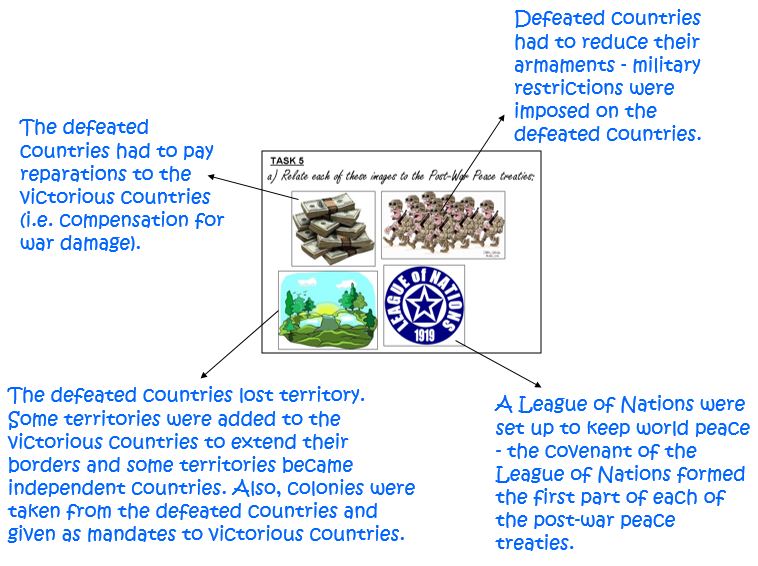


(WordPress advertisements may appear below.)
Today you are going to work on answering Paper 4 Exam Questions…!

We will use the following pages from your exam preparation Booklet:
DEPTH STUDY C: RUSSIA, 1905–41
1.
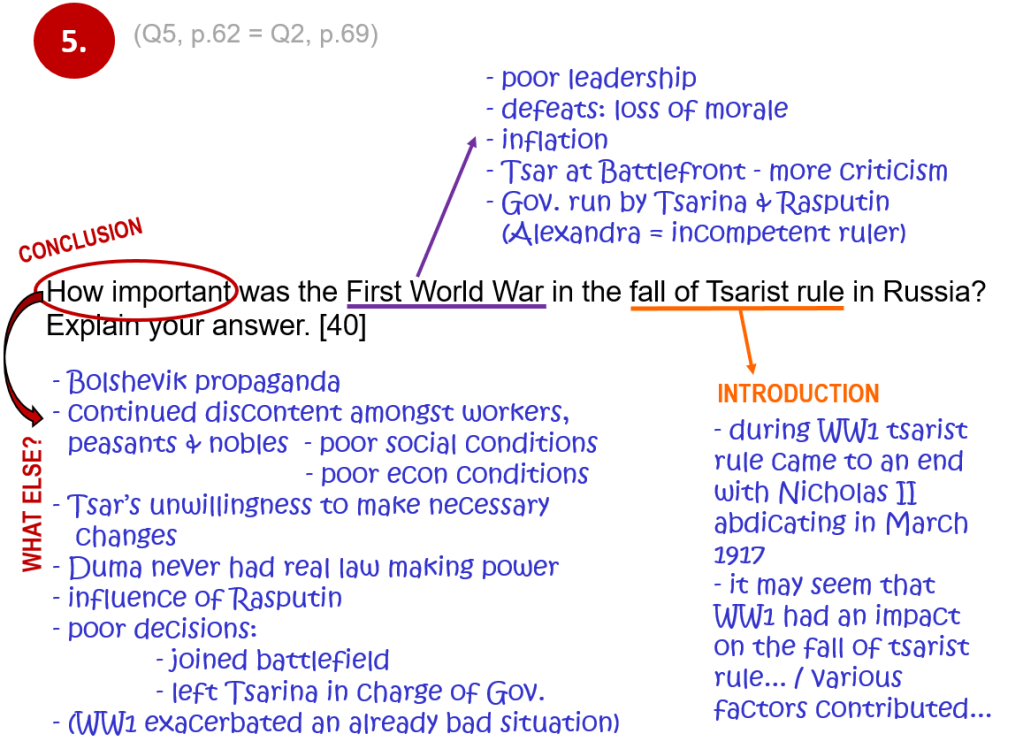
QUESTION 5.
(same as Q2, p.69)
How important was the First World War in the fall of Tsarist rule in Russia? Explain your answer. [40]
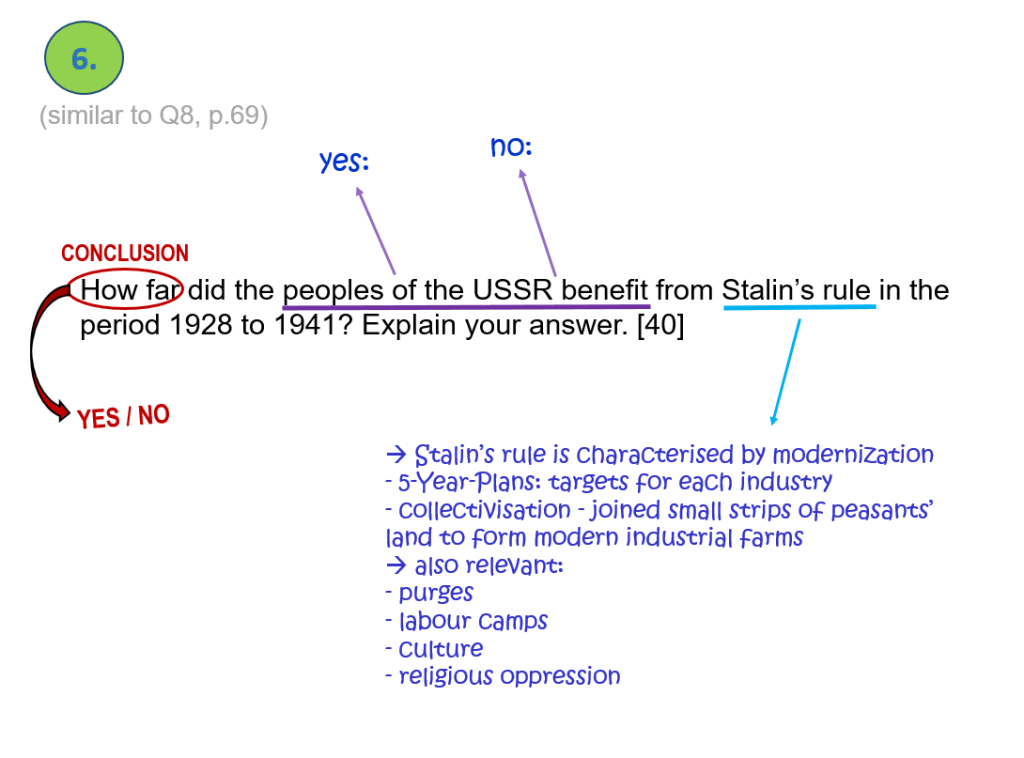
QUESTION 6.
(similar to Q-8, p.69)
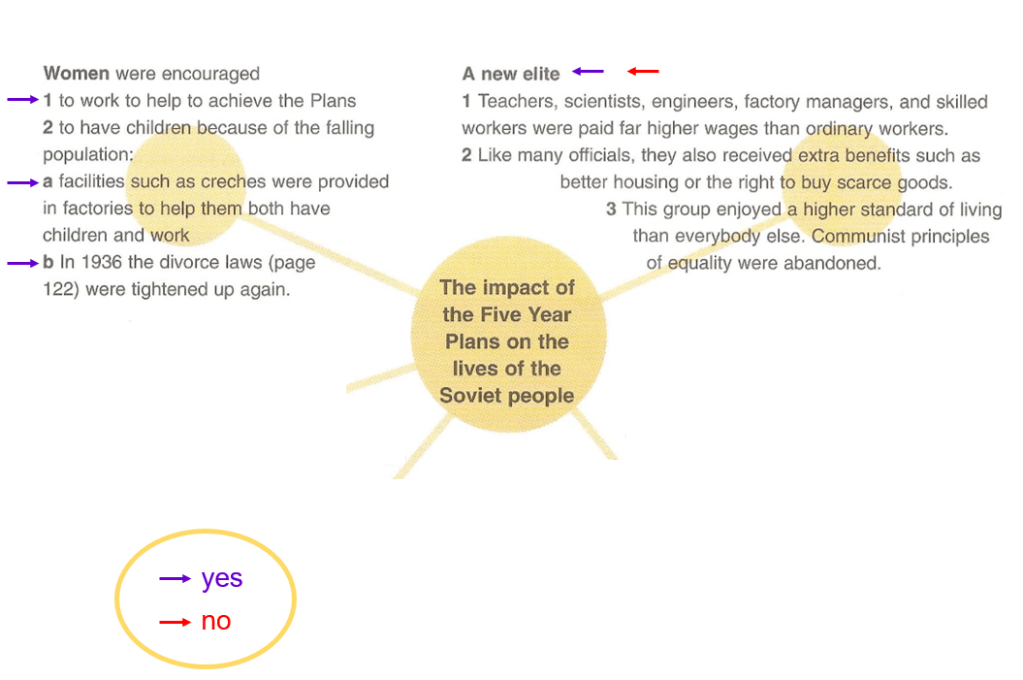
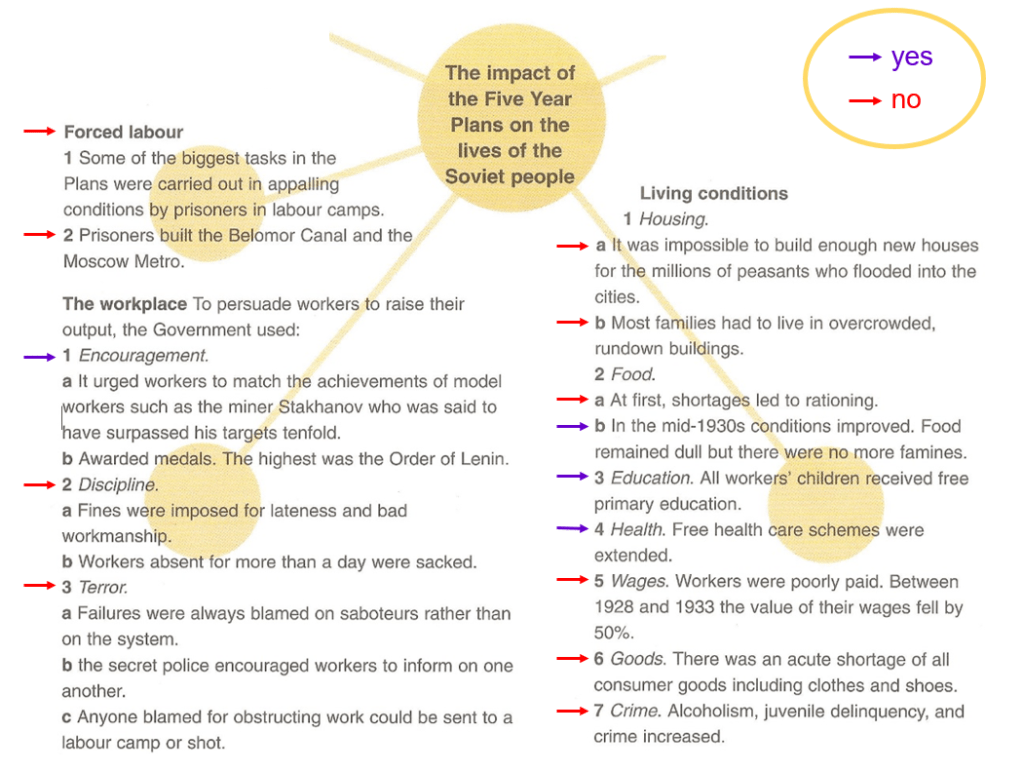
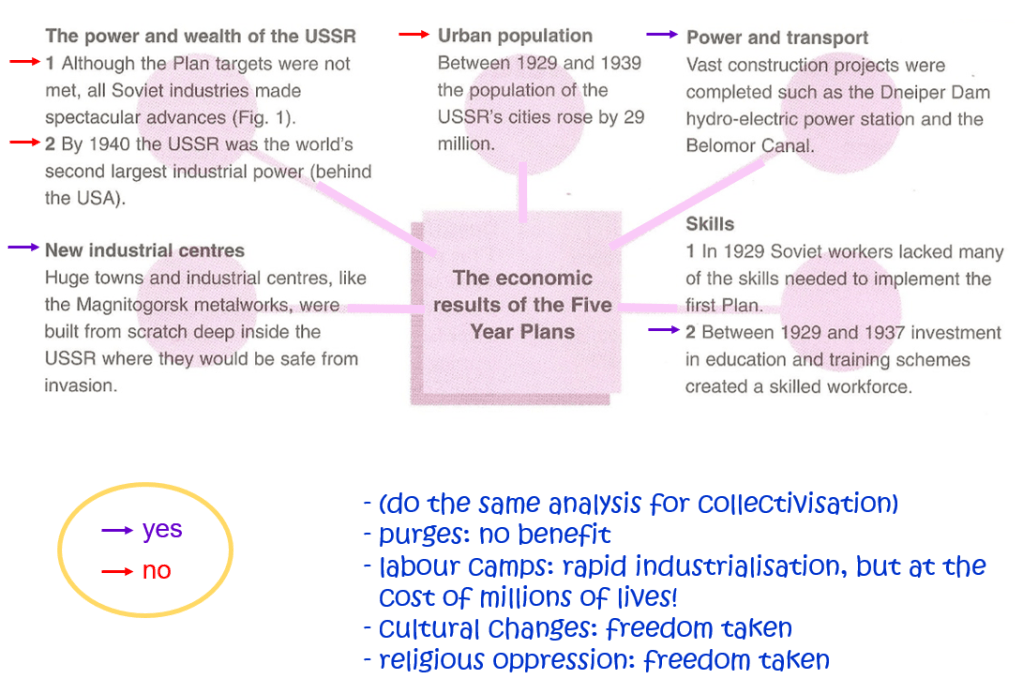
How far did the peoples of the USSR benefit from Stalin’s rule in the period 1928 to 1941? Explain your answer. [40]

2.

QUESTION 1.
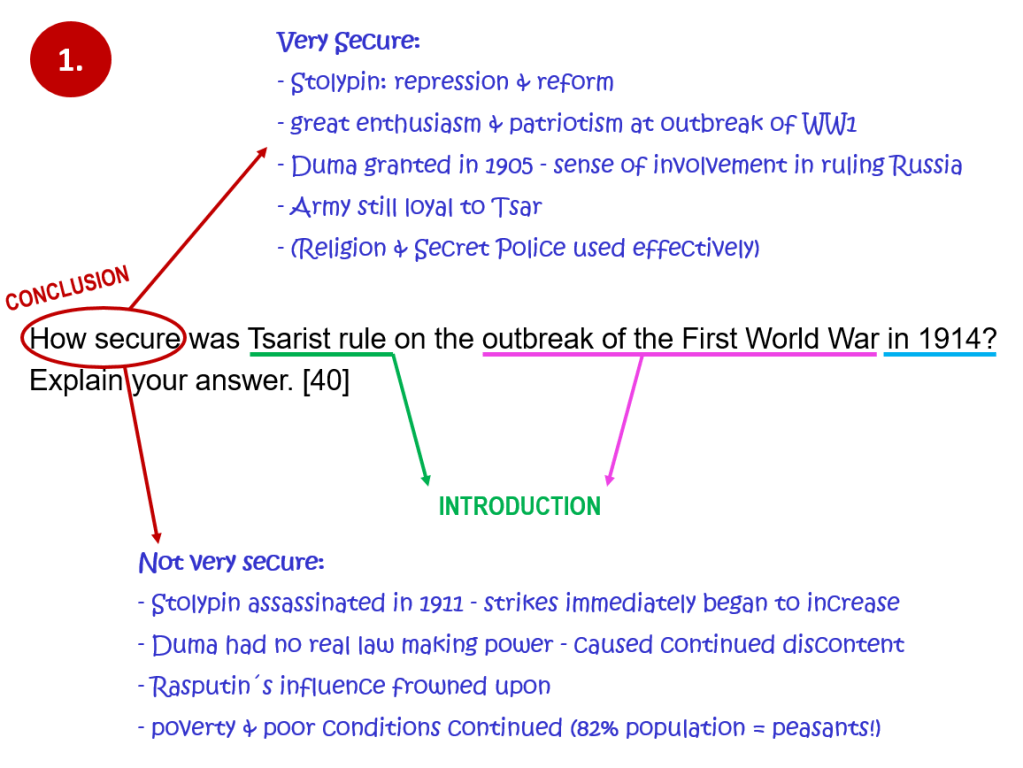
How secure was Tsarist rule on the outbreak of the First World War in 1914? Explain your answer. [40]
QUESTION 2.
(same as Q5, p.62)
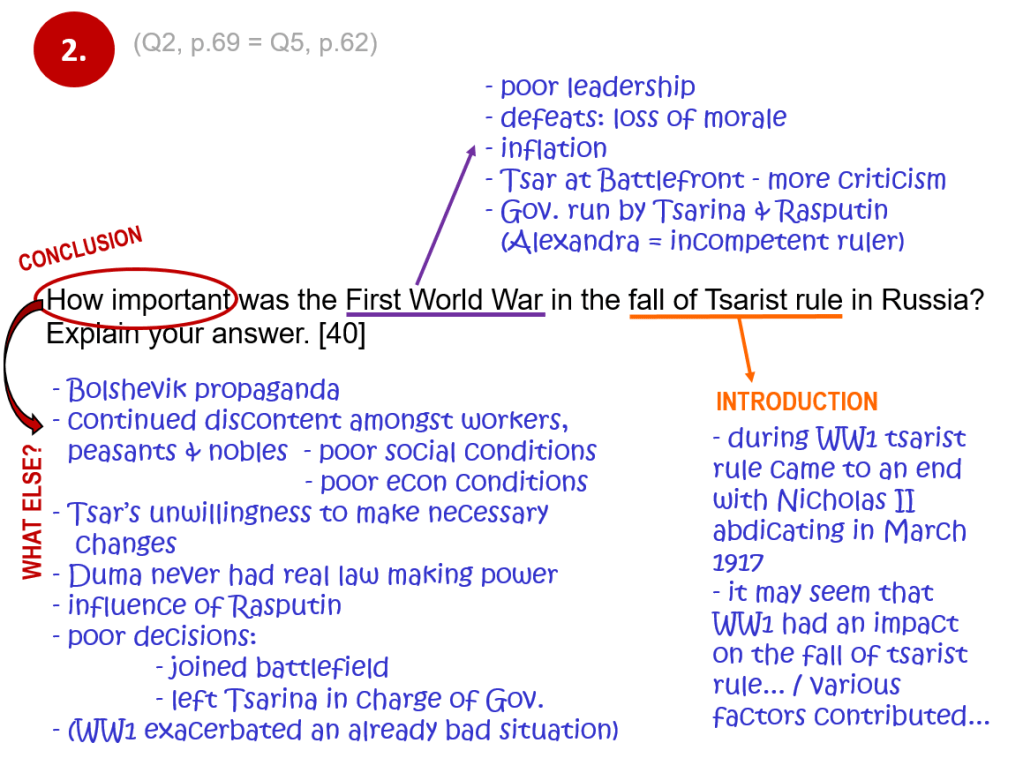
How important was the First World War in the fall of Tsarist rule in Russia? Explain your answer. [40]
QUESTION 3.
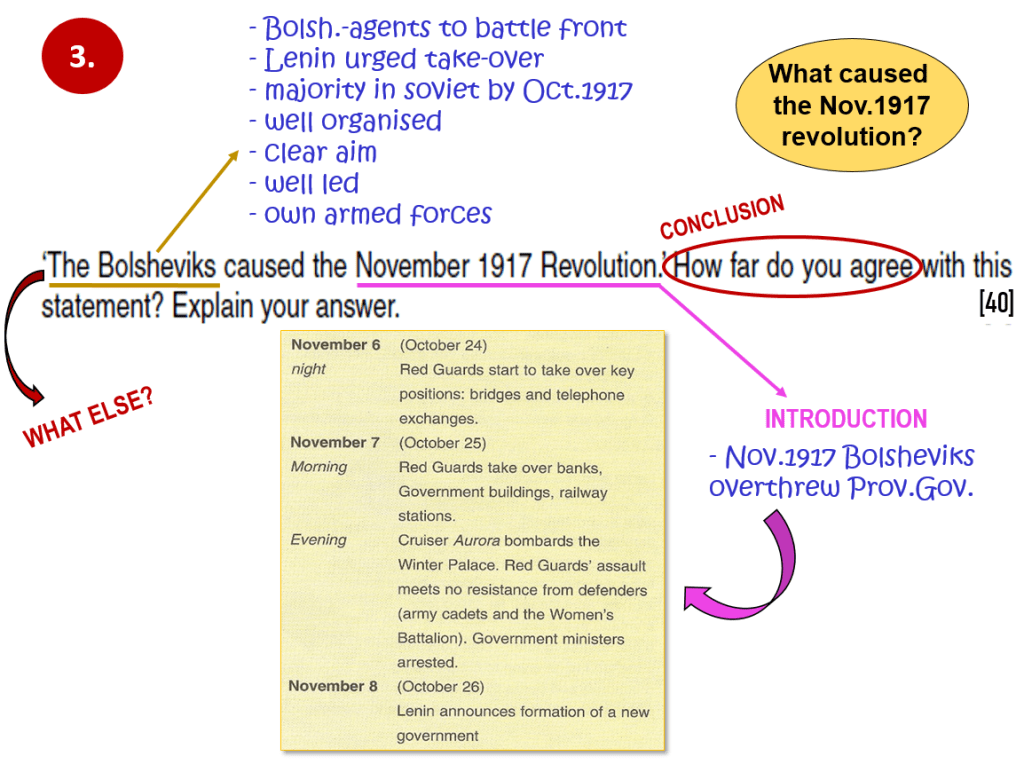
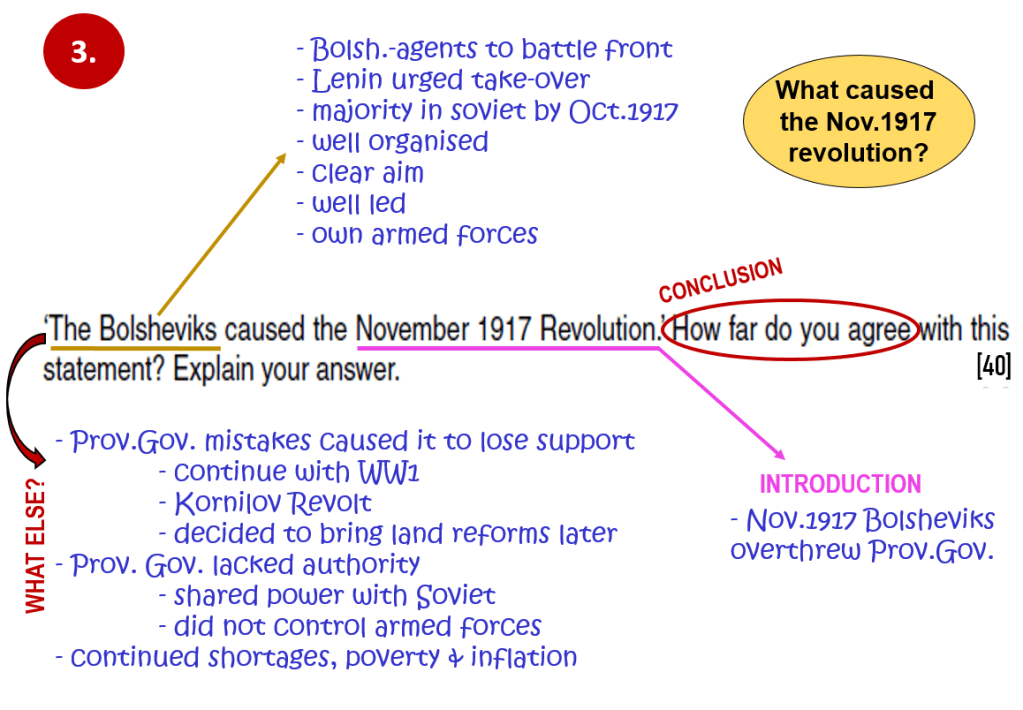
‘The Bolsheviks caused the November 1917 Revolution.’ How far do you agree with this statement? Explain your answer. [40]
QUESTION 4.
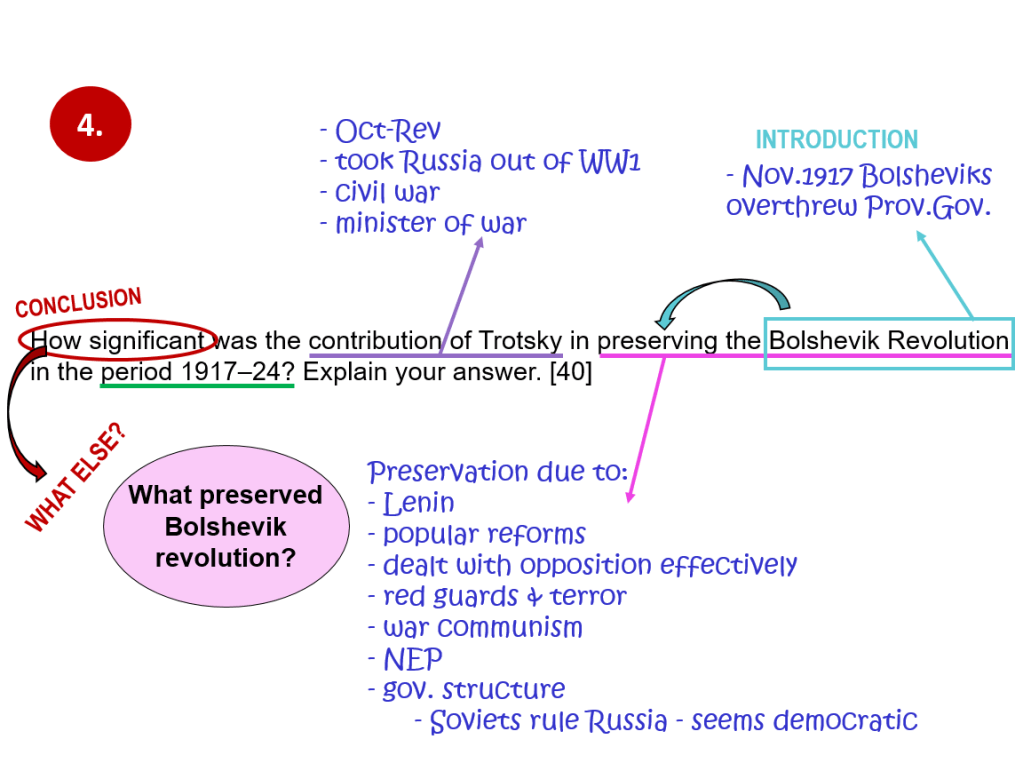
How significant was the contribution of Trotsky in preserving the Bolshevik Revolution in the period 1917–24? Explain your answer. [40]
QUESTION 5.
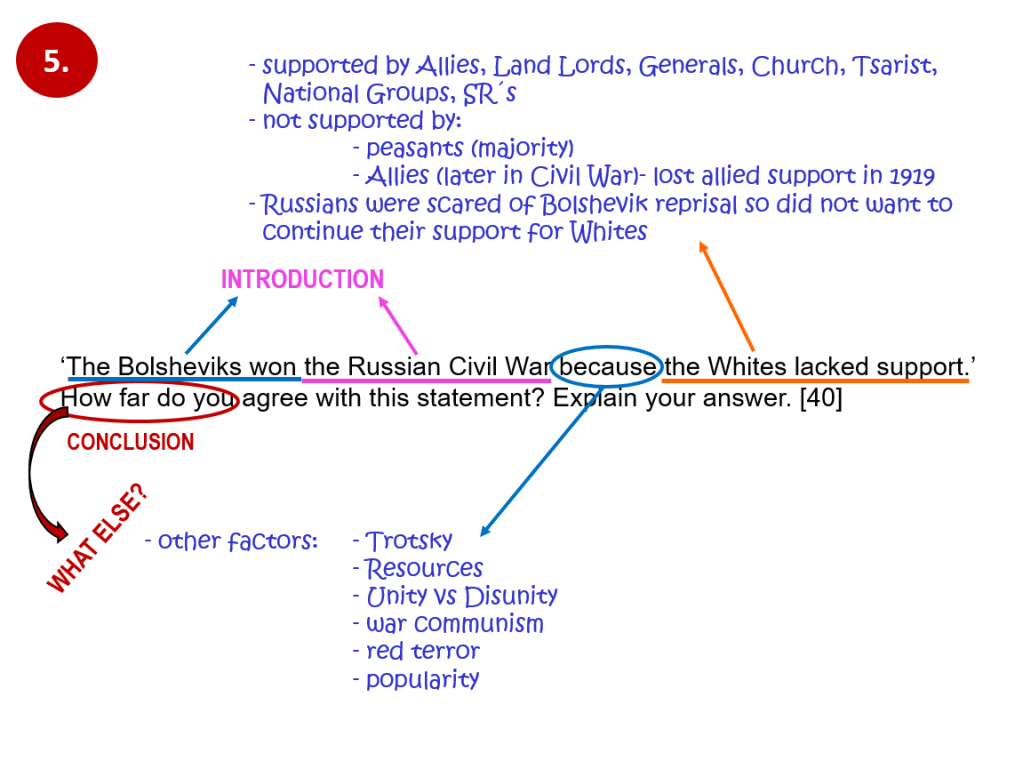
‘The Bolsheviks won the Russian Civil War because the Whites lacked support.’ How far do you agree with this statement? Explain your answer. [40]
QUESTION 6.
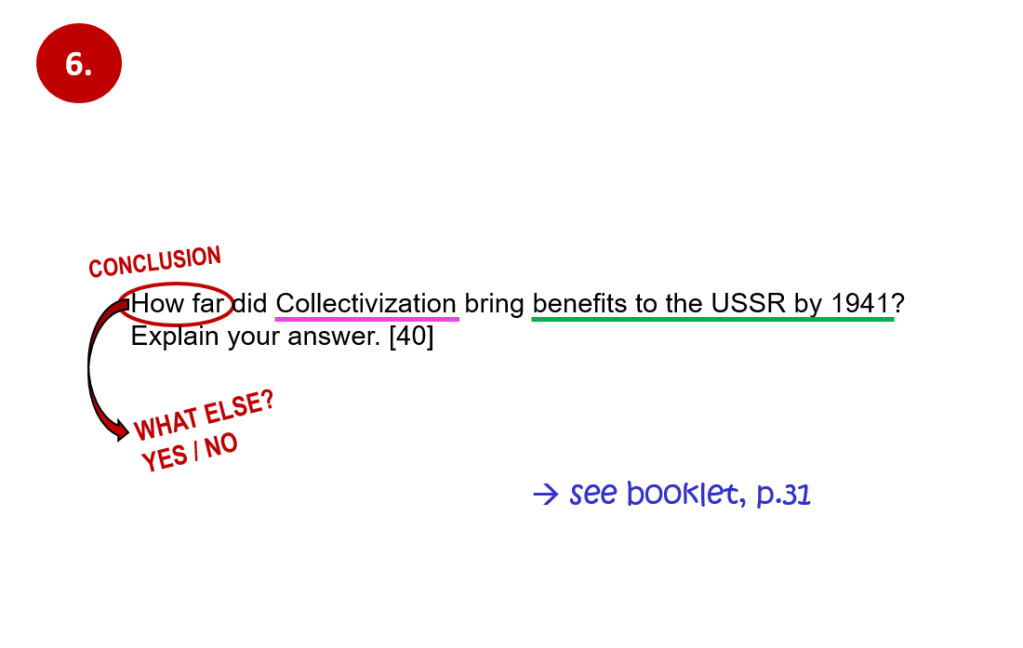
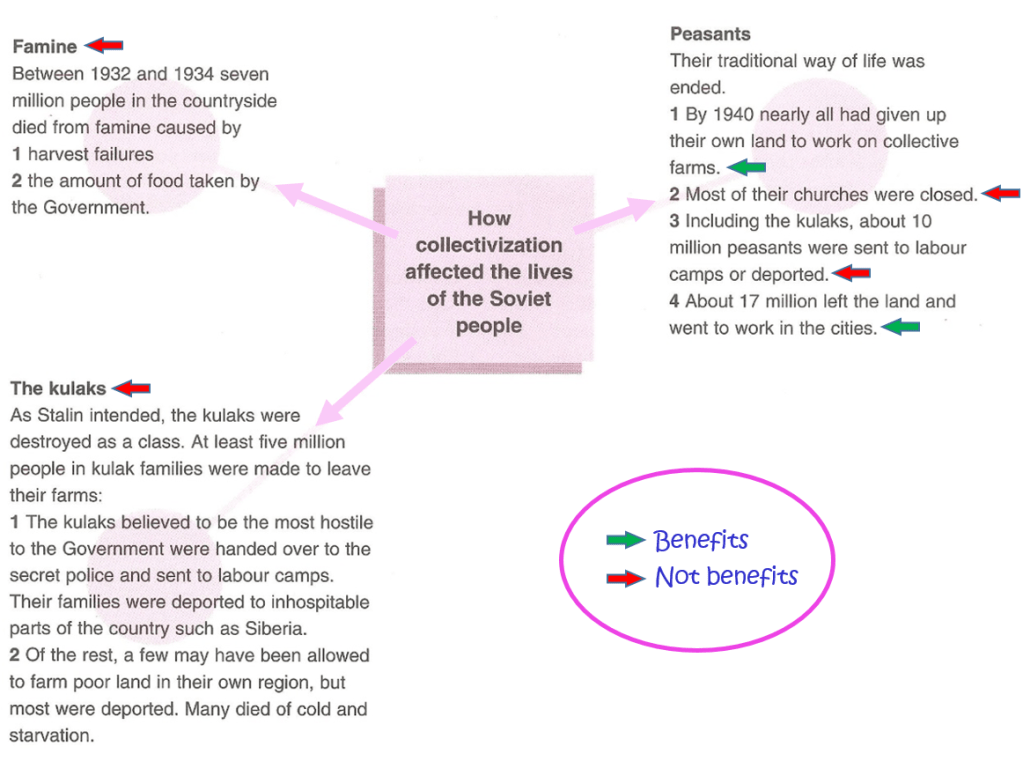
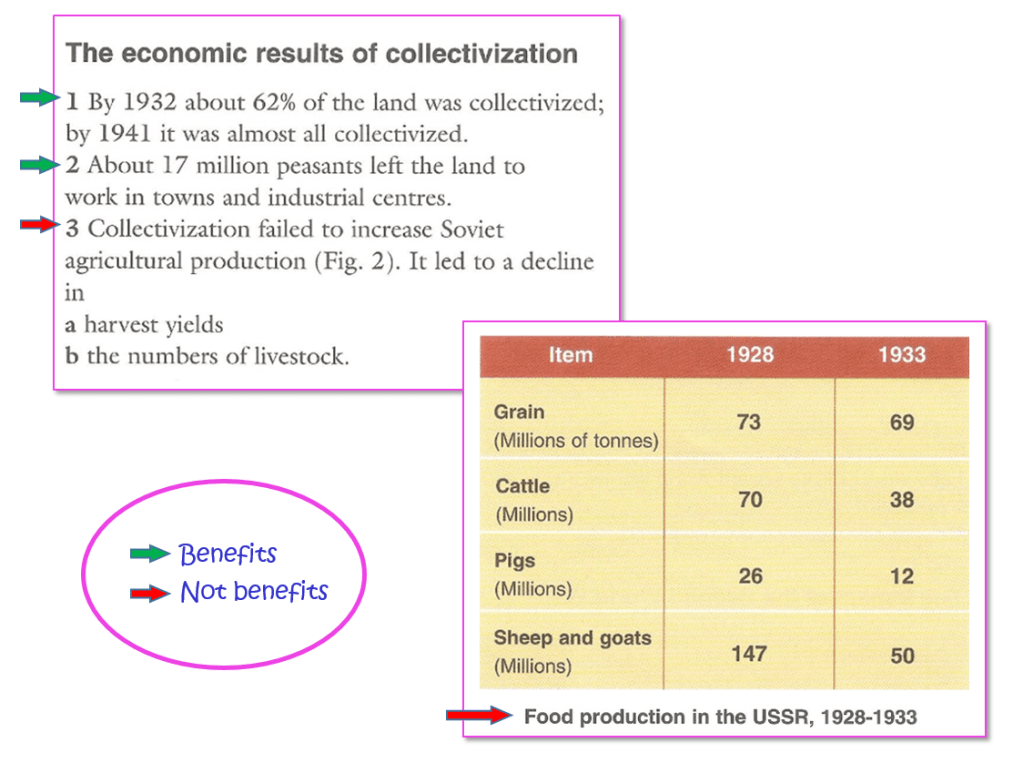
How far did collectivization bring benefits to the USSR by 1941? Explain your answer. [40]
QUESTION 7.
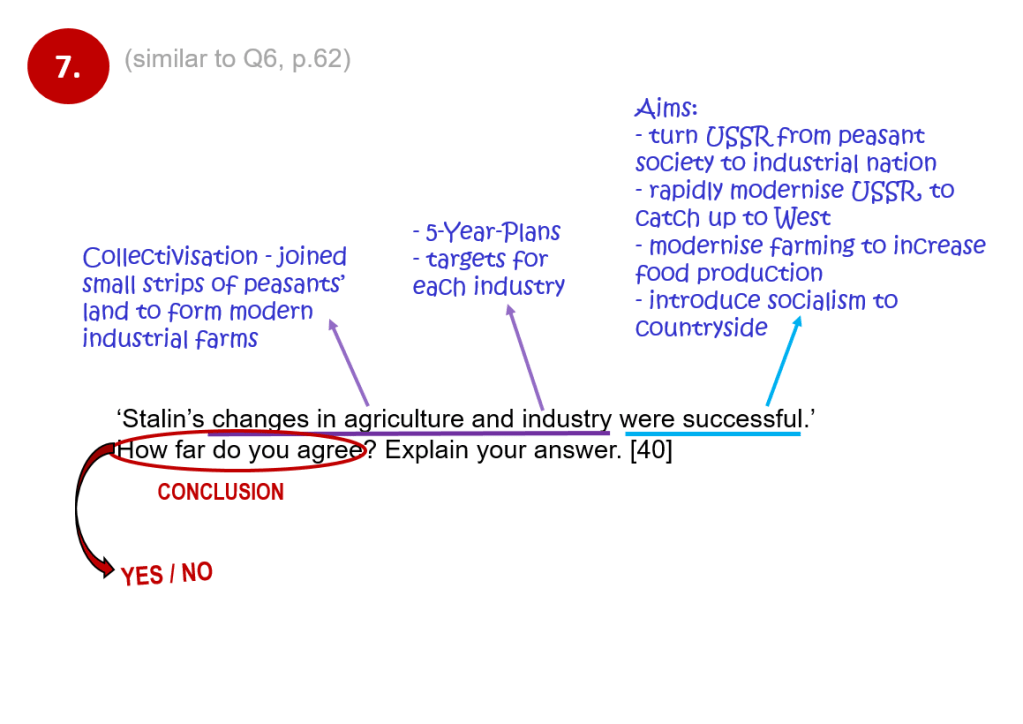
‘Stalin’s changes in agriculture and industry were successful.’ How far do you agree? Explain your answer. [40]
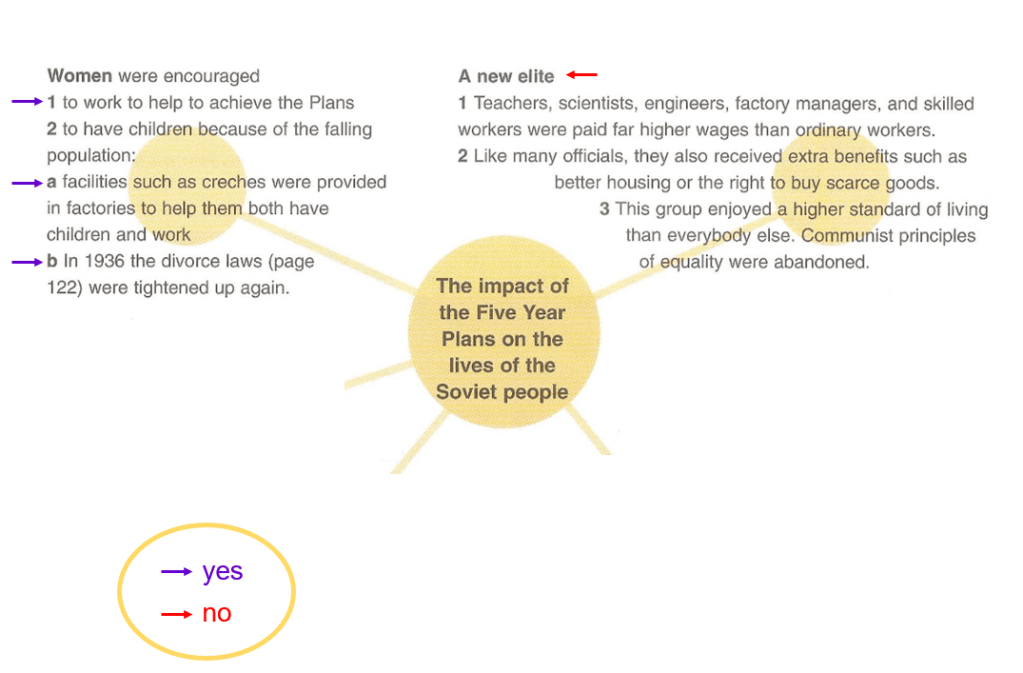
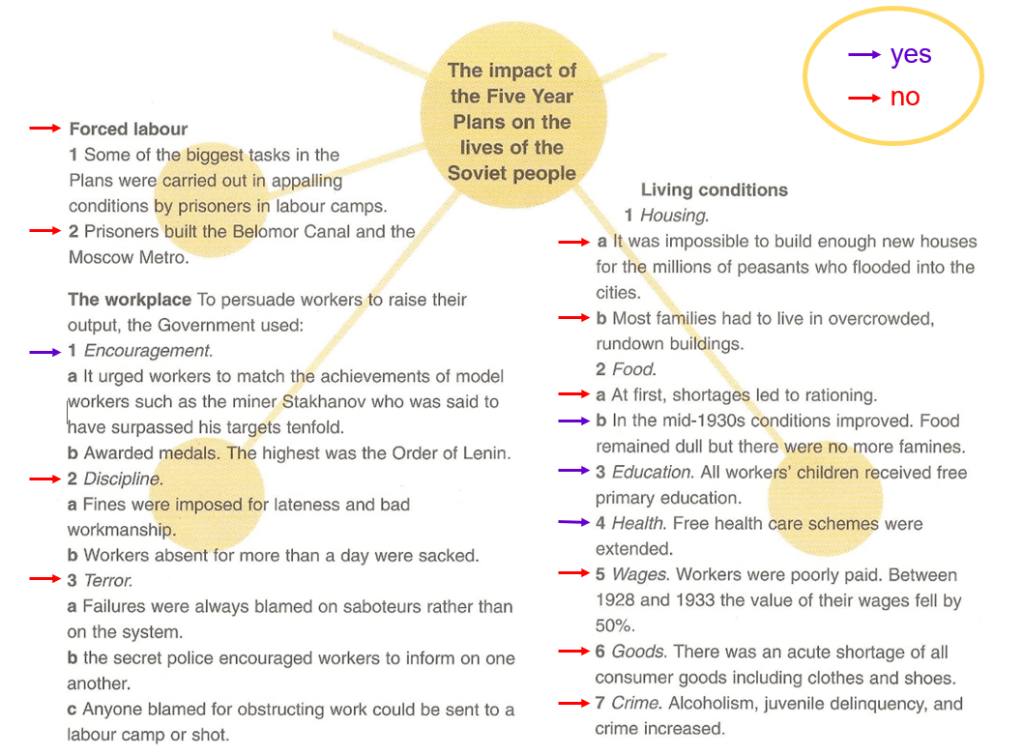
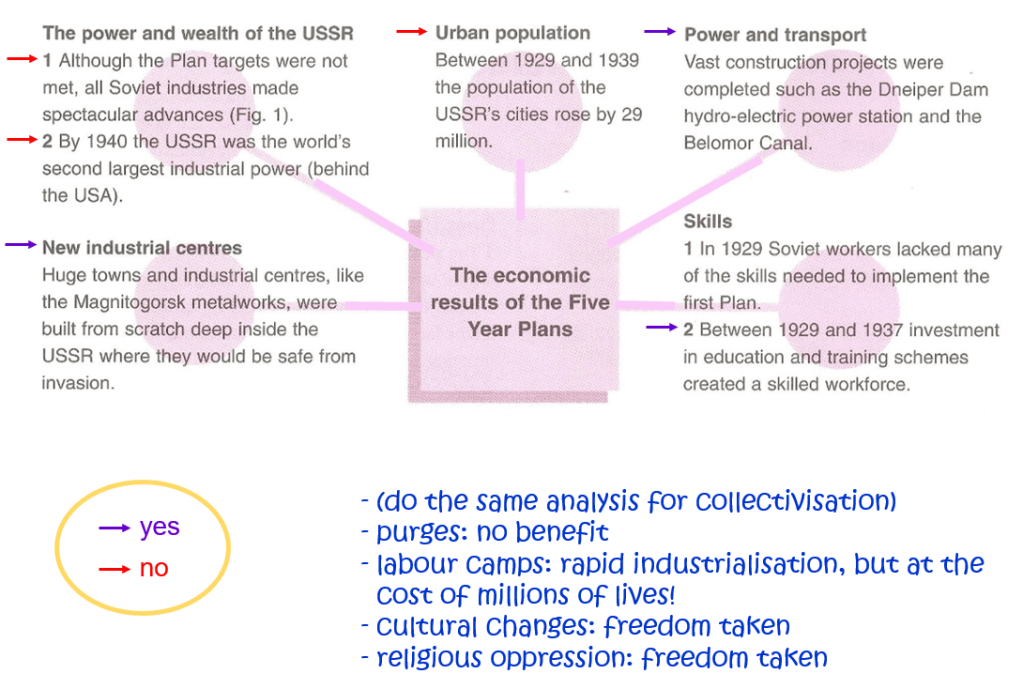
QUESTION 8.
(similar to Q-6, p.62)
‘Stalin’s rule brought little benefit to the people of the USSR.’ How far do you agree with this statement? Explain your answer. [40]
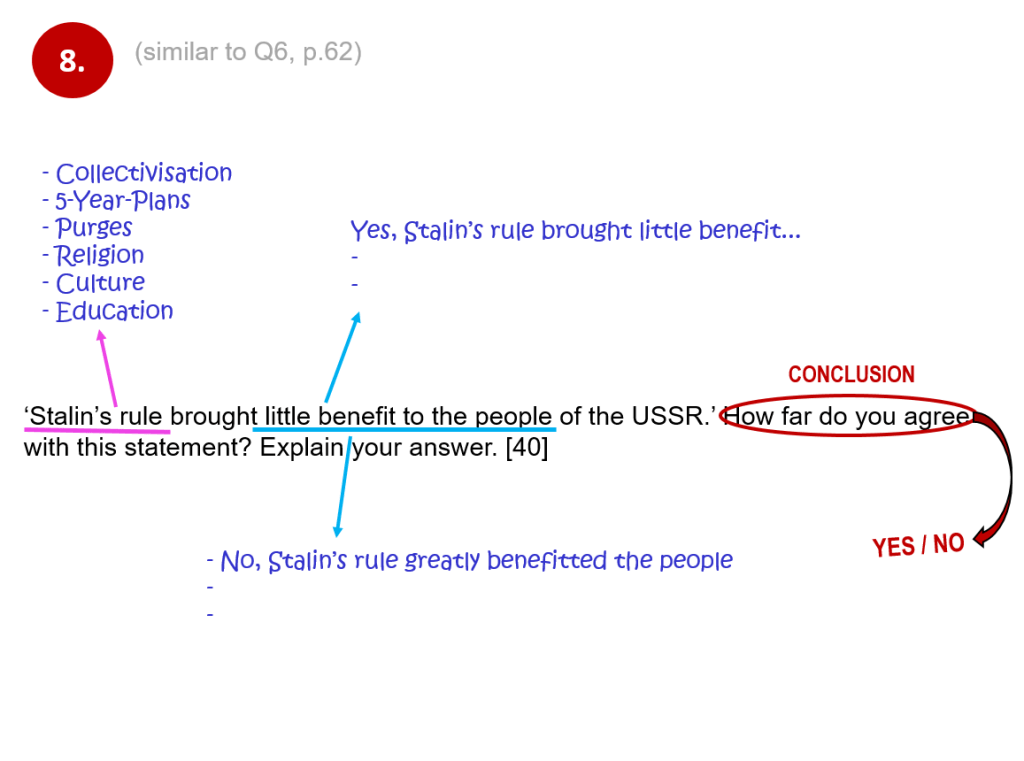
3.

Go back to the following lessons, and look specifically at the 10-mark questions on Russian. All these 10-mark questions from Paper 1 could be asked as 40-mark essay questions in Paper 4. (The only difference is that the questions usually start with “How important” or “How significant”. For 40 marks you need to answer in more depth, giving more details.)
4.
Look at the following lessons for LOADS of Paper 4 exam Questions…
(WordPress advertisements may appear below.)
Today you are going to work on answering even more Paper 1 Exam Questions…!
We will use pages 72-75 from your exam preparation Booklet.
1.
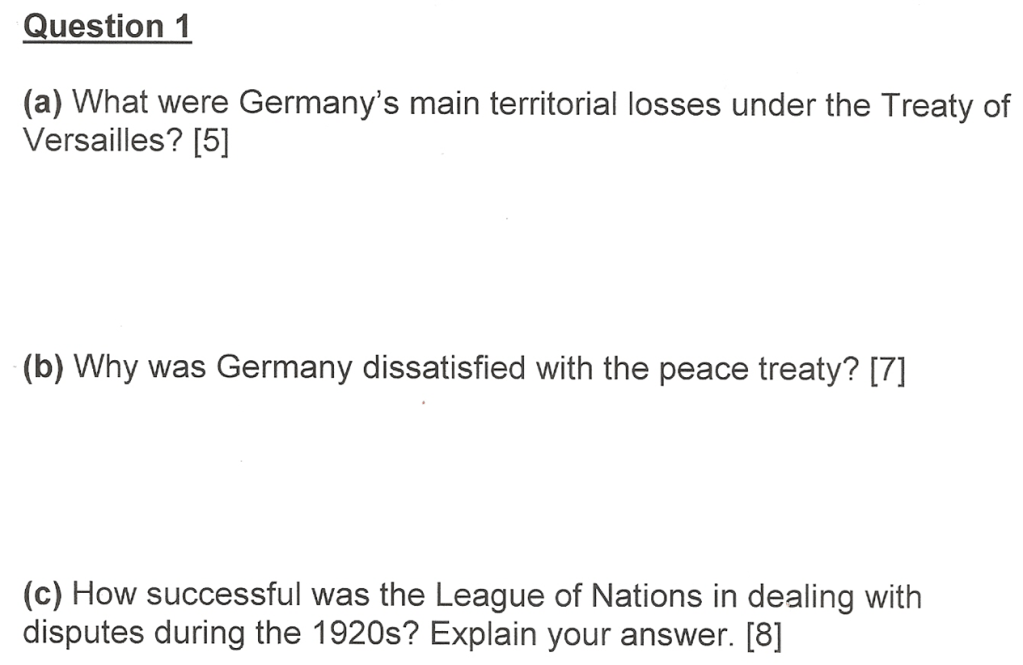
Question 1
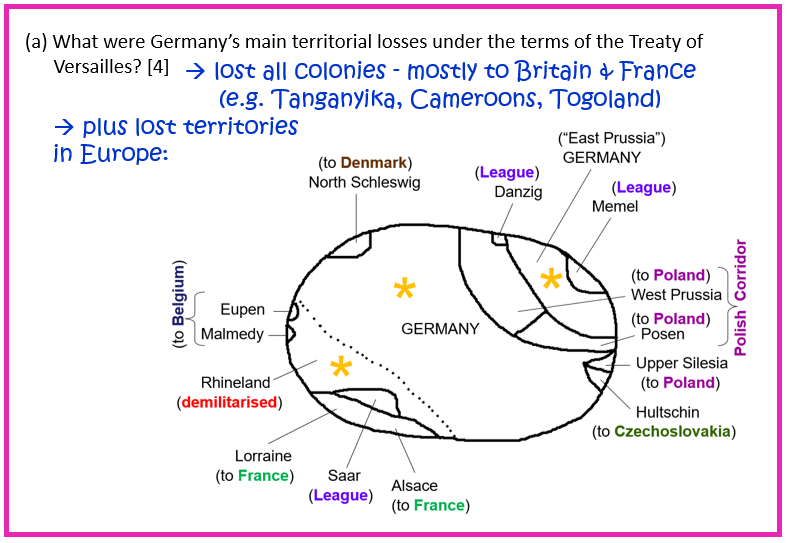
Question 1 (a)
What were Germany’s main territorial losses under the terms of the Treaty of Versailles? [4]

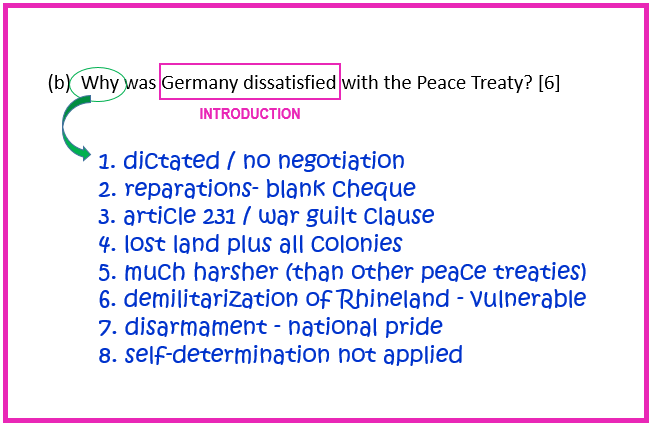
Question 1 (b)
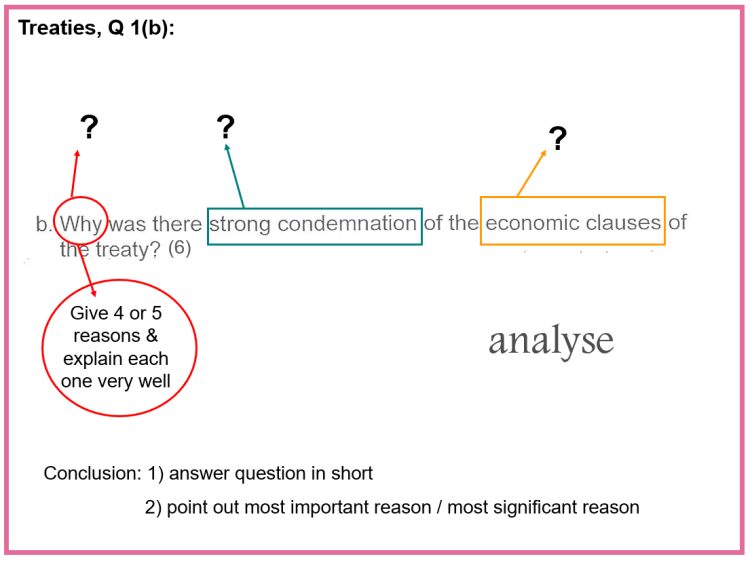
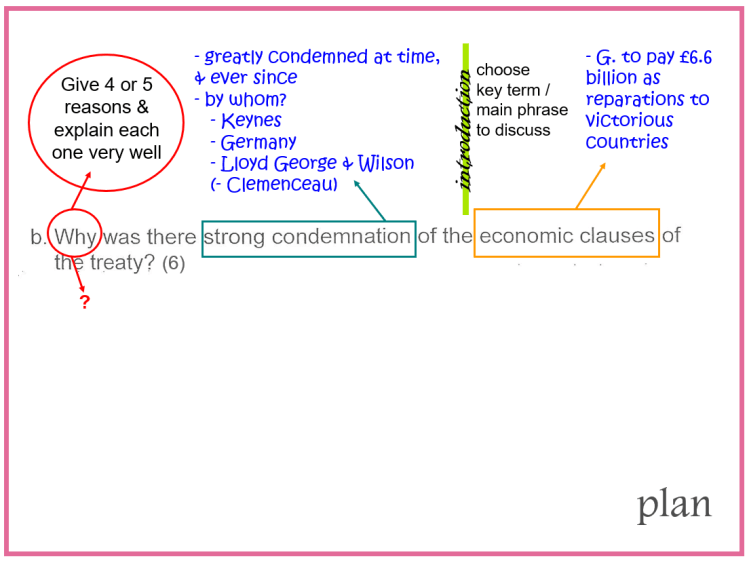
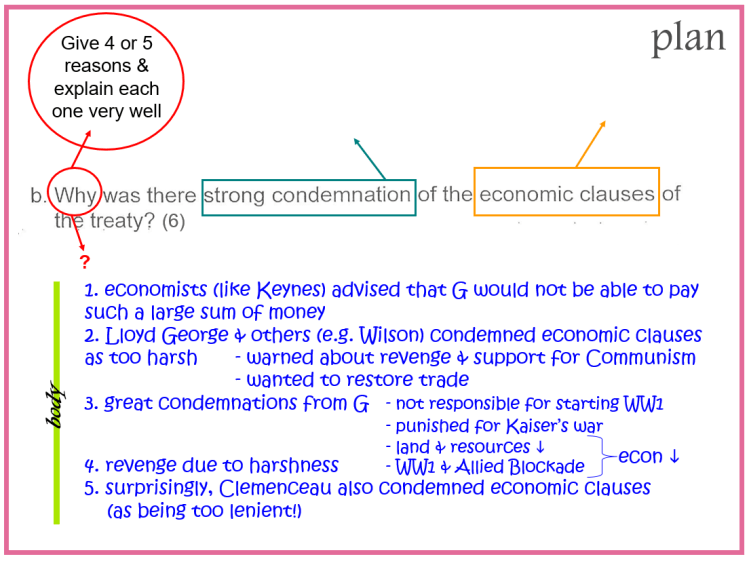
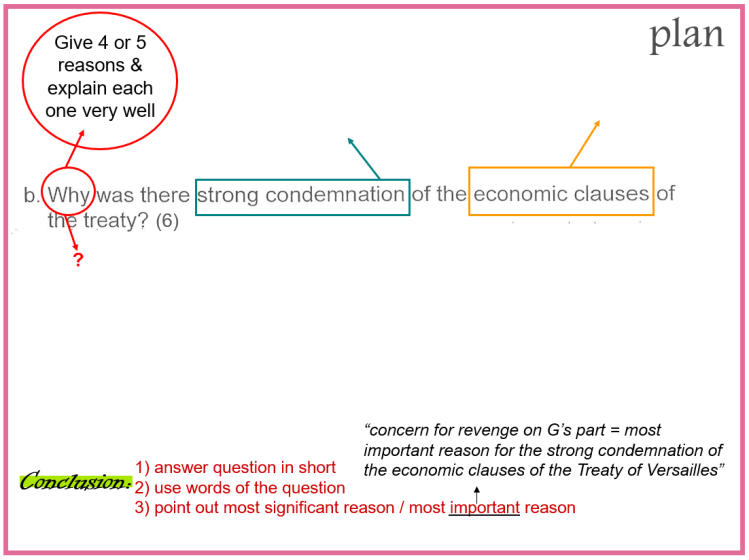
Why was Germany dissatisfied with the Peace Treaty? [6]

(It was made by students and may shed further light on how to answer this exam question.)
Exam Q on the Treaty of Versailles. (3:02 minutes long)
Question 1 (c)
How successful was the League of Nations in dealing with disputes in the 1920’s? Explain your answer. [10]

2.
Question 2

Question 2 (a)
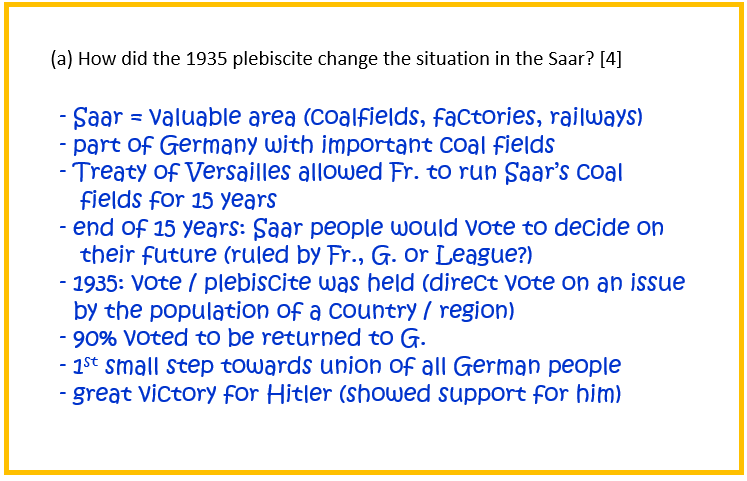
How did the 1935 plebiscite change the situation in the Saar? [4]
Question 2 (b)
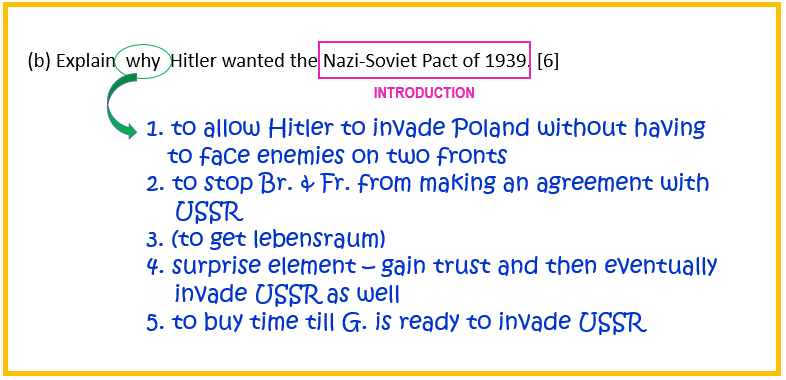
Explain why Hitler wanted the Nazi-Soviet Pact of 1939. [6]
Question 2 (c)
“The policy of appeasement was justified.” How far do you agree with this statement? Explain your answer. [10]

3.
Question 3

Question 3 (a)
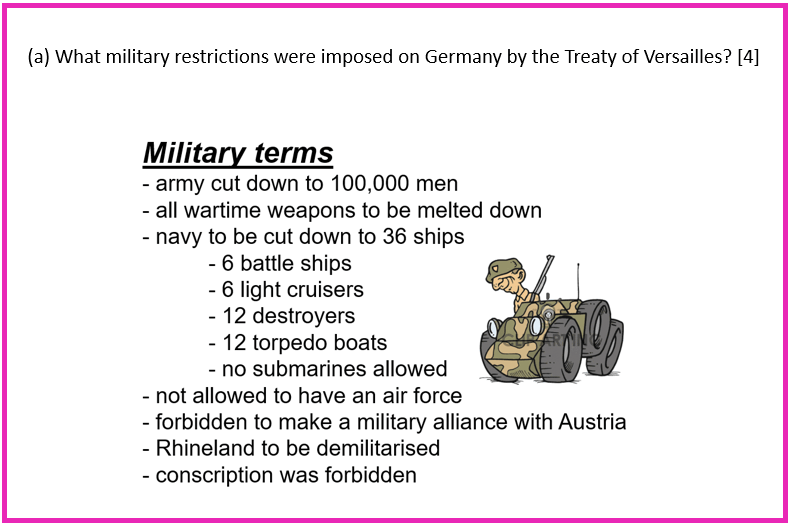
What military restrictions were imposed on Germany by the Treaty of Versailles? [4]
Question 3 (b)
Why did the aims of the “Big Three” at Versailles differ? [6]
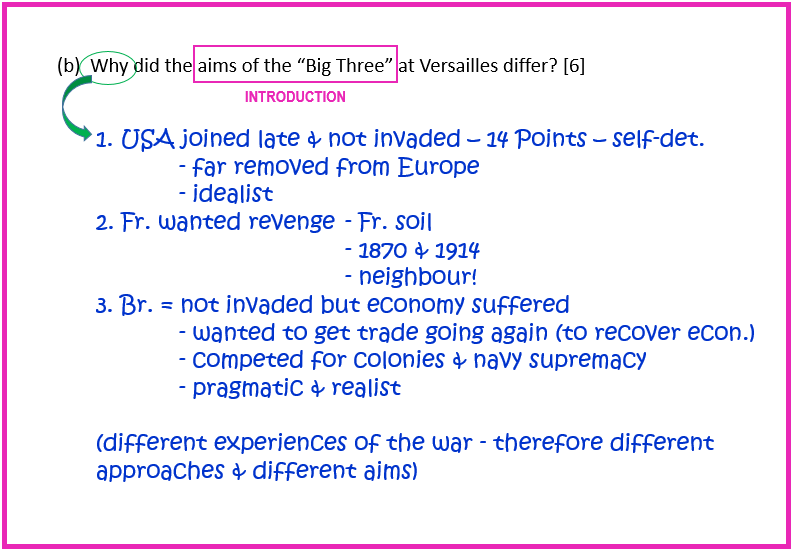
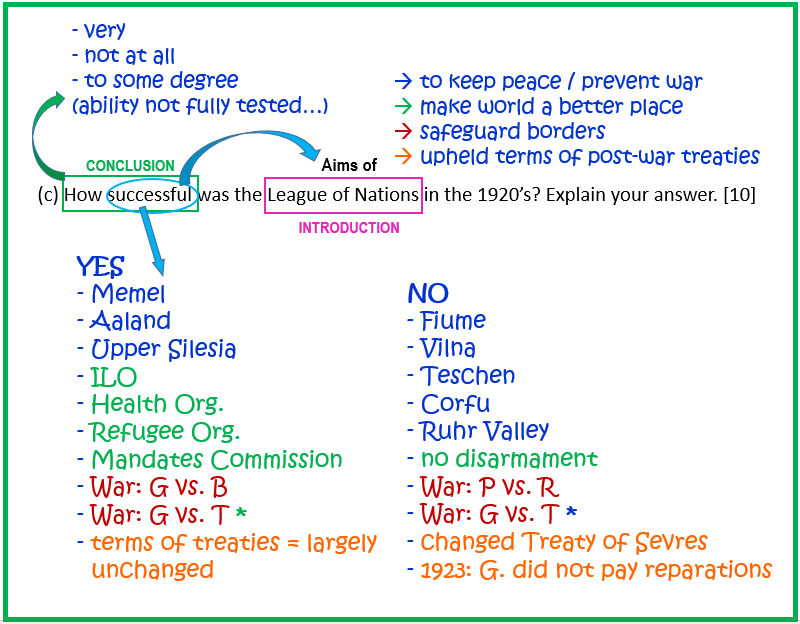
Question 3 (c)
How successful was the League of Nations in the 1920’s? Explain your answer. [10]
4.
Question 4
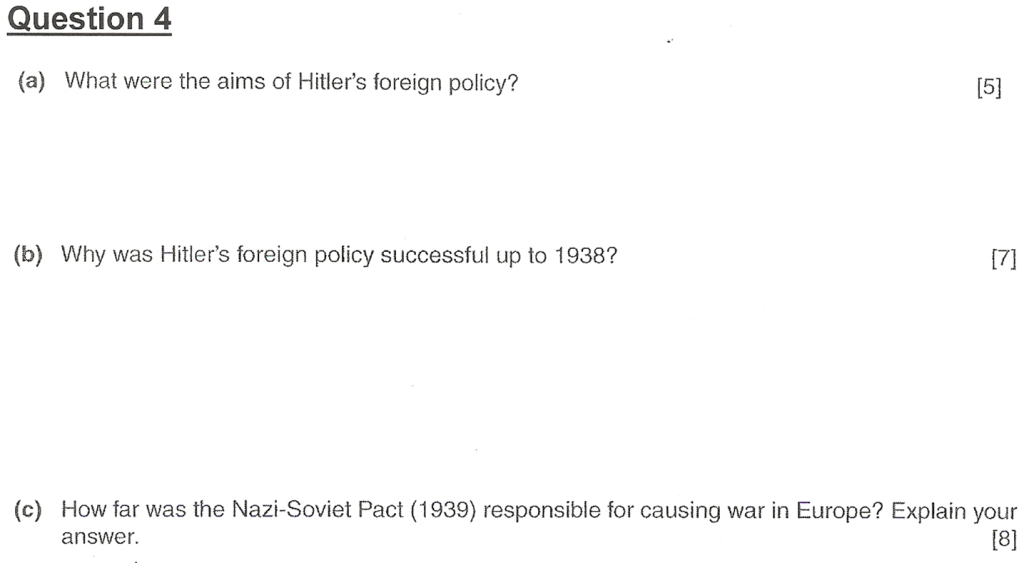
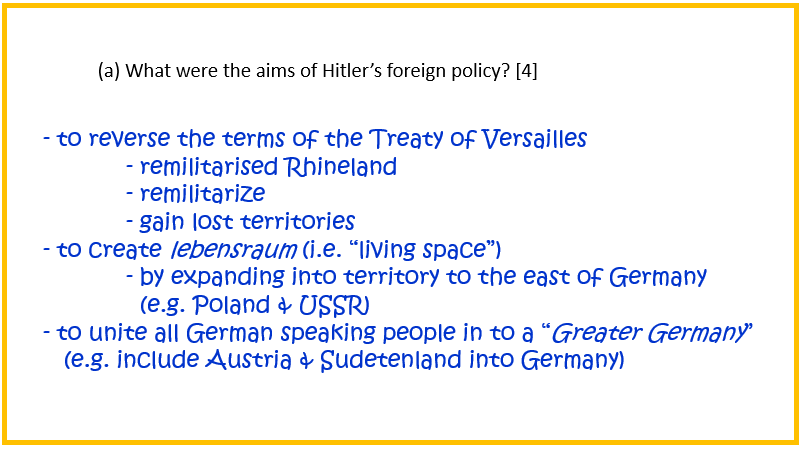
Question 4 (a)
What were the aims of Hitler’s foreign policy? [4]
Question 4 (b)
Why was Hitler’s foreign policy successful up to 1938? [6]
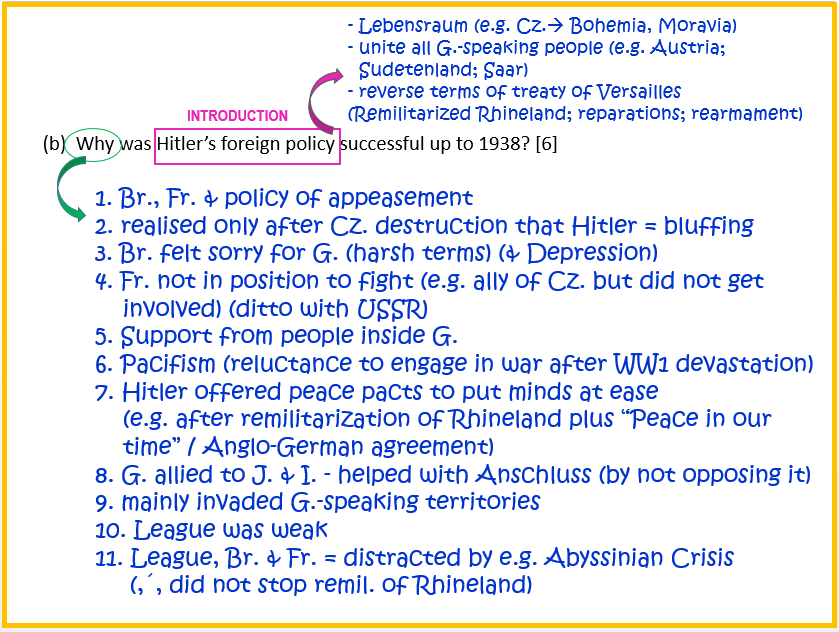
(It was made by students and may shed further light on how to answer this exam question.)
Exam Q on Hitler’s Foreign Policy. (3:26 minutes long)
Question 4 (c)
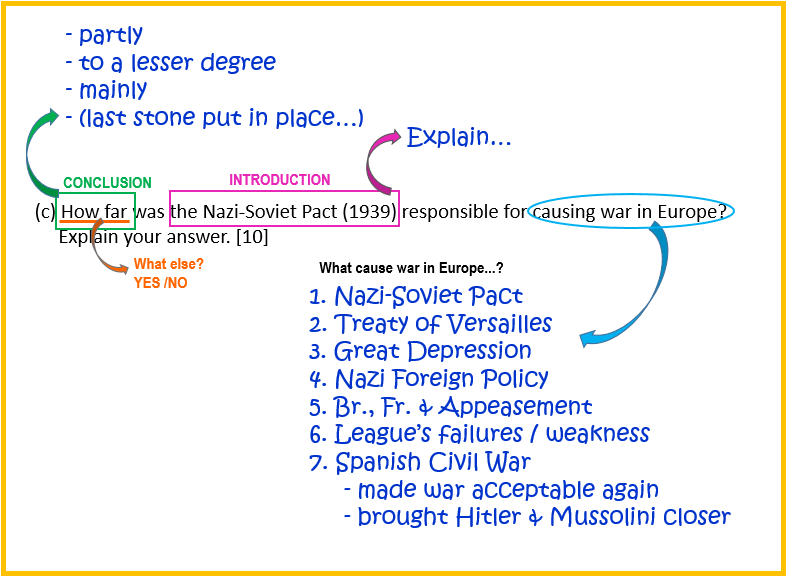
How far was the Nazi-Soviet Pact (1939) responsible for causing war in Europe? Explain your answer. [10]
5.
Question 5
Question 5 (a)
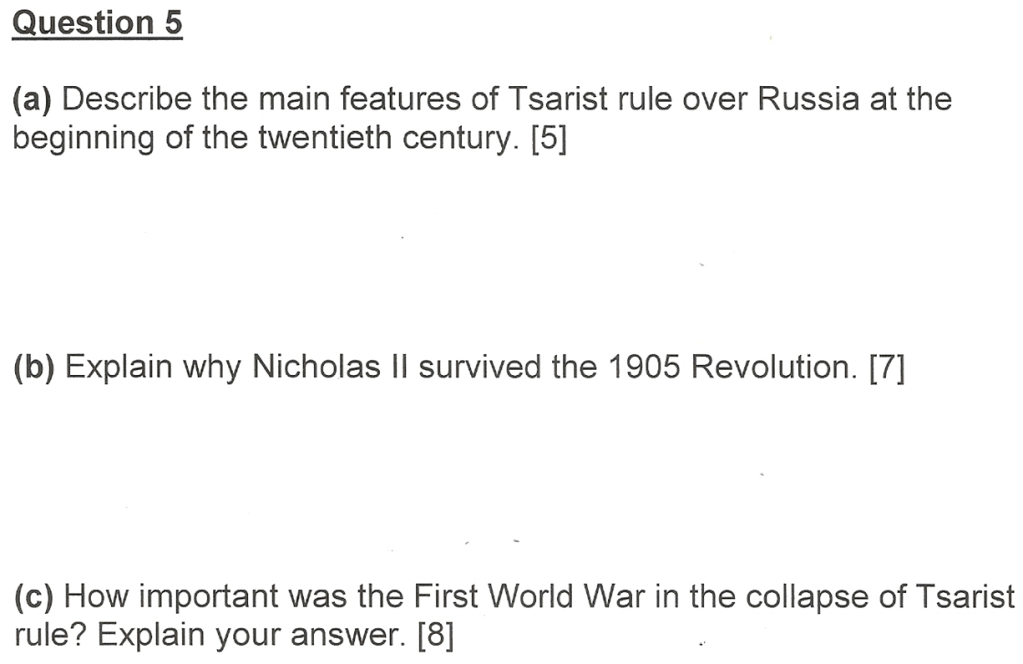
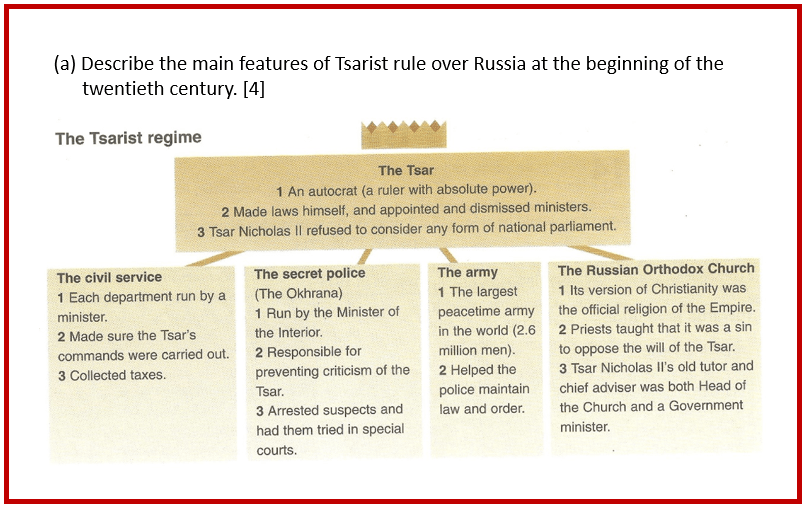
Describe the main features of Tsarist rule over Russia at the beginning of the twentieth century. [4]
Question 5 (b)
Explain why Nicholas II survived the 1905 Revolution? [6]

(It was made by students and may shed further light on how to answer this exam question.)
Exam Q on the 1905 Revolution. (2:23 minutes long)
And…
Exam Q on the 1905 Revolution. (2:22 minutes long)
And…
Exam Q on the 1905 Revolution. (2:27 minutes long)
Question 5 (c)
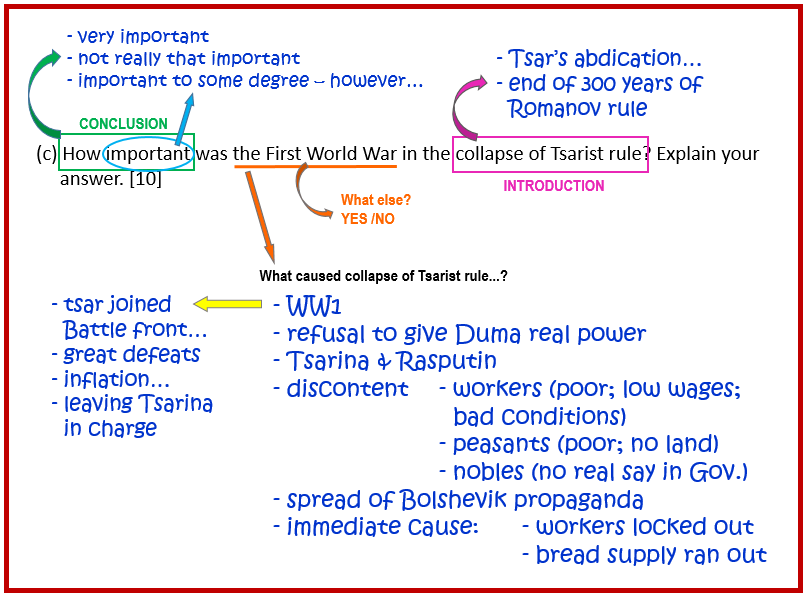
How important was the First World War in the collapse of Tsarist rule? Explain your answer. [10]
6.
Question 6
Question 6 (a)
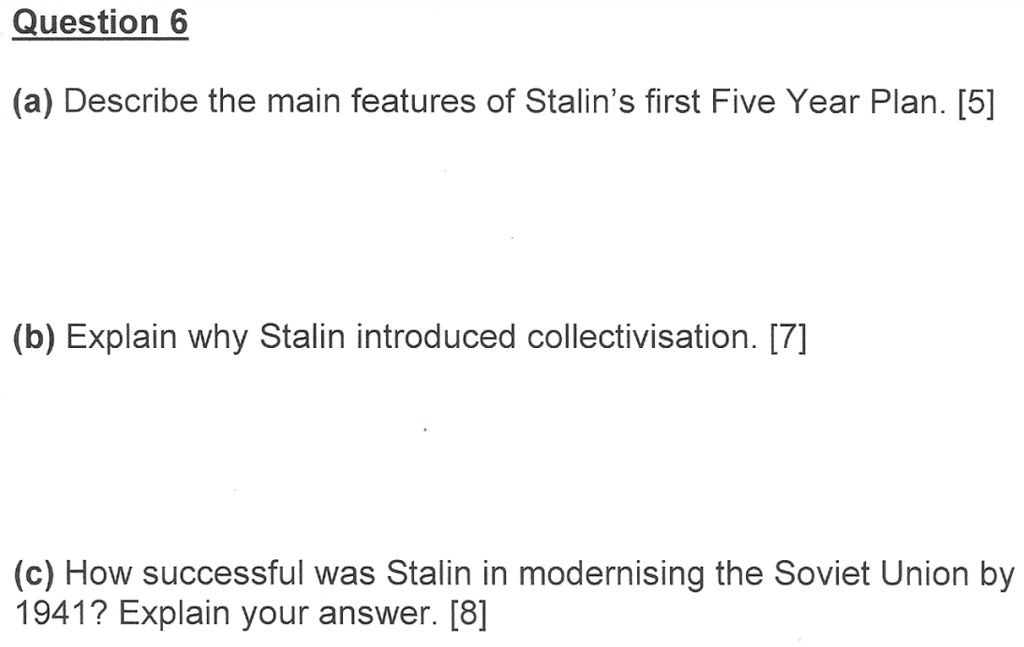
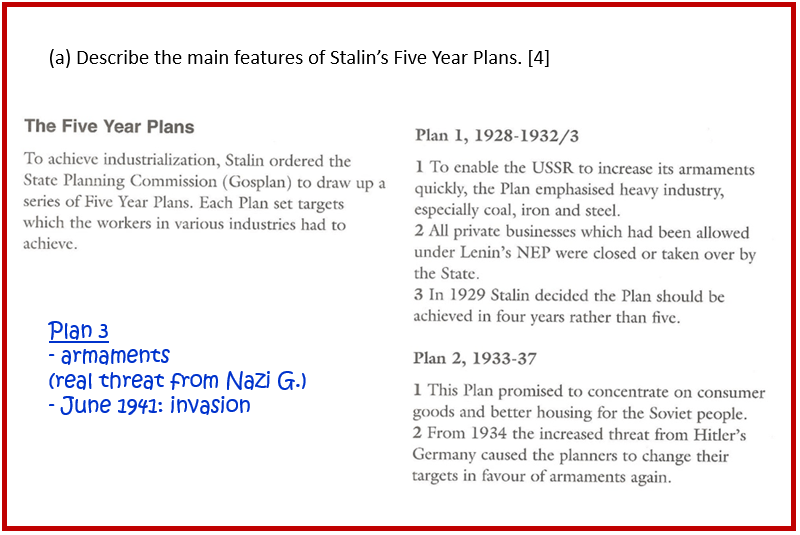
Describe the main features of Stalin’s Five Year Plans. [4]
Question 6 (b)
Explain why Stalin introduced collectivization. [6]
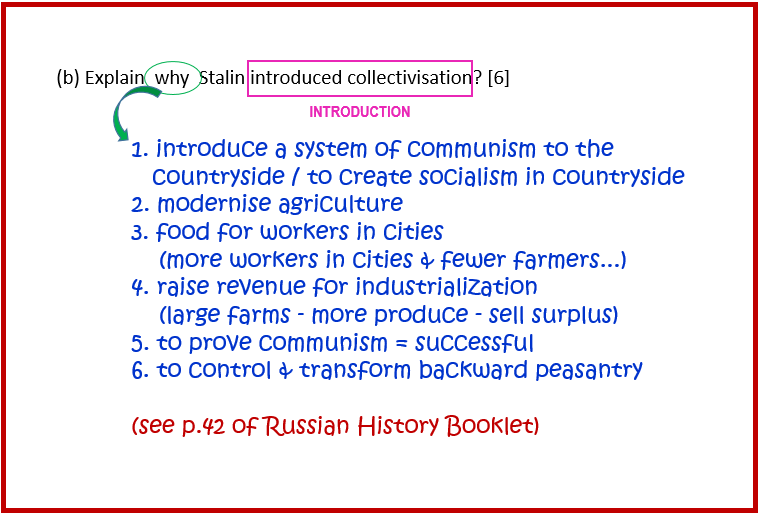
(It was made by students and may shed further light on how to answer this exam question.)
Exam Q on Collectivization. (3:28 minutes long)
Question 6 (c)
How successful was Stalin in modernising the Soviet Union by 1941? Explain your answer. [10]
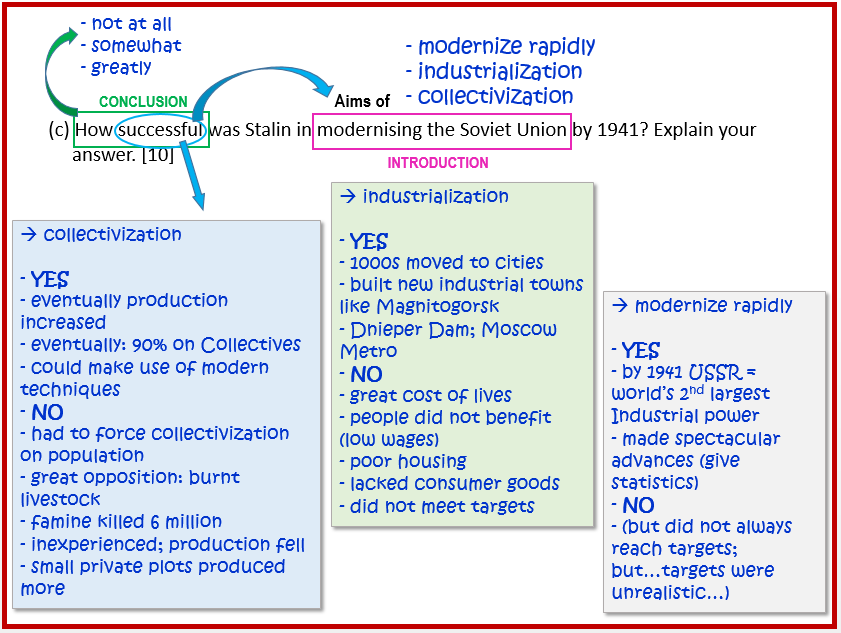
7.
Question 7
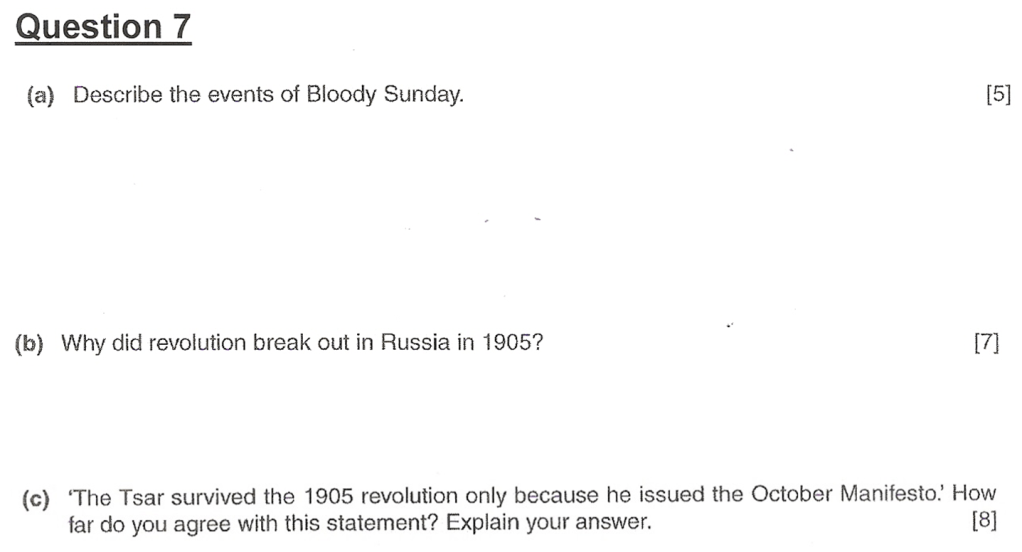
Question 7 (a)
Describe the events of Bloody Sunday. [4]
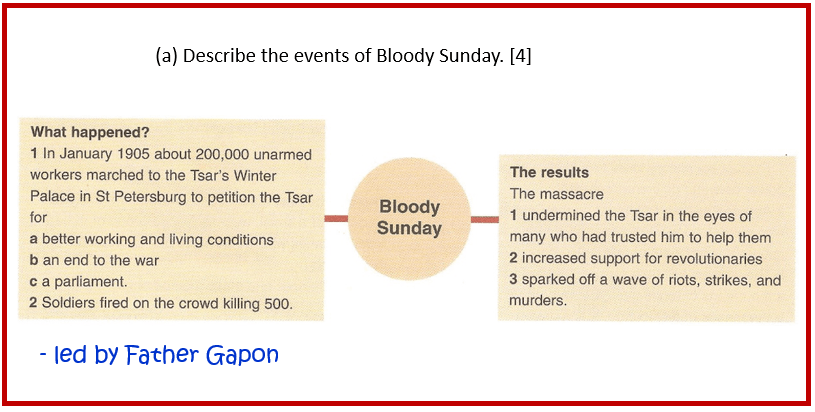
Question 7 (b)
Why did revolution break out in Russia in 1905? [6]

(It was made by students and may shed further light on how to answer this exam question.)
Exam Q on the 1905 Revolution. (3:21 minutes long)
Question 7 (c)
“The Tsar survived the 1905 revolution only because he issued the October Manifesto.” How far do you agree with this statement? Explain your answer. [10]
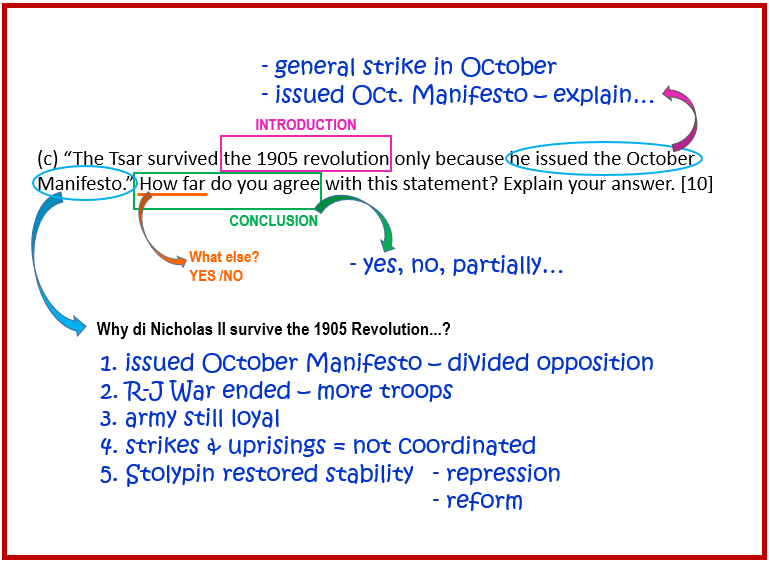
8.
Question 8
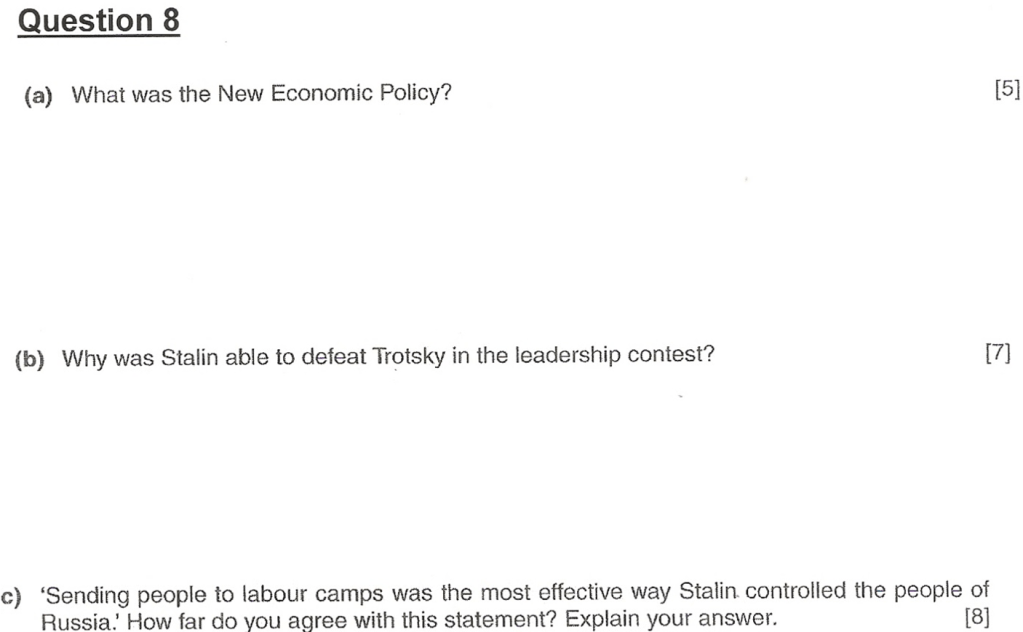
Question 8 (a)
What was the New Economic Policy? [4]

Question 8 (b)
Why was Stalin able to defeat Trotsky in the leadership contest? [6]

(It was made by students and may shed further light on how to answer this exam question.)
Exam Q on the Power Struggle. (2:20 minutes long)
Question 8 (c)
“Sending people to Labour Camps was the most effective way Stalin controlled the people of Russia.” How far do you agree with this statement? Explain your answer. [10]
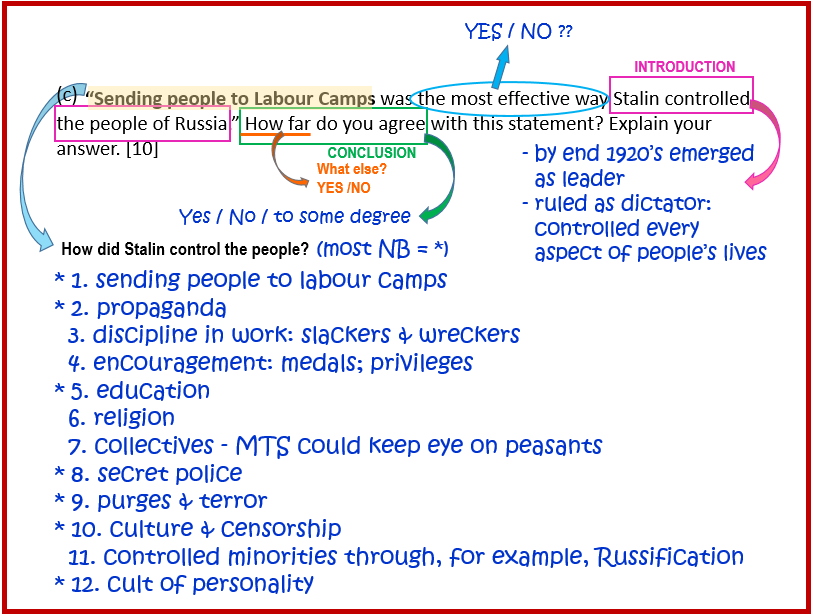
(WordPress advertisements may appear below.)

(WordPress advertisements may appear below.)
Today you are going to work on answering even more Paper 1 Exam Questions…!
We will use the following pages from your exam preparation Booklet:
1.

Question 5
SECTION A: CORE CONTENT
The Versailles Treaty created disagreement and hostility.
(a) What did Wilson hope to achieve from the peace settlement of 1919–20? [4]
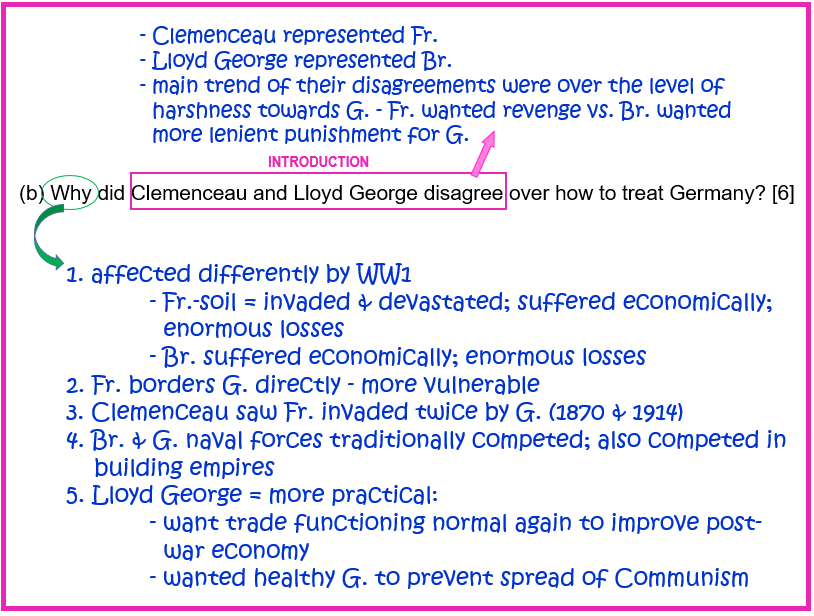
(b) Why did Clemenceau and Lloyd George disagree over how to treat Germany? [6]
(c) ‘The Treaty of Versailles was a fair settlement.’ How far do you agree with this statement? Explain your answer. [10]
Question 5 (a)
What did Wilson hope to achieve from the peace settlement of 1919–1920? [4]

Question 5 (b)
Why did Clemenceau and Lloyd George disagree over how to treat Germany? [6]
(It was made by students and may shed further light on how to answer this exam question.)
Exam Q on Big Three Disagreements. (2:03 minutes long)
Question 5 (c)
‘The Treaty of Versailles was a fair settlement.’ How far do you agree with this statement? Explain your answer. [10]

2.
Question 6
SECTION A: CORE CONTENT
Peace in Europe became increasingly threatened during the second half of the 1930’s.
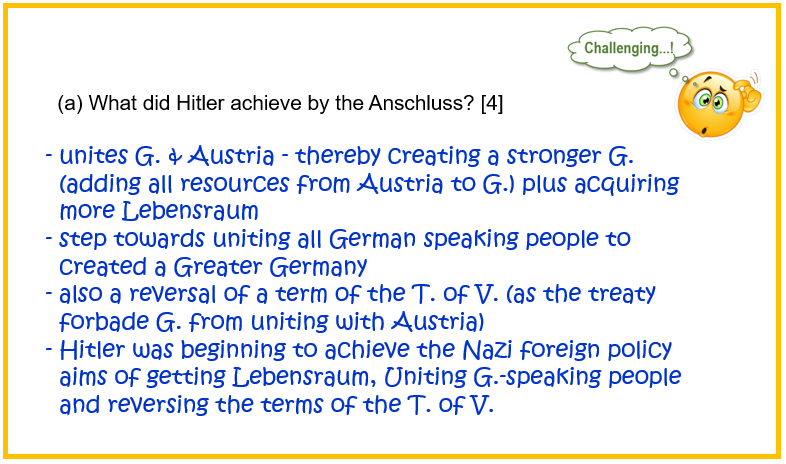
(a) What did Hitler achieve by the Anschluss? [4]
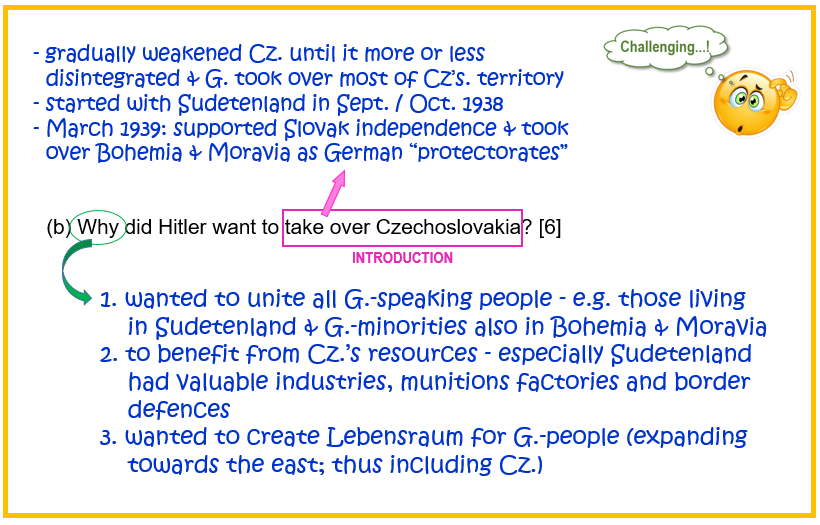
(b) Why did Hitler want to take over Czechoslovakia? [6]
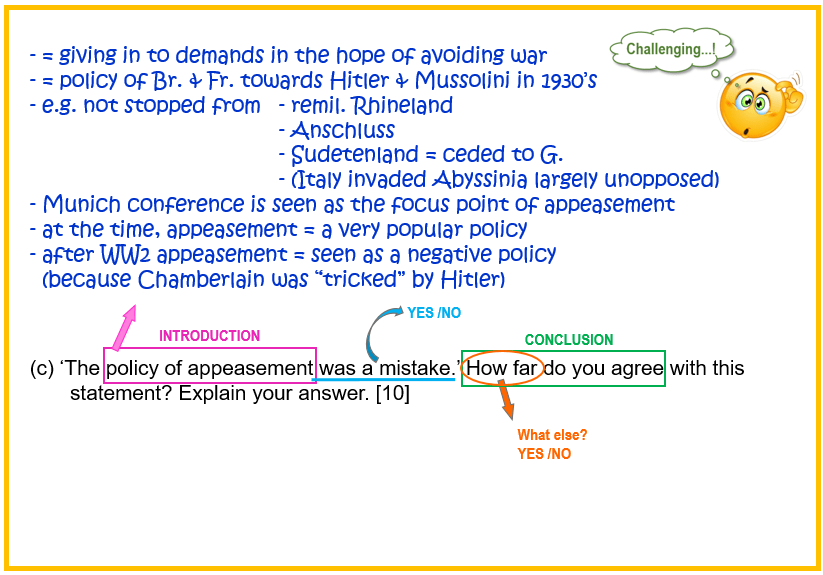
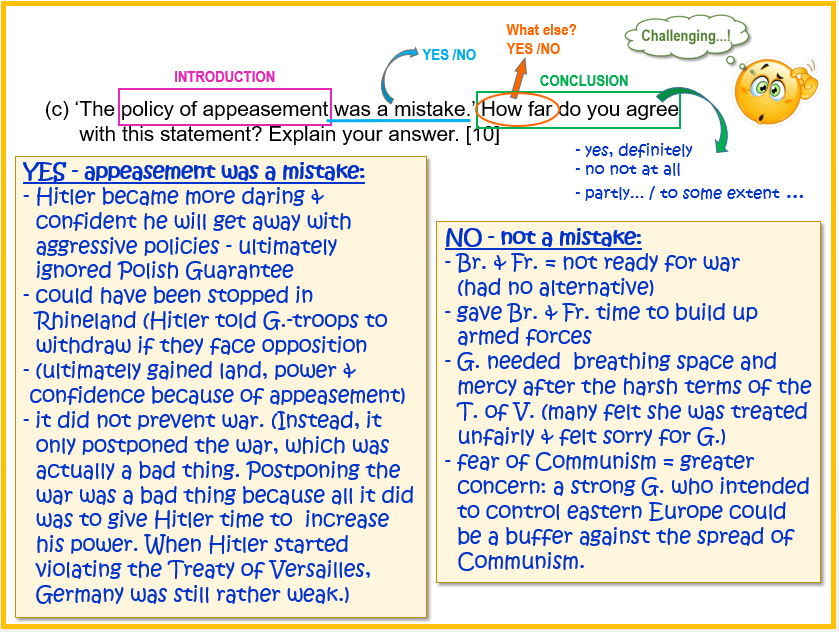
(c) ‘The policy of appeasement was a mistake.’ How far do you agree with this statement? Explain your answer. [10]
Question 6 (a)
What did Hitler achieve by the Anschluss? [4]
Question 6 (b)
Why did Hitler want to take over Czechoslovakia? [6]
Question 6 (c)
‘The policy of appeasement was a mistake.’ How far do you agree with this statement? Explain your answer. [10]
3.
Question 13
SECTION B: DEPTH STUDIES
There was pressure for change in Russia in the early years of the twentieth century.
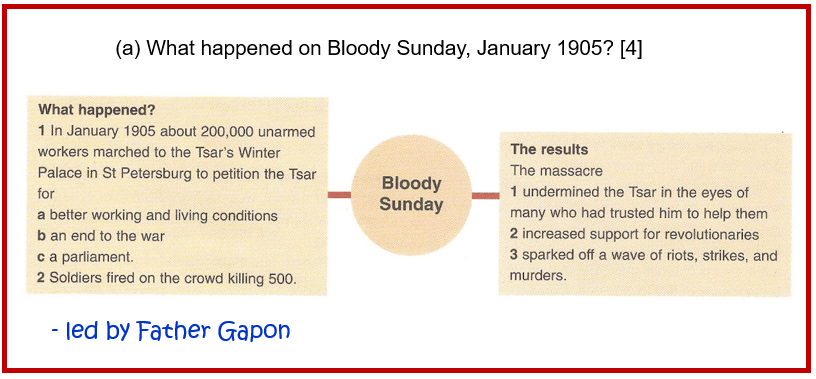
(a) What happened on Bloody Sunday, January 1905? [4]
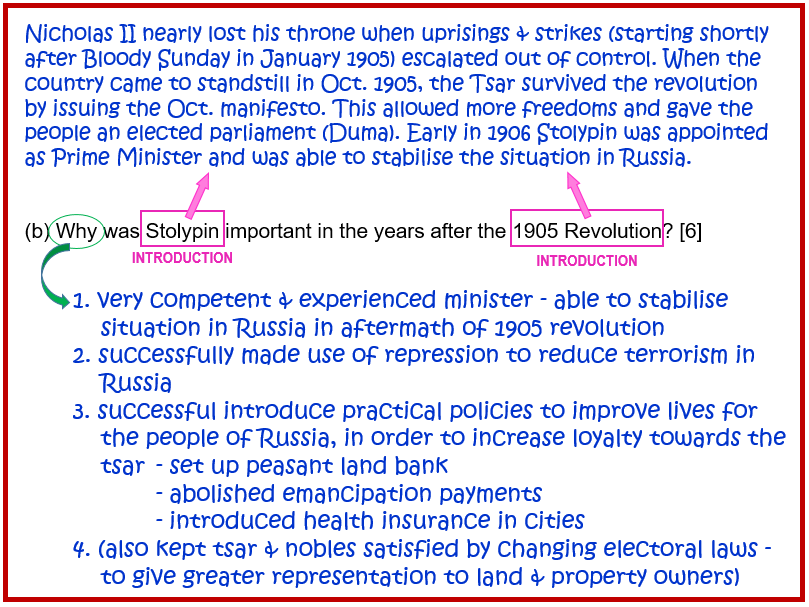
(b) Why was Stolypin important in the years after the 1905 Revolution? [6]
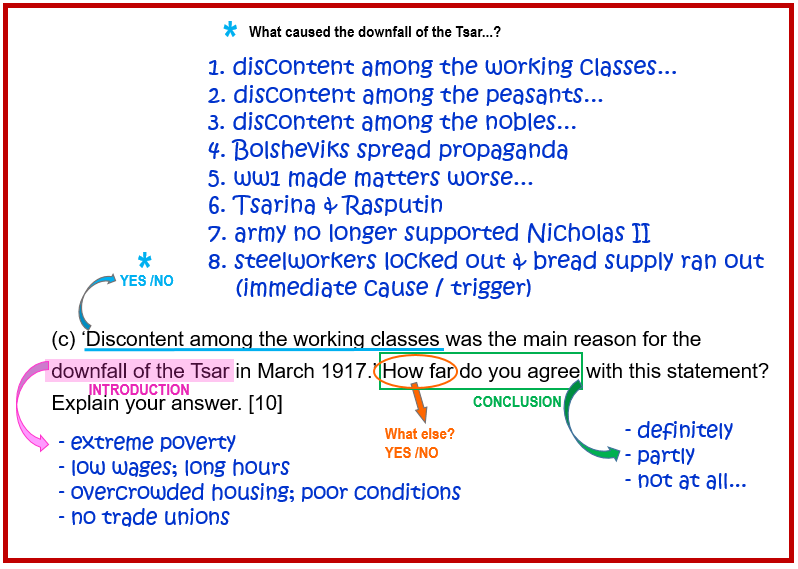
(c) ‘Discontent among the working classes was the main reason for the downfall of the Tsar in March 1917.’ How far do you agree with this statement? Explain your answer. [10]
Question 13 (a)
What happened on Bloody Sunday, January 1905? [4]
Question 13 (b)
Why was Stolypin important in the years after the 1905 Revolution? [6]
(It was made by students and may shed further light on how to answer this exam question.)
Exam Q on Stolypin. (2:50 minutes long)
Question 13 (c)
‘Discontent among the working classes was the main reason for the downfall of the Tsar in March 1917.’ How far do you agree with this statement? Explain your answer. [10]
4.
Question 14
SECTION B: DEPTH STUDIES
By 1929 Stalin was the supreme leader of the USSR.
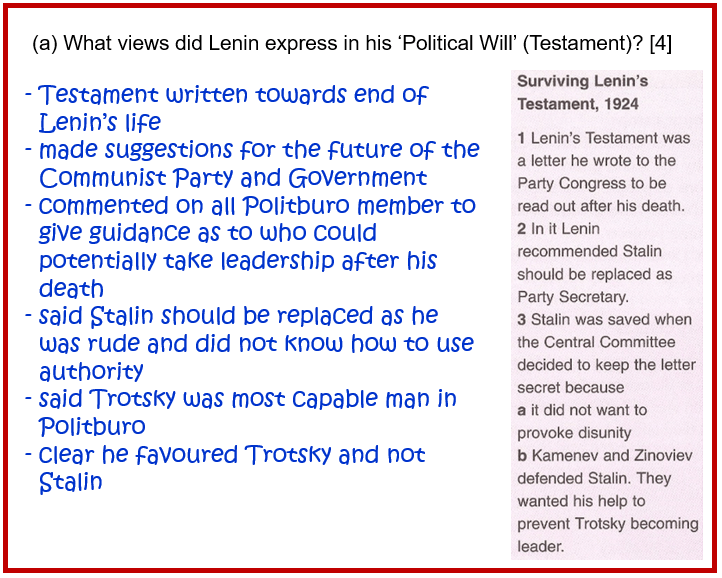
(a) What views did Lenin express in his ‘Political Will’ (Testament)? [4]
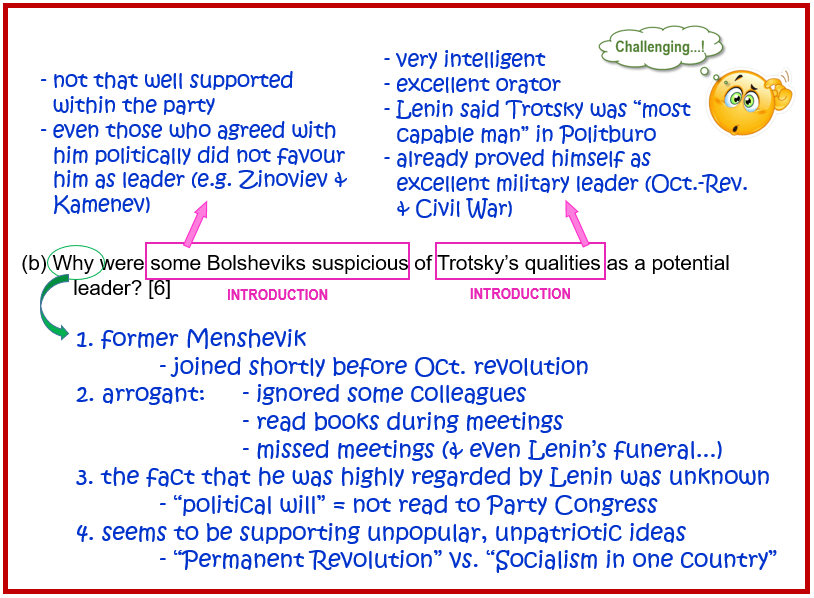
(b) Why were some Bolsheviks suspicious of Trotsky’s qualities as a potential leader? [6]
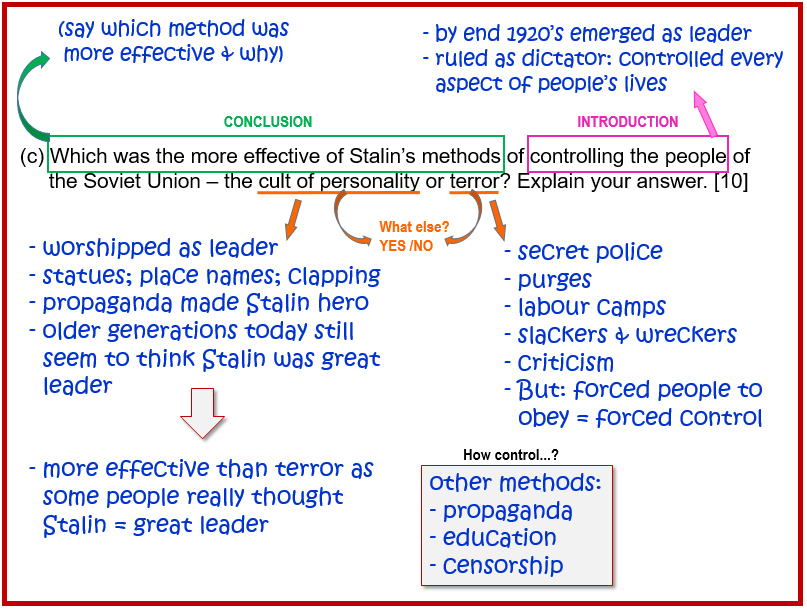
(c) Which was the more effective of Stalin’s methods of controlling the people of the Soviet Union – the cult of personality or terror? Explain your answer. [10]
Question 14 (a)
What views did Lenin express in his ‘Political Will’ (Testament)? [4]
Question 14 (b)
Why were some Bolsheviks suspicious of Trotsky’s qualities as a potential leader? [6]
Question 14 (c)
Which was the more effective of Stalin’s methods of controlling the people of the Soviet Union – the cult of personality or terror? Explain your answer. [10]
5.

Question 1
Question 1 (a)
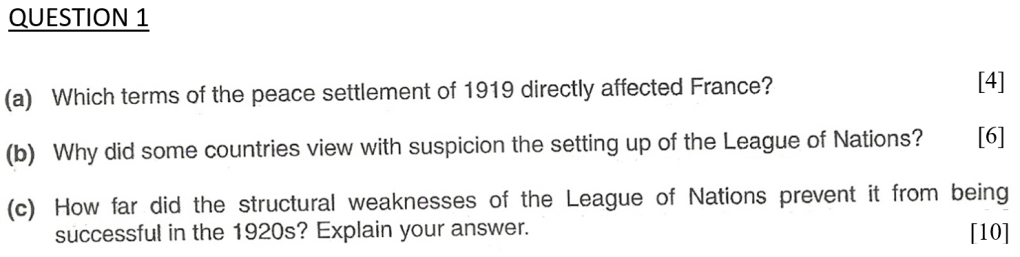
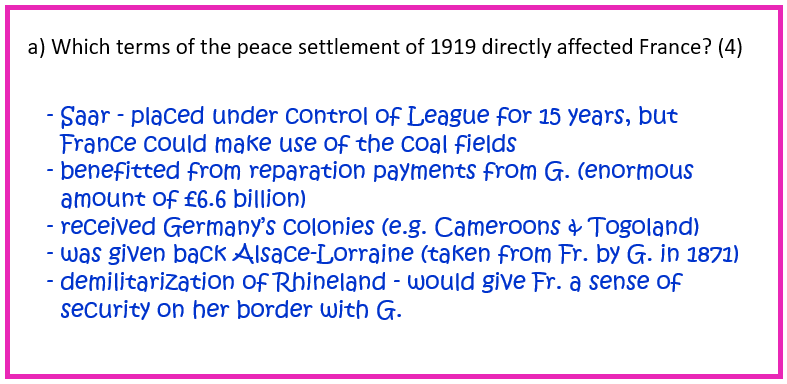
Which terms of the peace settlement of 1919 directly affected France? [4]
Question 1 (b)
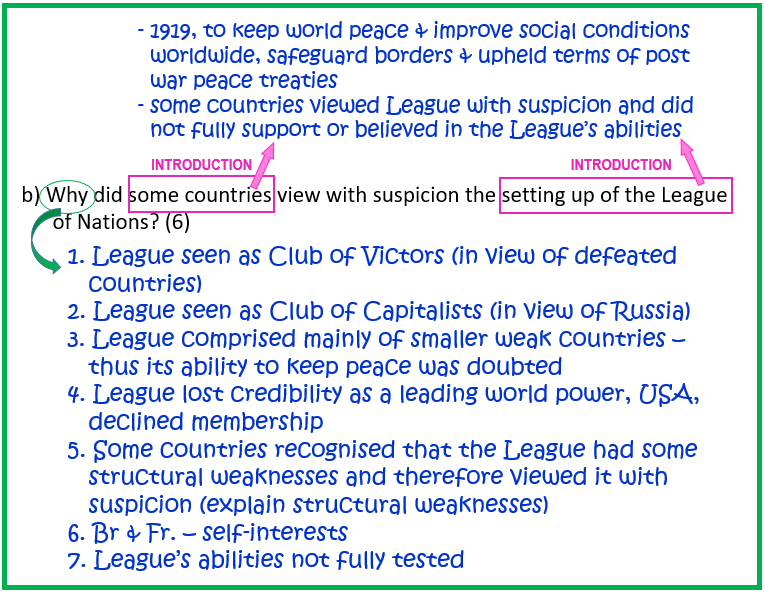
Why did some countries view with suspicion the setting up of the League of Nations? [6]
(It was made by students and may shed further light on how to answer this exam question.)
Exam Q on League of Nations. (1:52 minutes long)
Question 1 (c)
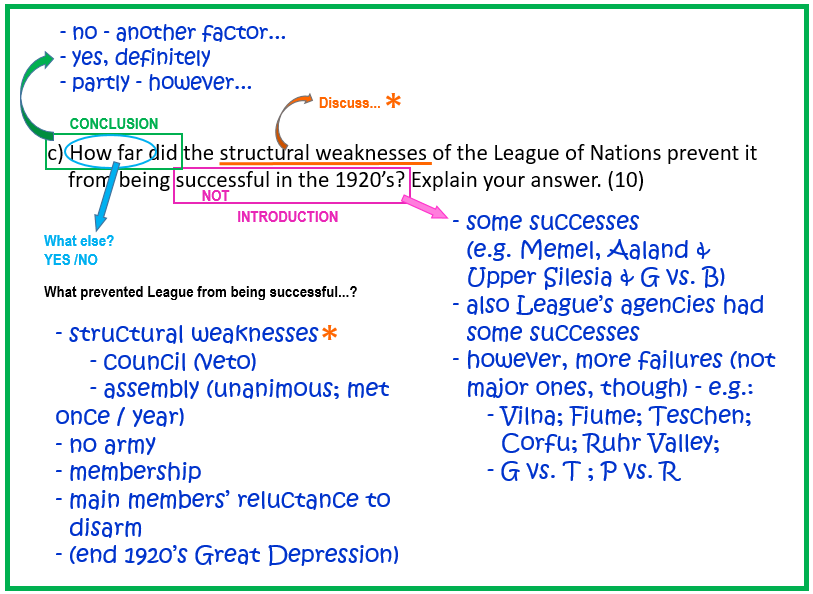
How far did the structural weaknesses of the League of Nations prevent it from being successful in the 1920’s? Explain your answer. [10]
6.
Question 2
Question 2 (a)
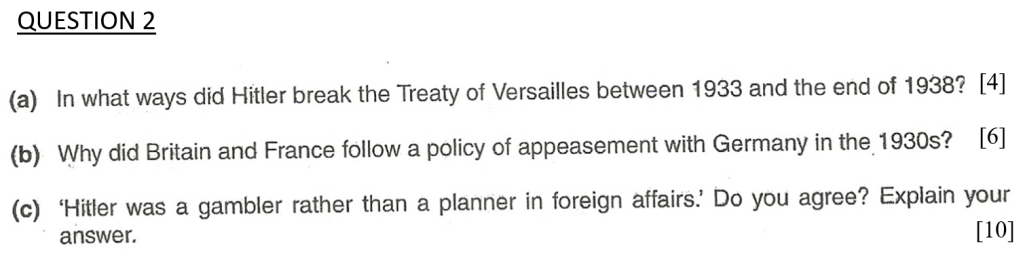
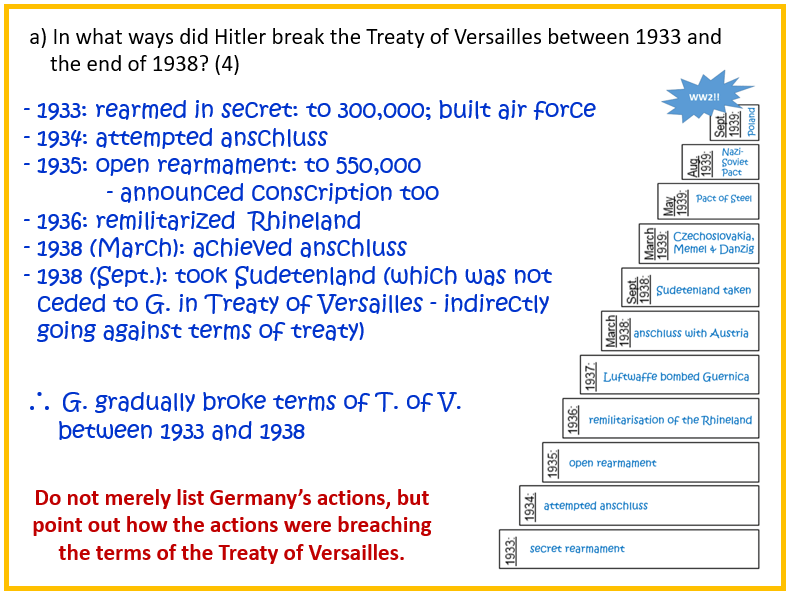
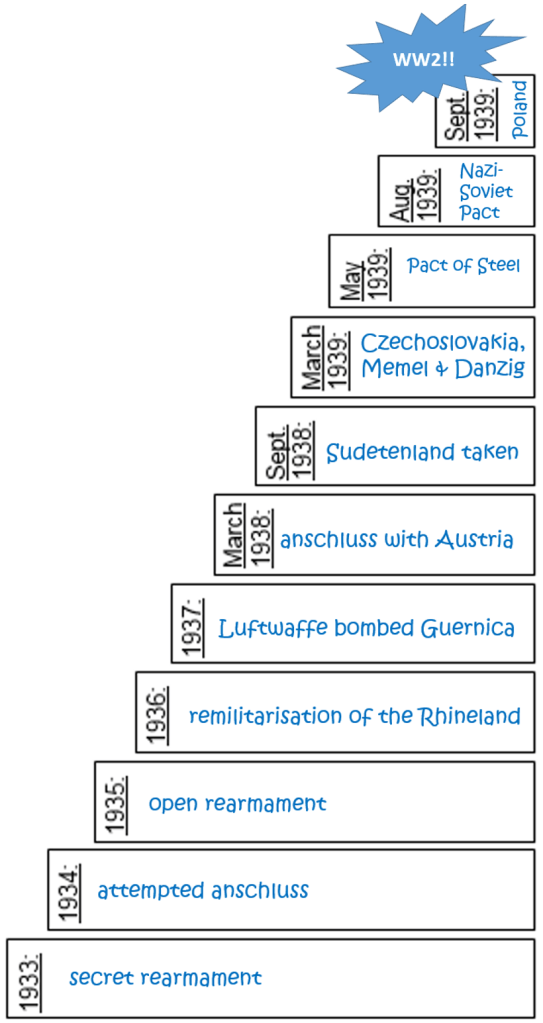
In what ways did Hitler break the Treaty of Versailles between 1933 and the end of 1938? [4]
Question 2 (b)
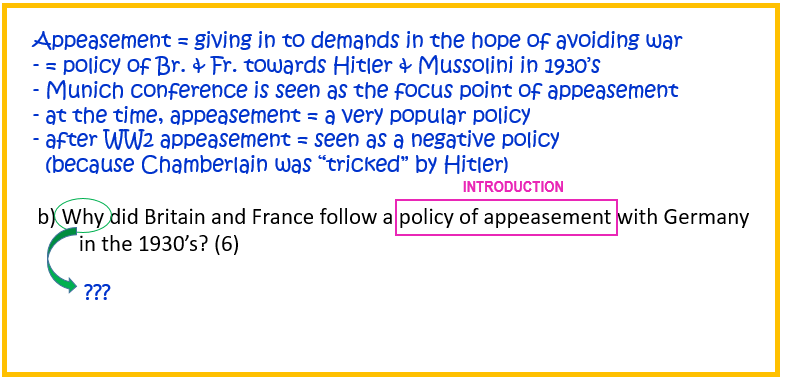
Why did Britain and France follow a policy of appeasement with Germany in the 1930’s? [6]

(It was made by students and may shed further light on how to answer this exam question.)
Exam Q on Appeasement (I). (1:45 minutes long)
(It was made by students and may shed further light on how to answer this exam question.)
Exam Q on Appeasement (II). (3:11 minutes long)
Question 2 (c)
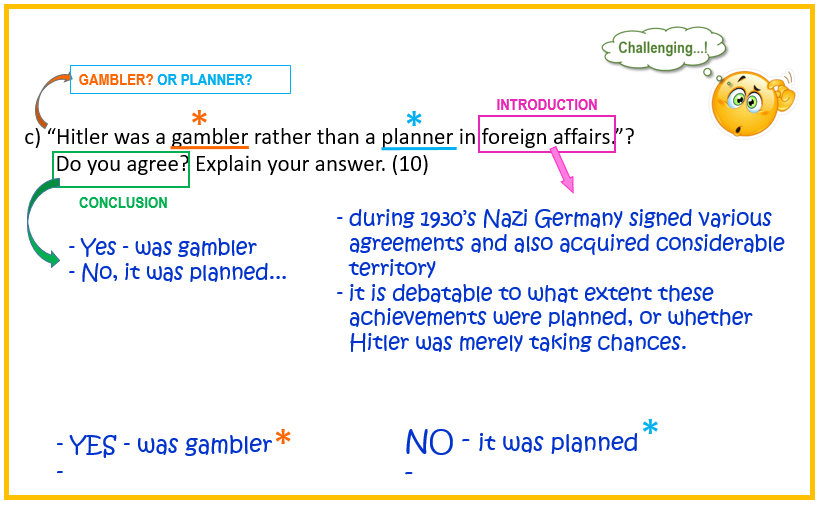
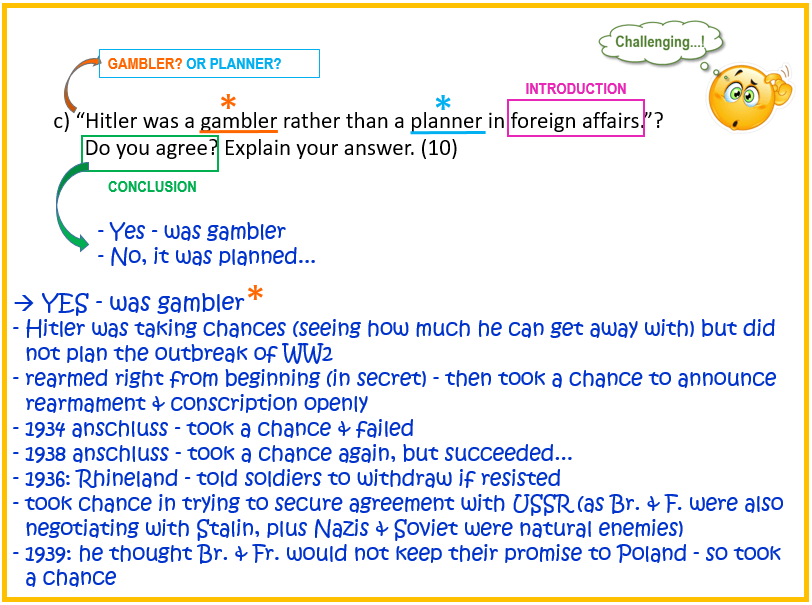
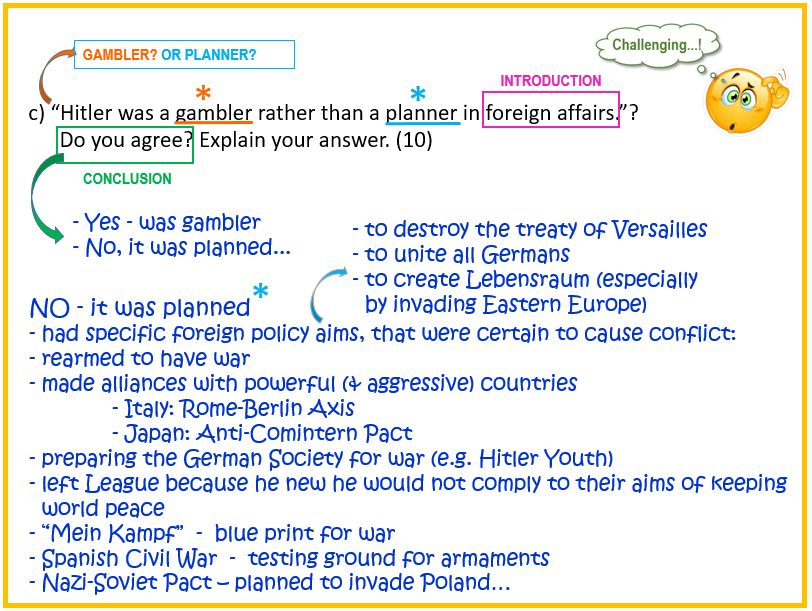
“Hitler was a gambler rather than a planner in foreign affairs.” Do you agree? Explain your answer. [10]
7.
Question 3
Question 3 (a)
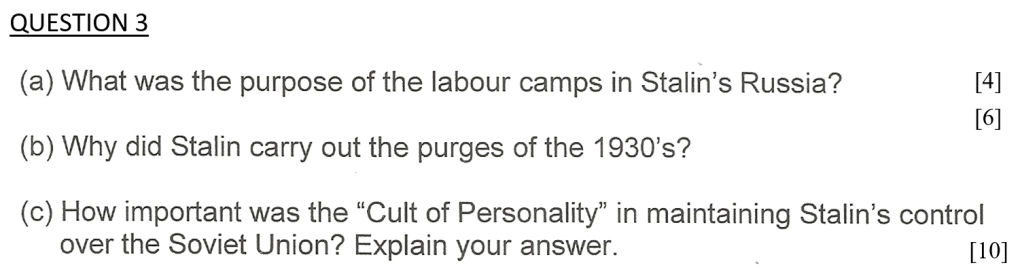
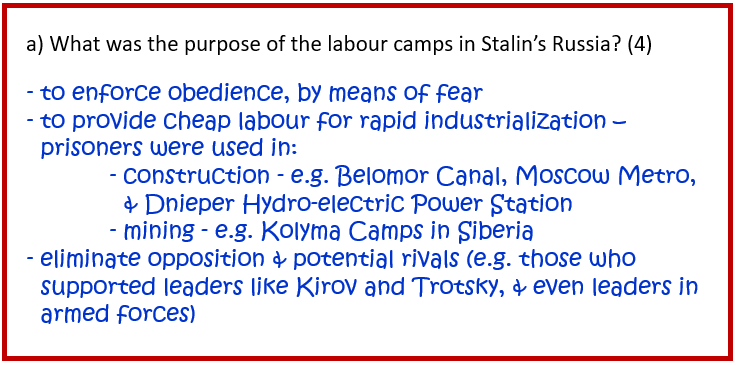
What was the purpose of the labour camps in Stalin’s Russia? [4]
Question 3 (b)
Why did Stalin carry out the purges of the 1930’s? [6]
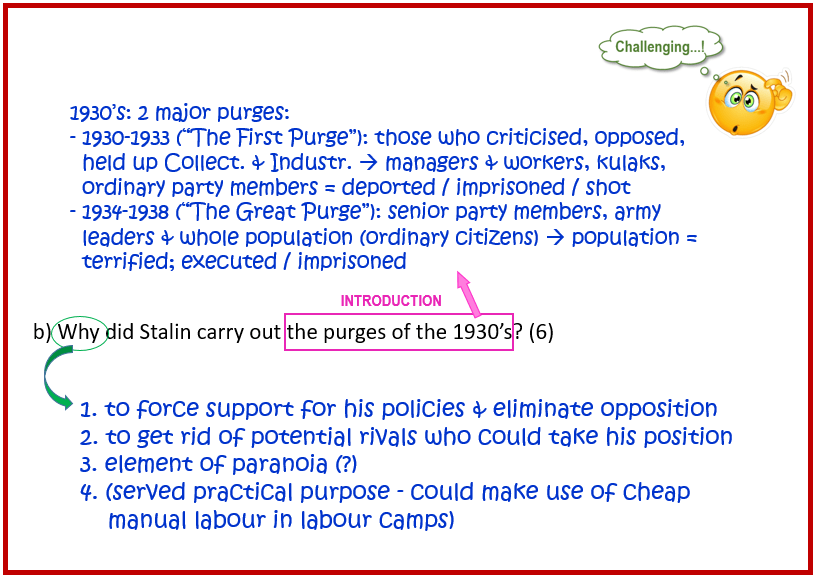
(It was made by students and may shed further light on how to answer this exam question.)
Exam Q on the Purges. (2:09 minutes long)
Question 3 (c)
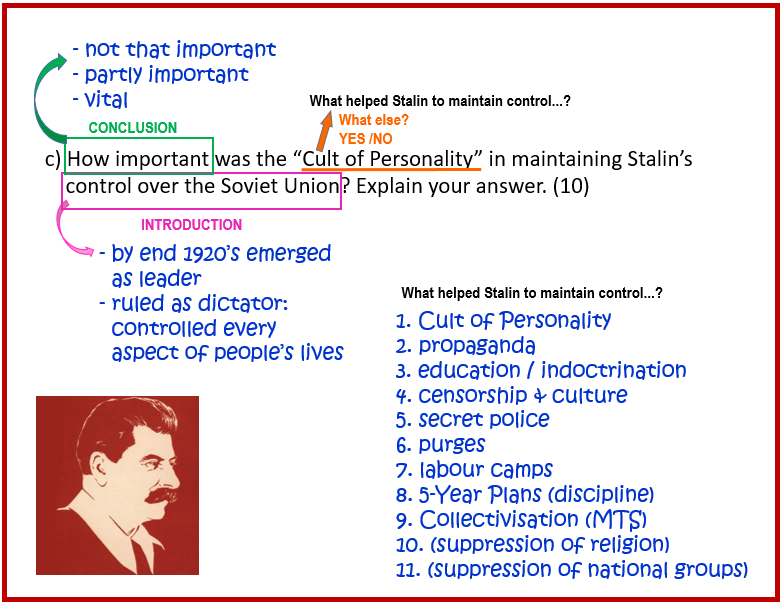
How important was the “Cult of Personality” in maintaining Stalin’s control over the Soviet Union? Explain your answer. [10]
8.
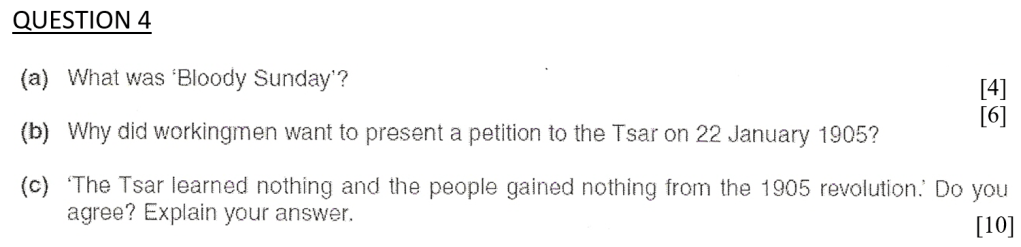
Question 4
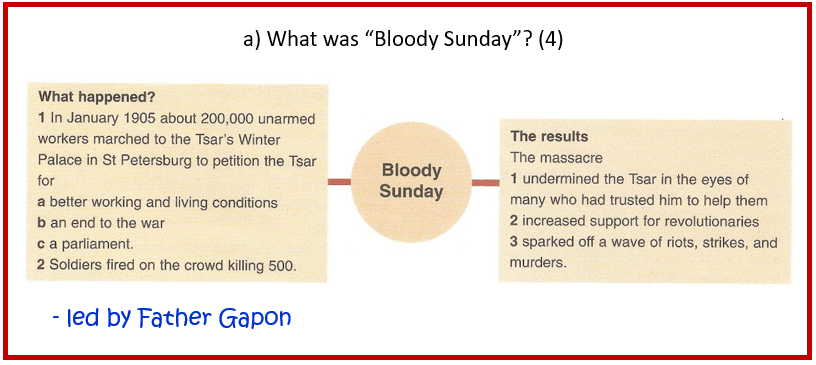
Question 4 (a)
What was “Bloody Sunday”? [4]
Question 4 (b)
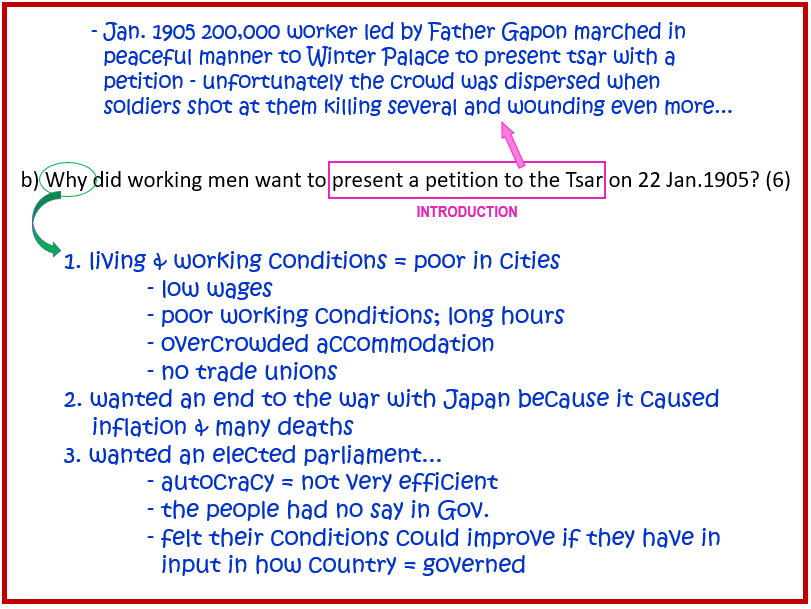
Why did workmen want to present a petition to the Tsar on 22 January 1905? [6]
Question 4 (c)
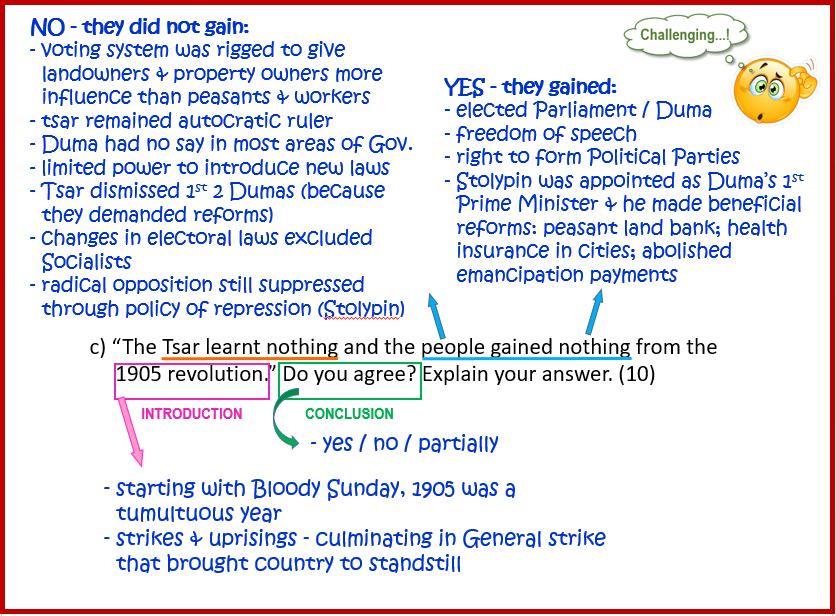
“The Tsar learnt nothing and the people gained nothing from the 1905 Revolution.” Do you agree? Explain your answer. [10]

9.
Question 5

Question 5 (a)
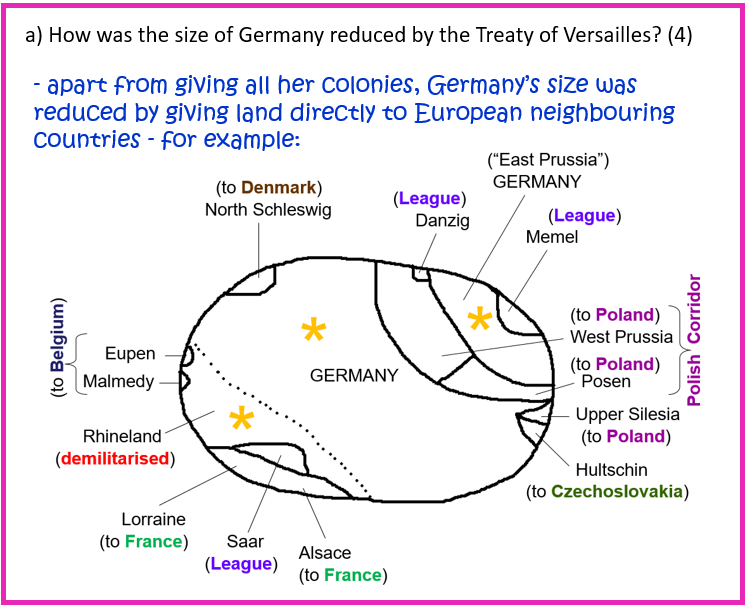
How was the size of Germany reduced by the Treaty of Versailles? [4]
Question 5 (b)
Why were all of Germany’s overseas colonies taken from her in 1919? [6]
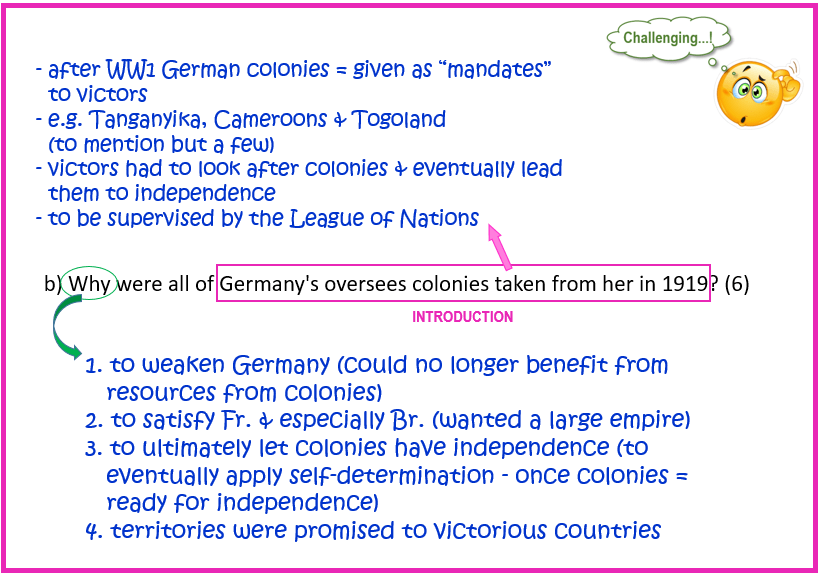
Question 5 (c)
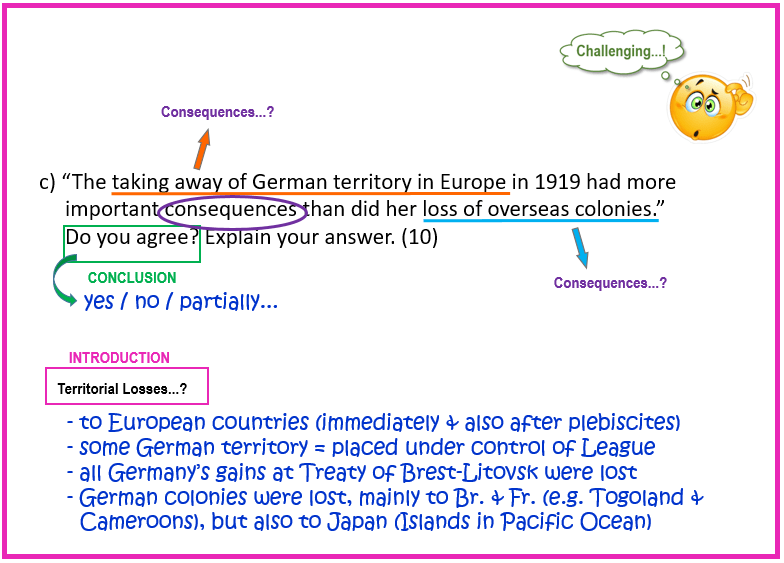
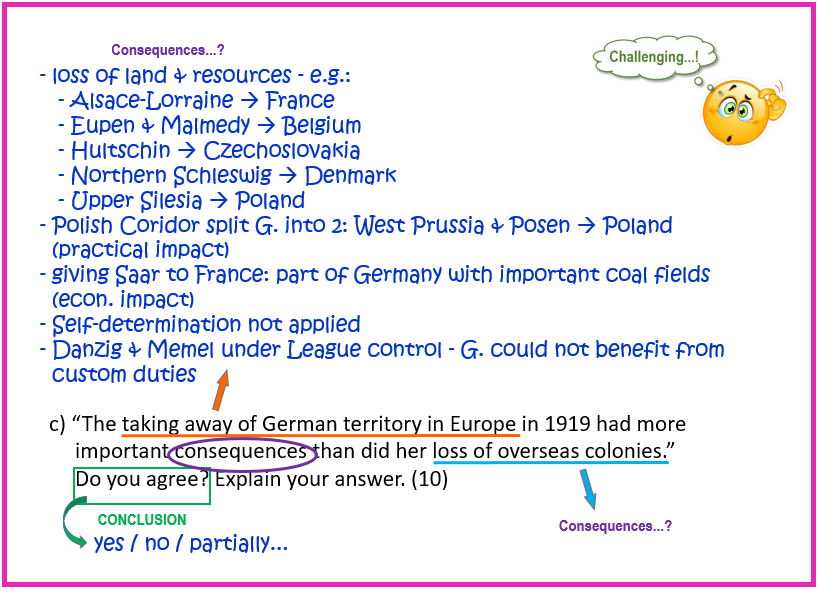
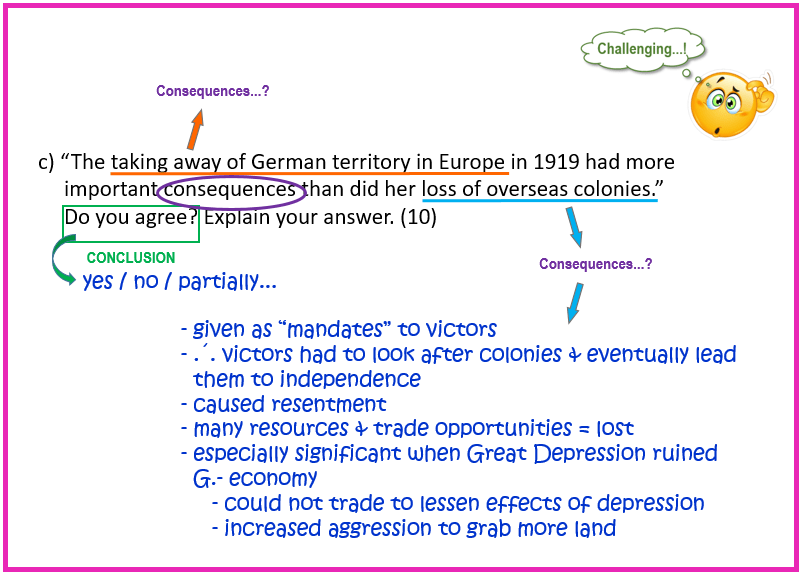
“The taking away of German territory in Europe in 1919 had more important consequences than did her loss of overseas colonies.” Do you agree? Explain your answer fully. [10]
10.
Question 6
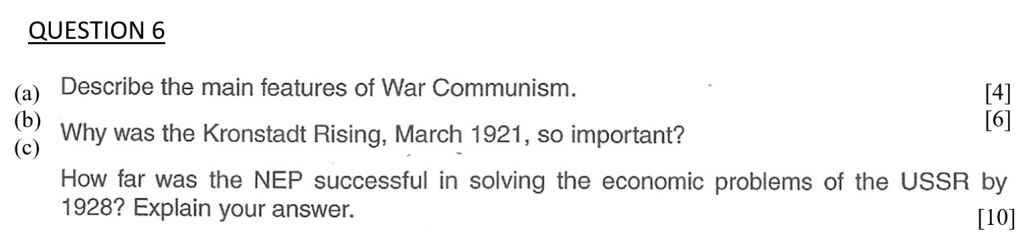
Question 6 (a)
Describe the main features of War Communism. [4]
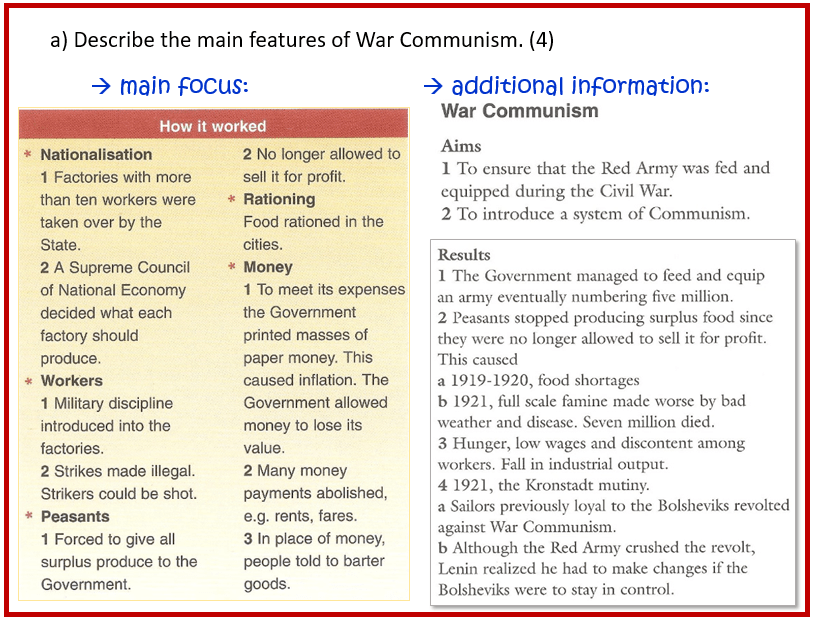
Question 6 (b)
Why was the Kronstadt Rising, March 1921, so important? [6]
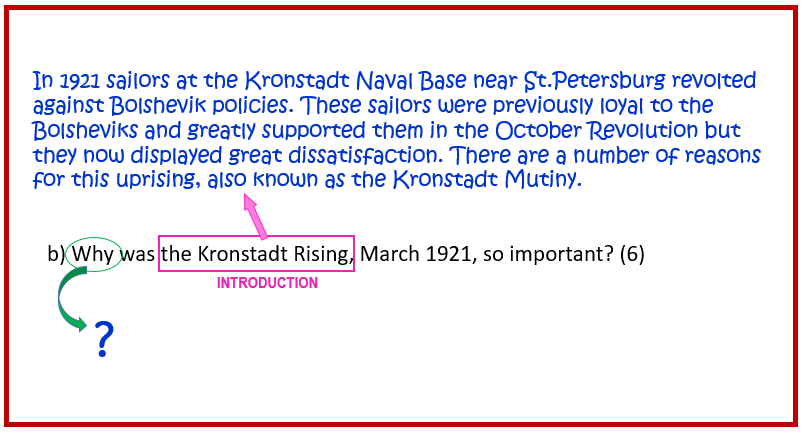
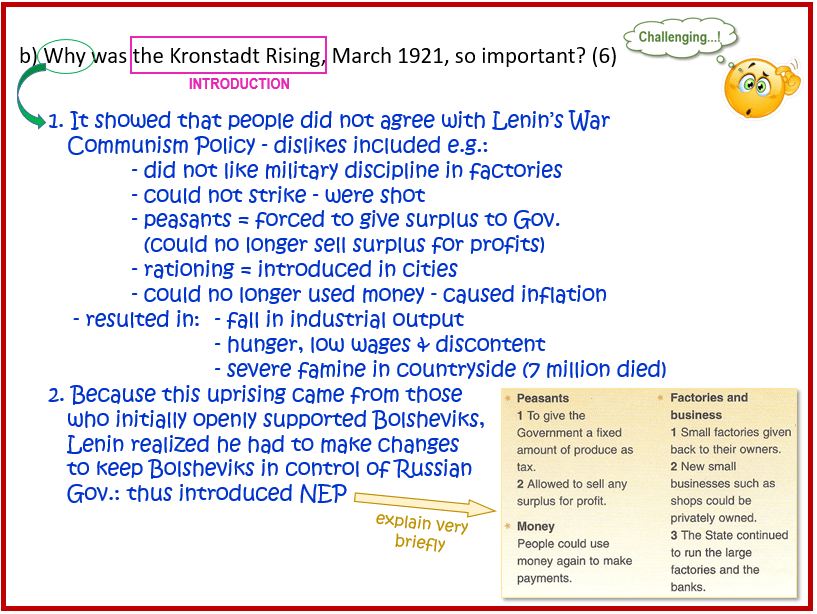
Question 6 (c)
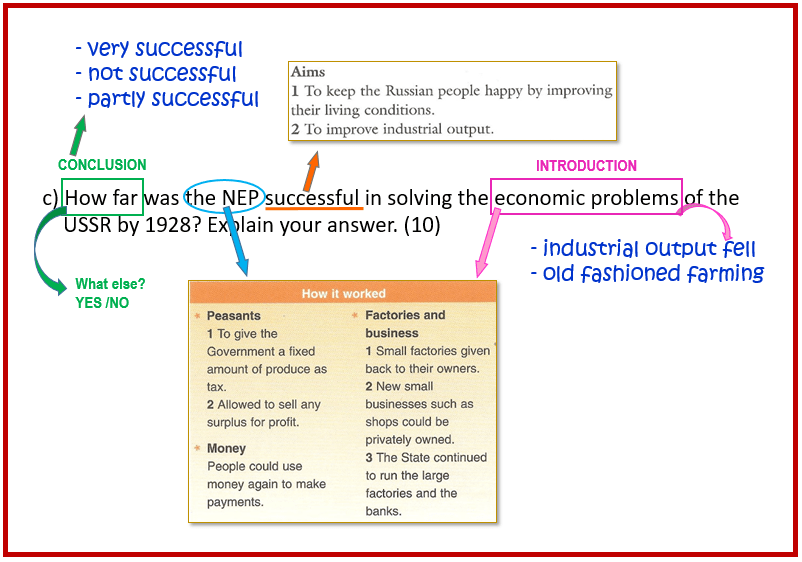
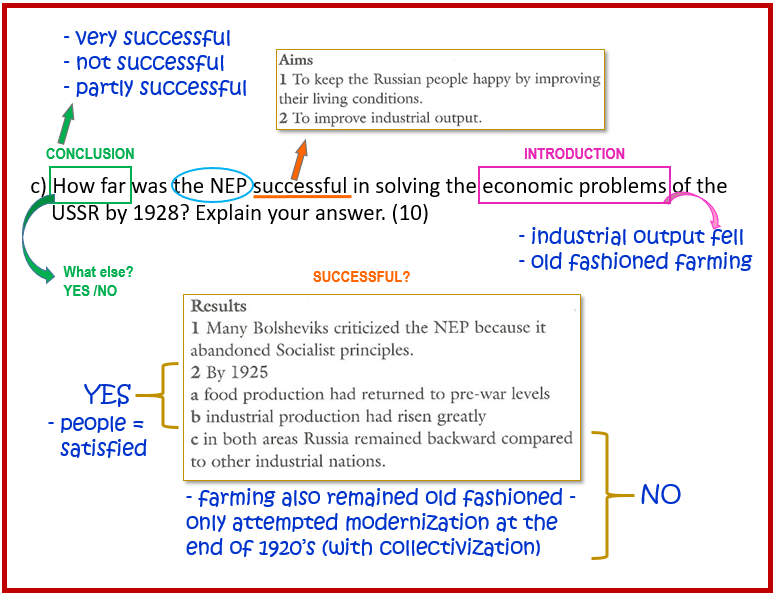
How far was the NEP successful in solving the economic problems of the USSR by 1928? Explain your answer. [10]
(WordPress advertisements may appear below.)
Today you are going to work on answering even more Paper 1 Exam Questions…!
We will use the following pages from your exam preparation Booklet:
1.
Page 43 – Question 5
20th CENTURY EUROPEAN HISTORY
The League of Nations’ ability to keep peace was seriously tested when Japan invaded Manchuria in the early 1930’s.
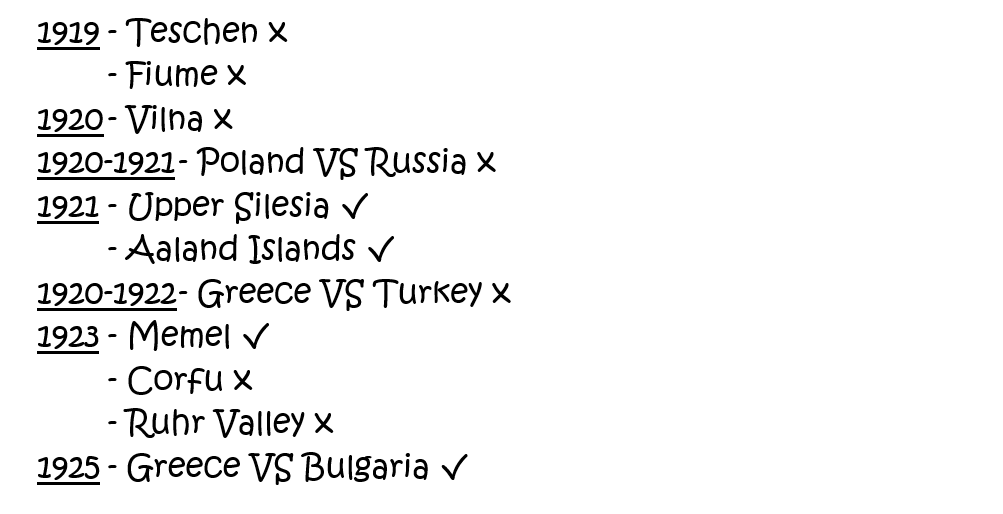
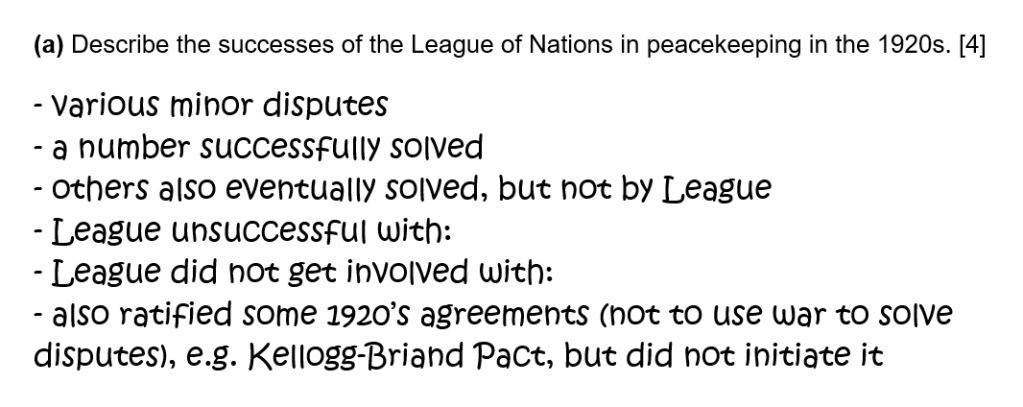
(a) Describe the successes of the League of Nations in peacekeeping in the 1920’s. [4]
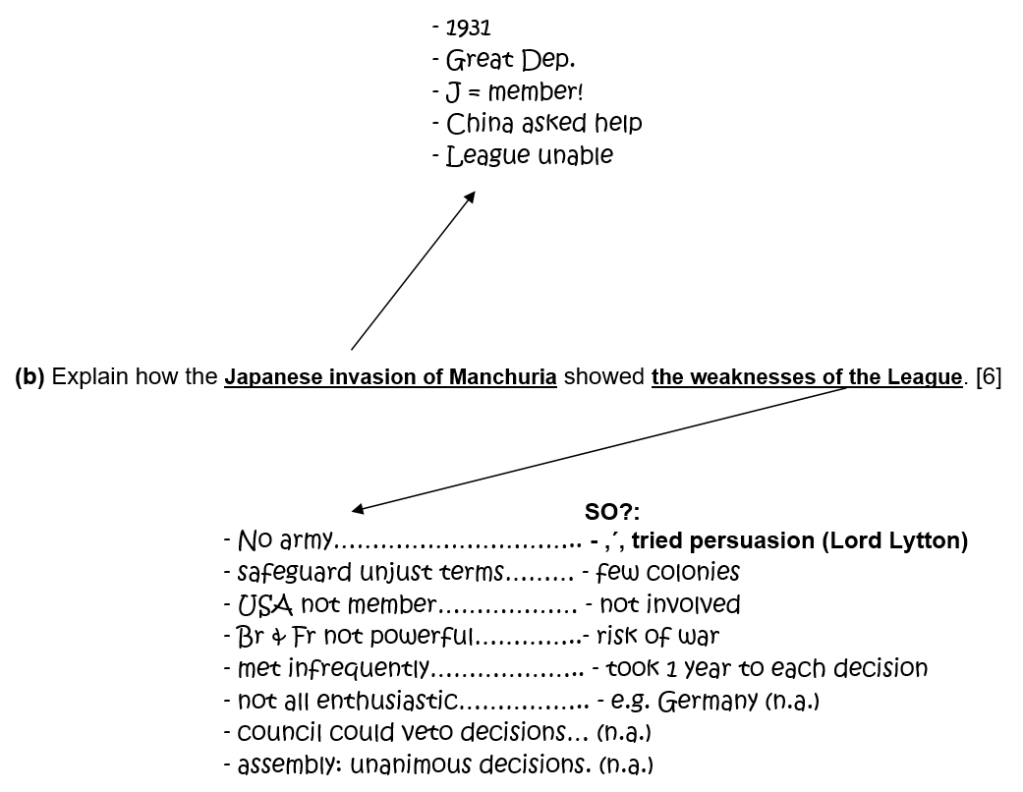
(b) Explain how the Japanese invasion of Manchuria showed the weaknesses of the League. [6]
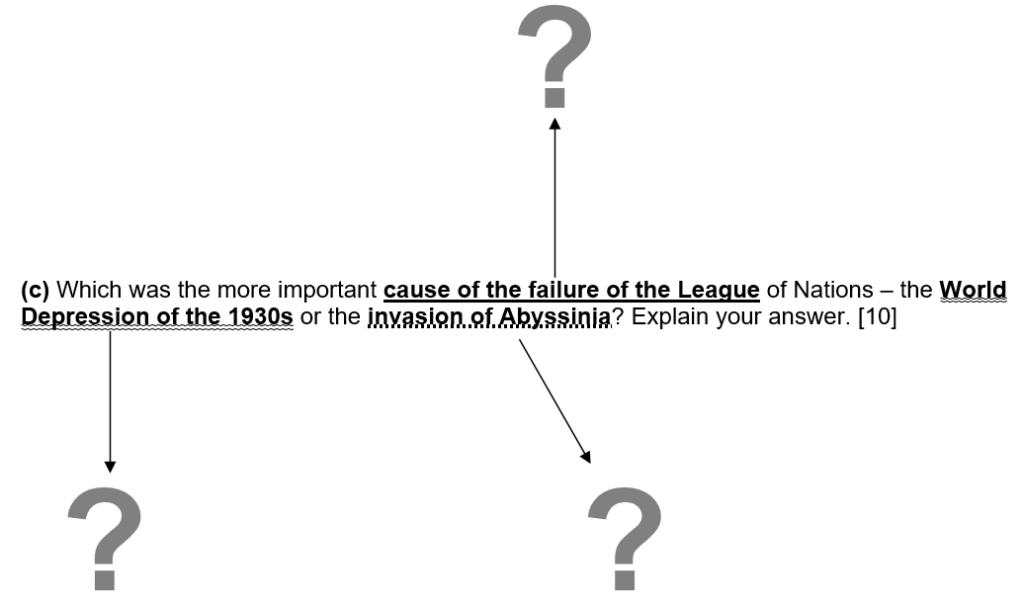
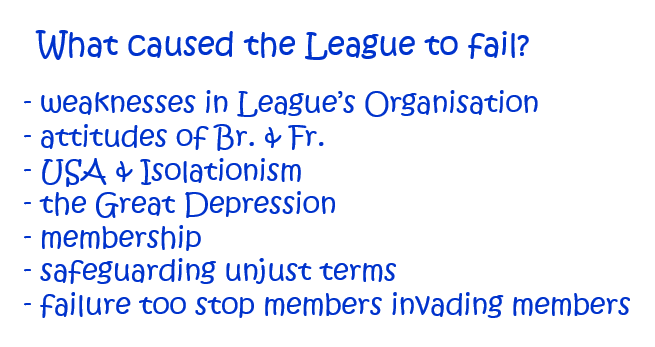
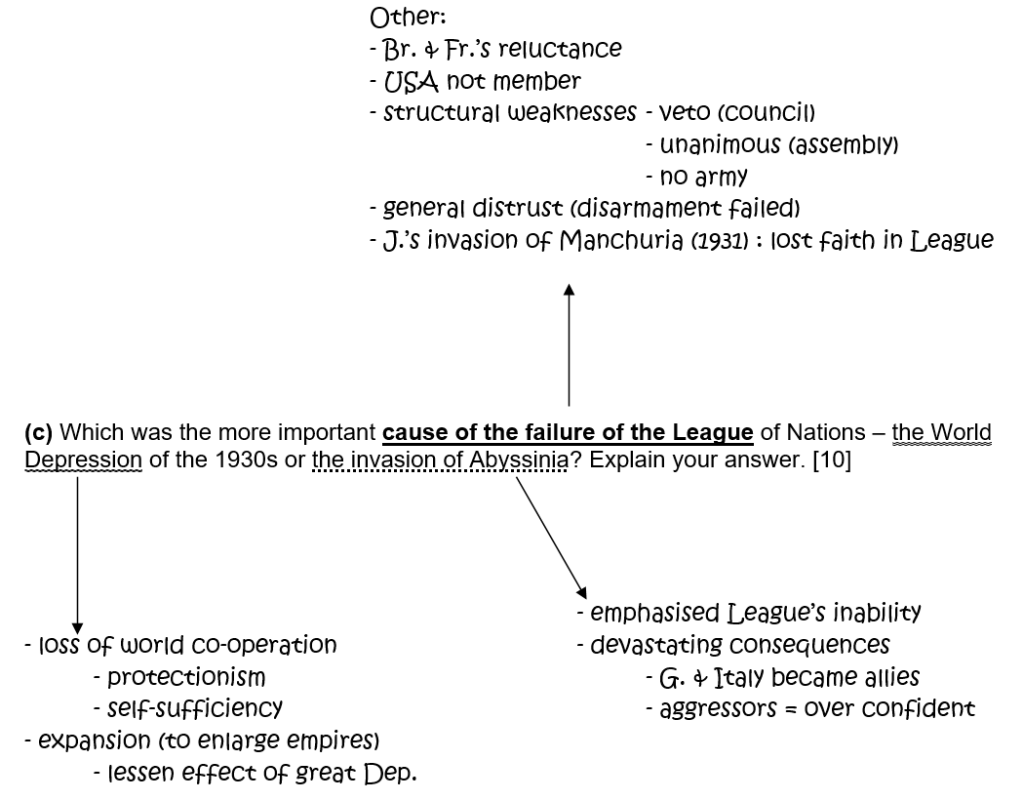
(c) Which was the more important cause of the failure of the League of Nations – the World Depression of the 1930’s or the invasion of Abyssinia? Explain your answer. [10]
Question 5 (a)
(a) Describe the successes of the League of Nations in peacekeeping in the 1920s. [4]
Question 5 (b)
(b) Explain how the Japanese invasion of Manchuria showed the weaknesses of the League. [6]
Question 5 (c)
(c) Which was the more important cause of the failure of the League of Nations – the World Depression of the 1930s or the invasion of Abyssinia? Explain your answer. [10]
2.
Page 43 – Question 6
20th CENTURY EUROPEAN HISTORY
The relationship between the Soviet Union and Nazi Germany took an unexpected turn shortly before the outbreak of the Second World War.
(a) What was agreed at the Munich Conference of September 1938? [4]
(b) Why was the Nazi-Soviet Pact of August 1939 important? [6]
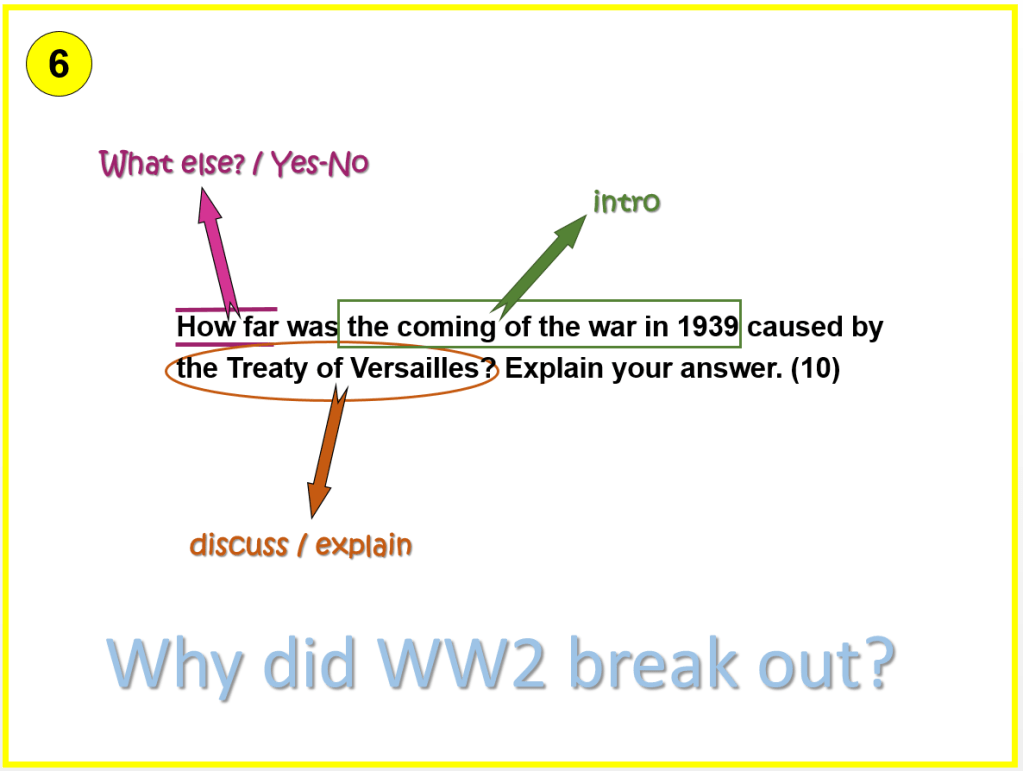
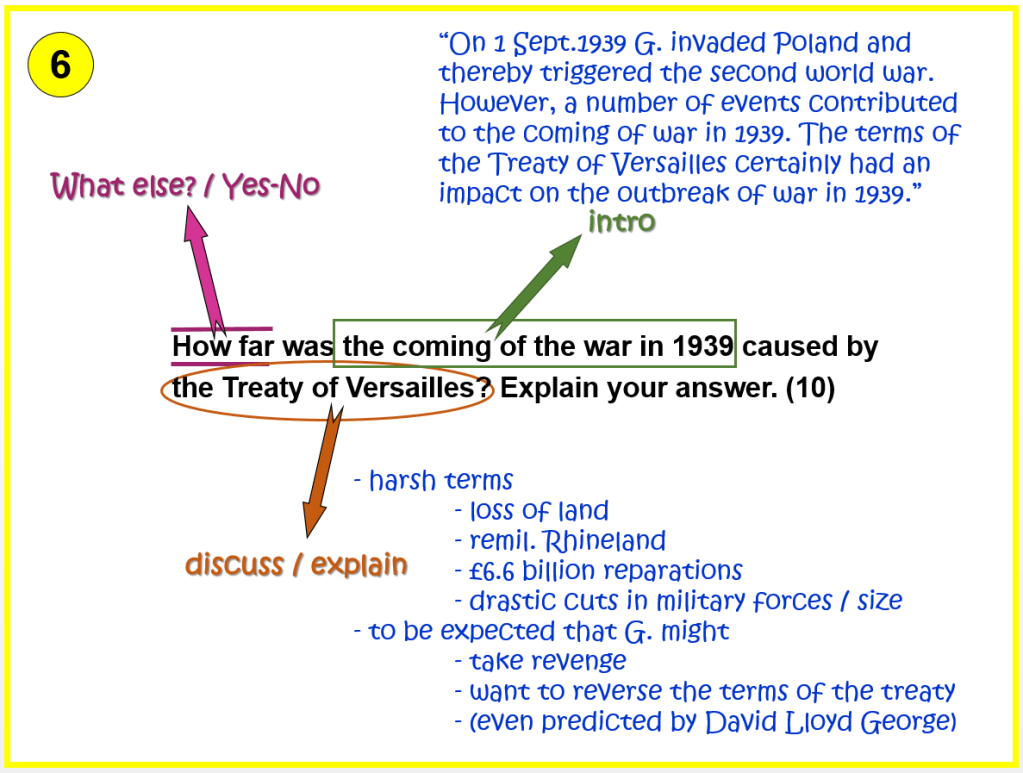
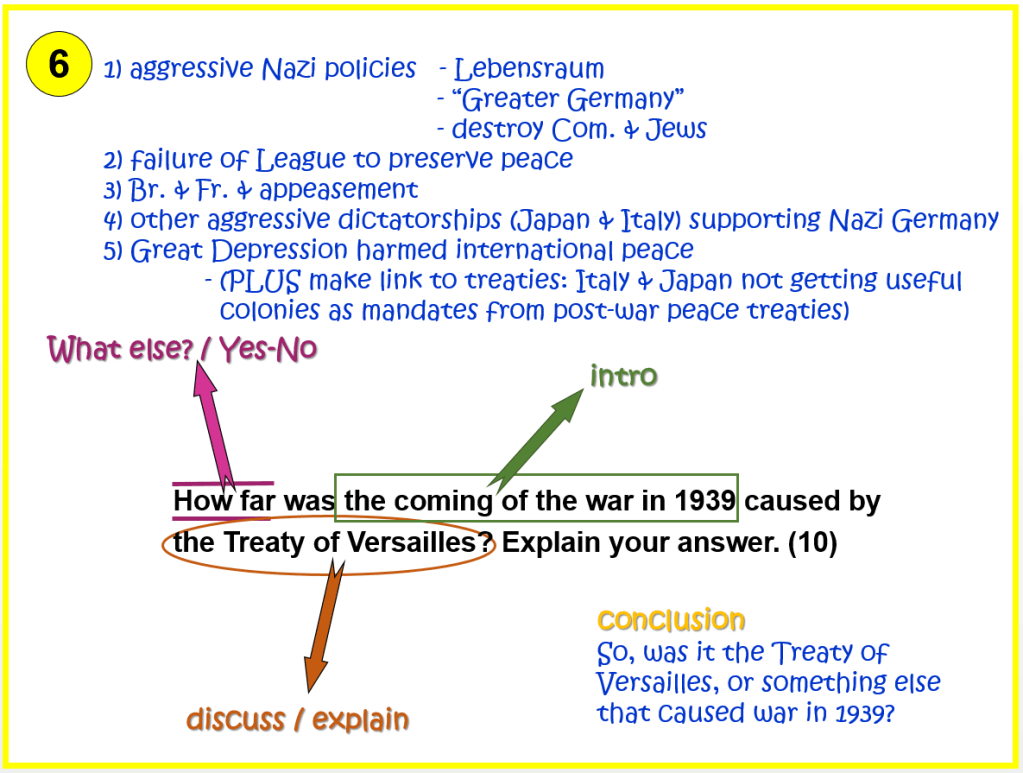
(c) How far was the Treaty of Versailles to blame for the outbreak of war in 1939? Explain your answer. [10]
Question 6 (a)
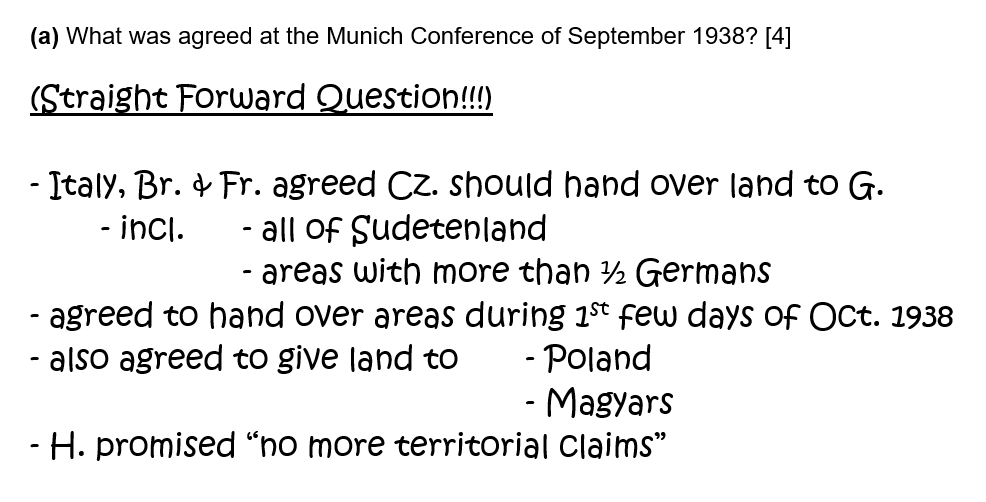
(a) What was agreed at the Munich Conference of September 1938? [4]
Question 6 (b)
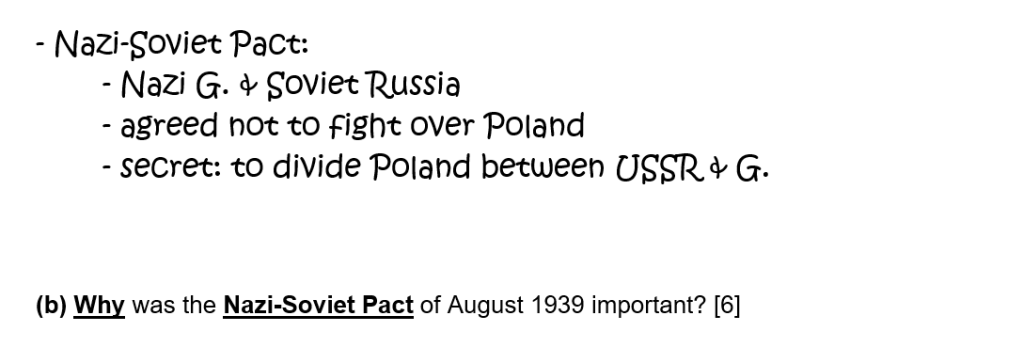
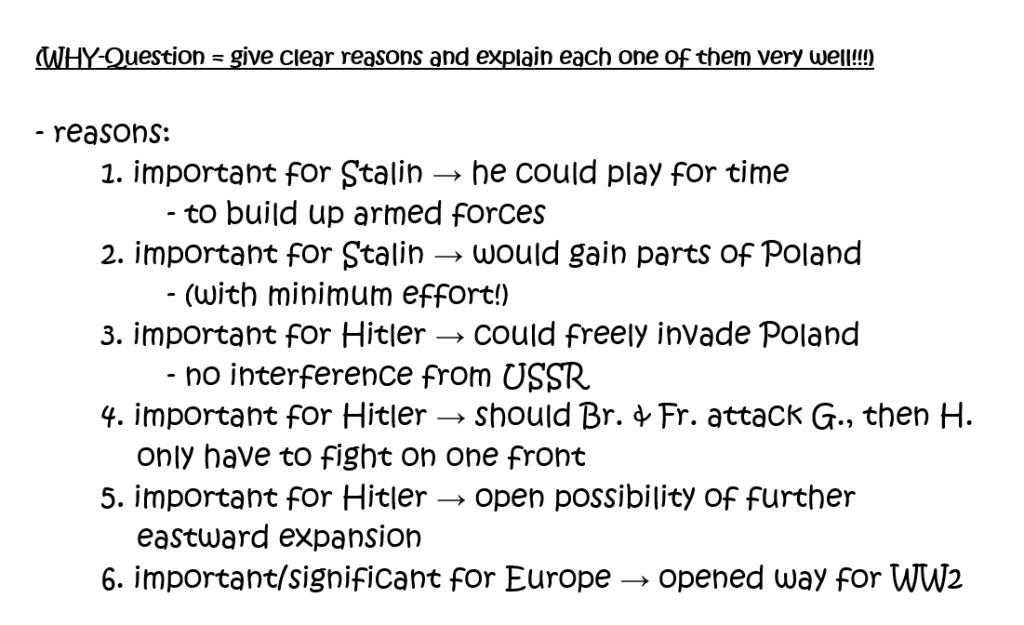
(b) Why was the Nazi-Soviet Pact of August 1939 important? [6]
Question 6 (c)
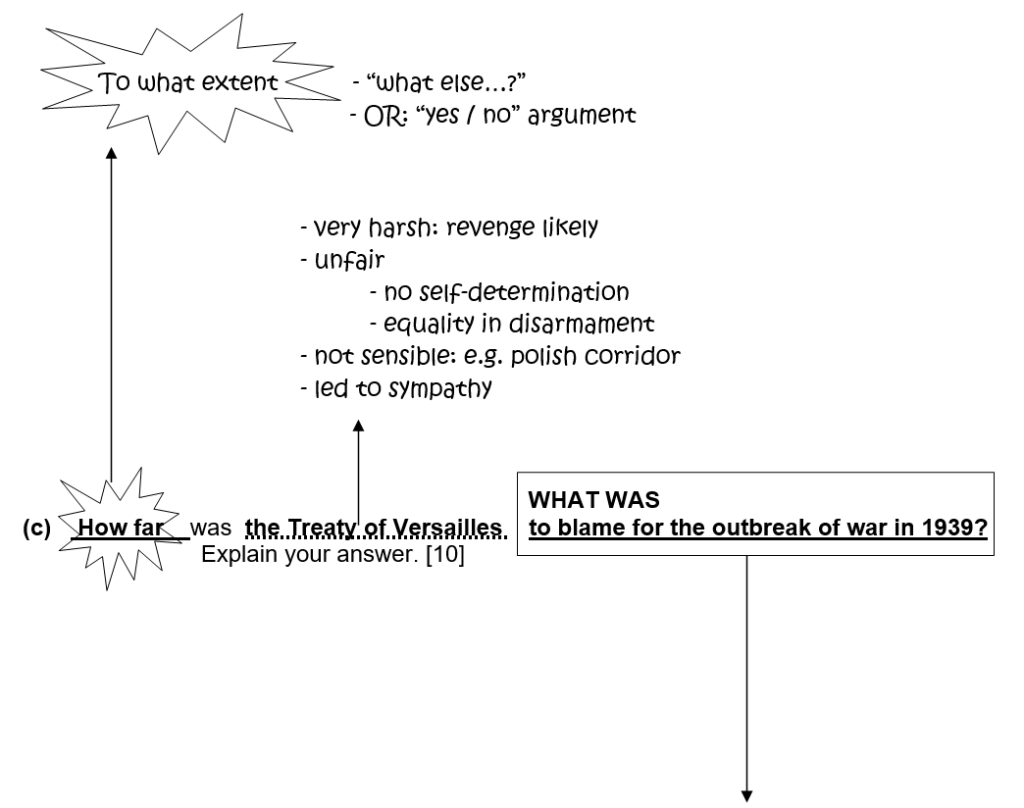
(c) How far was the Treaty of Versailles to blame for the outbreak of war in 1939? Explain your answer. [10]

3.
Page 44 – Question 11
DEPTH STUDY: RUSSIA, 1905-41
The Petrograd Soviet’s influence increased after Nicholas II abdicated in March 1917.
(a) What problems faced the Provisional Government in taking control of Russia after the Tsar’s abdication? [4]
(b) Why were the Bolsheviks able to seize power? [6]
(c) ‘The Bolsheviks won the Civil War because of the War Communism policy.’ How far do you agree with this statement? Explain your answer. [10]
Question 11 (a)
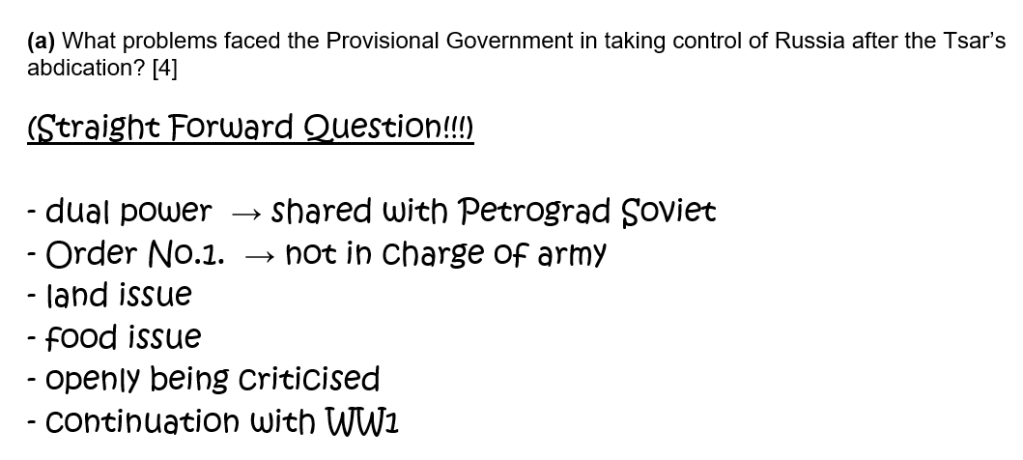
(a) What problems faced the Provisional Government in taking control of Russia after the Tsar’s abdication? [4]
Question 11 (b)
(b) Why were the Bolsheviks able to seize power? [6]

Question 11 (c)
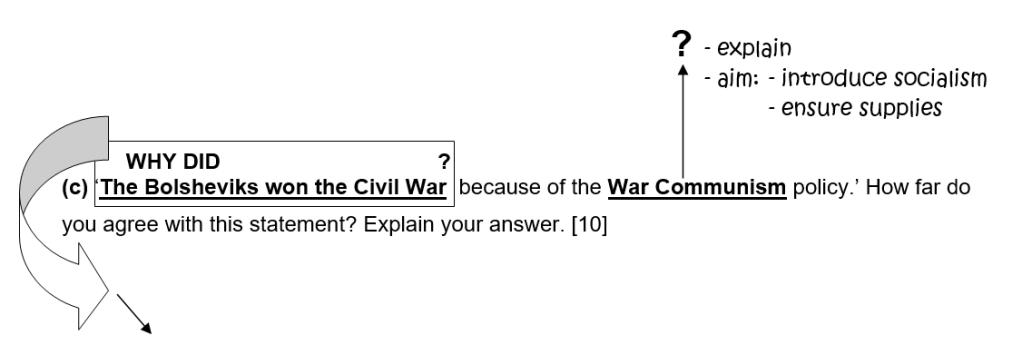
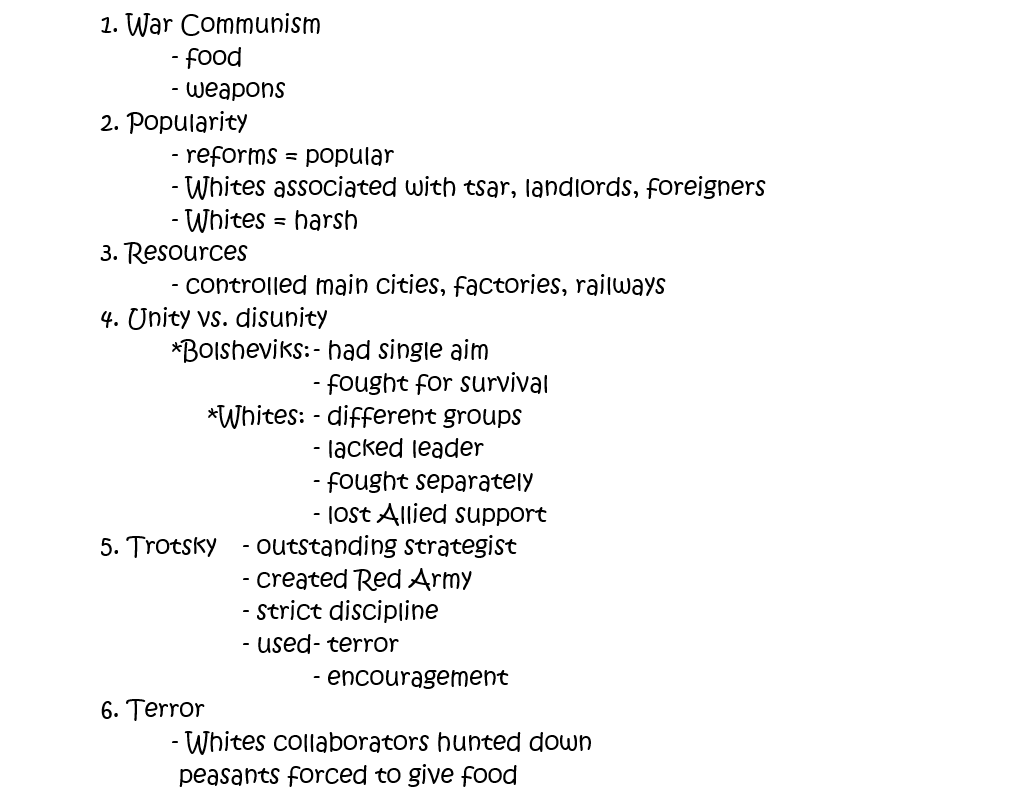
(c) ‘The Bolsheviks won the Civil War because of the War Communism policy.’ How far do you agree with this statement? Explain your answer. [10]
4.
Page 44 – Question 12
DEPTH STUDY: RUSSIA, 1905-41
Stalin set out to rapidly modernise the USSR by means of Collectivisation and Industrialisation.
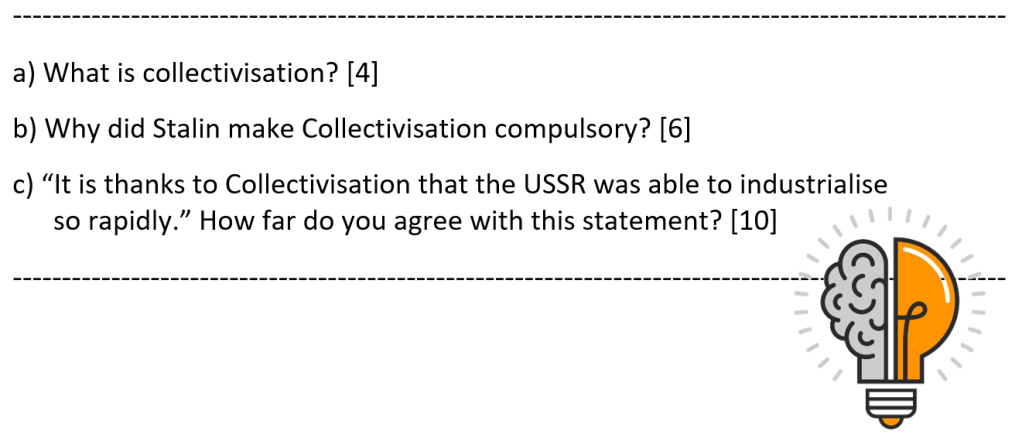
(a) What was collectivisation? [4]
(b) Why did Stalin introduce collectivisation? [6]
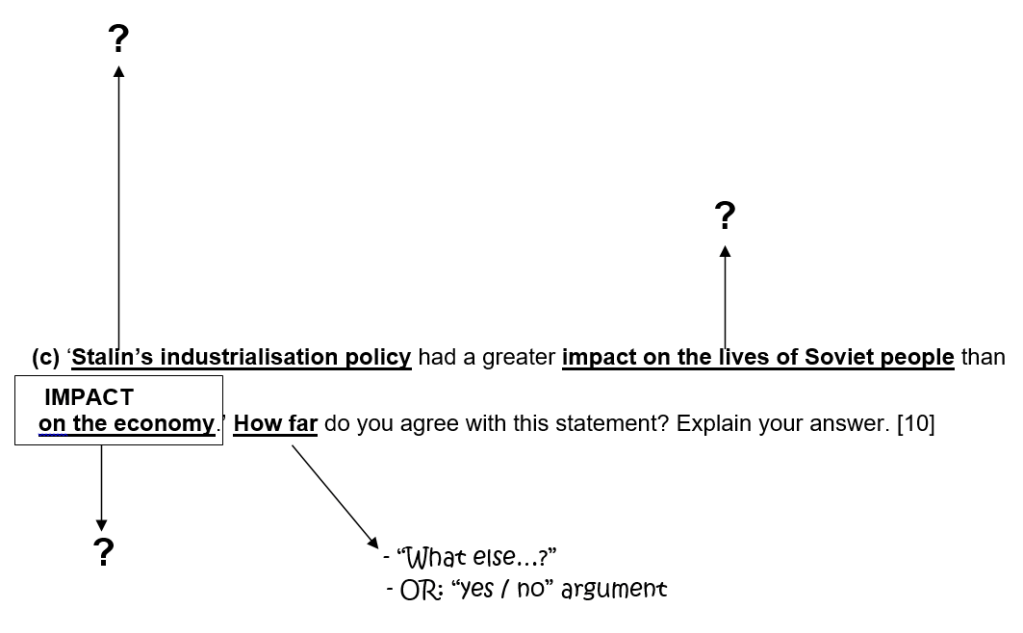
(c) ‘Stalin’s industrialisation policy had a greater impact on the lives of Soviet people than on the economy.’ How far do you agree with this statement? Explain your answer. [10]
Question 12 (a)
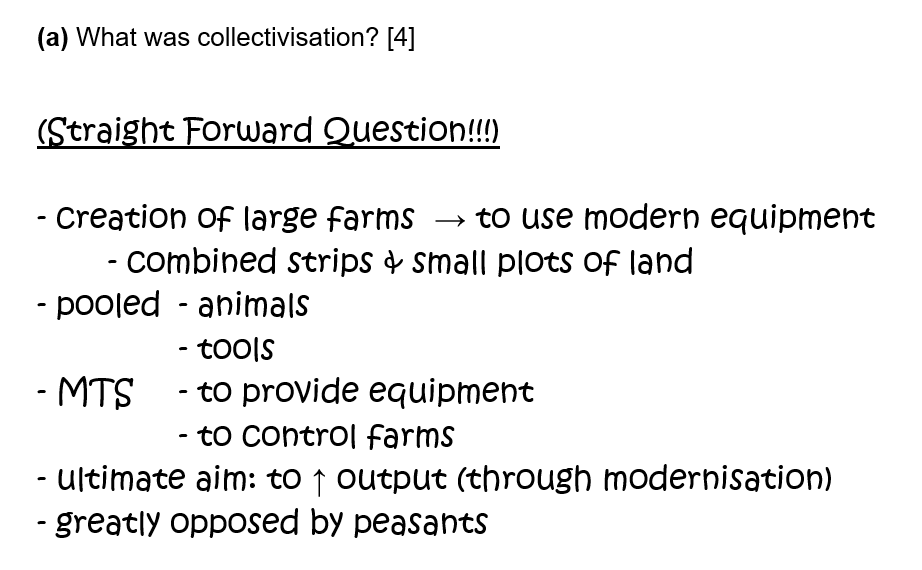
(a) What was collectivisation? [4]
Question 12 (b)
(b) Why did Stalin introduce collectivisation? [6]
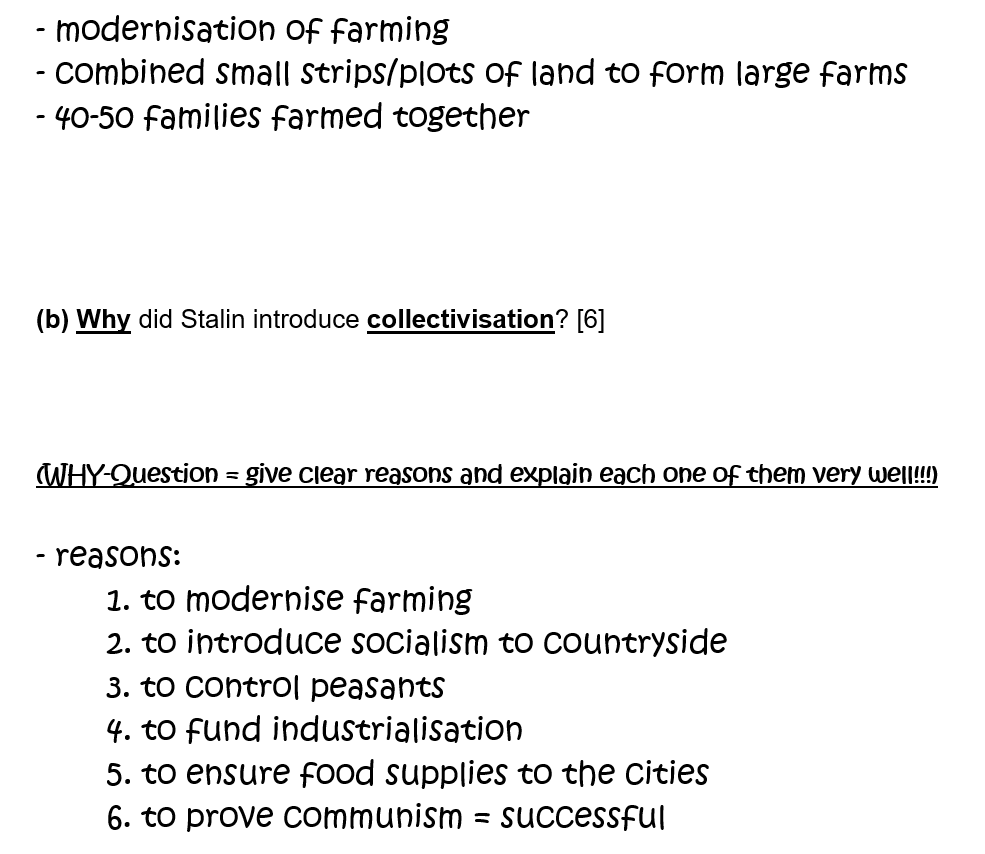
(It was made by students and may shed further light on how to answer this exam question.)
Exam Q on Collectivization. (3:28 minutes long)
Question 12 (c)
(c) ‘Stalin’s industrialisation policy had a greater impact on the lives of Soviet people than on the economy.’ How far do you agree with this statement? Explain your answer. [10]
(WordPress advertisements may appear below.)
Today you are going to continue working on answering How-Far Questions…!
We will use page 68 in your exam preparation Booklet.
1.

Remember, in the answer to a How-Far-Question, more than one argument is offered…
The question requires of you to give “points for” and “points against” the given statement and to ultimately give an evaluation, that concludes the answer. These are typical requirements of a How-Far-Question.
2.
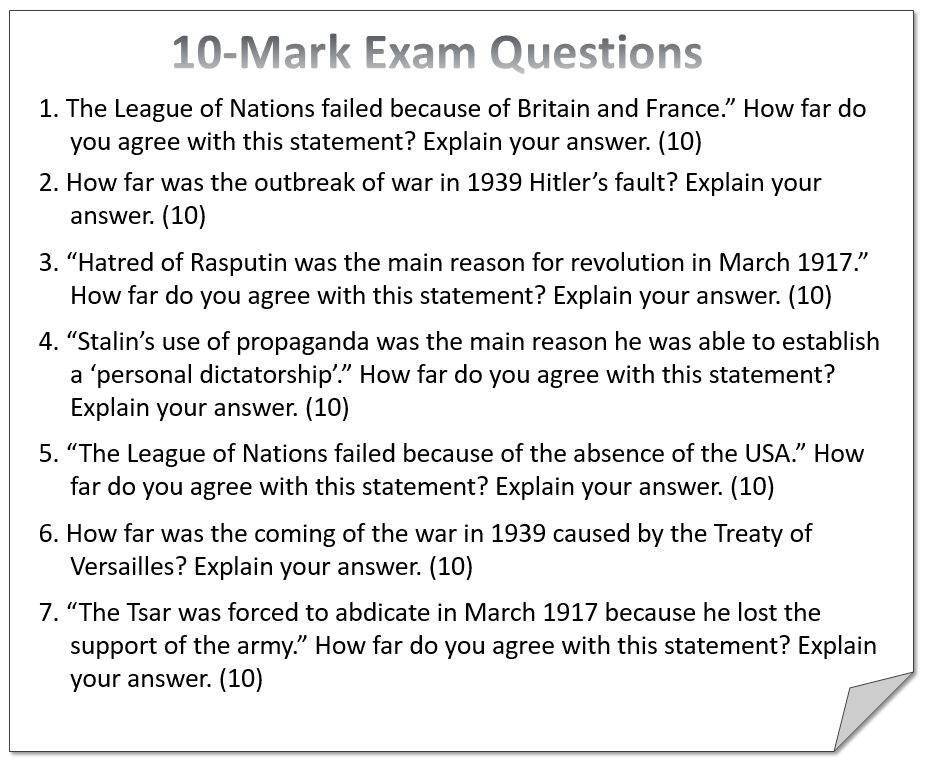
On page 68 in your Exam Preparation Booklet are some 10-mark questions. In this lesson we will look at Questions 5-7 in more detail.
3.

For each Question:
4.
Now compare your planning with the solutions below.
SOLUTIONS

Question 5
Question 6
Question 7
5.
Bonus Question
Here is a bonus question to analyse and plan:
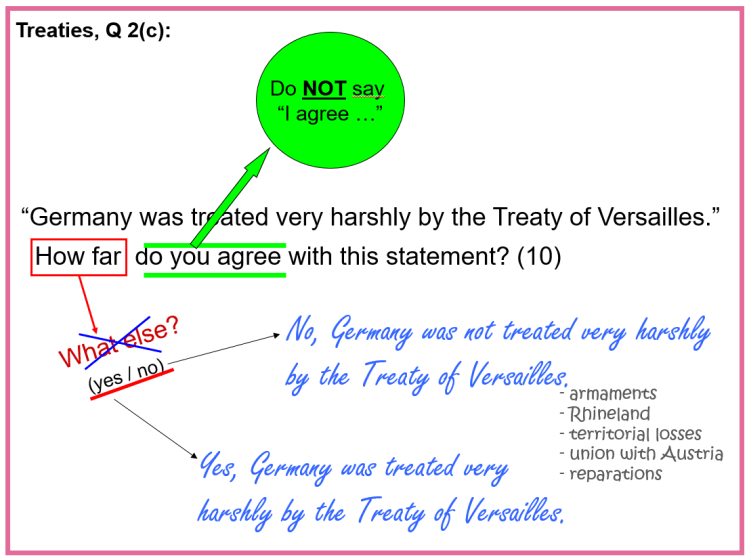
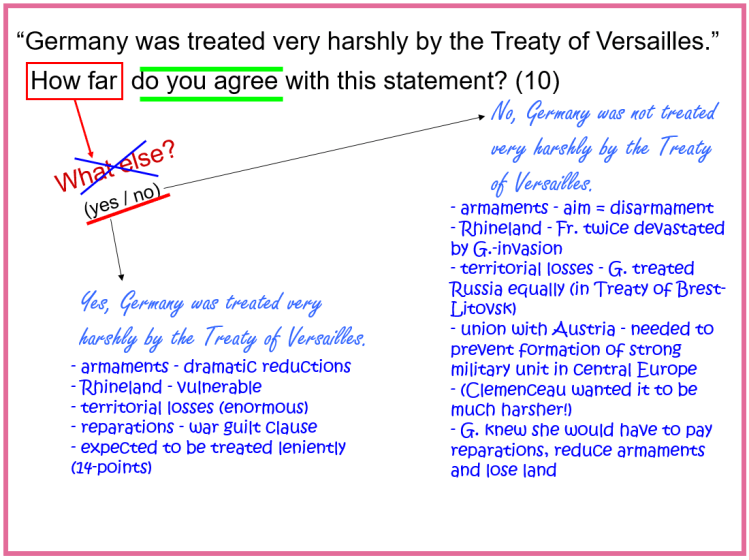
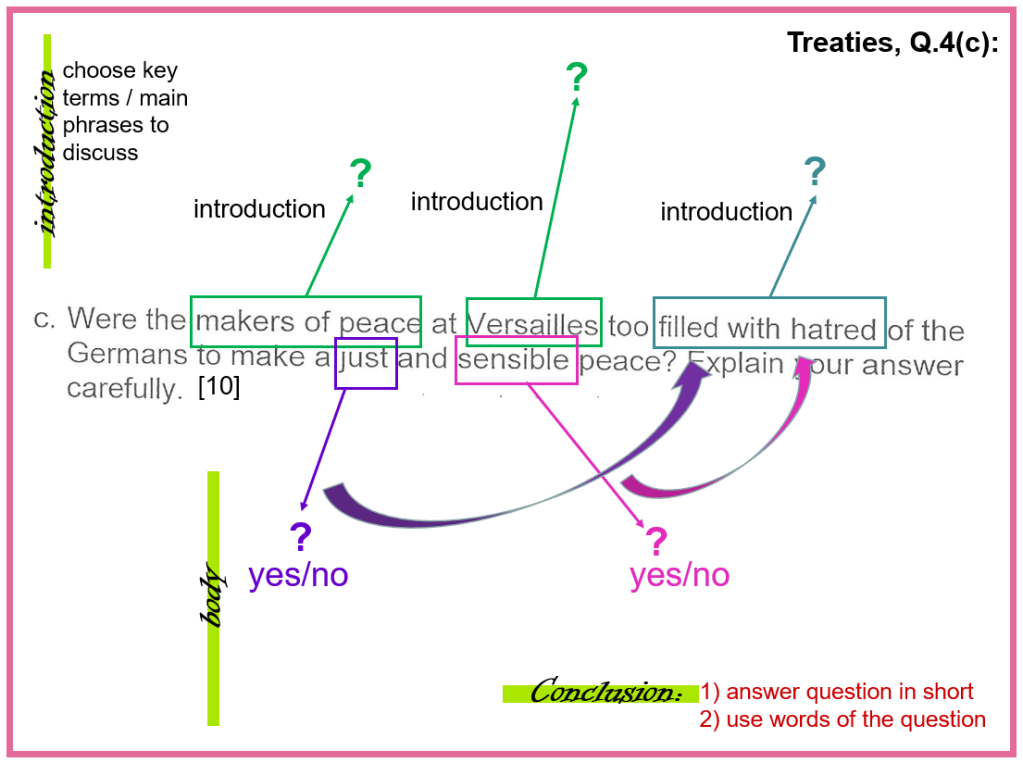
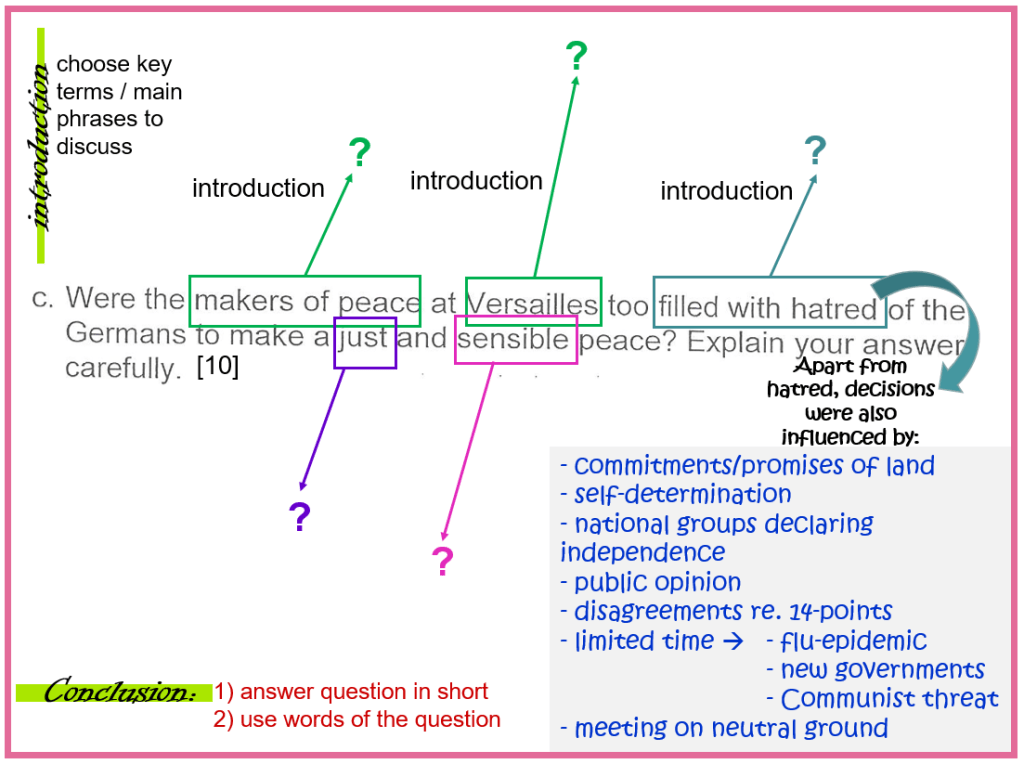
“The Treaty of Versailles was a fair settlement.” How far do you agree with this statement? Explain your answer. (10)
Remember to give both sides of the argument!
Look at the following video clip – as a brief analysis and plan for this question.

10-mark Post-War Peace Treaties Question. (6:32 minutes long)
(You may want to play this video on a faster speed…)
6.
Finally, choose one of the 10-mark questions (on p.68) to answer in full. I.e. you need to write the essay answer in your essay writing book for assessment.
An effective way to answer a How-Far-Question is to do the following:
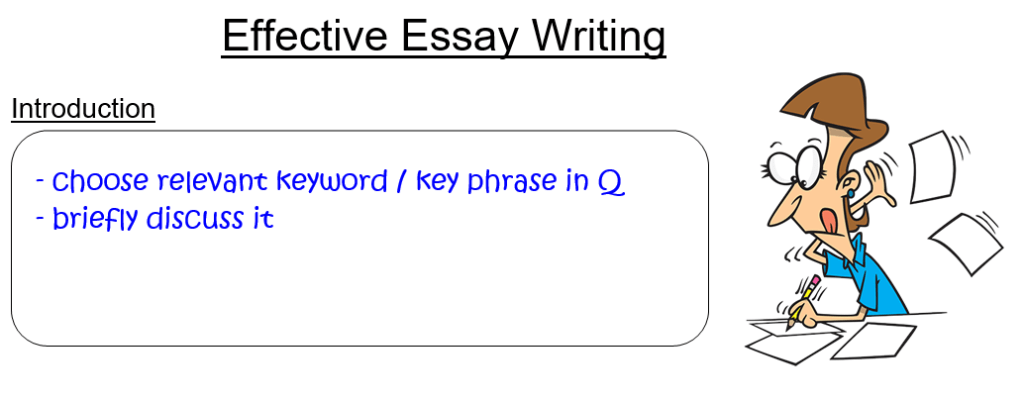
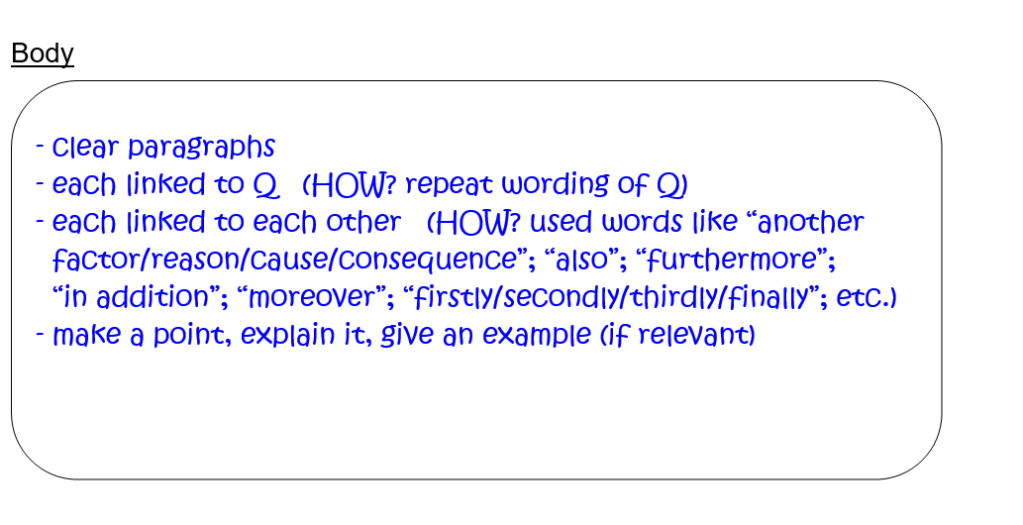
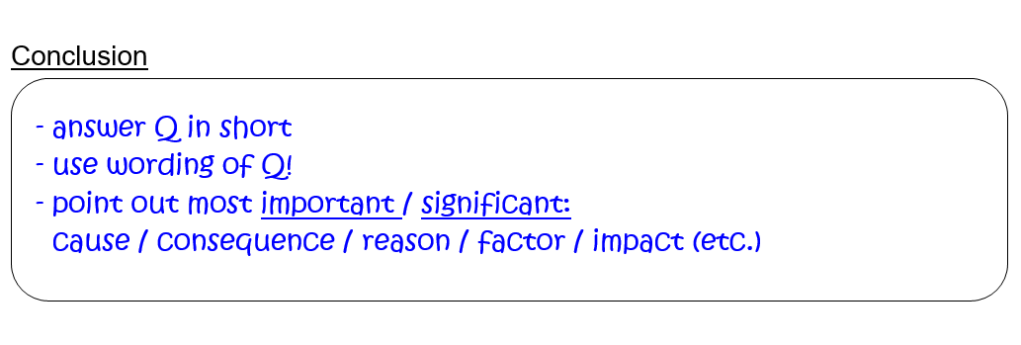
Also remember to give both sides of the argument!
(WordPress advertisements may appear below.)
Today you are going to begin working on answering How-Far Questions…!
We will use page 68 in your exam preparation Booklet.
1.
In the answer to a How-Far-Question, more than one argument is offered…
The question requires of you to give “points for” and “points against” the given statement and to ultimately give an evaluation, that concludes the answer. These are typical requirements of a How-Far-Question.
2.
On page 68 in your Exam Preparation Booklet are some 10-mark questions. In this lesson we will look at Questions 1-4 in more detail.
3.
For each Question:
4.
Now compare your planning with the solutions below. (There are also videos that may give further ideas as to what could have been included in an answer.)
SOLUTIONS
Question 1
More on Question 1:
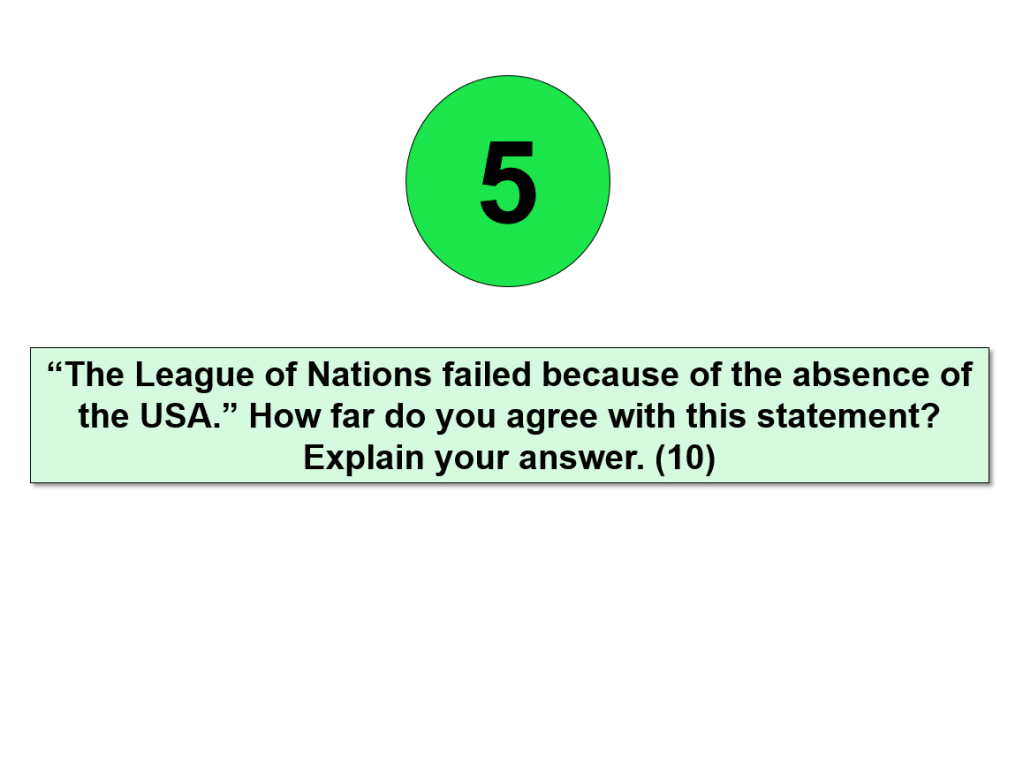
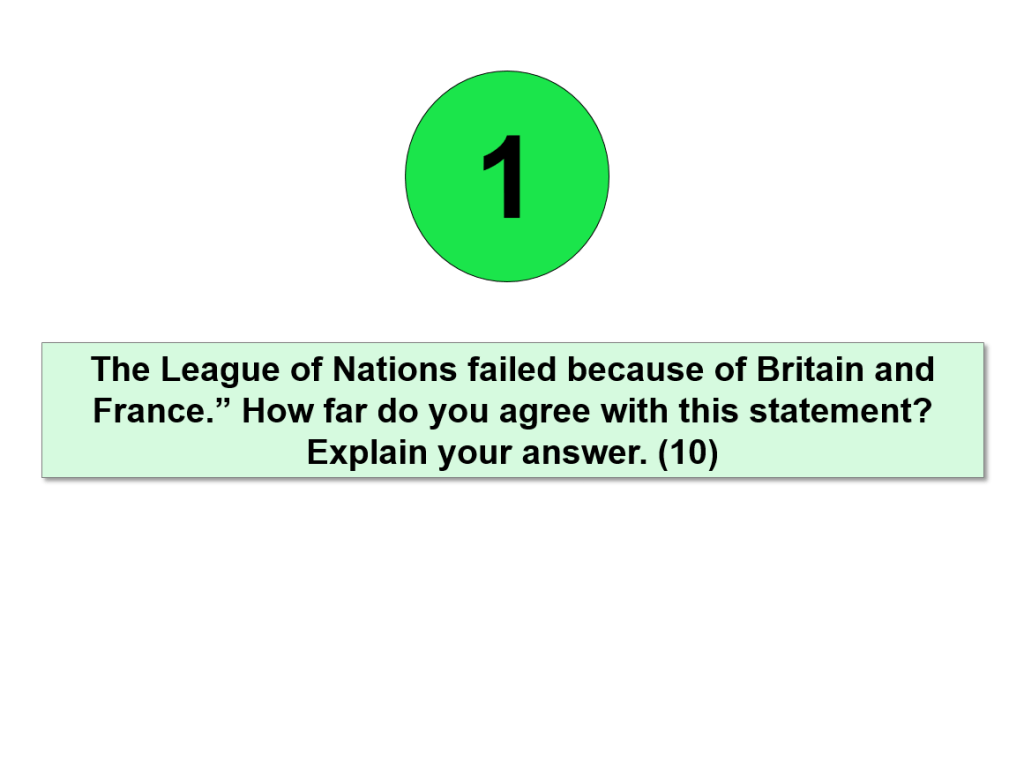
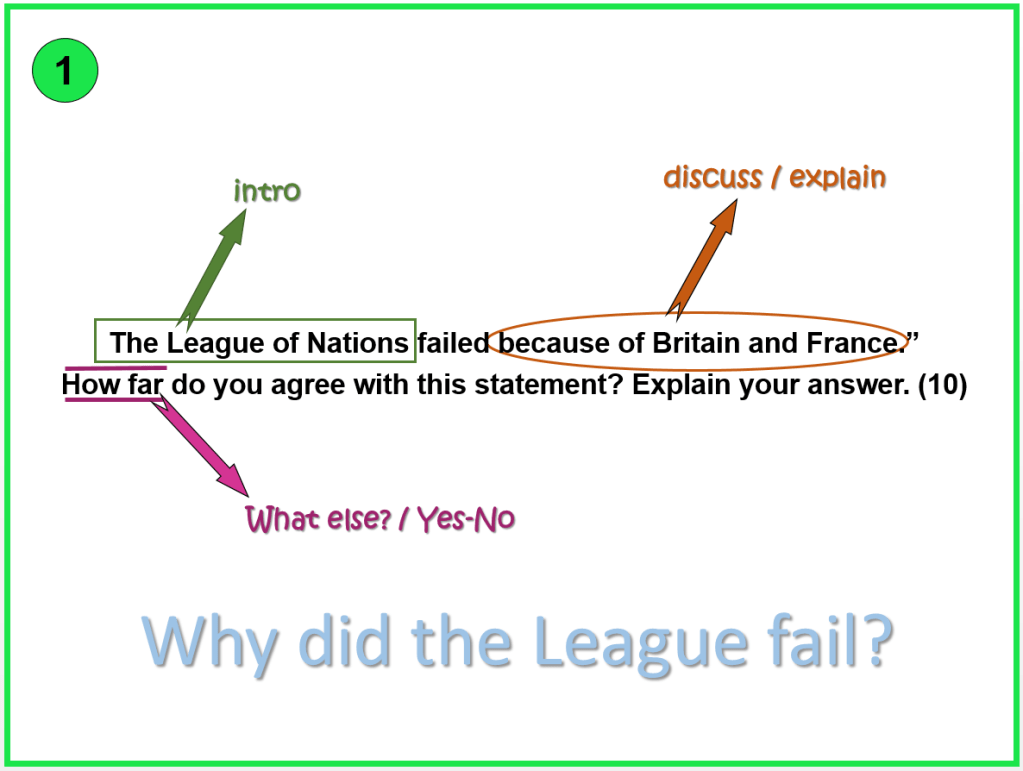
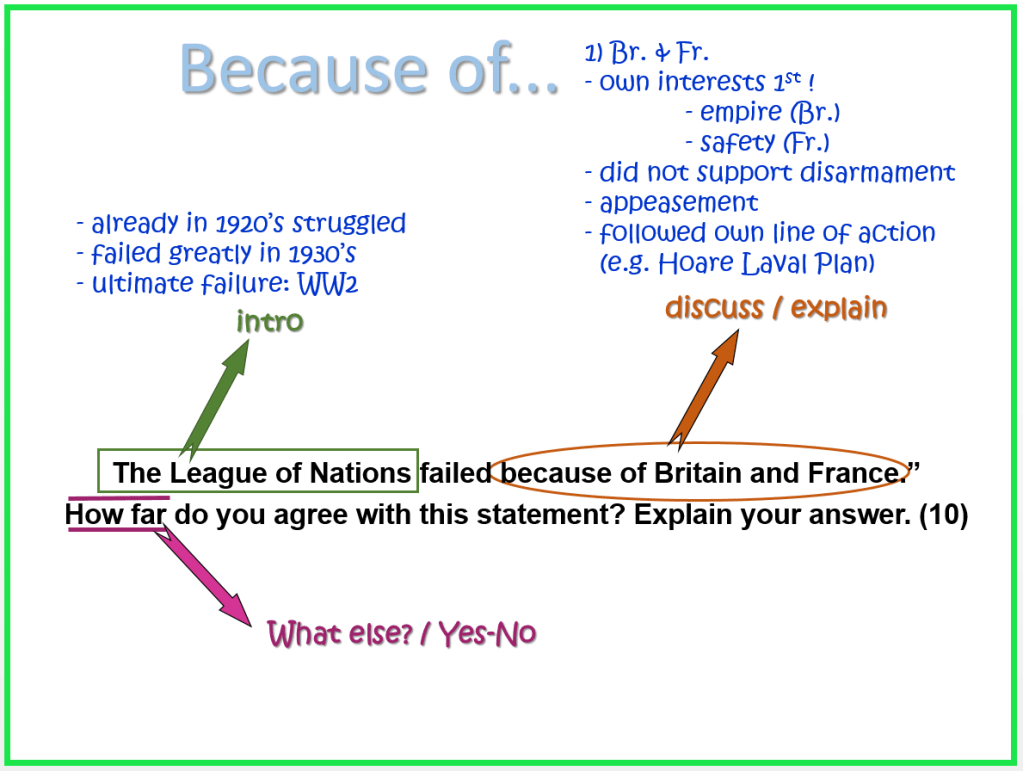
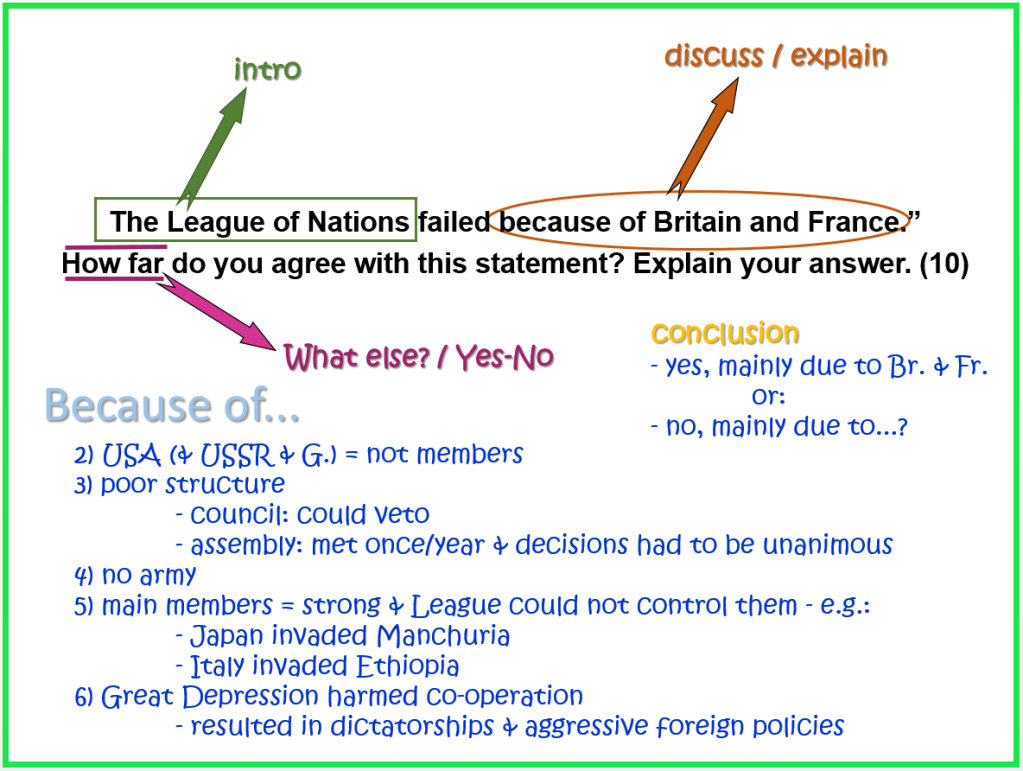
“The League of Nations failed because of Britain and France.” How far do you agree with this statement? Explain your answer. (10)
Remember to give both sides of the argument!
Look at the following video clip – as a brief analysis and plan for this question.

10-mark League of Nations Question. (2:37 minutes long)
Question 2
More on Question 2:
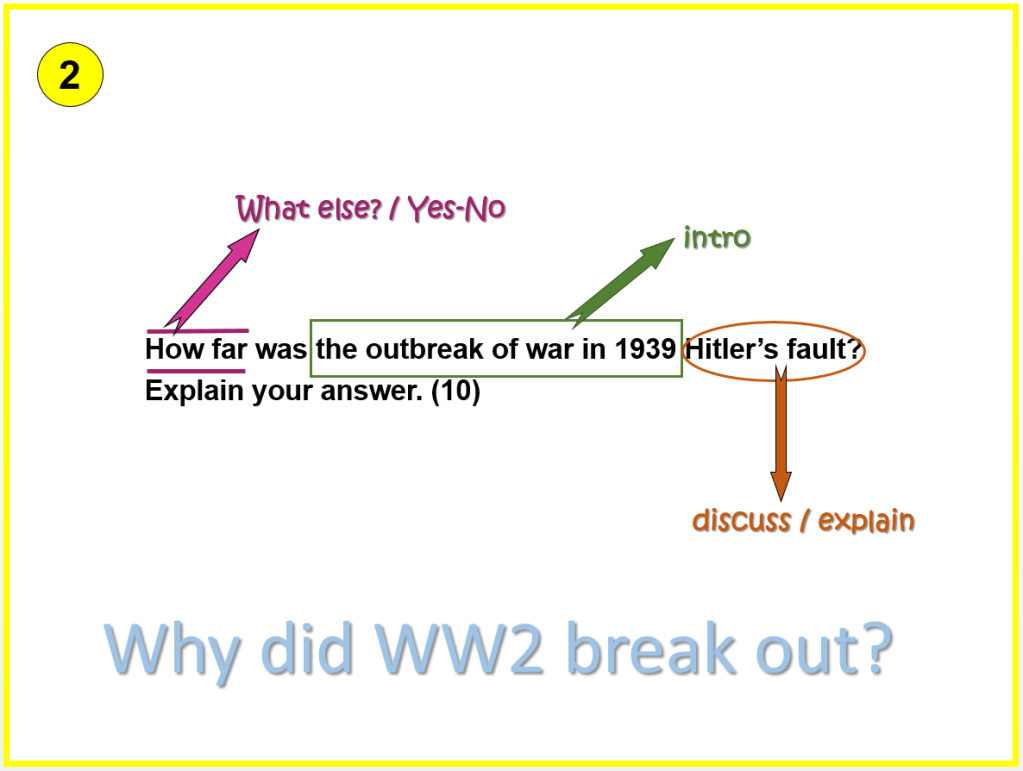
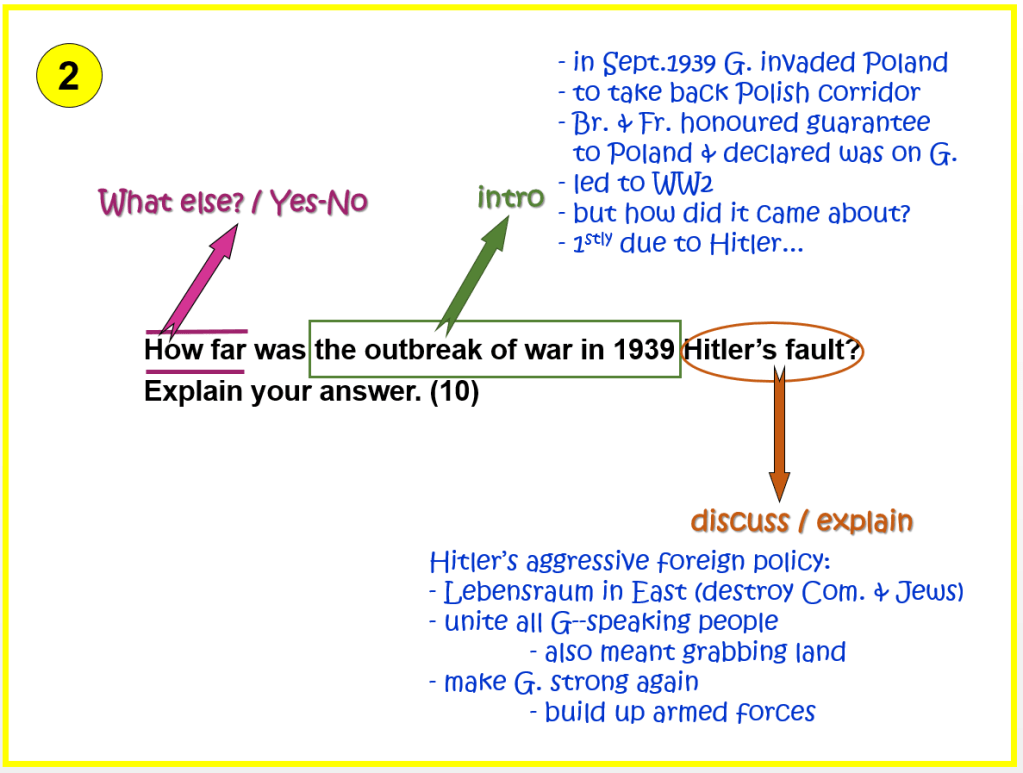
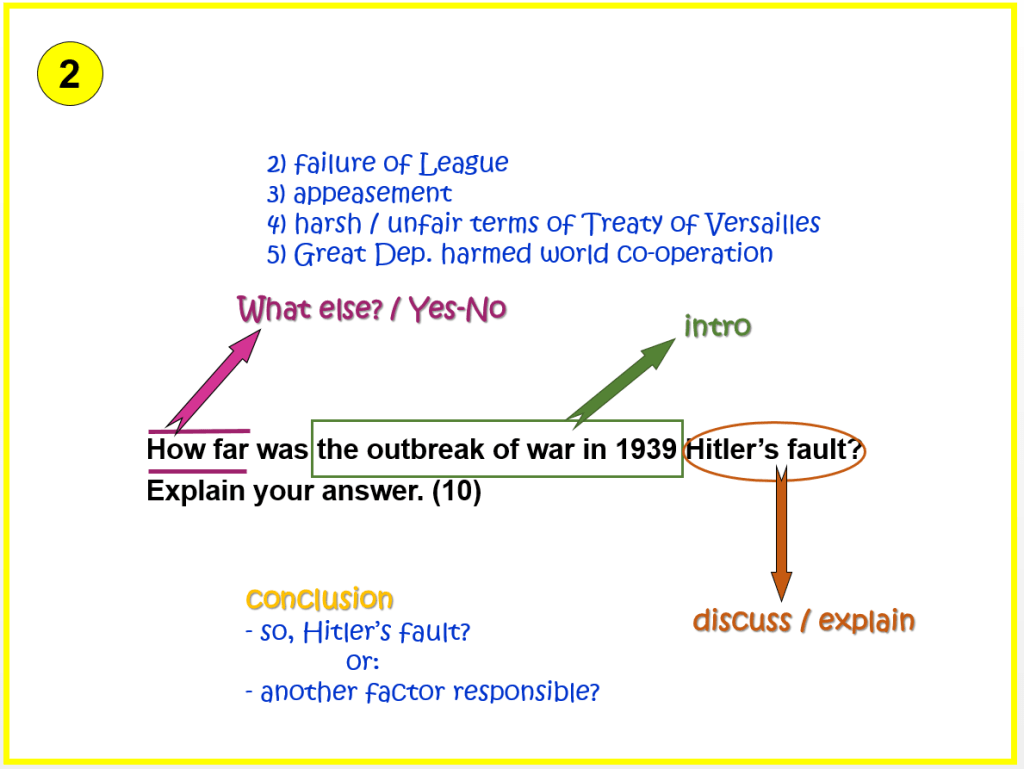
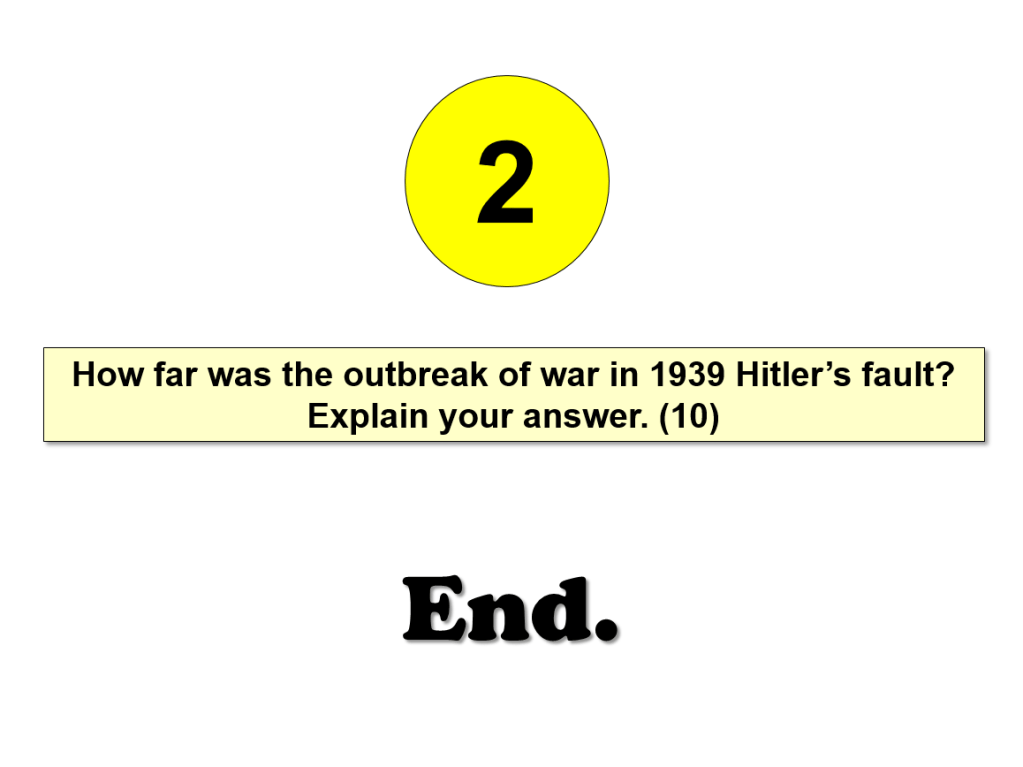
How far was the outbreak of war in 1939 Hitler’s fault? (10)
Remember to give both sides of the argument!
Look at the following video clip – as a brief analysis and plan for this question.
10-mark Road to War Question. (1:51 minutes long)
Question 3
More on Question 3:
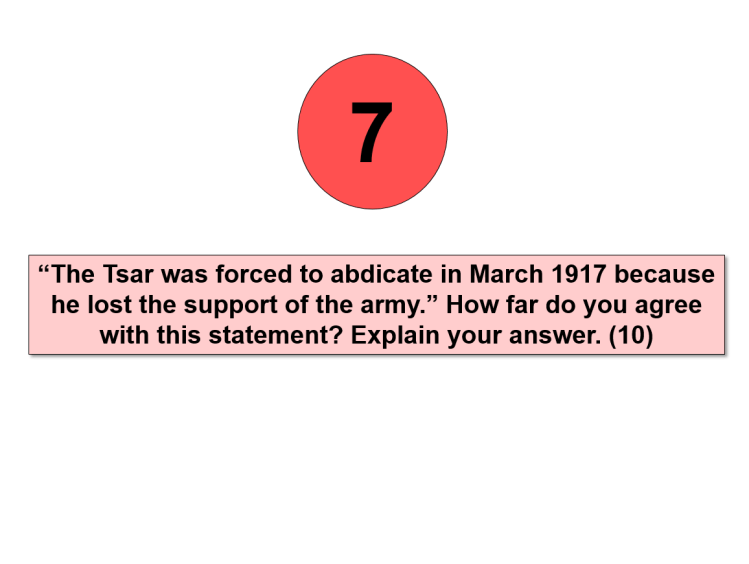
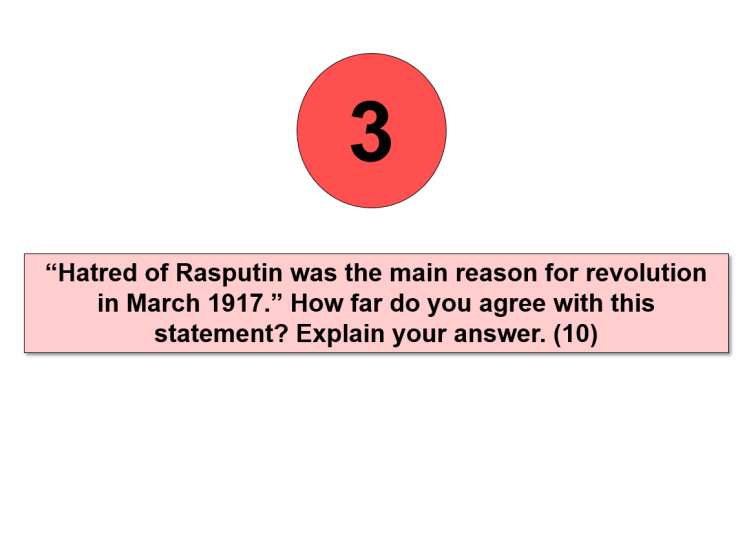
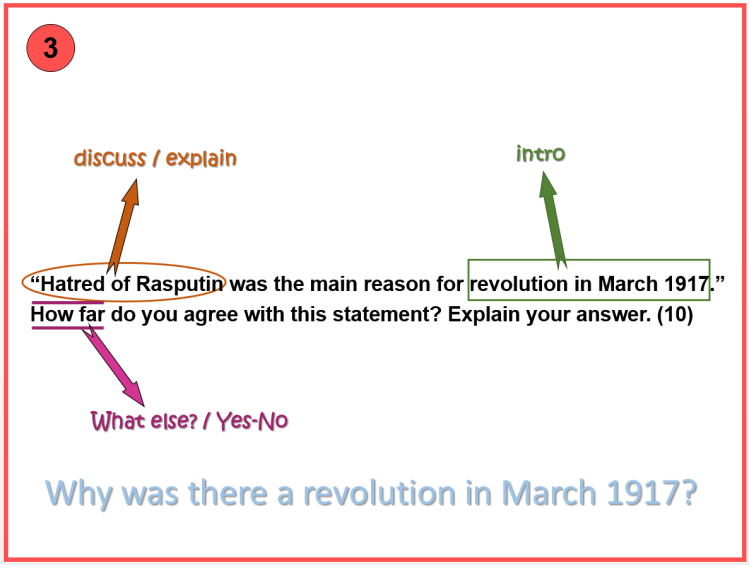
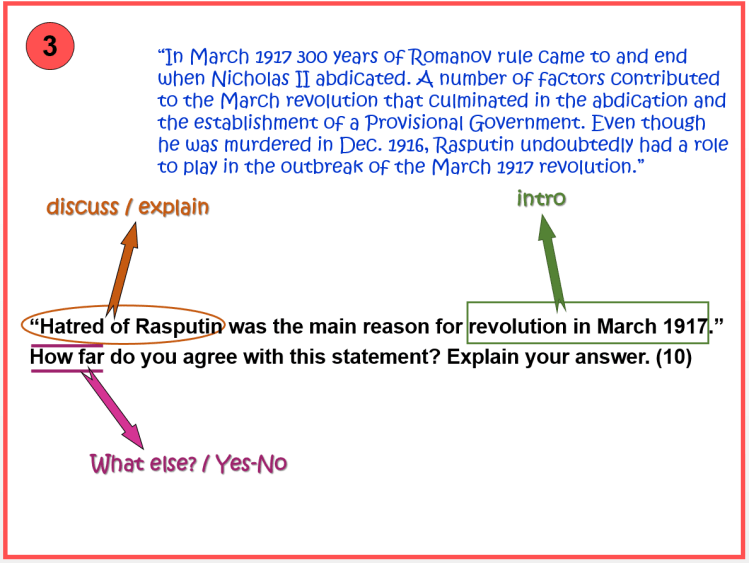
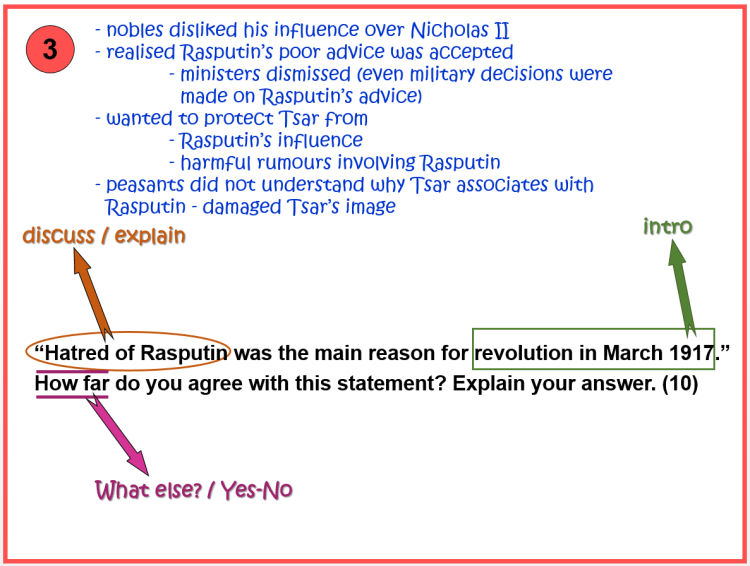
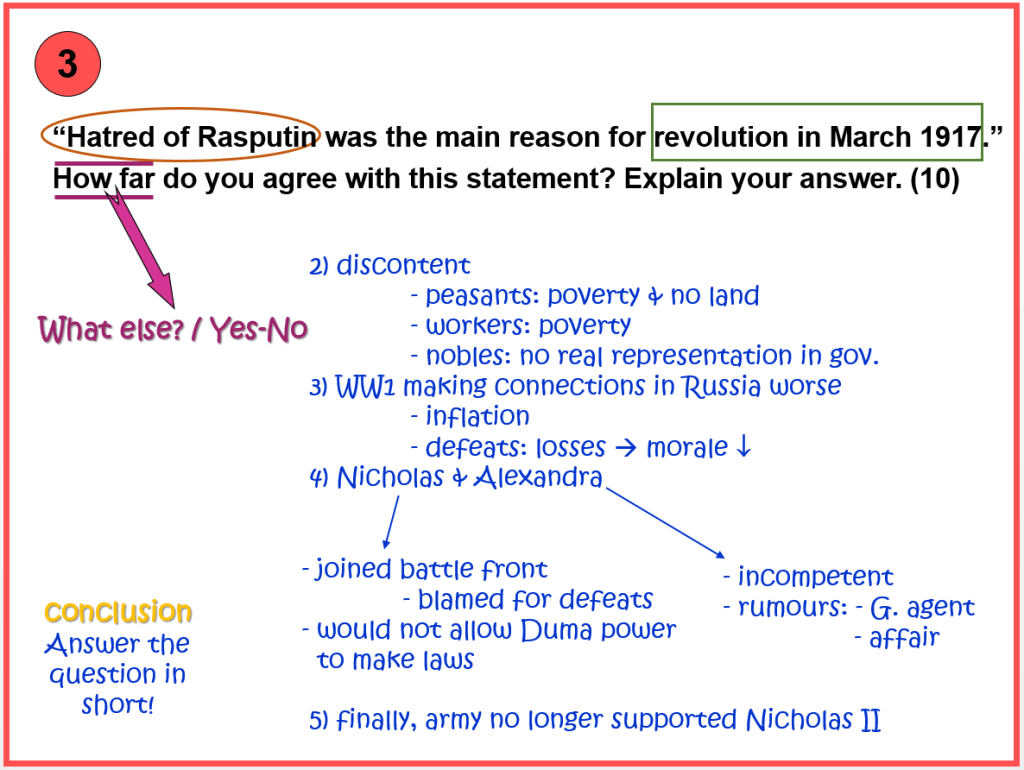
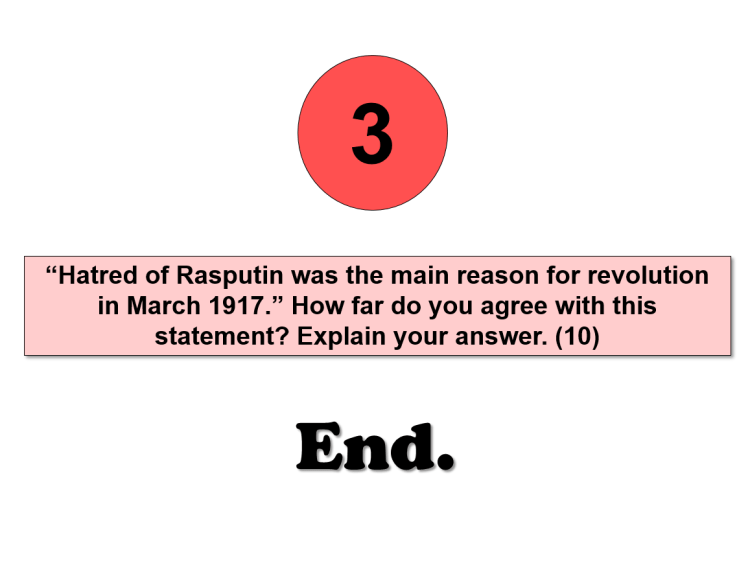
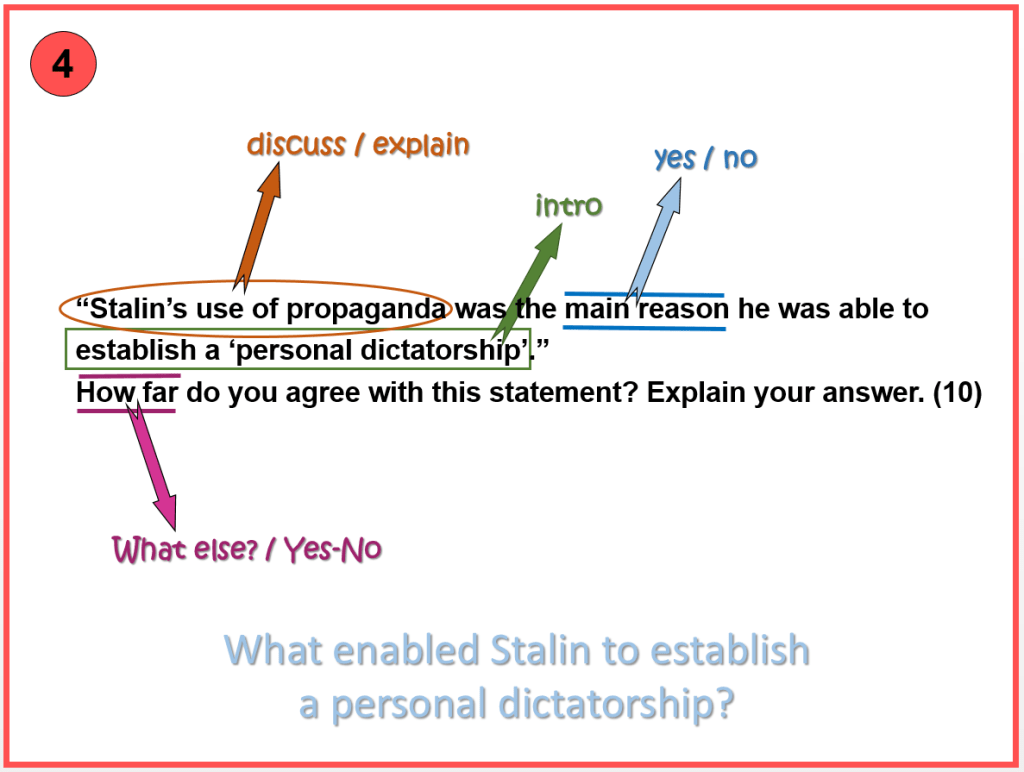
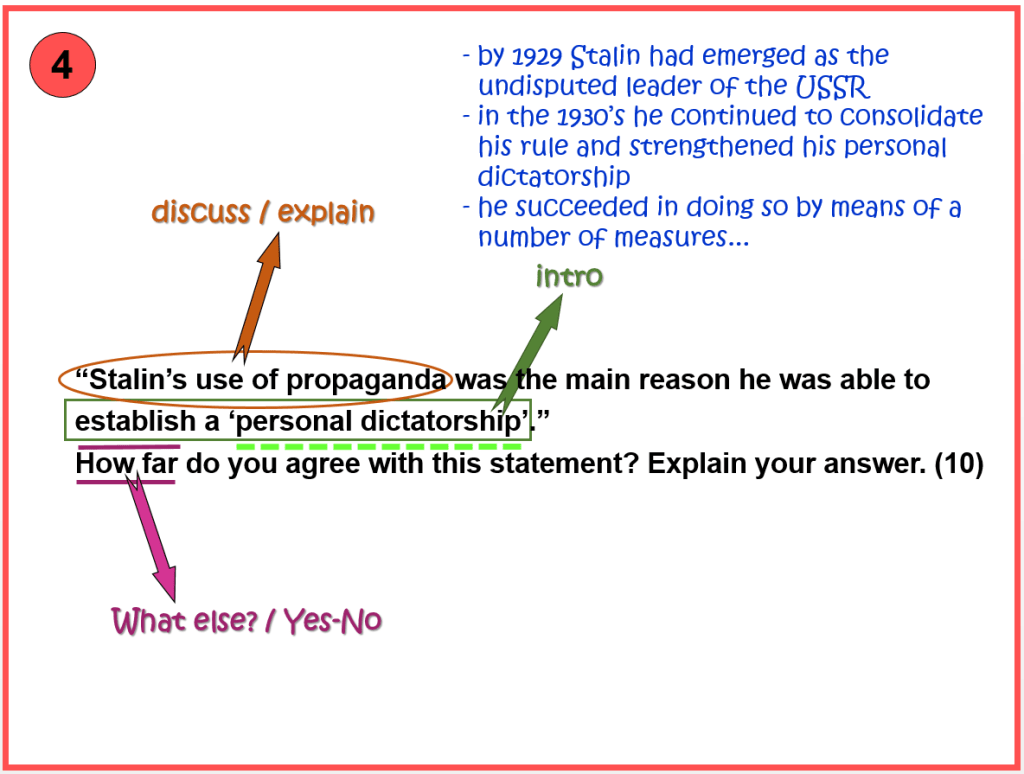
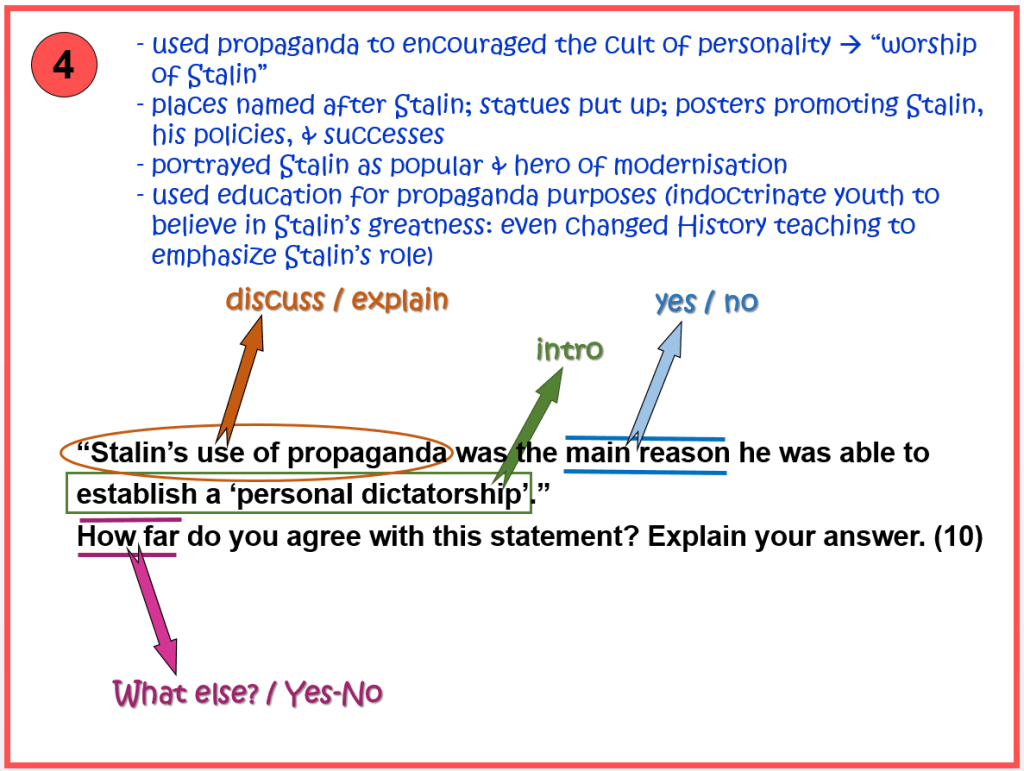
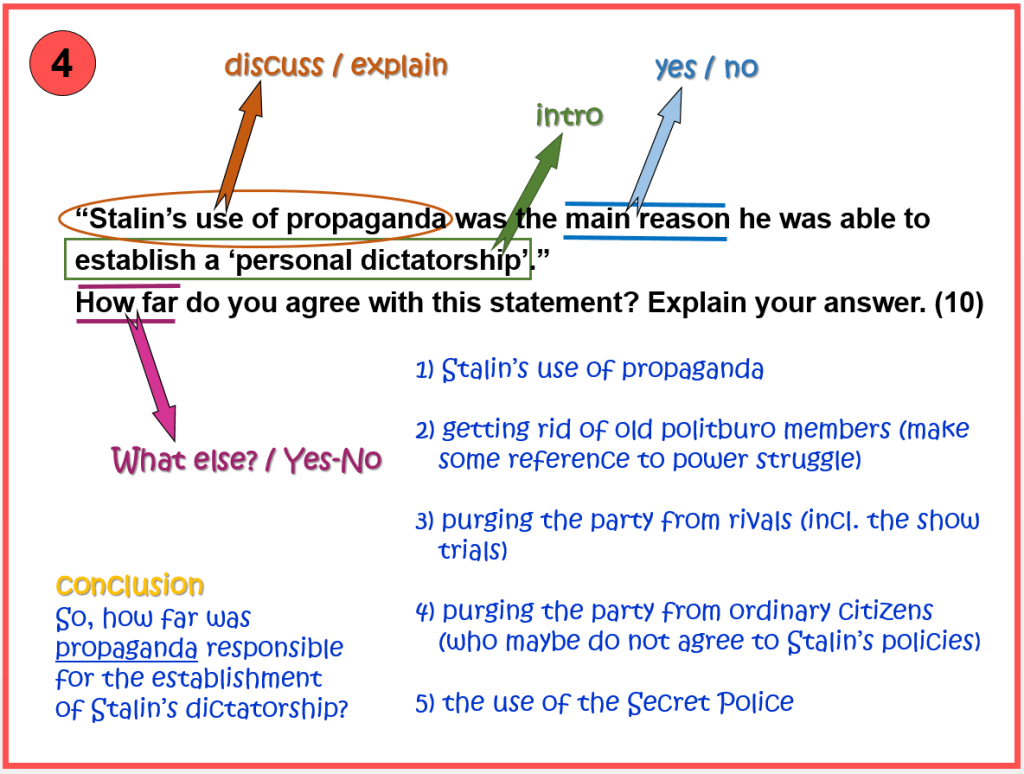
“Hatred of Rasputin was the main reason for revolution in March 1917.” How far do you agree with this statement? Explain your answer. (10)
Remember to give both sides of the argument!
Look at the following video clip – as a brief analysis and plan for this question.
10-mark Russian History Question. (2:09 minutes long)
And here is an example…

(This as an example of an essay answer to the same question.)
In March 1917 Tsar Nicholas II learnt that the army no longer supported him. He was overthrown and a Provisional Government took control of Russia. This marked the end of the Romanov Dynasty. Russia was now a democracy.
Hatred of Rasputin, main advisor to the crown, and faith healer to Alexi, was one of the reasons for this revolution. Rasputin gave poor advice to the Tsar and Tsarina. On his advice, important ministers were dismissed from government. Even military decisions were made based on Rasputin’s guidance, often with catastrophic results!
Moreover, ordinary Russians did not understand why Nicholas II associated with Rasputin, who was well known as a drunkard and a womanizer. This association damaged the Tsar’s image.
Nobles close to the Tsar disliked Rasputin’s influence and eventually murdered him, but a lot of damage was already inflicted and Tsarist rule became very unpopular.
However, there were more reasons for the 1917 March revolution. The Tsar failed to address longstanding discontent: Peasants and workers lived in great poverty and had no land of their own. Workers received low wages and were also very poor. Nobles had no say in the government.
Russia’s involvement in WW1 made conditions in Russia even worse. She suffered great defeats, which caused a loss of morale. Shortages caused inflation and increased suffering.
In addition, Nicholas and Alexandra’s incompetence brought revolution closer. Nicholas would not allow the Duma any powers to make laws. He also joined the Battlefront and left Alexandra in charge of ruling the country. She relied on Rasputin’s advice. This fuelled rumours that Alexandra and Rasputin were German spies. There were also rumours about her and Rasputin having an affair.
All these factors worked together to cause the March 1917 Revolution, and not only hatred for Rasputin. Ultimately, it was the fact that the army no longer supported Nicholas II, that was probably the most immediate reason for the Russian revolution of March 1917.
Finally…
This animated explainer video answers exactly the same question, but in video format:
“Hatred of Rasputin was the main reason for revolution in March 1917.” How far do you agree with this statement? Explain your answer. (10)
Animated Exam Question Answer. (2:50 minutes long)
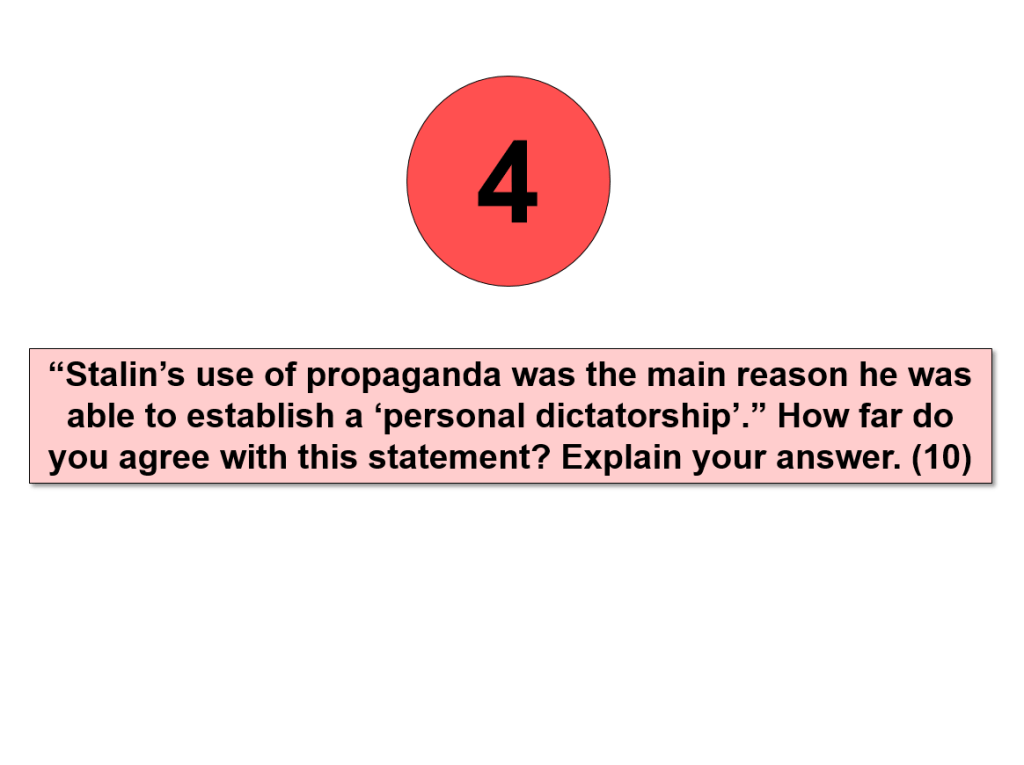
Question 4
5.
Finally, choose one of the above questions to answer in full. I.e. you need to write the essay answer in your essay writing book for assessment.
(WordPress advertisements may appear below.)
Today you are going to work on answering more Why-Questions…!
We will use page 67 in your exam preparation Booklet.
1.
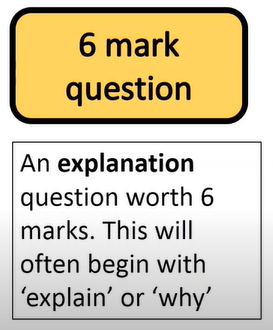
Here is a reminder of the requirements of a Why-Question!

Why-Questions call for clear reasons, that are very well explained. That is why the making of an explainer video can be so useful in organising the answer to a Why-Question – because you have to clearly formulate the reasons and then clearly explain each one of them!
2.
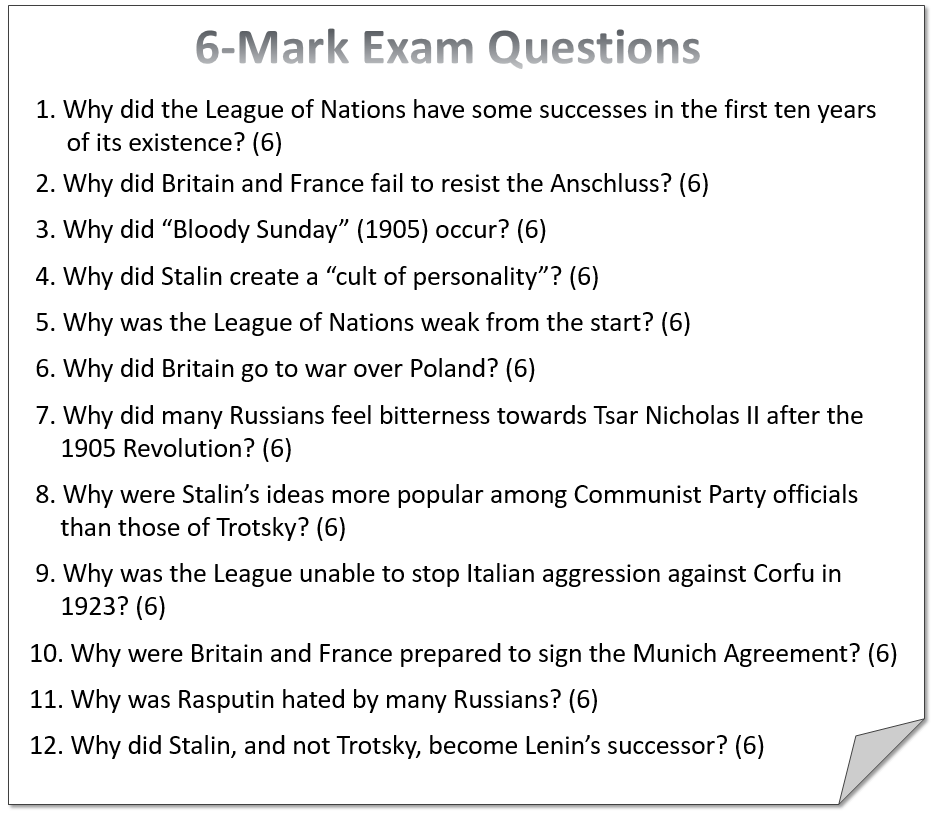
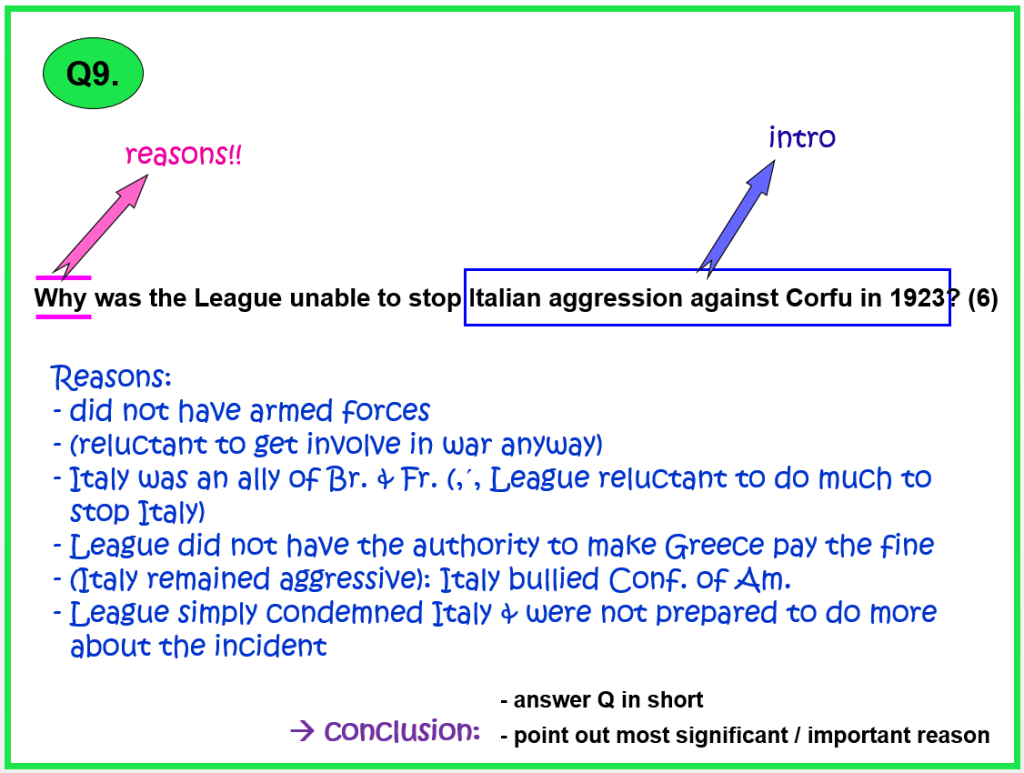
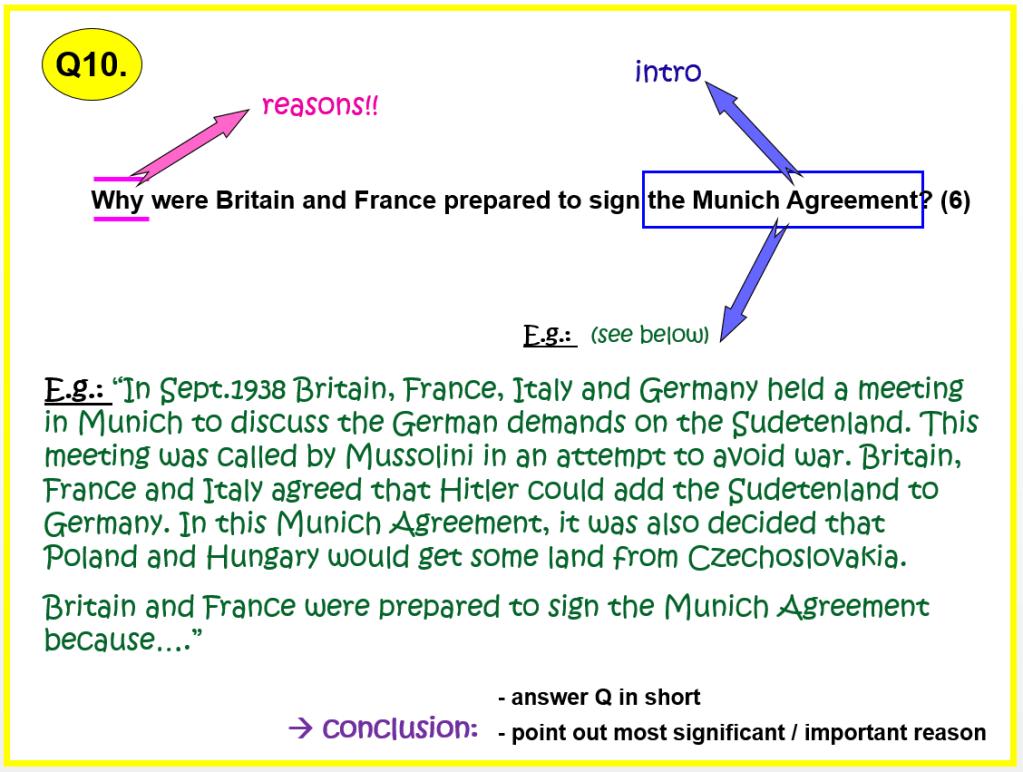
On page 67 in your Exam Preparation Booklet are some 6-mark questions. In this lesson we will look at Questions 7-12 in more detail.
3.
For each Question:
4.
Now compare your planning with the solutions below.
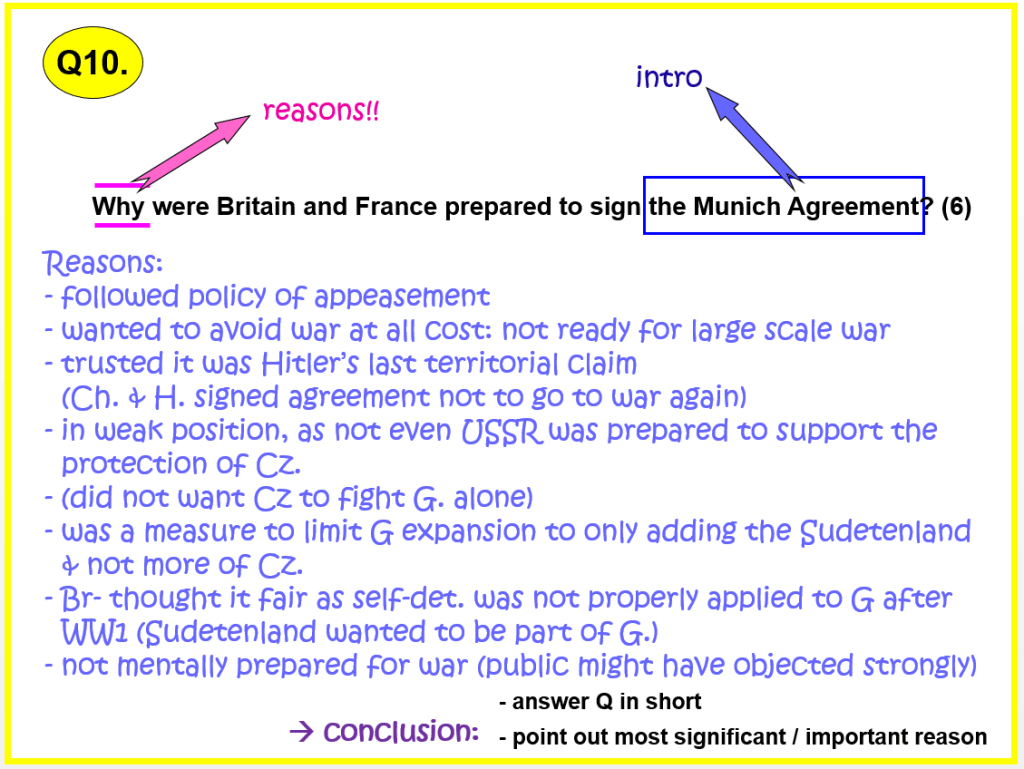
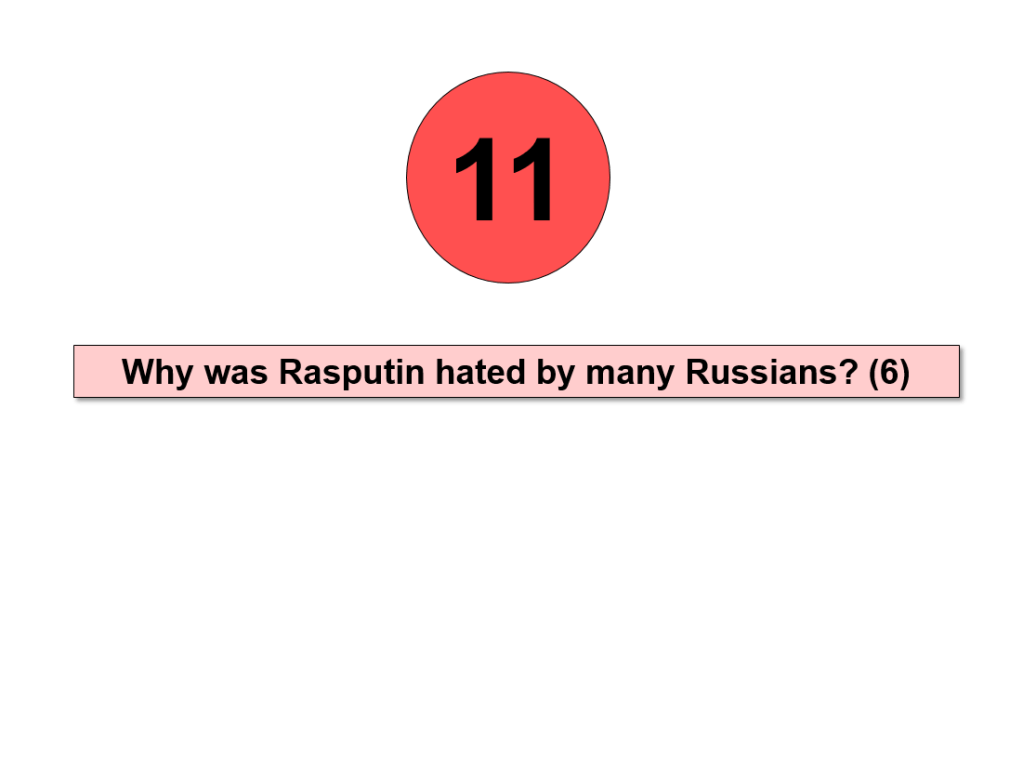
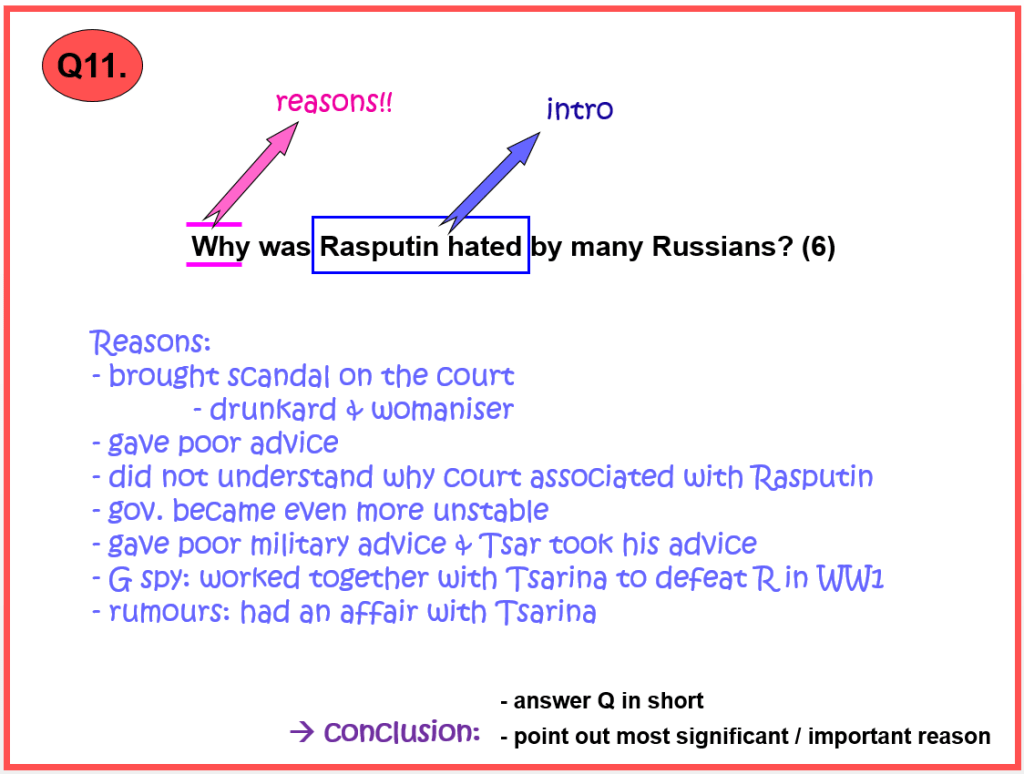
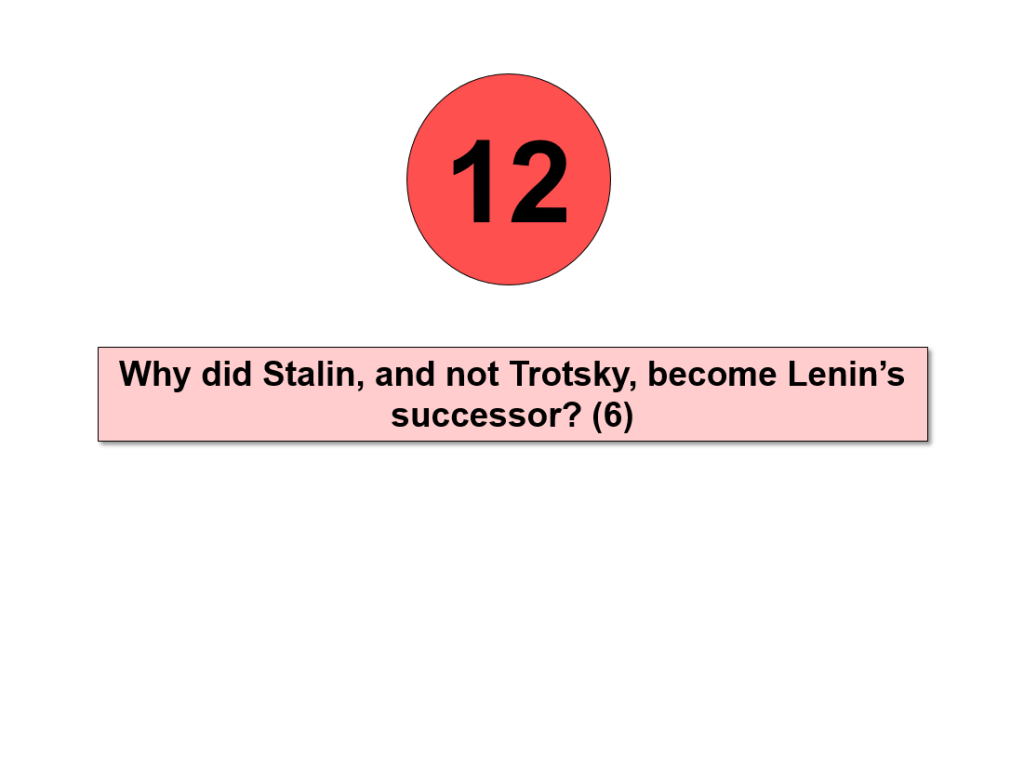
SOLUTIONS
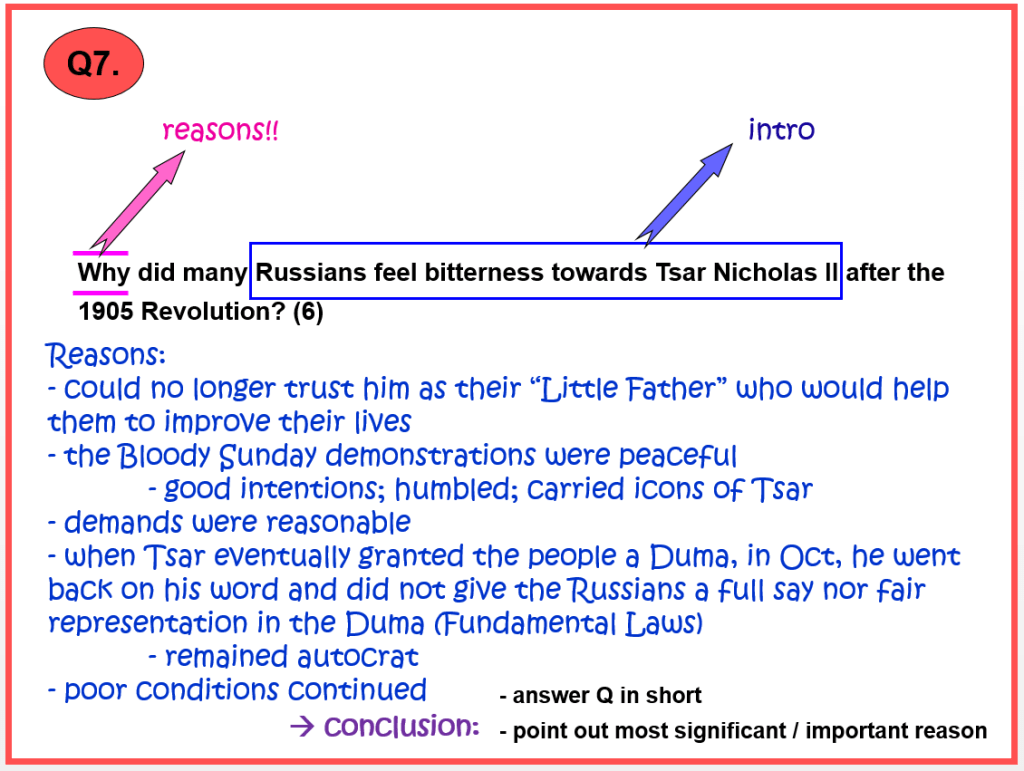
(It was made by students and may shed further light on how to answer this exam question.)
Exam Q on bitterness toward Nicholas II. (3:09 minutes long)
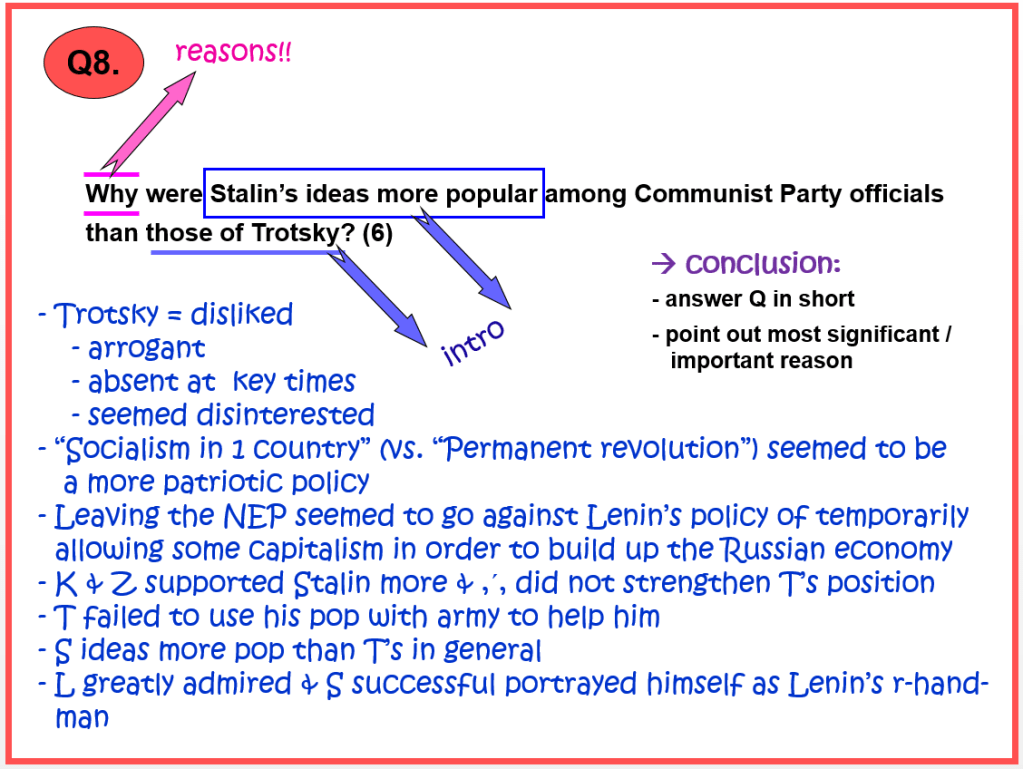
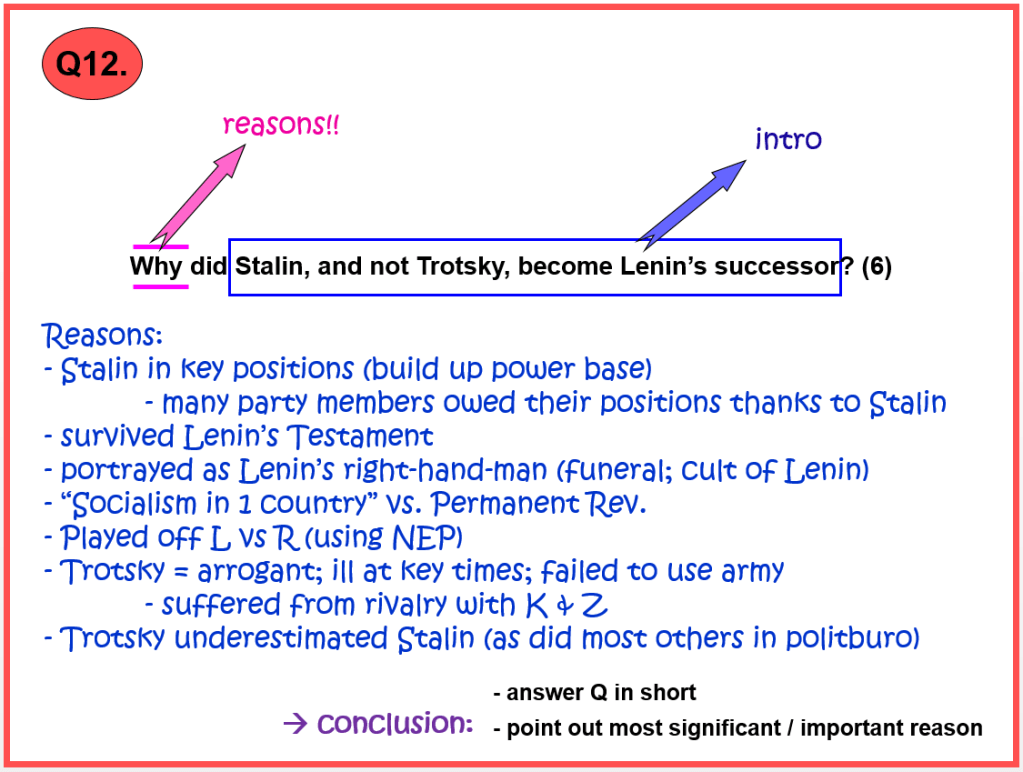
5.
Finally, choose one of the above questions to answer in full. I.e. you need to write the essay answer in your essay writing book for assessment. Below is a flow chart that shows you how to structure your essay answer:
An effective way to answer a Why-Question is to do the following:

(WordPress advertisements may appear below.)
Today you are going to begin working on answering Why-Questions…!
We will use page 67 in your exam preparation Booklet.
1.
Let’s first look at the requirements of a Why-Question!
Why-Questions call for clear reasons, that are very well explained. That is why the making of an explainer video can be so useful in organising the answer to a Why-Question – because you have to clearly formulate the reasons and then clearly explain each one of them!
2.
On page 67 in your Exam Preparation Booklet are some 6-mark questions. In this lesson we will look at Questions 1-6 in more detail.
3.
For each Question:
4.
Now compare your planning with the solutions below. (There are also videos that may give further ideas as to what could have been included in an answer.)
SOLUTIONS


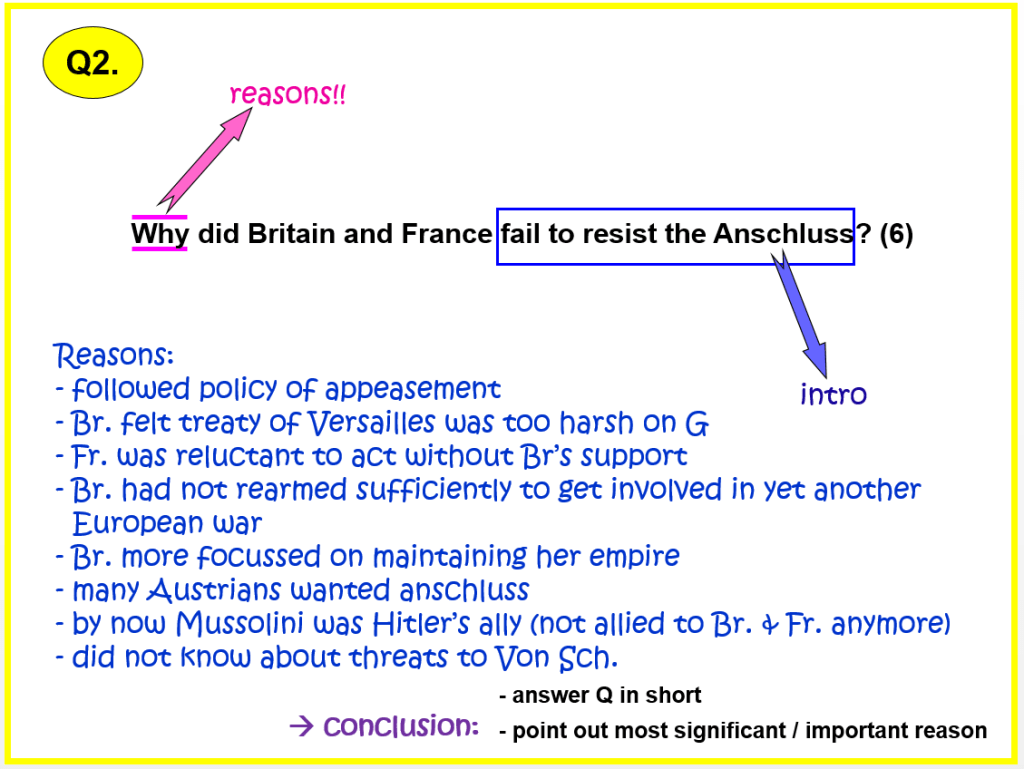
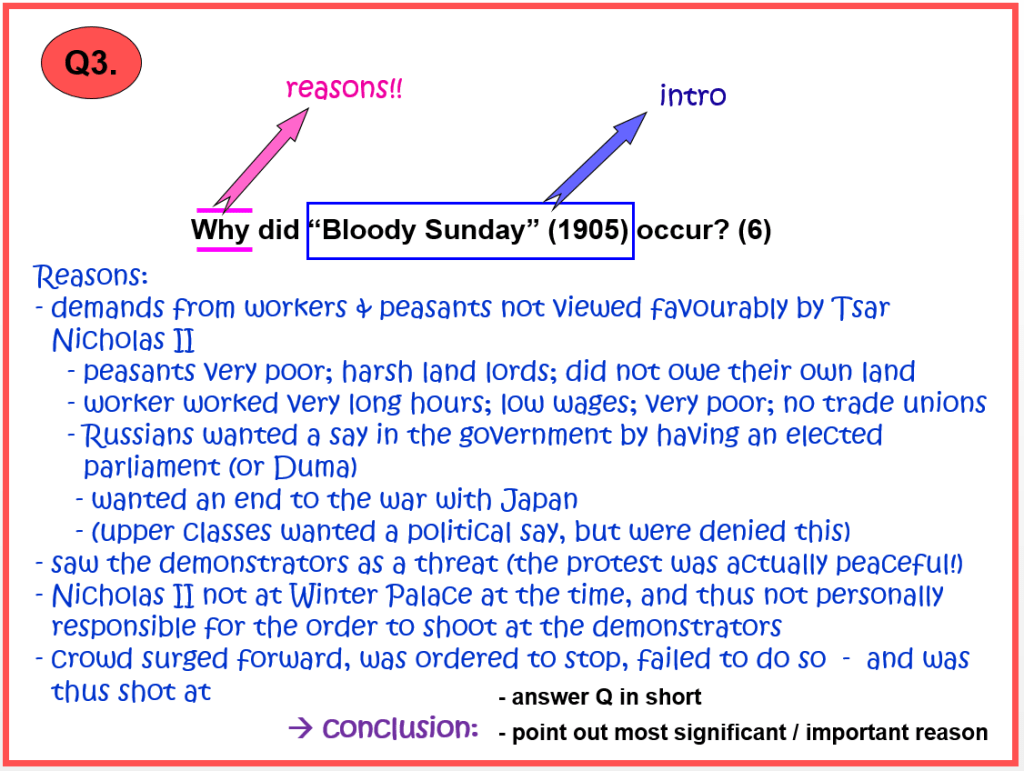
(It was made by students and may shed further light on how to answer this exam question.)
Exam Q on Bloody Sunday (1905). (2:06 minutes long)
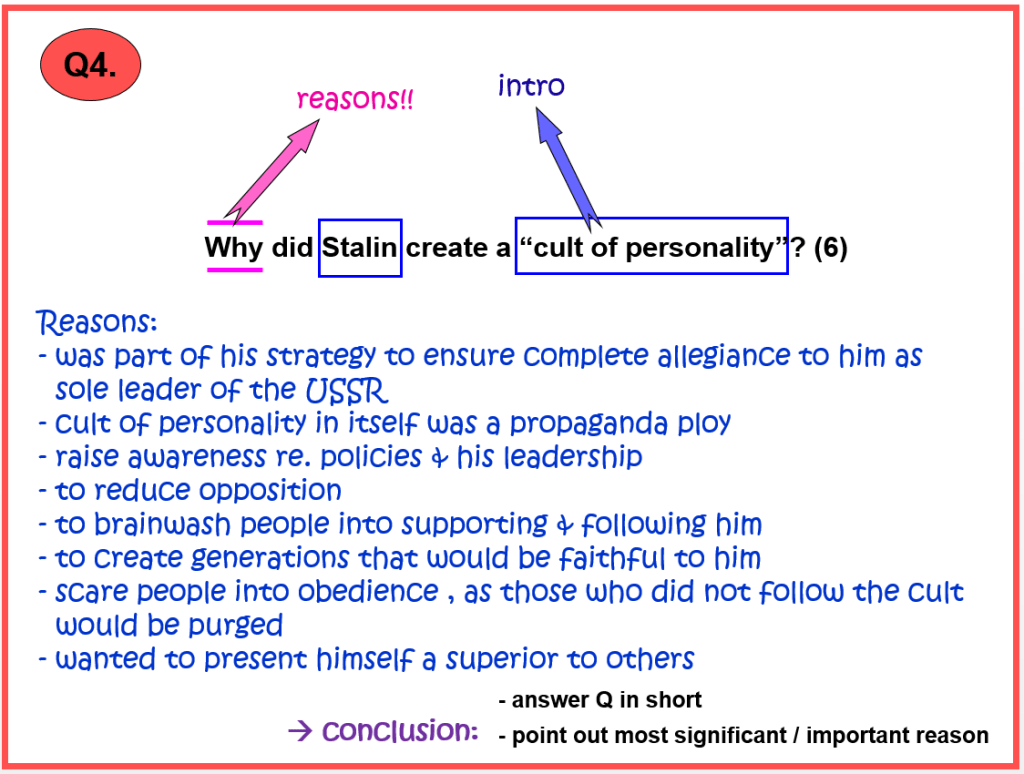
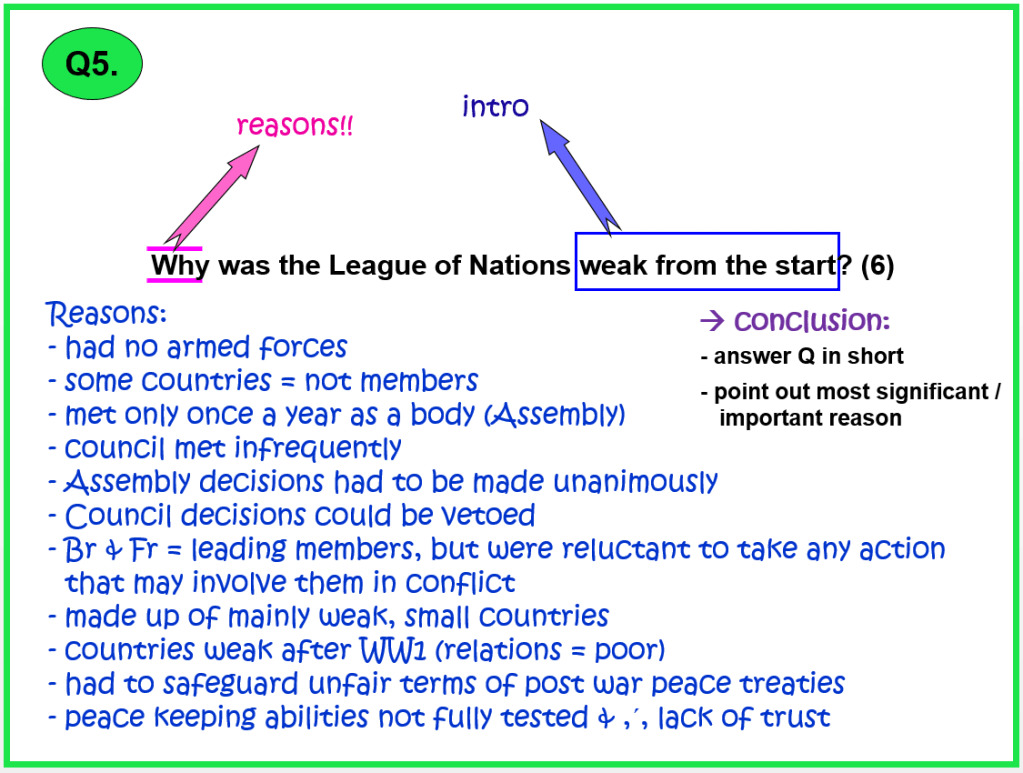
(It was made by students and may shed further light on how to answer this exam question.)
Exam Q on: League of Nations was weak from the start. (3:13 minutes long)
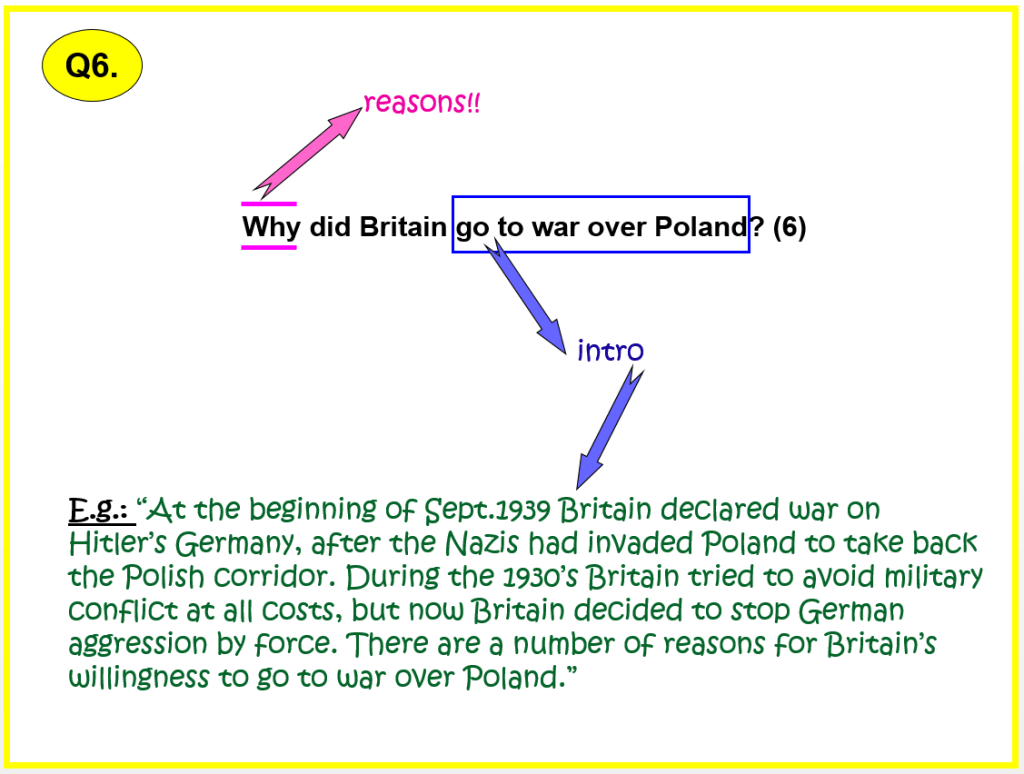
(It was made by students and may shed further light on how to answer this exam question.)
Exam Q on: Start of WW2. (2:40 minutes long)
5.
Finally, choose one of the above questions to answer in full. I.e. you need to write the essay answer in your essay writing book for assessment. Below is a flow chart that shows you how to structure your essay answer:
An effective way to answer a Why-Question is to do the following:
(WordPress advertisements may appear below.)
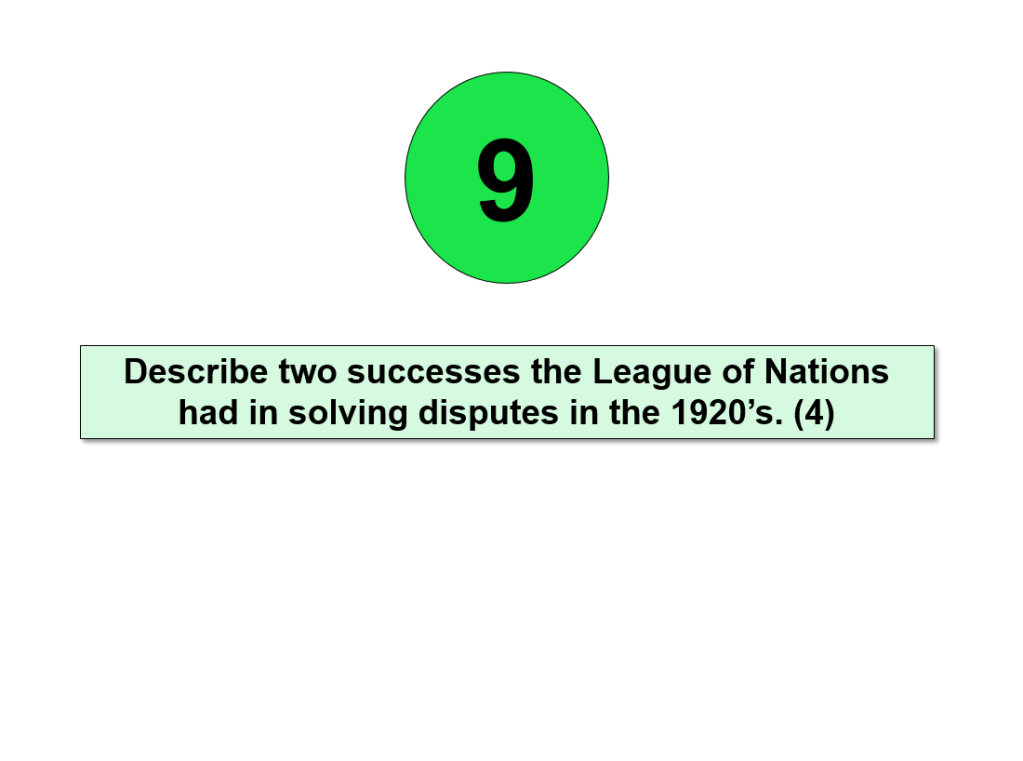
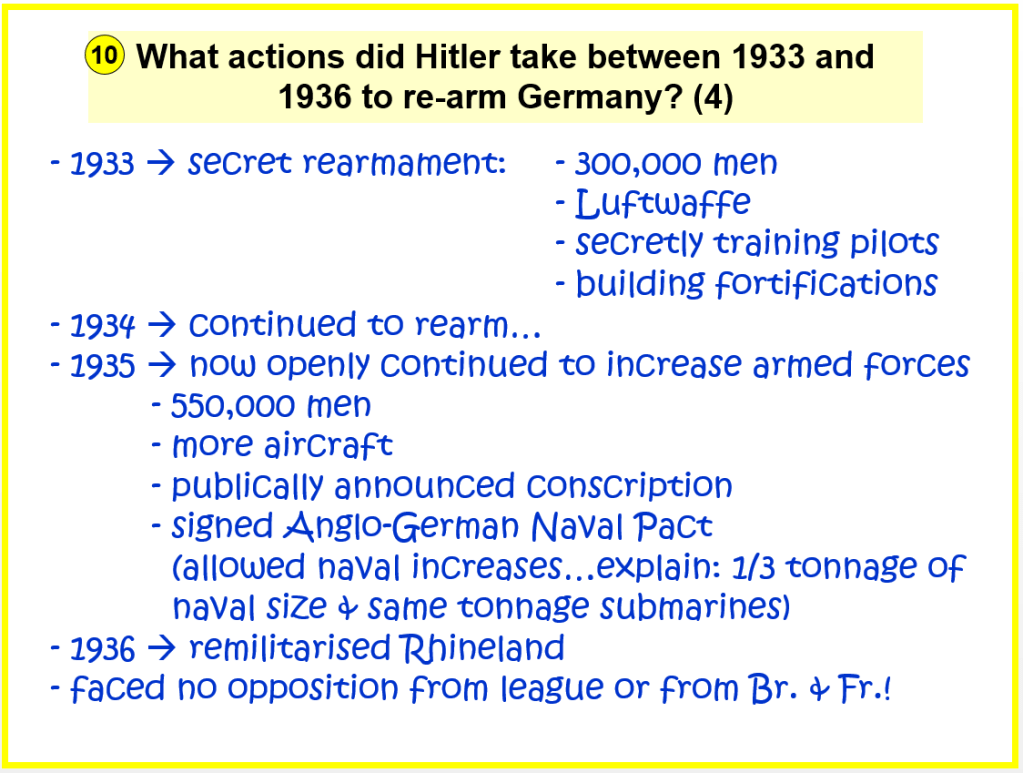
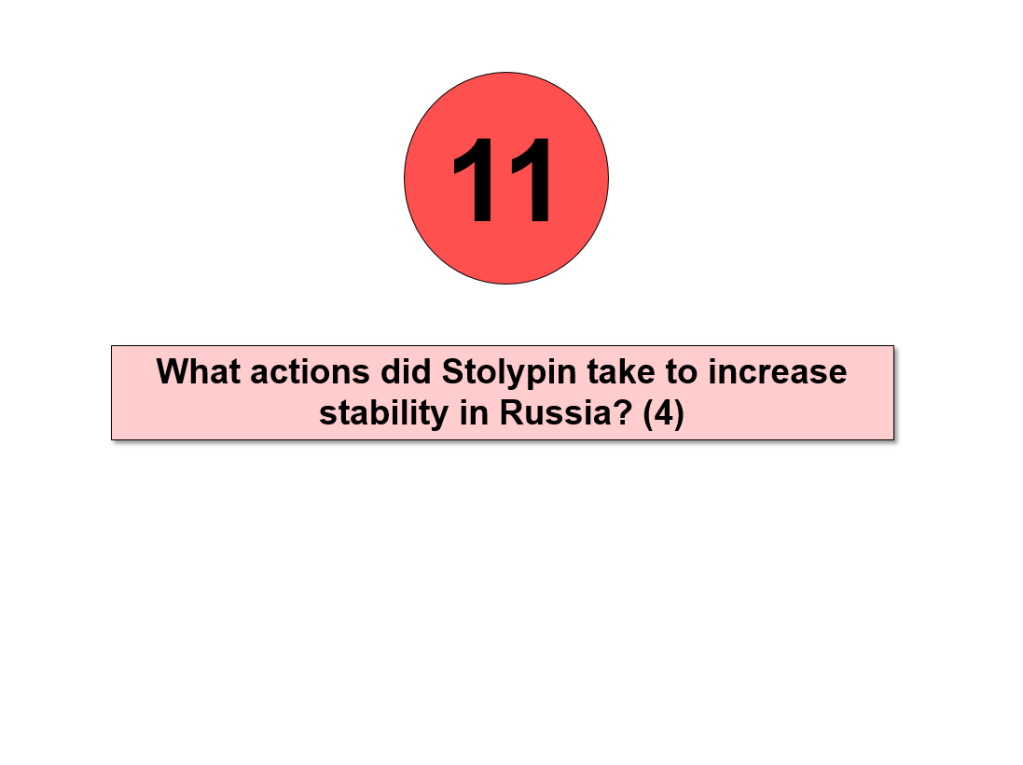
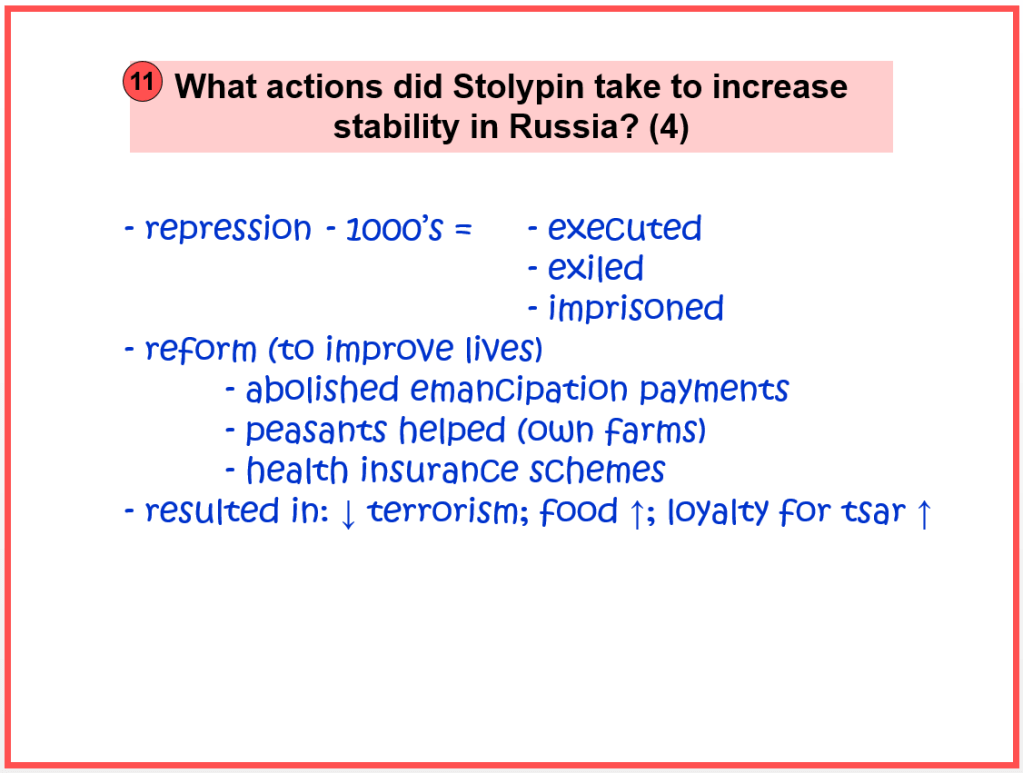
Today you are going to begin working on answering Paper 2 4-mark Questions…!
We will use page 66 in your exam preparation Booklet.
Let’s talk 4-mark Questions…

So, this is a “straight-forward” Question… that often starts with “what”, “how”, or “describe”. (The 4-mark questions are fairly easy – make sure that you get full marks for them!)
This question requires of you to write a short paragraph. For 4 marks you need to give four pieces of information to answer the question, or you need to explain two pieces of relevant information that answers the question.
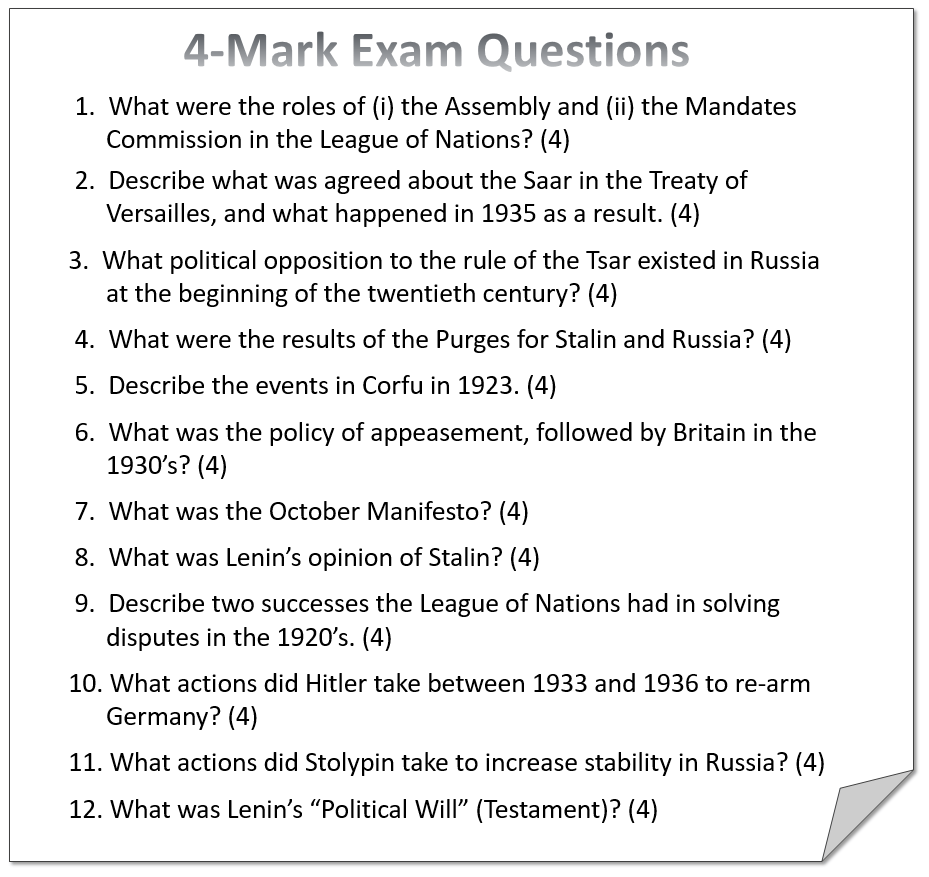
1.
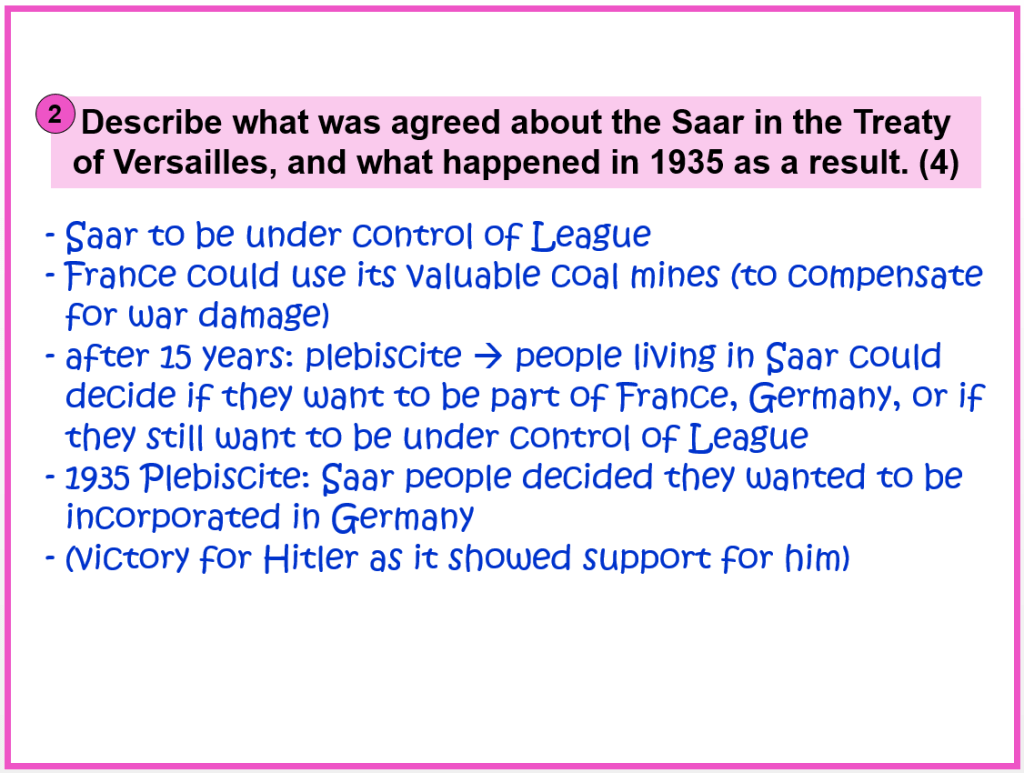
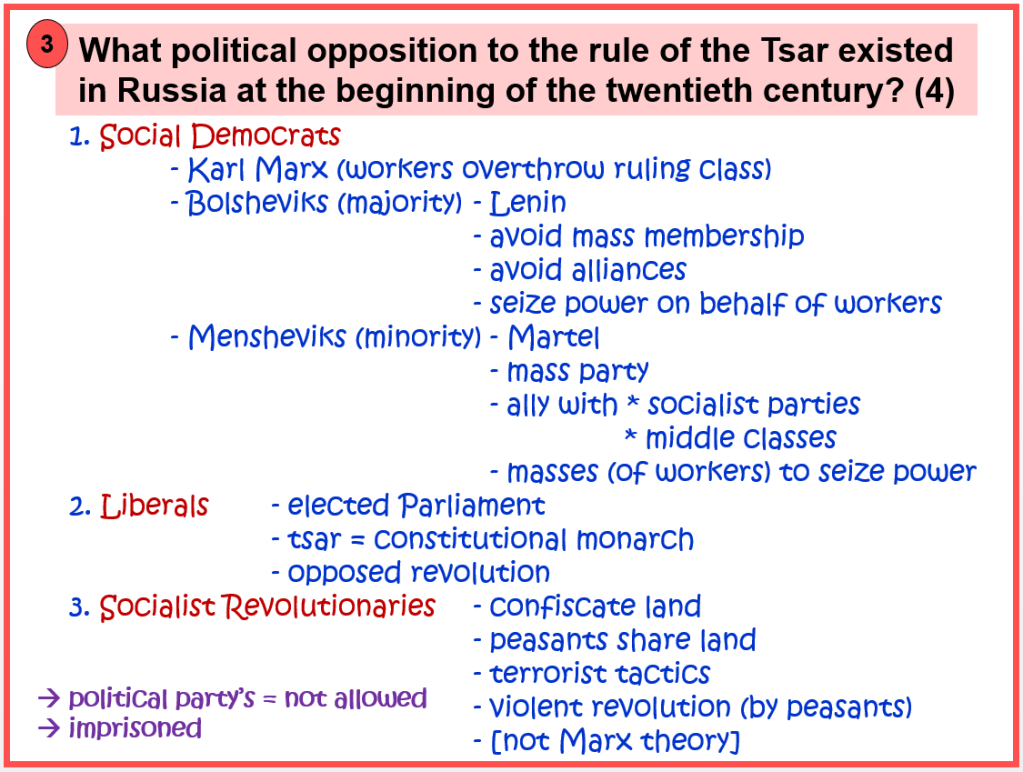
Now answer the four questions (from the following list of 4-mark questions) assigned to you in full. (Complete this in your essay writing book.)
You have 5 minutes to complete an answer…
2.

Read your best answer to the rest of the class.
3.
Now swap books to peer mark the rest of the 4-mark questions.
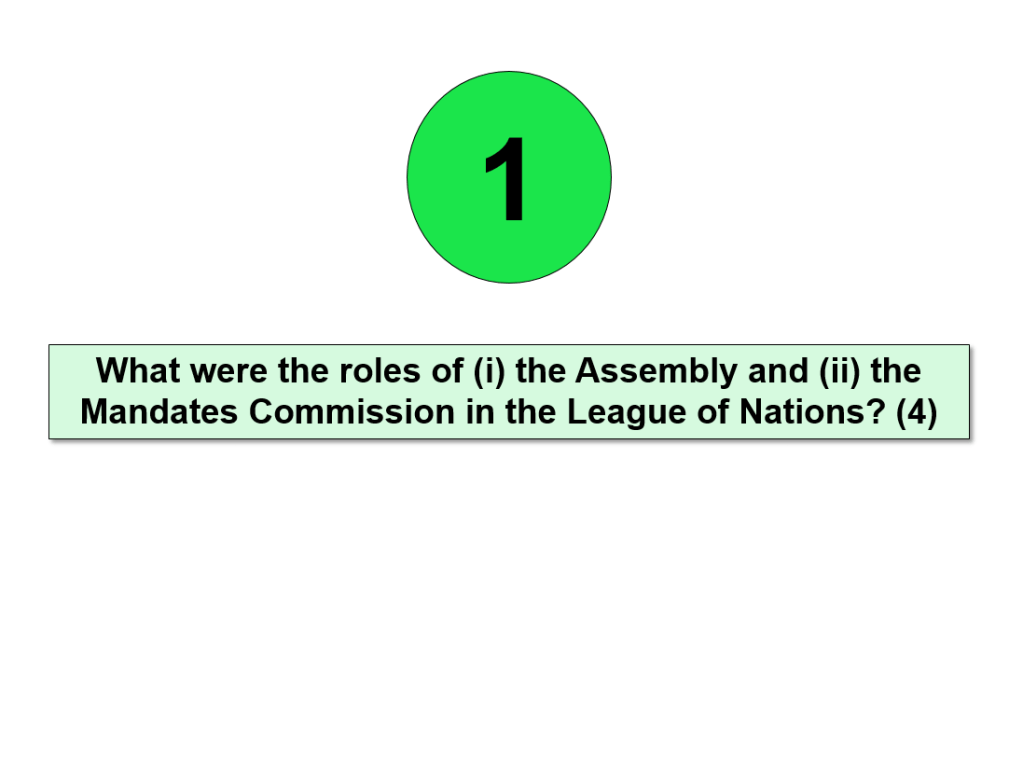
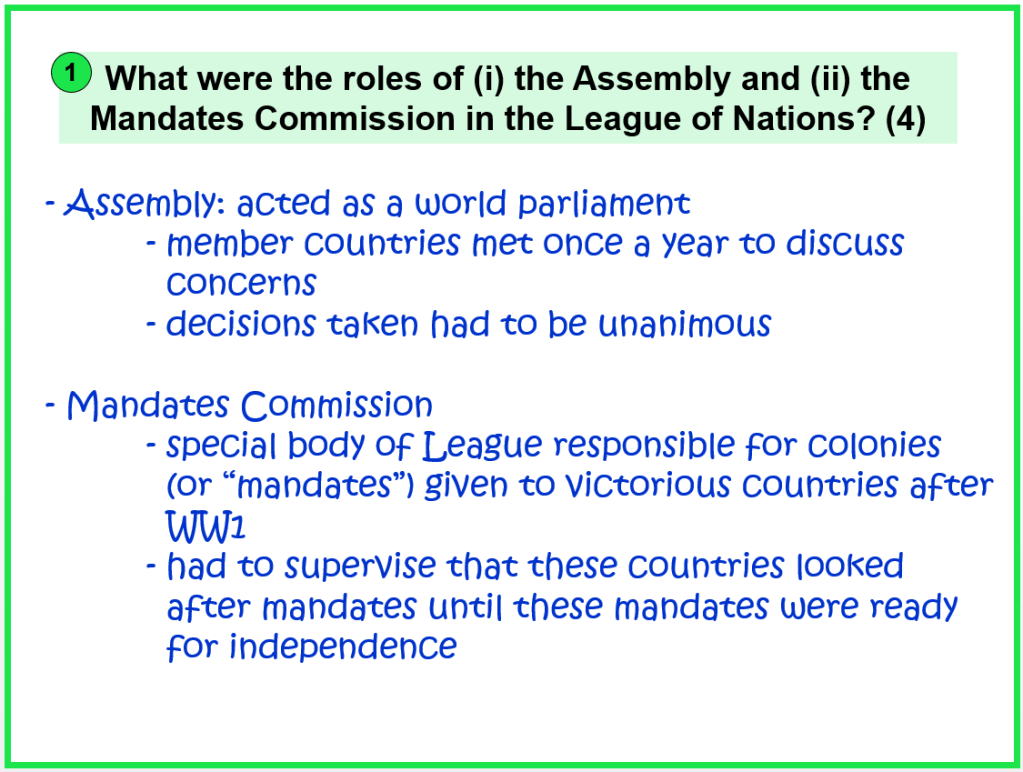
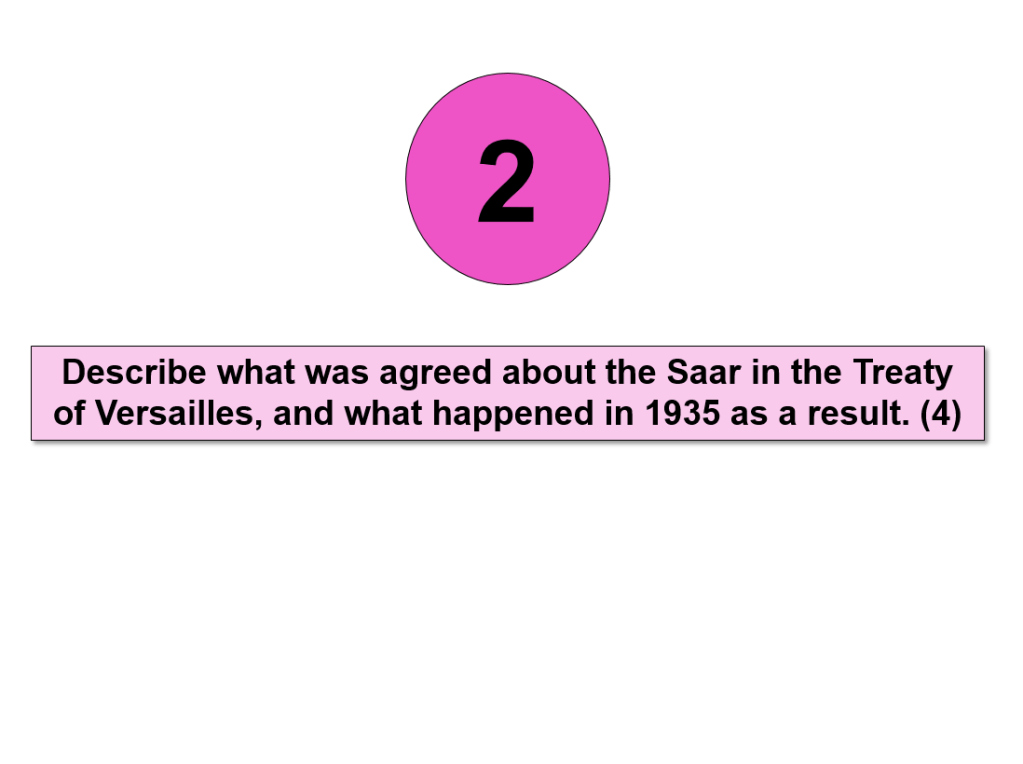
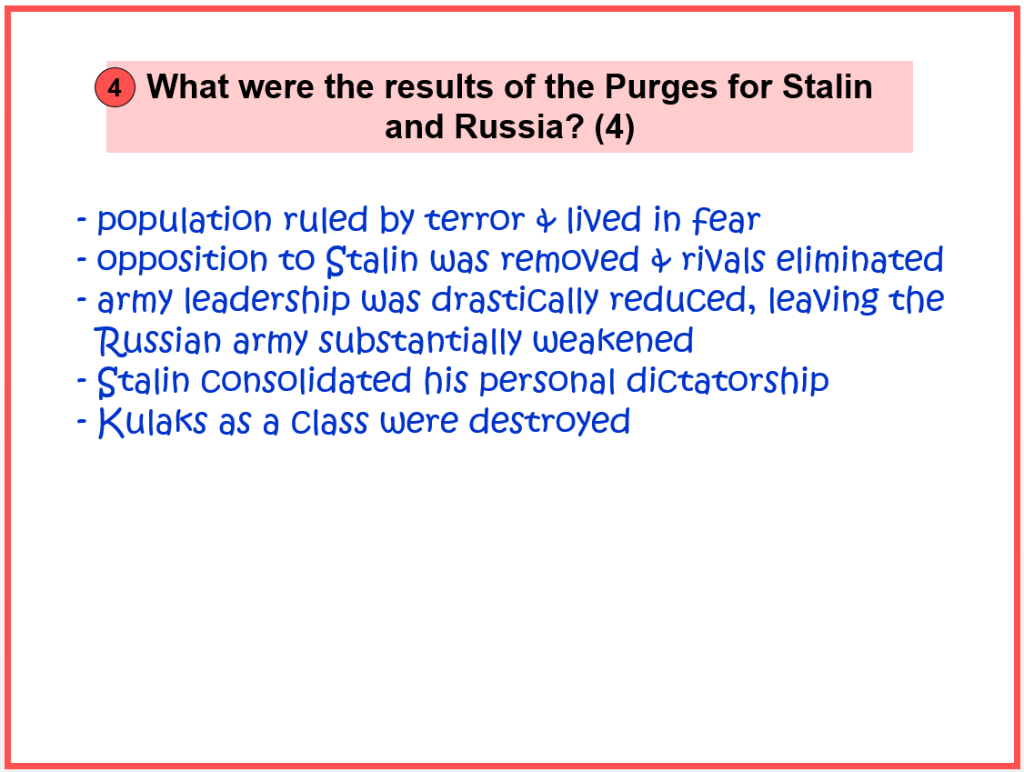
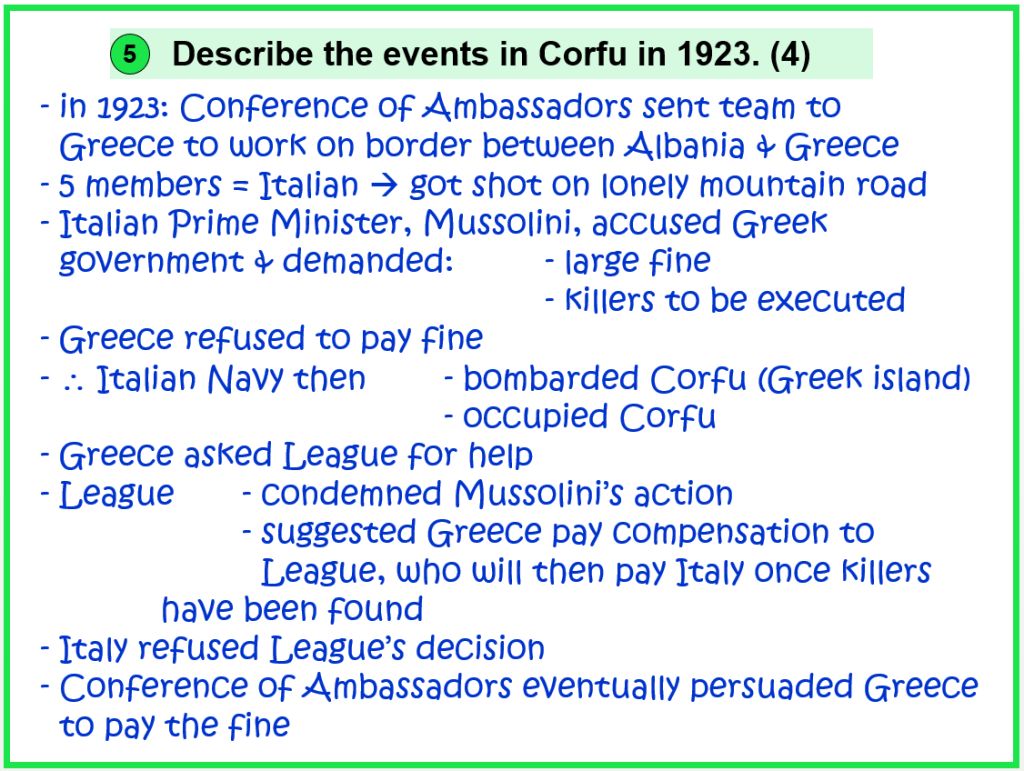
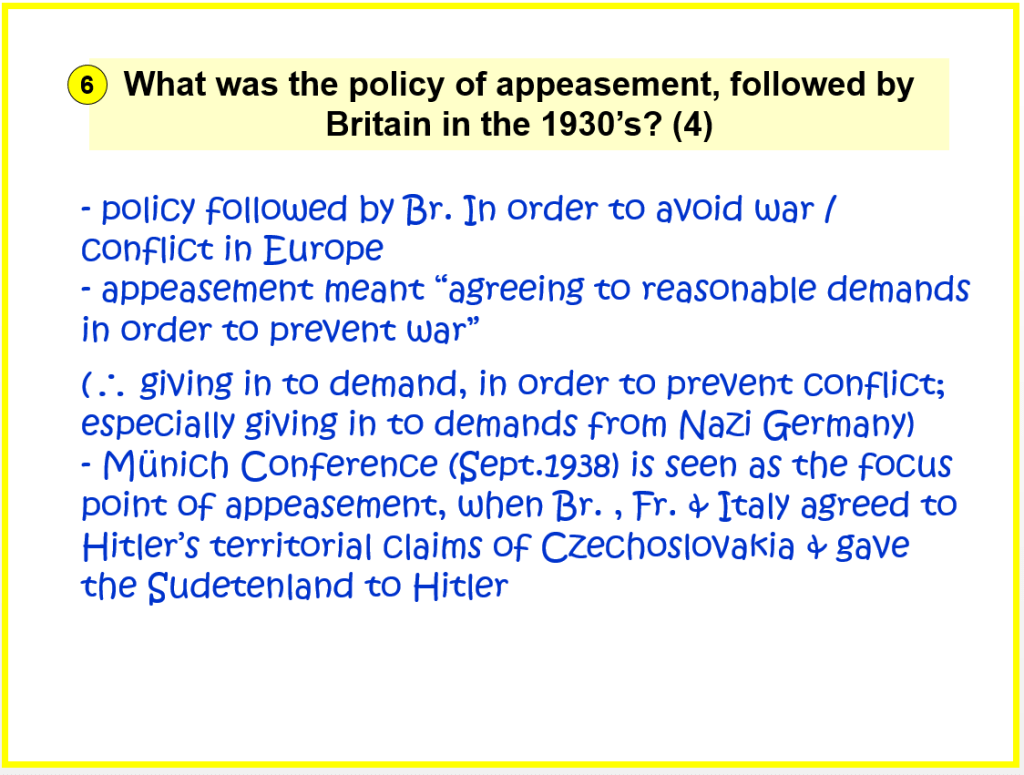
SOLUTIONS

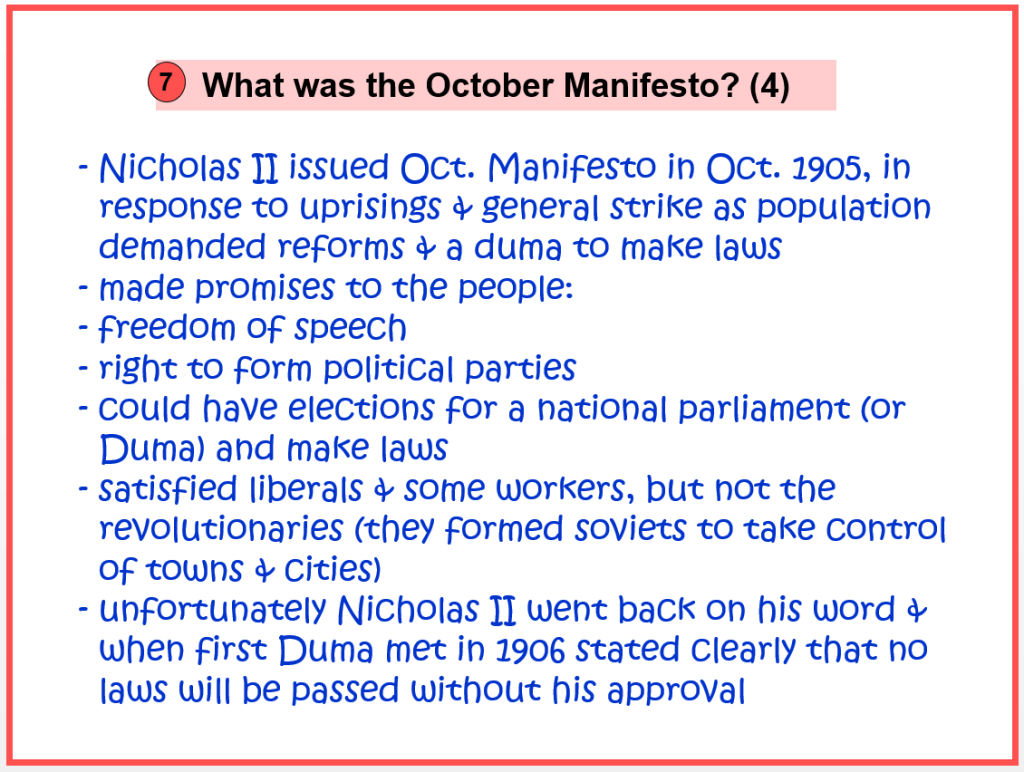
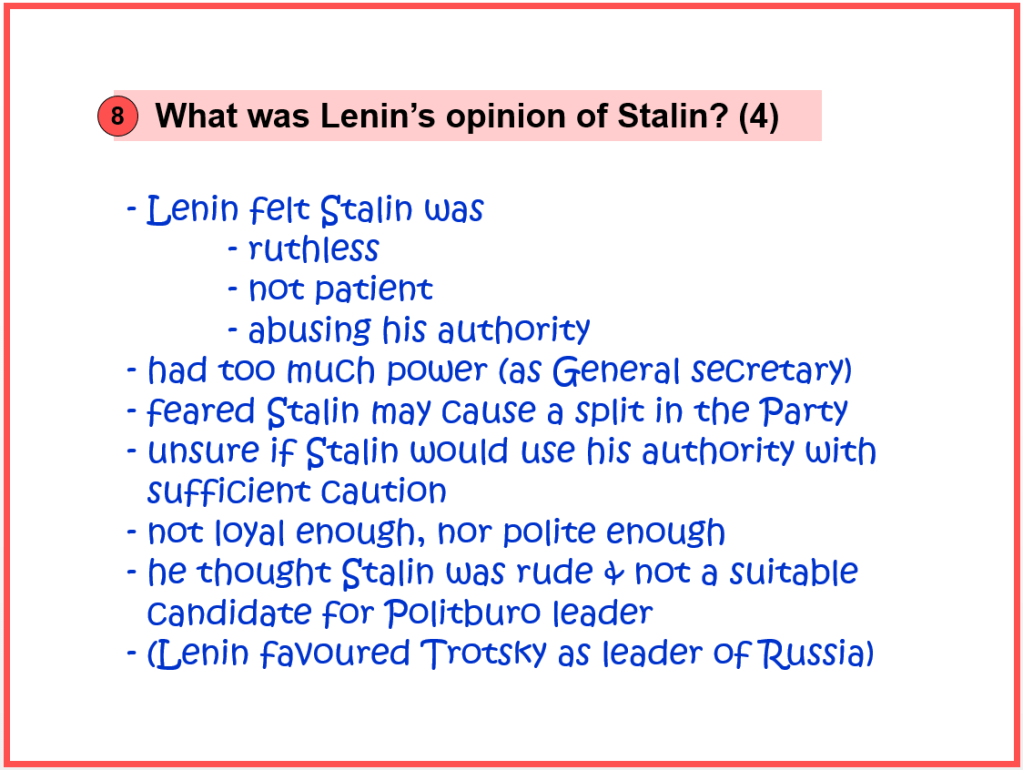



(WordPress advertisements may appear below.)
Today we will continue with the two exam papers from the previous lesson, in preparation for your Paper 2 examination….

We will:

Your homework for today was to revise the “Soviet Control over Eastern Europe” topic…
Below are two Paper 2 exam papers:
HUNGARY- 1956
CZECHOSLOVAKIA – 1968
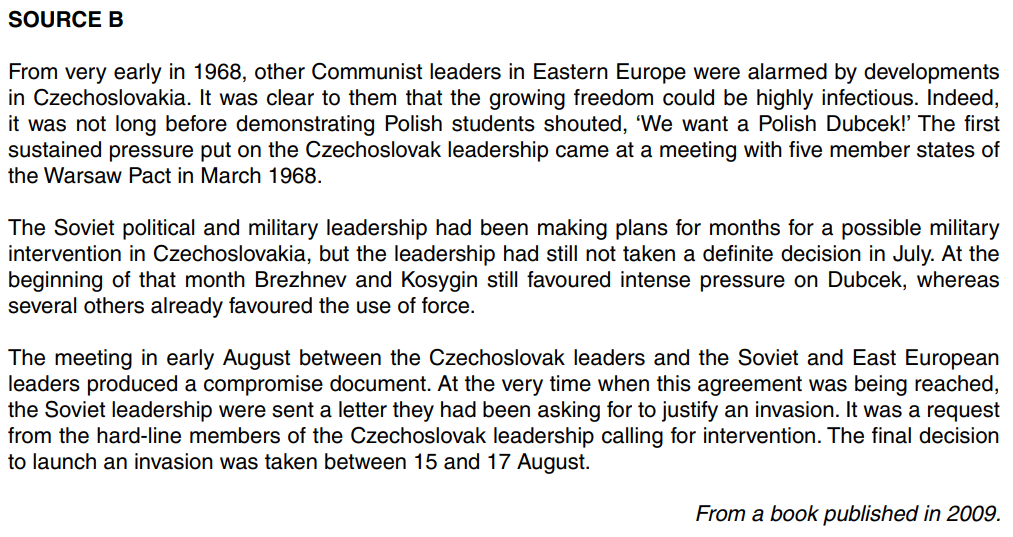
Source B has been removed from the above Paper. Below is a replacement Source:
1.
Complete the analysis as well as the answering of the questions that you started with in the previous lesson.
2.
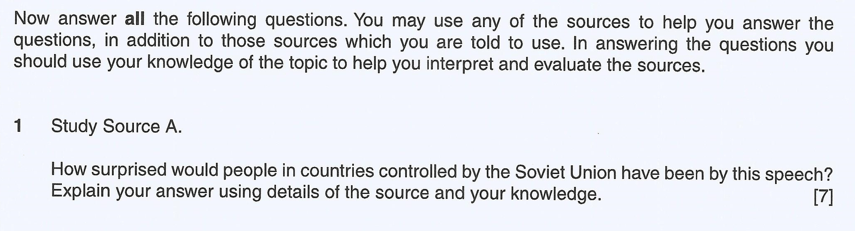
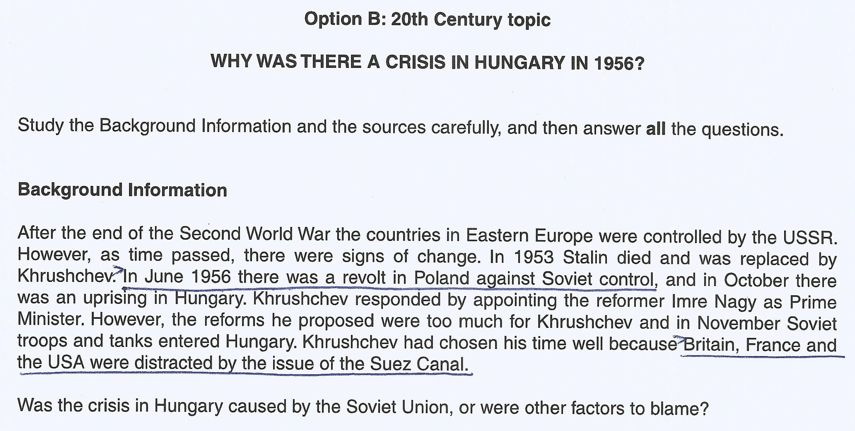
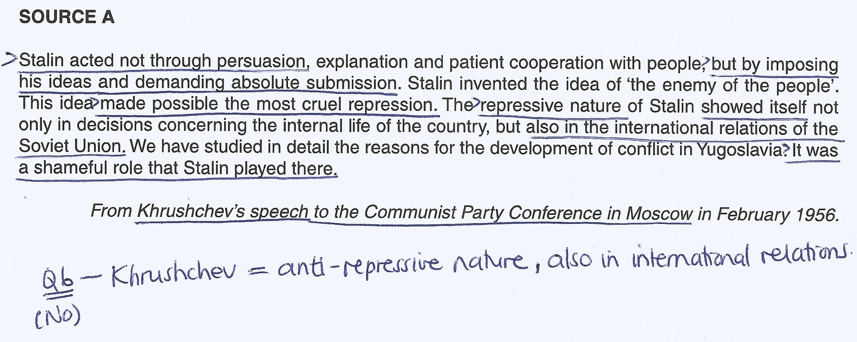
Here are possible solutions to the exam paper on Hungary (1956).
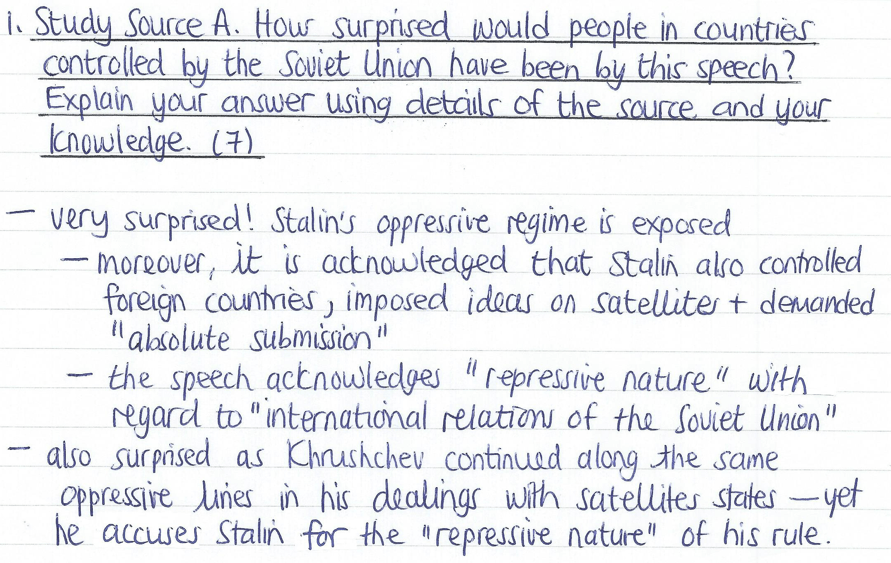
QUESTION 1.

QUESTION 2.

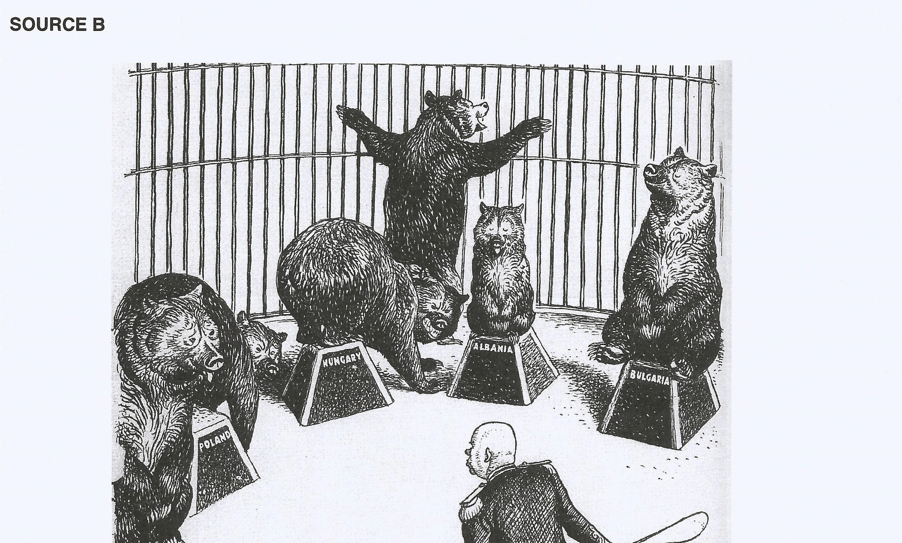

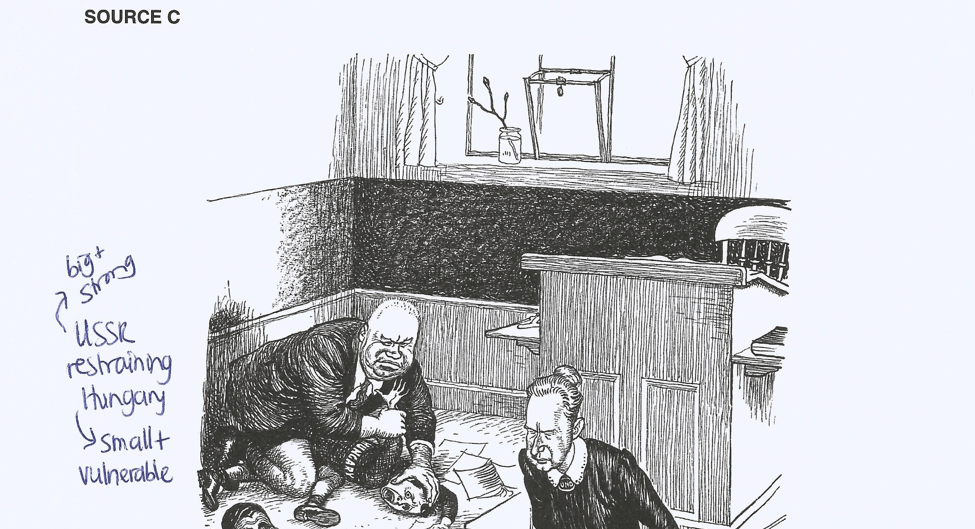
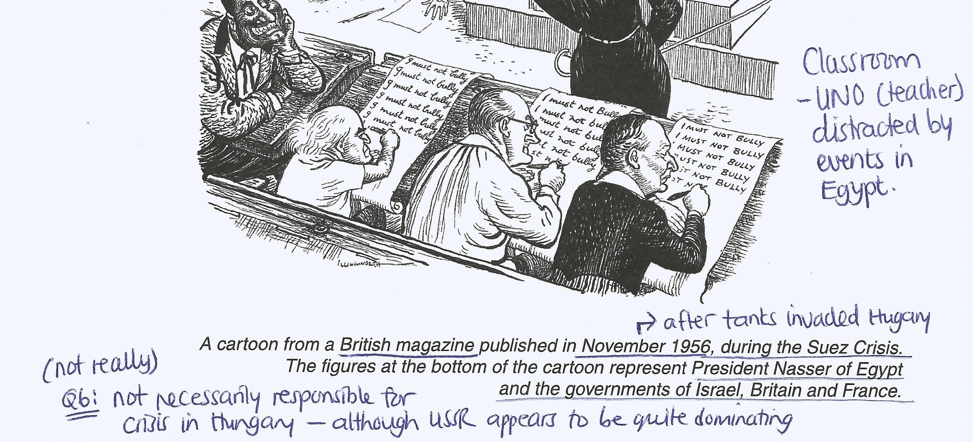

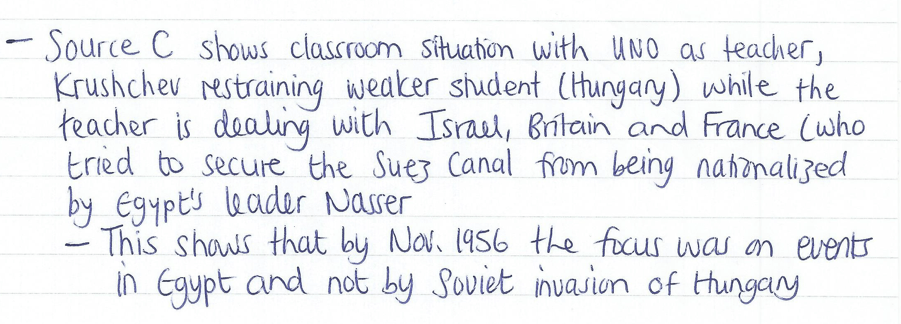
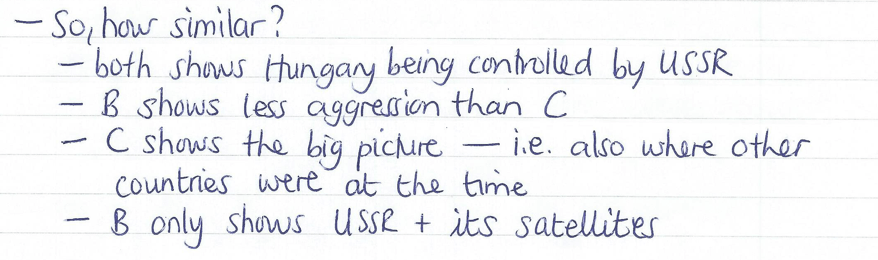
QUESTION 3.

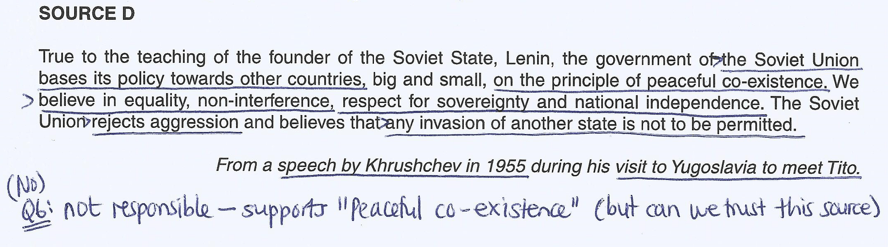
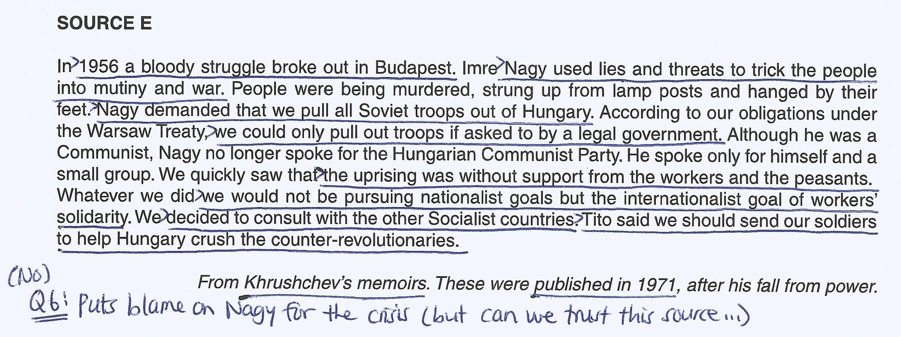
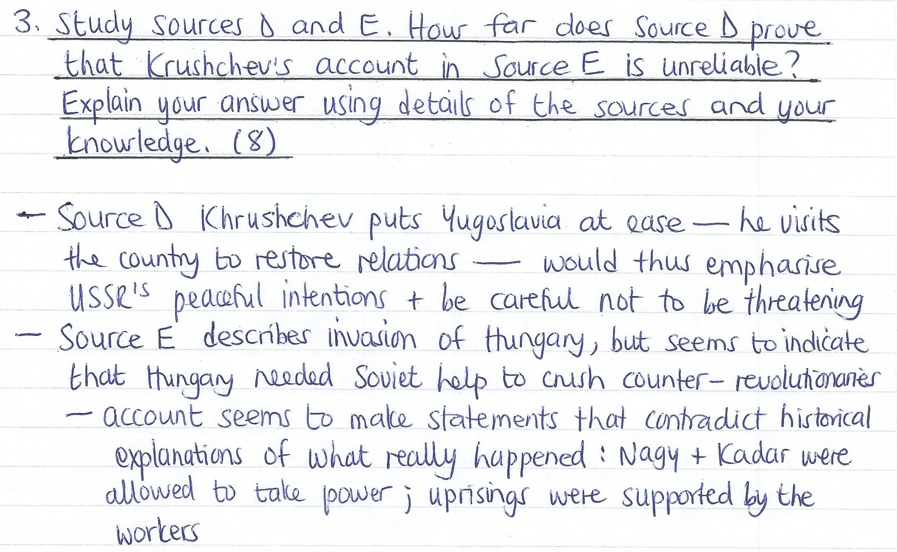

QUESTION 4.

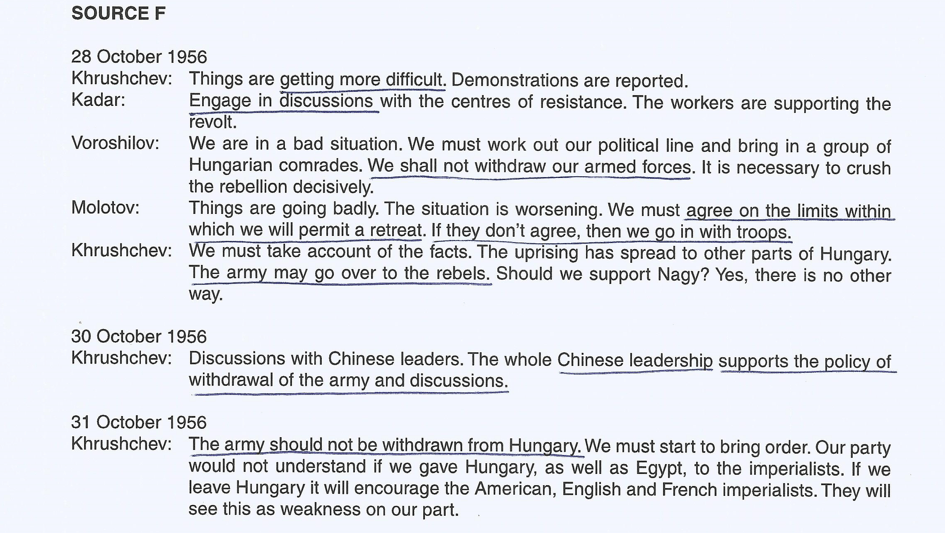
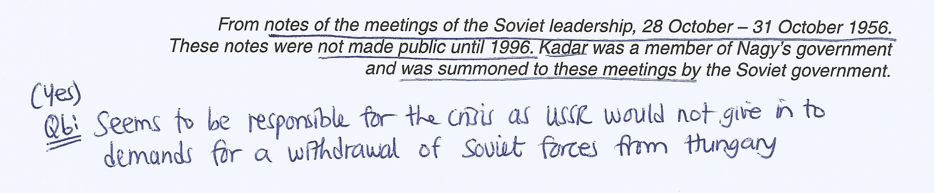
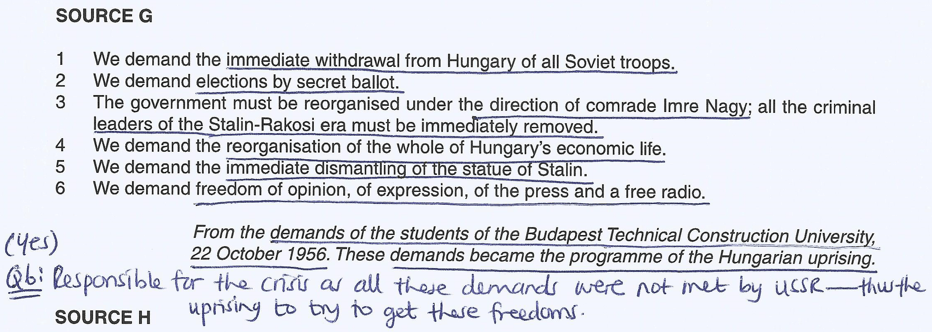
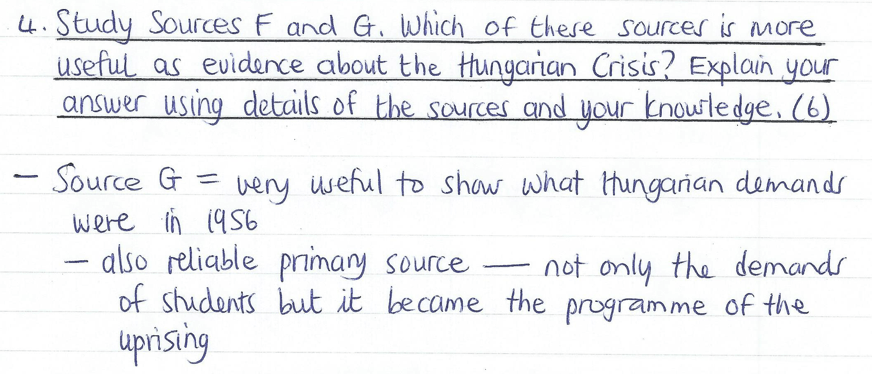
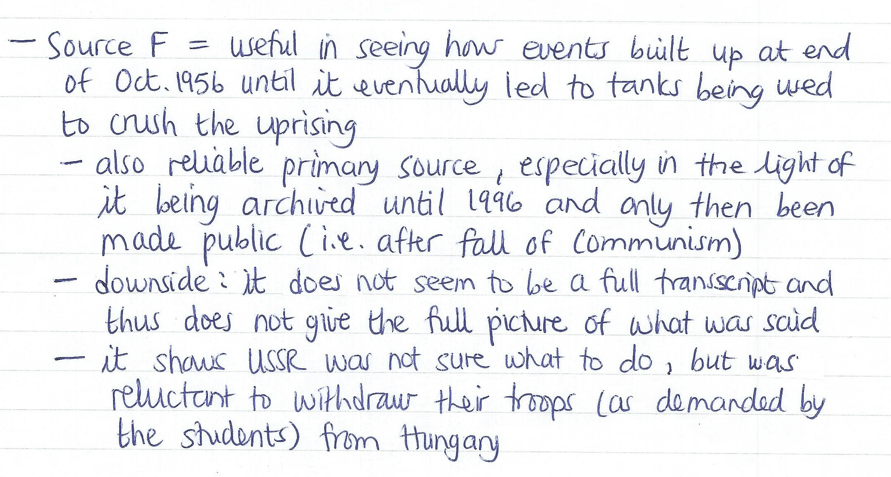
QUESTION 5.


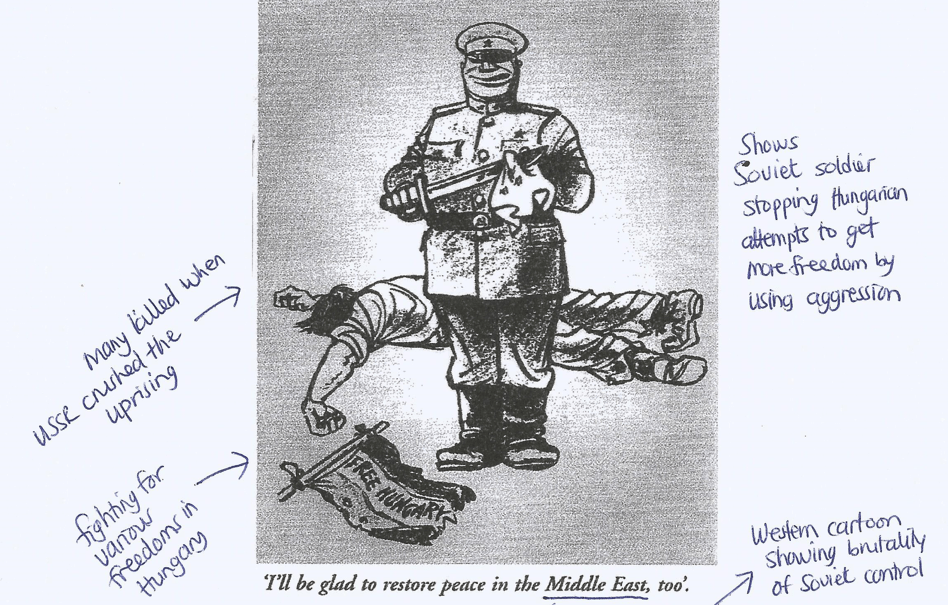
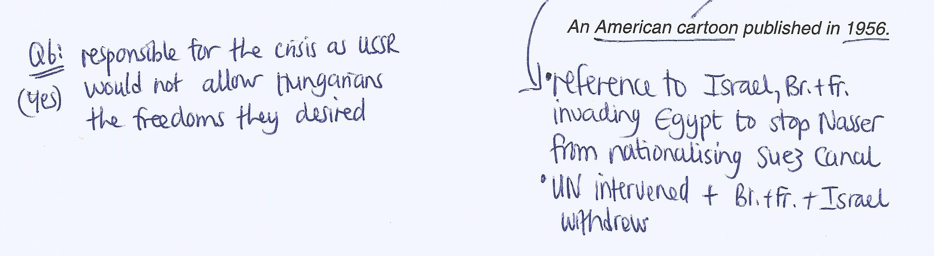
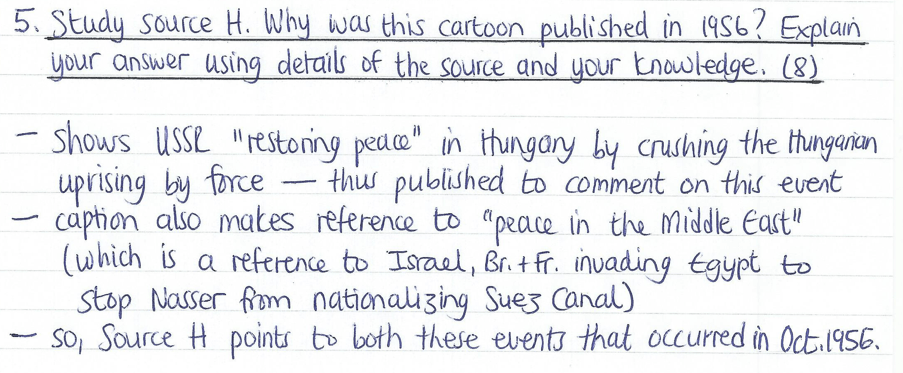
QUESTION 6.

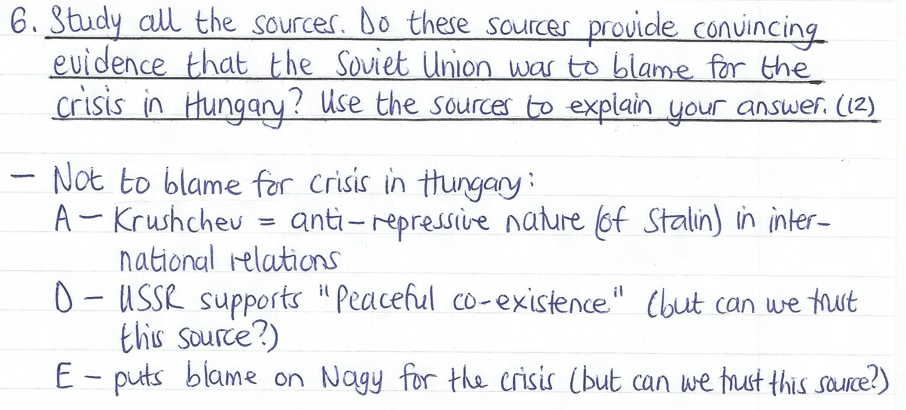
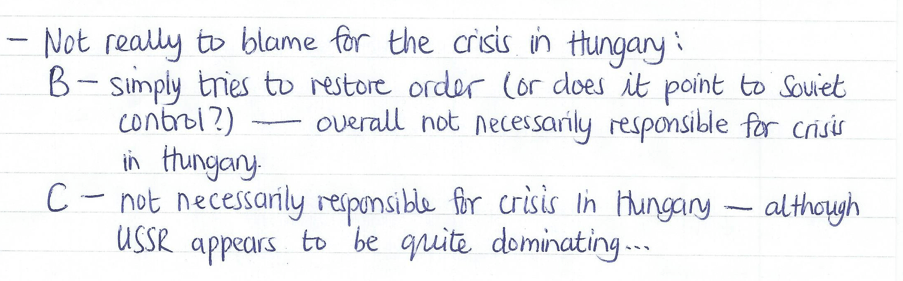
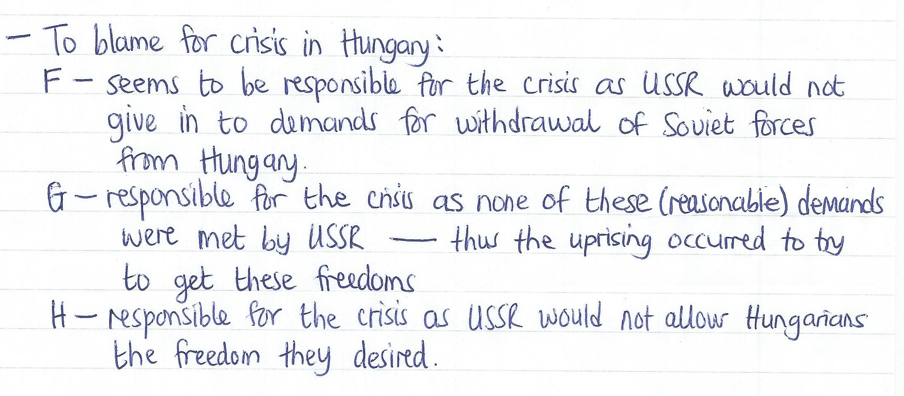
3.
Here are possible solutions to the exam paper on Czechoslovakia (1968).
QUESTION 1.
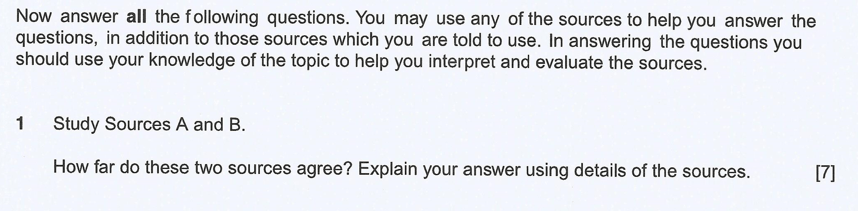
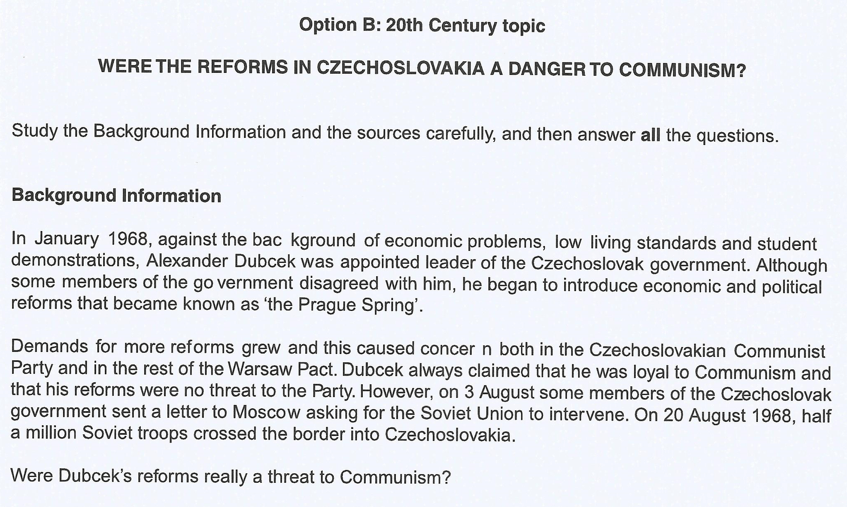
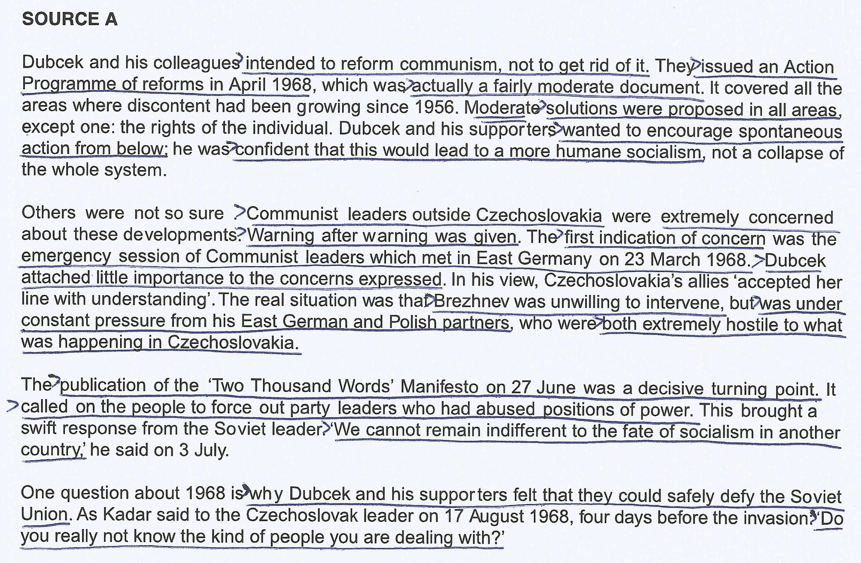

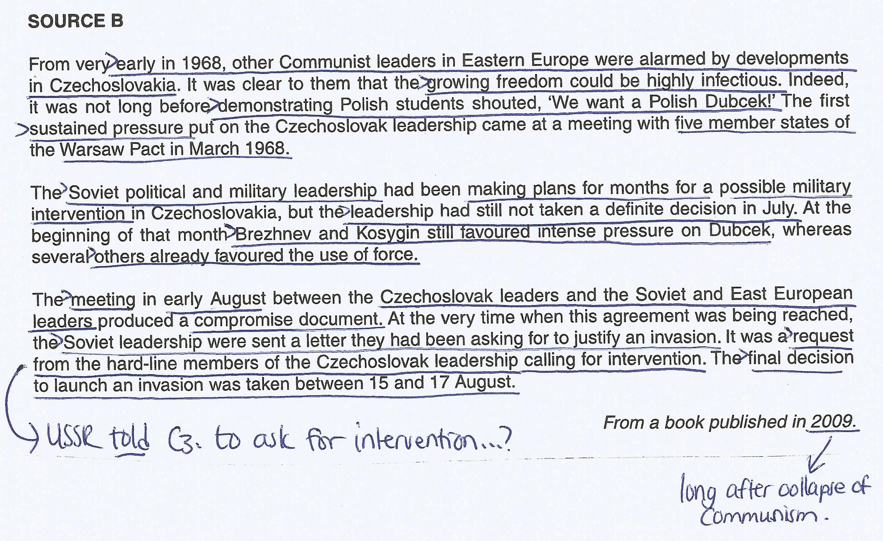
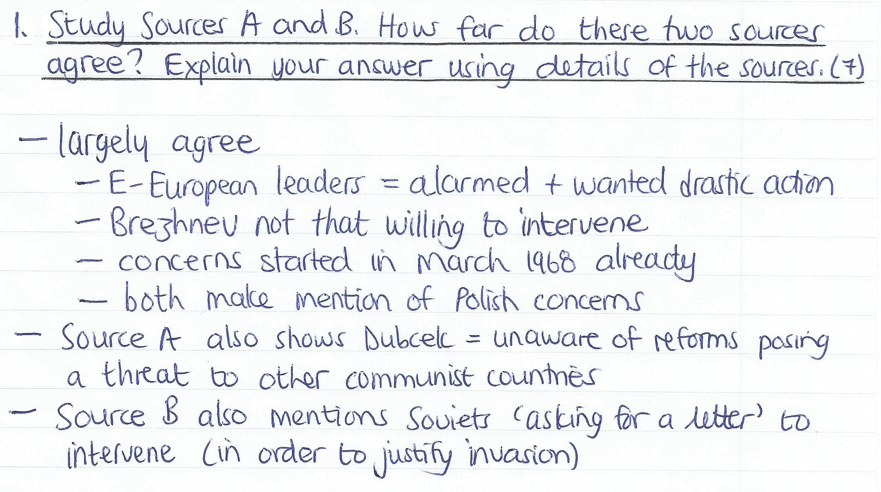
QUESTION 2.

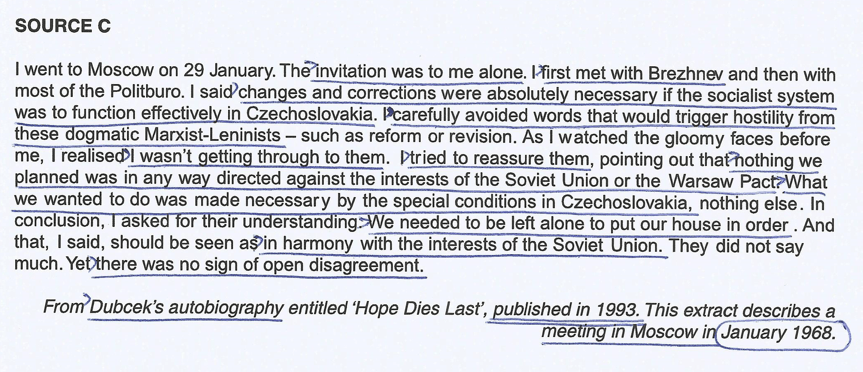
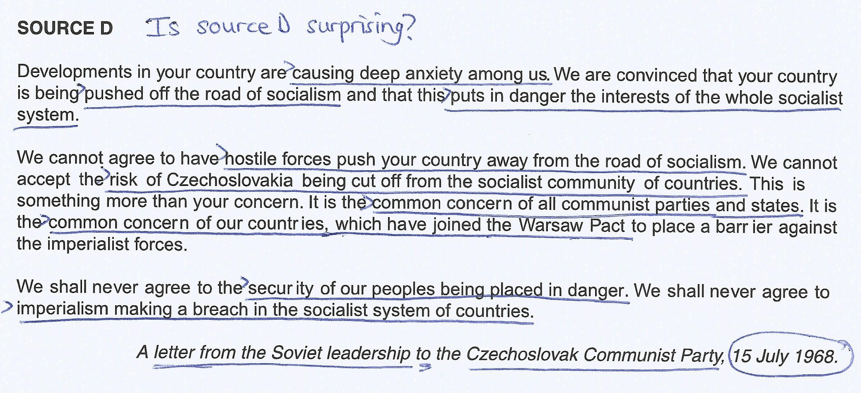

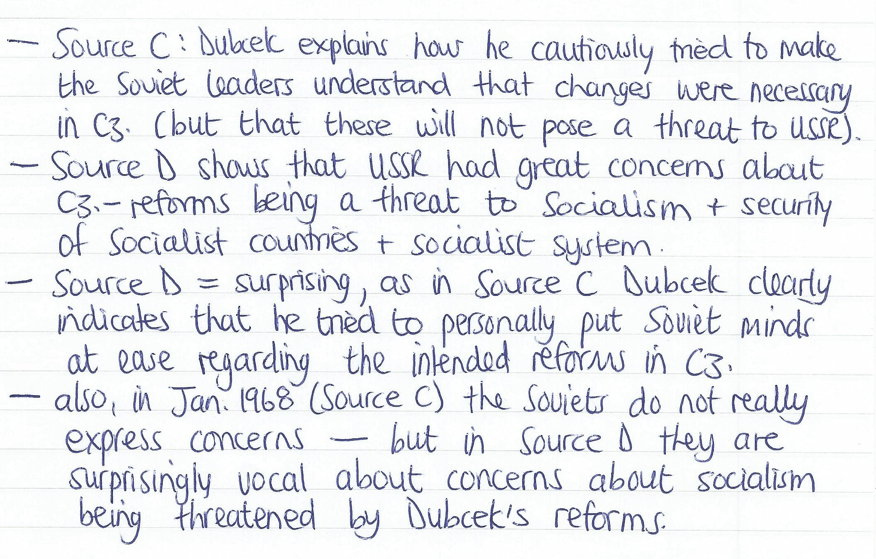
QUESTION 3.

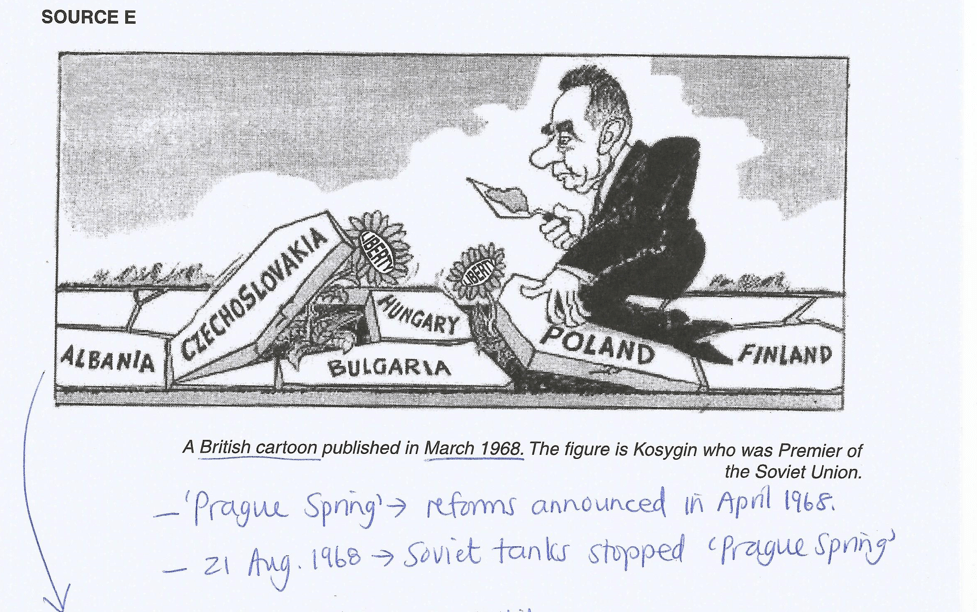
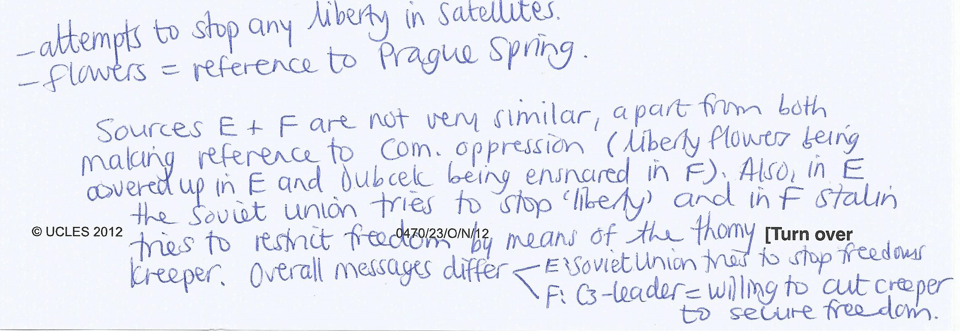
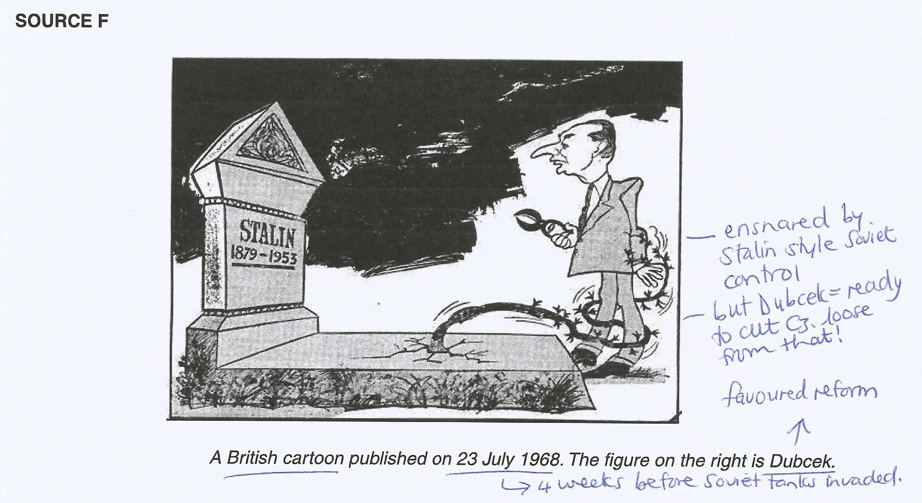
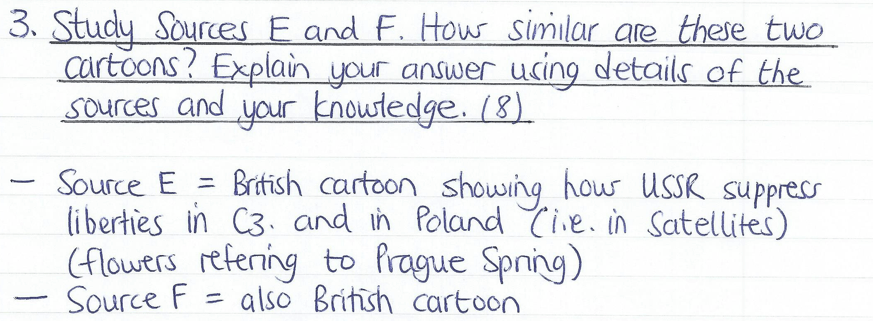
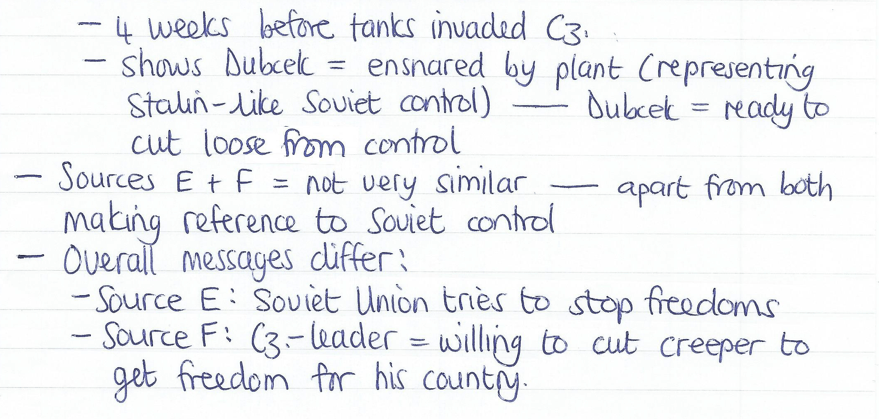
QUESTION 4.

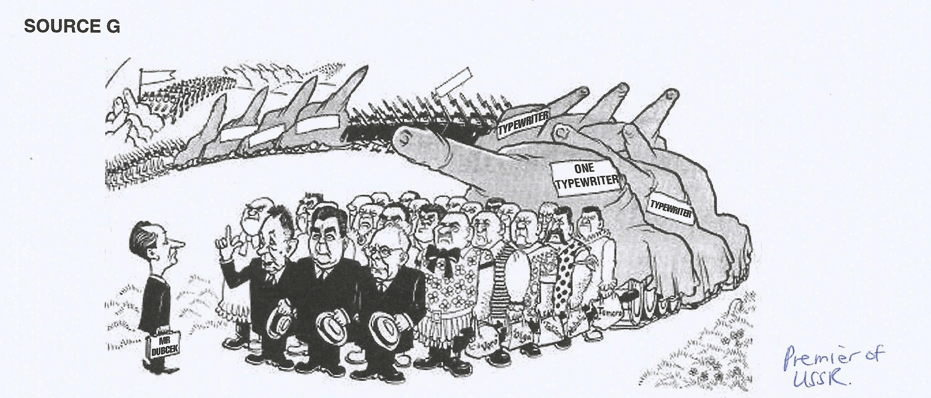
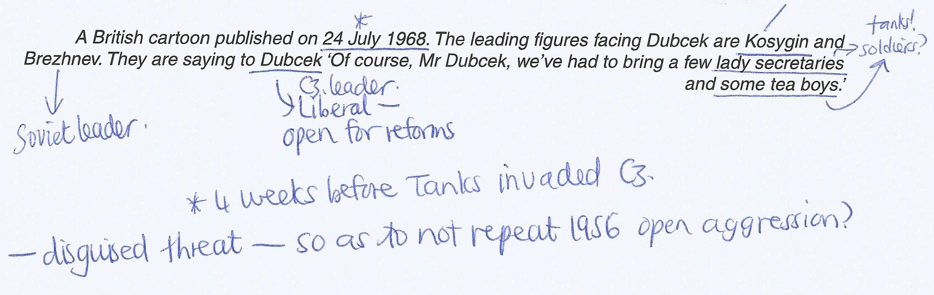
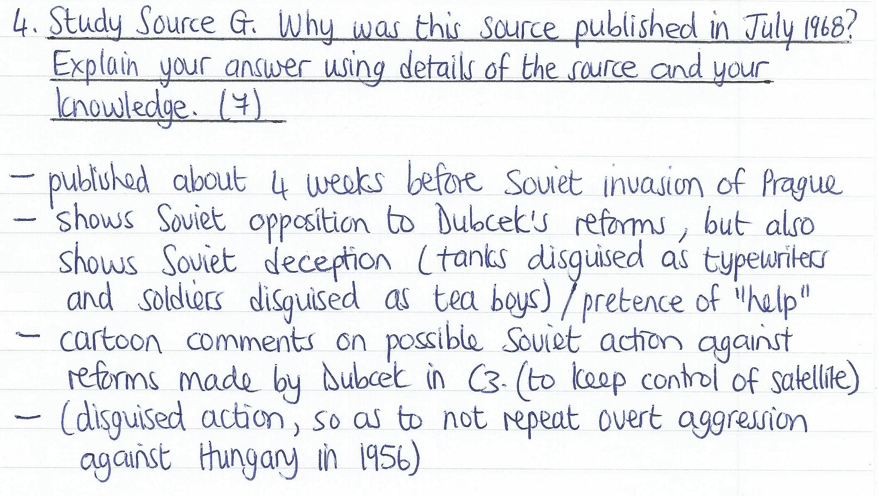
QUESTION 5.

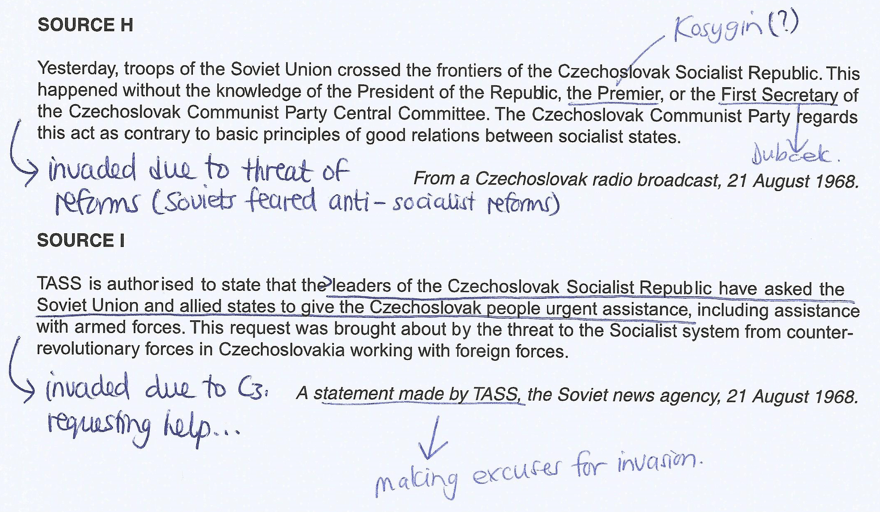
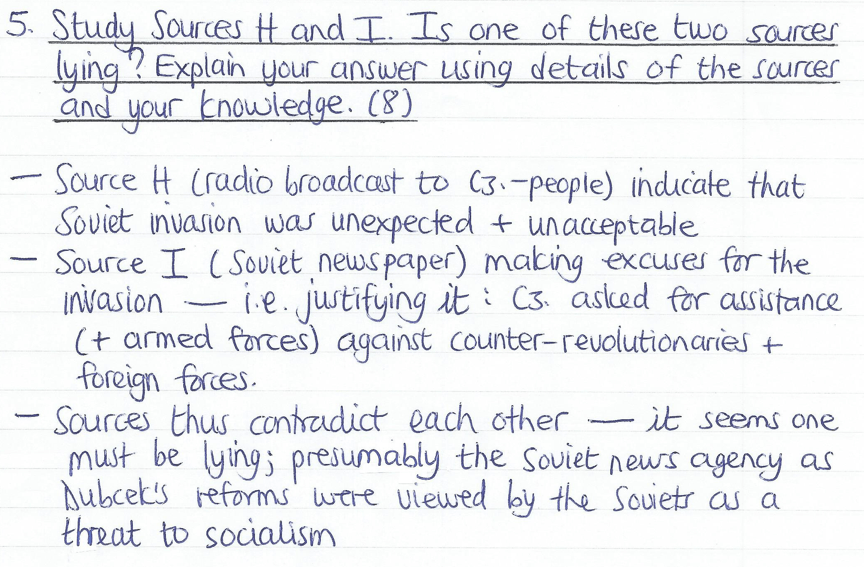
QUESTION 6.


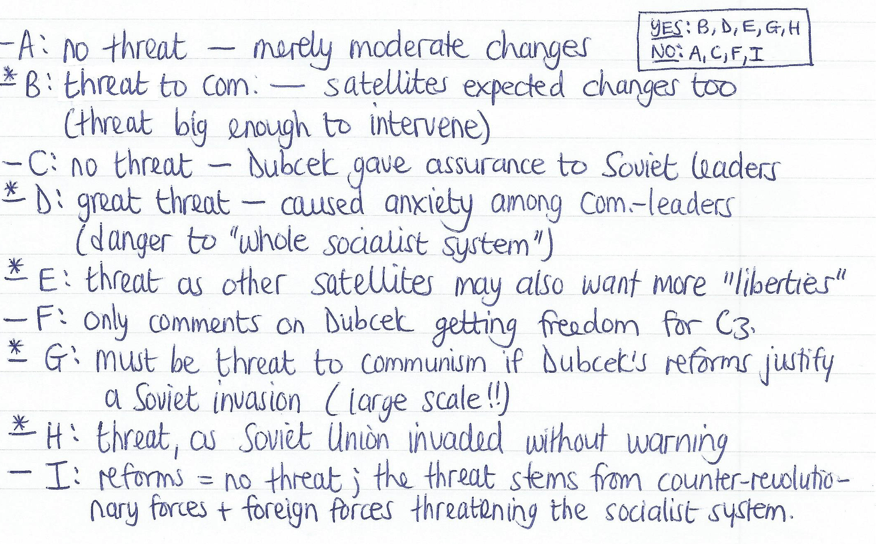
(WordPress advertisements may appear below.)
Today you are going to:
a) Do revision on Russian History, 1924-1941.
b) Look at some Russian History Questions.
1.
Look at the following video clip – to briefly revise the Russian History:
Stalin – Overview (12:11 minutes long)
2.
Now look Questions 11 – 20 on p.32-37 of your Exam Preparations Booklet. These are not necessarily typical exam questions, but these questions guide you as to what you need to know for the exam. So, to prepare yourself thoroughly, plan possible answers to Q.11 – Q.20.

Use your Exam Preparations Booklet, p.32-37.
(Please do not hesitate to ask me if you struggle with any of these questions!)
3.
SOLUTIONS

Stalin’s Rule.
QUESTION 11.
How did Stalin gain and hold on to power?
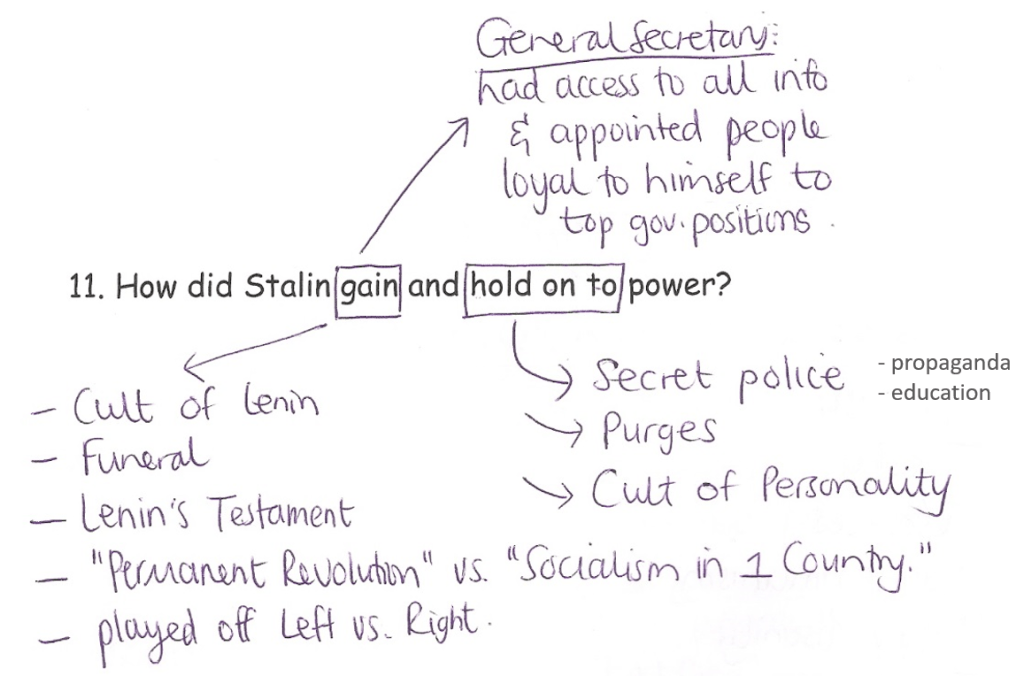
QUESTION 12.
Why did Stalin, and not Trotsky, emerge as Lenin’s successor?

QUESTION 13.
Why did Stalin launch the Purges?
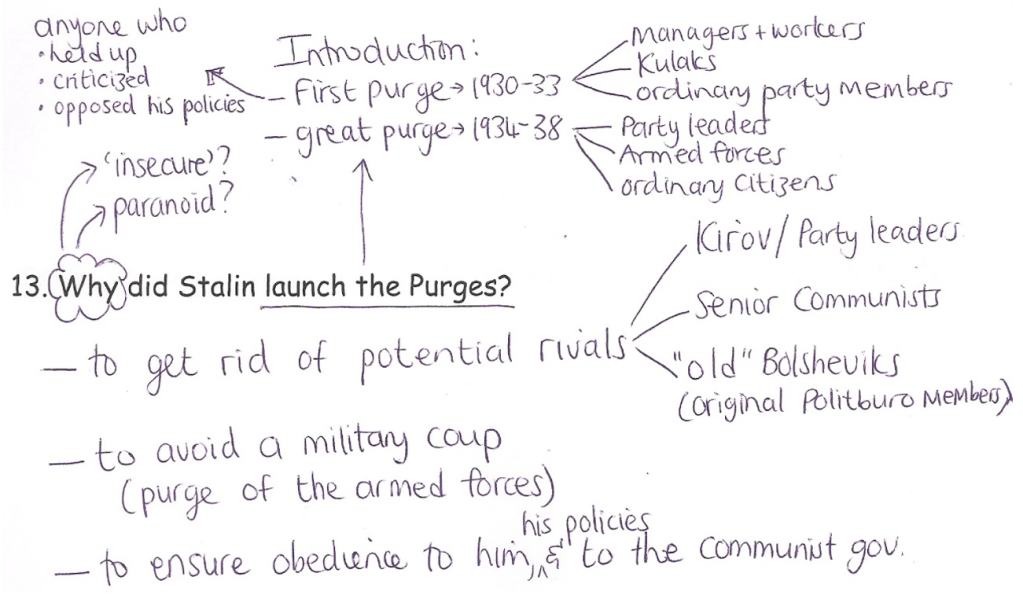
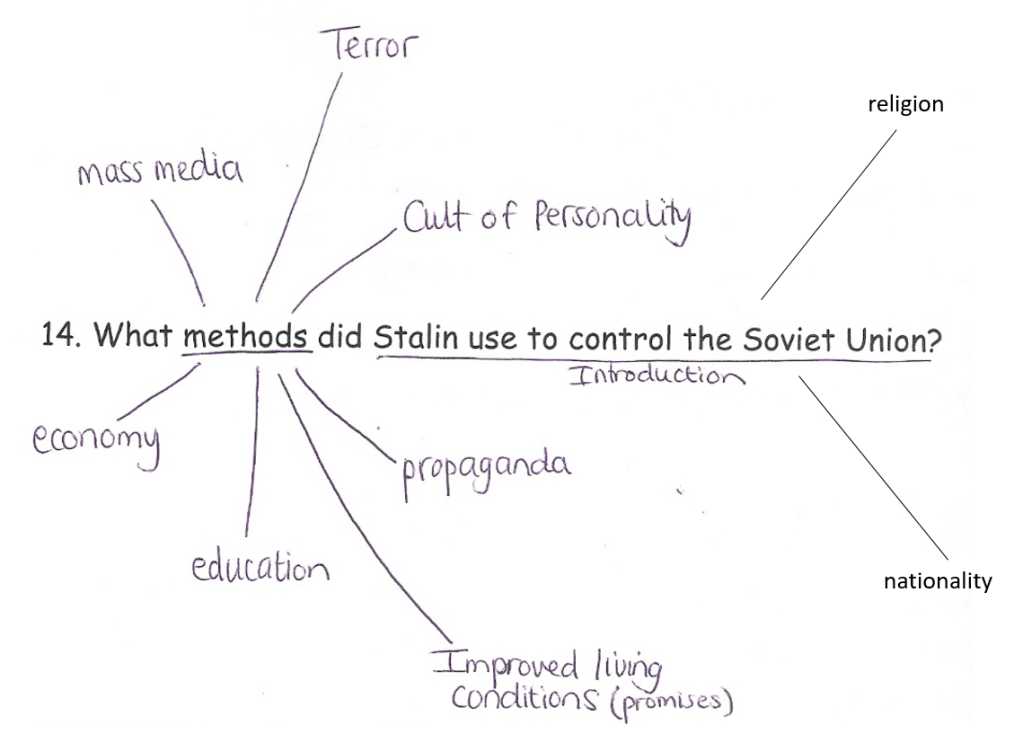
QUESTION 14.
What methods did Stalin use to control the Soviet Union?
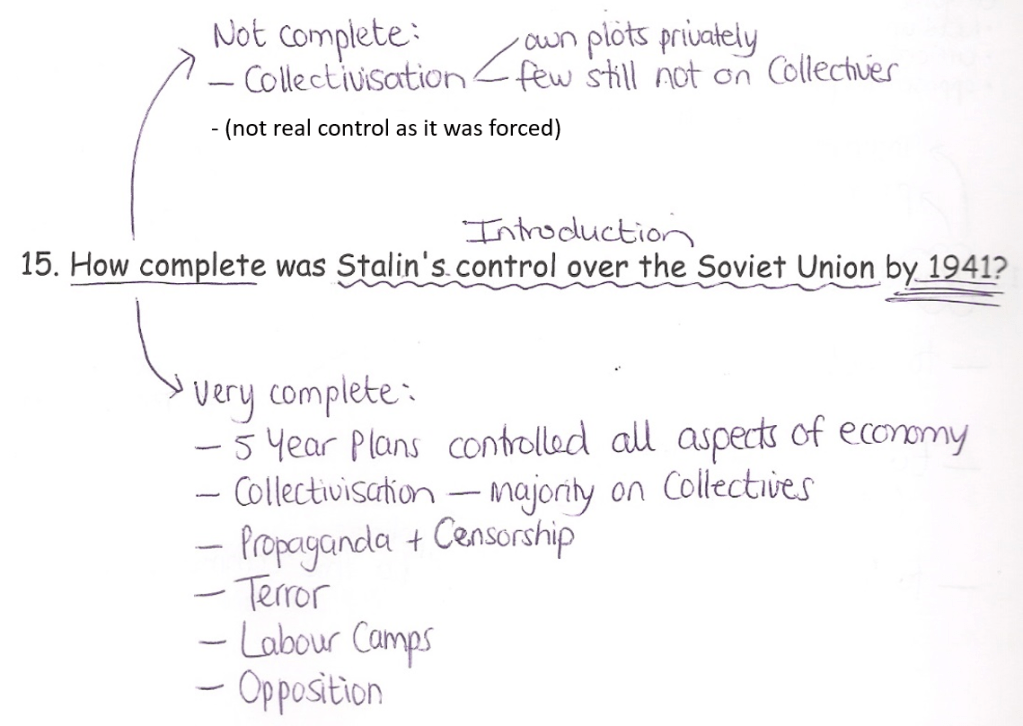
QUESTION 15.
How complete was Stalin’s control over the Soviet Union by 1941?
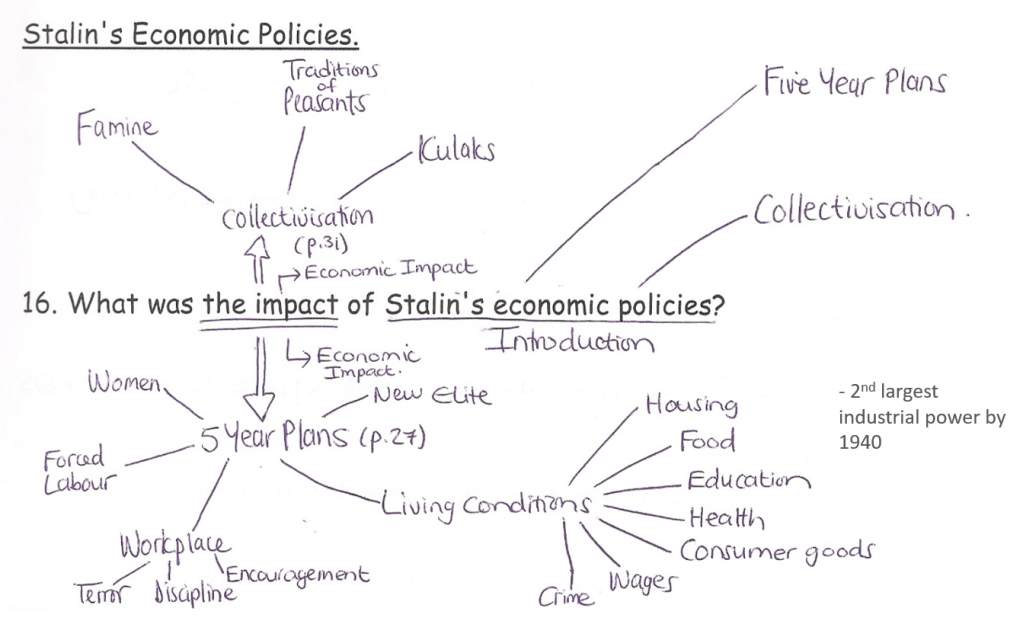
Stalin’s Economic Policies.
QUESTION 16.
What was the impact of Stalin’s economic policies?
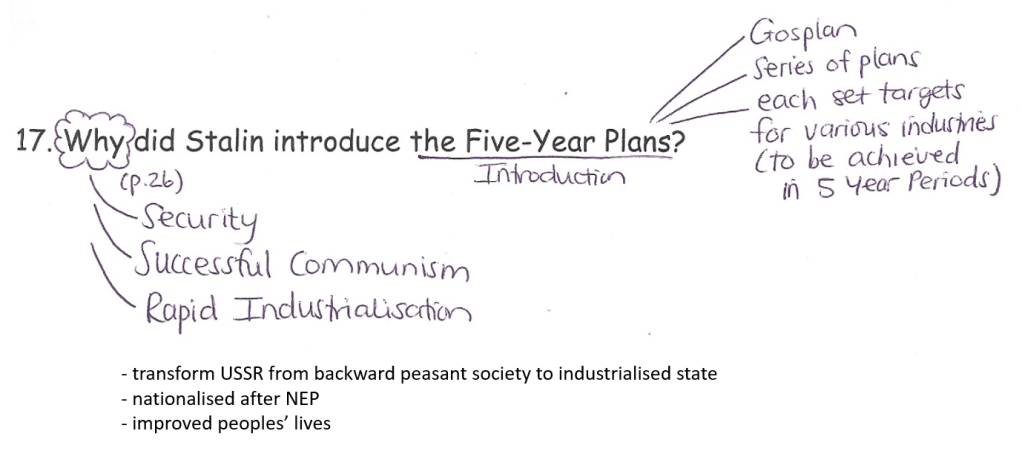
QUESTION 17.
Why did Stalin introduce the Five-Year Plans?
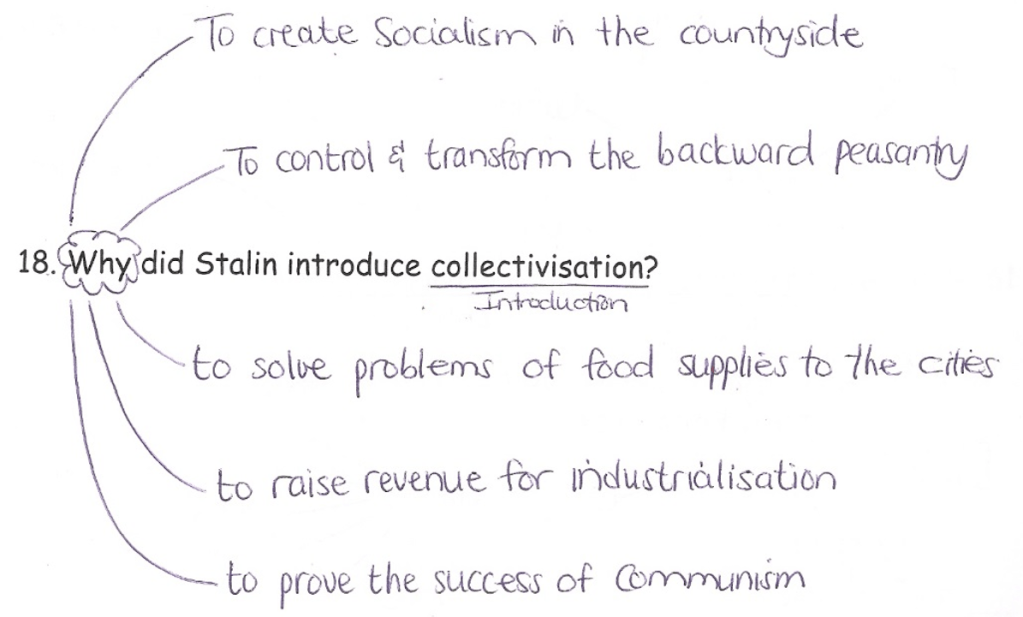
QUESTION 18.
Why did Stalin introduce Collectivization?
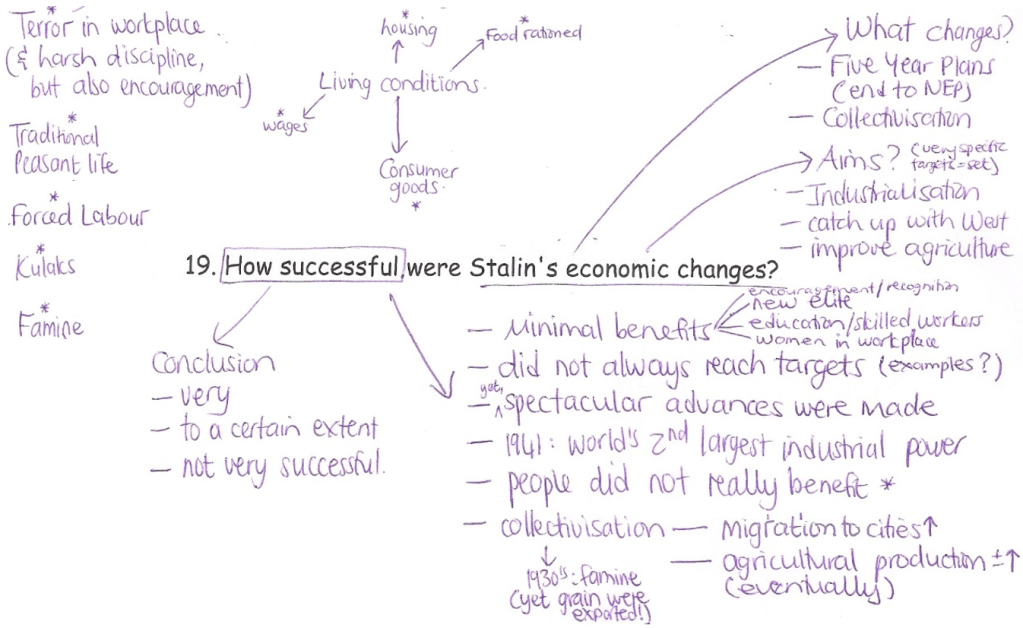
QUESTION 19.
How successful were Stalin’s economic changes?
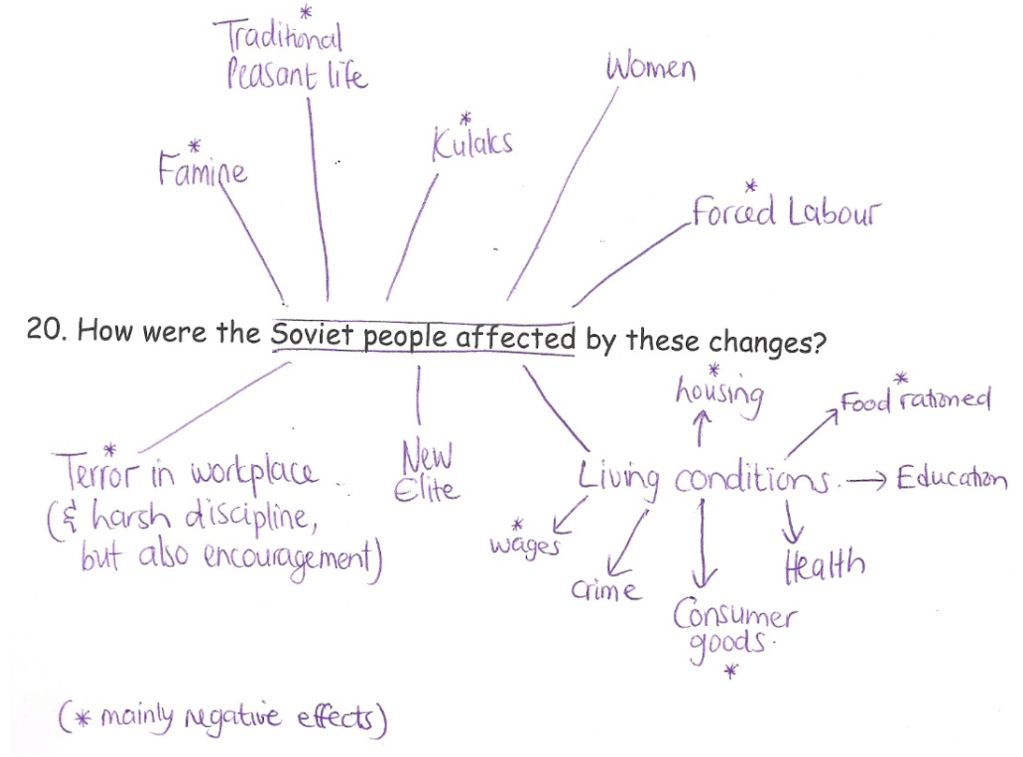
QUESTION 20.
How were the Soviet people affected by these changes?
3.
Now it is time to practise more Essay Writing!

Analyse and plan the answer to the following question:
“‘Stalin’s modernisation policies brought great benefit to the Soviet Union.’ How far do you agree? Explain your answer. [10]
Remember to give both sides of the argument!
(WordPress advertisements may appear below.)
Today you are going to:
a) Do revision on Russian History, 1900-1924.
b) Look at some Russian History Questions.
1.
Look at the following video clip – to briefly revise the Russian History:
Russian Revolutions (9:59 minutes long)
2.
Now look Questions 1 – 10 on p.27-32 of your Exam Preparations Booklet. These are not necessarily typical exam questions, but these questions guide you as to what you need to know for the exam. So, to prepare yourself thoroughly, plan possible answers to Q.1 – Q.10.
Use your Exam Preparations Booklet, p.27-32.
(Please do not hesitate to ask me if you struggle with any of these questions!)
3.
SOLUTIONS
The Collapse of the Tsarist regime.
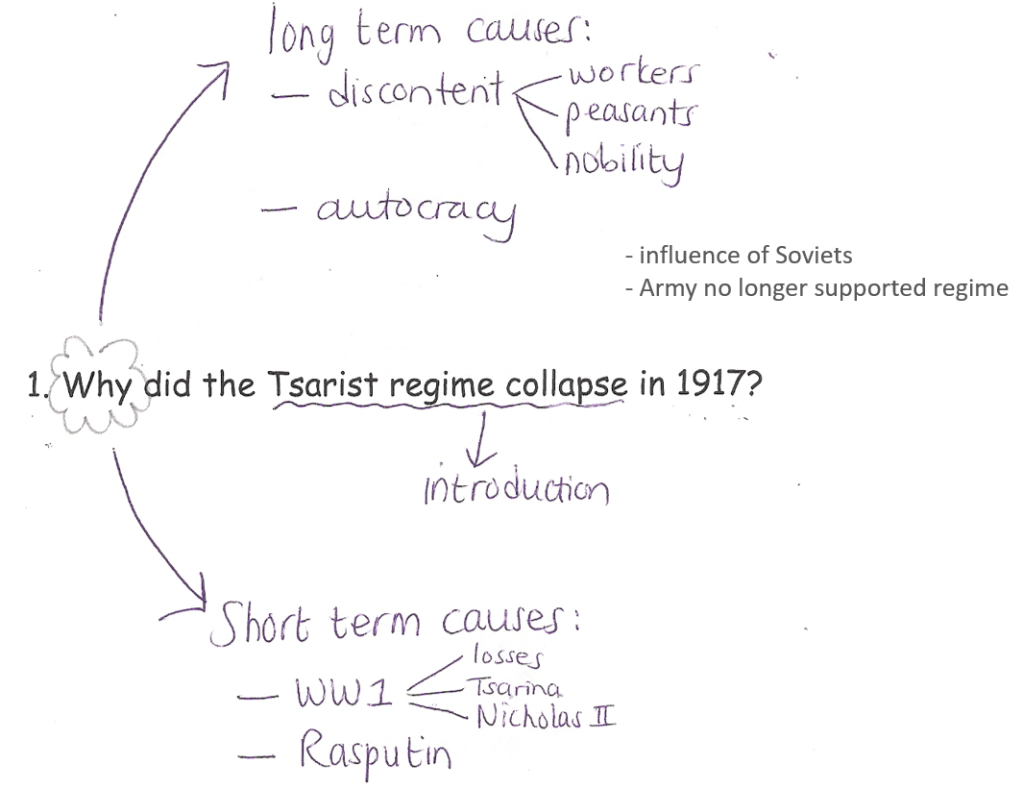
QUESTION 1.
Why did the Tsarist regime collapse in 1917?
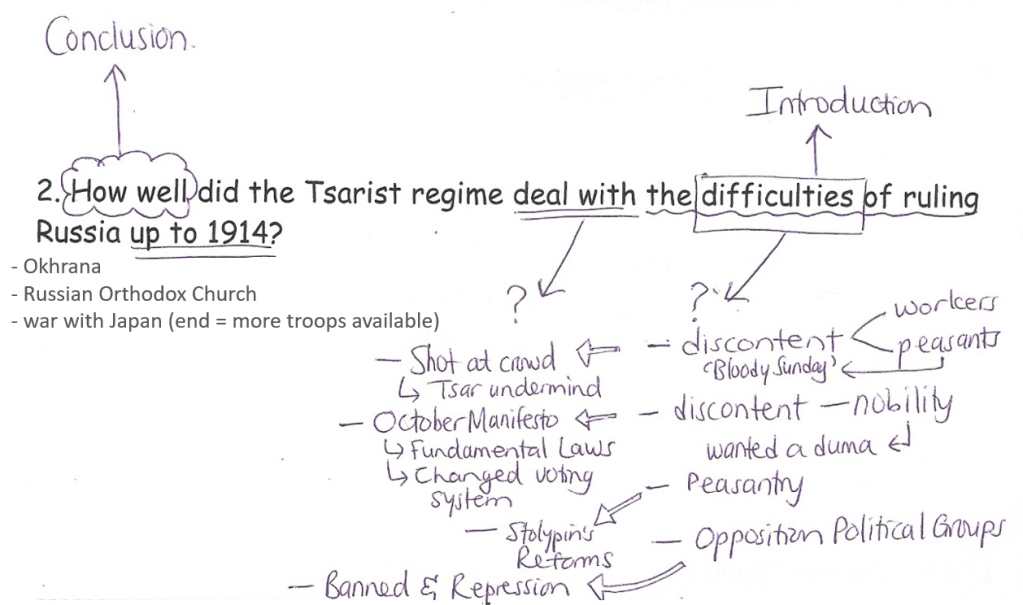
QUESTION 2.
How well did the Tsarist regime deal with the difficulties of ruling Russia up to 1914?
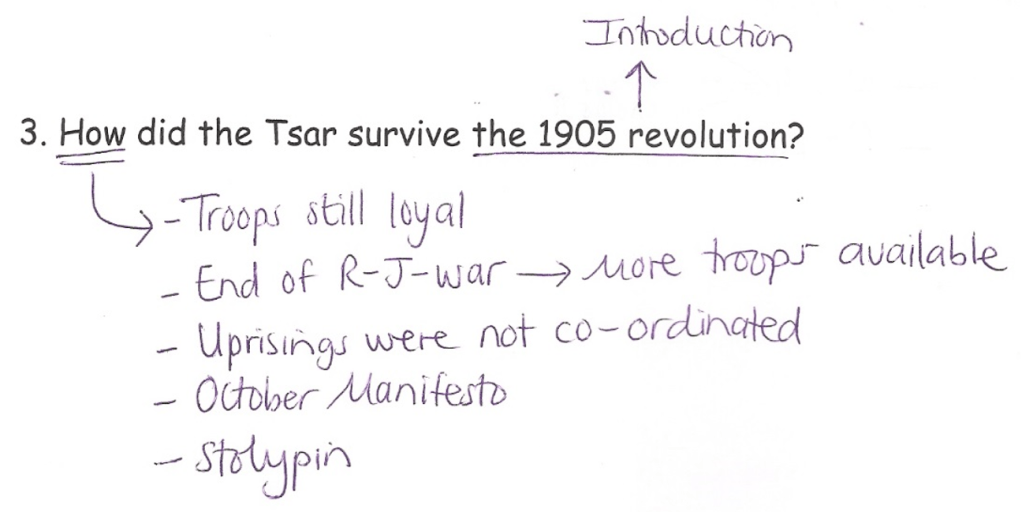
QUESTION 3.
How did the Tsar survive the 1905 revolution?
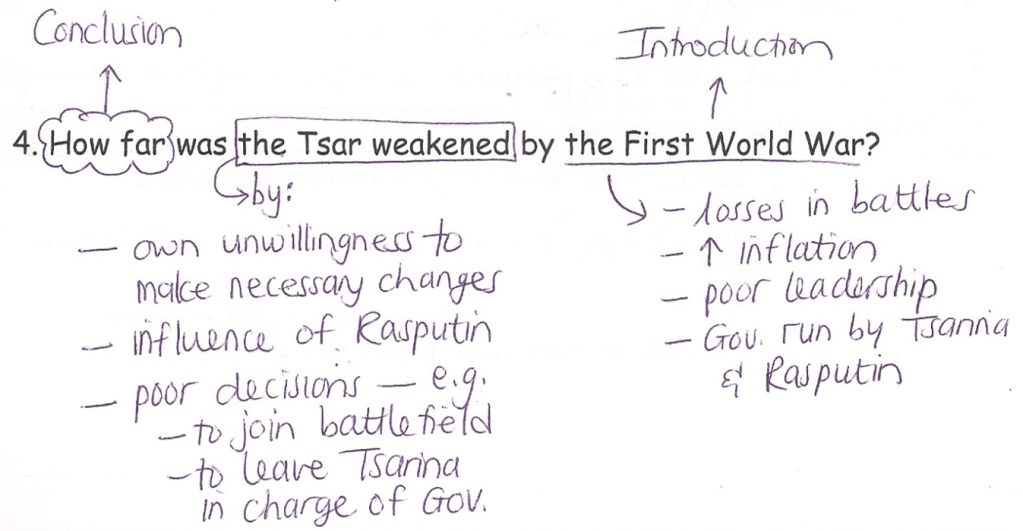
QUESTION 4.
How far was the Tsar weakened by the First World War?
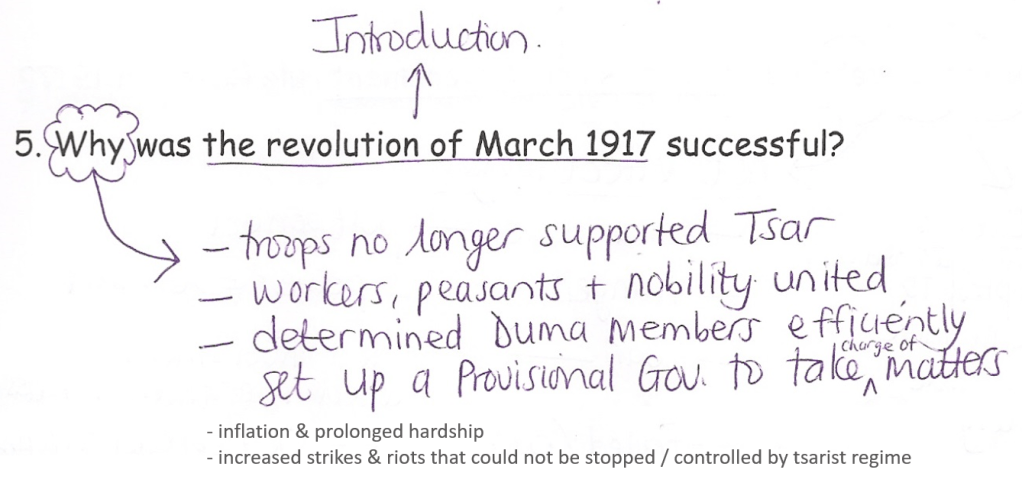
QUESTION 5.
Why was the revolution of March 1917 successful?
The Bolsheviks.
QUESTION 6.
How did the Bolsheviks gain power, and how did they consolidate their rule?

…how did the Bolsheviks consolidate their rule?

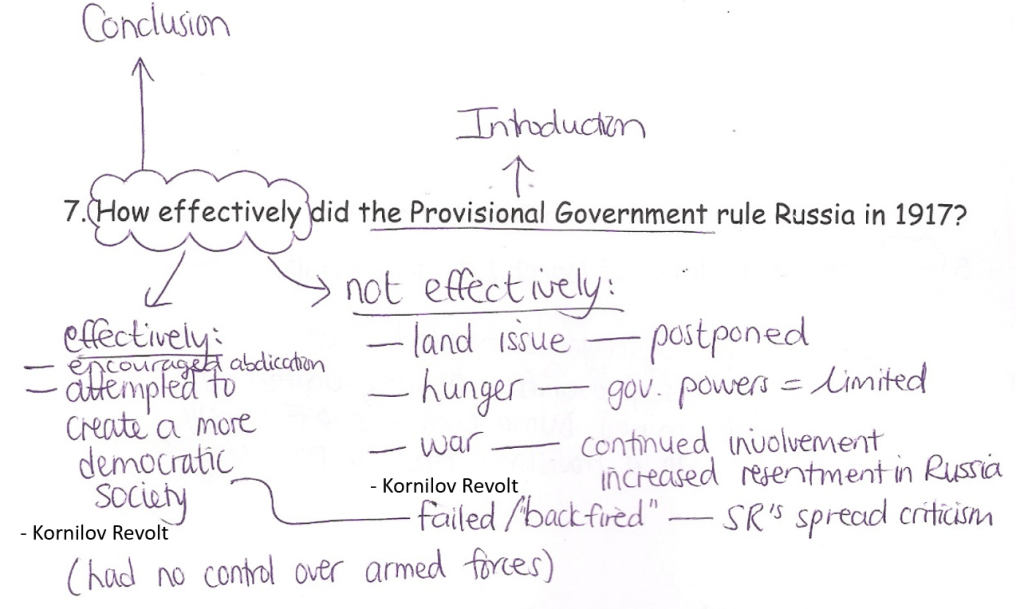
QUESTION 7.
How effectively did the Provisional Government rule Russia in 1917?
QUESTION 8.
Why were the Bolsheviks able to seize power in November 1917?

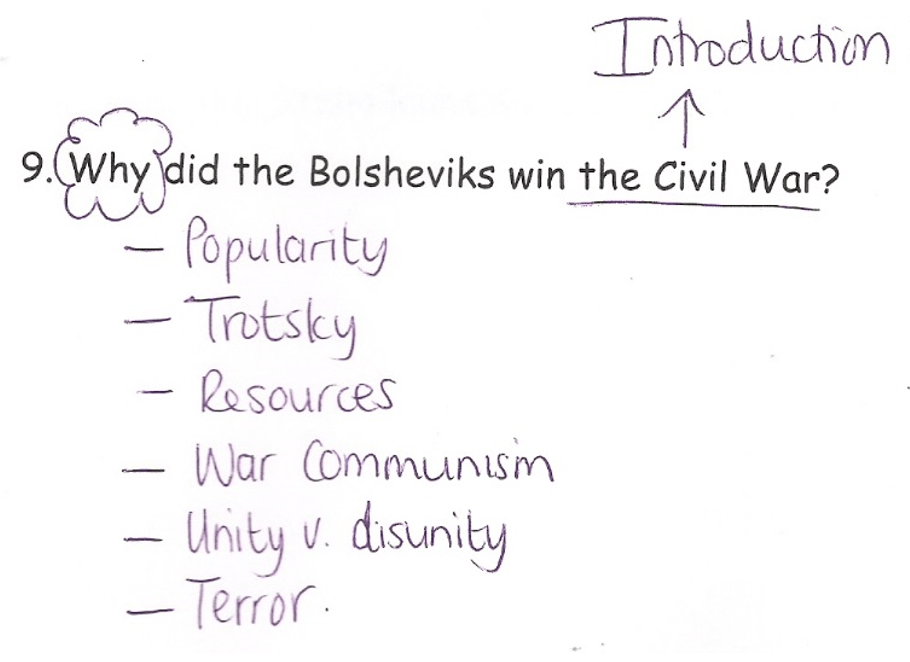
QUESTION 9.
Why did the Bolsheviks win the Civil War?
QUESTION 10.
How far was the New Economic Policy a success?

4.
Now it is time to practise more Essay Writing!
Analyse and plan the answer to the following question:
“Hatred of Rasputin was the main reason for revolution in March 1917.” How far do you agree with this statement? Explain your answer. (10)
Remember to give both sides of the argument!
(WordPress advertisements may appear below.)
Today you are going to:
a) Do revision on The Road to War.
b) Look at some Road to War Questions.
1.
Look at the following video clips – to revise The Road to War:
Road to War – Revision 1: (15:03 min long)
Road to War – Revision 2 – Appeasement: (10:02 min long)
2.
Now look Questions 11 – 17 on p.23-26 of your Exam Preparations Booklet. These are not necessarily typical exam questions, but these questions guide you as to what you need to know for the exam. So, to prepare yourself thoroughly, plan possible answers to Q.11 – Q.17.
Use your Exam Preparations Booklet, p.23-26.
(Please do not hesitate to ask me if you struggle with any of these questions!)
3.
SOLUTIONS

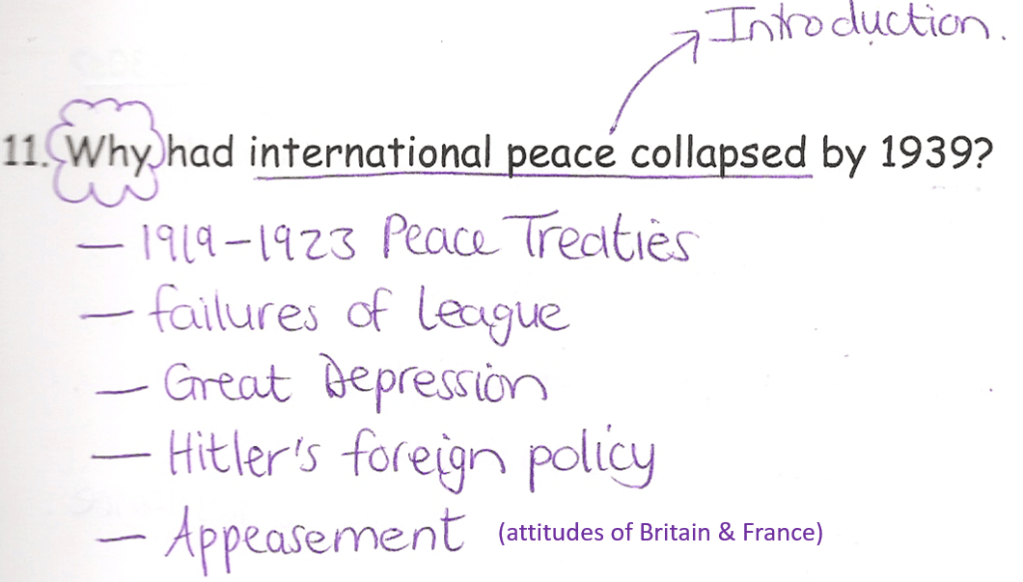
QUESTION 11.
Why had international peace collapsed by 1939?
QUESTION 12.
What were the long-term consequences of the peace treaties of 1919-1923?
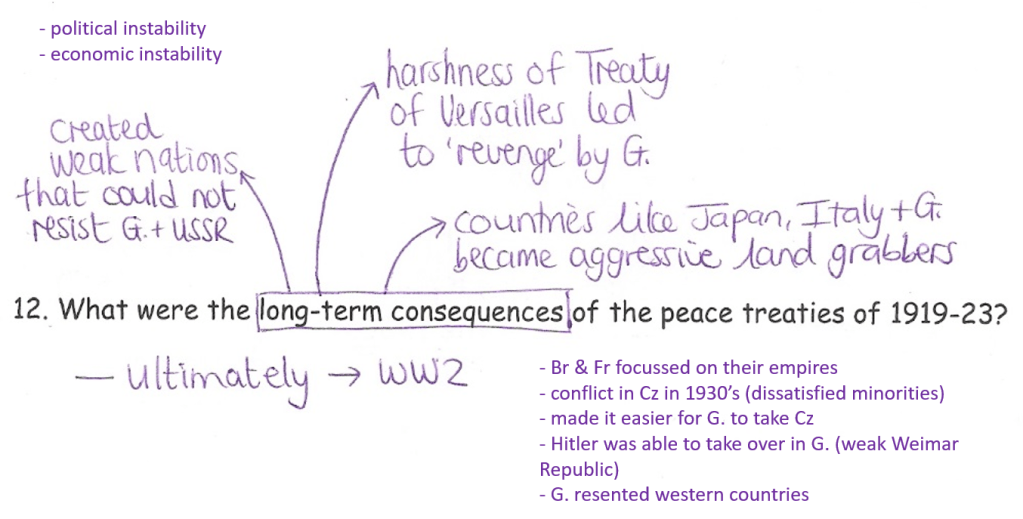
QUESTION 13.
What were the consequences of the failures of the League in the 1930’s?
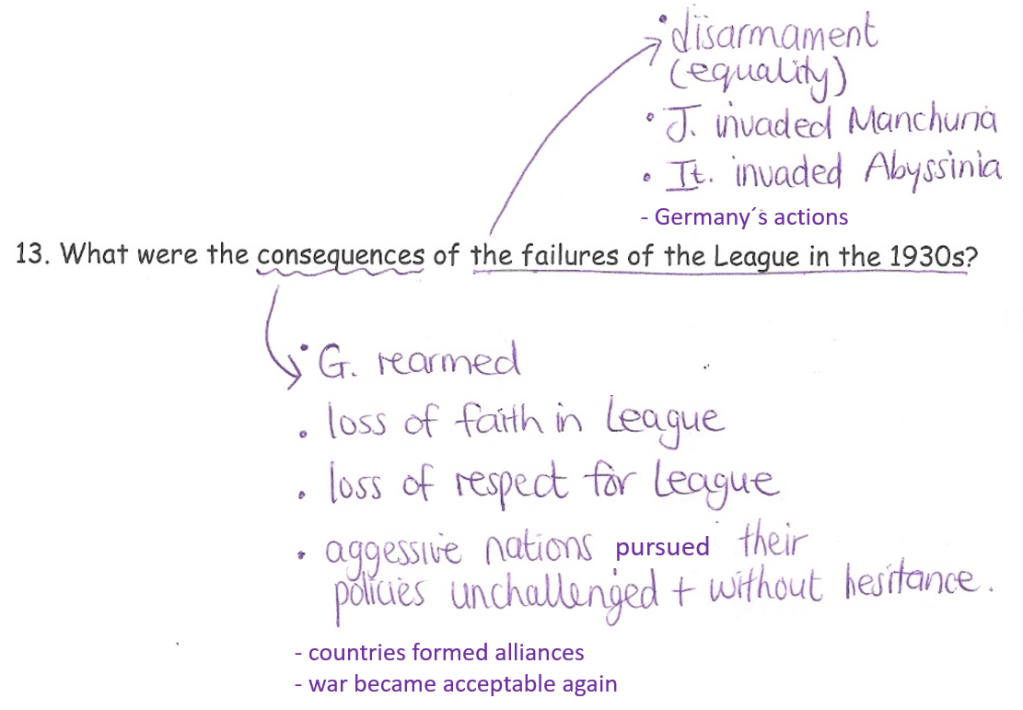
QUESTION 14.
How far was Hitler’s foreign policy to blame for the outbreak of war in 1939?
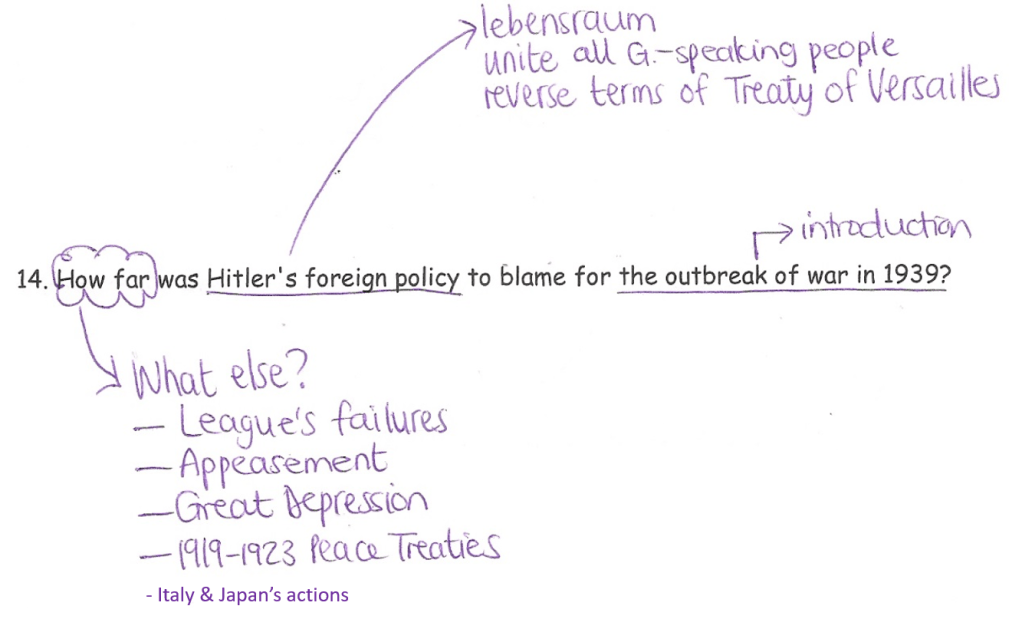
QUESTION 15.
Was the policy of appeasement justified?

QUESTION 16.
How important was the Nazi-Soviet Pact?
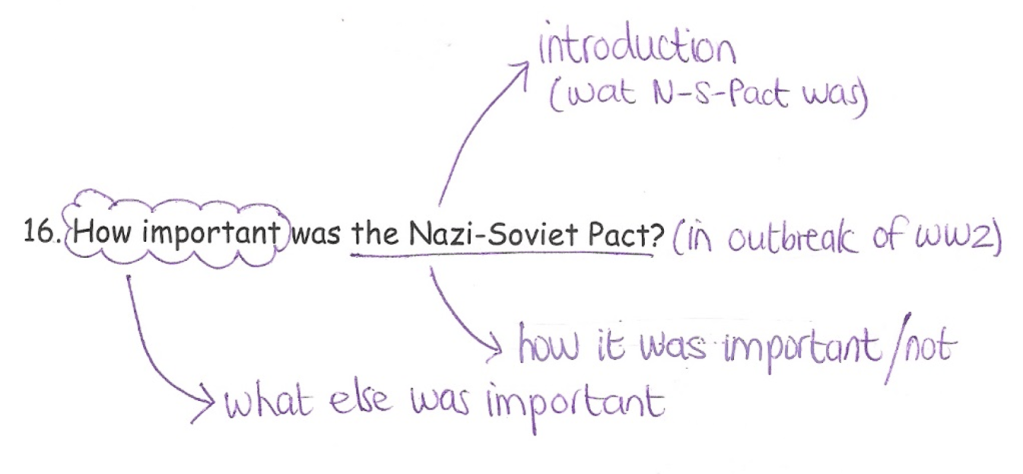


QUESTION 17.
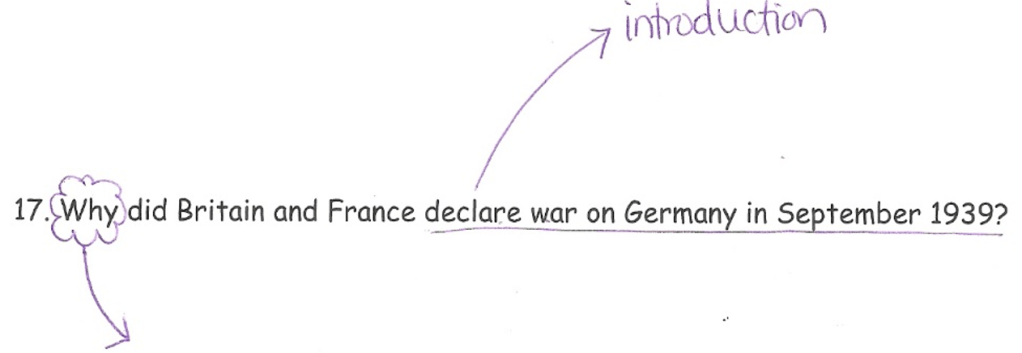
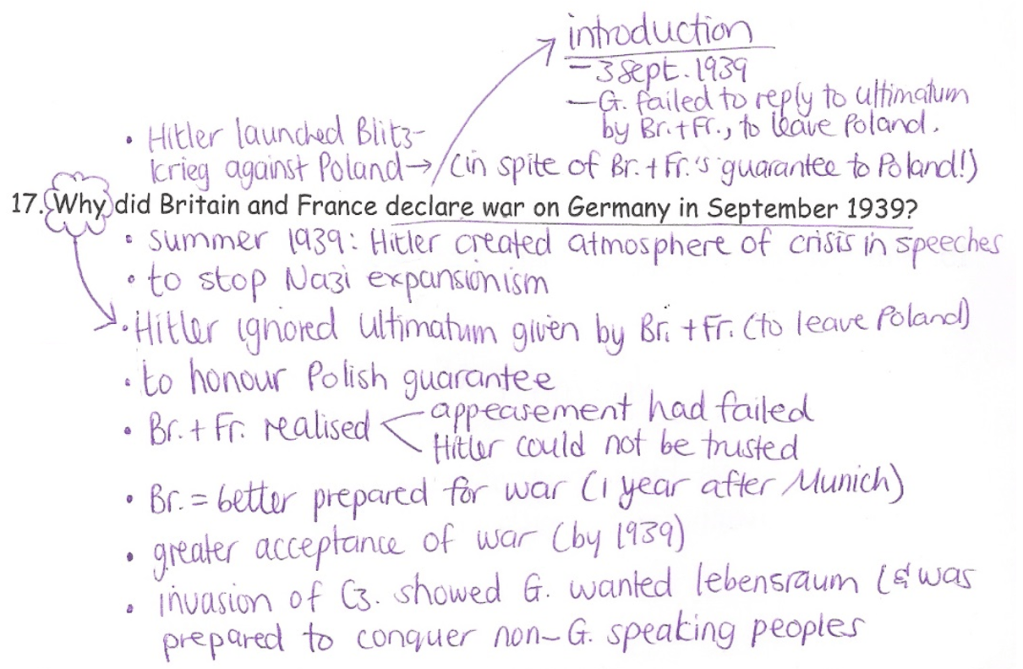
Why did Britain and France declare war on Germany in September 1939?
4.
Access more WHY-Questions
5.
Now it is time to practise more Essay Writing!
Analyse and plan the answer to the following question:
How far was the outbreak of war in 1939 Hitler’s fault? (10)
Remember to give both sides of the argument!
If you get stuck, here are some ideas…
Look at the following video clip – as a brief analysis and plan for this essay question:
How far was the outbreak of war in 1939 Hitler’s fault? (10)
10-mark Road to War Question. (1:51 minutes long)
(WordPress advertisements may appear below.)
Today you are going to:
a) Do revision on The League of Nations.
b) Look at some League of Nations Questions.
1.
Look at the following video clips – to revise The League of Nations:
League Revision 1 – League in 1920’s: (10:33 min long)
League Revision 2 – League in 1930’s: (10:09 min long)
League Revision 3 – How successful? (5:24 min long)
2.
Now look Questions 6 – 10 on p.21-23 of your Exam Preparations Booklet. These are not necessarily typical exam questions, but these questions guide you as to what you need to know for the exam. So, to prepare yourself thoroughly, plan possible answers to Q.6 – Q.10.
Use your Exam Preparations Booklet, p.21-23.
(Please do not hesitate to ask me if you struggle with any of these questions!)
3.
SOLUTIONS

QUESTION 6.
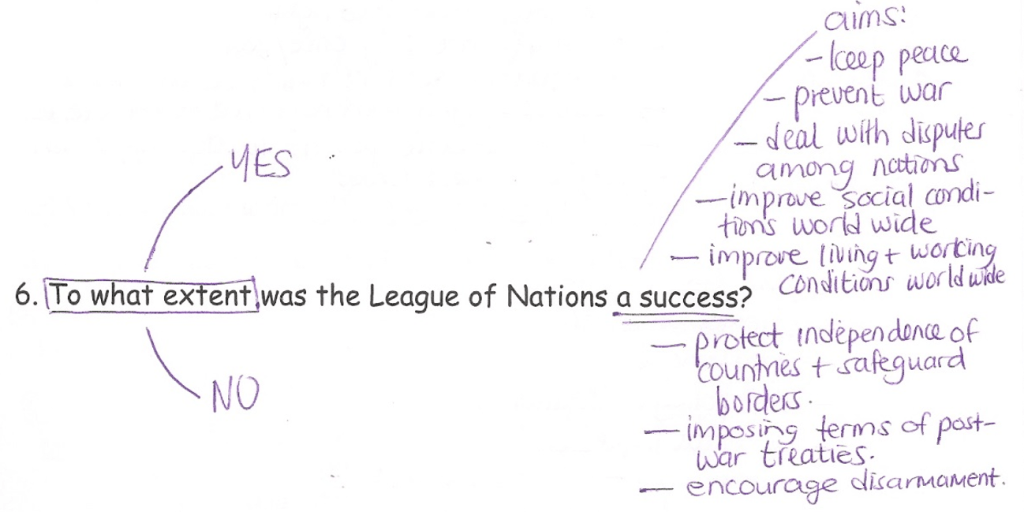
To what extent was the League of Nations a success?
QUESTION 7.
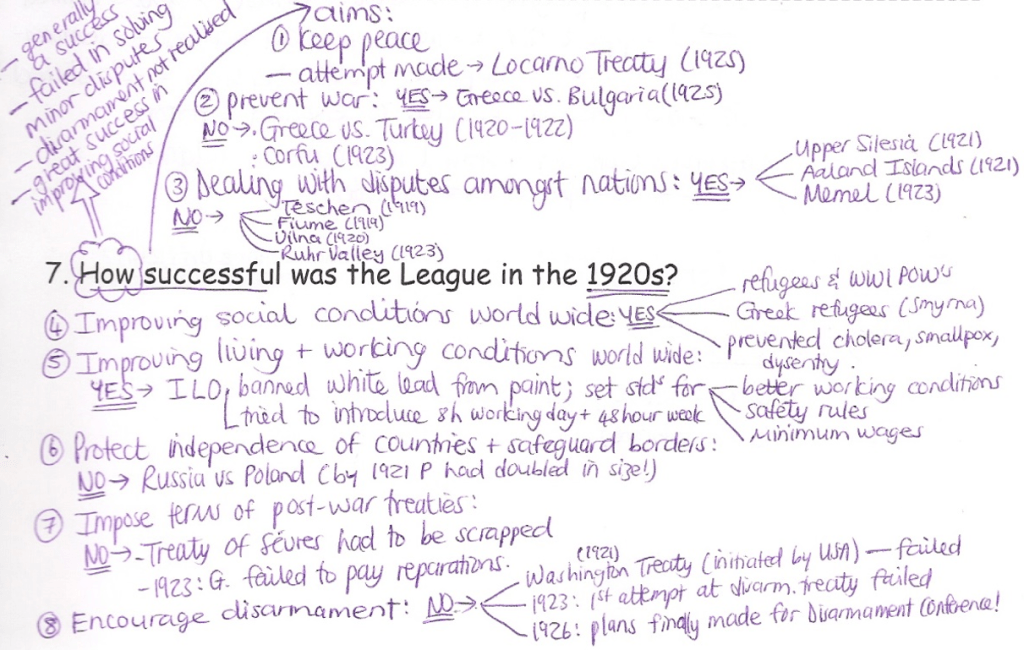
How successful was the League in the 1920’s?
QUESTION 8.
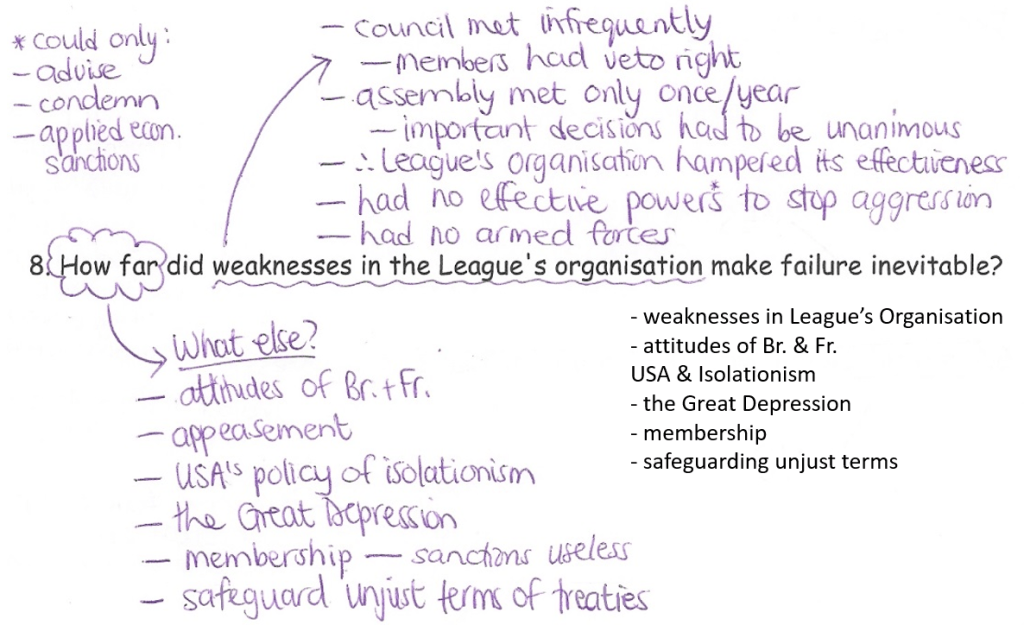
How far did weaknesses in the League’s organisation make failure inevitable?
QUESTION 9.
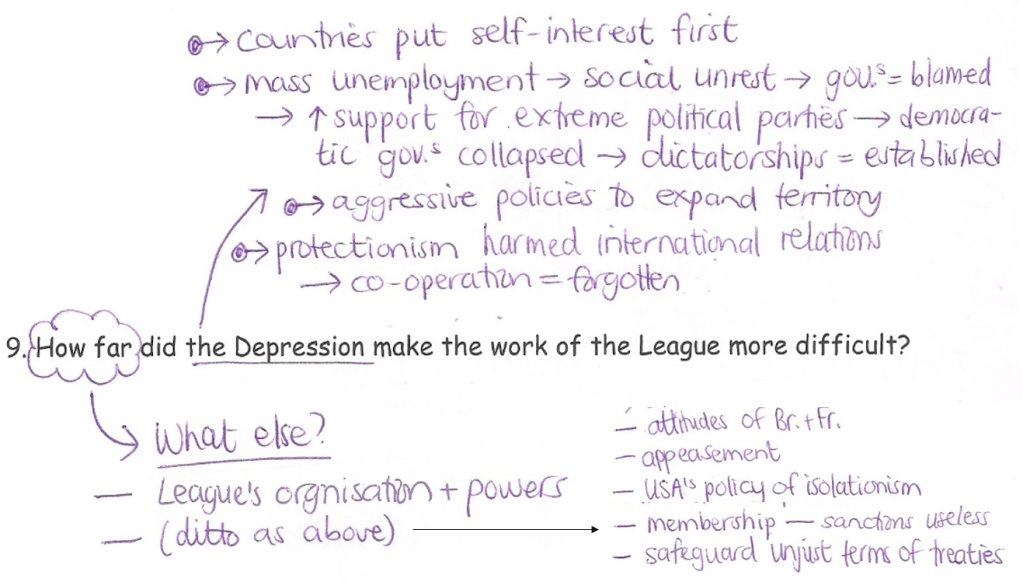
How far did the Depression make the work of the League more difficult?
QUESTION 10.
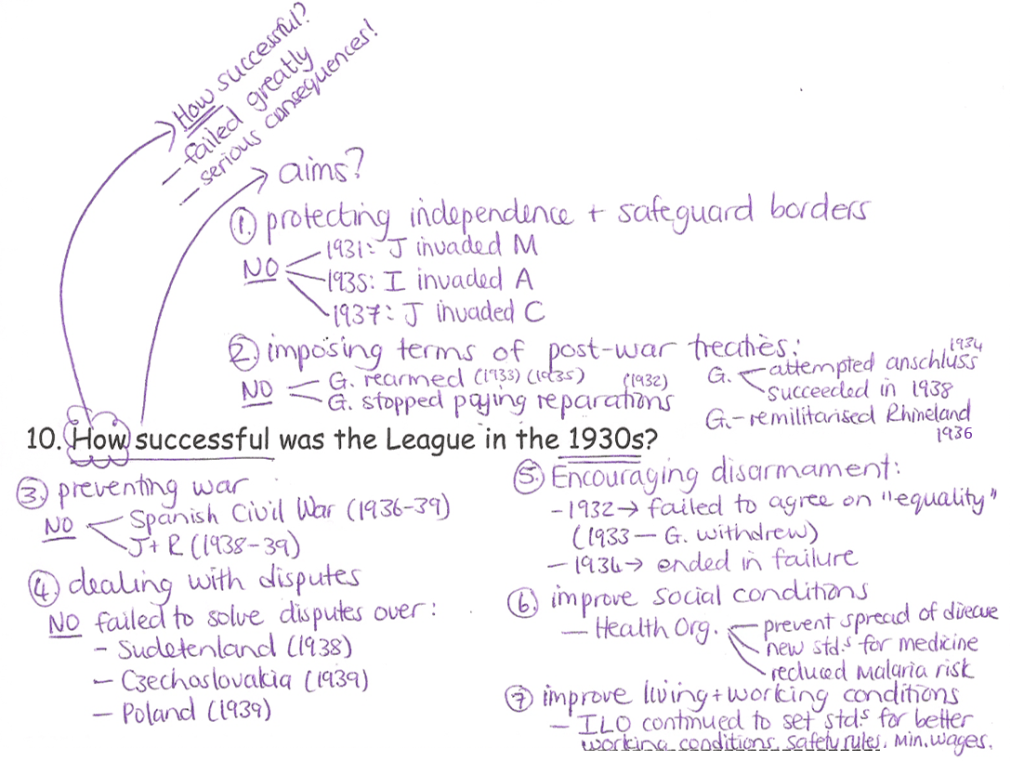
How successful was the League in the 1930’s?
4.
Now you need to practise more Essay Writing!
Analyse and plan the answer to the following question:
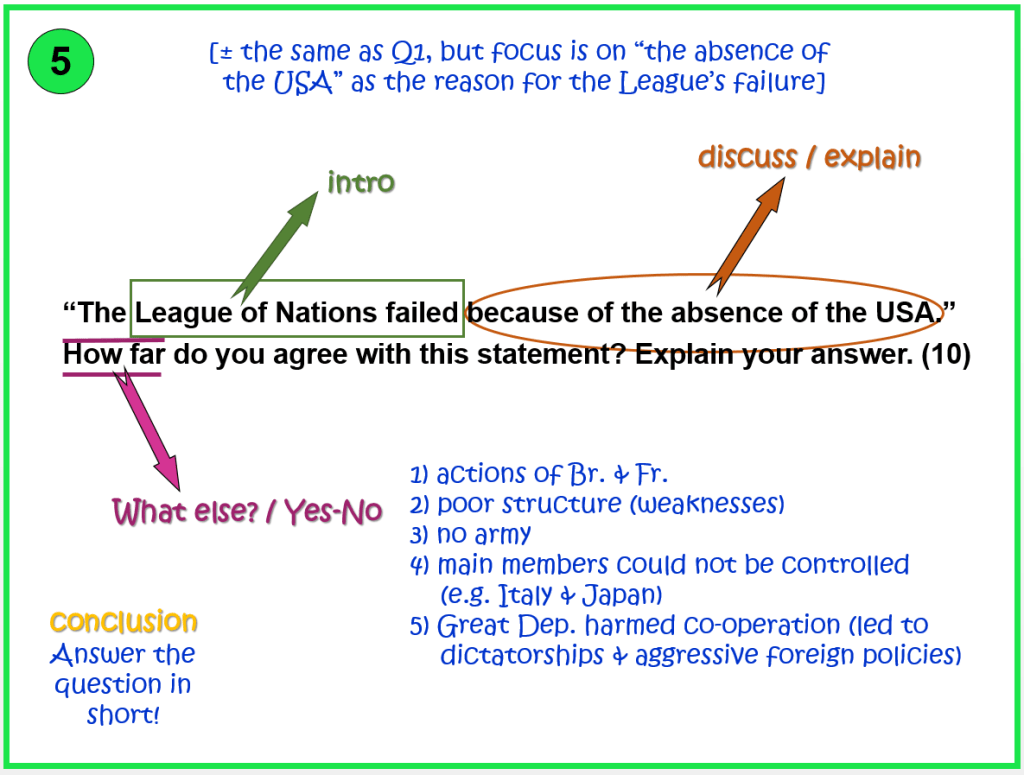
“The League of Nations failed because of Britain and France.” How far do you agree with this statement? Explain your answer. (10)
Remember to give both sides of the argument!
If you get stuck, here are some ideas…
Look at the following video clip – as a brief analysis and plan for this essay question:
“The League of Nations failed because of Britain and France.” How far do you agree with this statement? Explain your answer. (10)
10-mark League of Nations Question. (2:37 minutes long)
(WordPress advertisements may appear below.)
Today you are going to:
a) Do revision on Post-War Peace Treaties, 1919-1924.
b) Look at some Post-War Peace Treaties Questions.
1.
Look at the following video clips – to briefly revise the Post-War Treaties:

Treaties – Revision 1: (13:02 min long)
Treaties Revision 2: (13:10 min long)
Treaties Revision 3 – Other Treaties: (7:00 min long)
2.
Now look Questions 1 – 5 on p.18-20 of your Exam Preparations Booklet. These are not necessarily typical exam questions, but these questions guide you as to what you need to know for the exam. So, to prepare yourself thoroughly, plan possible answers to Q.1 – Q.5.
Use your Exam Preparations Booklet, p.18-20.
(Please do not hesitate to ask me if you struggle with any of these questions!)
3.
SOLUTIONS

QUESTION 1.
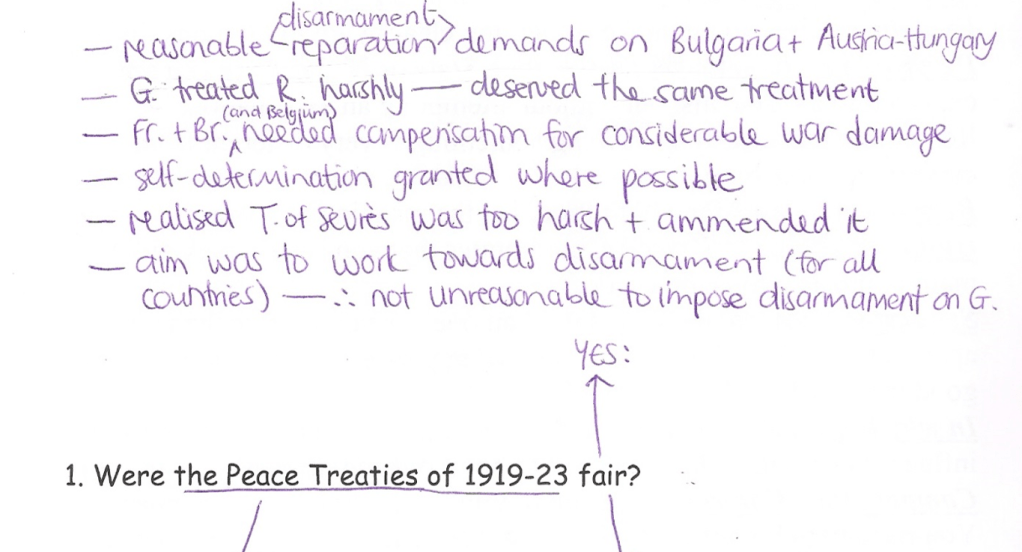
Were the peace treaties of 1919-1923 fair?
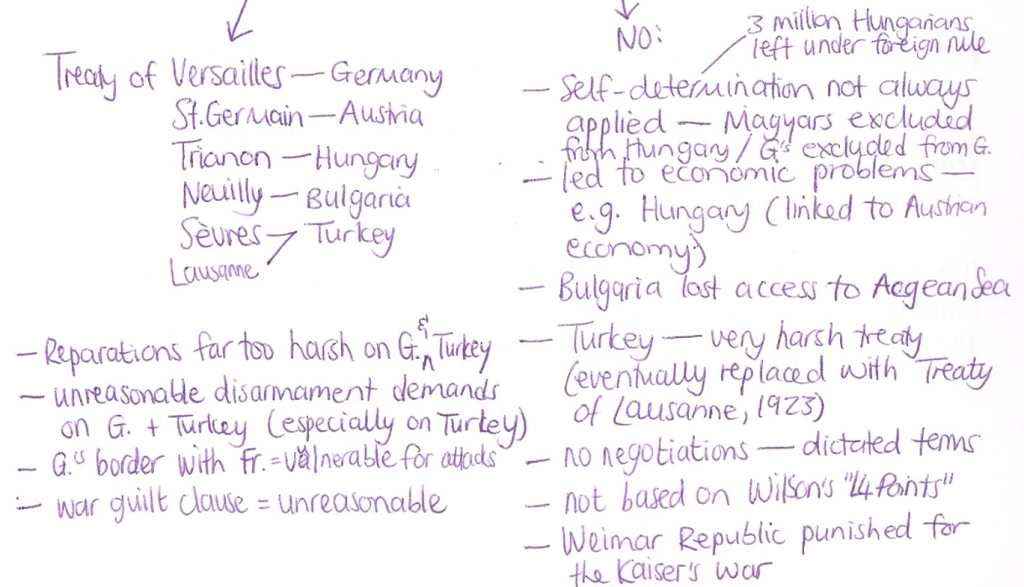
QUESTION 2.
What were the motives and aims of the Big Three at Versailles?


QUESTION 3.
Why did the victors not get what they wanted?
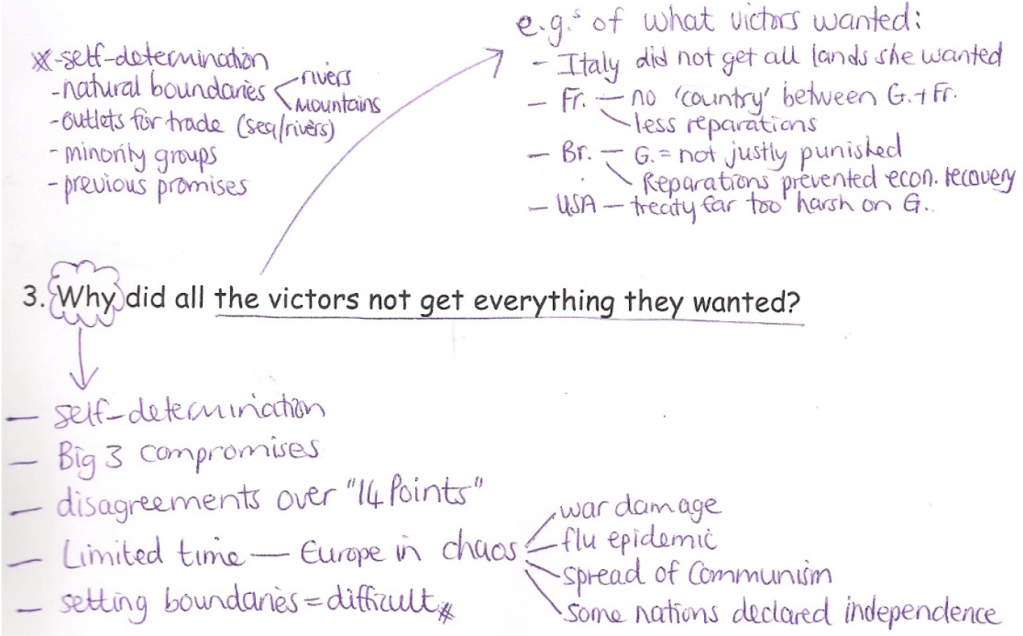
QUESTION 4.
What was the impact of the peace treaty on Germany up to 1923?
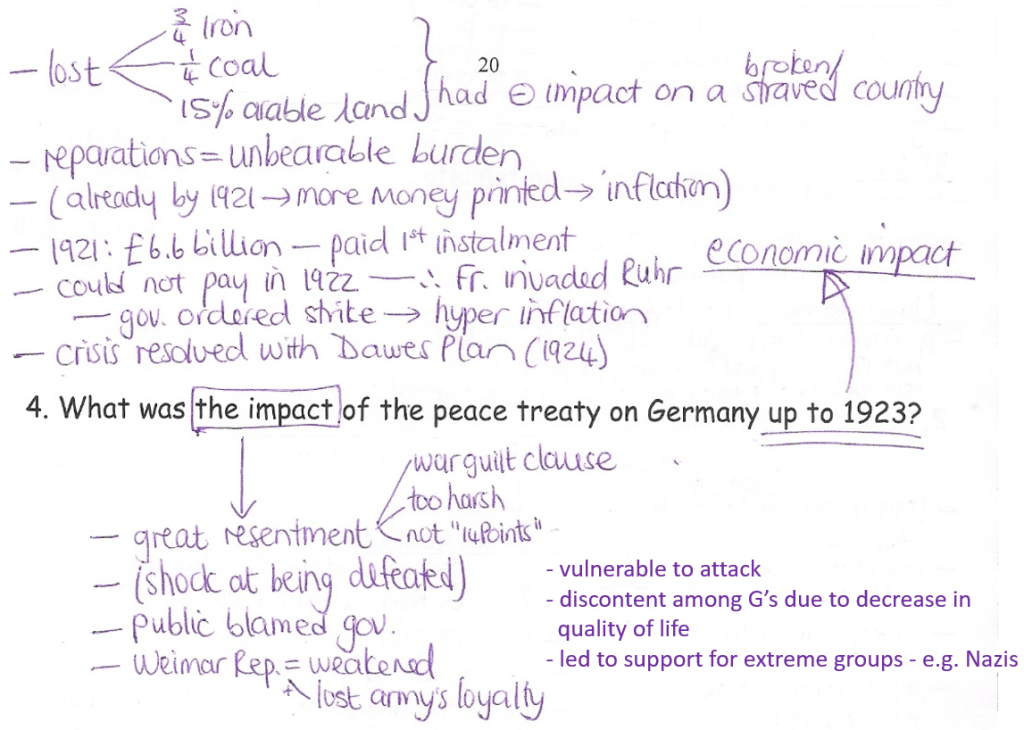
QUESTION 5.
Could the treaties be justified at the time?
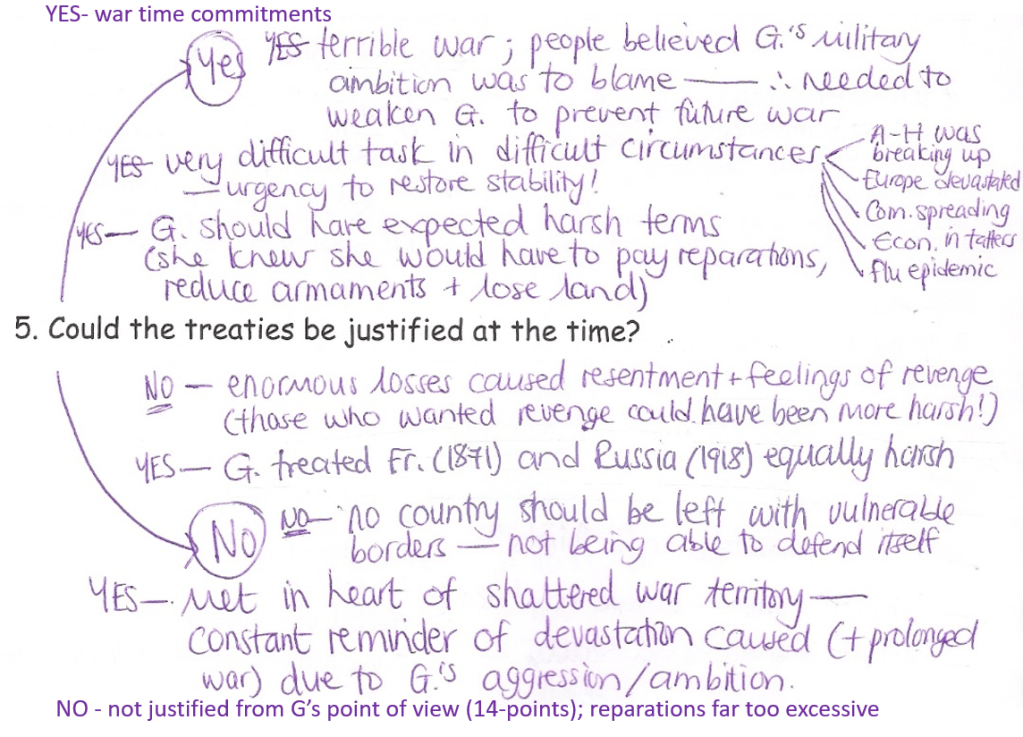
4.
Now, practise some Essay Writing!
Analyse and plan the answer to the following question:
“The Treaty of Versailles was a fair settlement.” How far do you agree with this statement? Explain your answer. (10)
Remember to give both sides of the argument!
If you get stuck, here are some ideas…
Look at the following video clip – as a brief analysis and plan for the essay question:
“The Treaty of Versailles was a fair settlement.” How far do you agree with this statement? Explain your answer. (10)
10-mark Post-War Peace Treaties Question. (6:32 minutes long)
(WordPress advertisements may appear below.)
Today we will look at more typical Paper 2 exam questions, in preparation for your Paper 2 examination….
We will:
Your homework for today was to revise the “Soviet Control over Eastern Europe” topic…
Below are two Paper 2 exam papers:
HUNGARY- 1956
CZECHOSLOVAKIA – 1968
Source B has been removed from the above Paper. Below is a replacement Source:
1.
Analyse the exam questions of one of the two papers. Then read the sources (of your chosen exam paper), underline important / relevant information and write brief annotations next to / below each source. In other words, try to work out what a possible answer to each of the questions may be.
2.
Now turn your attention to the other Exam paper. Complete the paper in order to further practice source analysis and also to practice writing exam essay answers.
We will continue with this task in the next lesson.
(WordPress advertisements may appear below.)
Year 8A & Year 8B
Complete these revision questions on The Reformation…
Follow the instructions step by step:
1.
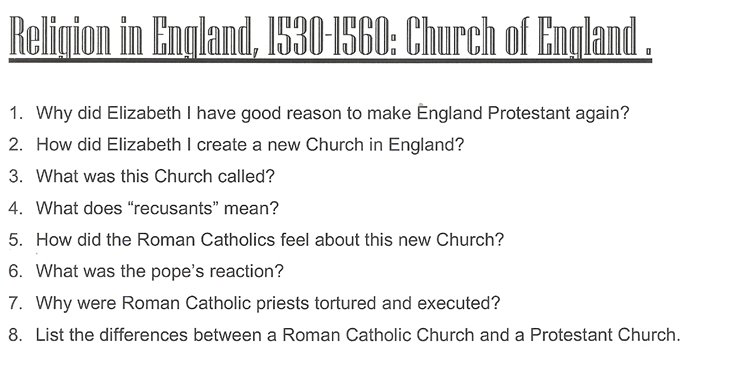
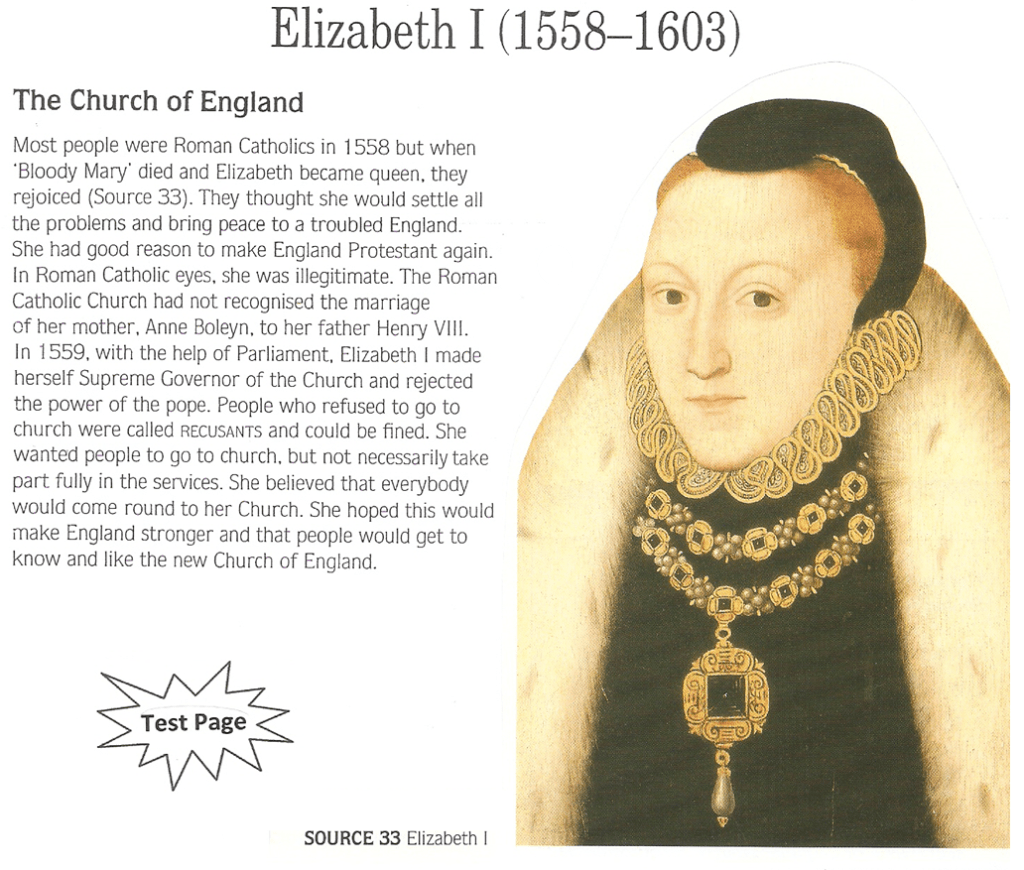
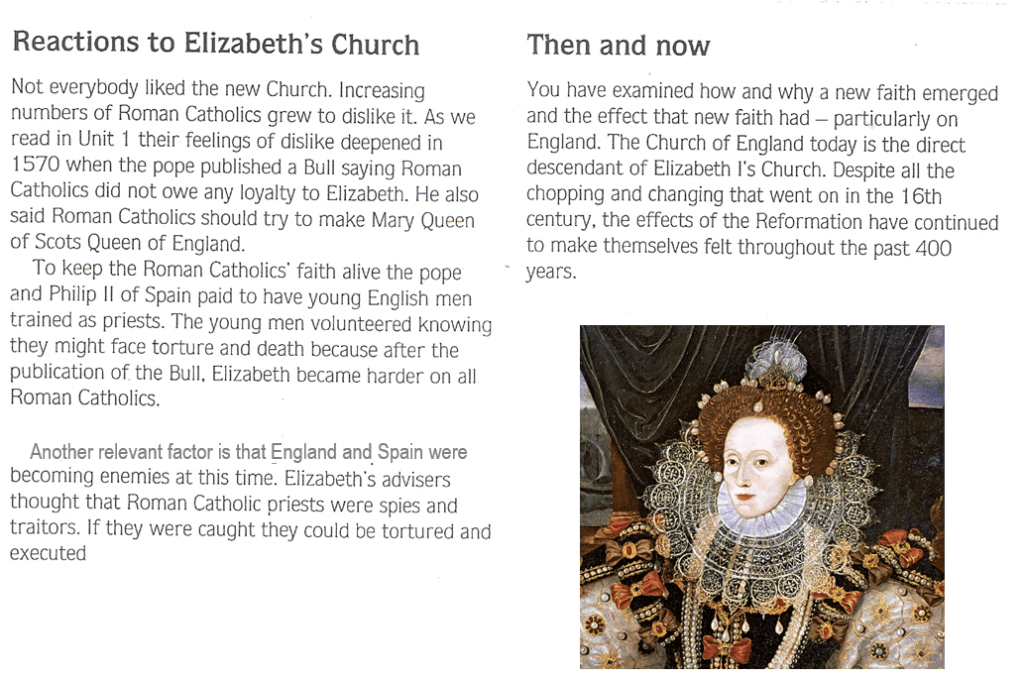
To test your knowledge on how Queen Elizabeth I made England Protestant again, complete the following tasks on the “Church of England”…
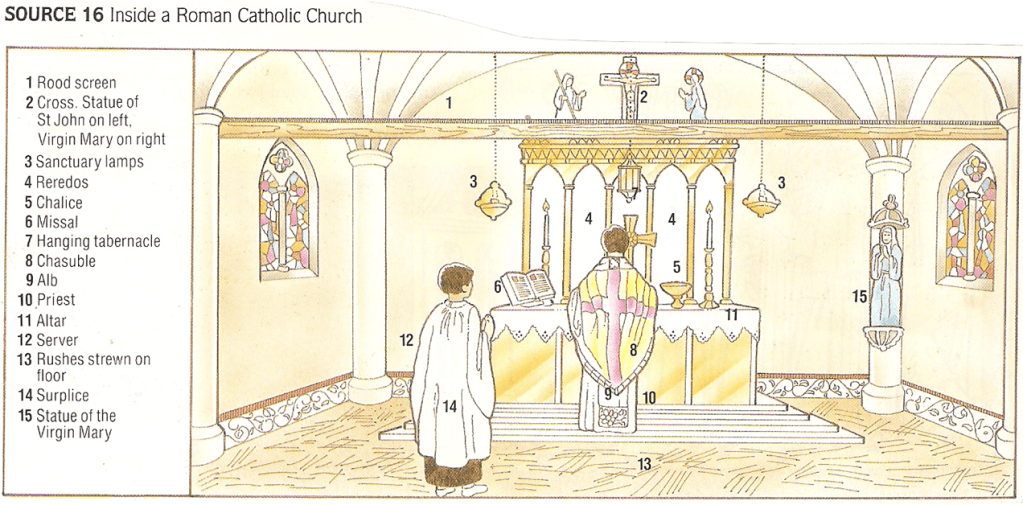
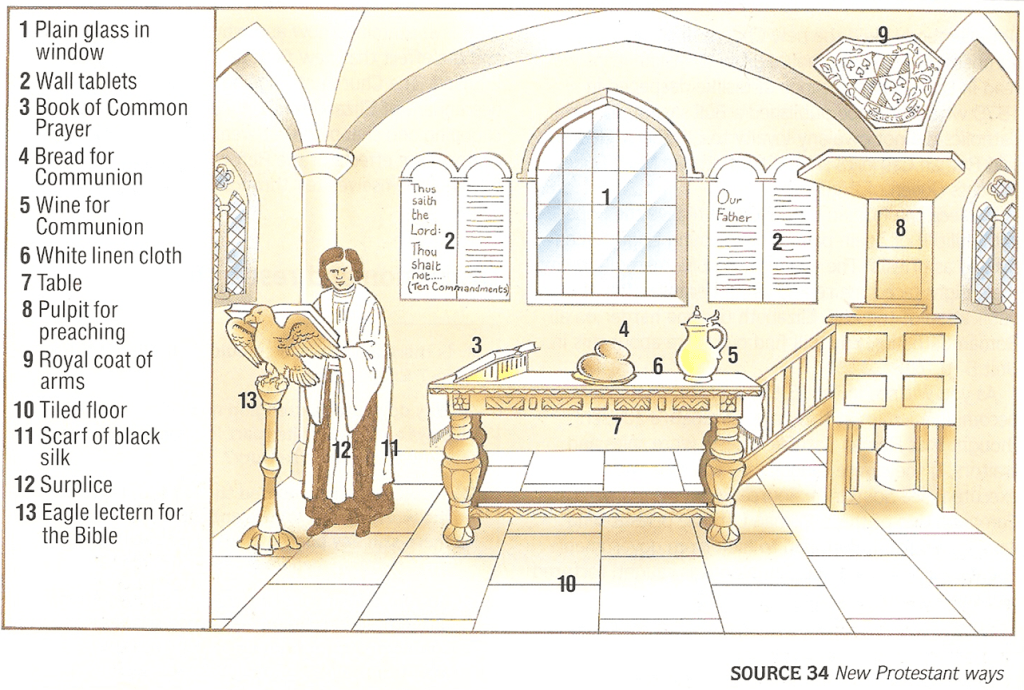
Carefully look at the differences made to the inside of the new Elizabethan Church. Then complete question 8 on page 62 by listing the differences between the interior of Elizabeth’s church and that of the Roman Catholic Church. (Use the table on p.62 for this task.)
Look at the images of the church interiors (below) to help you.
Use this table, on p.62!
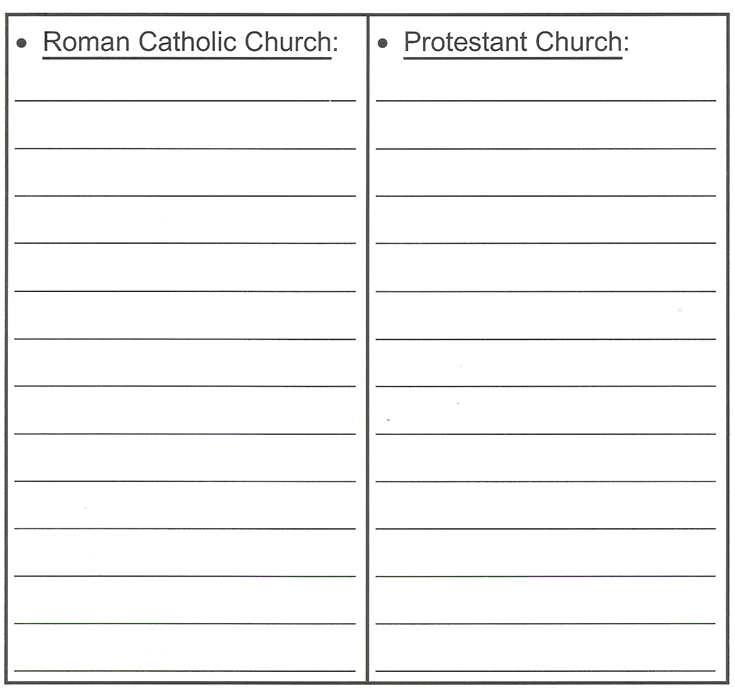
HELP:

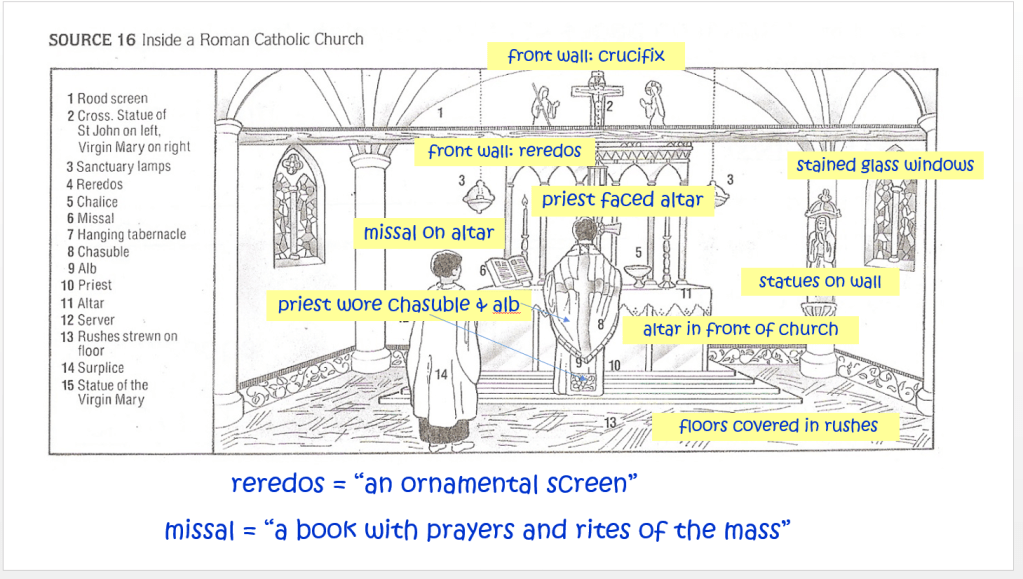
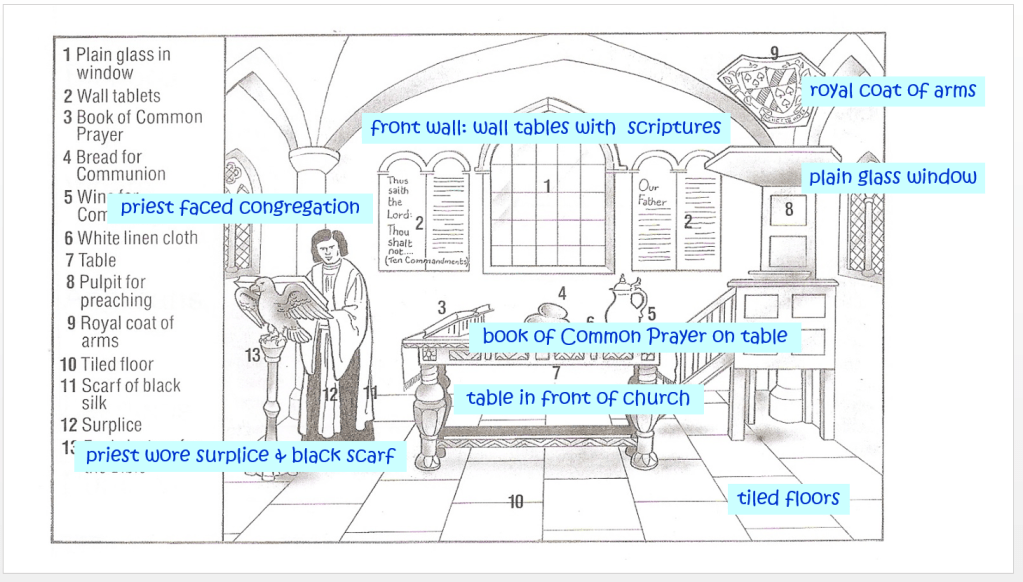
Reredos: “ornamental screen”
Missal: “book with prayers & rites of the mass”
2.
Now, let’s test your knowledge and understanding of the Reformation under Elizabeth I, by answering a few questions about the “Church of England”…

“Church of England, p.62”

3.

The information on “Elizabeth I (1558-1603)” (p.49) will help…

(WordPress advertisements may appear below.)
Year 8A & Year 8B
Complete these revision questions on The Reformation…
Follow the instructions step by step:
1.
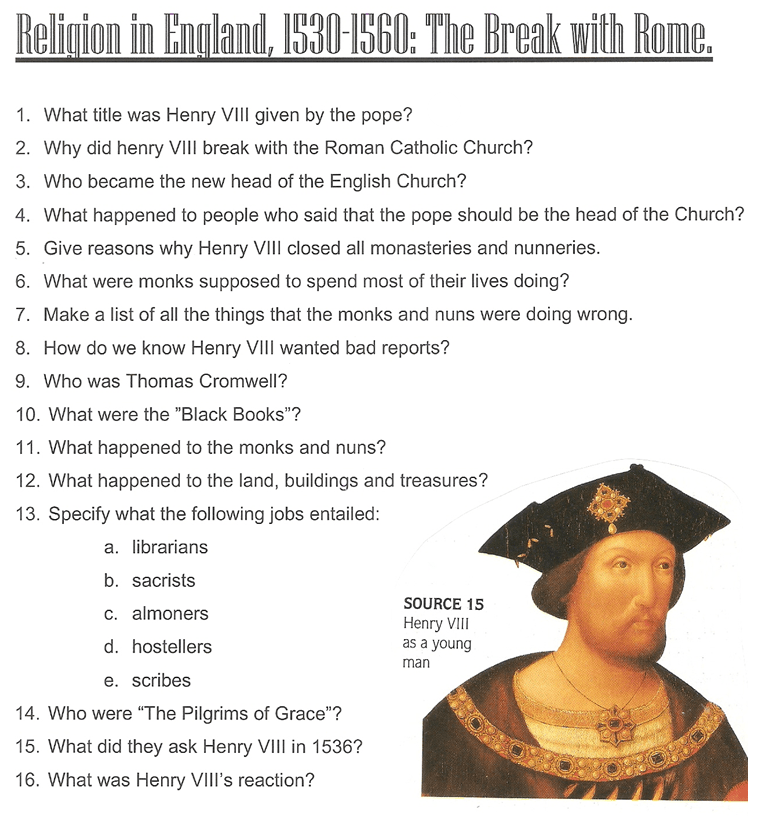
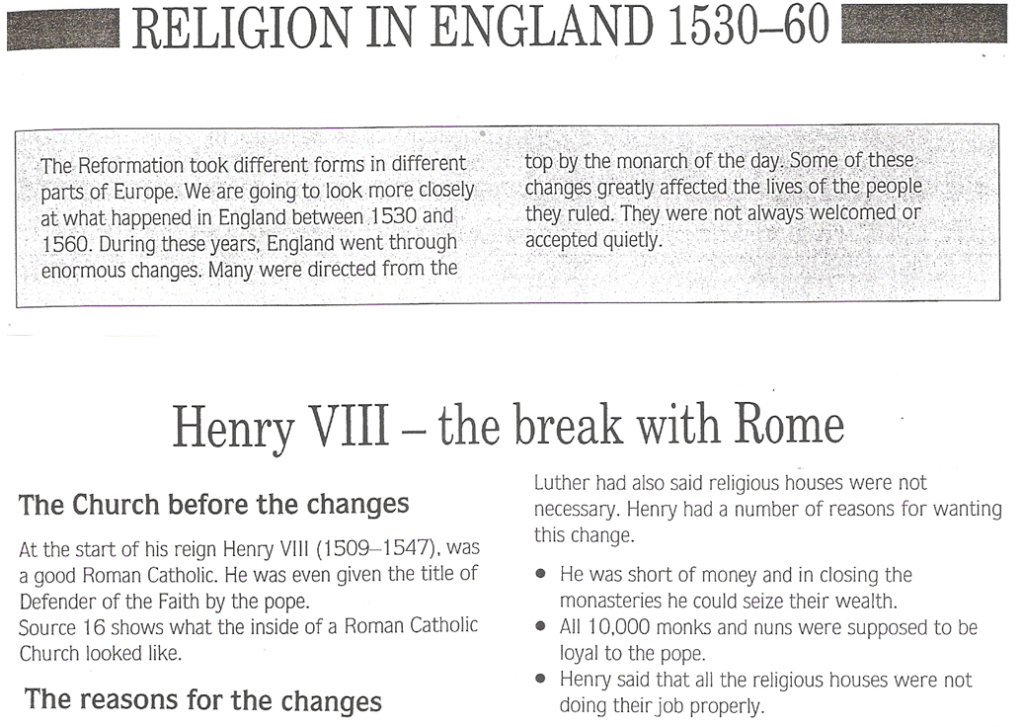
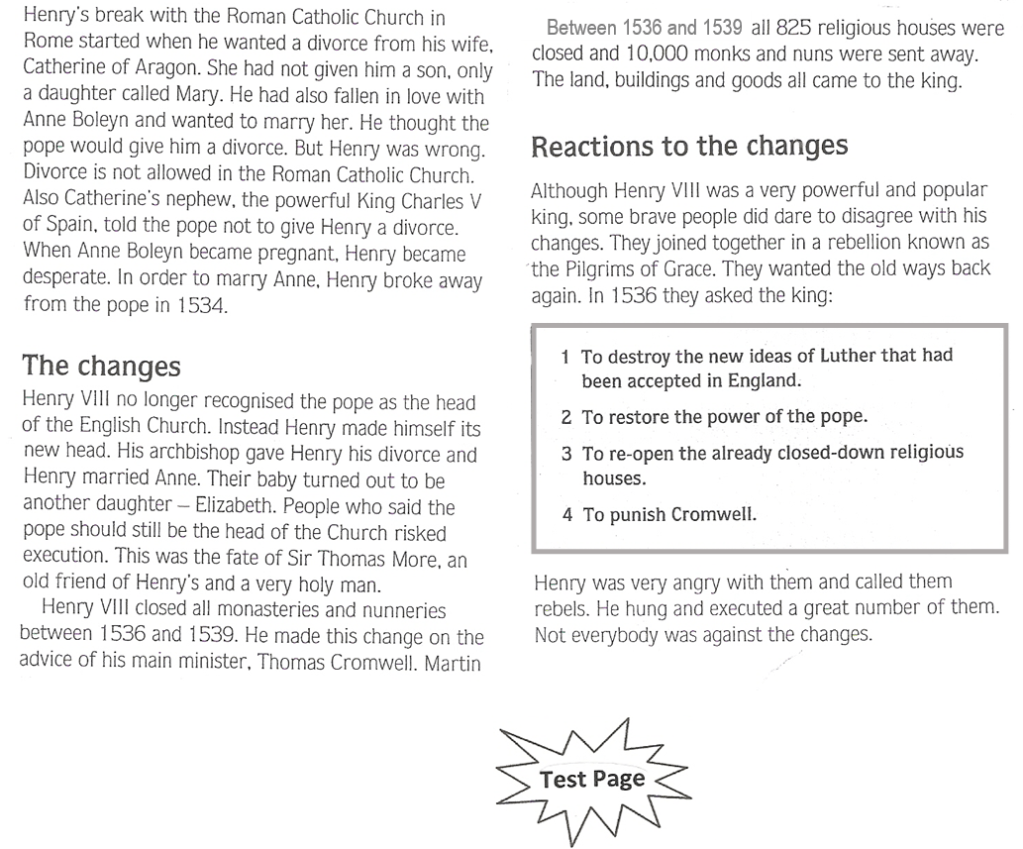
To test your knowledge and understanding, complete the following tasks on Henry VIII’s “Break with Rome”…
“The Break with Rome, p.56”
Please take note:
You may choose to complete:
EITHER: Questions 1-8
(Take Note: Q-5 and Q-6 need longer answers!!)
OR: Questions 9-14
(Take Note: Q-13 has sub-questions & Question 15 needs a longer answer!!)
Read the questions carefully before you decide which ones to do.
2.
The information on p.47 will help…
Read p.47
3.
Also…
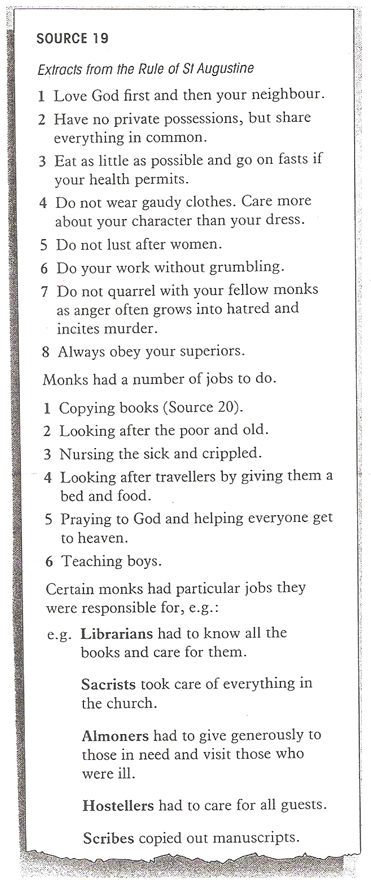
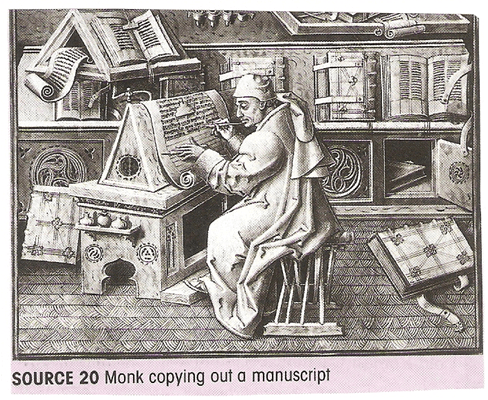
The sources about monks (Sources 19 & 20), on p.48, may also help…
(WordPress advertisements may appear below.)
Year 8A & Year 8B
Complete these revision questions on The Reformation…
Follow the instructions step by step:
1.
To test your knowledge on the role of Martin Luther in the reformation of the Roman Catholic Church…

Go to p.51 in your Workbook and read through all the questions on Martin Luther.
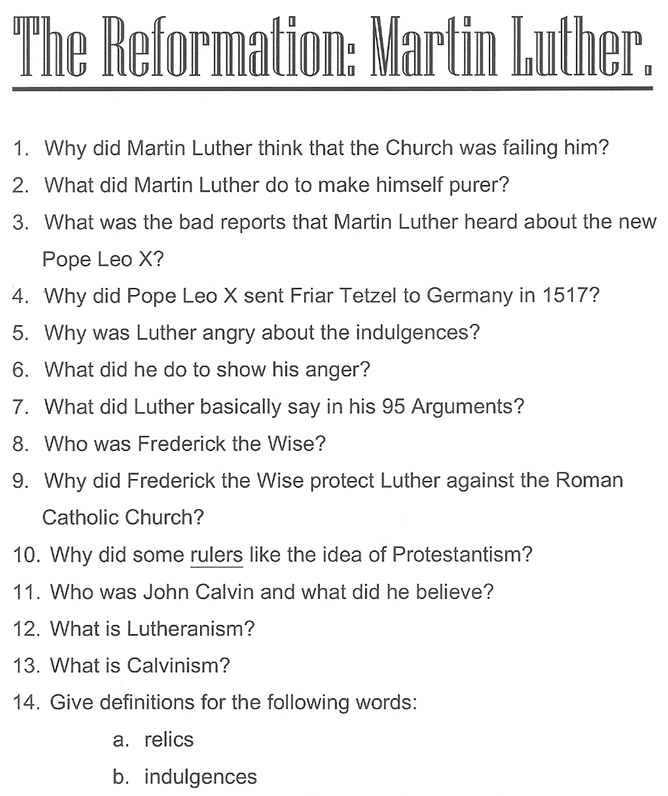

Now you are going to answer some of these questions to test your knowledge and understanding.
“Martin Luther, p.51”
Please take note:
You may choose to complete:
EITHER: the odd numbers (Q-1, Q-3, Q-5, Q-7, Q-9, Q-11, Q-13)
OR: the even numbers (Q-2, Q-4, Q-6, Q-8, Q-10, Q-12, Q-14)
Read the questions carefully before you decide which ones to do.


Here is a little bit of help with Question 14:
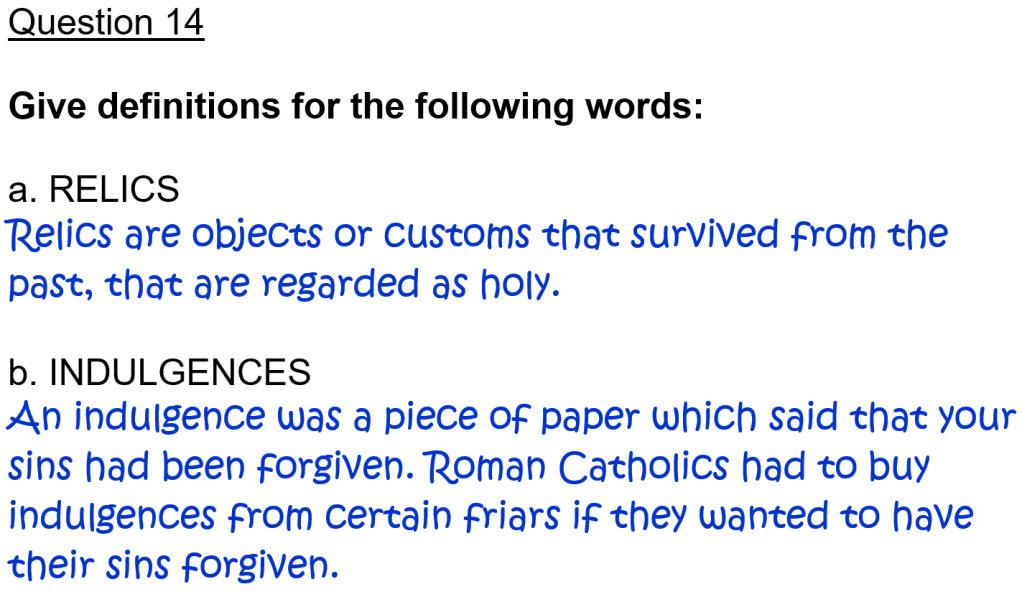
2.
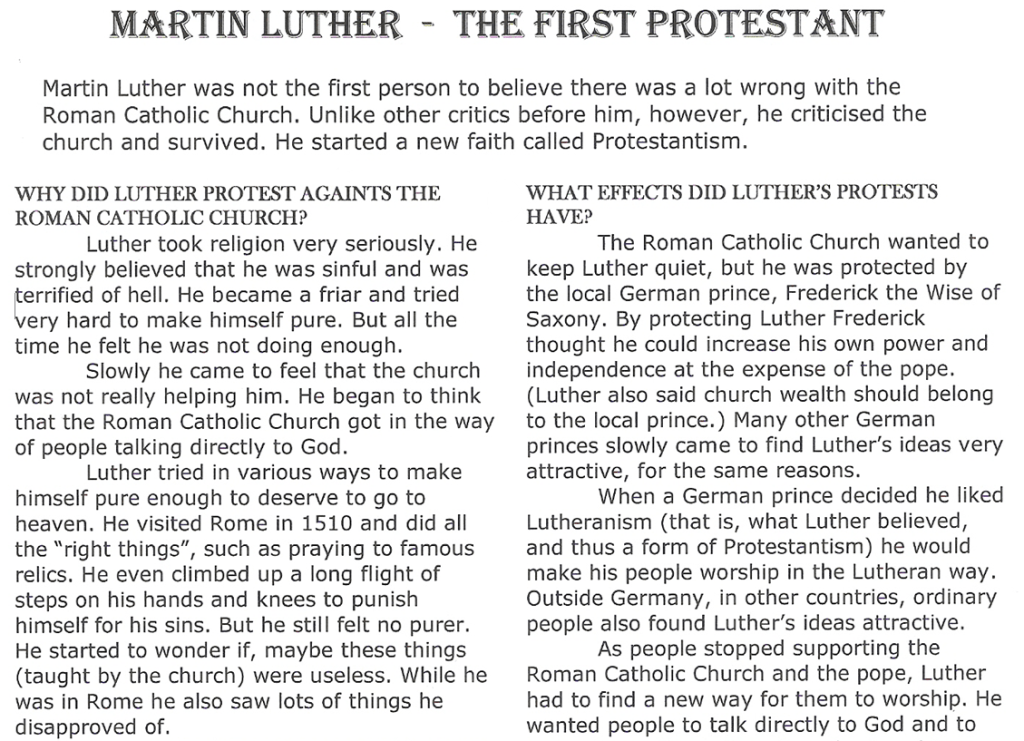
The information on p.46 may help…
Read p.46

(WordPress advertisements may appear below.)
Year 8A & Year 8B
Complete these revision questions on The Reformation…
Follow the instructions step by step:
1.
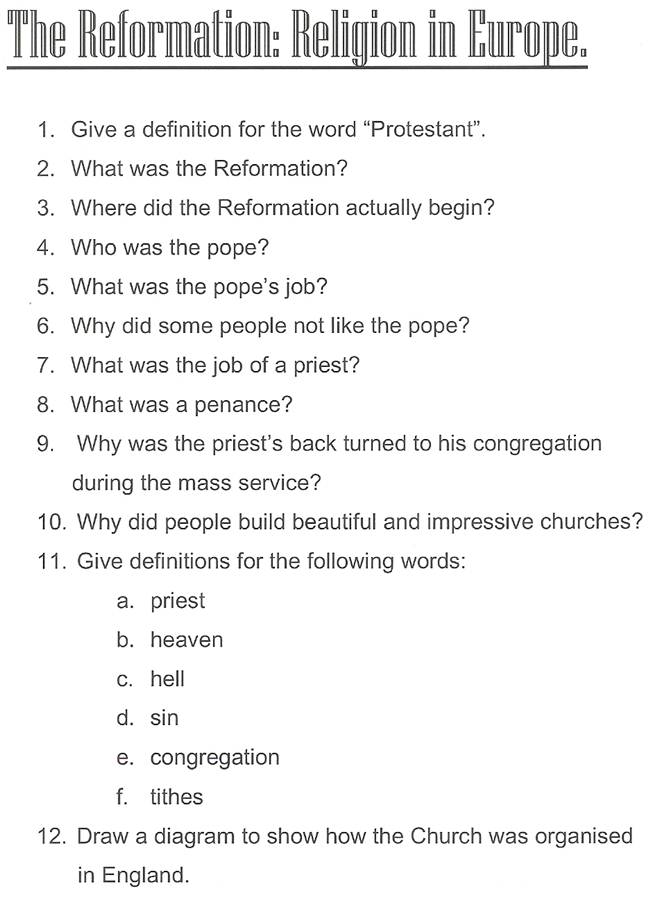
Let’s test your knowledge and understanding of “Religion in Europe” before the Reformation…
“Religion in Europe, p.50”
2.
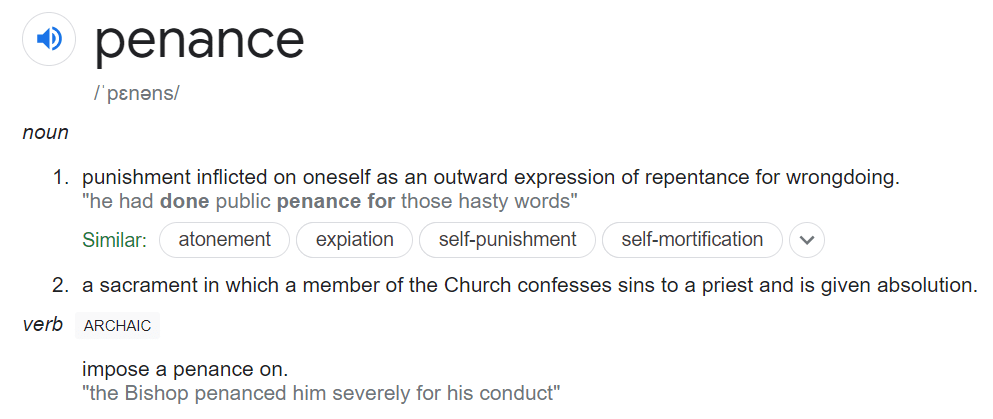
Here is a little hep with Question 8:
3.
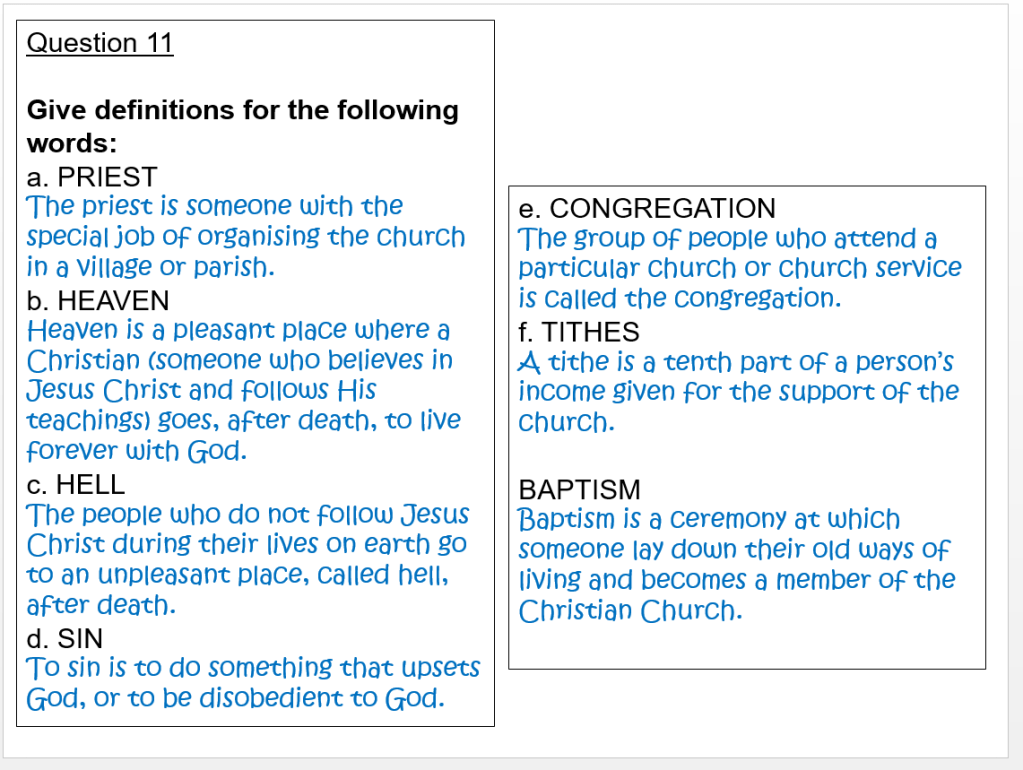
And here are possible answers to the definitions in Question 11:
4.
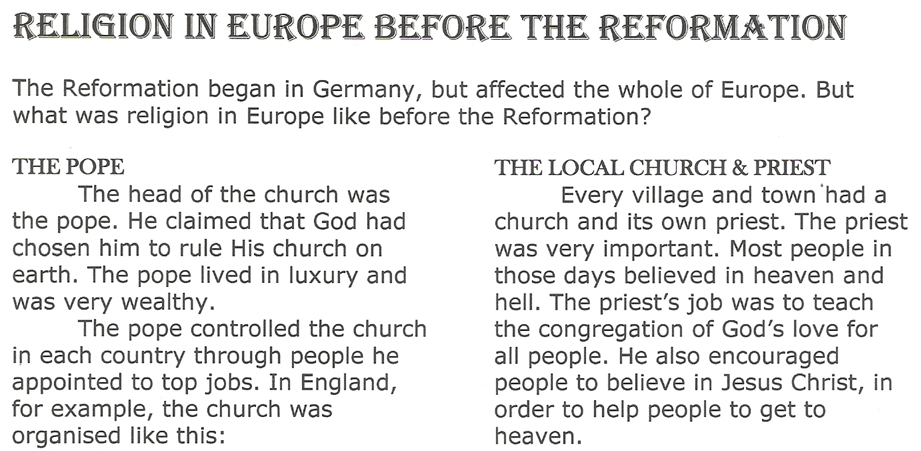
The information on p.45 may help…
Read p.45

(WordPress advertisements may appear below.)
Year 8A & Year 8B
Today you will continue showing the results of your projects on the Reformation to the rest of the class!
We will also mark some work and finish the topic on the Reformation.
Follow the instructions step by step:
1.
If you have completed this task…

Task 6 on p.40-42.
2.
Show your assessment project…



You will be asked to:
3.
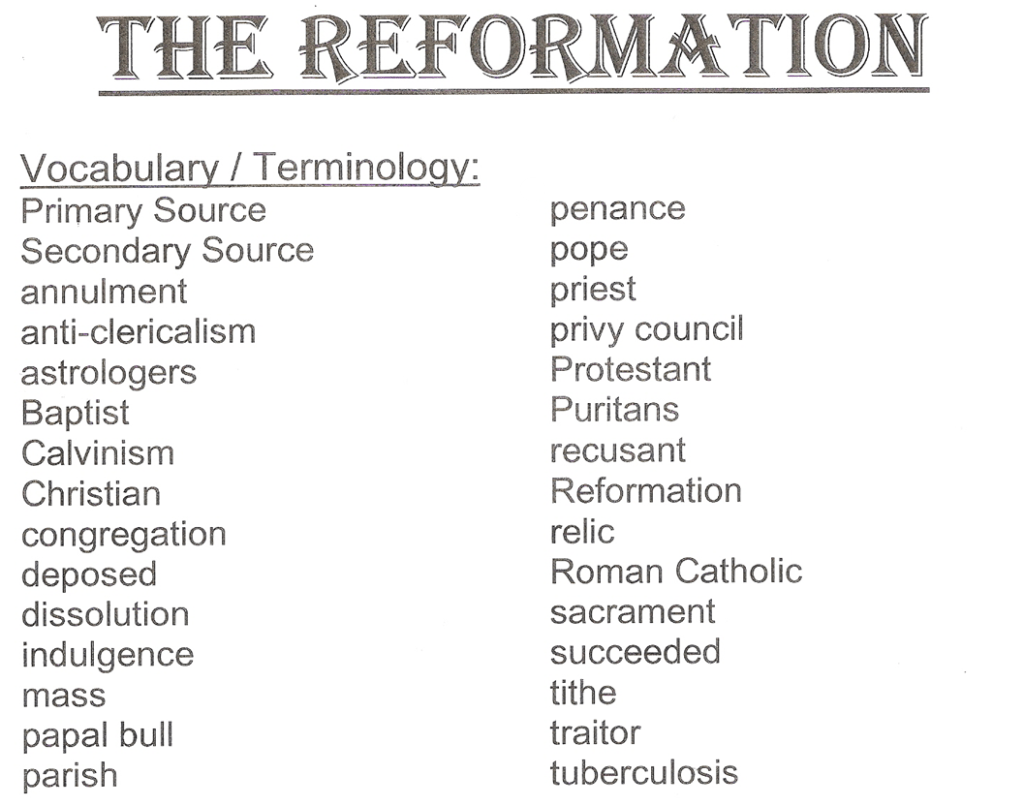
Make sure you know these words well enough to explain their meanings… (This is on p.64 in your workbook.)
4.
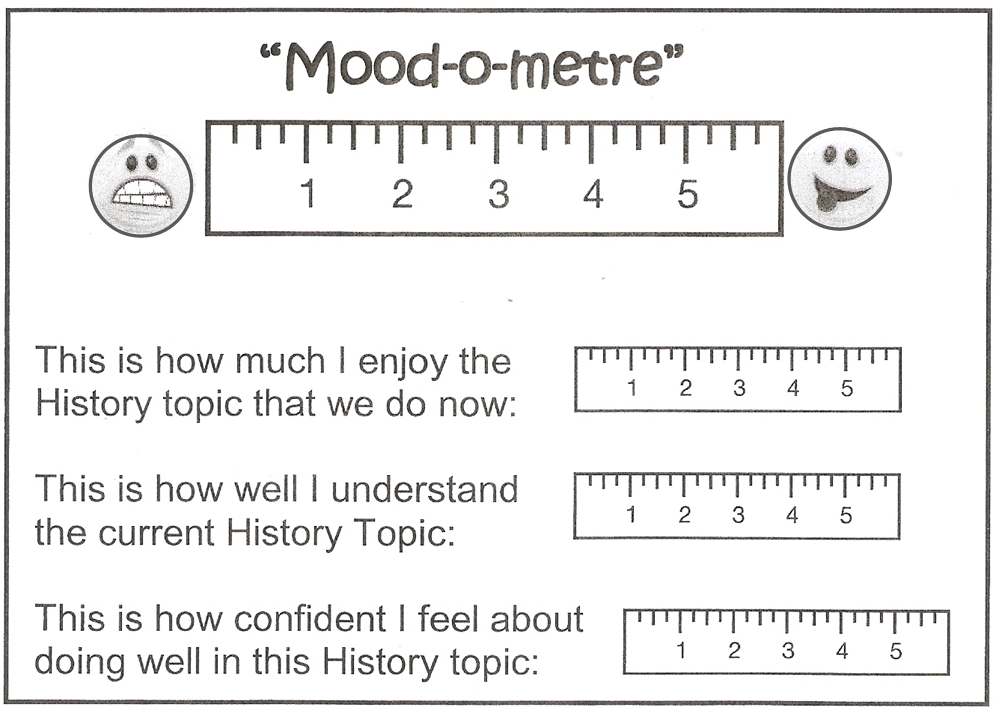
Finally, complete the Mood-O-Metre on The Reformation, on p.64.
5.

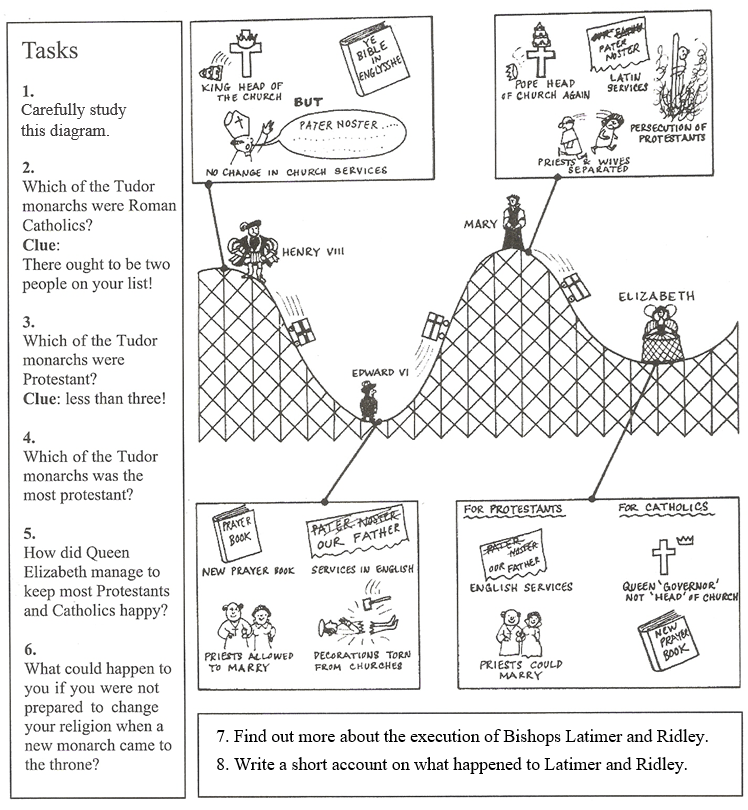
Complete the task on p.61

6.

–(to be uploaded)–
(WordPress advertisements may appear below.)






















 Best study methods