
You will learn about the Anglo-Saxon influence on life in Britain in Year 7 History!



Homework Booklet

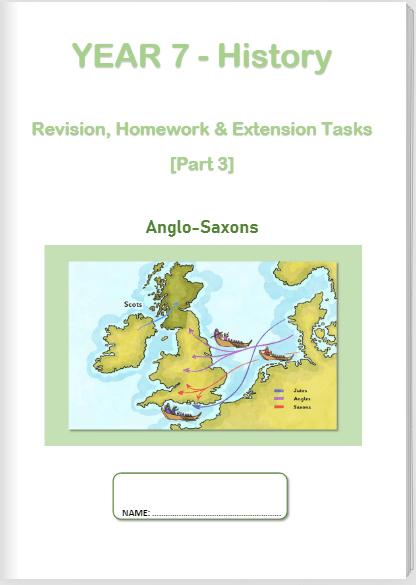
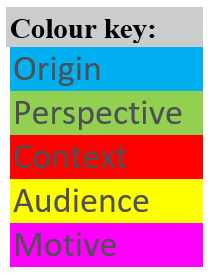
Homework Answers:

(WordPress advertisements may appear below.)
You will learn how to analyse and interpret historical sources in Year 9 History!
Homework Booklet
Homework Answers:

(WordPress advertisements may appear below.)
Year 8A – Wed. 17 June 2020
Year 8B – Thurs. 18 June 2020
Year 8, this is your last History lesson of this academic year! So, today you are going to finish and submit your mysimpleshow video on Slave Trade, for assessment purposes. However, BEFORE you continue with your video, you are going to fill in a short survey.
1.
Complete the survey, called “End of Year Review”… It is in Materials in Schoology. Do this to the best of your ability – I value your input!
IMPORTANT: If, for some reason, you have any problem with the survey, let me know immediately in Hangouts, so that I can sort it out.

2.
You get the rest of today’s lesson to complete the video task. In the previous lesson I said that your video is due no later than:
12h05 on Wednesday, 17 June (for Y8A)!
and
9h50 on Thursday, 18 June (for Y8B)!
However, because you also had to do the survey in today’s lesson, I decided to give you till 14h00 today to submit your video. So, log in to www.mysimpleshow.com
(You can click on the picture below to go straight to the website!)

3.
Finish editing your video. (Or Upload your completed PowerPoint script onto mysimpleshow to start editing the video, if you have not started yet…)
4.
ALSO REMEMBER:
Check your video before finalizing it, by clicking PLAY VIDEO (top right).

5.
Finalize your video in mysimpleshow.
6.
Send me the link (to your video) in Schoology mail.
7.
Finally, in case you have not realized, you can access your marks if you click on “Grades” (on the menu on the left in the Schoology History course).
8.
Send me a private message on Schoology to confirm that you have completed the tasks as instructed today, with the link to your mysimpleshow video. (If you are not ready to send the link to me, you still need to send me a message at the end of this lesson to inform me! And remember, I must have the link by 14h00 today!) I enjoyed teaching you, Year 8! Have a lovely summer holiday!
(WordPress advertisements may appear below.)
Wednesday 17 June 2020 – Year 9
It is very important that you follow the order in which I give you instructions today!
So, Year 9, this is your last History lesson of this academic year! To conclude our “Source Analysis” topic I want you to look at this short revision video that I have made in order to briefly revise some of the source analysis theory that you have learnt so far.
1.

(The video mentions some pages that you need to read – you may already have read the pages, so just watch the video.)
Analysing Sources. (4:49 minutes long)
2.
Now quickly do Homework Task 2 (p.74-78) NOW (as class work) in your Homework Book. This is an easy task and it will not take you long to complete.
3.
Watch the video below and mark the “homework” task that you have just completed with a pencil:
Sources Homework Task 2, p.74-78. (2:05 minutes long)
4.
Now we will investigate the option of taking GCSE History… Below are three short video clips that give you information about GCSE History. You need to watch all 3 clips (even if you already know that you are not going to take GCSE History). Then, after you have watched the videos, you need to complete a survey in Schoology.
Do NOT do the survey before watching all the videos!


In this video I show you How GCSE History can benefit you and also what the GCSE History course is about. (1:58 minutes long)
This video is a short discussion, by Queen’s students, about the pro’s and con’s of taking GCSE History. (The voices have deliberately been “mickey-moused”… (2:55 minutes long)
And finally… one last video to help you make up your mind. You do not want to miss this video clip!! (All I will say is that I have the Geography teacher’s permission to show you this video…)(4:10 minutes long)
5.
Now, complete the survey, in Materials in Schoology, called “End of Year Review”… Do this to the best of your ability – I value your input!
IMPORTANT: If, for some reason, you have any problem with the survey, let me know immediately in Hangouts, so that I can sort it out.
6.
And now, to end off today’s lesson I want to share my favorite “History song” with you! This song was written by a South African songwriter, Christopher Torr and is sung by his wife, Laurika Rauch, who is a well known South African singer. The song is unique – as you will discover – as the lyrics are almost entirely made up of the names of places…!! All the places mentioned in the song are places where famous battles and struggles occurred. (I am confident that you will recognize the significance of some of these places!) She also sings of a city where there will be peace and where the streets will be paved with gold and where no battles will occur… (The name of the song is “Hot Gates”, which is a place, in Greece, also known as Thermopylae, where a famous battle took place.) I hope you find this unique song as interesting as I do…
7.
Finally, in case you have not realized, you can access your marks if you click on “Grades” (on the menu on the left in the Schoology History course).
8.
I enjoyed teaching you, Year 9’s, and I wish you all of the best! Please send me a private message on Schoology (use the SAME mail-thread!!!) to confirm that you have completed the tasks as instructed today! And have a lovely summer holiday!

(If you want to access the information on Sources used in this lesson directly from the original website, here is the link to access it: https://www.history.org.uk/student/resource/3211/using-historical-sources .)
(WordPress advertisements may appear below.)
Year 7A – Wed. 17 June
Year 7B – Thurs. 18 June
Follow the order in which I give you instructions:
Year 7, this is your last History lesson of this academic year! So, here is what I would like you to do today:
1.
To conclude the tasks based on the film about William Thatcher (or Sir Ulrich von Liechtenstein), read the information below:
Eight Things you did not know about this film:
1. The entire film was shot in Prague, Czech Republic.
2. The film includes a great deal of jousting footage. The initial scene of the two knights jousting is actually footage of William’s stunt double in an accident. During filming of a later scene in the film, the lance of the stunt double’s opponent moved off target and hit him in the head. The double fell to the ground unconscious. In another incident, William knocked out one of the director’s front teeth with a broomstick when the two were demonstrating a jousting move. It took several months for the director’s mouth to heal enough to repair the damage.
3. Plenty of effort was expended creating lances that would convincingly explode upon impact without injuring the stunt riders. The body of each lance was scored so it would break easily, and the tips were made of balsa wood. Each was also hollowed out, with the holes filled with balsa splinters and uncooked linguine. Jousting armour was made by using a unique sprayed polyurethane system that was first invented for the film Gladiator. Onscreen, it is almost impossible to distinguish between the polyurethane stunt armour and steel armour. William’s armour was originally made in steel along with three polyurethane stunt replicas.
4. According to the director the film was intended to have occurred sometime in the 1370s during a six-month period in which Chaucer had apparently gone missing. The film shows what he might have done during this time, which then later on “inspired Chaucer to write his Canterbury Tales”. (The first Canterbury tale is called “The Knight’s Tale”.)
5. The scene in which the lady Jocelyn asks William to lose a joust to prove his love and then reverses her proposal for him to suddenly win, is also a direct reference to the classic tale of Lancelot, the Knight of the Cart, in which Queen Guinevere asks Lancelot to do the same during a tournament.
6. The film, which notionally took place during the Middle Ages, is notable for its deliberate use of classic rock songs in its soundtrack!
7. Despite the mixed critical reception, the film won four cinematic awards!
8. Heath Ledger played the part of William. Sadly, Heath Ledger died 7 years after the film was made.
2.
Complete the survey / quiz, in Materials in Schoology, called “End of Year Review”… Do this to the best of your ability – I value your input! (Please take note: the first question, a “vocabulary” test, is “timed”…!) All the questions must be completed NOW during lesson time! It MUST be submitted before the end of this lesson!
IMPORTANT: If, for some reason, you have any problem with the survey, let me know immediately in Hangouts, so that I can sort it out.
3.
Read these Memorable quotes from the film and decide which one you like the most: (You do not have to answer this – it is just something to think about…)
“Love should end with hope”
(Kate)
“If he believes enough, a man can do anything!”
(William’s father)
“Your men love you. If I knew nothing else about you, that would be enough”
(Prince Edward)
“Better a silly girl with a flower than a silly boy with a horse and a stick”
(Jocelyn)
“I was naked for a day; you will be naked for eternity”
(Chaucer)
4.
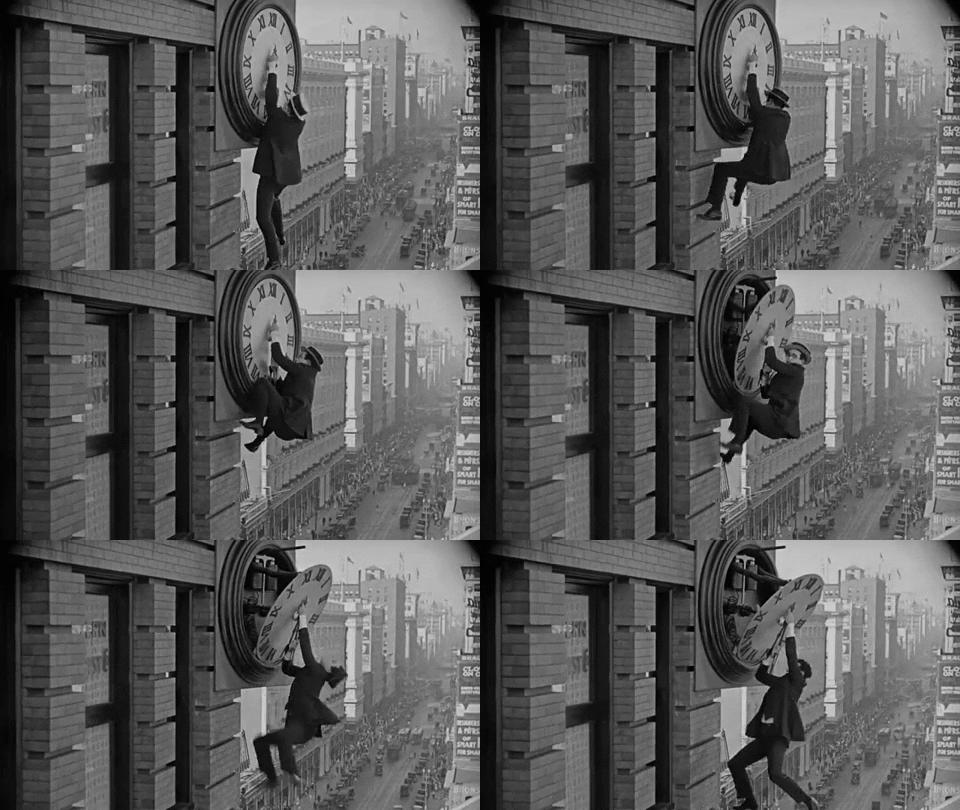
Finally, I have chosen a short film by one of the best silent movie makers ever. His name is Buster Keaton and he was an American actor, comedian, film director, producer, screenwriter, and stunt performer. Keaton is best known for his silent films (of the 1920’s), in which his trademark was physical comedy. So, let’s end off the Year 7 History course by seeing what films were like exactly 100 years ago!

MOVIE TIME!
This is what movies were like in the 1920’s!
Buster Keaton – Neighbors, 1920. (17:44 minutes long)
5.
Finally, in case you have not realized, you can access your marks if you click on “Grades” (on the menu on the left in the Schoology History course).
6.
Send me a private message on Schoology (use the same mail-thread that we have been using previously!) to confirm that you have completed the tasks as instructed today. And have a lovely summer holiday!
(WordPress advertisements may appear below.)
Monday 15 June 2020 – Year 9
It is very important that you follow the order in which I give you instructions today!
We are still busy with our final “topic” on The Use of Sources in History. Again, you will do quite a bit of reading, watch videos on the topic, and do an assessment quiz at the end of the lesson – so make sure that you work fast, because the quiz will expire by the end of the lesson!
You may NOT do the quiz before reading all the information and watching all the videos!
Do NOT even open the quiz before you are told to do so in the instructions below!
1.
First, watch the following video that I have made for you in order to revise some of the source analysis theory that you have learnt so far.
Primary and Secondary Sources. (3:30 minutes long)
2.
Now watch the following video that I have made about dealing with various types of Historical Sources.
Types of Sources. (3:38 minutes long)
3.
Now, read the information (below) about “Interpreting Photographs“. It comes (more or less directly!) from an excellent website on “Using Historical Sources”.
Interpreting Photographs
“Photographs are very useful types of primary sources. They provide a rare glimpse of a particular second in time, which will never again be repeated. This is especially true for events that occurred before the development of television or digital technologies.”
“Interpreting a visual source, like a photograph, is very different to interpreting words on a page, which is the case with written sources. Therefore, you need to develop a different set of skills.”
“Many people assume that photographs are unbiased, accurate records of historical events. However, that is not always the case. Photographers took great care to create the exact images they wanted their audiences to see. Therefore, it is important to analyse photographs in order to identify the message the creator wanted their audience to understand.”
“When people take a photograph, they make decisions about what to show in, or leave out of, the picture. Photographers do this by choosing the angle from which they take the shot and from what distance it will be taken, either close up or further away. Experienced photographers could then also edit their pictures later in order to change how the original image looked.”
“Therefore, to correctly interpret what the photographer intended their audience to understand from their image, we have to identify some specific information.” Identify the main subject (the most important people, locations or items in the image), the minor subjects (the background images) and the composition (the camera’s distance from the main object). Then consider “the purpose of the photograph, the motive of the photographer, the relevance of the source to your argument and the accuracy of the information presented in the image.”
4.

To see how different photographers can effect what an audience sees in an image, watch the following video: “A Portrait session with a twist”. (3:17 minutes long)
Also watch the following video as a further example of how photographs can be manipulated or staged. (3:31 minutes long)
5.

Read all the information (below) about, “Corroboration”, “Contradiction” and “Contestability”. It comes (more or less directly!) from an excellent website on “Using Historical Sources”.
Corroboration
“Corroboration is the ability to compare information provided by two separate sources and find similarities between them. When a second source provides the same or similar information to the first, the second source is considered to corroborate (e.g. support, or agree with) with the first. Finding corroboration between sources strengthens your conclusions, especially when you are making a historical argument. When choosing sources to corroborate, pick those that are deemed particularly reliable, which adds further certainty to your claims.”
“When you are analysing a source, it is helpful to compare what information it provides when compared with other sources. This helps you to more successfully evaluate your sources, especially in regards to their accuracy. If, in the process of finding corroboration between sources, you find that the two sources provide information that is different to each other, you have potentially discovered contradiction between them. This is another source analysis skill…” that is discussed below.
6.
Watch the following video that explains “How to corroborate sources in History”. (4:58 minutes long)

7.

Contradiction
“Contradiction is the ability to compare two separate sources and find information that differs between them. Contradiction is when the things said by the two sources cannot both be true: one has to be wrong.”
“When you are analyzing a source, it is helpful to compare what information it provides when compared with other sources. This helps you to more successfully evaluate your sources, especially in regards to their accuracy. For example, if one source said that Germany won World War One and another source said that Britain won World War One, they clearly cannot both be right. One of the sources has to be wrong. This is a point of contradiction.”
“Finding contradiction between sources helps you to determine how accurate or reliable a particular source is.” However, please note that “Sources may provide different kinds of information that may not prove contradiction. Contradictory is only information that is provided by two separate sources that cannot be true at the same time.”
8.
Watch the following video that explains “How to find contradiction in historical sources”. (4:51 minutes long)
9.
Contestability
“Contestability is a source evaluation skill which requires you to acknowledge that different historical interpretations can be supported by the surviving evidence. It is the idea that two separate sources can draw different conclusions about a historical person, concept or event.”
“Contestability most commonly occurs between two modern sources, typically academics, who have studied the surviving material in detail, but hold two different interpretations of the past. The ability for different interpretations is often caused by a lack of surviving primary sources for anyone to know for certain which interpretation is most likely to be correct. On these occasions, the different interpretations are both considered valid until further evidence is found.” For example, two different historians could have different explanations for an event, with either argument being supported by historical evidence and, therefore, the information they provide is contestable.
Take note: “Just because two different sources have different opinions doesn’t automatically show contestability. Both sources need to be considered reliable sources of information in order to trust their interpretation. If you find that one opinion is from an unreliable source, then its interpretation is not considered a valid basis for contestability. For example: A university academic could say that the Egyptian pyramids were built by humans, while a conspiracy theory website could say that the pyramids were built by aliens. Just because they have different opinions doesn’t show contestability: in this example the website is far less reliable than an academic and, therefore, its interpretation can be discounted.”
10.
Watch the following video: “Contestability in History Explained”. (5:42 minutes long)
11.
Finally, complete the quiz in Schoology about “Photographs“, “Corroboration”, “Contradiction” and “Contestability”.
IMPORTANT: Please note that you have only one attempt to complete the quiz. Also, it is a timed quiz, that expires at the end of the lesson!! So, do it now straight away! AND: If, for some reason, you have any problem with the quiz, let me know immediately in Hangouts, or you may lose marks!!
12.
Send me a private message on Schoology (use the SAME mail-thread!!!) to confirm that you have completed the tasks as instructed today!
(If you want to access the information on Sources used in this lesson directly from the original website, here is the link to access it: https://www.history.org.uk/student/resource/3211/using-historical-sources .)
(WordPress advertisements may appear below.)
Year 8A – Mon. 15 June & Wed. 17 June 2020
Year 8B – Wed. 17 June & Thurs. 18 June 2020
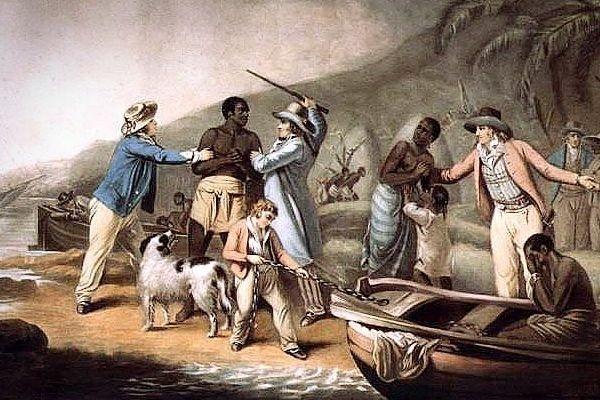
Today you are going to make a mysimpleshow video on Slave Trade, for assessment purposes.
But, before we start today, here is a bit of feedback, in the form of an example video… Some of you made great mysimpleshow videos on “Why Euroeans went exploring”, but others did not do so well… Either the script was not written very well, or you did not edit the video effectively. The script as well as the editing of the video is important! Here is an example of an excellent video. Have a look at it so that you can see how it compares with the one that you have created last week. (You may see a big difference!)
Why Europeans went exploring. (2:28 minutes long)
So, here is your assessment task – You need to make a mysimpleshow video that answers the following question:
“What was it like to be a slave?”
I have put a PowerPoint Template in “Materials” in Schoology. You must use this template to write the script. (That’s right, again you will have to write your own script for the video on “What was it like to be a slave?”!) Then you need to make the video in mysimpleshow.
You get today’s lesson as well as the next lesson to work on this task.
The video is due no later than:
12h05 on Wednesday, 17 June (for Y8A)
and
9h50 on Thursday, 18 June (for Y8B)!
Read the information below before you continue with today’s lesson!
IMPORTANT TIPS for you to take into account when making the video:

1. Before finalising the video listen carefully to the voiceover and make sure that it speaks satisfactorily. (For example, in many of your Exploration videos the voice read trade “routes” as trade “rauwts“…) If the voice pronounces a word incorrectly you may need to “trick” the program by spelling the word differently. In this case, if you had to spell the word as “roots”, the voice will probably read it correctly.
2. Make sure that the images you use make sense! For example, if your text says “navigation instrument” you should not use a “saxophone” to represent the “instrument”! Or, do not use an image of a “girl” for the word “monarch”. These images simply do not make sense… What you need to do is to search for more suitable images in the SEARCH function on the right. (For example, search for “compass” or “navigate” or even “GPS” to get a suitable image that will make more sense for “navigation instrument” than a “saxophone”!)
3. Make sure that the character images that you use make sense too. For example, do not use the same image for two different people. (E.g. Ptolemy and Pliny were not twins – you cannot use the same image to represent both of them!)
4. If the mysimpleshow program does not have a suitable image for the word / words that you want to represent in a scene it will simply give you a box that looks something like this:
This image cannot be used because, once again, it just does not make sense!
For example, the program may not be able to suggest an image for “technical advances”. If this is the case you need to “trick” the programme and search for a word like “machine” or “gears”, which may give you an image that can sort of be a symbol of “technical advances“. Alternatively, you can:
Remember all these options for next time!
5. Try not to place images in the top right corner of a scene as it will then be behind the mysimpleshow logo…
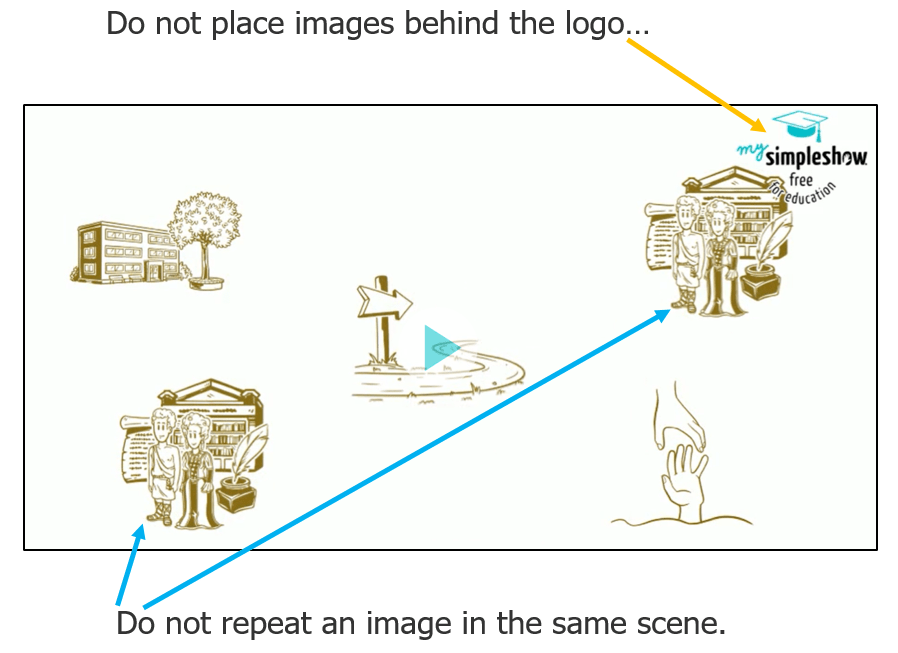
6. Do not repeat an image in the same scene – think of more interesting ways to display the same concept. (Perhaps use the image once and the second time use the TEXT function to write the word.)
7. Make sure that you use a variety of small as well as large images throughout the video. It makes the layout more interesting.
8. You have to use PUNCTUATION!! That is the only way that the computer voice will know when a sentence begins and when it stops!! (Otherwise the voice reads the text without any pauses and it absolutely does not make any sense at all!!)
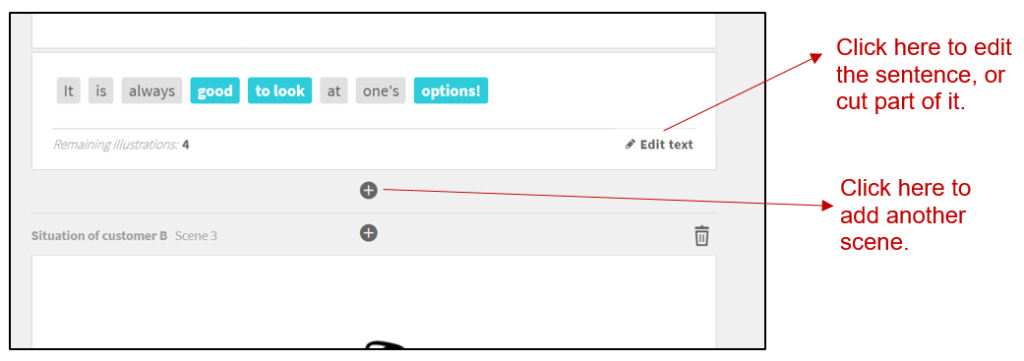
9. Make sure that there are no long “blank pauses” when you play the video. If there is, you need to select more keywords to include more images in the scene. If you have used the maximum number of images, you can split the scene:
10. Make sure that the conclusion to your video is good. A conclusion that says “I hope you enjoyed my video” is not a good conclusion! You need to conclude by giving a one or two sentence summary of the topic. If the topic is “Why did Europeans went exploring?”, a suitable conclusion could be something like. “Europeans, therefore, went exploring for a number of reasons – the most important of which is probably to find new uncharted territories.”
11. Before finalizing your video you need to check the video, by clicking PLAY VIDEO (top right).
Now, let me take you through the steps to make the new video:
1.
Download the PowerPoint Template called “What was it like to be a slave? – TEMPLATE” from Materials in Schoology and save it onto your computer.
2.
Use the template to write the script. You need to have an introduction. Then name and explain what it was like to be a slave. Make one point per slide and explain it on the next slide. Try to keep the explanations short, but make sure that they make sense! (You will see that the first slide, which will eventually be the first scene in the video, simply asks the question “What was it like to be a slave?”. This is a good way to start the script. Then after that, you need to fill in what the PowerPoint Template guides you to do, on each of the slides in the PowerPoint Template.)
3.
Log in to www.mysimpleshow.com
(You can click on the picture below to go straight to the website!)
4.
Upload your completed PowerPoint script onto mysimpleshow.
5.
Make the video in mysimpleshow.
6.
Send me the link (to your video) in Schoology mail.
7.
Let me know…how you have progressed by the end of today’s lesson by sending me a private message on Schoology to confirm that you have completed the tasks as instructed today.
8.
Once completed, send me a private message on Schoology (use the SAME mail-thread!!!) with the link to your mysimpleshow video.
REMEMBER: The video is due no later than:
12h05 on Wednesday, 17 June (for Y8A)
and
9h50 on Thursday, 18 June (for Y8B)!
(WordPress advertisements may appear below.)
Year 7A & Year 7B.
Monday 15 June 2020
Today we will continue with the film that tells the story of the peasant called William Thatcher who pretends to be a knight called Sir Ulrich von Liechtenstein. However, before you start with the fourth and last “episode” of the film, there are a few tasks that you need to do in preparation.
Follow the order in which I give you instructions:
1.
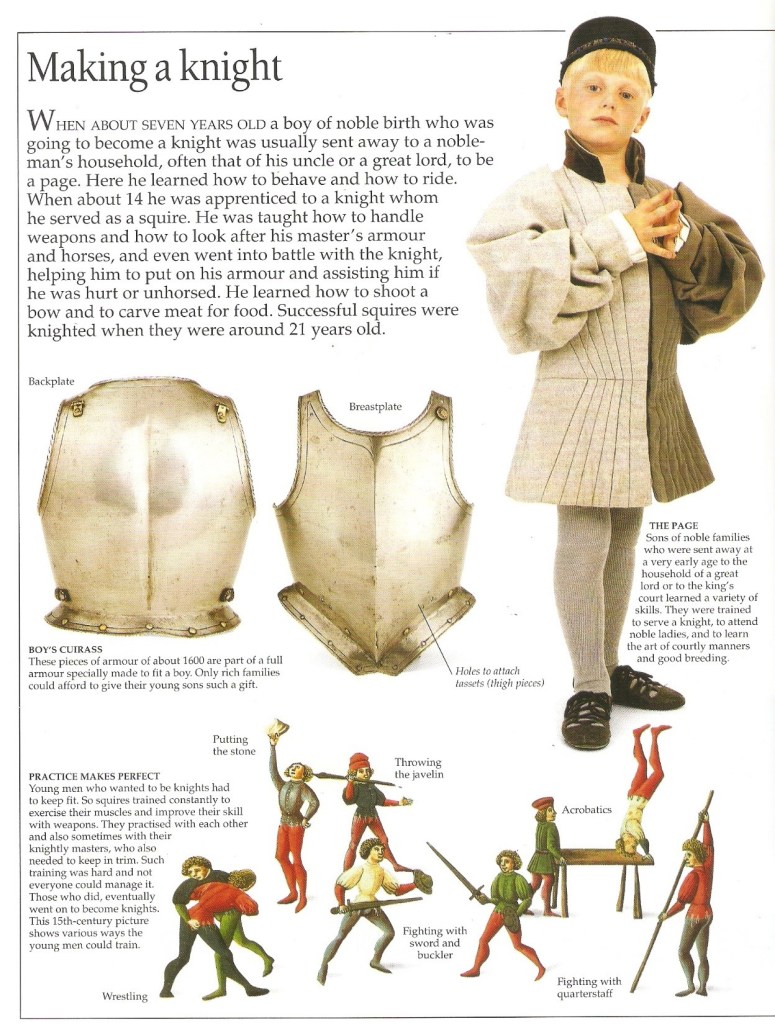
You are going to read this article again… Remember, we learn through repetition! Read this carefully as you will be tested further on some of the information that this article gives about knights.
2.
Complete the Quiz about “Knights keeping fit” in Schoology – it is “timed” and will take you no more than 10 minutes…! Please note that you have to do this NOW during lesson time! This MUST be completed NOW before you watch the rest of the film! (You only get one attempt at this and if you have not submitted the answers before the end of this lesson, you will receive zero for this task, as this quiz will expire.)
3.
Now read the following text which gives you a bit of an overview of the events in the fourth and final “episode” of the film:
In the previous “episode” William took part in a number of tournaments and achieved several victories. Eventually he returned to Cheapside, London to visit his father, but his true identity is then discovered by Adhemar…
Now, in this last “episode” William is placed in the pillory, but is defended from the hostile crowd by his friends. Then, the Black Prince emerges from the crowd… In acknowledgement of William’s honour, Edward (or the Black Prince) announces that, William is in fact, “beyond contestation” descended from a noble lineage, and knights him “Sir William”. Then William returns to the tournament to face Adhemar in the final match, but Adhemar cheats with an illegal sharpened lance… Let’s see what happens….
4.
Again, there are words that you may need to look up quickly so that you may fully understand their meanings: pillory, contestation, lineage, lance and “to knight“.
5.
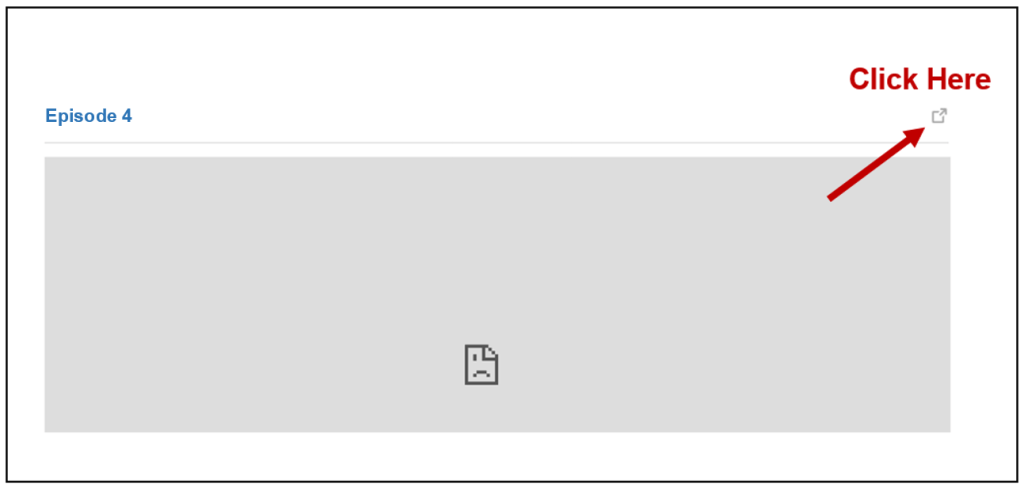
Now, watch “Episode 4” by accessing it in Schoology Materials. (This final “episode” is 26:48 minutes long.)
If, for some reason, it does not work, click on the square (at the top right) in the schoology page for “Episode 4” – then the video should work. It looks like this:
6.
Send me a private message on Schoology (use the same mail-thread that we have been using previously!) to confirm that you have completed the tasks as instructed today.
(WordPress advertisements may appear below.)
Year 7A – Wed. 10 June
Year 7B – Thurs. 11 June
Today we will continue with the film that tells the story of the peasant called William Thatcher who pretends to be a knight called Sir Ulrich von Liechtenstein. However, before you start with the third “episode” of the film, there are a few tasks that you need to do in preparation.
Follow the order in which I give you instructions:
1.
Read the following article which gives you a bit of background information about knights. It is important that you read this carefully as you will be tested on some of the information in this article…
2.
Complete the Quiz on “Squires and Knights” in Schoology – it is “timed” and will take you no more than 5 minutes…! Please note that you have to do this NOW during lesson time! This MUST be completed NOW before you watch the rest of the film! (You only get one attempt at this and if you have not submitted the answers before the end of this lesson, you will receive zero for this task, as this quiz will expire.)
3.
Read the following text which gives you an overview of the events in the third “episode” of the film:
In the previous “episode” William learnt that Sir Thomas Colville was actually Edward, the Black Prince. In this “episode”. Adhemar is called away to war (to the Battle of Poitiers). William takes part in more tournaments and achieved several victories in Adhemar’s absence. William proves his love for Jocelyn by complying when she first asks him to deliberately lose (in contrast to the countless knights who promise to win in her name), and then, just before he would be eliminated, to win the tournament in her name after all!
After this, the group travels to London for the World Championship. William remembers how he left his father as a little boy to become a squire for Sir Ector, to learn to become a knight, in the hope that he would “change his stars”. (That means to change his fortune, or to make his life better.) Adhemar has also arrived in London and announces that he is in negotiations with Jocelyn’s father for her hand in marriage. William dominates at the tournament. William also visits his father, now blind and living alone in Cheapside, London. However, Adhemar then realises who William (or “Sir Ulrich von Liechtenstein”) really is…
4.
Now, watch “Episode 3” by accessing it in Schoology Materials. (This “episode” is 34:51 minutes long.)
If, for some reason, it does not work, click on the square (at the top right) in the schoology page for “Episode 3” – then the video should work. It looks like this:
5.
Send me a private message on Schoology (use the same mail-thread that we have been using previously!) to confirm that you have completed the tasks as instructed today.
(WordPress advertisements may appear below.)
Wednesday 10 June 2020 – Year 9
It is very important that you follow the order in which I give you instructions today!
We are still busy with our final “topic” on The Use of Sources in History. Again, you will do quite a bit of reading, watch videos on the topic, and do an assessment quiz at the end of the lesson – so make sure that you work fast, because the quiz will expire by the end of the lesson!
You may NOT do the quiz before reading all the information and watching all the videos!
Do NOT even open the quiz before you are told to do so in the instructions below!
1.
Read all the information (below) about “Bias“, “Usefulness”, and “Reliability”. It comes (more or less directly!) from an excellent website on “Using Historical Sources”.
Bias
“As you read historical sources, particularly primary sources, you may find yourself noticing that some language used by the source’s creator is extreme or obviously one-sided.” This is also known as bias. “Bias is when the creator’s perspective is so strongly for or against something that the information in the source is clearly unbalanced or prejudiced. All sources contain some degree of bias, but it is not always possible to detect it.”
“Bias can either be extremely positive or extremely negative. If extremely positive, it is described as “pro-”, or “in favour of”, etc. If extremely negative, it is described as “anti-”, or “strongly against”, etc. If you cannot detect a bias, it is described as a “balanced” source”.”
“How do I detect bias in a source? Look for times in a source where any of the following happen:”
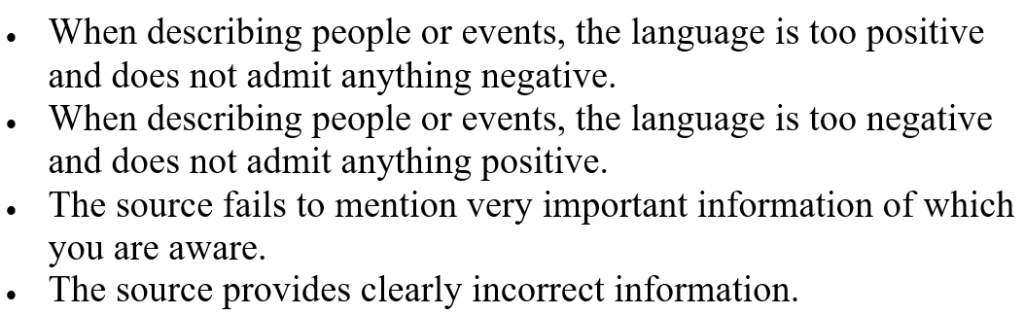
“If you noticed any of the above in your source, it indicates that the creator has a specific bias about the person or event and wants to communicate in a way that positions the audience to see things from the same perspective.”
Please note: “Bias in sources does not automatically make a source unreliable or inaccurate. Acknowledging which side the source supports simply allows us to highlight gaps in information.”
2.
Now, watch the following video that explains “How do you know if a historical source is biased?”. (5:34 minutes long)

3.
Usefulness
“Usefulness is a judgement about how relevant or helpful a particular source is in providing information about your topic.” Usefulness helps one to “prove that a source is valuable. The measure of a source’s usefulness is based upon the question being asked of it: If a source provides any information about the specific topic you’re investigating, it is considered to be a useful source.”
“How do I prove usefulness? Since a source’s usefulness is based primarily upon its ability to provide valuable information on your topic, there are four different ways to prove that a source is useful:”
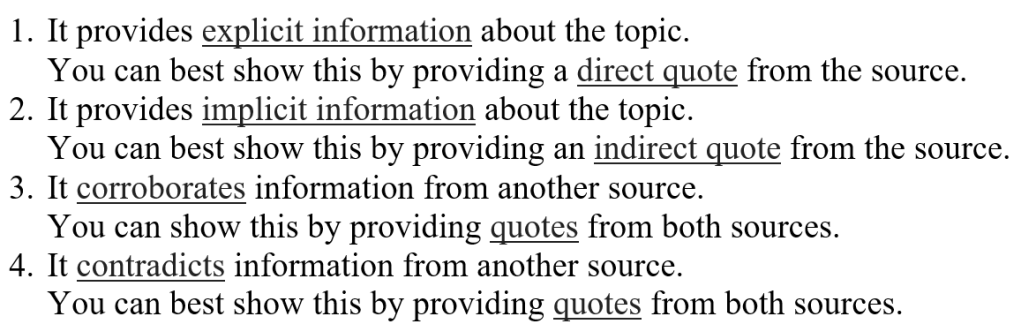
4.
Now, watch the following video that explains “How to evaluate historical sources for usefulness”. (3:40 minutes long)

5.
Reliability
“Reliability of sources evaluates whether they are trustworthy. It is important that the sources you use… are reliable so that the quotes (evidence) you use from them can be trusted. In history, it is rare that we are completely sure that sources are 100% reliable. Therefore, when we talk about reliability of sources, we can talk in terms of ‘degrees of reliability’:”
“Extremely – Very – Somewhat – Rarely – Not very”
“For example, we can say that a source is “extremely reliable”, or “not very reliable”.”
“How do I evaluate reliability? Based upon what you discovered in your analysis of the source, you can establish reliability based upon any of the following:”
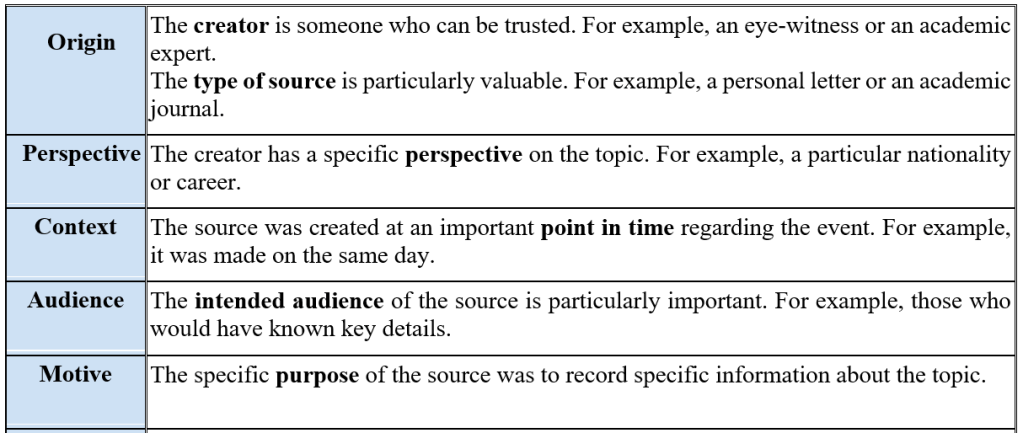
“Based upon what you discovered in your analysis of the source, you can establish its unreliability based upon any of the following:”
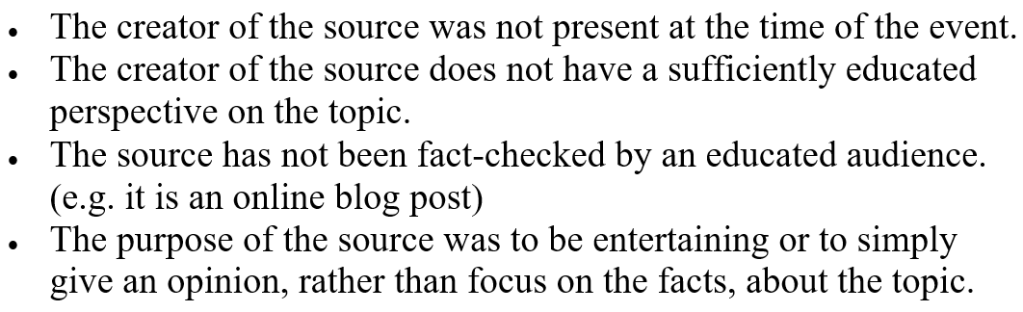
“When using information from sources to prove your own argument, you need to be able to use sources that are reliable. If you have found a source which you discover to be unreliable, the best advice would be not to use the source.”
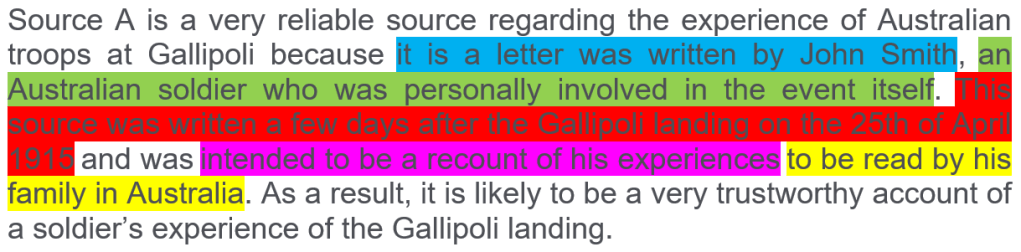
Here is an example of how to write the evaluation of reliability:
6.
Now, watch the following video that explains “What makes a source reliable?”. (5:53 minutes long)
7.
Also watch the following video that I have made for you to explain usefulness, reliability and bias in source analysis. Pay careful attention!
Usefulness, Reliability and Bias. (5:04 minutes long)
8.
Finally, complete the quiz in Schoology about “Bias“, “Reliability”, and “Usefulness”…
IMPORTANT: Please note that you have only one attempt to complete the quiz. Also, it is a timed quiz, that expires at the end of the lesson!! So, do it now straight away! AND: If, for some reason, you have any problem with the quiz, let me know immediately in Hangouts, or you may lose marks!!
9.
Send me a private message on Schoology (use the SAME mail-thread!!!) to confirm that you have completed the tasks as instructed today!
(If you want to access the information on Sources used in this lesson directly from the original website, here is the link to access it: https://www.history.org.uk/student/resource/3211/using-historical-sources .)
(WordPress advertisements may appear below.)
Year 7A & Year 7B.
Monday 8 June 2020
Today we will continue with the film that tells the story of the peasant called William Thatcher who pretends to be a knight called Sir Ulrich von Liechtenstein. However, before you start with the second “episode” of the film, there are a few tasks that you need to do in preparation.
1.
Read the following text which gives you a bit of an overview of the events in the second “episode” of the film:
In the previous “episode” William and his two friends met Geoffrey Chaucer. Chaucer forged a document (the patent of nobility) that allowed William to enter jousting tournaments under the false name of “Sir Ulrich von Liechtenstein” from Gelderland.
In this episode the four of them are at the tournament in France. William is brought before two men Simon the Summoner and Peter the Pardoner, because Chaucer has a gambling problem and is in their debt. William demands Chaucer be released and promises to make the payment. Then, in the course of competition, William’s armour is damaged. He asks Kate, a female blacksmith, to repair it without payment and goes on to win the sword event at the tournament. In this joust, he faces a Sir Thomas Colville, who withdraws from the tournament after being injured by William, though they exchange a ceremonial pass so that Colville can retain the honour of never having failed to complete a match. The proceedings are observed by Jocelyn, a noblewoman with whom William has become infatuated, and Count Adhemar. Count Adhemar is a rival both in the joust and for Jocelyn’s heart… This is bound to cause problems… Eventually, Count Adhemar and William fought in the final joust of that tournament…
Also in this episode, a female blacksmith called Kate joins William’s group and makes new lightweight armour that allows William greater mobility. Then, in the next tournament, Adhemar and William are both assigned to compete against Sir Thomas Colville, but they learn that he is actually Edward, the Black Prince! Adhemar withdraws, but William continues the match and then addresses the prince by name, further earning Edward’s respect. Adhemar is called away to war (to the Battle of Poitiers), and William achieves several victories in his absence.
2.
Again, there are words that you may need to look up quickly so that you may fully understand their meanings: gambling, debt, blacksmith and infatuated.
3.
Now, watch “Episode 2” by accessing it in Schoology Materials. (This “episode” is 41:51 minutes long.)
If, for some reason, it does not work, click on the square (at the top right) in the schoology page for “Episode 2” – then the video should work. It looks like this:
4.
Send me a private message on Schoology (use the same mail-thread that we have been using previously!) to confirm that you have completed the tasks as instructed today.
(WordPress advertisements may appear below.)
Year 8A – Mon. 8 June & Wed. 10 June 2020
Year 8B – Wed. 10 June & Thurs. 11 June 2020
Today you are going to make a mysimpleshow video on Exploration, for assessment purposes.
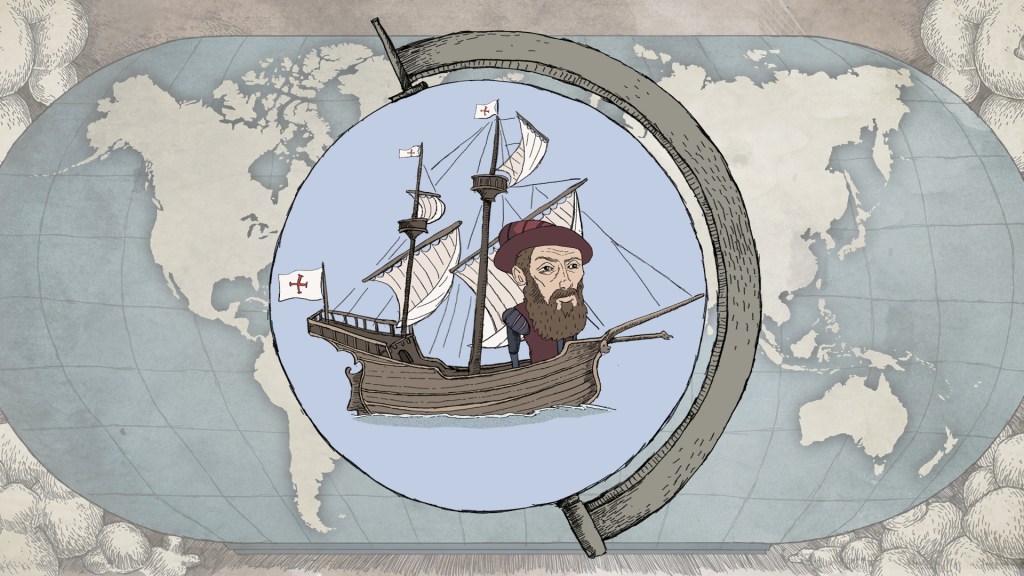
But, before we start, here is a bit of feedback, in the form of an example video… Some of you made great mysimpleshow videos, but others did not really edit their videos very well. The editing of the video is very important! Here is an example of a video that was edited very effectively. Have a look at it so that you can see how it compares with the one that you have made in the last lesson. (You may see a big difference!)
So, here is your assessment task – You need to make a mysimpleshow video that answers the following question:
“Why did Europeans go exploring?”
I have put a PowerPoint Template in “Materials” in Schoology. You must use this template to write the script. (That’s right, unlike the previous time, when I have already written the script about “Why we study History?” for you, you will have to write your own script for the video on “Why did Europeans go exploring?”!) Then, you need to make the video in mysimpleshow. (If you want a good mark for this, you need to make a good video!) I will, of course, be online during lesson time to help you should you get stuck.
You may use today’s lesson as well as the next lesson to work on this task. However, THE VIDEO IS DUE at the end of the next lesson – make sure that you have it ready then! Here are the precise deadlines:
12h05 on Wednesday, 10 June (for Y8A)!
AND
9h50 on Thursday, 11 June (for Y8B)!
So, let me take you through the steps:
1.
Download the PowerPoint Template called “Why did Europeans go exploring?” from Materials in Schoology and save it onto your computer.
2.
Use the template to write the script. You need to have an introduction on the first slide. Then name and explain the reasons one by one, with one reason per slide. Try to keep the explanations short, but make sure that they make sense! (You will see that the first slide, which will eventually be the first scene in the video, simply asks the question “Why did Europeans go exploring?”. This is a good way to start the script. Then after that, you need to fill in what the PowerPoint Template guides you to do, on each of the slides in the PowerPoint Template.)

The following pages in your Workbook may help you with ideas: p.28, p.29 & p.35

3.
Log in to www.mysimpleshow.com
(You can click on the picture below to go straight to the website!)
4.
Upload your completed PowerPoint script onto mysimpleshow.
5.
Make the video in mysimpleshow.
6.
Once completed, send me the link (to your video) in Schoology mail.
7.
Let me know…how you have progressed by the end of today’s lesson by sending me a private message on Schoology (using the SAME mail-thread!!!) to update me about your progress. Once you have completed the video, also send me the link to the video.
(WordPress advertisements may appear below.)
Monday 8 June 2020 – Year 9
It is very important that you follow the order in which I give you instructions today!
We are going to continue with our final “topic” on The Use of Sources in History. Again, you will do quite a bit of reading PLUS another quiz at the end of the lesson – so make sure that you work fast, because the quiz will expire by the end of the lesson!
You may NOT do the quiz before reading all the information and watching all the videos!
You will start by reading all the information (below) about “Historical Context“, “Audience“, “Purpose” and “Perspective“. It comes (more or less directly!) from an excellent website on “Using Historical Sources”.
1.
Historical Context
“When you are analyzing sources, it is important to remember that they were created at a time that is very different to our own.” This time of creation is the historical context. One needs to be aware “that the people who created sources were living at a time which may have held opinions and beliefs that are very different to what we consider ‘normal’….”
In addition, one also needs to be “aware of the important events at the time that influenced the creation of the source. Particular events often motivated people to create sources in a specific way. The creator may have specifically mentioned certain people or events, or used a certain language…”
How do we determine the historical context of a source?
Firstly, you need to know when the source was made. “Ensure that you are as precise as possible when identifying the date of creation: the century, decade, year, month and or day may help.”
“Secondly, …you need to discover where it was created.” (E.g. “a soldier wrote a letter in camp before battle, or a convict wrote a letter in a ship while in transit, or a newspaper printed a news report in a particular country town” – this “can all become important to knowing the context of the source.”)
“Thirdly, …you need to discover what significant event occurred at that time” (that may be relevant to the specific source that you are examining).
“Finally, carefully read the information in the source to identify specific language, ideas, and terminology that you need to learn more about in order to make sense of the source.”
2.
Now, watch the following video that explains “How to analyse a source’s historical context”. (5:03 minutes long)
3.
Audience
“When analysing a source, it is important to realise that all sources were created for a particular individual or group of people. Therefore, knowing about the intended audience of a source can help you in evaluating it.” The intended audience “is the person, or group of people, who were originally intended to see or use” the source.
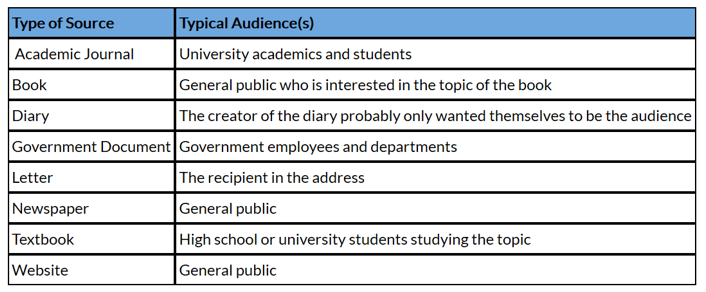
“Based upon what you know about the time the source was created and who created it, you need to identify for whom the source was originally created… Some sources make it easy for you to discover who their intended audience was, because they may specifically address them. For example, if your source is a letter, it might simply begin with “Dear John”; in which case, John was clearly the intended audience. However, most of the time you will be required to make an informed guess regarding the original reader or viewer. These are some general guidelines that may help you discover the intended audience:”
4.

Now, watch the following video that explains “How to discover a historical source’s intended audience”. (4:40 minutes long)
5.
Purpose
“The purpose of a source is the reason it was originally made. The creator of the source put in the time and effort to create it, and it was usually so that it could be used for something. Usually, knowing the purpose for its creation will help you evaluate its relevance and reliability to your argument.”
“How do I discover a source’s purpose? Based upon what you know about the creator and the intended audience, you can usually identify why the source was originally made. It can also be helpful to know what motivated the creator at a particular point in time.”
“This can be a simple as creating an ancient ceramic pot to store grain. Or it could be as complex as writing a 1960s pop song in order to criticise the government’s role in the Vietnam War.”
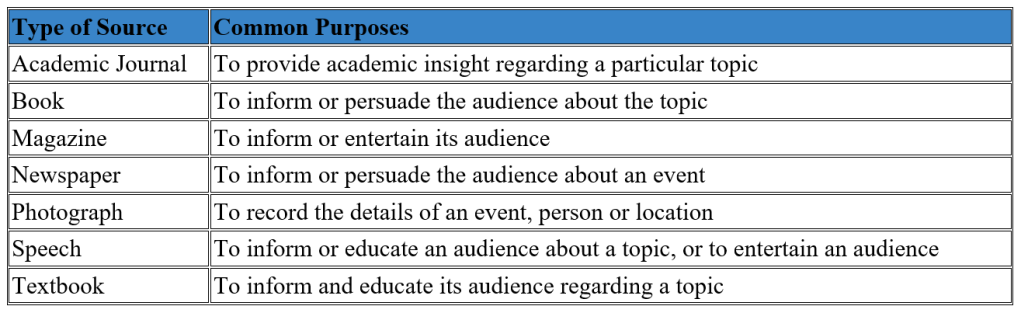
“Depending upon the type of source, there are some common purposes for their creation:”
6.
Now, watch the following video that explains “How to analyse a source’s purpose”. (6:24 minutes long)
7.

Perspective
“When analysing a source, it is (also) helpful to know the perspective of the creator, as this helps you to accurately assess its reliability and relevance. Perspective is the ‘point of view’ from which the creator of a source described historical events.”
“Every person sees and understands events differently depending on their age, gender, social position, beliefs and values. Even modern historians have their own perspectives which can influence how they interpret the past.”
For example:
“Two groups of fans at a football match will see the same game differently. Fans of the winning side will have a positive view and will usually talk about how great their team’s actions were. The fans of the losing side will be quite negative and may blame the result on referees or ‘cheating’ by the opposing team. How can two groups see the same event differently? The answer is ‘perspective’: they had a different point of view.”
“Perspective works the same in history. Two opposing sides in war, or politics, or social struggles, will see the same event differently.”
Take note that “different perspectives doesn’t necessarily mean that one side is ‘honest’ and the other is ‘lying’.” Or, that one side is “right” and the other is “wrong”. “It simply means that there are different points of view. However, if the difference in perspective causes someone to lie or have an unfair view…” it is biased. This implies that the perspective shows an unfair inclination for (or against) the events or people.
In order to determine a source’s perspective one needs to determine “who the creator was. Once you have sufficient knowledge about who made the source”, you can speculate about how they viewed the past,” by considering the following about the creator:
| nationality | e.g. American, Japanese, etc. |
| profession | e.g. university professor, soldier, etc. |
| political persuasion | e.g. conservative, Communist, etc. |
| cultural background | e.g. Egyptian, European, etc. |
| gender | e.g. male, female, etc. |
| religious beliefs | e.g. Christian, Muslim, etc. |
| educational background | e.g. what university they work for |
8.
Now, watch the following video that explains “How to determine a source’s perspective”. (5:13 minutes long)

9.
Finally, complete the quiz in Schoology about “Historical Context“, “Audience”, “Purpose” and “Perspective”…
IMPORTANT: Please note that you have only one attempt to complete the quiz. Also, it is a timed quiz, that expires at the end of the lesson!! So, do it now straight away! AND: If, for some reason, you have any problem with the quiz, let me know immediately in Hangouts, or you may lose marks!!
10.
Send me a private message on Schoology (use the SAME mail-thread!!!) to confirm that you have completed the tasks as instructed today!
(If you want to access the information on Sources used in this lesson directly from the original website, here is the link to access it: https://www.history.org.uk/student/resource/3211/using-historical-sources .)
(WordPress advertisements may appear below.)
Year 7A – Wed. 3 June
Year 7B – Thurs. 4 June
As mentioned in the previous lesson, over the next few lessons you will watch an adventure-comedy film, set in Medieval times, about a peasant called William Thatcher who creates a new identity for himself, as a knight called Sir Ulrich von Liechtenstein. (He did this, because he wanted to participate in more tournaments, but only knights and nobles were allowed to take part in the tournaments.) So, today we will watch the first “epidose” of the film. Make sure that you pay attention to all the information that I provide you with and that you concentrate when watching the film, as you will be tested in the next lesson!
Follow the order in which I give you instructions:
1.
Read the following text which gives you a bit of background information:
The film that you are about to watch is a medieval adventure action film. It is told in an anachronistic style with many modern references. The film follows a peasant who pretends to be a knight, along with his companions, in the world of medieval jousting. William poses as a knight and competes in tournaments, winning accolades and acquiring friendships with such historical figures as Edward, the Black Prince of Wales and Geoffrey Chaucer. (The film takes its title from Chaucer’s “The Knight’s Tale” in his Canterbury Tales, though the plot is not similar.)
2.
It is very important to understand what you read. So, quickly look up the following words online to find out what they mean: anachronistic, jousting and accolades. Do this right now, before you continue with the lesson.
3.
Read the following text which gives you a bit of an overview of the events in the first “episode” of the film:
At a jousting tournament in 14th-century Europe, young squires William Thatcher, Roland, and Wat discover that their master, Sir Ector, has died. If he had completed one final pass he would have won the tournament. Destitute, William wears Ector’s armour to impersonate him, winning the tournament and taking the prize.
Although only nobles are allowed in tournaments, William is now inspired to compete and win more prizes. Roland and Wat would rather take their share of coins and leave, but William convinces them to stay and train him to joust. Along the way to his first tournament in Rouen (in France), the three bumped into Geoffrey Chaucer, who is also destitute and agrees to forge the patent of nobility, a document to prove that the contestant is indeed a noble. This document was needed to allow William to enter, using the false name “Sir Ulrich von Liechtenstein” from Gelderland!
4.
Again, there are words that you may need to look up quickly so that you may fully understand their meanings: squires, destitute, joust and forge.
5.
Now, watch “Episode 1” by accessing it in Schoology Materials. (This “episode” is 23:34 minutes long.)
If, for some reason, it does not work, click on the square (at the top right) in the schoology page for “Episode 1” – then the video should work. It looks like this:
6.
Send me a private message on Schoology (use the same mail-thread that we have been using previously!) to confirm that you have completed the tasks as instructed today.
(WordPress advertisements may appear below.)
Year 7A and Year 7B
If you cannot access the various “episodes” of this film in Schoology, you will have to watch the film in Spanish. (Click on the red button to watch it on YouTube.) Make sure that you ONLY watch today’s episode.
Episode 1 is from 00:00:00 to 00:25:00
Episode 2 is from 00:24:00 to 01:07:00
Episode 3 is from 01:07:00 to 01:43:30
Episode 4 is from 01:42:30 to 02:07:30 (the end)

After watching today’s “episode”, remember to send me a private message on Schoology (use the same mail-thread that we have been using previously!) to confirm that you have completed ALL the tasks as instructed today.
(WordPress advertisements may appear below.)
Year 8A – Wednesday 3 June 2020
Year 8B – Thursday 4 June 2020
Today you are going to sign up and familiarise yourself with an online video making tool called mysimpleshow. (Some of you may already, to some extent, be familiar with it and may even have an account already.)
So, here is what you have to do today: (It is VERY important that you follow the instructions step by step!!)
1.
Watch the video on “How to Open an Account and join a Classroom”. (1:57 minutes long)
2.
Now go to Gmail and open the invitation email to the mysimpleshow team account. Then follow the instructions as explained in the video above, to join the classroom account. (If you already have an account, you obviously do not have to “sign up” but simply login to your account and then join the Team Account. HOWEVER, your account MUST use your SCHOOL G-mail.)
(I am about to send you an invitation to join – so, if it is not in your inbox yet, it should be there in a few minutes… If not, let me know IN HANGOUTS, please, so that I can quickly send you another invitation.)
3.
Watch the video below. It explains how to start making a video by uploading a script written in PowerPoint. Pay close attention!! (If you get a little bit lost, watch this video a few times…)
“Using Mysimpleshow“. (3:24 minutes long)
4.
Now, go to “Materials” in Schoology. Open the PowerPoint script (that I have already made for you to practice with) called “Why we study History” and download it onto your computer.
5.
Then upload the PowerPoint script to mysimpleshow and make the video on “Why we study History“! The purpose of the task is purely to give you an opportunity to get familiar with the mysimpleshow program.
(In the next lesson you will be making a video for assessment purposes on a topic that I will give to you in your next lesson.)
6.
Finally, let me know how you got on with this!
Send me a private message on Schoology (use the SAME mail-thread!!!) to confirm that you have completed the tasks as instructed today, plus send me the link to your mysimpleshow video.
(WordPress advertisements may appear below.)
Year 8A – Monday 1 June 2020
Year 8B – Wednesday 3 June 2020
1.
Use this lesson to finalize your videos. Then, just like you sent photos of work to me in the “Schoology mail”, you need to send the video to me in “Schoology mail”. I must have this before the end of today’s lesson!! (Remain available on Hangouts and on Schoology during the entire lesson, in case I need to get hold of you!)
Do NOT send the video to me in G-mail. If you struggle to send the video to me in Schoology, look at the document that I have placed in “Materials” about ” how to send Videos”.
2.
So, send me a private message on Schoology (use the SAME mail-thread!!!) to submit your video today!
(WordPress advertisements may appear below.)
Wednesday 3 June 2020 – Year 9
It is very important that you follow the order in which I give you instructions today!
(You need to work fast as you will also complete 2 quizes…)
1.
We will start today’s lesson with a short assessment of the Holocaust Topic. So, immediately, go to Schoology and complete the quiz about “The Holocaust – an Assessment“.
IMPORTANT: Please note that you have only one attempt to complete the quiz. Also, it is a timed quiz, that expires within the next half hour!! So do it now straight away! AND: If, for some reason, you have any problem with the quiz, let me know immediately in Hangouts, or you may lose marks!!
2.
Now we are going to do the final “topic” in your History course. We are going to look at The Use of Sources in History. You will do quite a bit of reading PLUS another quiz at the end of the lesson – so make sure that you work fast! First of all, read the information on Historical Sources from p.73-75 in your Workbook.
3.
Now read the information below about “Different Types of Sources”. It comes (more or less directly!) from an excellent website on “Using Historical Sources”.
Different Types of Sources
What is a ‘source’?
“A source is something that provides information about the historical topic you are studying. They can either be written (e.g. books or websites), or non-written (e.g. photographs or artefacts). No matter what you’re doing in History, you will use sources. This could be simply learning information from a textbook or website, or actually looking at ancient artefacts made in the past. Either way, they provide information about the past and are considered ‘sources of information’.”
Two kinds of sources…
“There are two kinds of sources: primary and secondary. The main difference between a primary and a secondary source is when they were made. In order to determine whether a particular sources is a primary or secondary source, you need to discover its time of creation.”
Primary Sources…
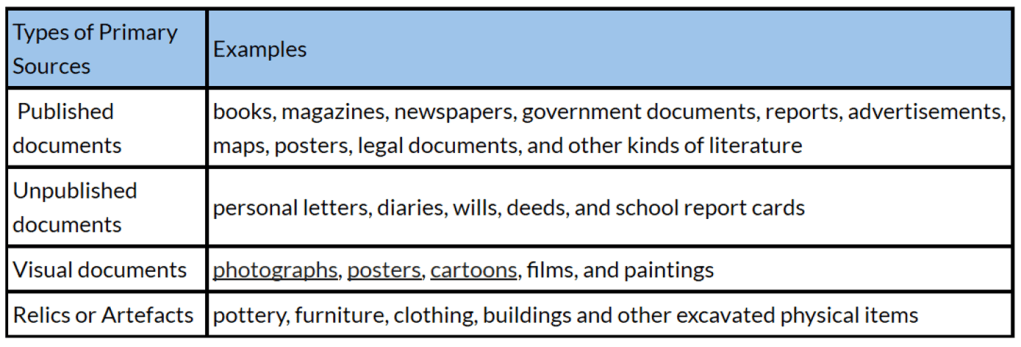
“Primary sources were made during the historical period that is being investigated. These are often the hardest to find but, as a result, are often the strongest evidence you can use…” There are many different types of primary sources:”
Secondary Sources…
“Secondary sources were made after the time period you are investigating. As a general rule, historians value secondary sources that are created by scholars, as they are usually more reliable. However, whilst modern scholars aim to produce reliable and unbiased historical accounts, read their writings with the same critical eye as you would primary source creators. Like primary sources, secondary sources come in different types:”
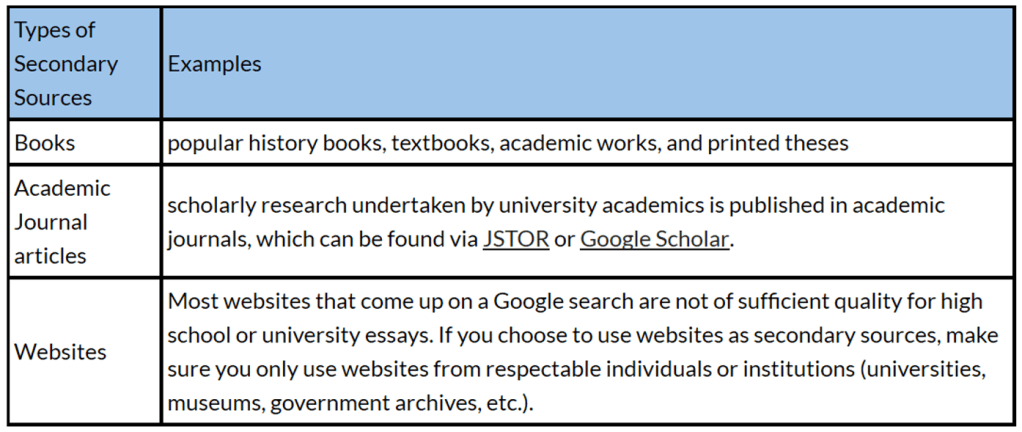
4.
Watch the following video on different types of sources:

Primary and Secondary Sources. (8:42 Minutes Long)
5.

Source Attributions…
When dealing with any source, whether primary or secondary, it is important to first look at the attributes. That means the information given about the source. (Usually a short attribution at the end of a source tells your who created the source, or the origins of the source, as well as when it was created. This information is essential in order to analyse the relevance of the information given in the source.
Origins / Source Creator…
“The first step in creating an effective analysis of a source is to find out who created it. While this might sound like a simple thing to do, it can often take significant time to find out all the required information about the creator of a source. When we talk about the ‘creator’ of a source, we want to know who originally made it. Different kinds of sources usually have a particular kind of creator.” (See the examples in the table below.)
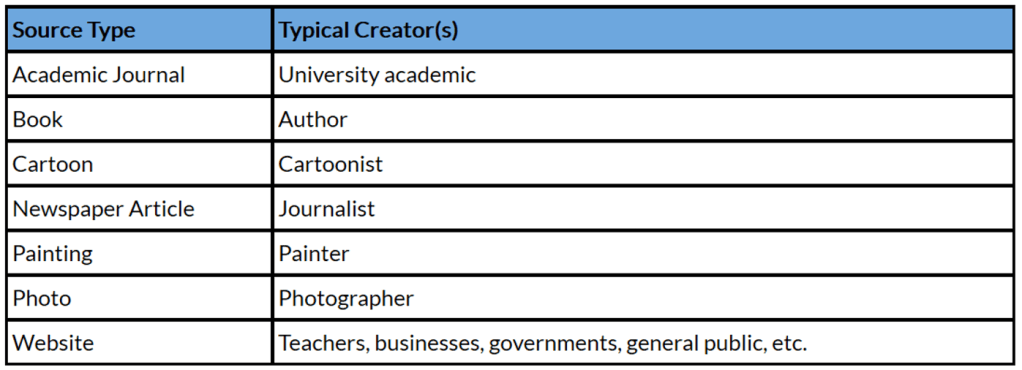
Information about the creator…
When dealing with the creator of a source, try to predict what his / her perspective may be on the events, consider “the creator’s career (university professor, soldier, etc.) as well as what experience they have on the topic (they experienced the event personally, or they study the topic professionally, etc.).” This will influence the degree to which you value the source of information.
6.
Watch the following video about the creators of sources:

The Origins of Sources. (3:44 minutes long)
7.

Time of Creation…
“When analysing a source, you need to be aware of when it was made. This will not only help you to determine whether it is a primary or a secondary source, but it will also help you in your source evaluation. The ‘time of creation’ is the date when the source was originally made. For some sources, particularly secondary sources, you can find out the exact year it was published. For primary sources, particularly from the ancient or medieval time period, you may only be able to provide the decade or century when it was created.”
8.
Finally, complete the quiz in Schoology about “Types of Sources, Origins & Time of Creation“.
IMPORTANT: Please note that you have only one attempt to complete the quiz. Also, it is a timed quiz, that expires at the end of the lesson!! So do it now straight away! AND: If, for some reason, you have any problem with the quiz, let me know immediately in Hangouts, or you may lose marks!!
9.
Send me a private message on Schoology (use the SAME mail-thread!!!) to confirm that you have completed the tasks as instructed today!
(If you want to access the information on Sources used in this lesson directly from the original website, here is the link to access it: https://www.history.org.uk/student/resource/3211/using-historical-sources .)
(WordPress advertisements may appear below.)
Monday 1 June 2020 – Year 9
Follow the order in which I give you instructions:
1.
Mark the following tasks, with a pencil:

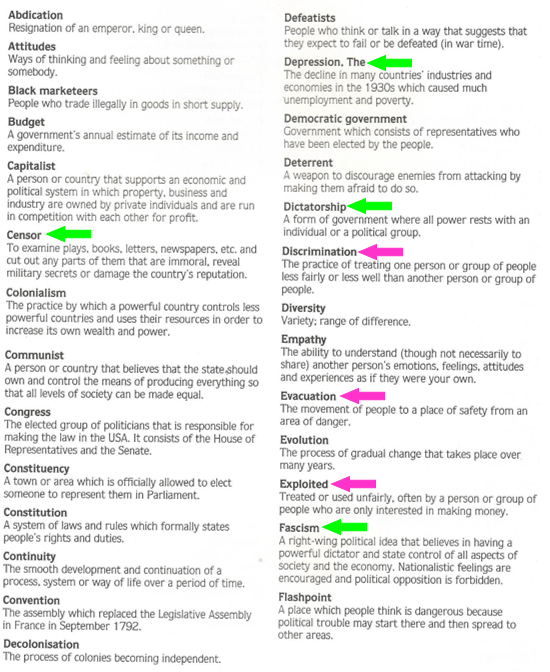
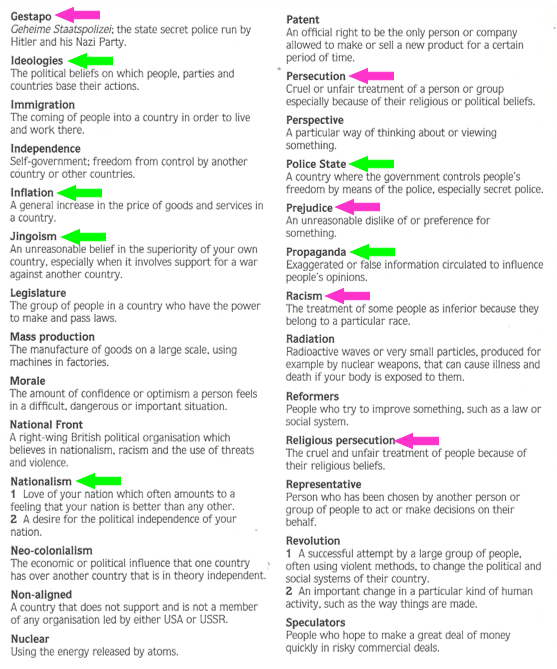
GLOSSARY
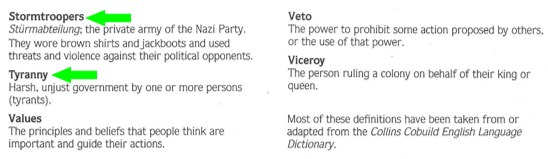
2.
Carefully go over the following words – you may need to know what they mean as you work through today’s lesson about Nazi officers and their victims. (You do not have to memorise these meanings – it is simply given to you because these words are used in today’s videos.)
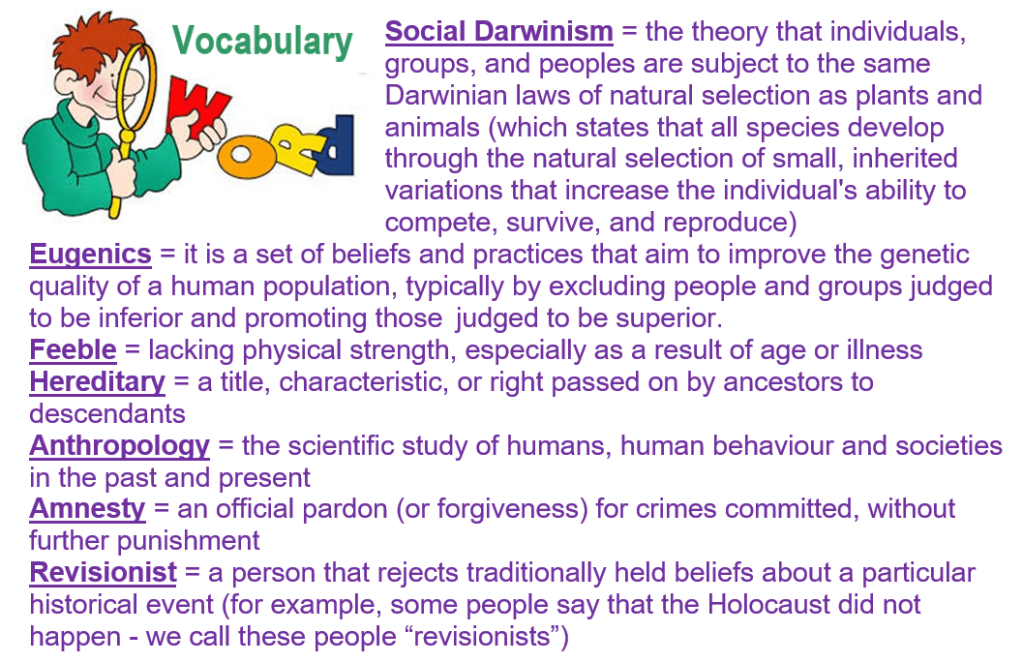
3.
And now for two unbelievable stories… These two stories will make up the rest of today’s lesson. So, sit back and watch the videos in the order that they appear below:

First, I want you to watch the following story… It is a short biography of Josef Mengele, also known as “the Angel of Death” (because he was unthinkably cruel!) or “the White Angel” (because he wore a white uniform). Mengele was a German Schutzstaffel (SS) officer and physician (doctor) during World War II. He is mainly remembered for his actions at the Auschwitz concentration camp, where he performed deadly experiments on prisoners and was a member of the team of doctors who selected victims to be killed in the gas chambers.
Josef Mengele Biography: The Angel of Death. (20:08 minutes long)
And now for the story of one of Mengele’s victims…! Eva Mozes Kor was experimented on as one of Dr. Josef Mengele’s twins at Auschwitz. It is a fascinating story with a twist: after decades of anguish, Eva decided to forgive the Nazis! She became one of the best-known and most-active Holocaust survivors in the world. Read this brief story about Eva:
“At the age of 10, Eva Mozes Kor became a victim of Josef Mengele, the doctor at the Auschwitz concentration camp notorious for his barbaric experiments on twins. Eva and her twin sister Miriam lost both of their parents and two older sisters in the Holocaust; only Eva and Miriam survived. Eva later married an American and moved to the United States to begin a new life. In 1984, she founded the organization CANDLES together with the help of her sister Miriam. The name is an acronym for “Children of Auschwitz Nazi Deadly Lab Experiments Survivors”. Working with the organization, Eva was able to locate 122 other survivors of Dr. Mengele’s horrific experiments around the world. In 1995, Eva also founded CANDLES Holocaust Museum and Education Center to educate the public about eugenics, the Holocaust, and the power of forgiveness. That same year she publicly forgave the Nazis for what had been done to her – a decision that brought her international attention. Eva circled the globe delivering her message of peace, kindness, healing and self-empowerment for future generations. Her lessons went far beyond her own experience, addressing current global atrocities and two of the biggest problems facing today’s youth: bullying and discrimination.”
What a remarkable woman! Watch the video below where she tells her story…
“I Survived The Holocaust Twin Experiments”. (14:47 minutes long)
Sadly, Eva Mozes Kor died on 4 July 2019 in Krakow. We can remember her example of forgiveness in spite of all that she went through – she knew that to forgive is to help yourself to overcome, by not continuing to carry the burden!
Eva Mozes Kor once said:
“We cannot changed what happened, but we can change how we relate to it.”
4.
The video that you have just seen about Eva Mozes was the cut-version of the documentary. This is optional – if you would like to watch the full documentary, here it is below:
Twins: Eva and Miriam Mozes. (42:25 minutes long)
5.
Send me a private message on Schoology (use the SAME mail-thread!!!) to confirm that you have completed the tasks as instructed today!
(WordPress advertisements may appear below.)
Year 7A & Year 7B.
Monday 1 June 2020
Follow the order in which I give you instructions:
1.
Complete the “Quiz/Test” on Feudalism, in Schoology – it is “timed” and will take you no more than 7 minutes…! Please note that you have to do this NOW during lesson time! This MUST be completed FIRST- so, immediately go to the quiz and do it before continuing with the rest of today’s instructions. (If you have not submitted the answers within the next 30 minutes, you will receive zero for this task, because the task will expire.)
2.
Mark the following task with a pencil:

HOMEWORK 7
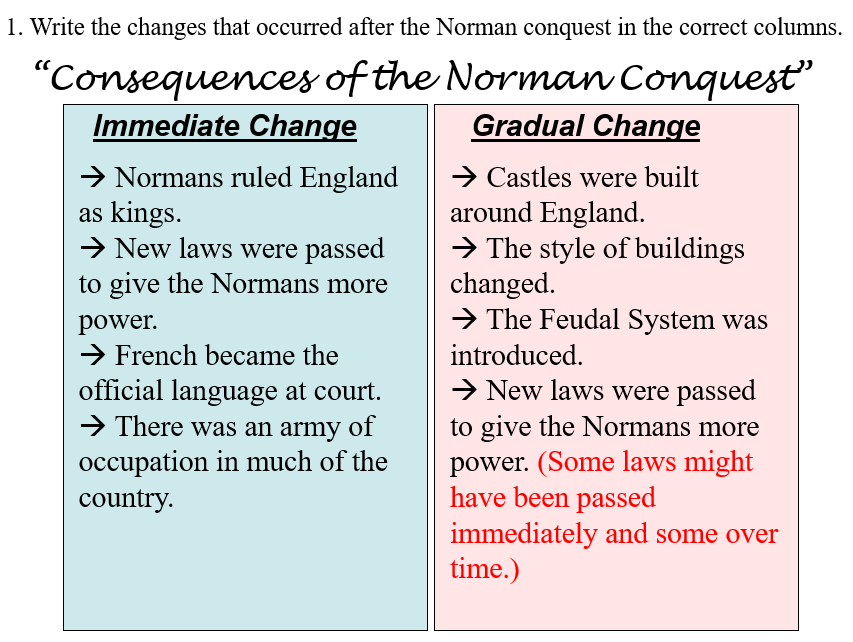
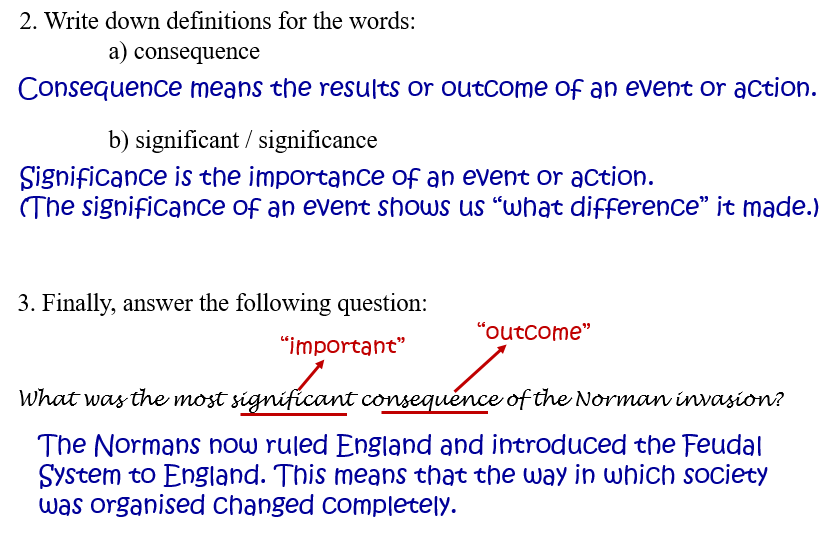
3.
Over the next few lessons you will watch a film that is set in Medieval times, when Feudalism was the norm in Europe and in England. We will start with the film in the next lesson, but there are a few things that you need to know before we start watching the film.

The film is an adventure-comedy film about a peasant (called William Thatcher) who discovers that his master (Sir Ector) is dead. So, William then puts on his master’s armour to impersonate him at a jousting tournament. (If you do not know what jousting is, watch the short video below. It shows you that some people still do jousting today!)
Knights of Valour: Full Contact Jousting. (2:39 minutes long)
In the film, William wins the tournament and then decides to participate in more tournaments. However, only knights and nobles were allowed to take part in the tournaments, and not peasants. Therefore, William creates a new identity for himself, as a knight called Sir Ulrich von Liechtenstein.
There is a lot of jousting in the film, but there is also a bit of a love story: William meets a noble lady… which creates a slight problem, because she is a noble and he is a peasant, pretending to be a knight!
4.
I believe that you will all enjoy the film – even if you do not particularly like jousting! However, before you start with the first “episode” of the film, there are a few bits of reading to do, in preparation.
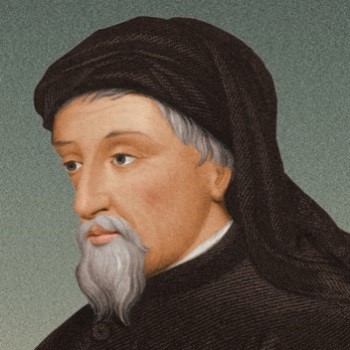
You will understand the film better if you also know a bit about the Black Prince, Geoffrey Chaucer and the Canterbury Tales. So, read the following information with great attention:
So, what is The Canterbury Tales?
The Canterbury Tales is a collection of 24 stories written in Middle English by Geoffrey Chaucer between 1387 and 1400.
Who was Geoffrey Chaucer?
Geoffrey Chaucer (c. 1343 – 1400), known as the Father of English literature, is widely considered the greatest English poet of the Middle Ages. While he achieved fame during his lifetime as an author and philosopher, Chaucer also had an active career as a courtier. He is best known today for The Canterbury Tales.
Who was the Black Prince?
The Black Prince (1330-1376) was the eldest son of King Edward III of England, and the father of King Richard II of England. He had many other titles: He was also known as the first Duke of Cornwall, the Prince of Wales and the Prince of Aquitaine! And he was known as Edward of Woodstock! (He was called “Edward of Woodstock” in his early life, after his birthplace, but since the 16th century has been popularly known as “the Black Prince”.)
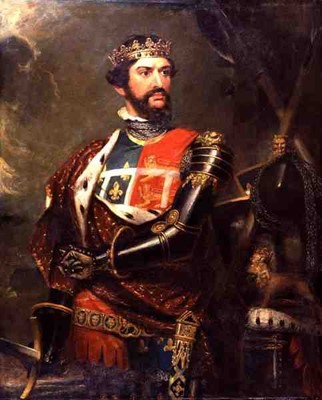
The origins of the name “Black Prince” are uncertain, though many believe it may come from Edward’s black shield, and/or his black armour. Or, maybe it comes from Edward’s brutal reputation, particularly towards the French in Aquitaine. (Edward was an exceptional military leader, and his victories over the French made him very popular in England during his lifetime.) Sadly, Edward died one year before his father, and so became the first English Prince of Wales that did not become King of England. The throne passed instead to his son Richard II, who was only a young boy when Edward III died.
In the next lesson we will start watching the film!
5.
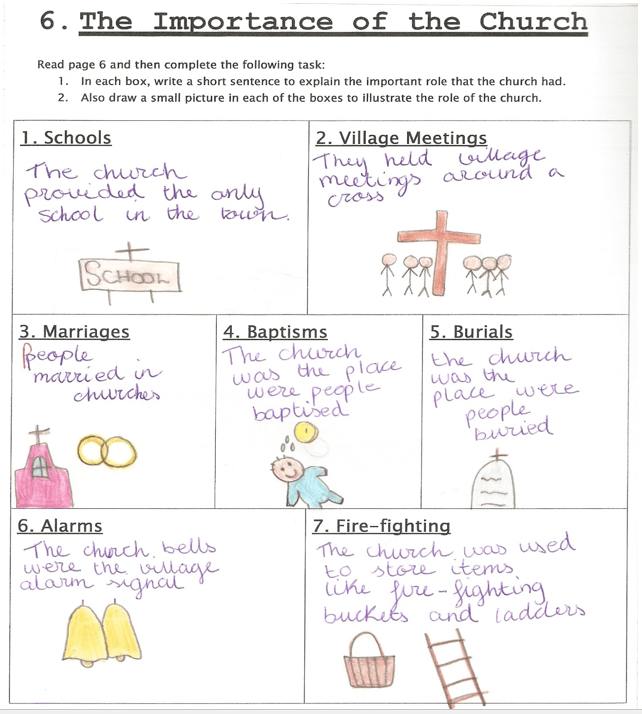
And now, as a final task for today’s lesson, look at the feedback that I sent to your schoology mail. You will find a table that lists the tasks and it also gives your marks. Look at the comments made and then, very carefully, go over the answers below, so that you know where you can improve:
THE IMPORTANCE OF THE CHURCH
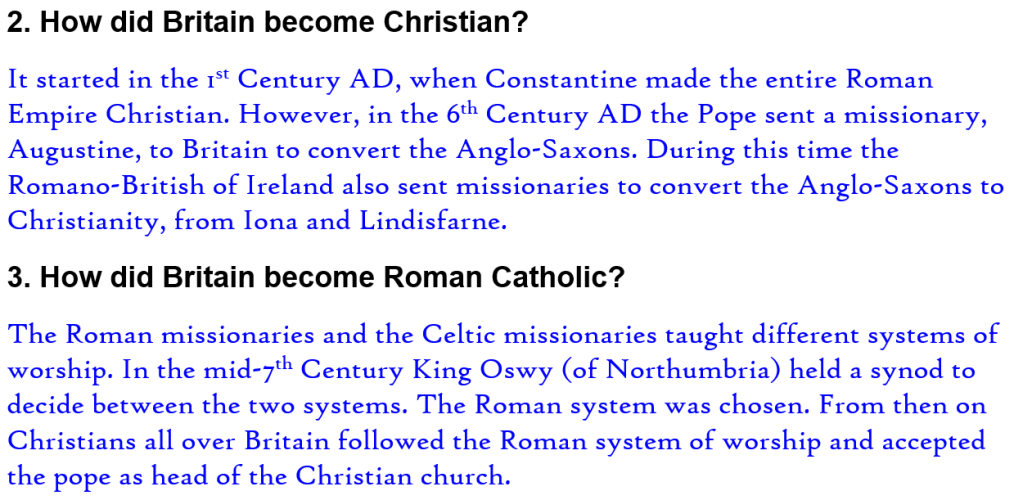
Roman and Celtic Missionaries. (p.58)
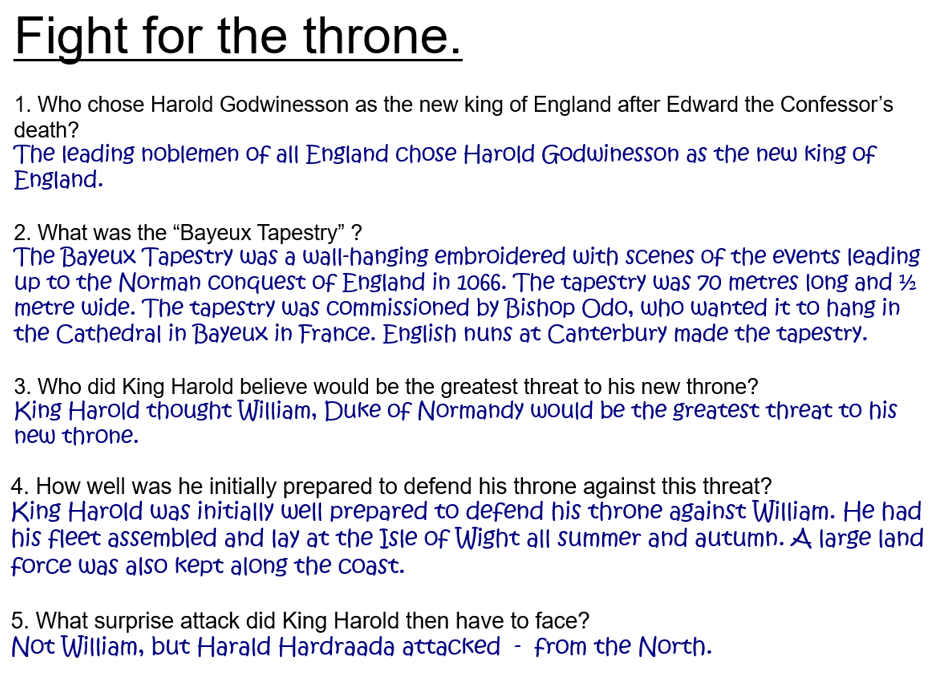
FIGHT FOR THE THRONE. (p.69)
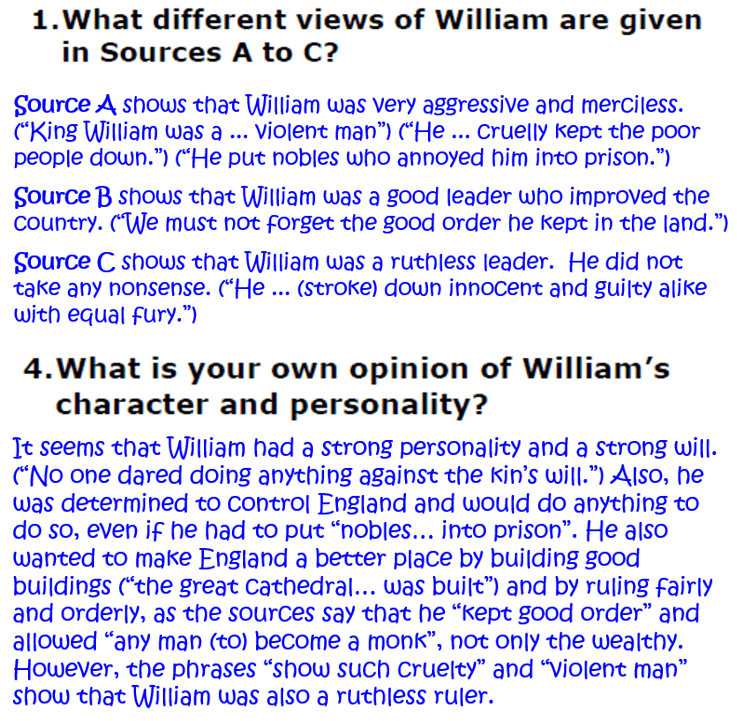
HOMEWORK TASK-5. (p.62-64)
6.
Send me a private message on Schoology (use the same mail-thread!) to confirm that you have completed all the tasks as instructed today!
(WordPress advertisements may appear below.)
Year 8A – Wednesday 27 May 2020
Year 8B – Thursday 28 May 2020
Important: First read ALL the instructions for today, before you start doing any of them!!
-INTRODUCTION-
Over the next few lessons we will be finalizing assessment for the topics that you have done in the Year 8 History course. You will not do a final assessment task for the Renaissance, but you will do one for the rest of the topics. So, that leaves the following topics for assessment:
1. Exploration.
2. The Reformation.
3. The Slave Trade.
The first assessment task that you are going to do will be on the Reformation: You are going to “act out” the play that you were given when we started with the Reformation topic, by making a video of the play.
You may choose how you want to do this. You could use your phone to make video recordings. Or, you could make use of images in PowerPoint, with a voice over, if you are good with ICT. You can use toys, dolls, drawings, lego, puppets, parents, siblings, etc. Or, just do the play by yourself… Whatever you do, the end product should be a video of the play that you were given about the Reformation.
A FEW MORE THINGS THAT YOU NEED TO KNOW:
Some of you… were given two plays. If this is the case, you may choose which one you want to use.
If you are… in the play about Henry VIII’s six wives, you are allowed to only do your monologue, but you need to make it into an interesting video!
You will probably have to… work on this task over the weekend as well. However, you will also get your next History lesson to finalize the task – that means the lesson of Monday 1 June for Year 8A and the lesson of Wednesday 3 June for Year 8B.
Year 8A: All videos must be submitted by the end of your lesson on Monday, 1 June.
Year 8B: All videos must be submitted by the end of your lesson on Wednesday, 3 June.
This is… an individual task – that means that you alone are responsible for the creation of the video of the play that you were given – you are not going to do the plays in groups or make the videos in groups.
However, if there are some of you who really want to make the video with the rest of the students in your play’s group, you may ask me for permission. (If you want to do this you need to explain clearly how you will make the video together, before I will consider giving you permission. Think carefully before you make such a decision, as you will be given marks for your project and it would be a pity if others in the group let you down. Personally, I think it will be the least complicated to just make the video by yourself.)
So, here is what you have to do now in this lesson:
1.
Get out your script.
2.
Read over your script.
3.
Think of ideas for the task and start planning what you will do.
4.
Complete the “Plays Planning AND Film Review.” task in Schoology… This is simply a feedback form that I need you to complete, however, you will be given marks for the feedback that you give me. IT IS IMPORTANT THAT YOU FINISH THIS TASK BY THE END OF THIS LESSON!!
5.
Finally, if there is still time in this lesson, start working on your video.
Be creative and have fun!
6.
Send me a private message on Schoology (use the SAME mail-thread!!!) to confirm that you have completed the tasks as instructed today.
(WordPress advertisements may appear below.)
Wed. 27 May & Thurs. 28 May 2020
The last question that you are going to work on in this course will be a Why-Question about the Road to War.
1.
Consider these Why-Questions on the Road to War:
ONE:
Why was Hitler’s foreign policy successful up to 1938? [6]
TWO:
Why did Britain and France follow a policy of appeasement with Germany in the 1930’s? [6]
THREE:
Why did Britain go to war over Poland? [6]
2.
Look carefully at my feedback to the previous videos that you created with Mysimpleshow.
3.
Use the template (in Schoology) to make a video answer to one of the above Why-Questions. The procedure is the same as last time:
1. Download the PowerPoint “Why-Question-Template” – it is in “Materials” in Schoology.
2. Use the template to write the answer / script in PowerPoint.
[Remember, each slide (in PowerPoint) will be a scene (in the video).]
3. Upload the script to Mysimpleshow.
4. Then make the video.
As always, I will be online in case you need to ask a question or need help.
4.
Remember to “invite” me to this new video. You can do so even if you have not completed the video yet – in other words while still working on it.
5.
At the end of the lesson, please send me a message in Schoology (use the SAME mail-thread…) to inform me on your progress with the work set for today.
(WordPress advertisements may appear below.)
Year 7A – Wed. 27 May
Year 7B – Thurs. 28 May
Follow the order in which I give you instructions:
1.
Mark the following task with a pencil:
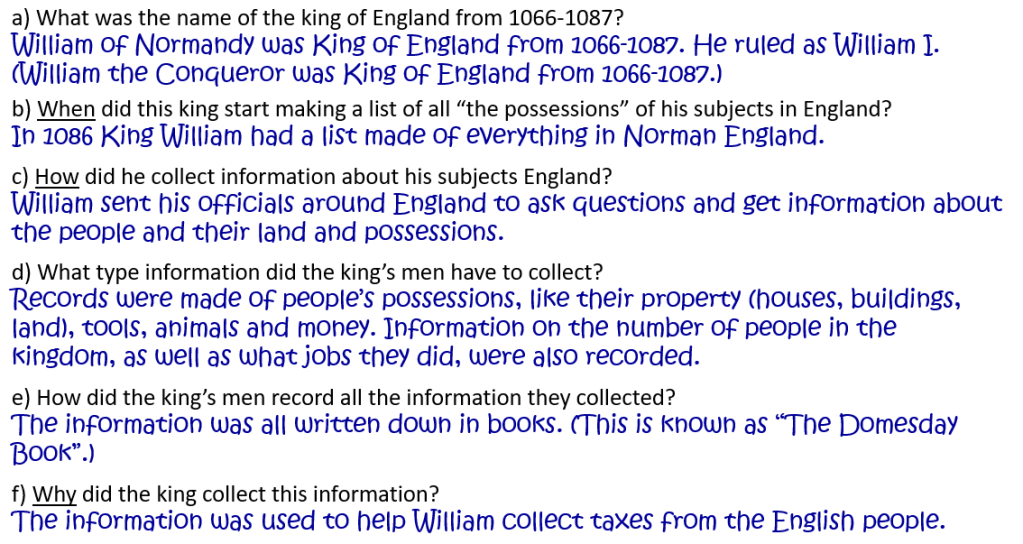
Domesday Book
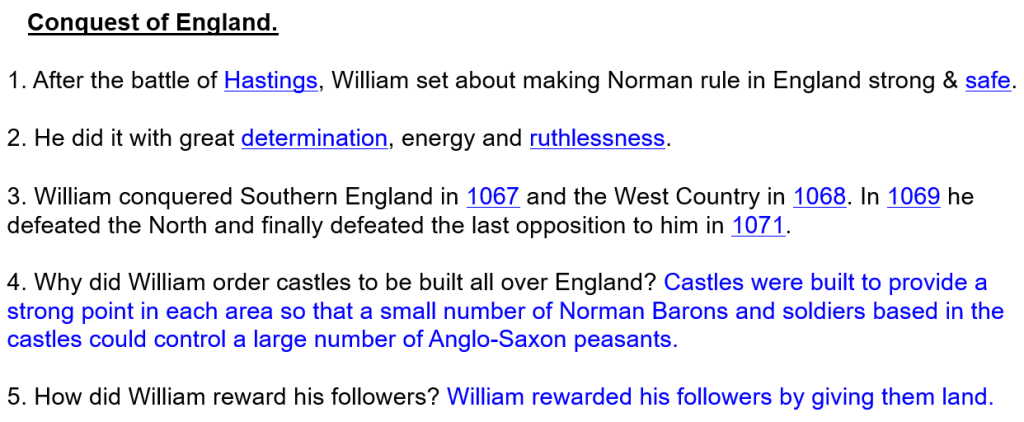
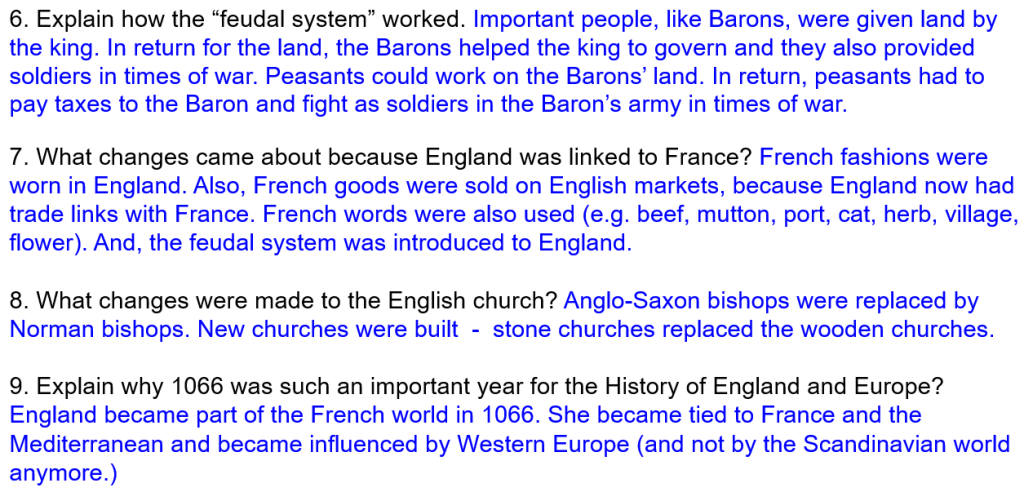
Conquest of England
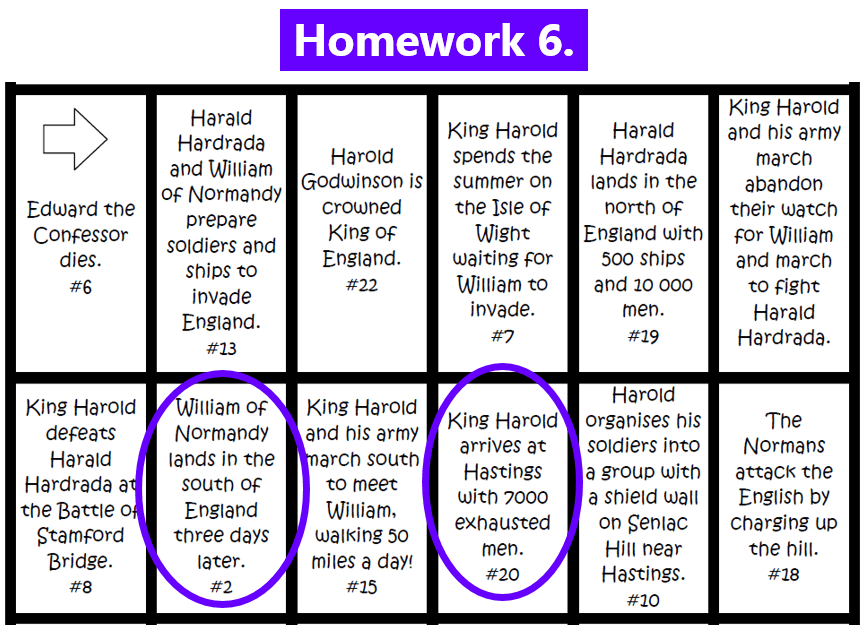
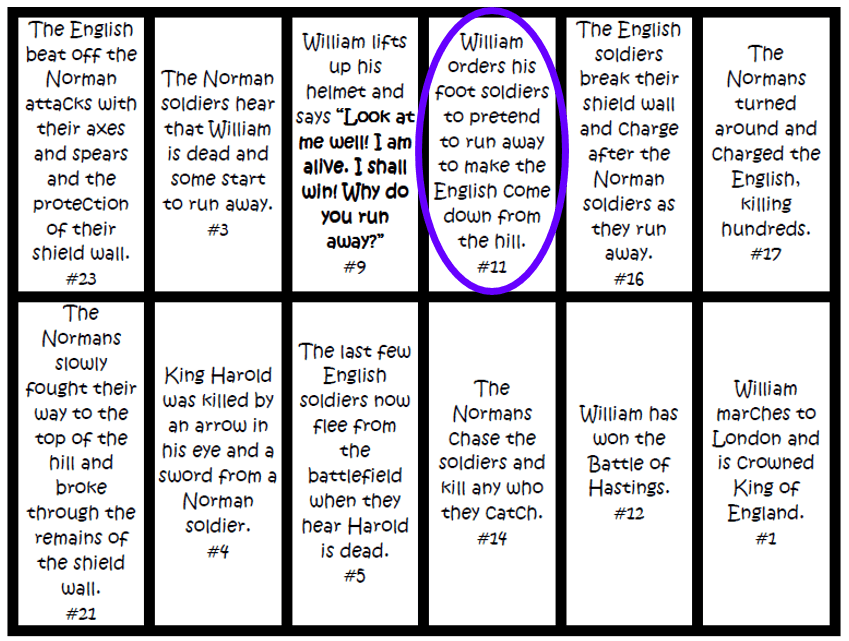
2.
Do Homework Task 7 (p.68-69) NOW (as class work) in your Homework Book.
3.
Send me a private message on Schoology (use the same mail-thread!!!) to confirm that you have completed all the tasks as instructed today!
(WordPress advertisements may appear below.)
Wednesday 27 May 2020 – Year 9
Follow the order in which I give you instructions:
1.
Look at the feedback that I sent to your schoology mail. You will find a table that lists the tasks and it also gives your marks. Look at the comments made and then, very carefully, go over the answers below, so that you know where you can improve:
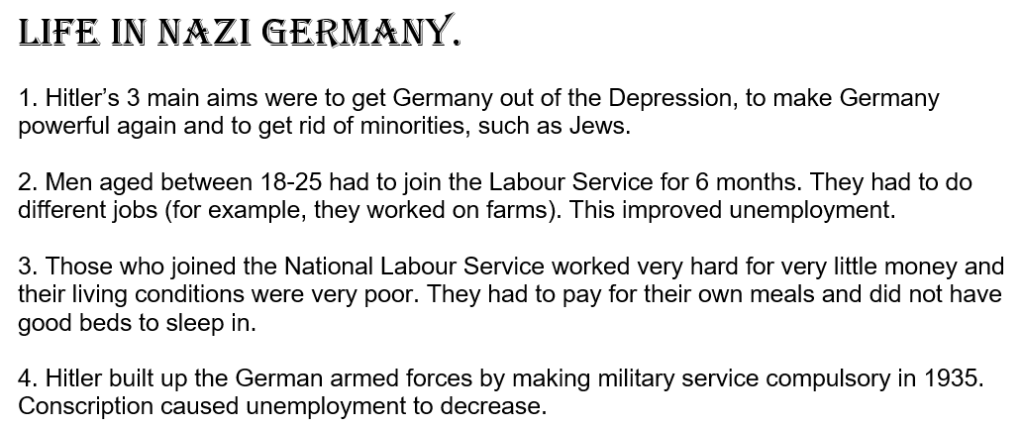
HOW HITLER BECAME LEADER OF GERMANY (p.17)
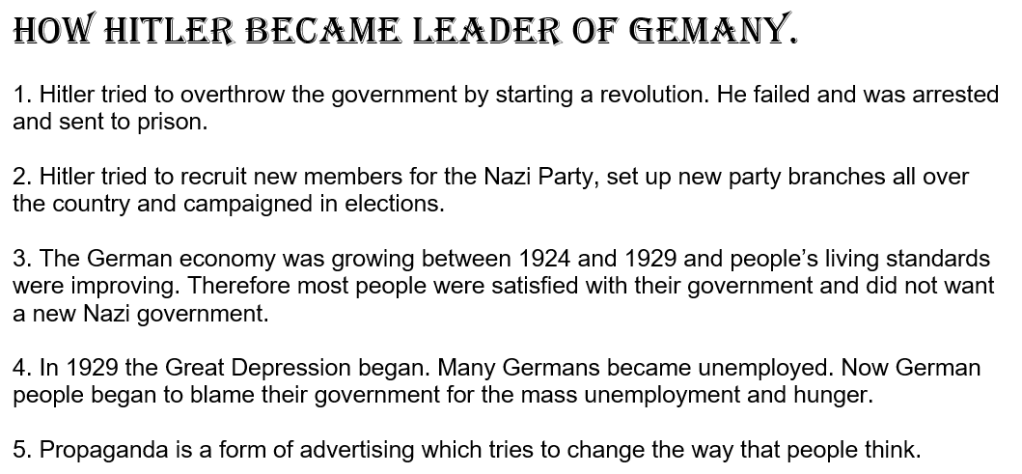
LIFE IN NAZI GERMANY (p.33)
ANTI-JEWISH LAWS (p.56)
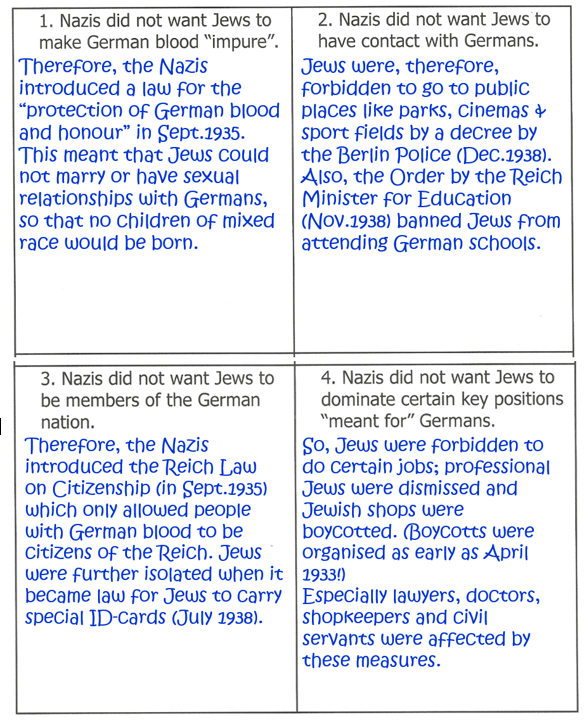
2.
Mark the following tasks with a pencil:

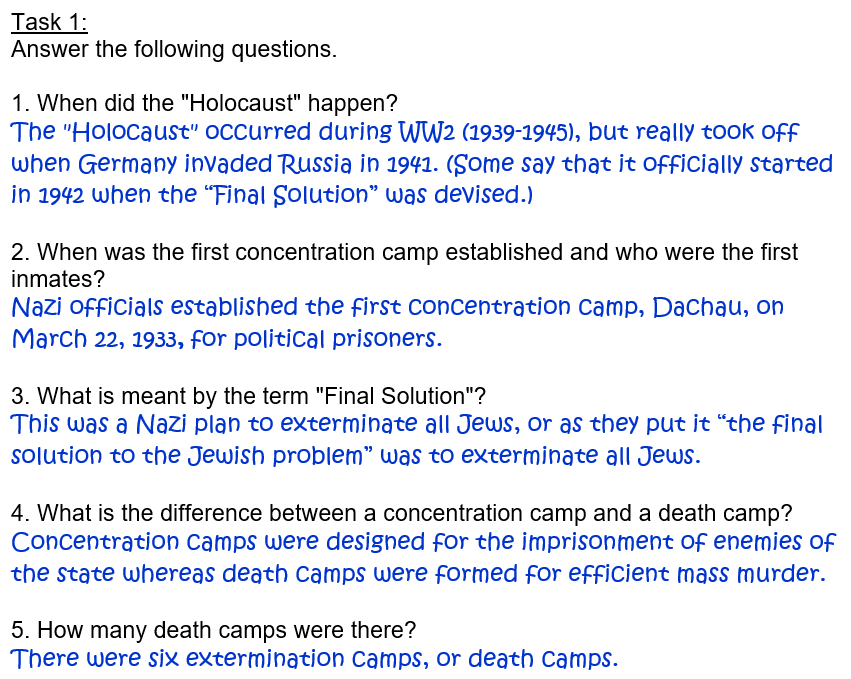
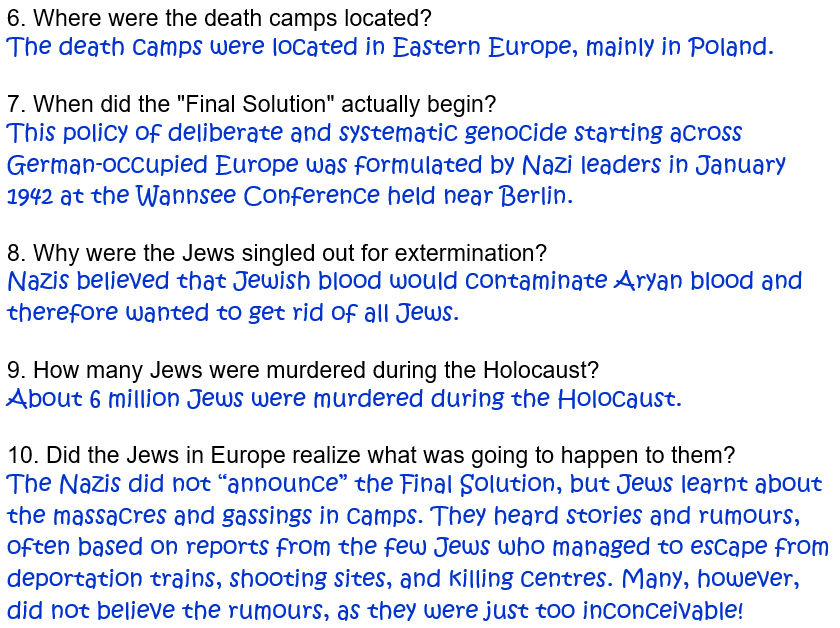
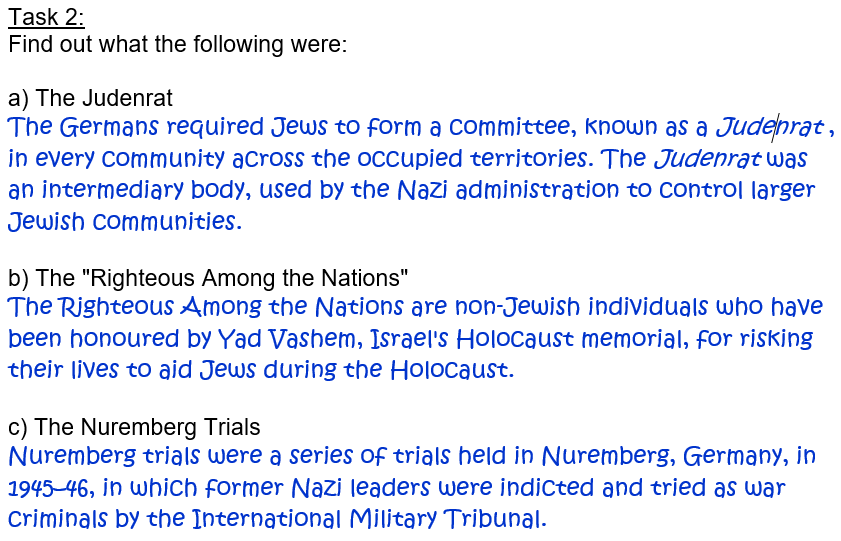
QUESTIONS ON p.59
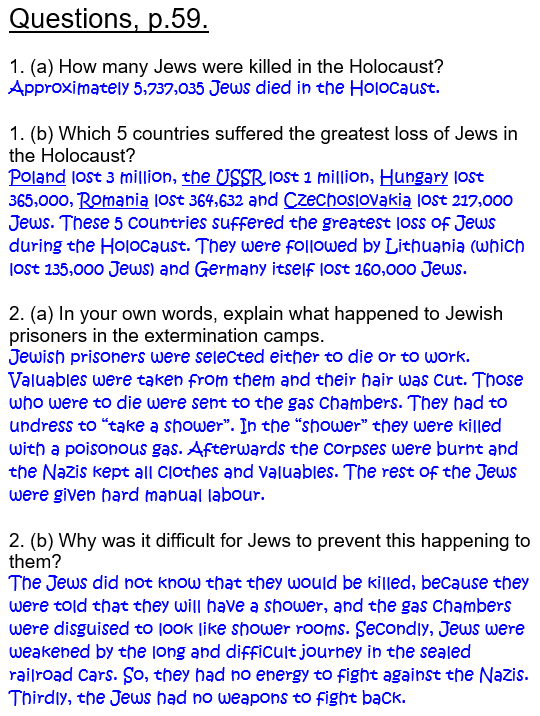
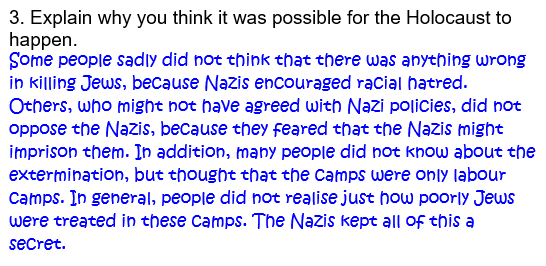
HOMEWORK TASK-3 p.61
3.
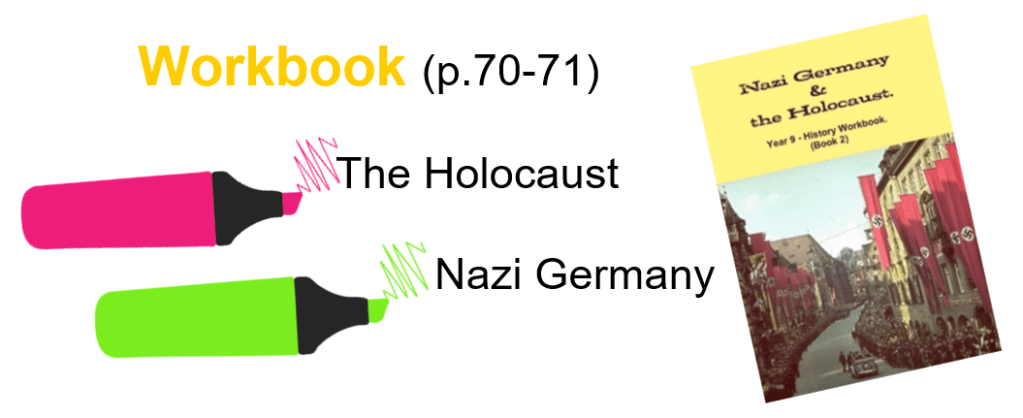
Look at the Glossary (on p.70-71, in your Workbook). Read the words and explanations and highlight words that relate to the Holocaust topic in one colour and words that relate to the Nazi Germany topic in a different colour.
4.
Watch this rather sad story about a teenage girl who escaped the Nazis:
‘They’re taking us to our death’. (3:49 minutes long)
5.
Watch the following video clip that discusses good “Holocaust Films”.

Top 10 Holocaust Films. (14:31 minutes long)
6.
Send me a private message on Schoology (use the SAME mail-thread!!!) to confirm that you have completed the tasks as instructed today!
(WordPress advertisements may appear below.)
Year 8A – Monday 25 May 2020
Year 8B – Wednesday 27 May 2020
INTRODUCTION:
In the previous lesson you learnt about Harriet Tubman, Frederick Douglas and the Underground Railroad, a network of secret routes and safe houses used by enslaved African-Americans to escape into the free northern States, or even to Canada. Today you are going to watch part of a movie about the Underground Railroad. (I have decided to show you only the second half of the movie, because the second half is very relevant to your study.) The movie is about a slave called Samuel who escapes with his elderly mother, his wife and his son. The Underground Railway helps them to escape from the south to Canada. Unfortunately, the slave owner to whom Samuel and his family belong has hired someone to track them down and bring them back to his plantation… (The movie is set in the mid-1850’s – remember, slavery was abolished in 1865.) Also, every now and then you will see that there are flashback scenes to the mid-1750’s. These flashback scenes shows how Samuel’s great grandfather was brought to the Americas on the slave ship of John Newton… (It shows 100 years earlier, in 1748, when John Newton, the Captain of a slave trader, sails from Africa with a cargo of slaves, bound for America. On board is Samuel’s great grandfather. The voyage changes Newton’s life forever…) Make sure that you pay close attention, as you will be given a quiz to complete in a next lesson.
1.
Watch the following movie!
Slavery & Freedom. (43:46 minutes long)
2.
Send me a private message on Schoology (use the SAME mail-thread!!!) to confirm that you have completed the tasks as instructed today.
(WordPress advertisements may appear below.)
Mon. 25 May, Wed. 27 May & Thurs. 28 May 2020

This week you are going to work on Why-Question about the League of Nations.
1.
Consider these Why-Questions on the League of Nations:
ONE:
Why did some countries view with suspicion the setting up of the League of Nations? [6]
TWO:
Why was the League of Nations weak from the start? [6]
THREE:
Why was the League unable to stop aggression against Abyssinia and Manchuria in the 1930’s? [6]
2.
Look carefully at my feedback to the previous videos that you created with Mysimpleshow.
3.
Use the template (in Schoology) to make a video answer to one of the above Why-Questions. The procedure is the same as last time:
1. Download the PowerPoint “Why-Question-Template” – it is in “Materials” in Schoology.
2. Use the template to write the answer / script in PowerPoint.
[Remember, each slide (in PowerPoint) will be a scene (in the video).]
3. Upload the script to Mysimpleshow.
4. Then make the video.
As always, I will be online in case you need to ask a question or need help.
4.
Remember to “invite” me to this new video. You can do so even if you have not completed the video yet – in other words while still working on it.
5.
At the end of the lesson, please send me a message in Schoology (use the SAME mail-thread…) to inform me on your progress with the work set for today.
(WordPress advertisements may appear below.)
Year 7A & Year 7B.
Monday 25 May 2020
Follow the order in which I give you instructions:
1.
What is the Bayeux Tapestry?
“The Bayeux Tapestry is an embroidered cloth nearly 70 metres (230 ft) long and 50 centimetres (20 in) tall, which depicts the events leading up to the Norman conquest of England.”
Today you are going to do a lot of reading – in the form of an article about the Bayeux Tapestry.
Reading is very important!
Click on the picture of the Bayeux Tapestry to access the article: (or access the article in Schoology Materials.)
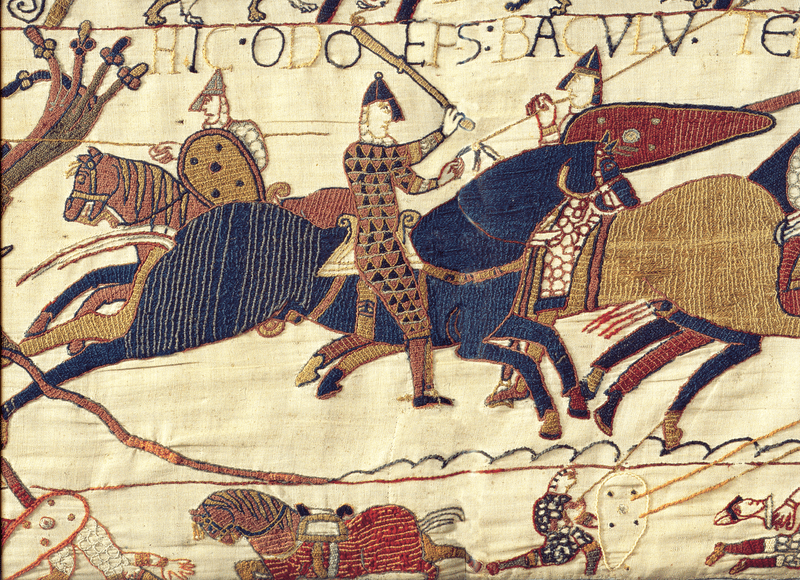
2.
Do Homework Task 6 (p.65-67) NOW (as classwork!) You have to cut out the information cards at the back of the book and then stick them in the correct order (of events) in your Homework Book. (Please note: do NOT stick the cards in number-order!! Stick the cards in event-order!! (The numbers are simply there for easy reference.)
3.
If you still have time, do the extension task.


Click on the icon below to listen to a podcast on the Bayeux Tapestry. (19 minutes long)

4.
Send me a private message on Schoology (use the same mail-thread that we have been using previously!) to confirm that you have completed the tasks as instructed today.
(WordPress advertisements may appear below.)
Monday 25 May 2020 – Year 9
Follow the order in which I give you instructions:
1.
Watch the following animated escape story:

Escaping The Nazi Death Camp – animated escape. (10:56 minutes long)
2.
Did the Jews resist the Nazis? Let’s find out….
3.
Do Homework Task 2 (p.58-60) in your Homework Book.

If you are interested: A movie was made about the Bielski brothers. It is called “Defiance” and you can find it on Youtube or on Netflix. It is a very good movie, but you need to get your Parents’ permission (!) if you want to watch this full length movie.
4.
Send me a private message on Schoology (use the same mail-thread!) to confirm that you have completed all the tasks as instructed today!

(WordPress advertisements may appear below.)
Wednesday 20 May 2020 – Year 9
Follow the order in which I give you instructions:
1.
Watch this video as an overview of the Final Solution:
The “Final Solution” – Jewish Life on the Brink of Death. (16:04 minutes long)
2.
Do Homework Task 3 (p.61-64) NOW (as classwork!). There are quite a few questions. Answer them in detail! If you get stuck, consult your Workbook on “Nazi Germany & the Holocaust” or do a little research on the internet.

3.
Send me a private message on Schoology (use the SAME mail-thread!!!) to confirm that you have completed the tasks as instructed today!
(WordPress advertisements may appear below.)
Year 7A – Wed. 20 May
Year 7B – Thurs. 21 May
Follow the order in which I give you instructions:
1.
Watch the video below to revise the Norman Invasion and its consequences.
The Norman Conquest – an animated explained video. (11:16 minutes long)
2.
Do all the Questions on “Conquest of England” (p.71).

3.
If there is still time, do the following word search ONLINE about the Norman Invasion and Conquest. You need to look for 10 words that you would have to use if you want to describe changes that took place in England after the Norman Conquest. Click on the word search to be able do it online – you can then “highlight” the words with the cursor as you find them.

Click on the word search to be able do it online – you can then “highlight” the words with the cursor as you find them.
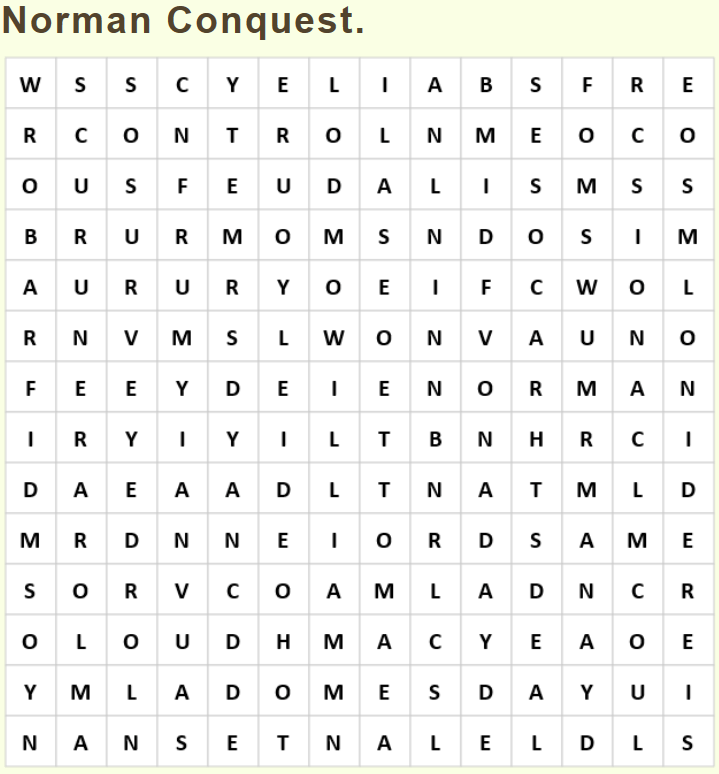
If you struggle…
scroll
down…
to
see
the
words
…
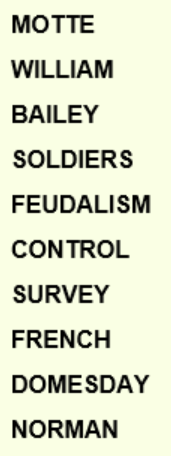
4.
Send me a private message on Schoology (use the same mail-thread!) to confirm that you have completed all the tasks as instructed today!
(WordPress advertisements may appear below.)
Year 8A – Wednesday 20 May 2020
Year 8B – Thursday 21 May 2020
INTRODUCTION:
As a final task on this topic, we are going to look at the story of Harriet Tubman. She was an American abolitionist and anti-slavery activist. Harriet was born into slavery, but she escaped and made about 13 missions to rescue approximately 70 enslaved people! She used a network of anti-slavery activists and safe houses known as the Underground Railroad to take slaves from the southern States (where slavery was allowed) to the northern States (where slavery was not allowed). The Underground Railroad was a network of secret routes and safe houses used by enslaved African-Americans to escape into the free northern States. All this began before the American Civil War (1861-1865). (This was a war that was fought between the northern States and the southern States, because of the enslavement of black people. The northern States were against slavery and began to abolish slavery (already in the 1780’s!), but the southern States wanted slaves to work on the plantations in the south. So, there was a civil war between north and south. In the end the northern States won and slavery was therefore abolished all across America in 1865.)
Follow the order in which I give you instructions:
1.
Watch the following 2 video clips on Harriet Tubman. You need to listen carefully, because you will be tested on this!
1822-1913 – Harriet Tubman. (1:52 minutes long)
Harriet Tubman: A Maryland Story. (24:20 minutes long)
2.
Now, go to Schoology and do the timed quiz about the information given today and the video clips that you have just seen. (You have no more than 10 minutes to do this!) This MUST be completed NOW in lesson time! (If you have not submitted the answers before the end of this lesson, you will receive zero for this task.)
3.
Look at the feedback that I sent to your schoology mail. You will find a table that lists the tasks and it also gives your marks. Look at the comments made and then, very carefully, go over the answers below, so that you know where you can improve:
RELIGION IN EUROPE (p.50)
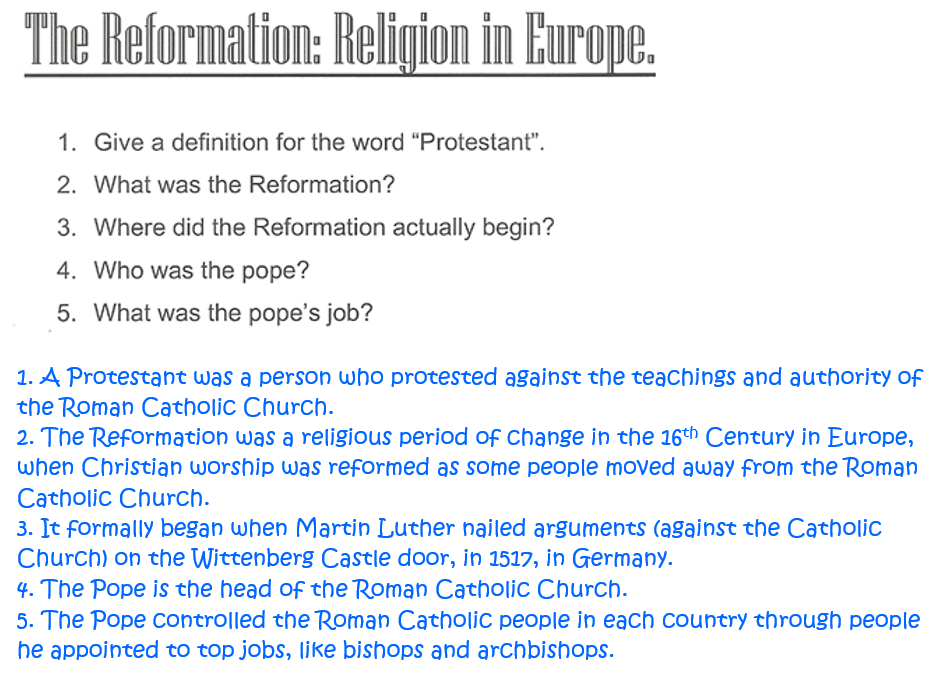
BREAK WITH ROME (p.56)
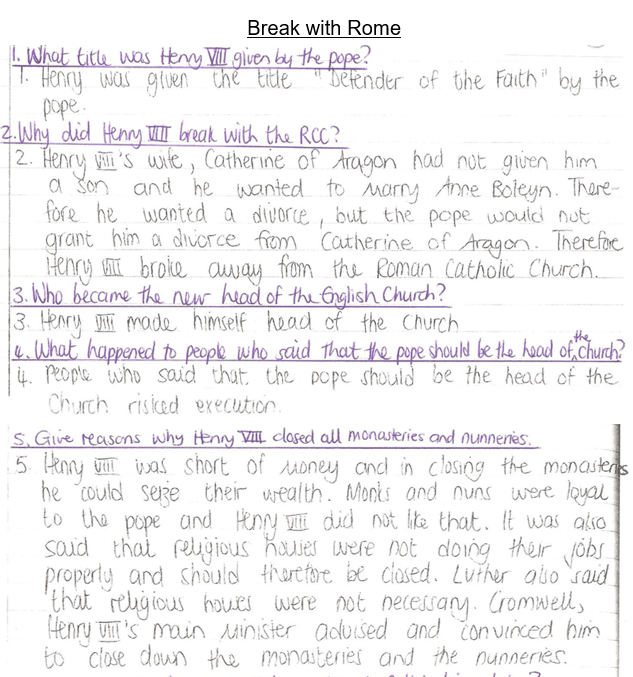
BACK TO ROME (p.60)
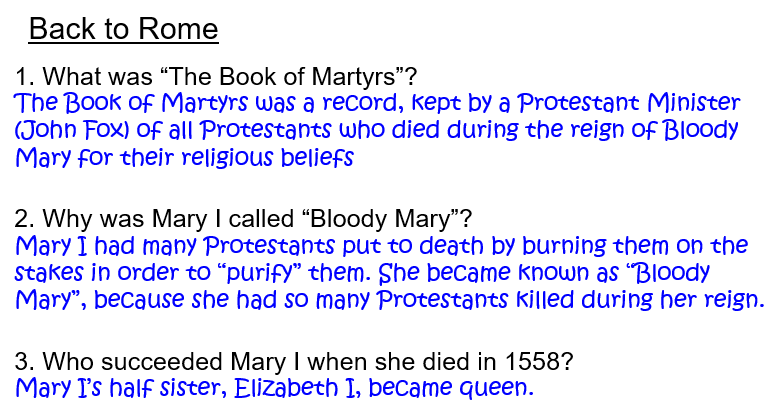
GROWTH OF BRITISH TRADE (p.72)
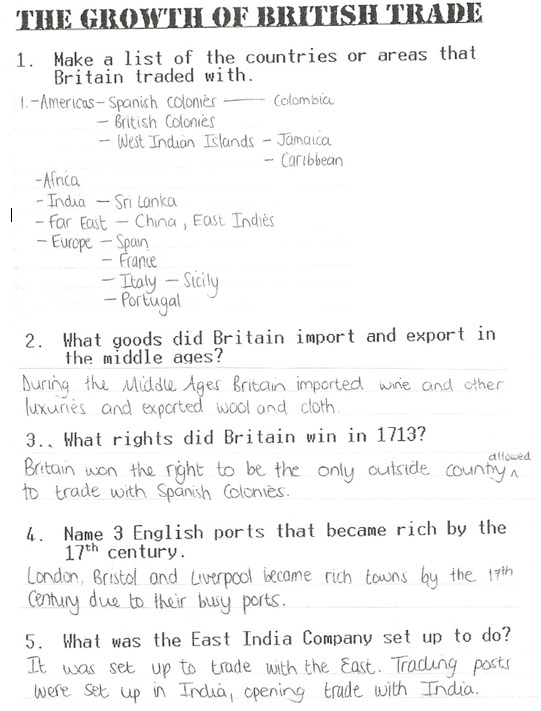
ABOLITION OF SLAVE TRADE (p.79)
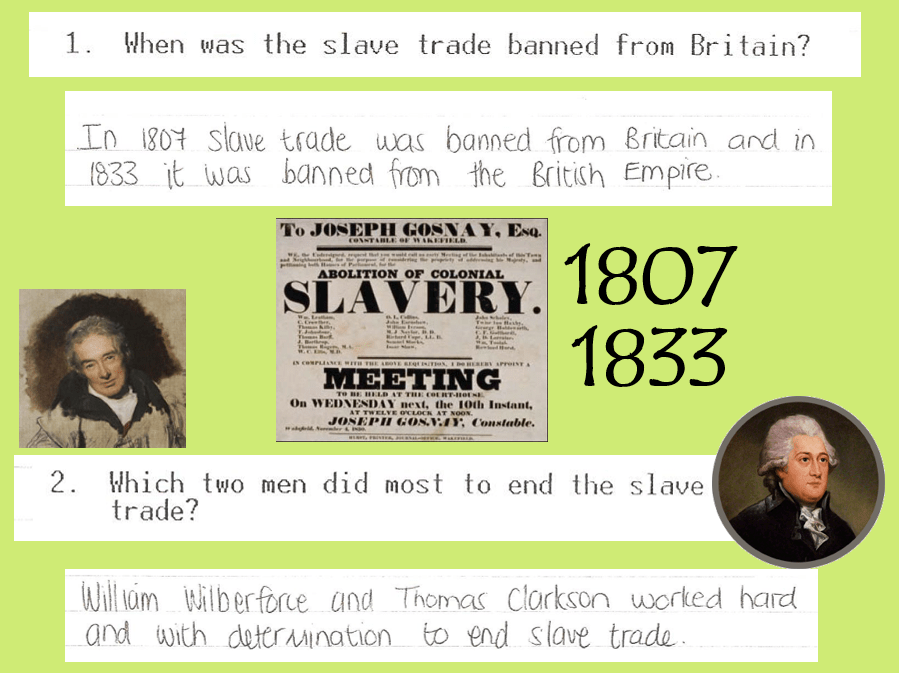
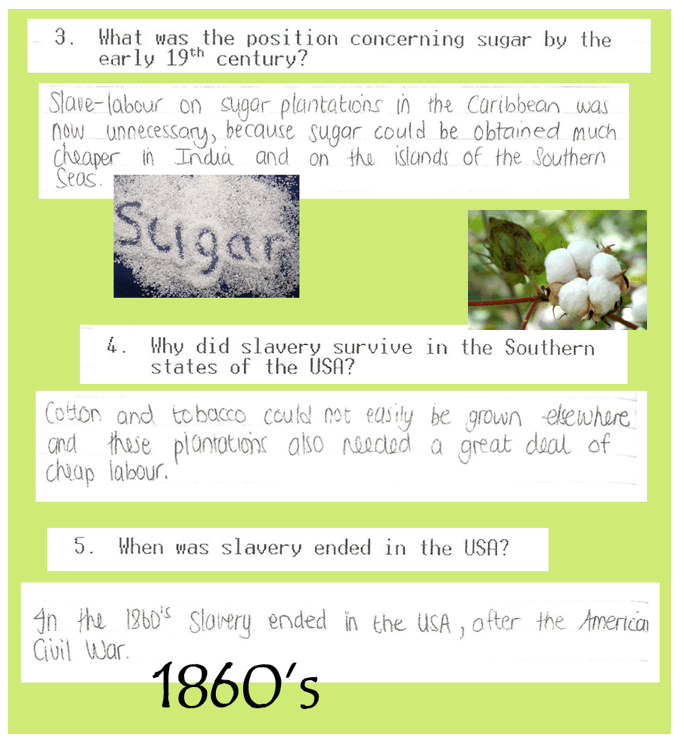
4.
Send me a private message on Schoology (use the SAME mail-thread!!!) to confirm that you have completed the tasks as instructed today.
(WordPress advertisements may appear below.)
Mon. 18 May, Wed. 20 May & Thurs. 21 May 2020
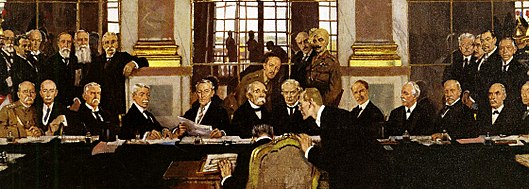
This week you are going to work on Why-Question about the Post-War Peace Treaties.
1.
Consider these Why-Questions on the Post-War Peace Treaties:
ONE:
Why did Clemenceau and Lloyd George disagree over how to treat Germany? [6]
TWO:
Why was France dissatisfied with the peace treaty? [6]
THREE:
Why was Germany dissatisfied with the peace treaty? [6]
2.
Look carefully at my feedback to the previous videos that you created with Mysimpleshow.
3.
Use the template (in Schoology) to make a video answer to one of the above Why-Questions. The procedure is the same as last time:
1. Download the PowerPoint “Why-Question-Template” – it is in “Materials” in Schoology.
2. Use the template to write the answer / script in PowerPoint.
[Remember, each slide (in PowerPoint) will be a scene (in the video).]
3. Upload the script to Mysimpleshow.
4. Then make the video.
As always, I will be online in case you need to ask a question or need help.
4.
Remember to “invite” me to this new video. You can do so even if you have not completed the video yet – in other words while still working on it.
5.
At the end of the lesson, please send me a message in Schoology (use the SAME mail-thread…) to inform me on your progress with the work set for today.
(WordPress advertisements may appear below.)

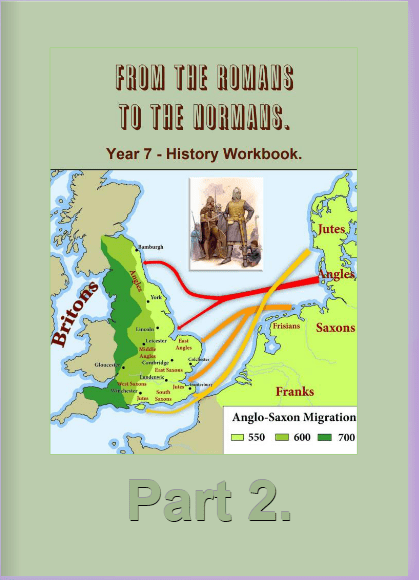
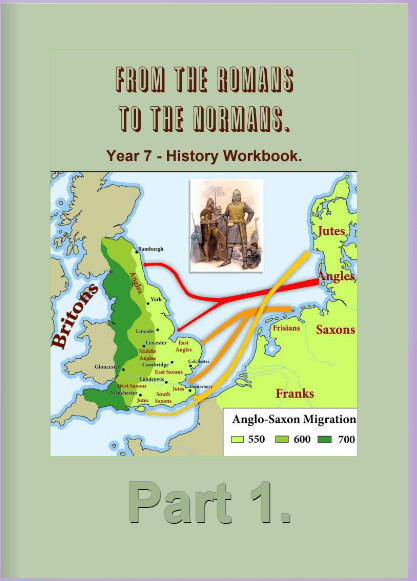


 Best study methods