

You need to complete Task 1:
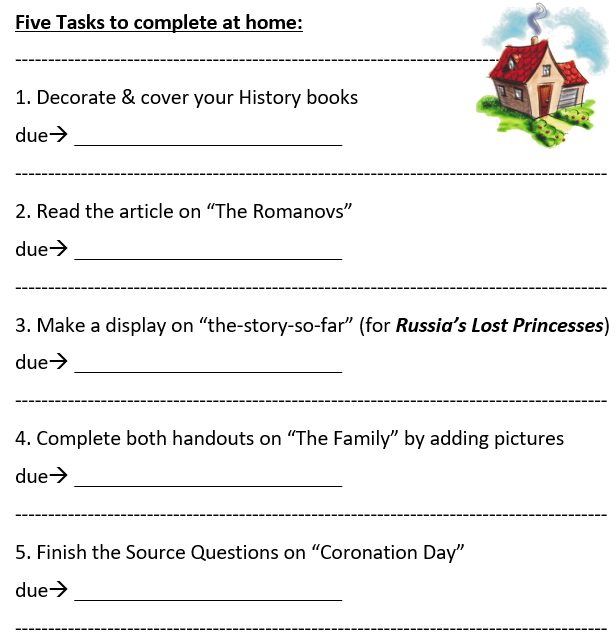

Task 1 is due:
Monday 13 September 2021
(WordPress advertisements may appear below.)
You need to complete Task 1:
Task 1 is due:
Monday 13 September 2021
(WordPress advertisements may appear below.)
Year 7A & Year 7B
Today you are going to learn:
Follow the instructions step by step:
1.
Before we talk about the article that we read in the previous lesson, “Father Time”, I want you to tell me a little bit more about yourself, by completing the “My Profile” questionnaire.
2.
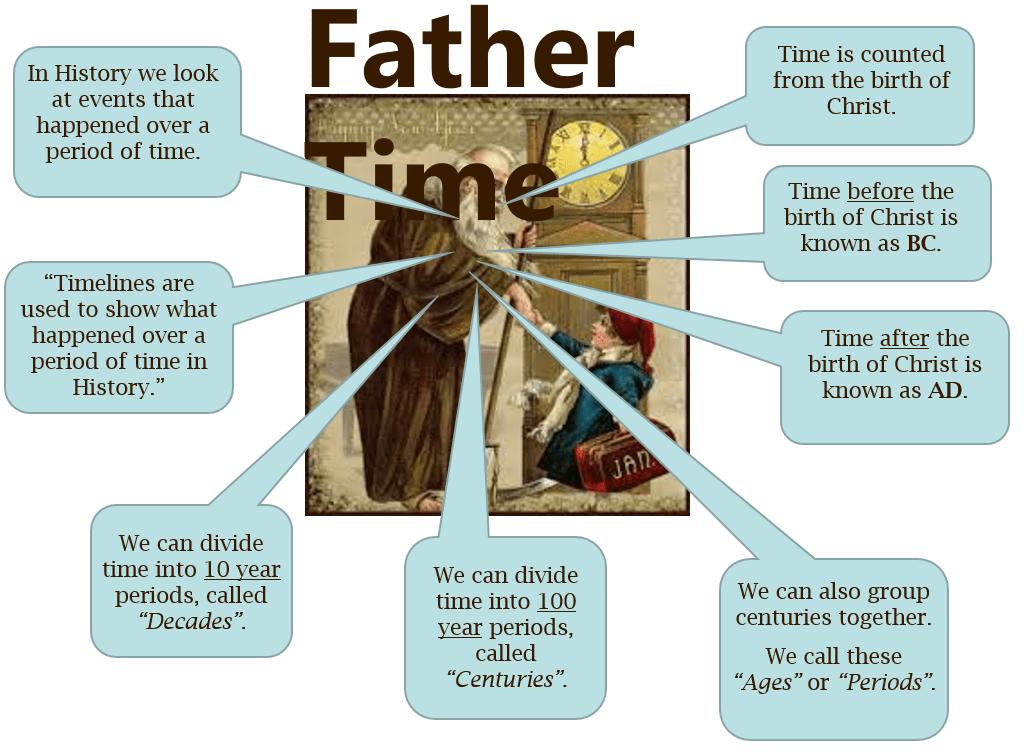
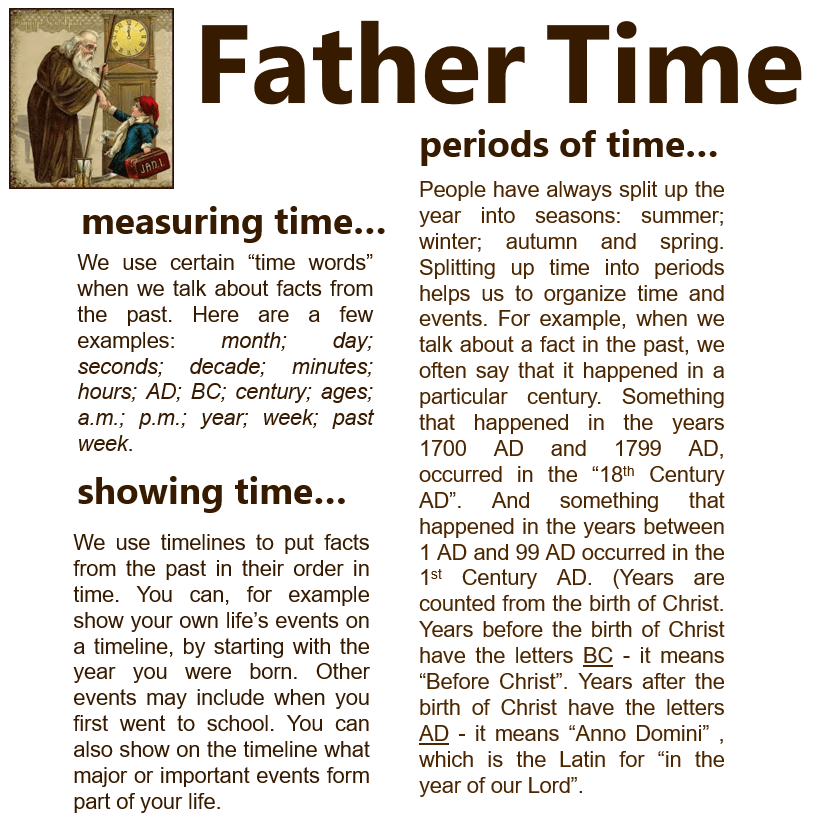
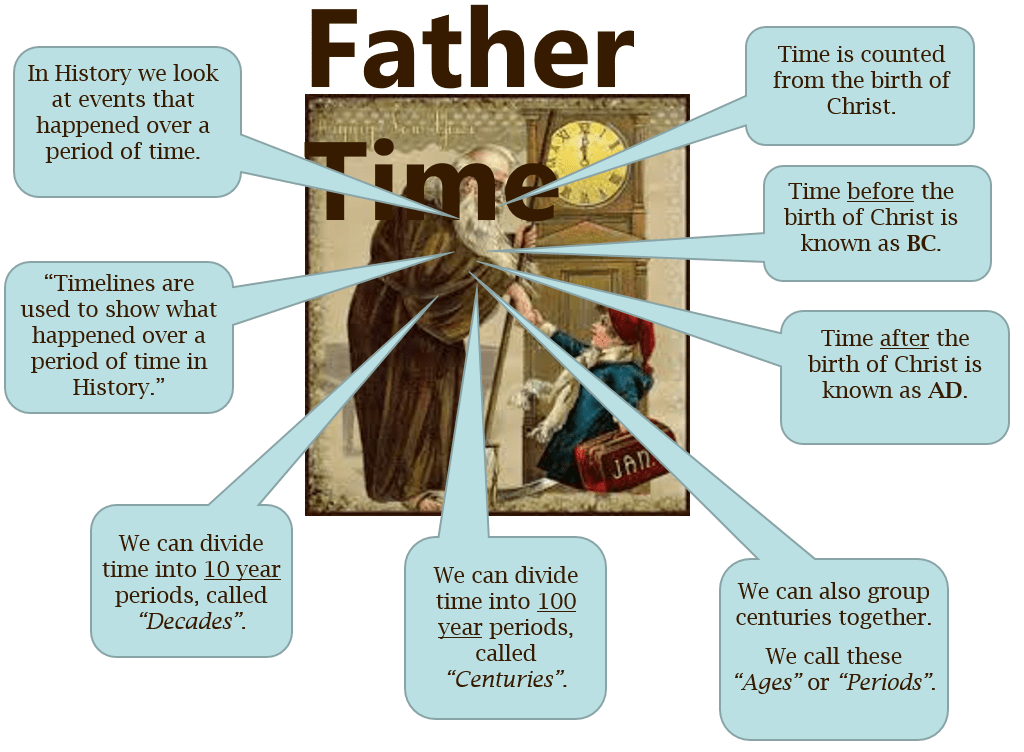
The “Father Time” article explains a bit about the use of time and timelines. Read it now if you have not done so in the previous lesson.

3.
Watch the following three videos to clarify some of the concepts in the article:

The first video explains how we show events on timelines.
Father Time – Part 1. (0:57 minutes long)
The second video explains how time is counted from the year zero.
Father Time – Part 2. (1:54 minutes long)
The third video explains what decades and centuries are. It also explains how to determine in which century a specific year falls.
Father Time – Part 3. (2:15 minutes long)
Important: When mentioning a date (or a century) one also has to say if it is AD or BC.
4.
And now for a short test! Let’s see if you can say in which century a specific year falls… (Follow the instructions in the video.)
Father Time – Part 4. (2:56 minutes long)
5.
And now you are going to start with the “Father Time” Tasks. You will get the rest of this lesson as well as the next lesson to work on the tasks.
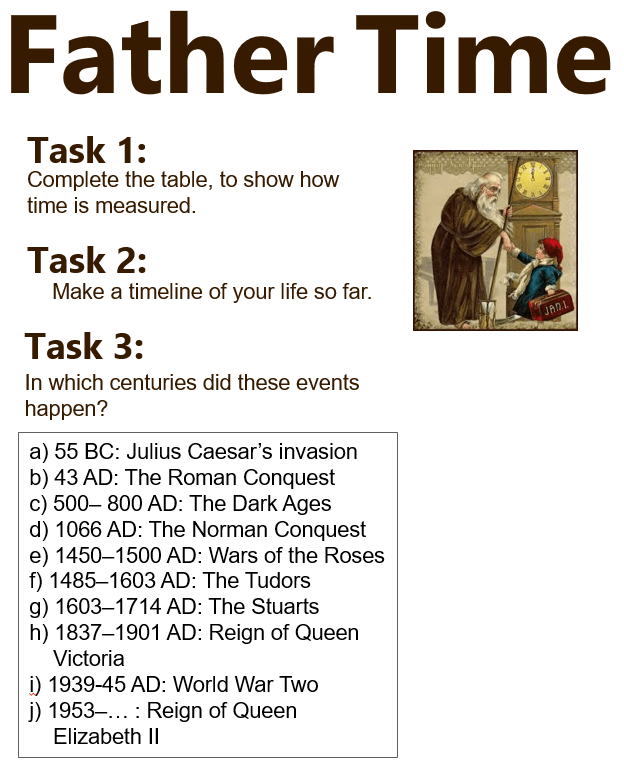
So, let’s begin with Task 1.
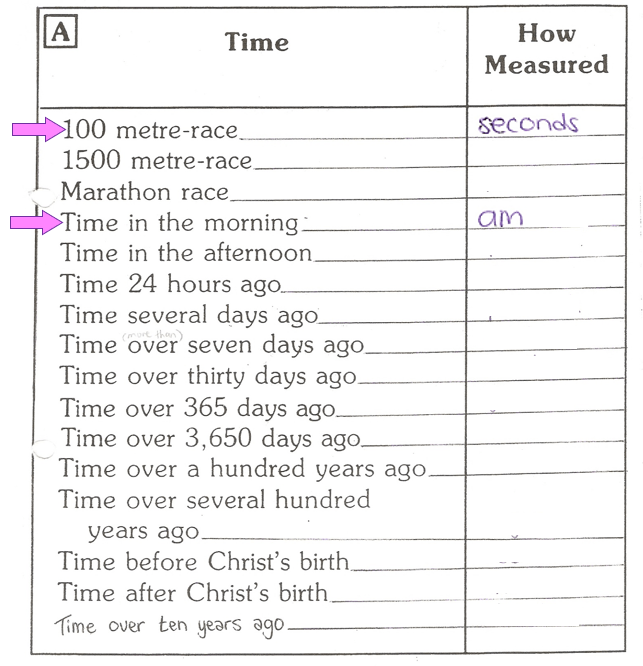
Complete the table to show how time is measured. (There are some clues in the “Father Time” article!) Here is an example of what you have to do:

(WordPress advertisements may appear below.)
Year 7A & Year 7B
Today you are going to investigate the study of History in a bit more detail.
Follow the instructions step by step:
1.
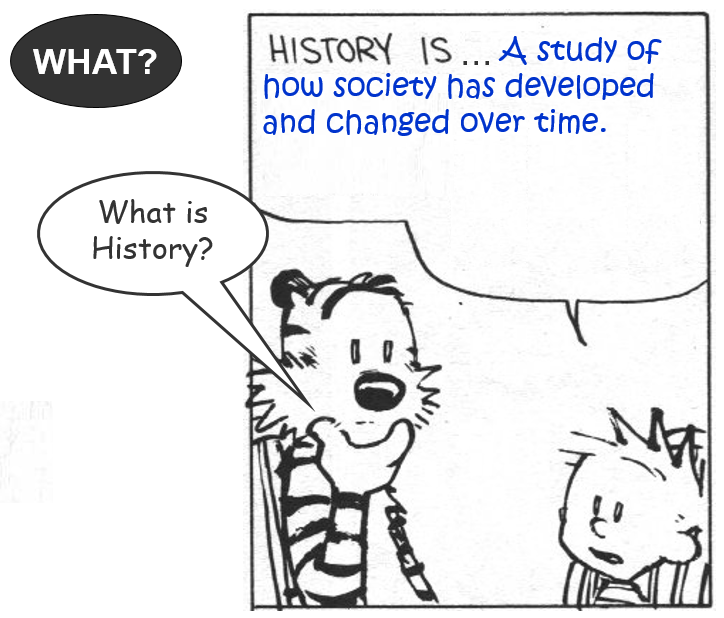
A bit of revision:

2.
WHY do we study History?
3.
Let’s look at the benefits of studying History:

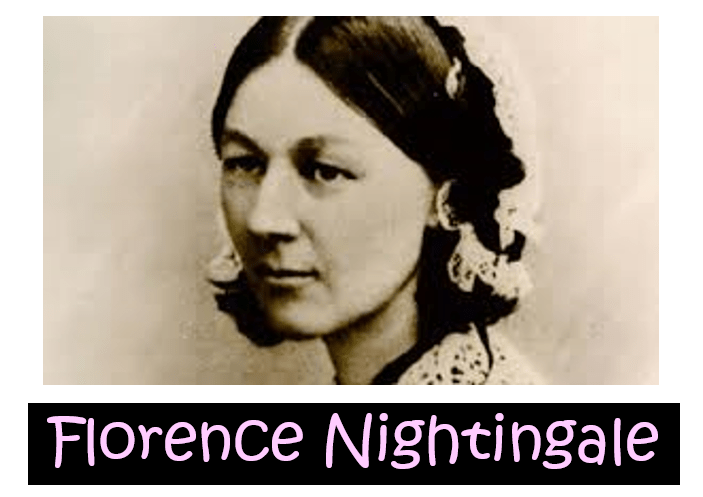
For example, based on her experiences and observations in Crimea, Florence Nightingale trained nurses to work in clean sanitized conditions in hospitals. Today, our hospitals are clean and organised because many years ago Florence Nightingale created sanitary conditions so that patients could receive the best care.
Here is another example:
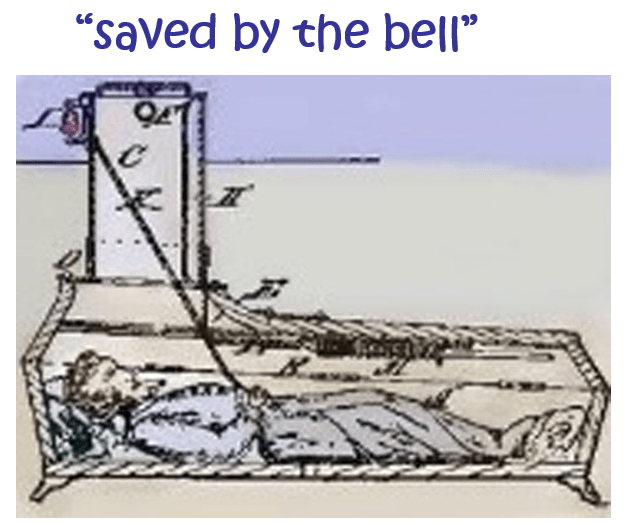
“Saved by the bell” means “rescued from an unwanted situation”. This expression has an interesting history: Many years ago people were sometimes mistakenly buried alive! Medicine was not so advanced and doctors sometimes thought that people were dead when they were simply in a coma. People who feared being buried alive were buried in special coffins that were connected to a bell above ground. Guards listened for any bells in case they had to dig up a living person and save them “by the bell.”

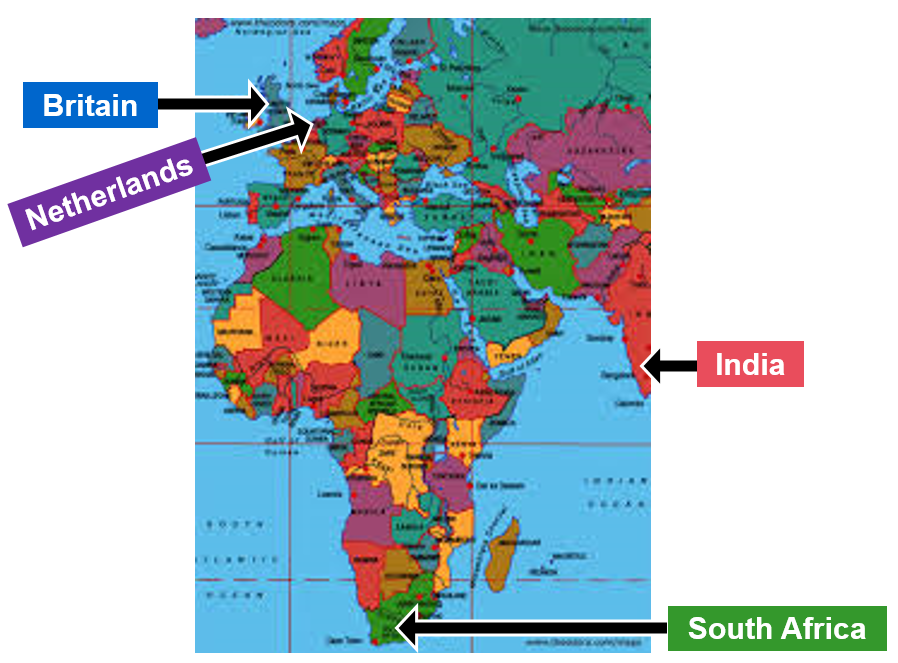
For example, there are Europeans living in Southern Africa because of colonization. In the 1600’s the Dutch traded with India by sailing around Africa to the east. The set up a halfway post at the tip of Africa to get fresh supplies for their sailors. These Dutch settlers are my ancestors! (That is also why I speak a language that is very similar to Dutch, called Afrikaans.) Today, some people in South Africa speak Afrikaans and some speak English. That is because the Dutch and the English were fighting in a war in the 1800’s and the English then took over the Dutch colony in Southern Africa.

Here are two examples:
Theodore Roosevelt Inspires the Teddy Bear. (1:51 minutes long)
The Dentist Who Created Cotton Candy. (1:31 minutes long)


Carefully read the information in the table below to see which skills you will acquire by doing History as one of your school subjects.
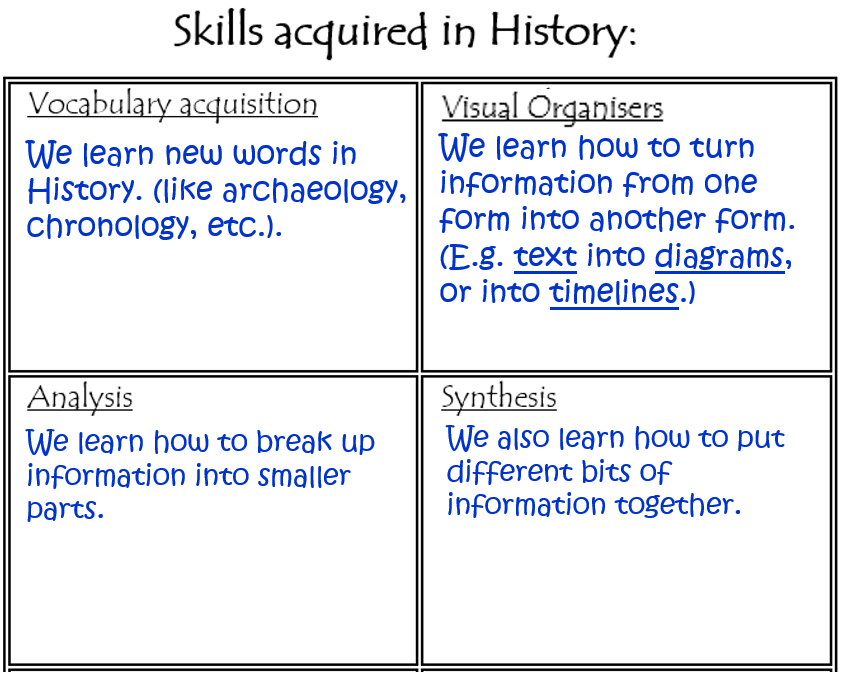
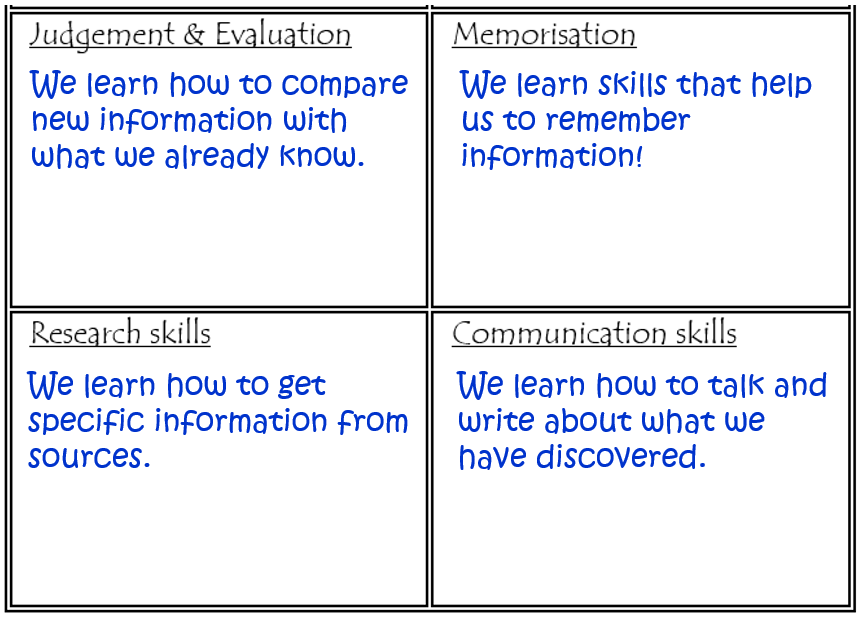
As we progress through the Year 7 History course we will fill in the table (stuck into your History book), as you acquire new skills.
4.
Now that you know what History is and why we study History, we need to consider “time”… In the study of History we often mention dates. So, let’s read the article called “Father Time”. (It is stuck into your exercise book.) In the next lesson we will discuss this article in more detail.
(WordPress advertisements may appear below.)

Homework Task 2 (p.5) is due:
(See Schoology)
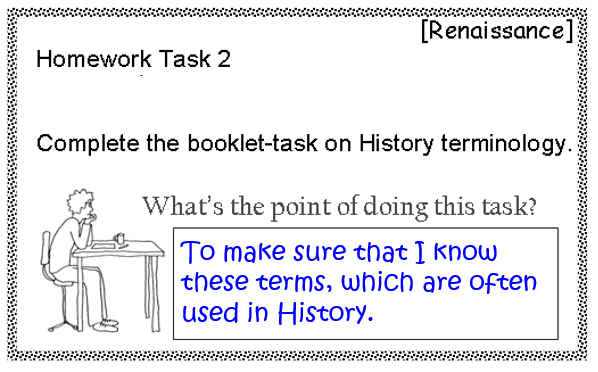

Make sure that you have completed this project to the best of your ability!. If you are unsure of some concepts / terminology google them to find clarity!

(WordPress advertisements may appear below.)


Homework Task 2 (p.6-9) is due:
(See Schoology)
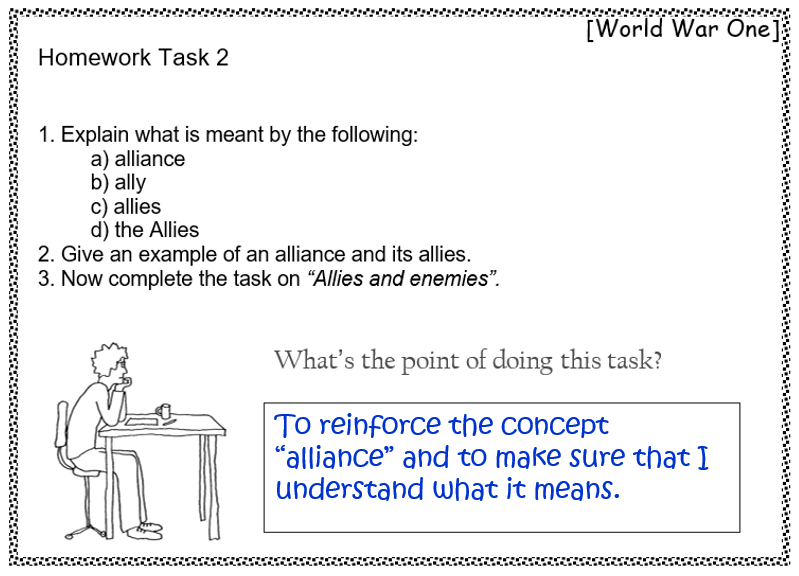
If you get stuck…
The following may also be useful…

Alliance Definition. (1:36 minutes long)
What is “Alliance”? (3:03 minutes long)
To clarify even further…

(WordPress advertisements may appear below.)

Homework Task 2 (p.6-7) is due:
(See Schoology.)
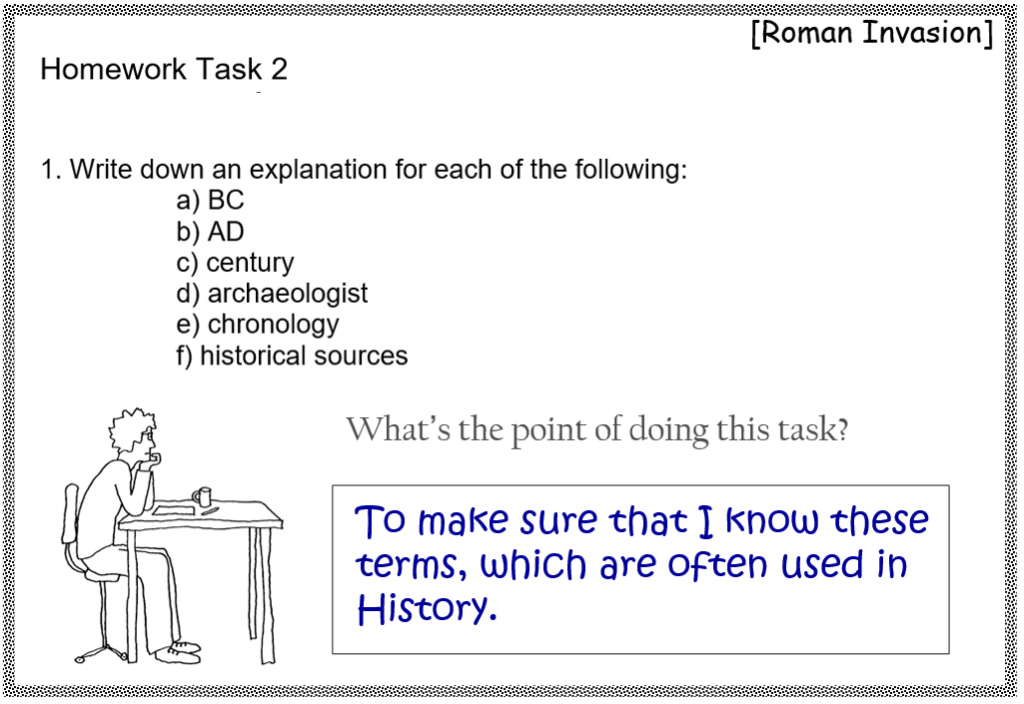
Make sure that you write clear definitions that you yourself understand! Also, write in full sentences!!
(WordPress advertisements may appear below.)
Year 8A & Year 8B
Today you are going to continue with the self-study project on terminology often used in History… Most of the concepts and vocabulary were taught in Year 7. So, it is really a revision task, to determine what you know and which areas you still need to work on.

So, here is what you have to do:
Follow the instruction in the booklet step by step:

Complete all the tasks in the Terminology Booklet. You will get this lesson to work on this task. (IMPORTANT: What you do not complete today in class must be completed at home for the next lesson!!)
(WordPress advertisements may appear below.)
Let’s continue with the story of the Russian princesses…
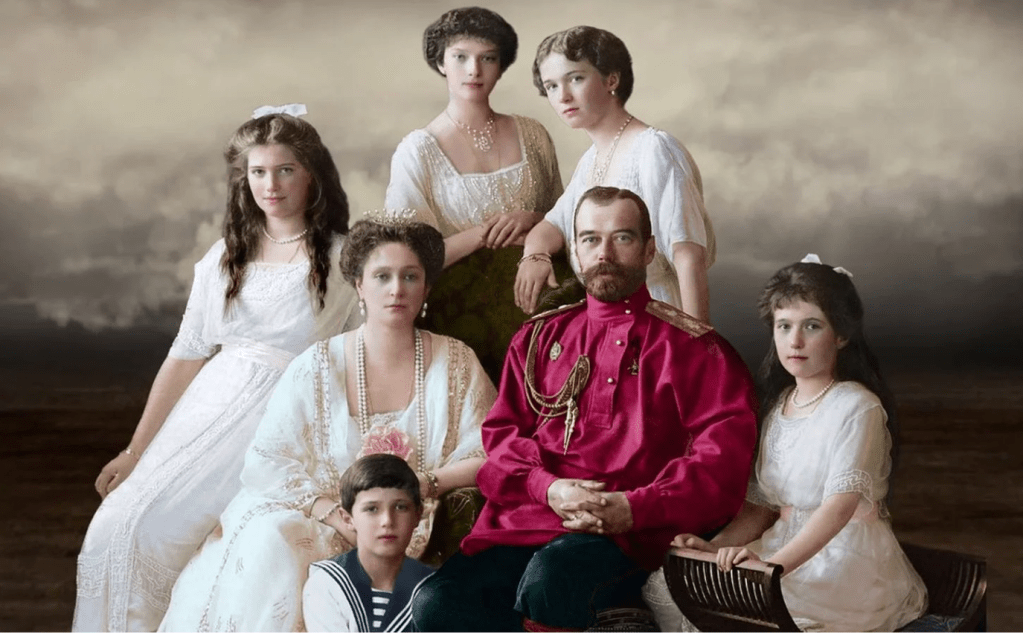
1.
Can you recall the section that we watched in the last lesson: what impressions were given of Nicholas II & Alexandra?
2.
Now, let’s continue watching the story on…
In the last “episode we were introduced to Nicholas and Alexandra and we saw the Coronation of Nicholas…

Tsarist Russia – Part II, 14:36 minutes long.
3.
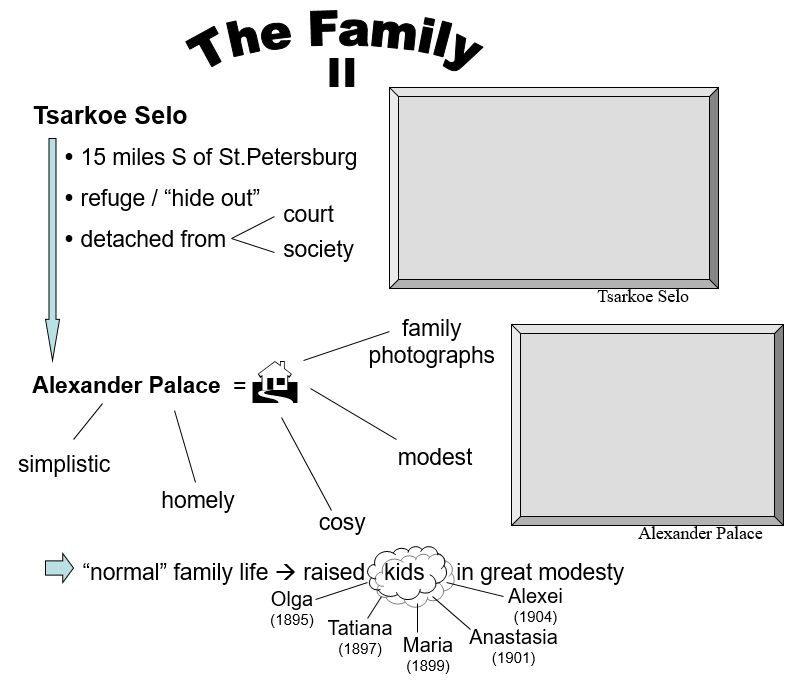
By now you know quite a bit about family life and the children of Nicholas and Alexandra. Here is a little recap of the content:
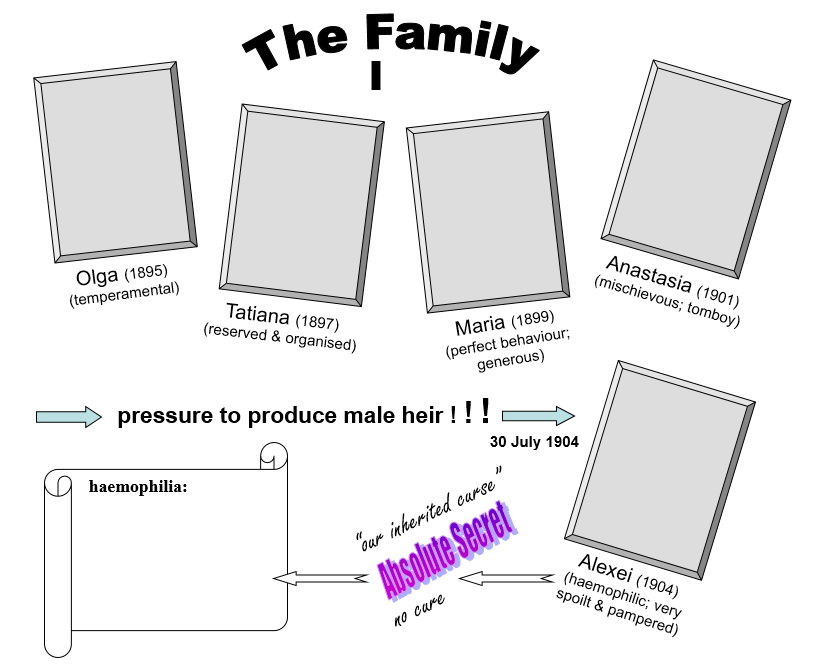
4.
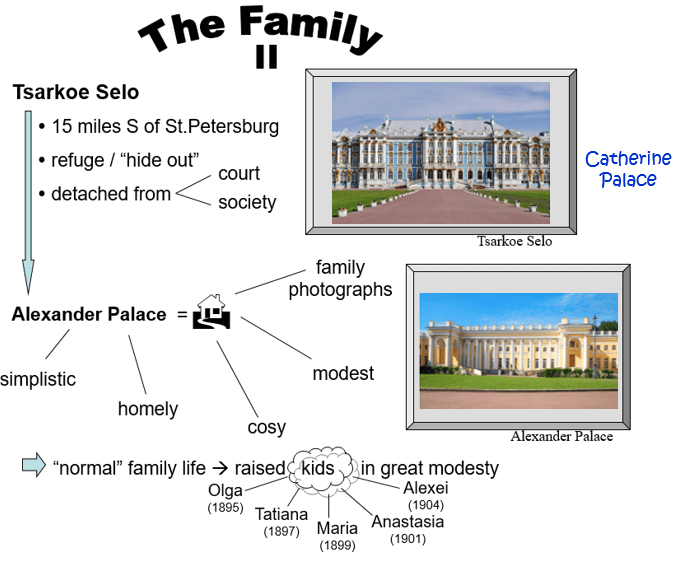
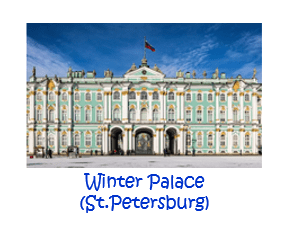
You need to print and stick photos onto the “Family I” and “Family II” worksheets and stick them into your books. Alternatively, can you tell who is who, using the photos below?
SOLUTION


5.
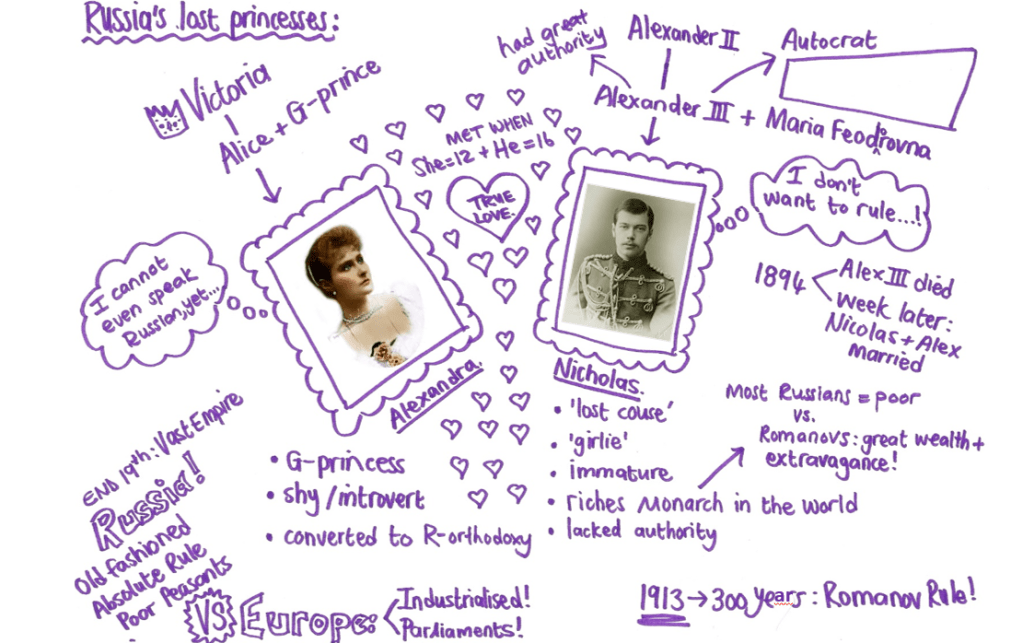
Here is a collage of:
The Story so far…
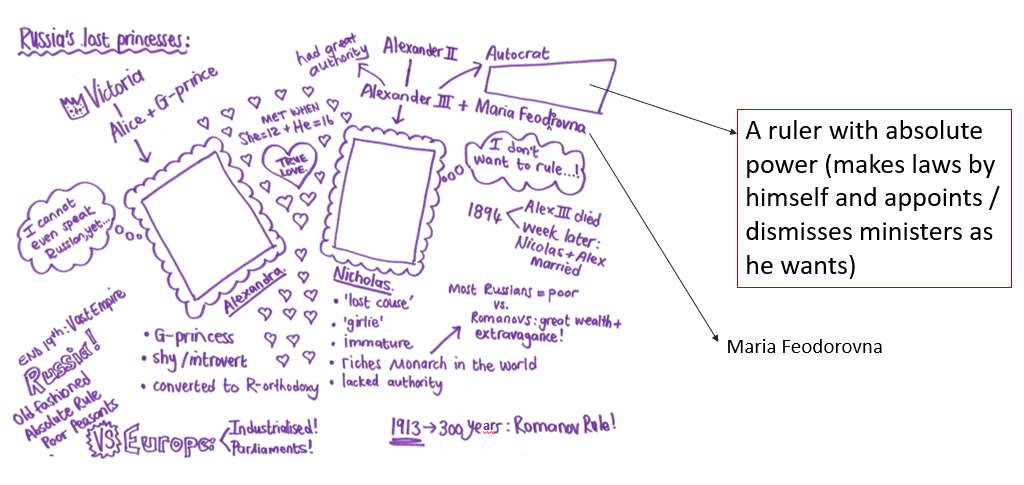
6.
Use the images below to make your own collage on “the story so far”.
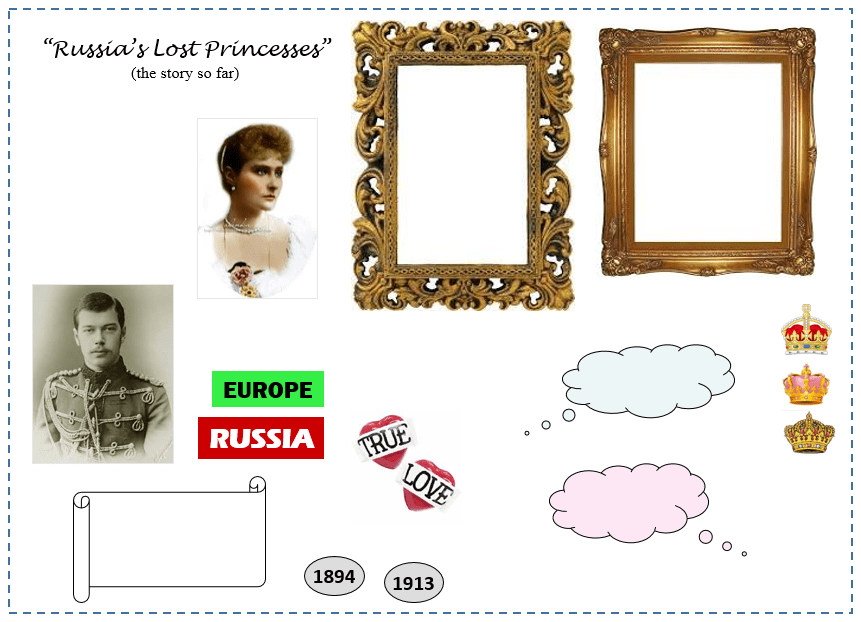
(WordPress advertisements may appear below.)
Today we are going to start with the Russian History!
(Follow the instructions step by step!!)
1.
Before we start with our first topic, we need to talk about homework…
What about homework?
You will get homework on a regular basis. The aim is to help you revise what has been covered in class. There will be an ongoing task: make notes on the information covered in class, in your homework book. In addition, you may be given additional tasks from time to time. These may, for example include essay writing or other activities.
You will also write short tests on a regular basis. Make sure that you study very well for these mini tests!!
2.

THE HISTORY OF HOMEWORK
Who Invented Homework? | COLOSSAL QUESTIONS. (2:00 minutes long)
Year 10 Homework. (1:28 minutes long)
3.
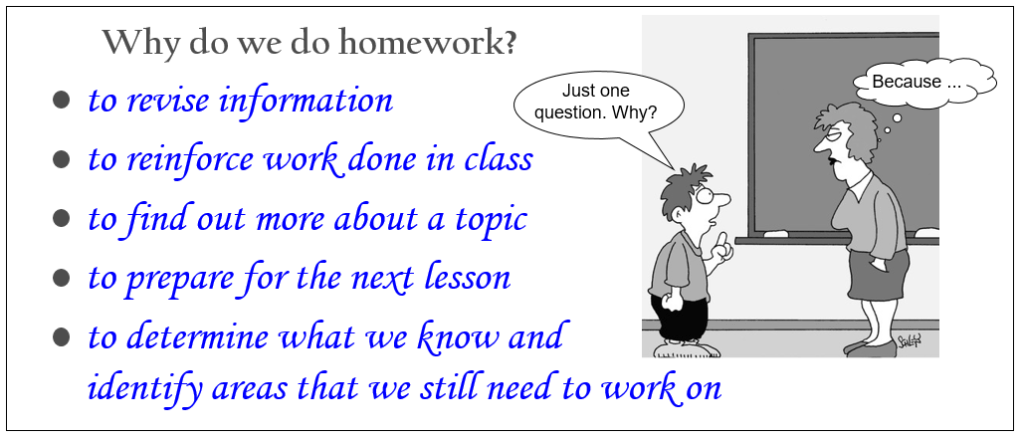
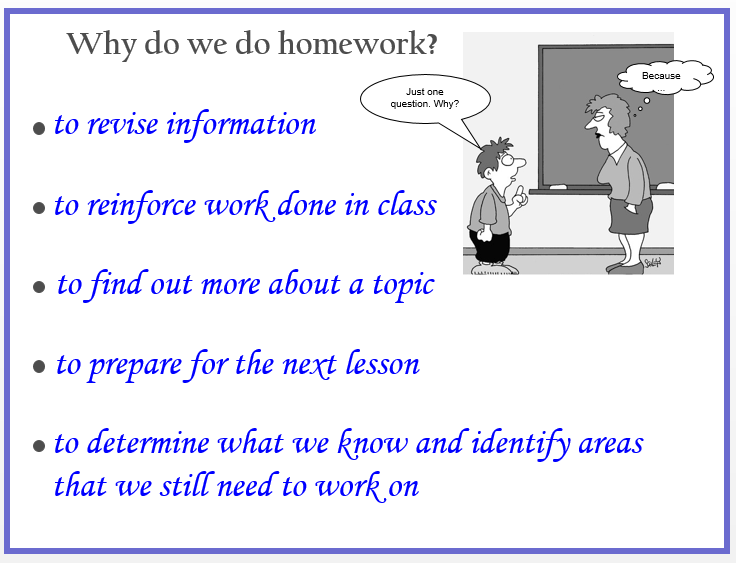
Here is a reminder “Why we do homework” …

4.
This is the content of the topic on Russia:

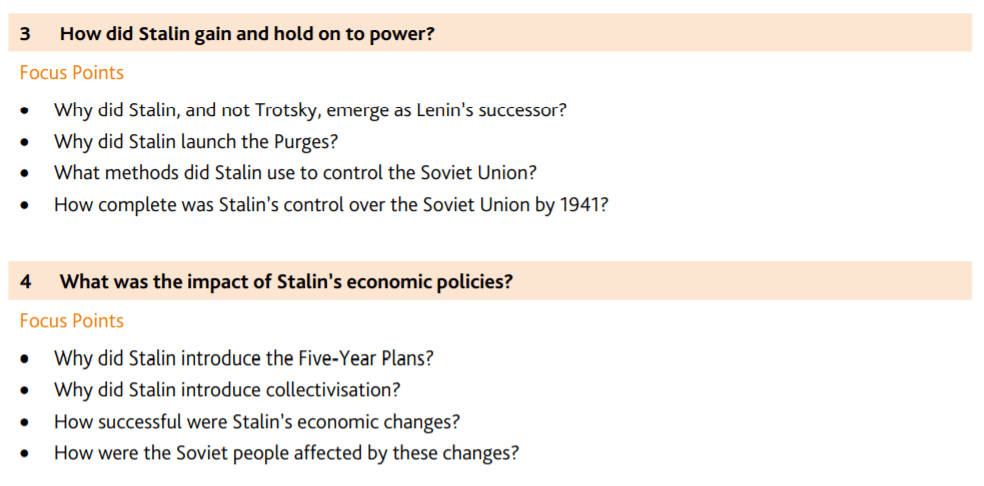
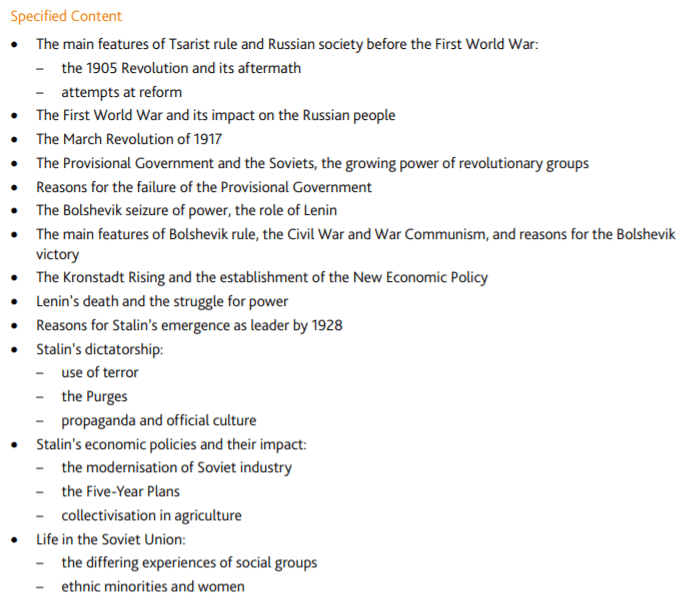
5.
What do you know about Russia and its History?
At the beginning of the 1900 Russia was ruled by Tsar Nicholas II. He ruled as an autocrat. Let’s consider exactly how Nicholas II was able to rule over such an extensive country….

The Tsarist Regime. (2:32 minutes long)
6.
The information about “The tsarist regime“, p.4.
7.
As an introduction to the Russian History we are going to watch a documentary on:
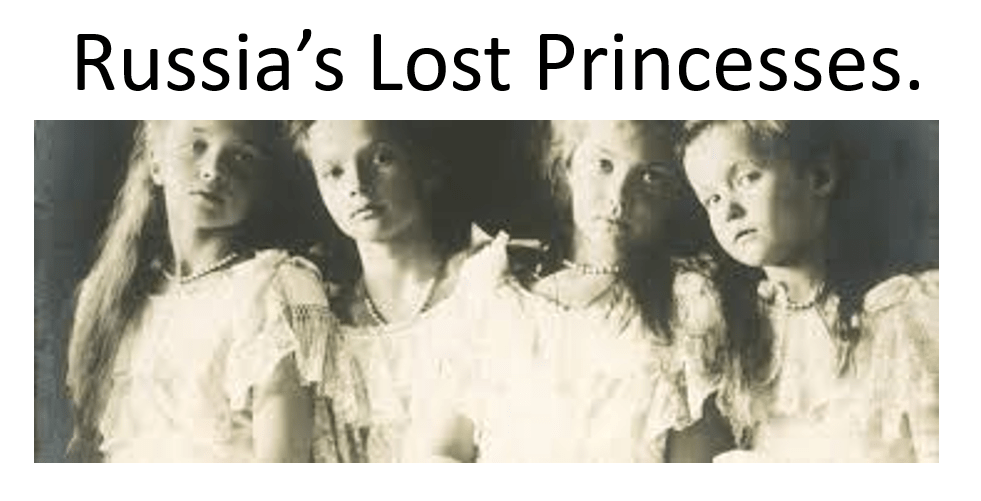
Today, we will watch the first 20 minutes.

Tsarist Russia – Part I. (22:15 minutes long.)
8.
Remember to…
(WordPress advertisements may appear below.)
Year 8A & Year 8B
Today you are going to start doing a self-study project on terminology often used in History… Most of the concepts and vocabulary were taught in Year 7. So, it is really a revision task, to determine what you know and which areas you still need to work on.
So, here is what you have to do:
Follow the instruction in the booklet step by step:
Complete all the tasks in the Terminology Booklet. You will get this lesson as well as the next lesson to work on this task.
(WordPress advertisements may appear below.)
Year 7A & Year 7B
Today you are going to look at what History is and why it is important….
Follow the instructions step by step:
1.
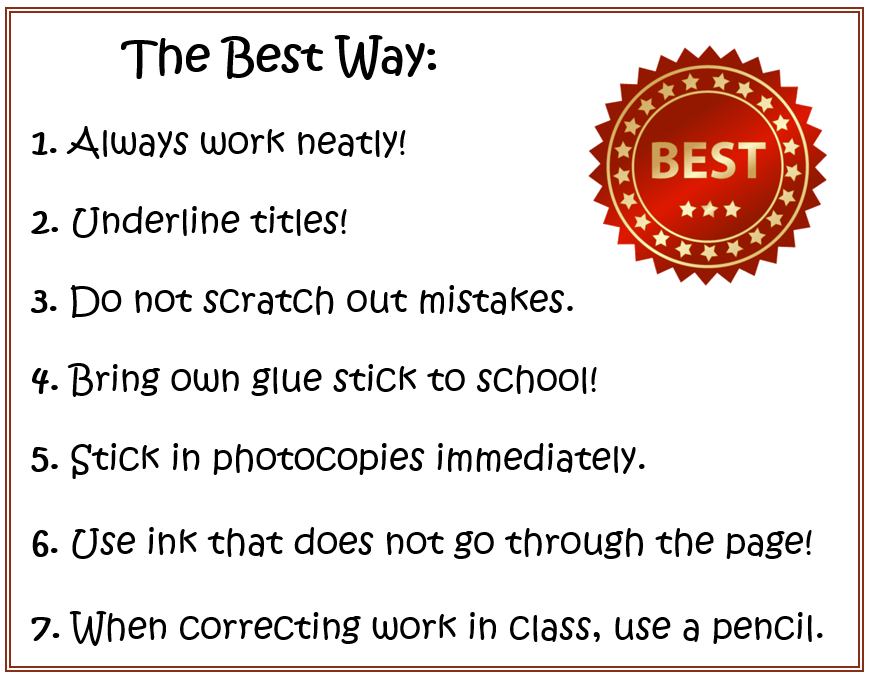
First look at expectations for your work in the History class. This is “the best way” to work in the History class:
2.
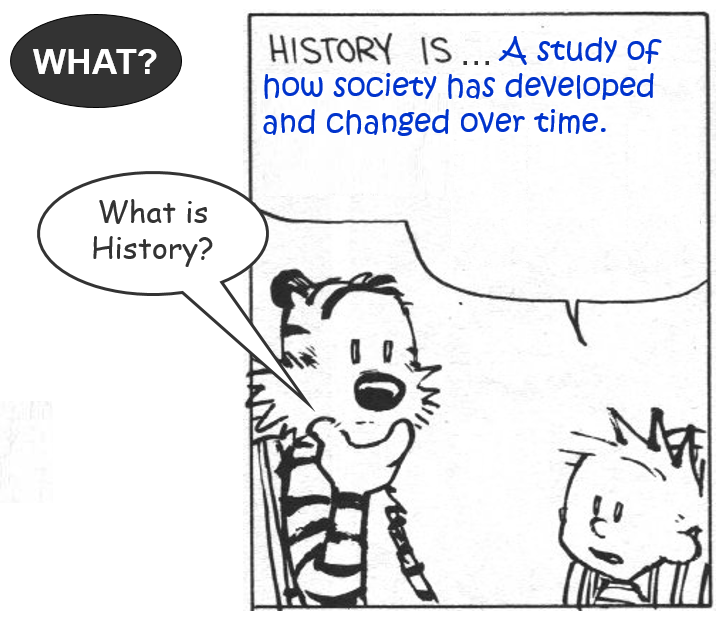
So, what exactly is History?
What is History? (0:57 minutes long)
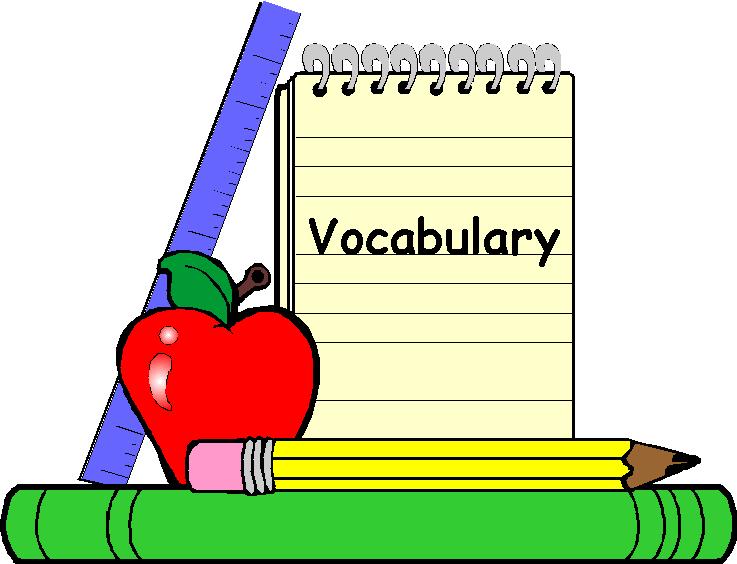
Society = a group of people living at a certain time, interacting with each other and sharing the same environment – in simple terms: “the people living on this earth”…
What is History – detailed. (2:20 minutes long)
3.
Fill in the missing information on the worksheet on “What is History”.

4.
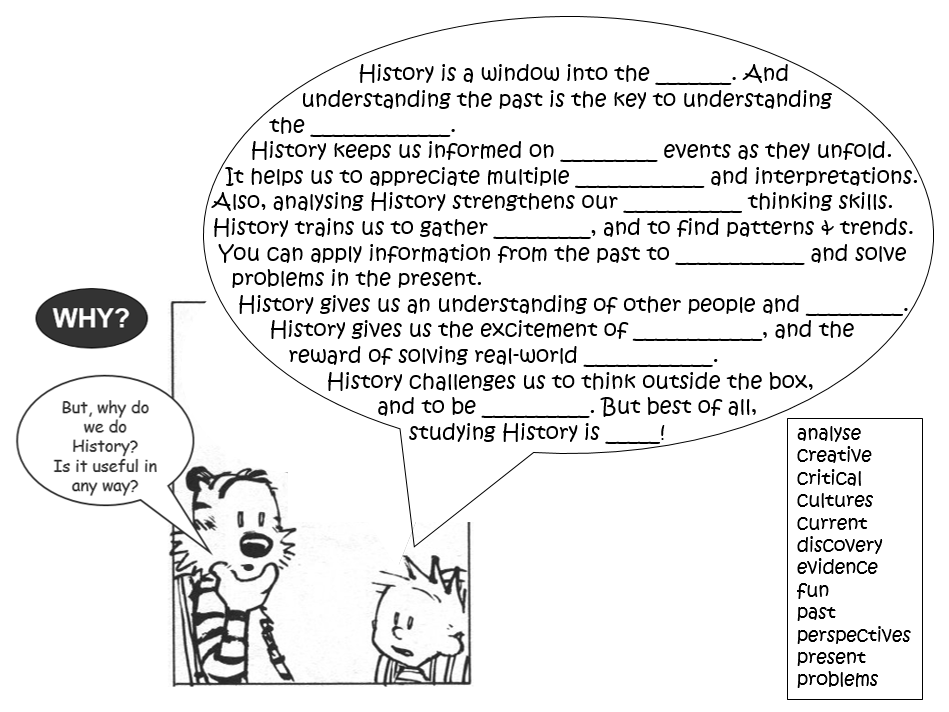
So, why do we do History?

Why do we study History? (3:25 minutes long)
5.
Watch the video below to see the text of the previous video again…
Why do we do History – in text. (1:06 minutes long)
6.
See if you can fill in the missing words on the worksheet on “Why we do History”!
7.
Let’s mark the previous task:

Why History – worksheet answers. (1:01 minutes long)
(WordPress advertisements may appear below.)
Welcome to the IGCSE History course!

Before we start looking at all the exciting things that this course has to offer we need look at a few organisational issues. So, here is what you have to do today:
(Follow the instructions step by step!!)
1.

It gives a bit more information about… “What is History”…
2.
Fill in the “My Fact File” form so that I can get to know you a bit better…
3.
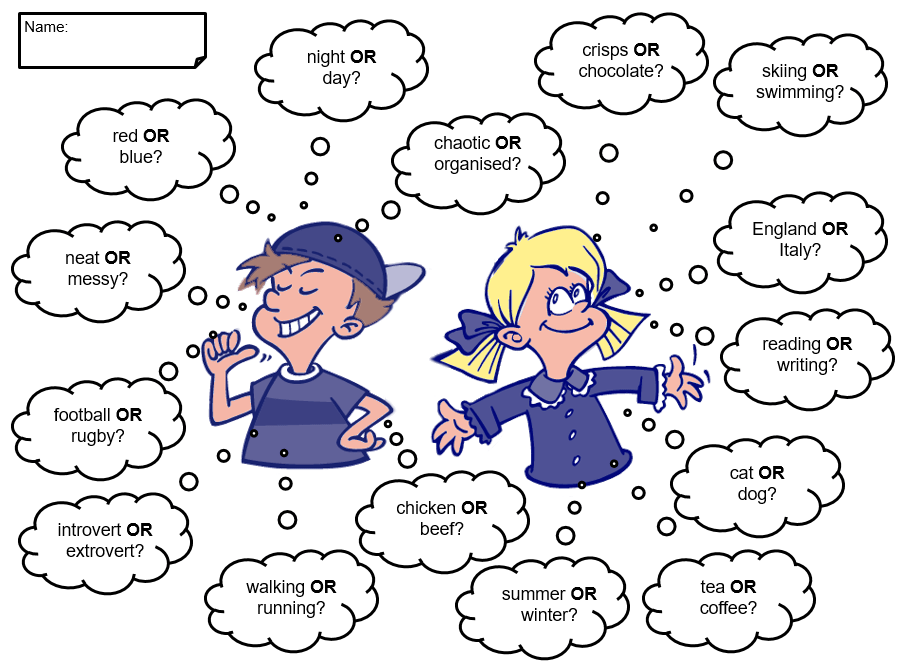
Fill in the “Coffee or Tea” form so that we can get to know each other a bit better…
And here’s what your teacher has to say…
4.
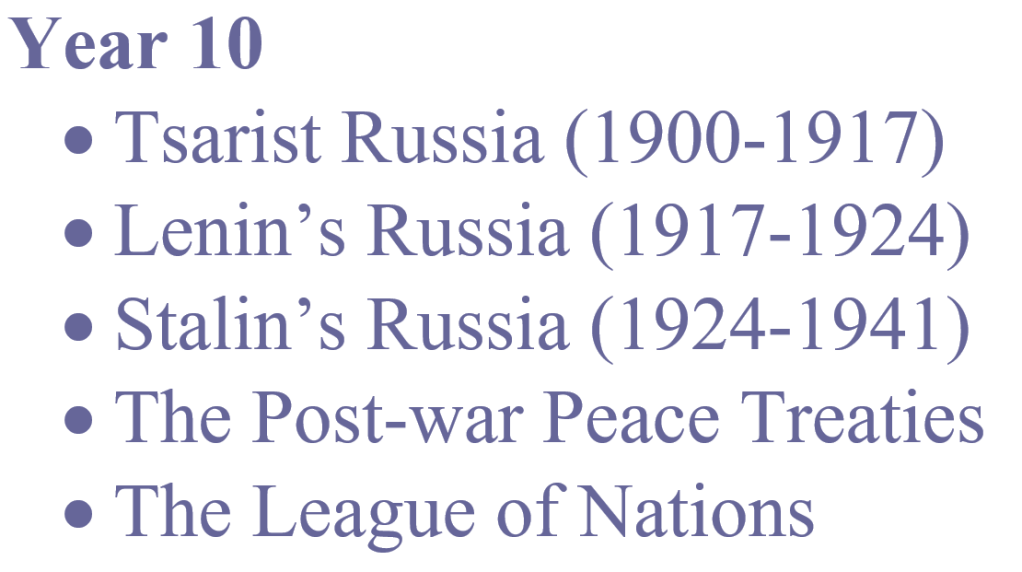
These are the topics that you will be doing in Year 10:
5.
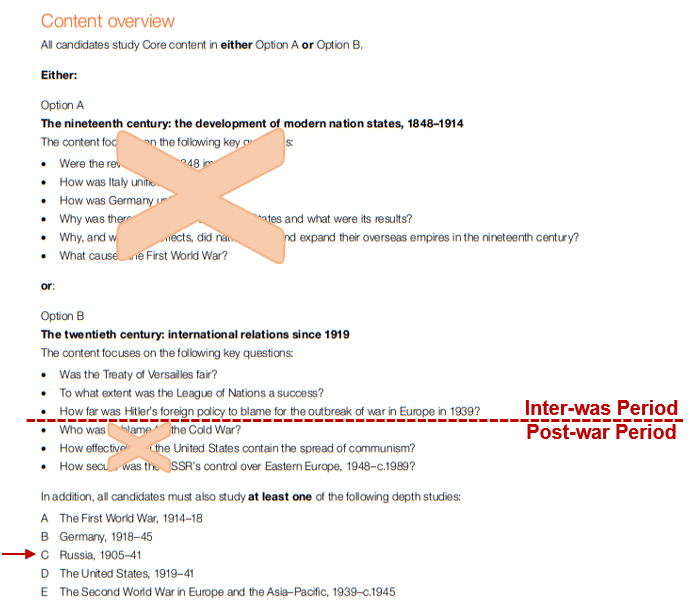
Let’s look at the specification in a bit more detail:
6.
And what about assessment? Here is an overview of the IGCSE History course assessment:

7.
You will receive the following books for History:
Various Flipbooks based on the following textbooks:
8.
Expectations…
9.
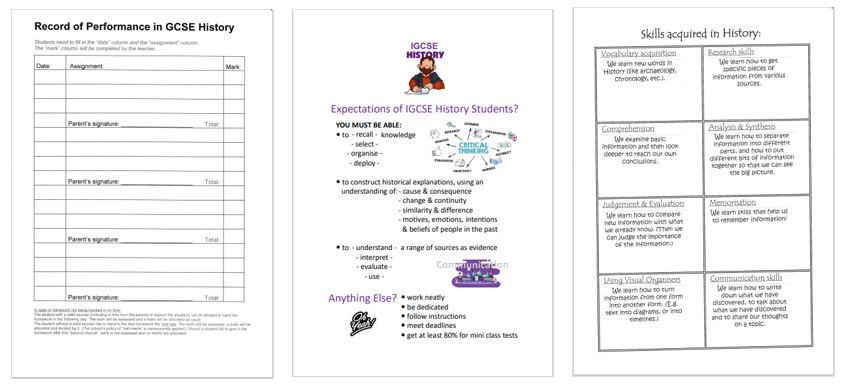
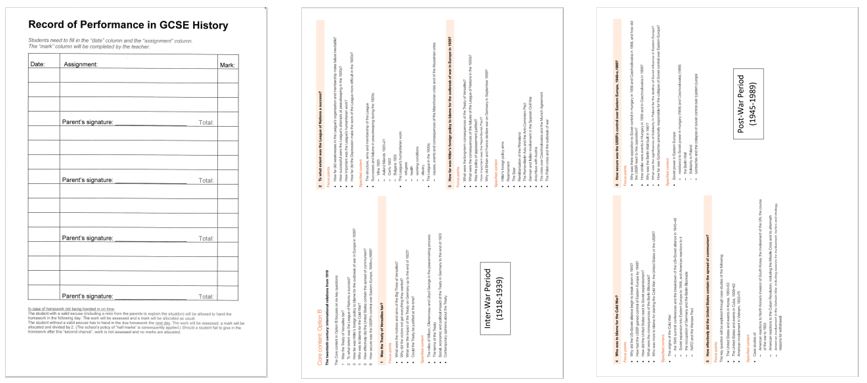
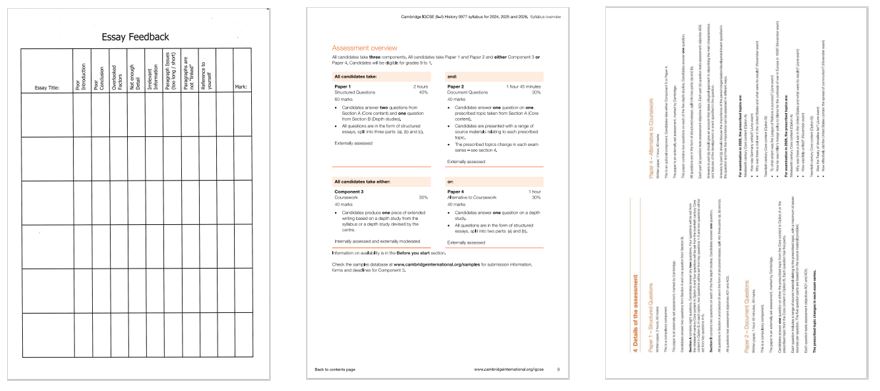
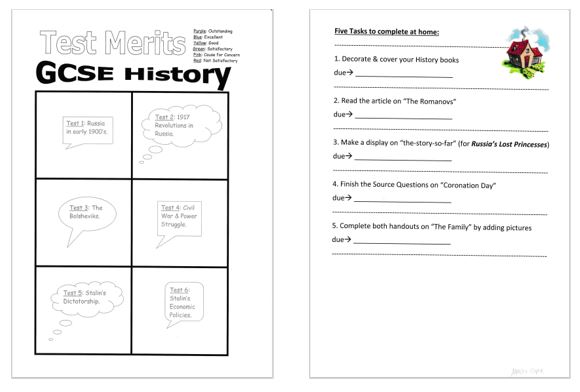
Your teacher will tell you which of the following you need to stick into your books:



10.
For the next lesson, remember to…
… decorate & cover your books & get a protective folder for History!
(WordPress advertisements may appear below.)
Year 8A & Year 8B
Welcome to Year 8 History! Before we start looking at all the exciting things that this course has to offer we need look at a few organisational issues. So, here is what you have to do today:
(Follow the instructions step by step!!)
1.
In Year 8 History there are 2 books. One of the books need to be decorated and both of them need to be covered with plastic:
1) purple Exercise Book – decorate and cover in plastic
2) pink History Textbook – cover in plastic
2.
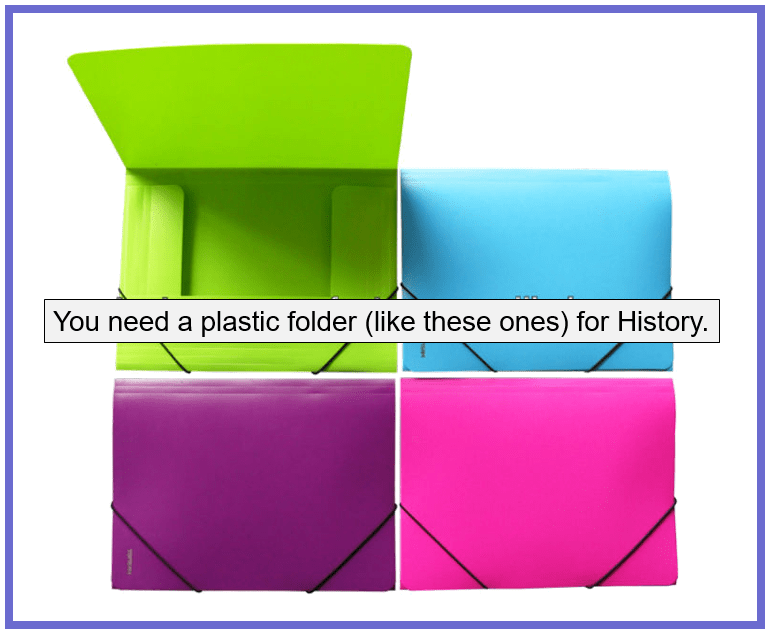
You should also have taken note of the plastic folder required to keep all your History books in! You must always have the folder plus the 2 books in class when you have History.
3.
With regard to the History homework, please take note of the following:
1) You will get homework fairly regularly.
2) Homework is important as it benefits your learning in a number of ways.
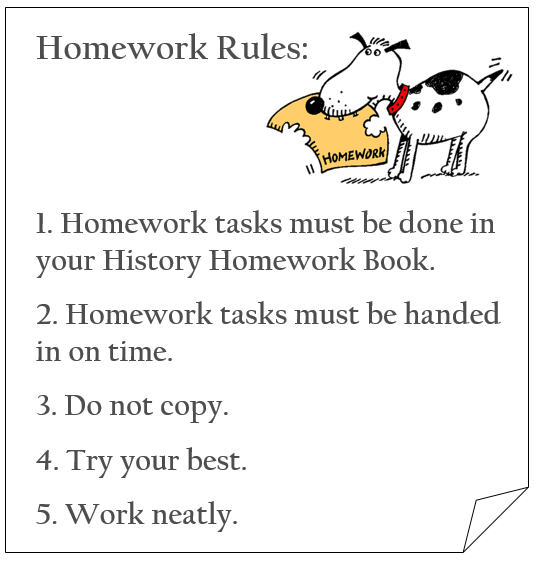
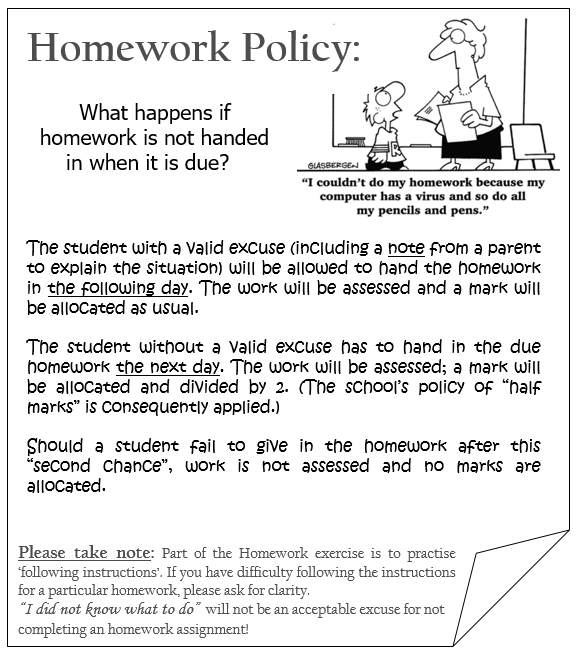
3) You are expected to give your best when doing homework!! Read the following homework rules:
4) The school’s homework policy encourages students to hand in homework on time. (If not, you will lose marks or even get zero!)
4.
Stick the following pages into your History book:
5.
Complete the missing information on the History Skills worksheet, to remind yourself of the skills that we acquire through the study of History. Below are some words that may help you to complete the worksheet…

6.

(WordPress advertisements may appear below.)
Year 9A & Year 9B
Welcome to Year 9 History! Before we start looking at all the exciting things that this course has to offer we need look at a few organisational issues. So, here is what you have to do today:
(Follow the instructions step by step!!)
1.
In Year 9 History there are 3 books. One of the books need to be decorated and all three of them need to be covered with plastic:
1) purple Exercise Book – decorate and cover in plastic
2) blue History Textbook 1 – cover in plastic
3) yellow History Textbook 2 – cover in plastic
2.
You should also have taken note of the plastic folder required to keep all your History books in! You must always have the folder plus the 3 books in class when you have History.
3.
With regard to the History homework, please take note of the following:
1) You will get homework fairly regularly.
2) Homework is important as it benefits your learning in a number of ways.
3) You are expected to give your best when doing homework!! Read the following homework rules:
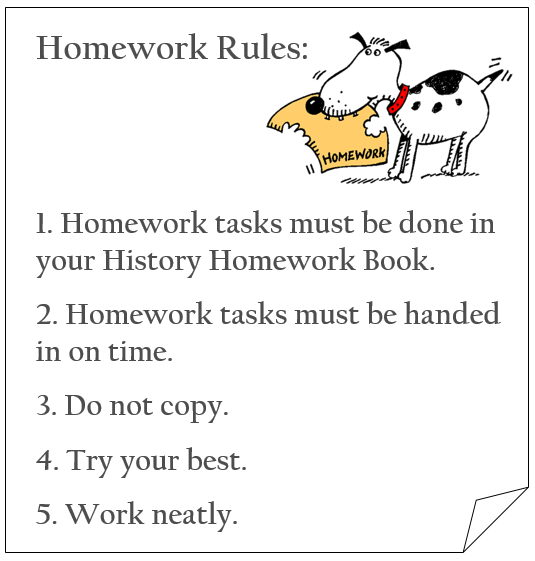
4) The school’s homework policy encourages students to hand in homework on time. (If not, you will lose marks or even get zero!)
4.
Stick the following pages into your History book:
5.
Complete the missing information on the History Skills worksheet, to remind yourself of the skills that we acquire through the study of History. (You need to match the explanations with the skills mentioned on the table.)
6.
(WordPress advertisements may appear below.)
Year 7A & Year 7B
Welcome to Year 7 History! Before we start looking at all the exciting things that this course has to offer we need look at a few organisational issues. So, here is what you have to do today:
(Follow the instructions step by step!!)
1.
In Year 7 History there are 2 books. One of the books need to be decorated and both of them need to be covered with plastic:
1) purple Exercise Book – decorate and cover in plastic
2) green History Textbook – cover in plastic
2.
You must also have a plastic folder to keep all your History books in! You must always have the folder plus the 2 books in class when you have History.
3.
With regard to the History homework, please take note of the following:
1) You will get homework fairly regularly.
2) Homework is important as it benefits your learning in a number of ways.
3) You are expected to give your best when doing homework!! Read the following homework rules:

4) The school’s homework policy encourages students to hand in homework on time. (If not, you will lose marks or even get zero!)
4.
Finally, stick the following into your History Book:
IMPORTANT: leave a page open…!
Now also stick the following into your History Book:
Finally, we are ready for the next History lesson!
(WordPress advertisements may appear below.)
Please take note of the following:
1.
You will get homework regularly – it is usually a homework task set (and completed) in the History Homework Book.
2.
Homework is important as it benefits your learning in a number of ways.
3.
You are expected to give your best when doing homework!!
4.
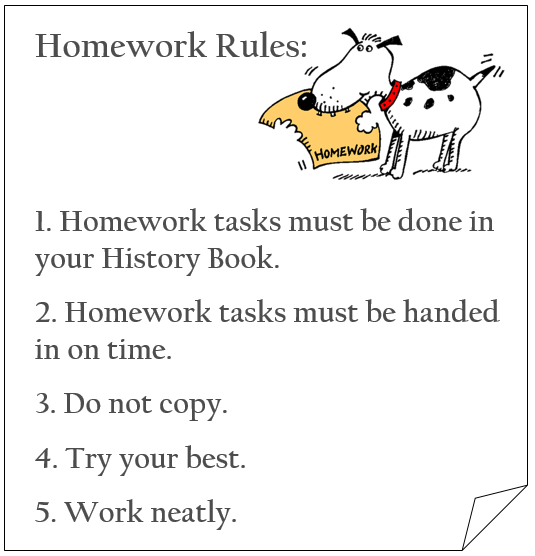
The school’s homework policy encourages students to hand in homework on time. (If not, you will lose marks or even get zero!)
5.
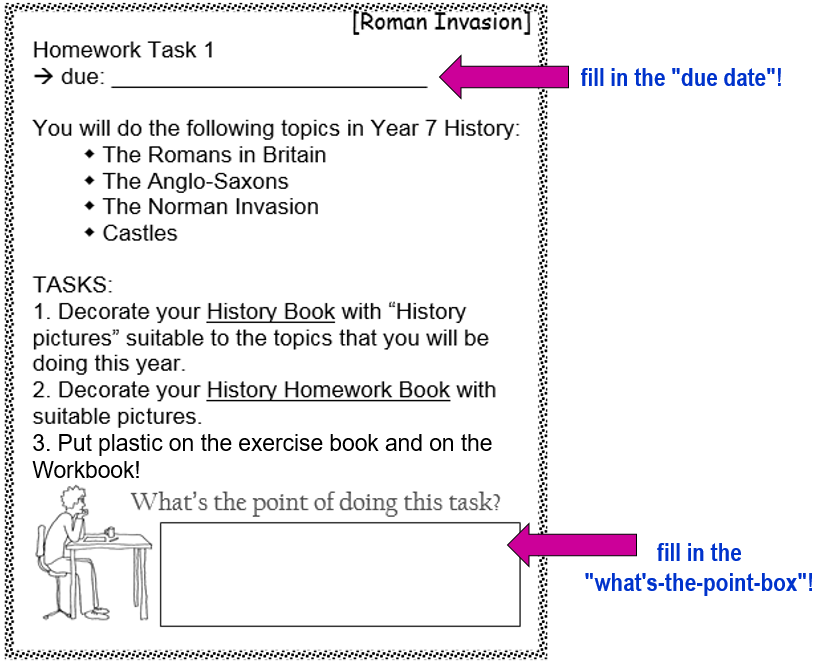
For all homework tasks, always fill in the “due date” as well as the “what’s-the-point-box”!
Good luck with your homework!
(WordPress advertisements may appear below.)
Please take note of the following:
1.
You will get homework regularly – it is usually a homework task set (and completed) in the History Homework Book.
2.
Homework is important as it benefits your learning in a number of ways.
3.
You are expected to give your best when doing homework!!
4.
The school’s homework policy encourages students to hand in homework on time. (If not, you will lose marks or even get zero!)
5.
For all homework tasks, always fill in the “due date” as well as the “what’s-the-point-box”!
Good luck with your homework!
(WordPress advertisements may appear below.)
Please take note of the following:
1.
You will get homework regularly – it is usually a homework task set (and completed) in the History Homework Book.
2.
Homework is important as it benefits your learning in a number of ways.
3.
You are expected to give your best when doing homework!!
4.
The school’s homework policy encourages students to hand in homework on time. (If not, you will lose marks or even get zero!)
5.
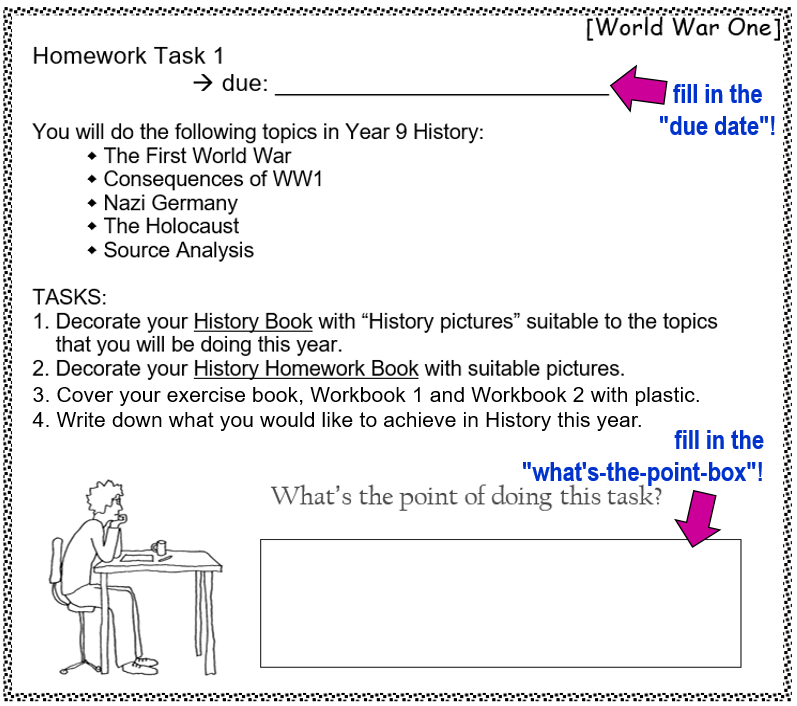
For all homework tasks, always fill in the “due date” as well as the “what’s-the-point-box”! For example:
Good luck with your homework!
(WordPress advertisements may appear below.)
Please take note of the following:
1.
You will get homework regularly – it is usually a homework task set (and completed) in the History Homework Book.
2.
Homework is important as it benefits your learning in a number of ways.
3.
You are expected to give your best when doing homework!!
4.
The school’s homework policy encourages students to hand in homework on time. (If not, you will lose marks or even get zero!)
5.
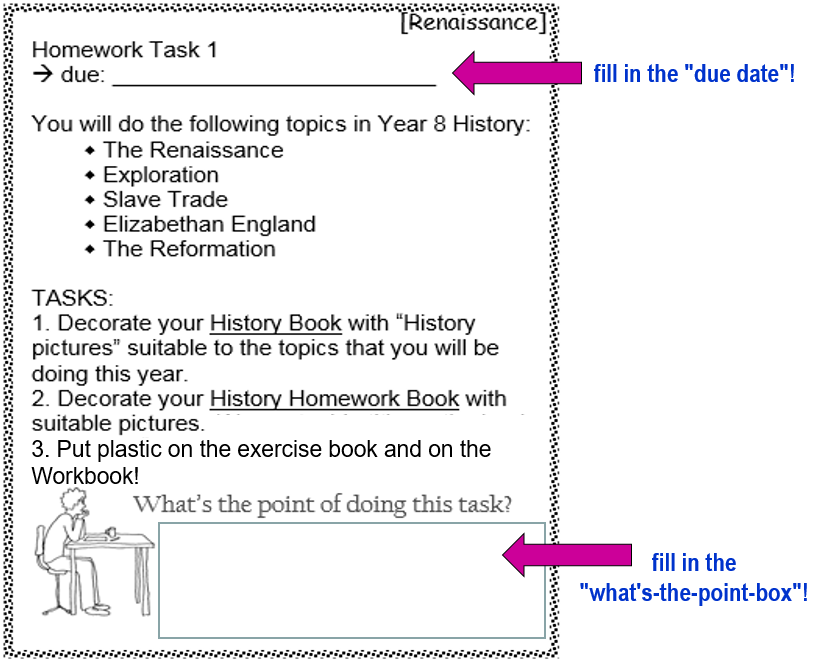
For all homework tasks, always fill in the “due date” as well as the “what’s-the-point-box”! For example:
Good luck with your homework!
(WordPress advertisements may appear below.)
You will do extensive revision and assessment tasks at the end of the Year 9 History course!
A few tasks to get you started…
1.
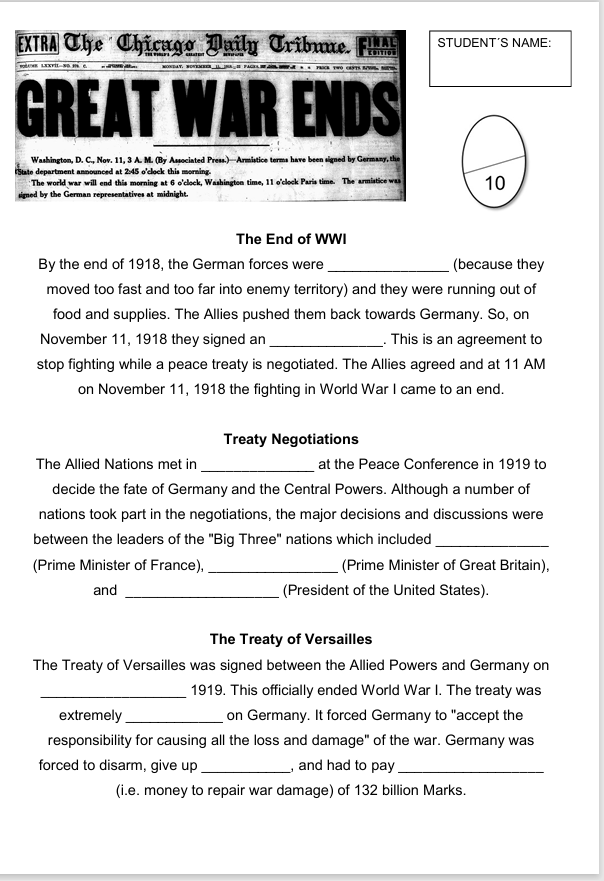
SOLUTION

2.

SOLUTION
3.

SOLUTION
(WordPress advertisements may appear below.)
You will do extensive revision and assessment tasks at the end of the Year 8 History course!
A few tasks to get you started…
1.
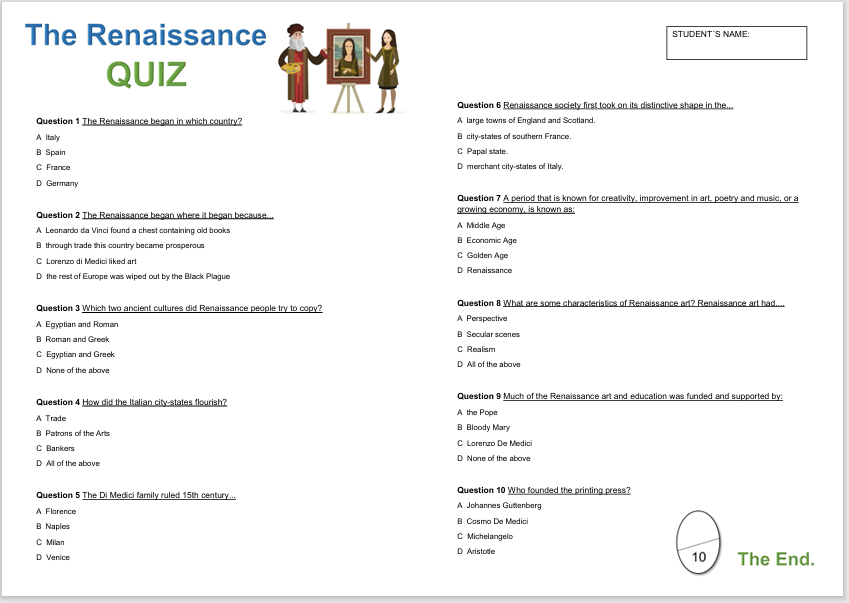
SOLUTION
2.
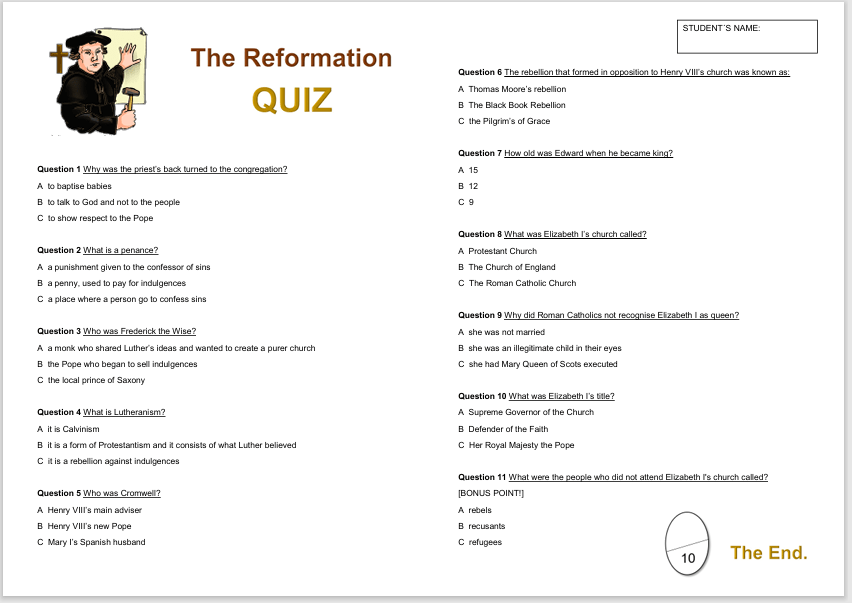
SOLUTION
(WordPress advertisements may appear below.)
You will do extensive revision and assessment tasks at the end of the Year 7 History course!
A few tasks to get you started…
1.
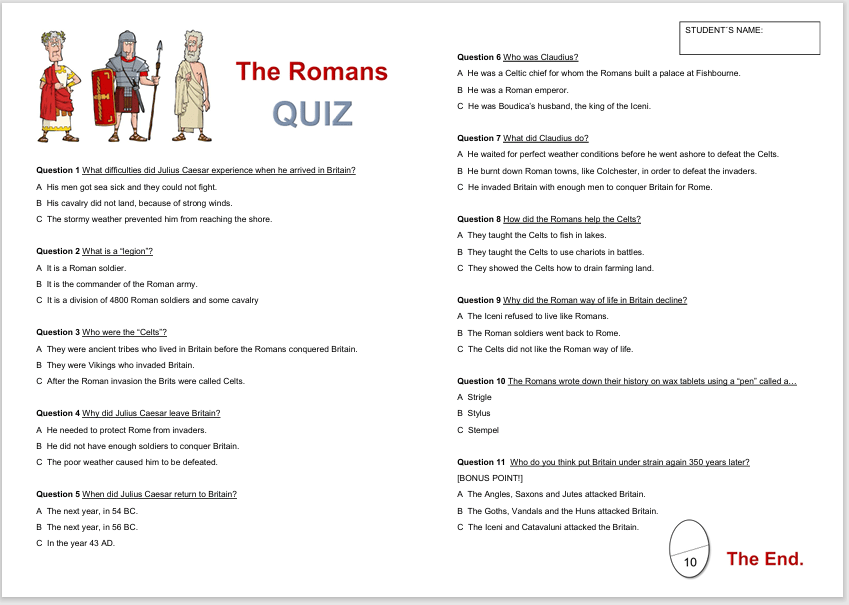
SOLUTION
2.

SOLUTION
3.
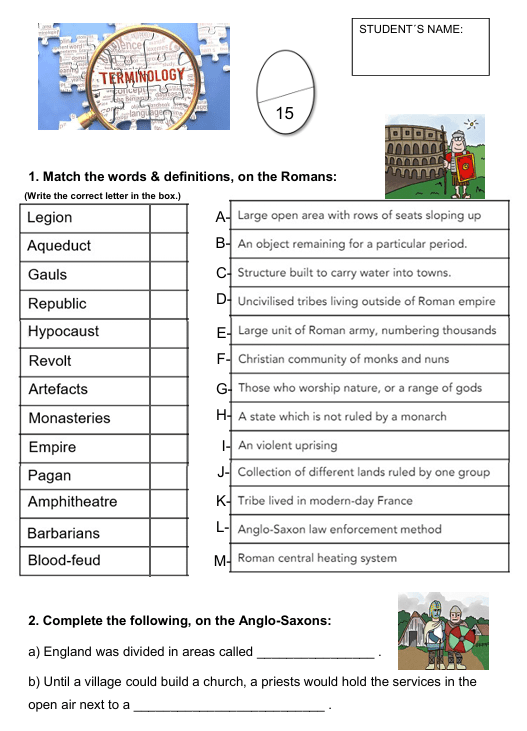
SOLUTION
(WordPress advertisements may appear below.)
1.
You will analyse exam questions and practise essay writing in preparation for the IGCSE History mock examination!
Click on the button…
2.
You will analyse exam questions and practise essay writing in preparation for the final IGCSE History examination!
Click on the button…
(WordPress advertisements may appear below.)

Homework 1 (p.5) is due:
(See Schoology.)



1. Get a plastic folder for History!
2. Parents must read and sign page 3!!
Search for Google Images of the topics, but make sure that you choose pictures from the right periods of History!
(WordPress advertisements may appear below.)

Homework 1 (p.5) is due:
(See Schoology)
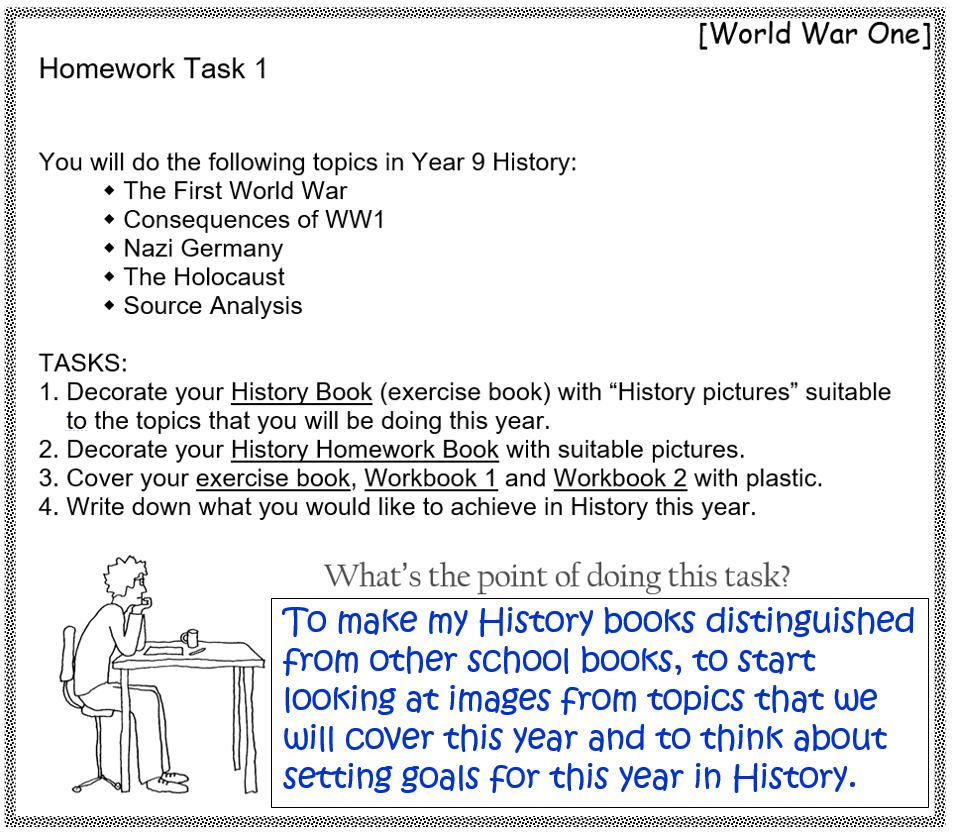
Get a plastic folder for History!
Search for Google Images of the topics, but make sure that you choose pictures from the right periods of History!
(WordPress advertisements may appear below.)
Homework Task 1 (p.5) is due:
(Check with your teacher…)
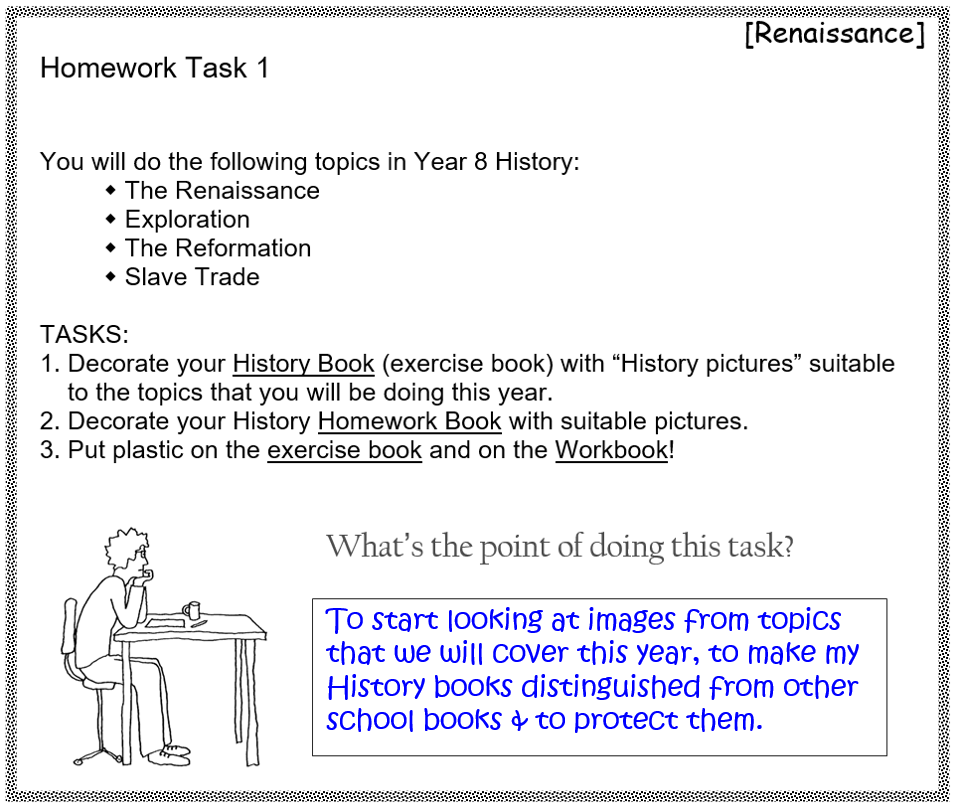
Get a plastic folder for History!
Search for Google Images of the topics, but make sure that you choose pictures from the right periods of History!
(WordPress advertisements may appear below.)
Please take note of the following:
1.
You will get homework regularly – it is usually a homework task set (and completed) in the History Homework Book.
2.
Homework is important as it benefits your learning in a number of ways.
3.
You are expected to give your best when doing homework!!
4.
The school’s homework policy encourages students to hand in homework on time. (If not, you will lose marks or even get zero!)
5.
For all homework tasks, always fill in the “due date” as well as the “what’s-the-point-box”! For example:
Good luck with your homework!
(WordPress advertisements may appear below.)
At the end of Year 10 you will write a mock GCSE exam in History!
WATCH THIS SPACE…
(WordPress advertisements may appear below.)
You will analyse exam questions and practise essay writing in preparation for the final IGCSE History examination!
WATCH THIS SPACE…
You will write a mock IGCSE History examination in January…
WATCH THIS SPACE…
(WordPress advertisements may appear below.)

You are going to practise some serious Essay Writing in Year 10 History!
WATCH THIS SPACE…
(WordPress advertisements may appear below.)
You will examine and analyse historical sources and answer source questions in preparation for the Paper 2 examination…
(WordPress advertisements may appear below.)
You will learn about the The work of the League of Nations in the 1920’s and 1930’s in the Year 11 History course!
WATCH THIS SPACE…
(WordPress advertisements may appear below.)
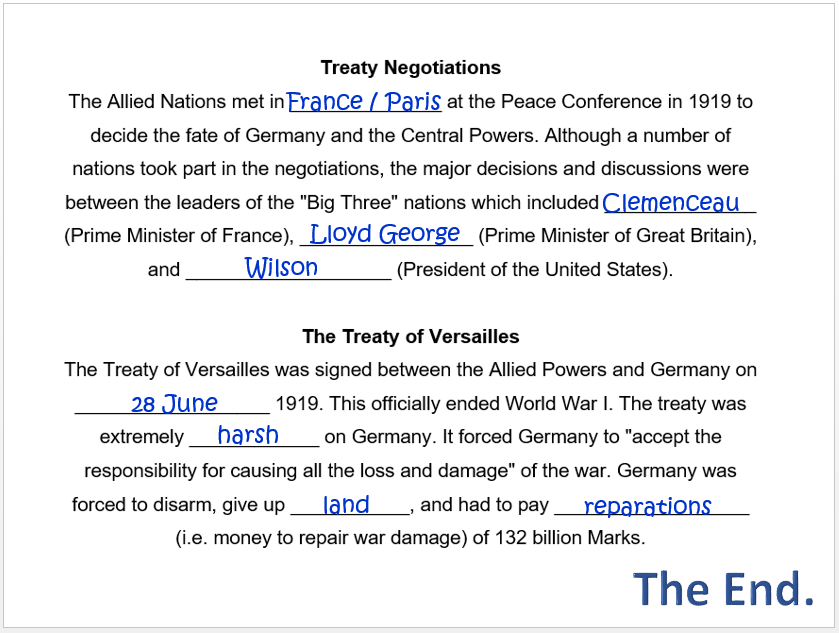
You will learn about the Post-war Peace Treaties in Year 10 History, with specific focus on the Treaty of Versailles!
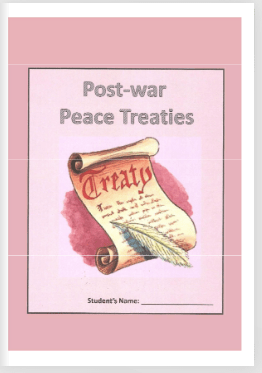

The B.Walsh Booklet

I

II
III
(WordPress advertisements may appear below.)
You will learn about the Stalin’s Reign of Terror in the Russian History!
WATCH THIS SPACE…
(WordPress advertisements may appear below.)
You will learn about the Lenin setting up the world’s first communists regime in the Russian History topic!
WATCH THIS SPACE…
(WordPress advertisements may appear below.)
You will learn about the The fall of the Romanov’s in the Russian History topic in Year 10!
WATCH THIS SPACE…
(WordPress advertisements may appear below.)
You will learn about the The events of the 1930’s that led to the outbreak of the Second World War in the Year 11 History course!
WATCH THIS SPACE…
(WordPress advertisements may appear below.)





 Best study methods