Today you are going to test your knowledge on how Queen Elizabeth I made England Protestant again…
Follow the instructions step by step:
1.
Test
Time!
First we are going to write a short test on “The Reformation in Europe”.
2.
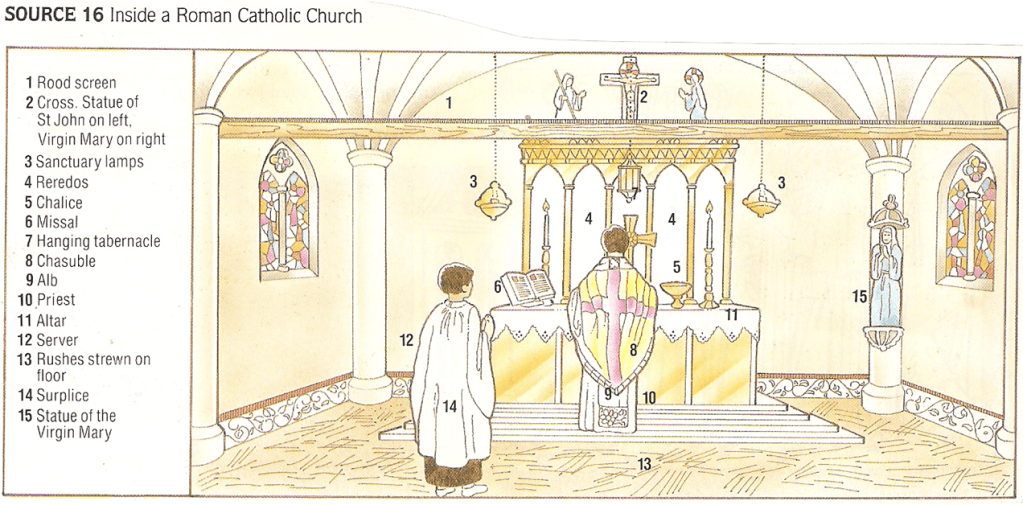
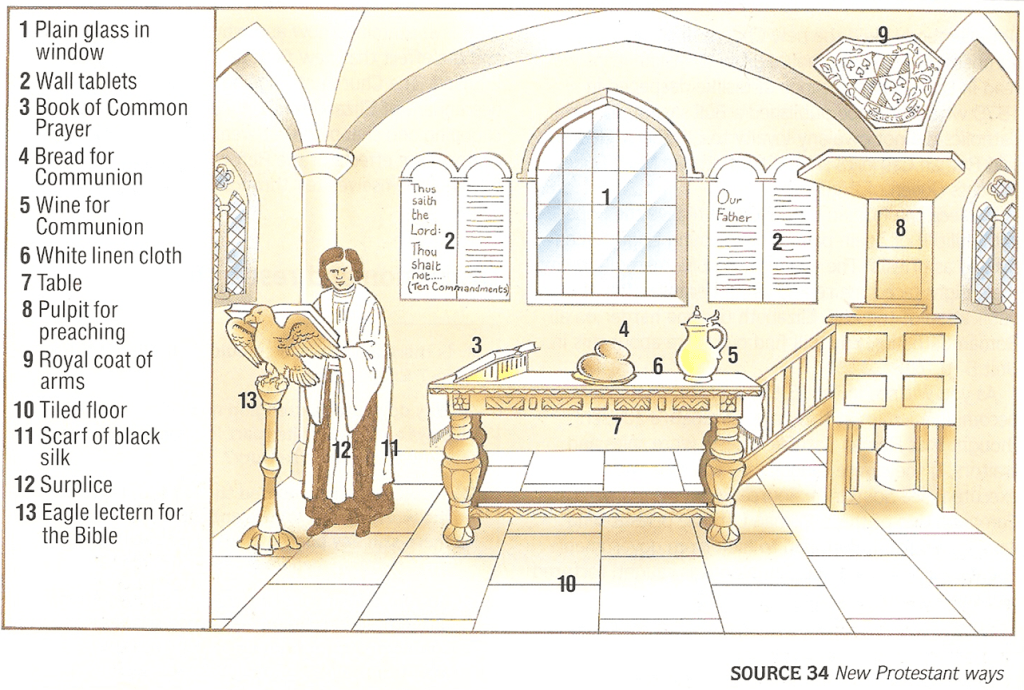
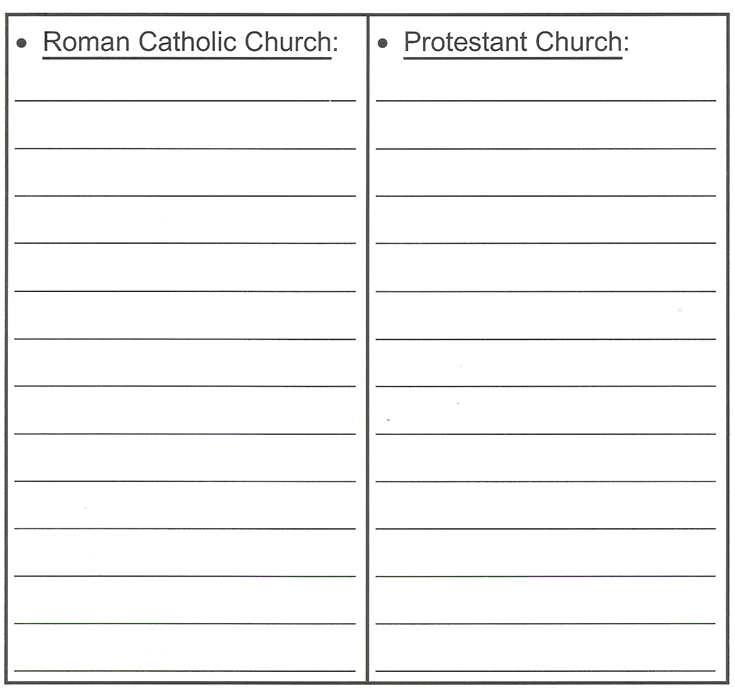
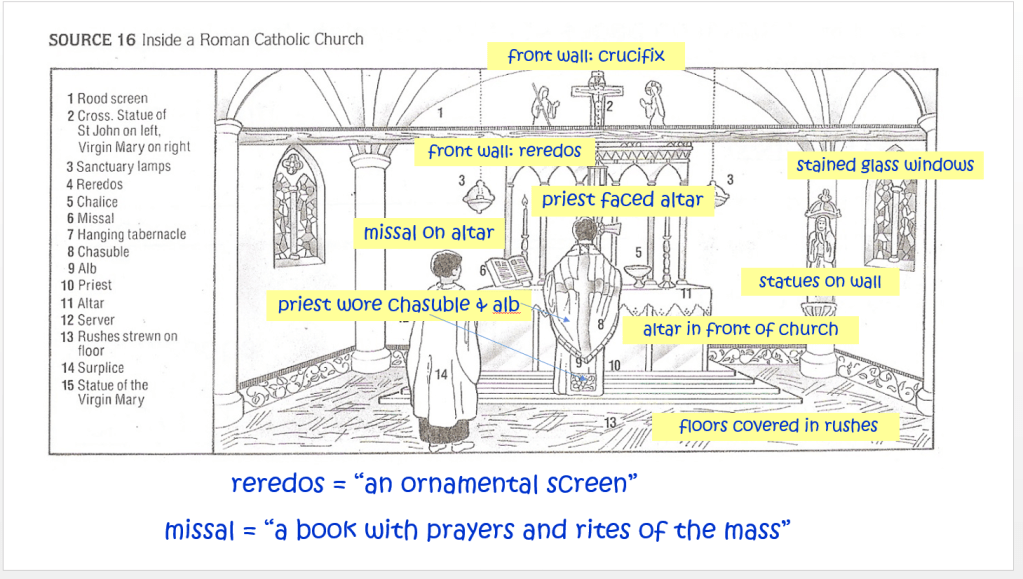
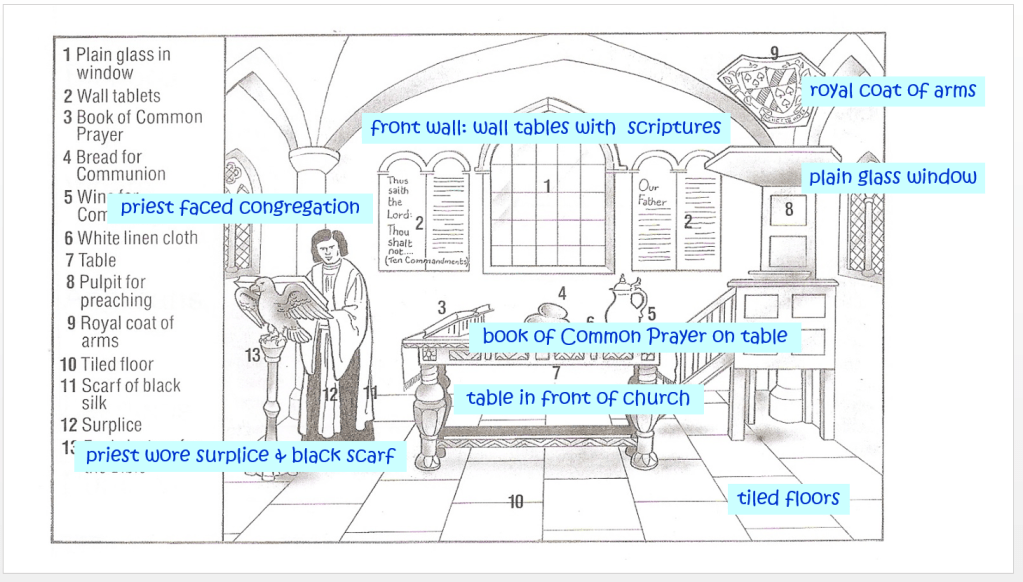
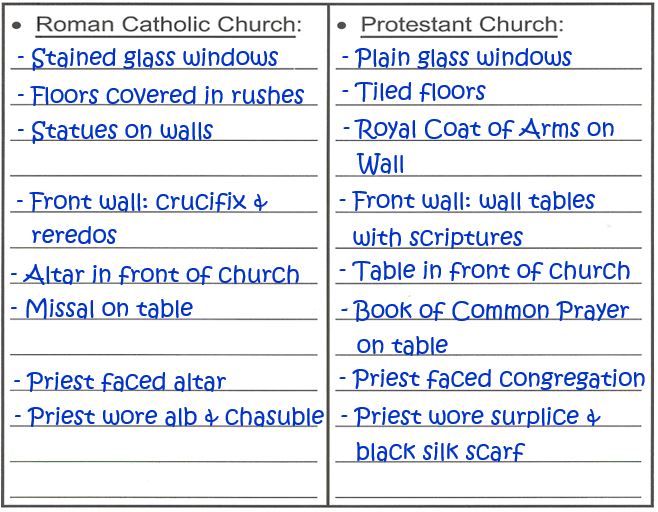
Carefully look at the differences made to the inside of the new Elizabethan Church. Then complete question 8 on page 62 by listing the differences between the interior of Elizabeth’s church and that of the Roman Catholic Church. (Use the table on p.62 for this task.)
Look at the images of the church interiors (below) to help you.
(This image is also on p.63 of your Workbook.)
(This image is also on p.63 of your Workbook.)
Use this table, on p.62!
HELP:
SOLUTION:
Reredos: “ornamental screen”
Missal: “book with prayers & rites of the mass”
3.
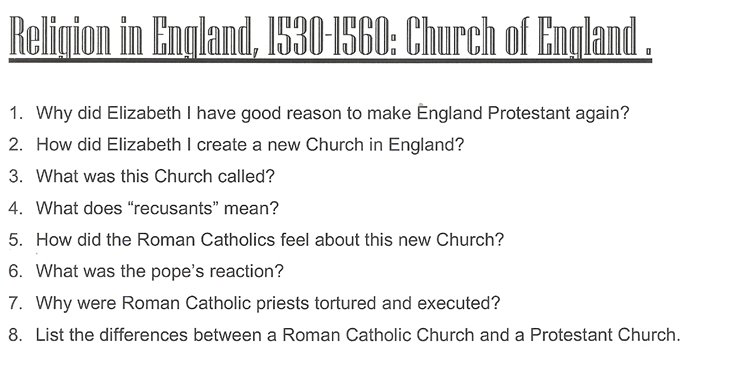
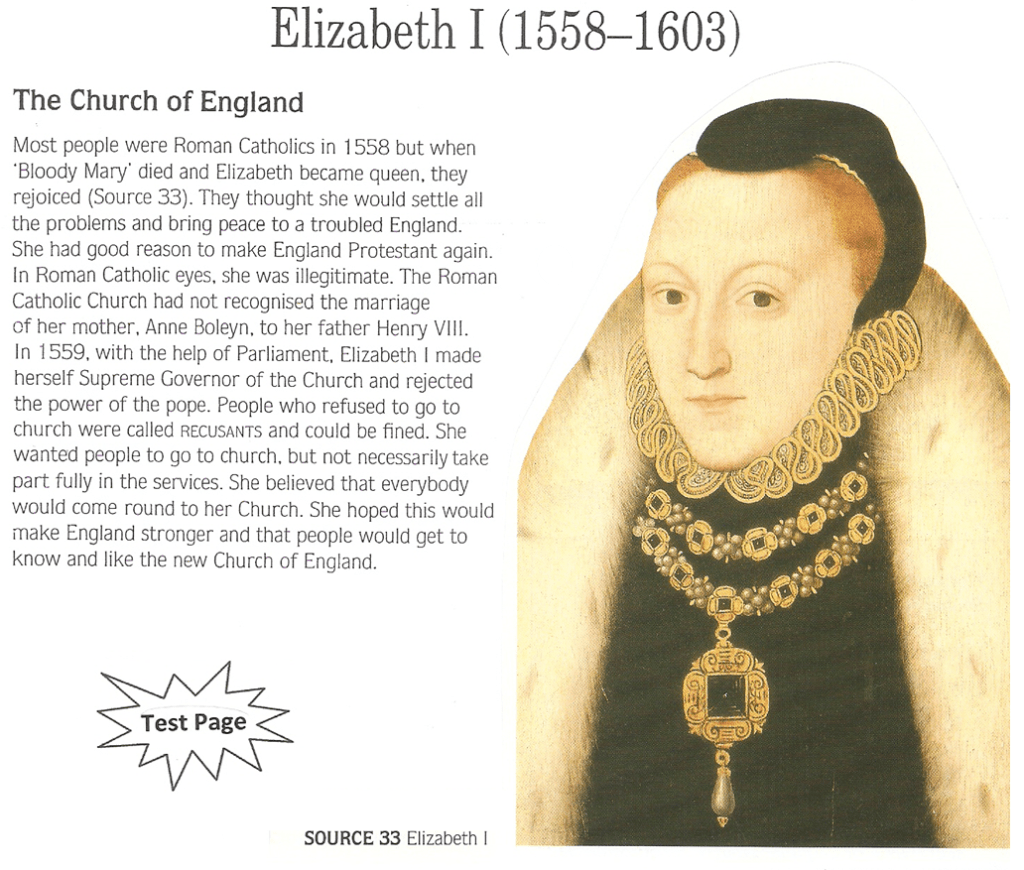
Now, let’s test your knowledge and understanding of the Reformation under Elizabeth I, by answering a few questions about the “Church of England”…
“Church of England, p.62”
4.
The information on “Elizabeth I (1558-1603)” (p.49) will help…
5.
The ElizabethanReligious settlement. (5:48 minutes long)
Elizabeth I (1533-1603) Queen of England. (3:59 minutes long)
Follow the order in which I give you instructions:
1.
Test
Time!
First we are going to write a short test on “Anglo-Saxons & Religion”.
2.
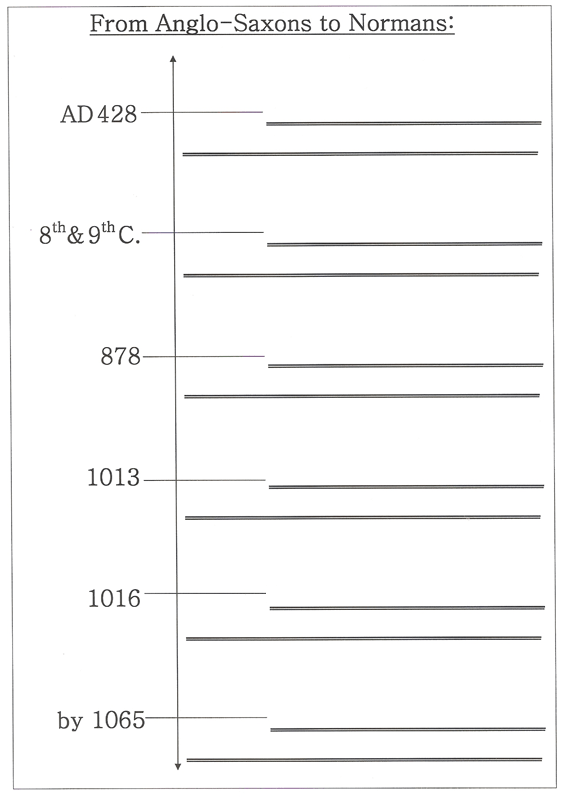
In the eleventh century the Anglo-Saxons’ influence in England declined and the Normans influence increased. Let’s look at a brief overview of how England become ruled by Normans…
From Anglo-Saxons to Normans. (3:31 minutes long)
3.
Fill in the missing words on the timeline “From Anglo-Saxons to Normans”, p.61.
4.
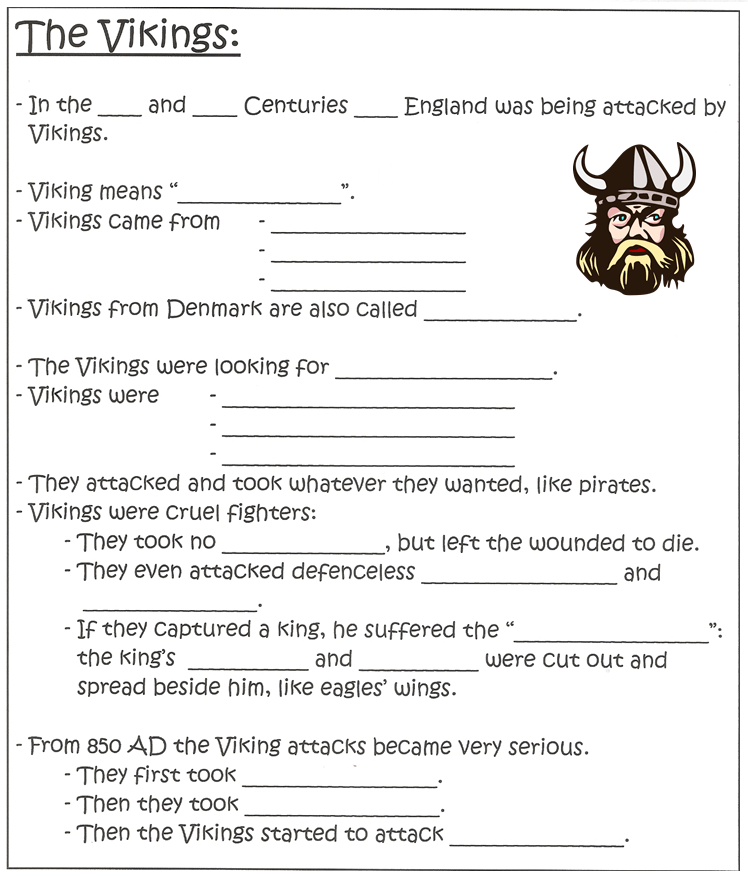
Now, let’s go back to the 8th and 9th Centuries AD and look at the Vikings…
The Vikings – an introduction. (1:46 minutes long)
5.
Fill in the missing words on the notes on “The Vikings”, p.62.
6.
Here are videos with additional information about the Vikings:
60-Second Histories: Vikings – Who Were the Vikings? (1:49 min long)
The Vikings – In a nutshell. (2:07 min long)
Vikings: ‘The Real Vikings’ – Who Were the Vikings? (2:30 min long)
Also watch this video clip about the Vikings – it is not for the faint-hearted, as it explains the Blood-Eagle (in quite gruesome terms…
What is a Blood Eagle. (1:33 min long)
7.
Use the rest of the lesson to make sure that your books are up to date…
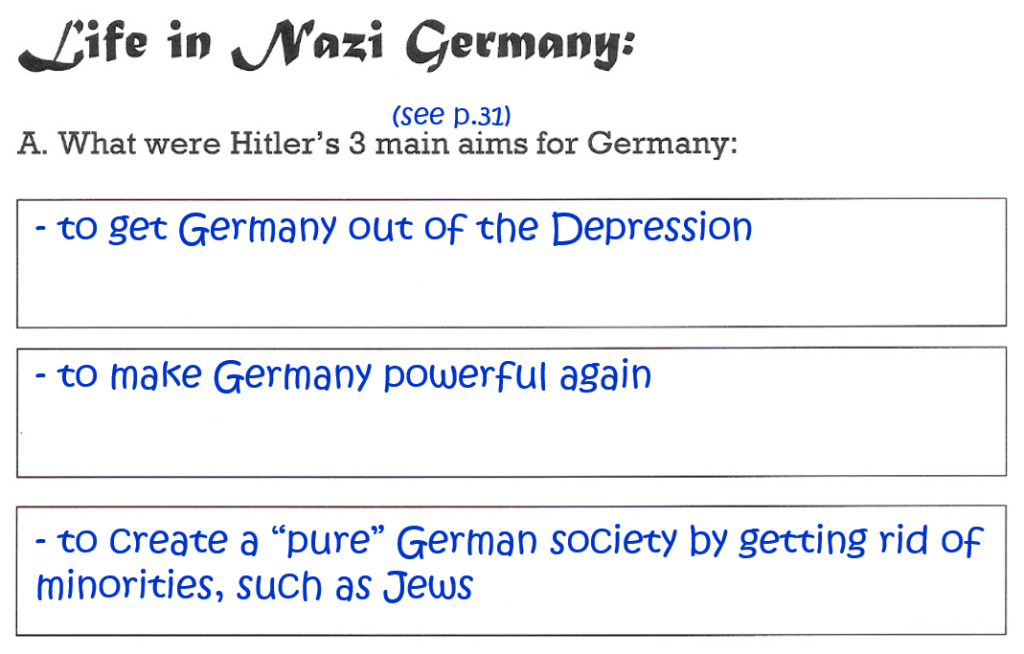
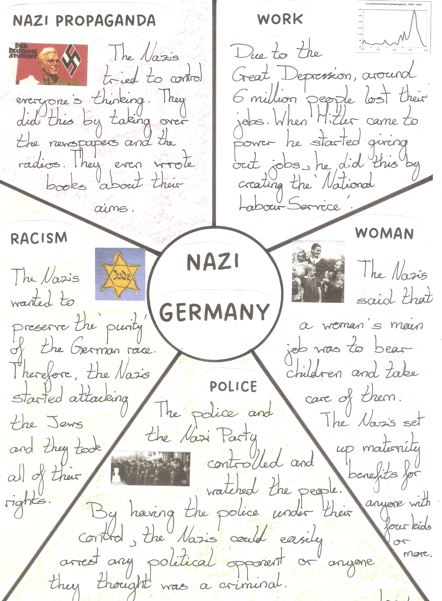
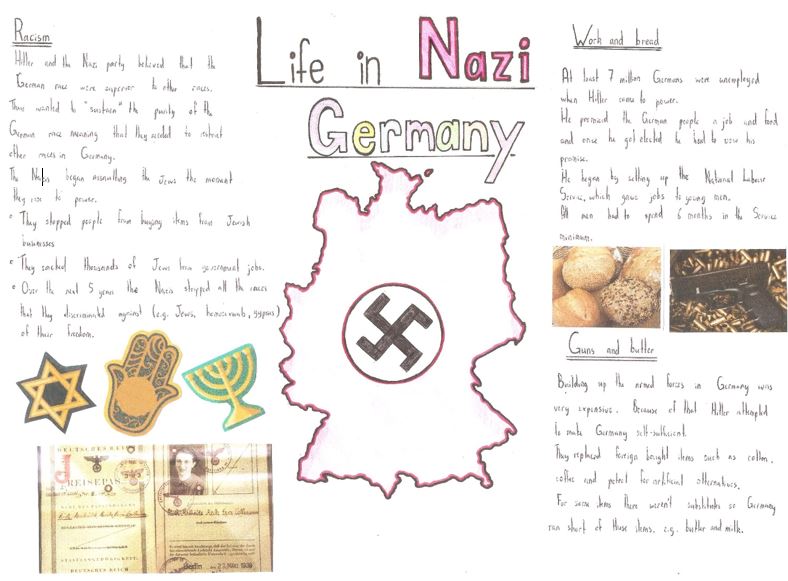
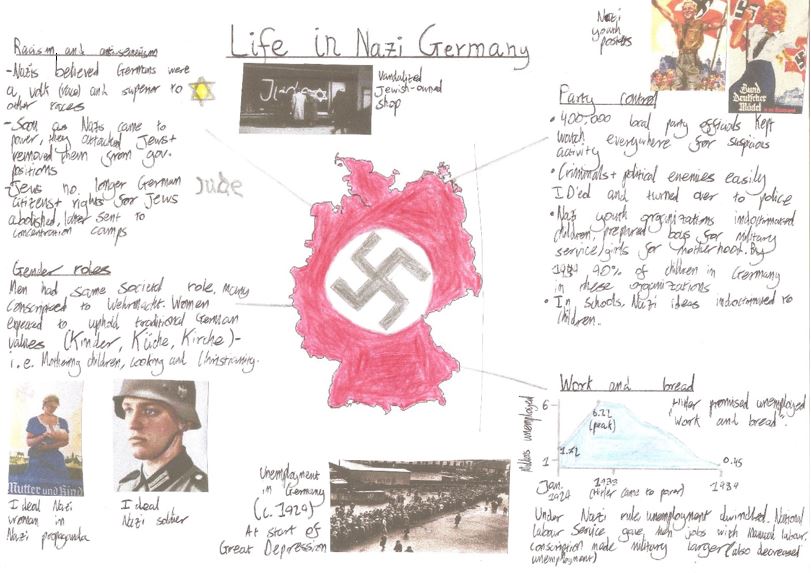
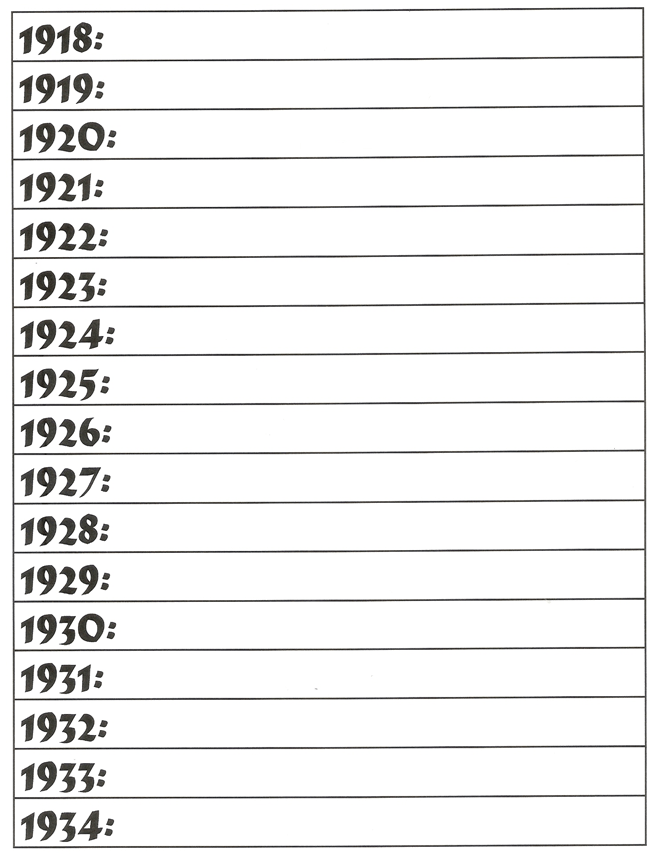
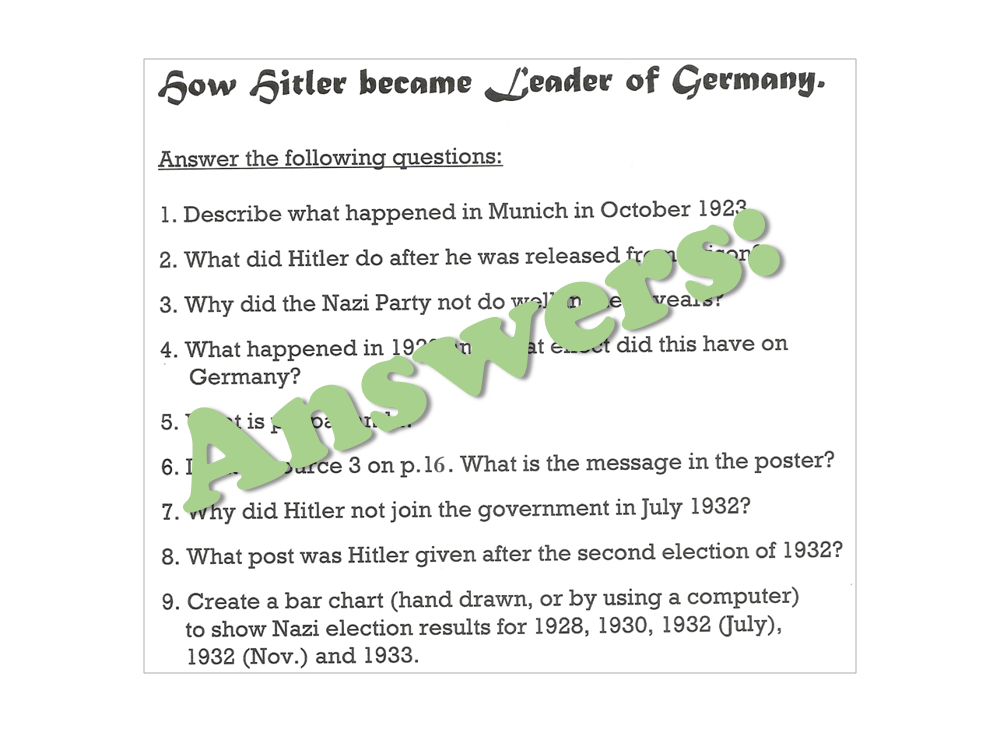
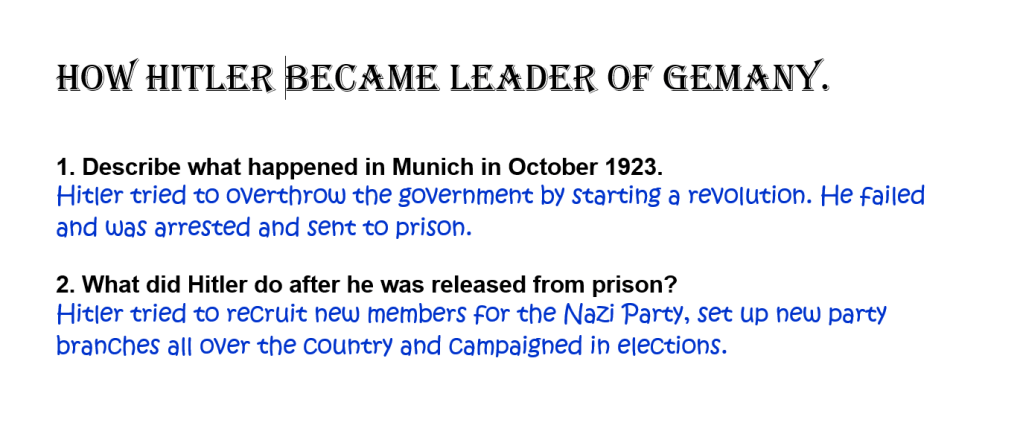
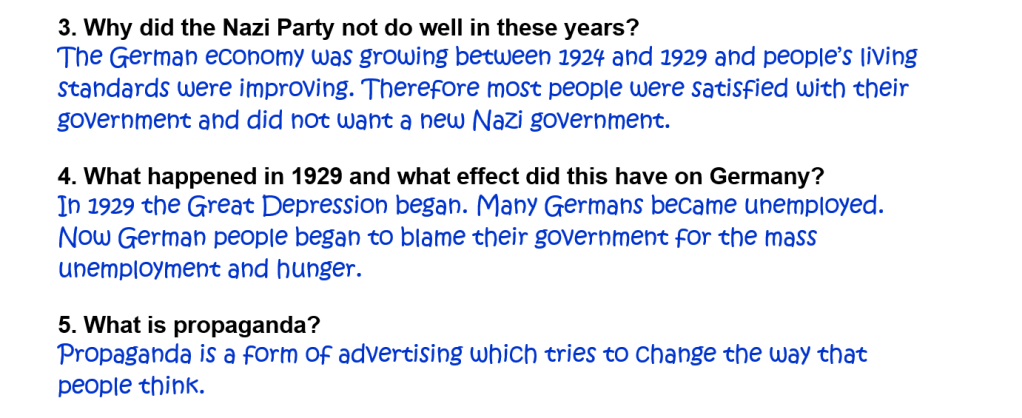
In the space provided on page 38, fill in Hitler’s aims for Germany.
SOLUTION:
3.
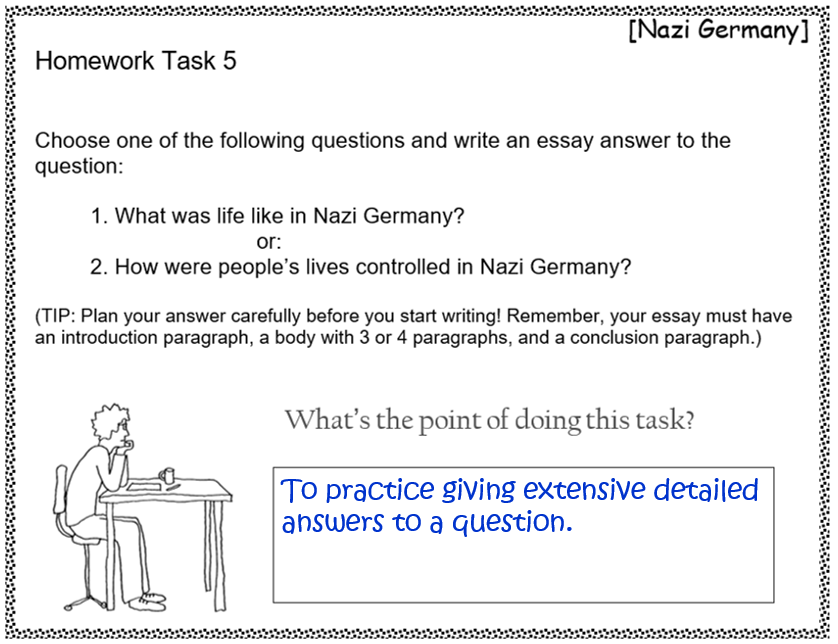
Now, do either the rest of this task on “Life in Nazi Germany” (p.38), OR do the Questions on “Hitler’s Germany”(p.37).
EITHER (p.38)
OR (p.37)
Answer the Questions on page p.37 in your Workbook.
“Hitler’s Germany, p.37”
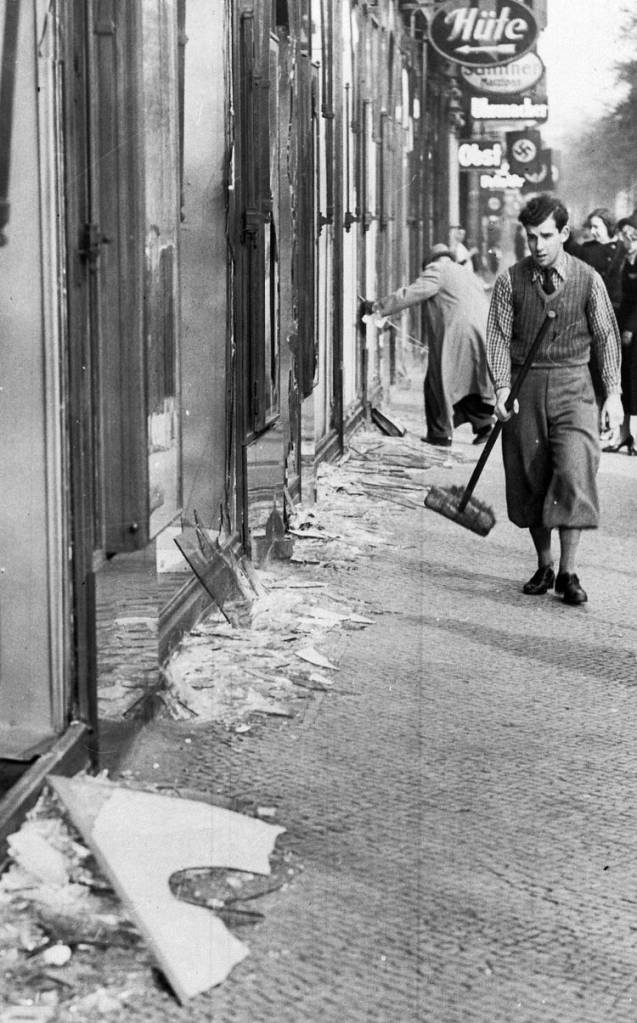
Crystal Night: When a Jew killed a Nazi in Paris, Hitler was furious and ordered an attack on the Jews in Germany. Jewish shops were destroyed, Synagogues were burnt down, Jewish homes were destroyed, and many Jews were arrested. This attack became known as “Crystal Night”, because of all the broken shop windows.
You can read more on “Crystal Night” on p.47, under the heading “Organised violence against Jews”. (Take note: the date in this paragraph should be 1938 and not 1958.)
The Glossaries on p.42 and on p.70-71 may be useful!
Finally, complete the “mood-o-metre” (on p.2) to show how you feel about the topic on “Nazi Germany” …!
5.
To finish off our topic on “Nazi Germany”, watch the complete History of Nazi Germany – from beginning to end, as explained in this great animated video.
The Weimar Republic and Nazi Germany. (9:59 min long)
Today we are going to look at what it was like to live in Nazi Germany.
Follow the instructions step by step:
1.
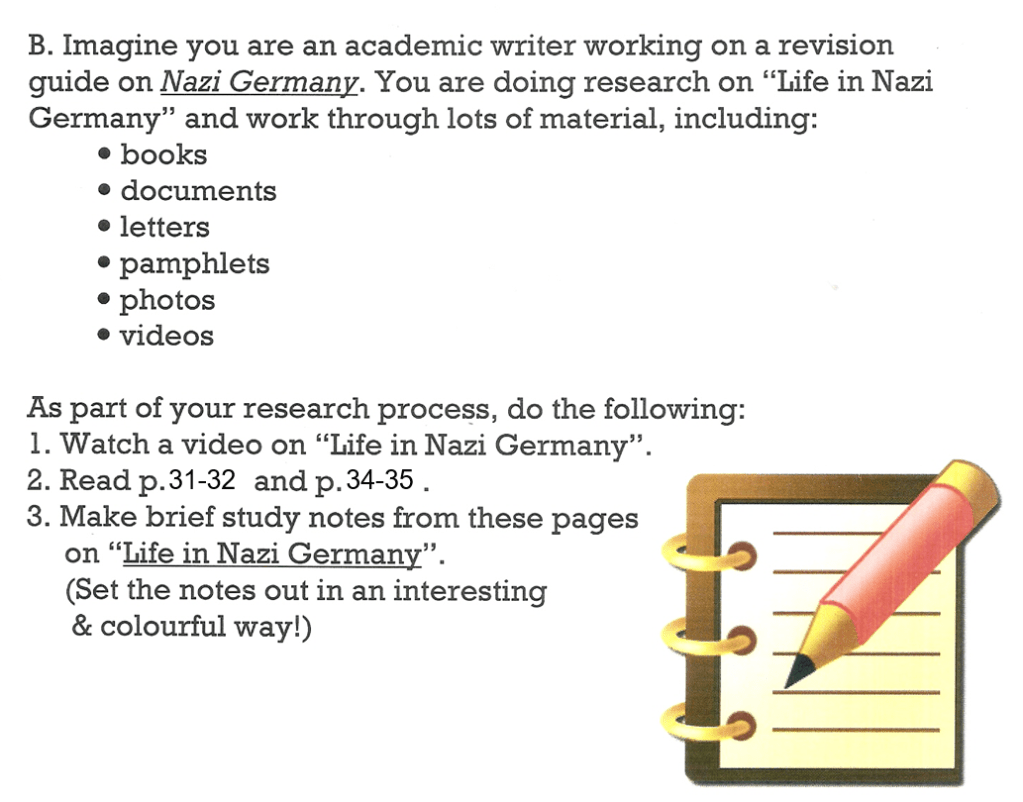
Watch the following animated video clip to learn more about Life in Nazi Germany:
Life in Nazi Germany. (8:32 min long)
2.
In order to discover further what it was like to live in Nazi Germany let’s see what your Workbook can tell you about life in Nazi Germany. (Underline important information as you read.)
Read p.31-32 and p.34-35
3.
Let’s revise what you have learnt about Nazi Germany so far…
How was life in Nazi Germany? (8:24 minutes long)
4.
The Nazis made extensive use of propaganda to ensure that the people are on their side. (They even had a Minister of Propaganda, Goebbels!) Watch the following video that explains two terms that you need to be familiar with in History…
Bias and Propaganda. (1:43 minutes long)
5.
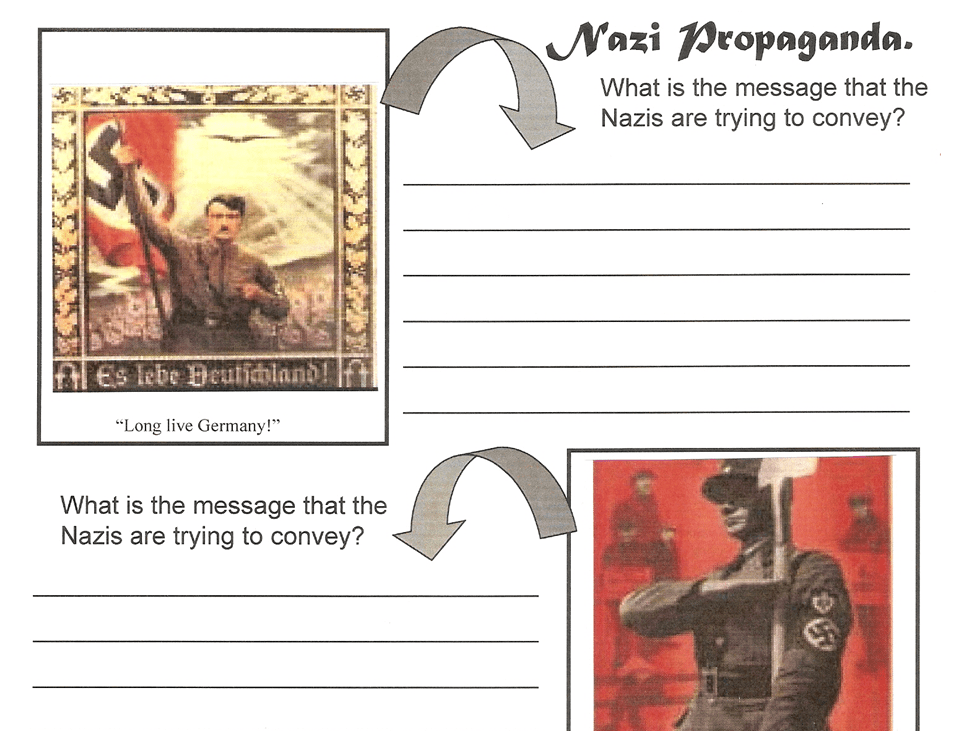
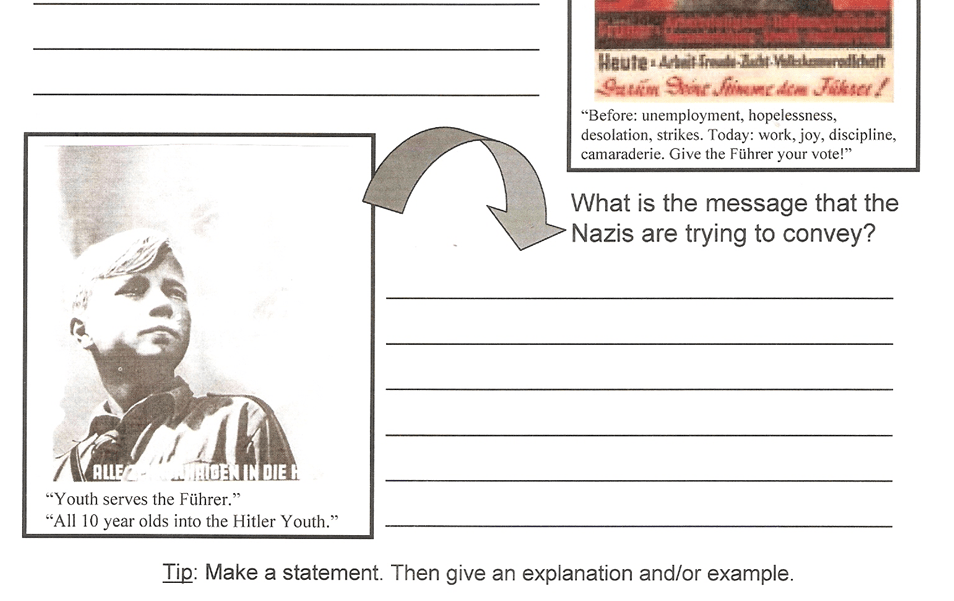
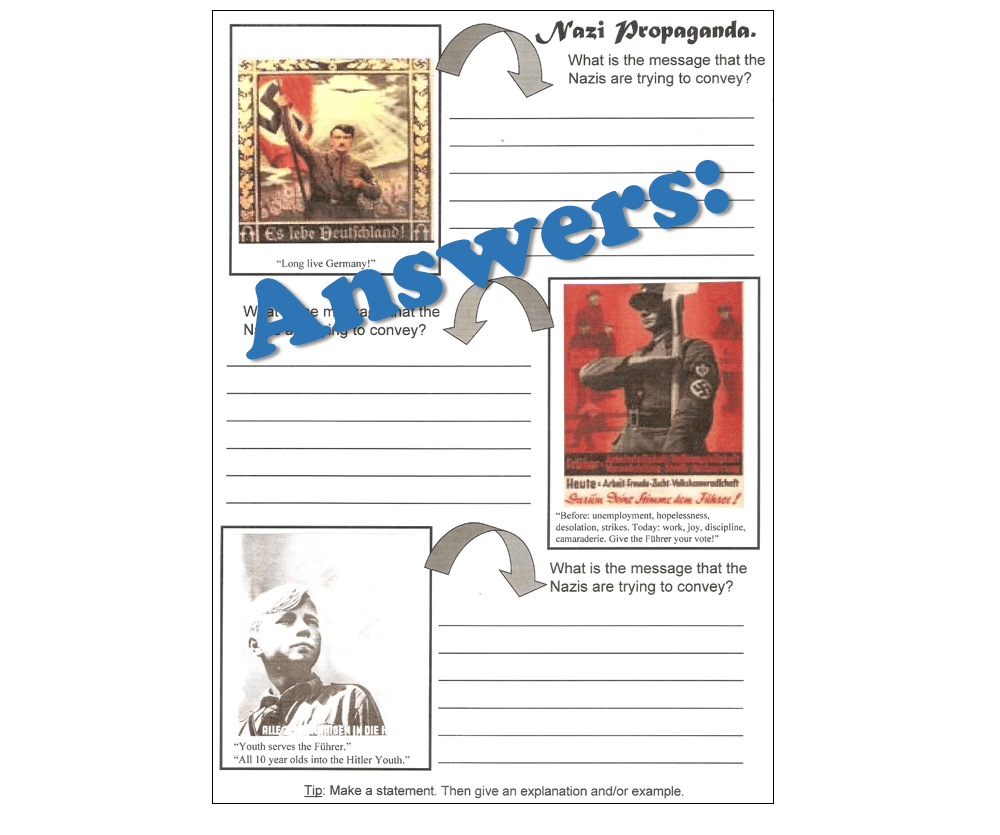
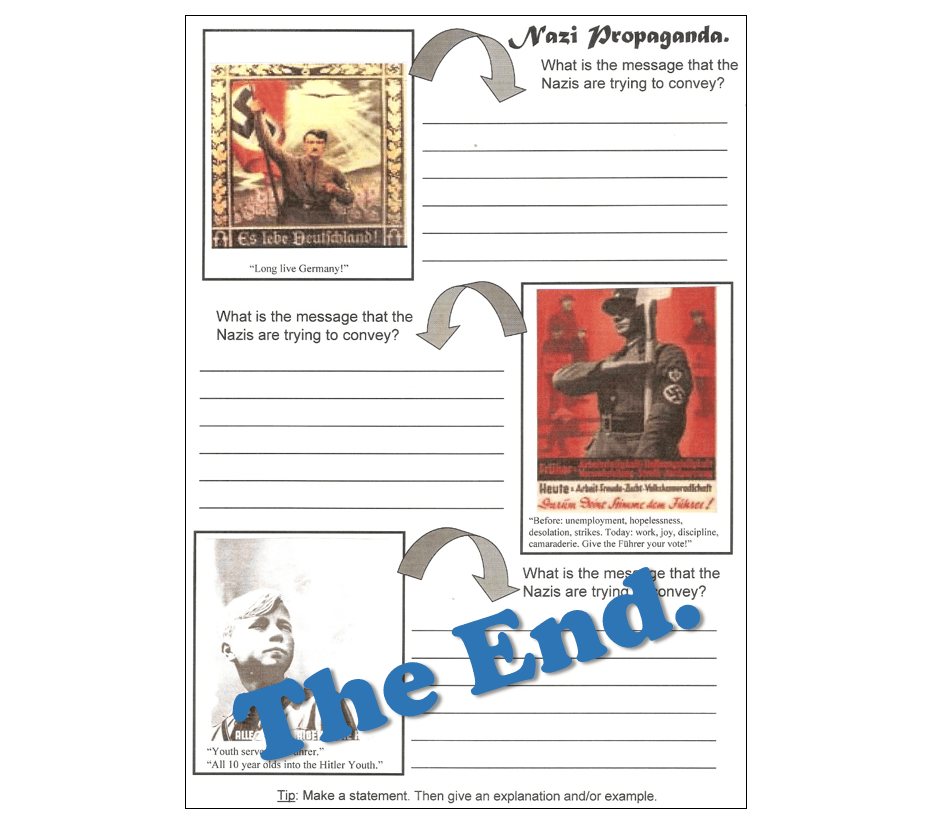
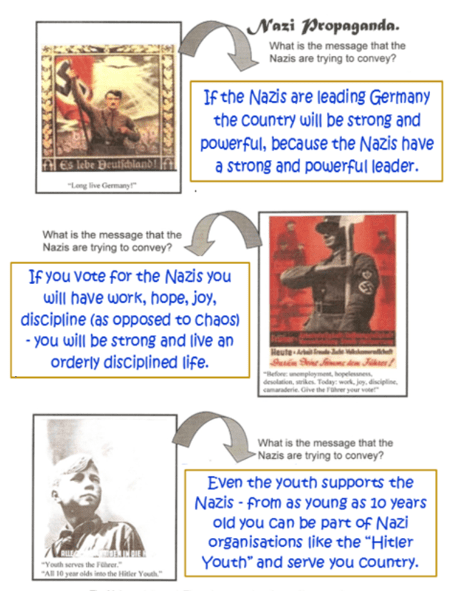
Fill in the Propaganda Task on p.36, in your Workbook.
Here are some clues:
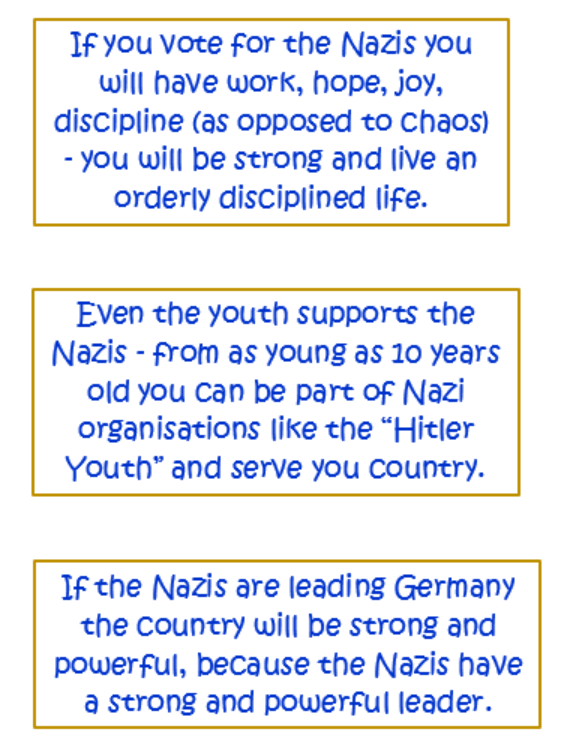
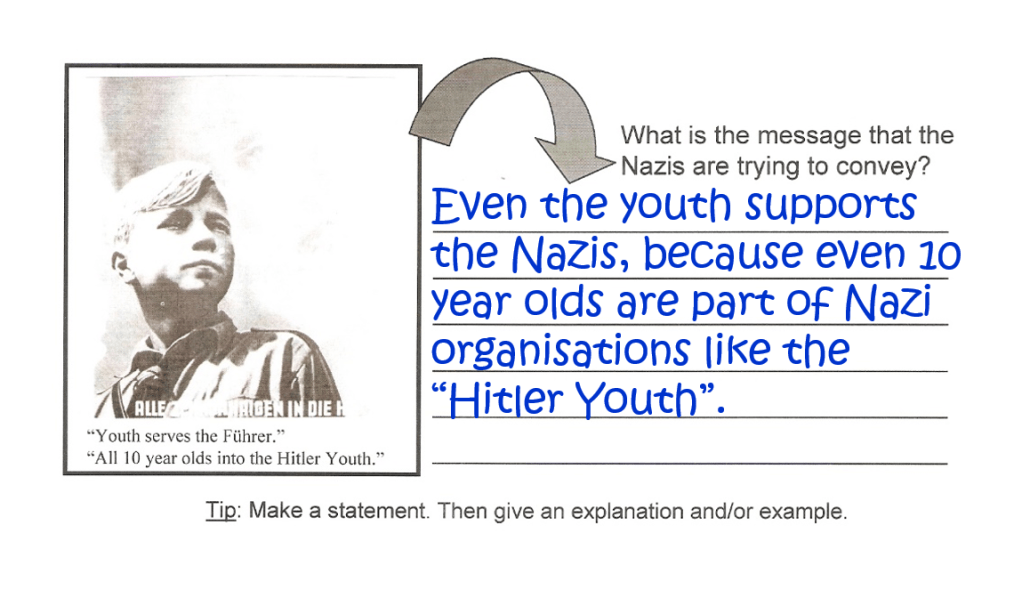
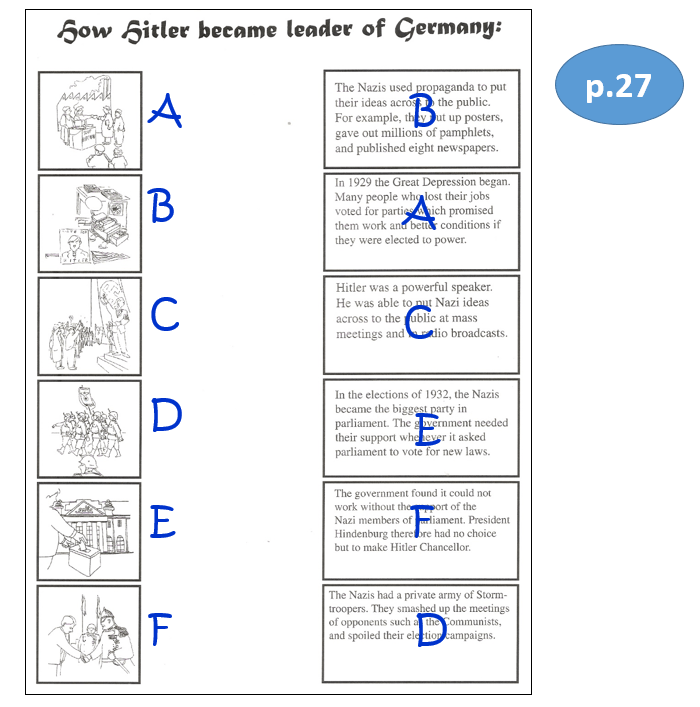
Below are the answers, but you need to match them to the correct propaganda poster, by choosing the statement that best explains each of the propaganda posters’ messages. (Write the statement in the space provided on p.36 in your Workbook!)
SOLUTION:
6.
Time provided, let’s test your knowledge and understanding of “Life in Nazi Germany”. Answer the Questions on page p.33 in your Workbook.
Today you are going to learn how Queen Elizabeth I made England Protestant again…
Follow the instructions step by step:
1.
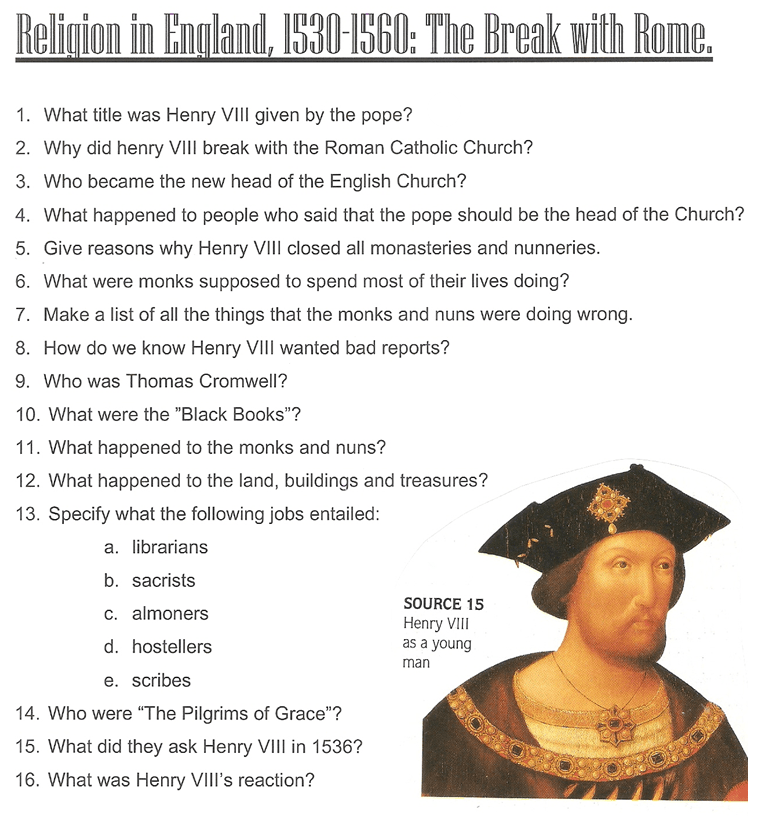
Mark the questions on “The Break with Rome, p.56”.
(You need to swipe the slides to the left to navigate through the answers.)
2.
Let’s see what we can learn about Elizabeth, the youngest daughter of King Henry VIII…
On This Day: 15 January 1559 The Coronation of Elizabeth I. (2:52 minutes long)
2.
Elizabeth I’s reign was complicated by religious matters! It even posed a threat to her position as Queen of England, despite her efforts to please both Protestants and Catholics… Watch the video below to see why.
Elizabethan Religious Settlement. (3:49 minutes long)
3.
“Elizabeth I (1558-1603)”, p.49
4.
Elizabeth was advised to authorize the execution of Mary Queen of Scots in order to secure her reign. It appears that Elizabeth was plagued by her decision to have Mary Queen of Scots executed for the rest of her life…
FULL: Mary Queen of Scott’s Execution Scene. (3:09 minutes long)
5.
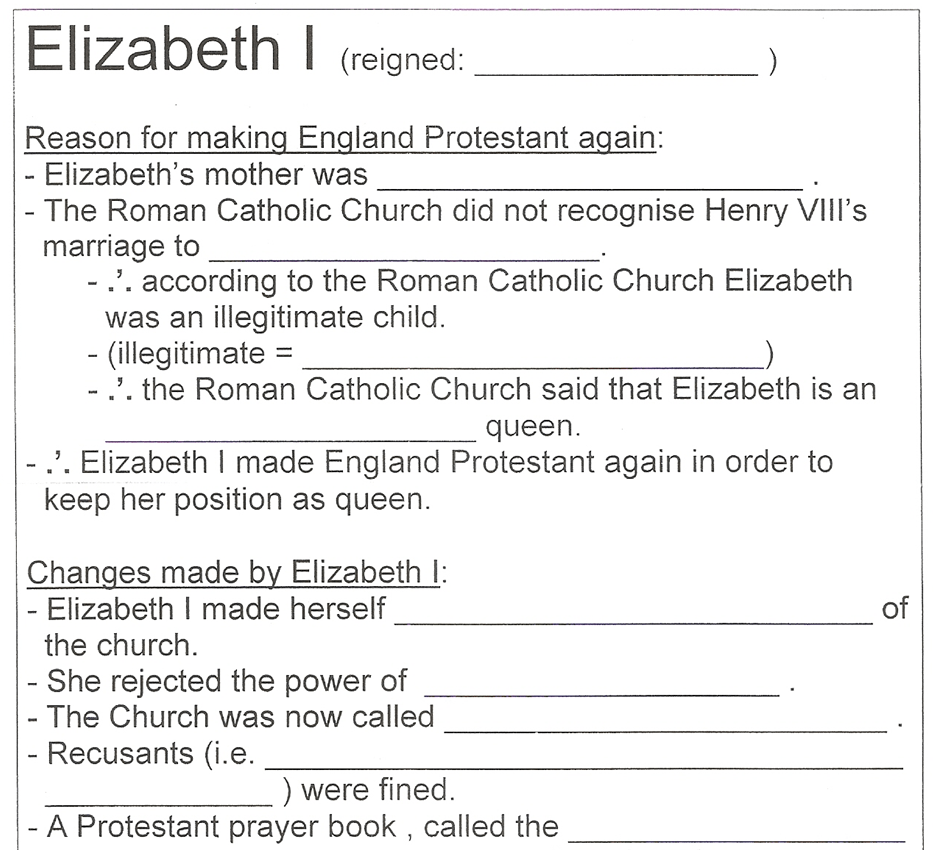
Fill in the missing information on the notes on Elizabeth I (p.55).
6.
Mark your fill-in notes on Elizabeth I:
&
(2:11 minutes long)
7.
In an attempt to secure her position and at the same time please her subjects, Elizabeth I passed the Act of Supremacy and the Act of Uniformity. Together they are known as the Elizabethan Religious Settlement. Passing these laws was a difficult decision for Elizabeth…
Elizabethan Act of Uniformity. (3:00 minutes long)
8.
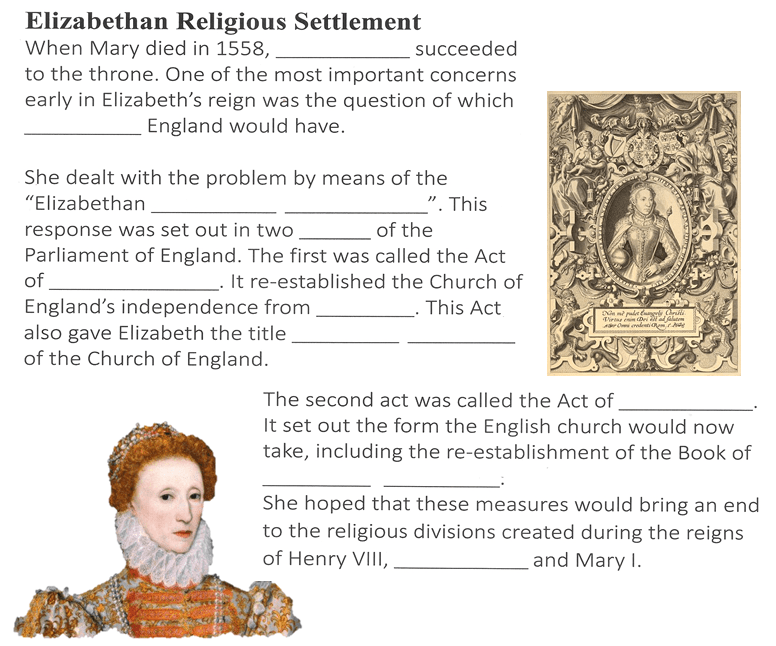
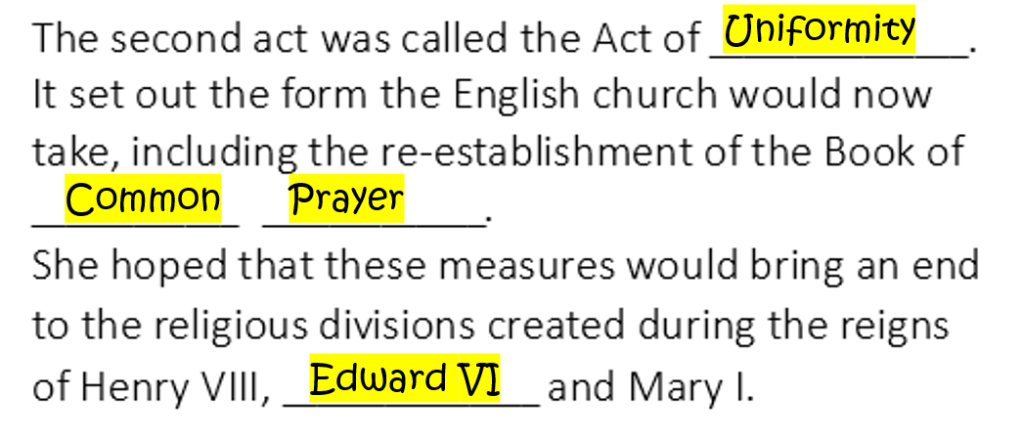
Fill in the missing information on the notes about the “Elizabethan Religious Settlement”, on p.60.
SOLUTION:
9.
The ElizabethanReligious settlement. (5:48 minutes long)
Today you are going to discover that the Church played an increasingly important role in Anglo-Saxon times.
Follow the instructions step by step:
1.
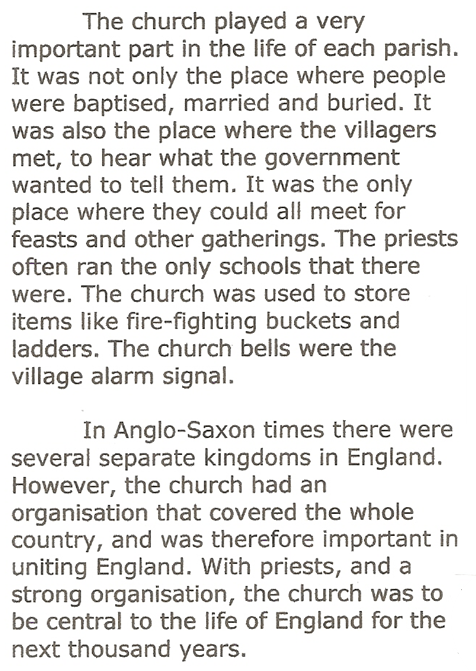
The video below explains how important the Roman Catholic Church was in life during Anglo-Saxon times (and after) – it played a rather important role in society…
The important of the Church. (2:27 minutes long)
2.
Let’s see what your Workbook can tell you about the importance of the Church…
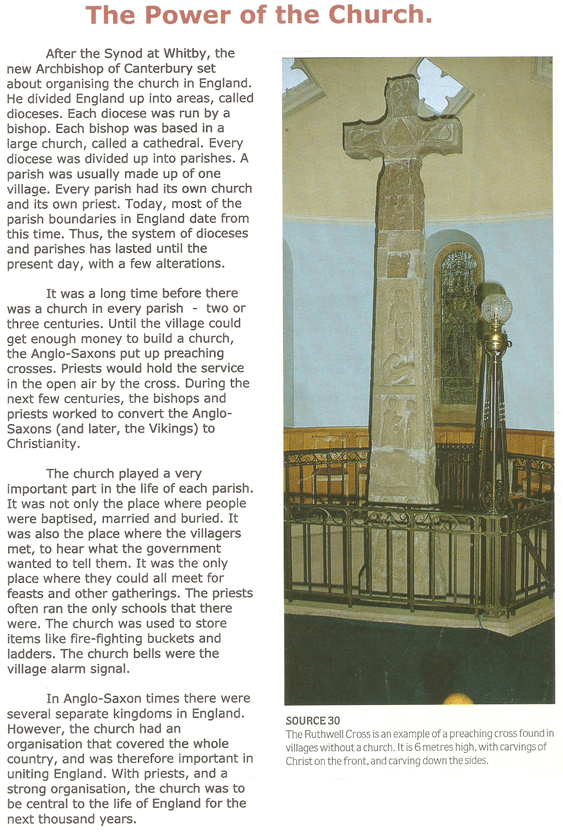
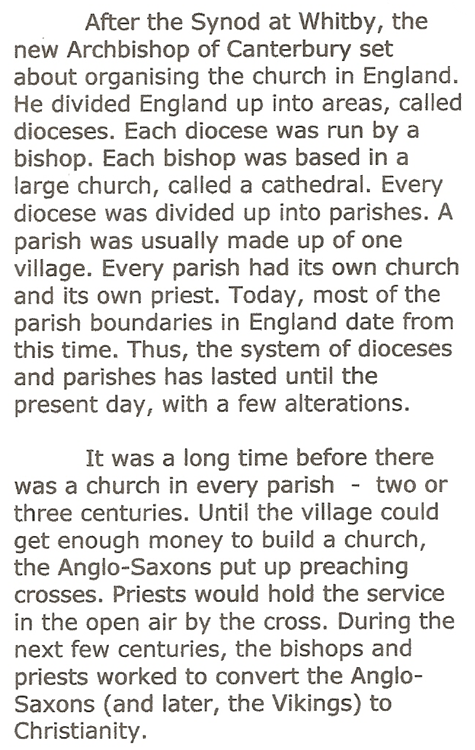
“The Power of the Church”.
(the first column on p.59)
3.
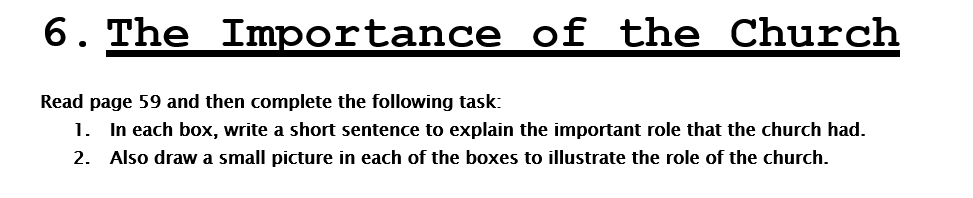
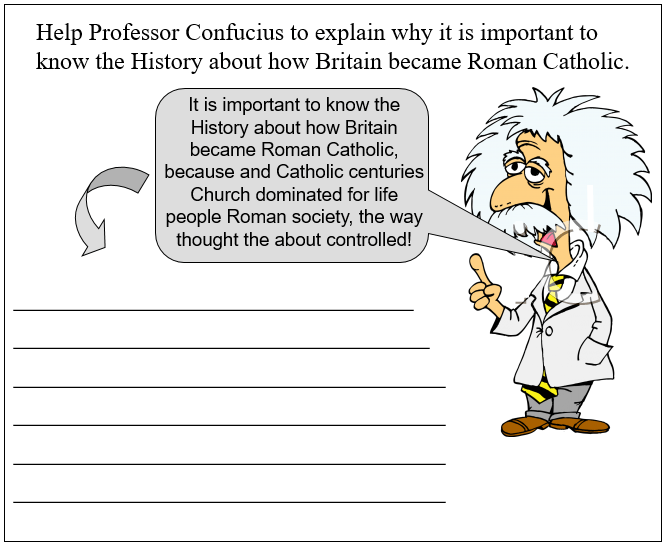
Complete the worksheet (provided) to show the important role that the Church played in Anglo-Saxon Britain and after…
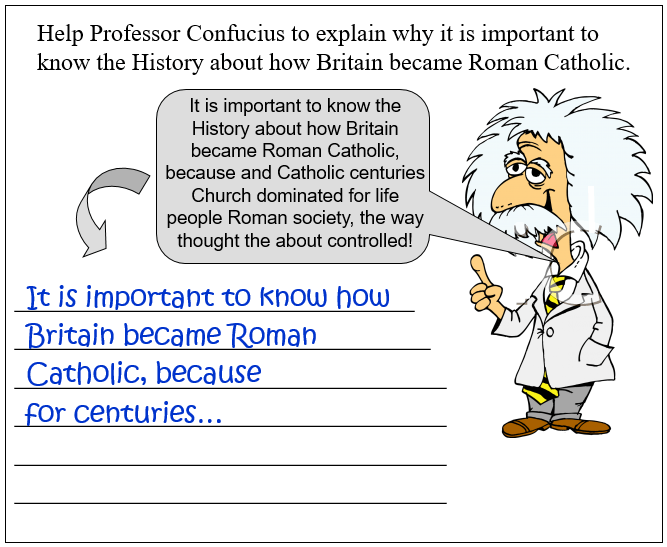
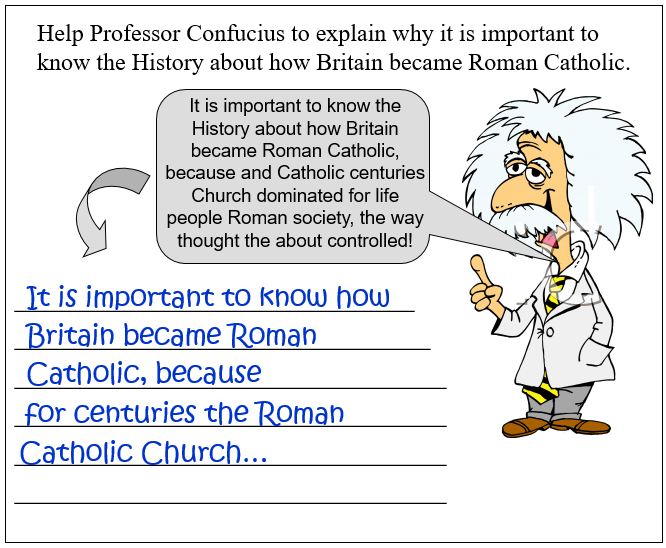
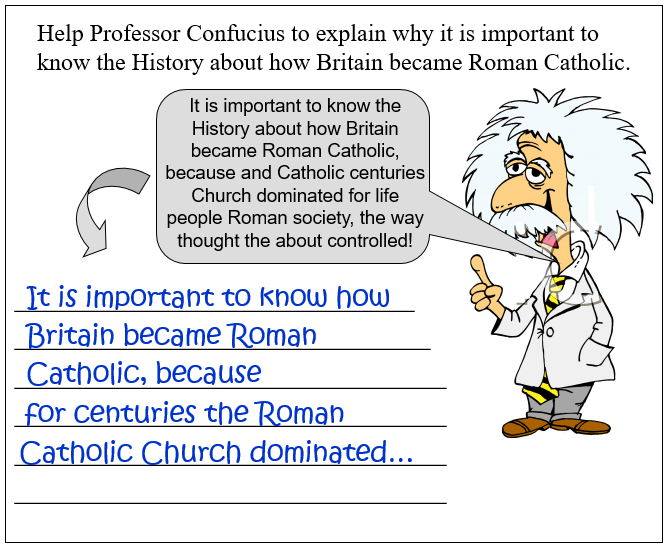
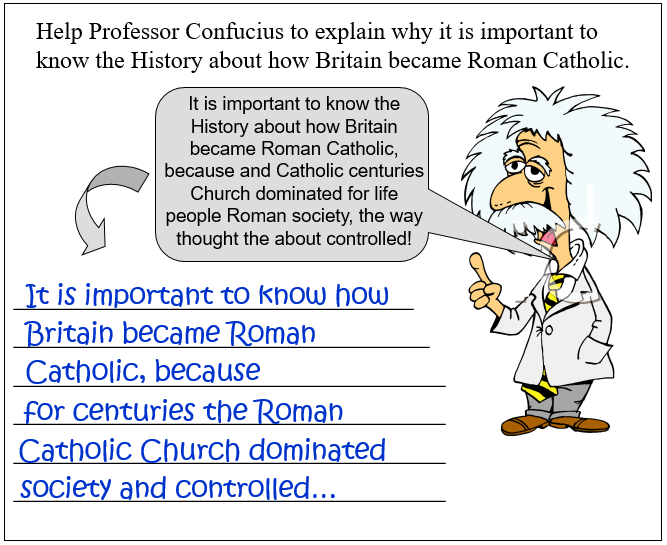
If not completed previously: Complete the task on p.59 to show why it is important to know the history about how Britain become a Roman Catholic country…
p.59
SOLUTION:
5.
Finally, complete the “mood-o-metre” (on p.37) to show how you feel about the topic on “The Anglo-Saxons” …!
Let’s investigate the option of taking GCSE History in Years 10 & 11… Below are three short video clips that give you information about GCSE History. Watch all 3 clips, even if you have already decided which subjects you will take next year.
In this video you will see How GCSE History can benefit you and also what the GCSE History course is about.
GCSE History. (1:58 minutes long)
Here is a short discussion, by Queen’s students, about the pro’s and con’s of taking GCSE History. (The voices have deliberately been “mickey-moused”…)
TAKE NOTE: Both positive and negative aspects are discussed, to give a balanced view on taking GCSE History…
What students say about GCSE History… (2:55 minutes long)
And finally… one last video to help you make up your mind. You do not want to miss this video clip!!
(PS: I have the Geography teacher’s permission to show you this video…)
Doing GCSE History. (4:10 minutes long)
The topics for History next year are:
1) Russia, 1905-1941 (We will look at Tsarist Russia, Lenin’s Russia, and Stalin’s Russia.)
2) Post-war Peace Treaties (We will mainly focus on the Treaty of Versailles and its impact)
The topics for Year 11 are:
1) The League of Nations (We will look at what the League did in the 1920’s and in the 1930’s.)
2)The Road to War (We will look at all the things that Germany did in the 1930’s that eventually led to WW2.)
2.
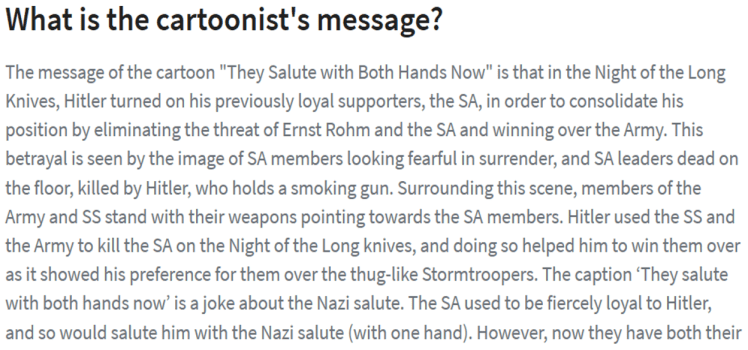
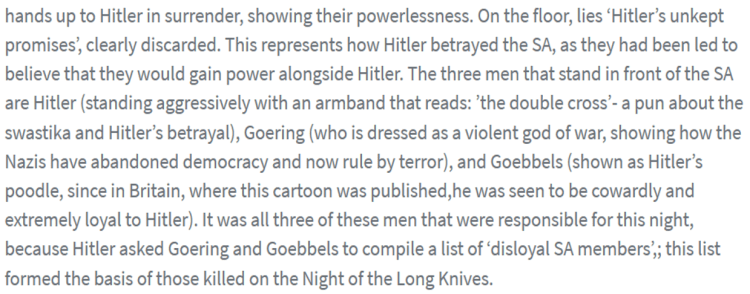
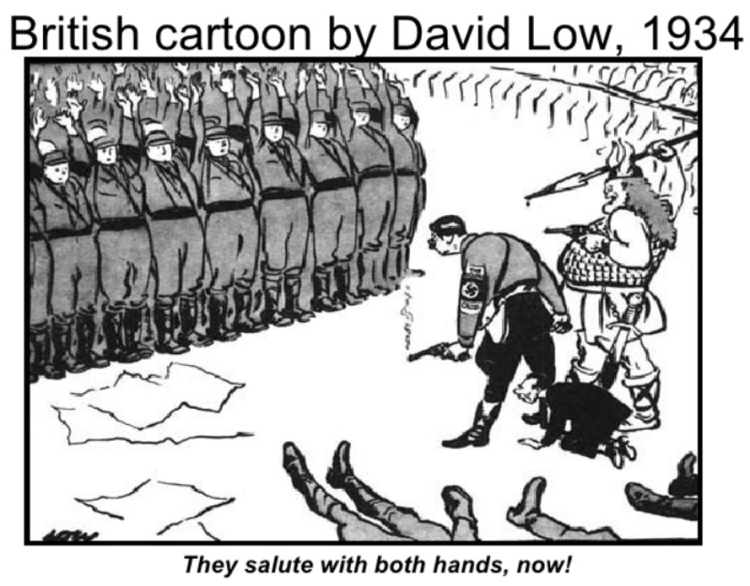
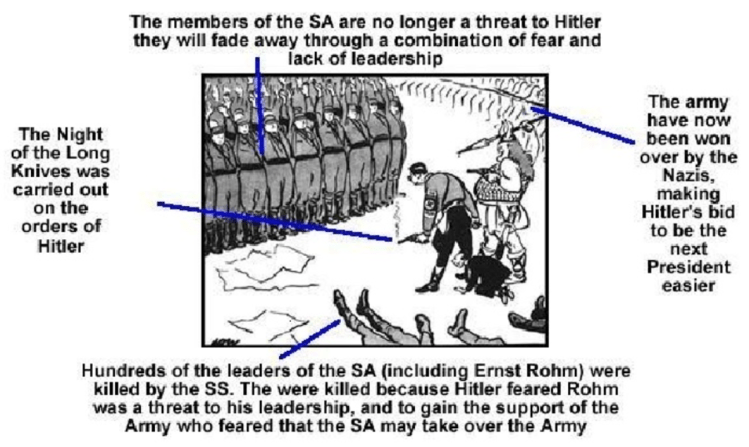
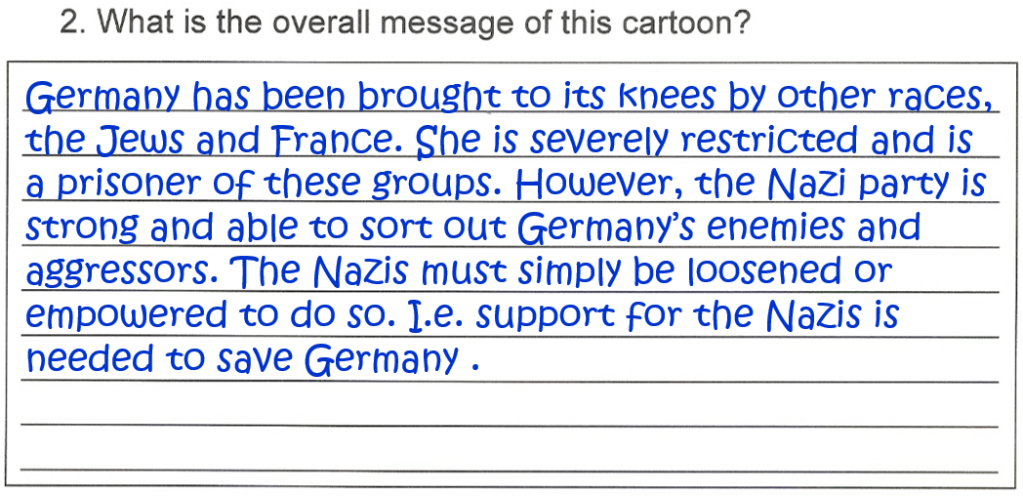
Before we start with the revision, look at the feedback for the cartoon analysis task that you completed recently. Below is a possible response to the question about the overall message of the cartoon on p.13:
Complete the tasks on Henry VIII’s break with Rome…
Follow the instructions step by step:
1.
Henry VIII died on 28 January 1547.
His son, Edward, succeeded him as king.
On This Day: 28 January 1547 Death of Henry VIII. (2:58 minutes long)
2.
Here is a short biography of Edward VI…
Edward VI – 60 Second History. (0:59 minutes long)
3.
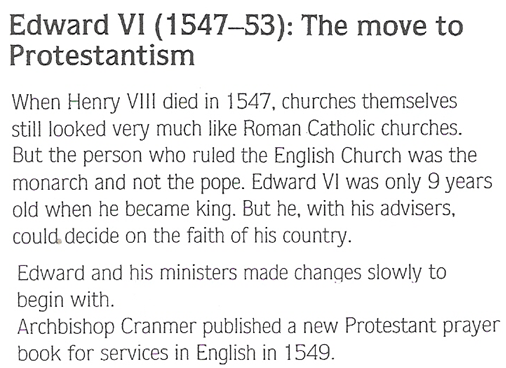
Edward VI…p.48
4.
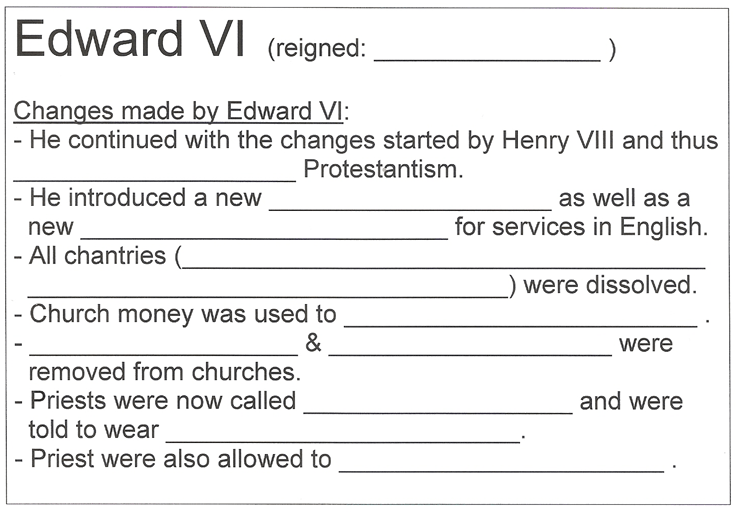
Fill in the missing information on the notes on Edward VI (p.53).
5.
Mark your fill-in notes on Edward VI:
&
(1:04 minutes long)
6.
The story of Lady Jane Grey is interesting… She never wanted to be queen in the first place! The following videos tell you a little more about Edward VI and also about Lady Jane Grey.
How Lady Jane Gray became Queen. (1:42 minutes long)
King Edward VI (1537-1553). (2:53 minutes long)
Story of Lady Jane Grey | Terrible Tudors | Horrible Histories. (2:48 minutes long)
7.
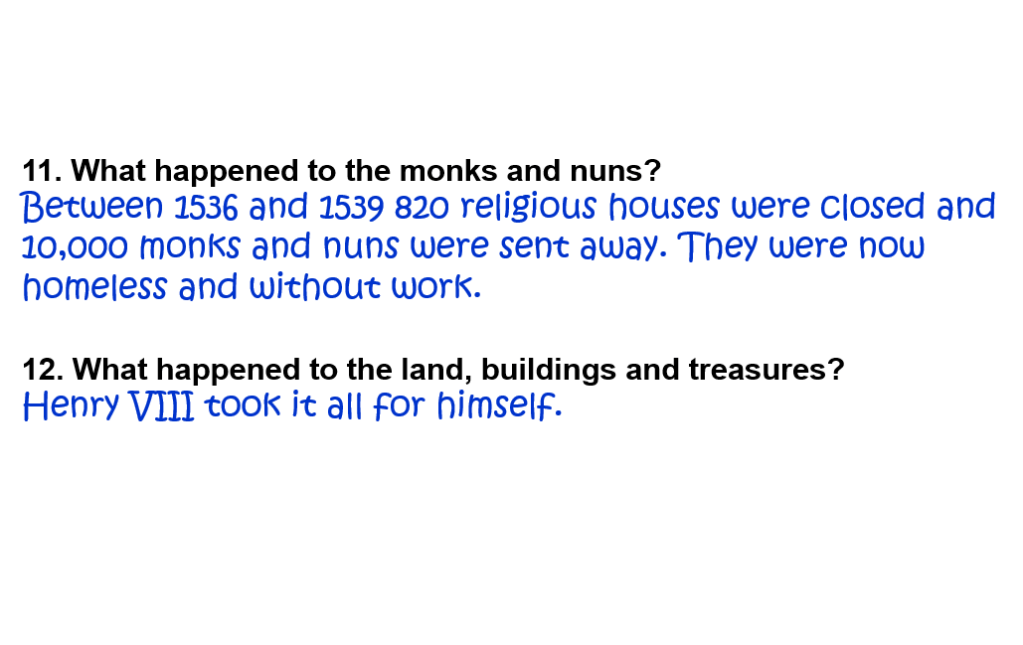
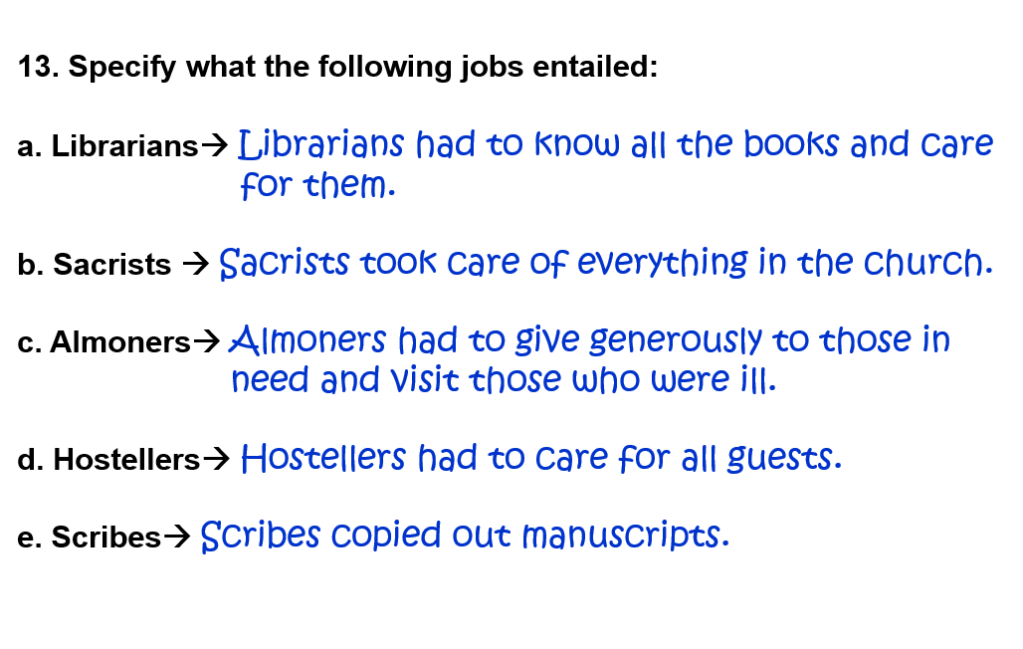
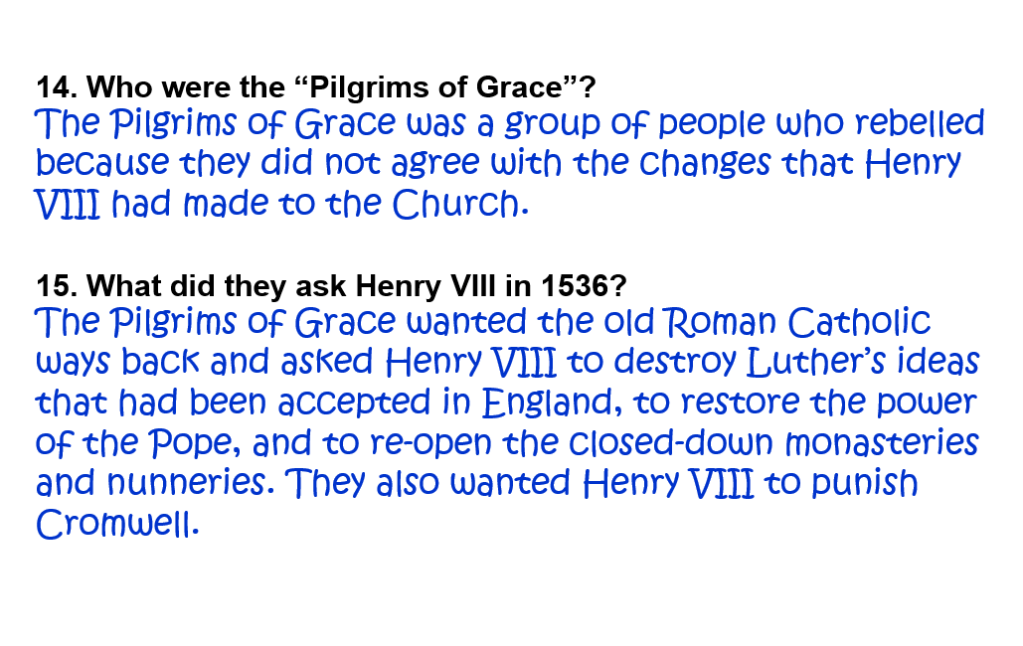
Finally, if not completed yet, finish the questions on “The Break with Rome”.
“The Break with Rome, p.56”
Please take note:
You may choose to complete:
EITHER: Questions 1-8
(Take Note: Q-5 and Q-6 need longer answers!!)
OR: Questions 9-14
(Take Note: Q-13 has sub-questions & Question 15 needs a longer answer!!)
Read the questions carefully before you decide which ones to do.
Let’s investigate the option of taking GCSE History in Years 10 & 11… Below are three short video clips that give you information about GCSE History. Watch all 3 clips, even if you have already decided which subjects you will take next year.
In this video you will see How GCSE History can benefit you and also what the GCSE History course is about.
GCSE History. (1:58 minutes long)
Here is a short discussion, by Queen’s students, about the pro’s and con’s of taking GCSE History. (The voices have deliberately been “mickey-moused”…)
TAKE NOTE: Both positive and negative aspects are discussed, to give a balanced view on taking GCSE History…
What students say about GCSE History… (2:55 minutes long)
And finally… one last video to help you make up your mind. You do not want to miss this video clip!!
(PS: I have the Geography teacher’s permission to show you this video…)
Doing GCSE History. (4:10 minutes long)
2.
Before we start with the revision, look at the feedback for the cartoon analysis task that you completed recently. Below is a possible response to the question about the overall message of the cartoon on p.13:
3.
Let’s remind ourselves how Hitler came to power – watch these video clips to revise Hitler’s rise to power…
How did Hitler rise to power? (5:36 minutes long)
The rise of Hitler. (2:04 minutes long)
The Rise of the Nazis. (3:30 minutes long)
4.
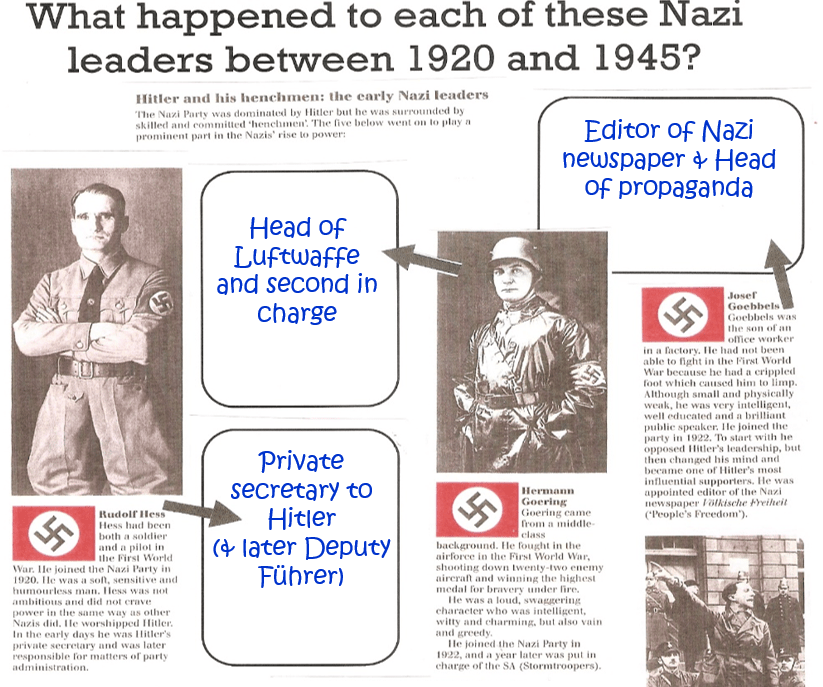
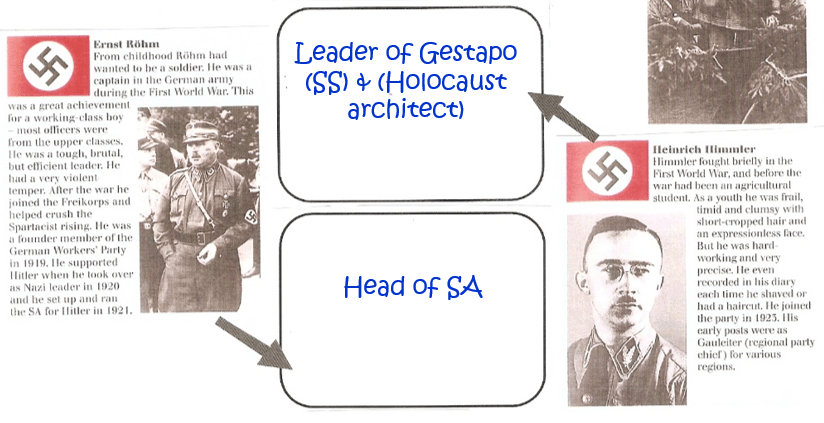
You need to know who the most important leaders in Nazi Germany were. Watch the video on “Nazi leaders”, to get to know who each one was…
Nazi Leaders (Third Reich). (3:32 minutes long)
5.
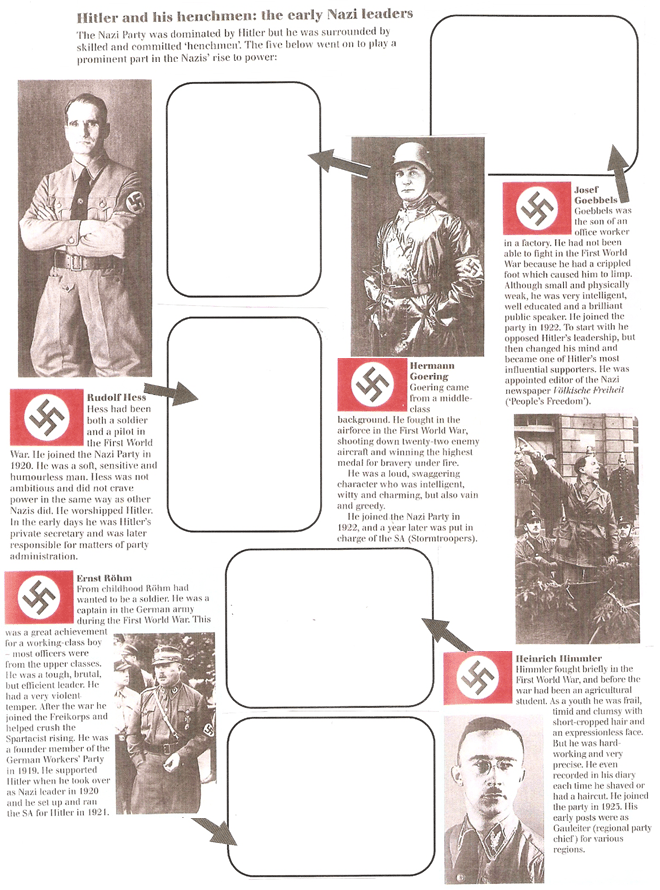
“What happened to each of these Nazi leaders…” (p.24)
6.
Fill in the missing information on “Nazi Leaders” in the boxes on p.24. (For study purposes, you can simply memorise the brief notes in the boxes…)
7.
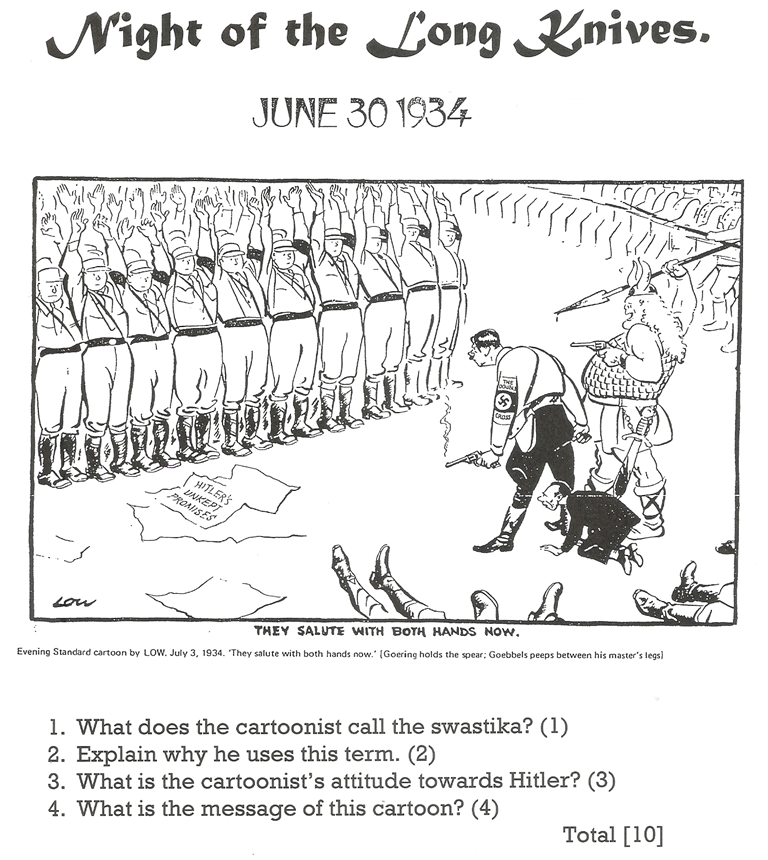
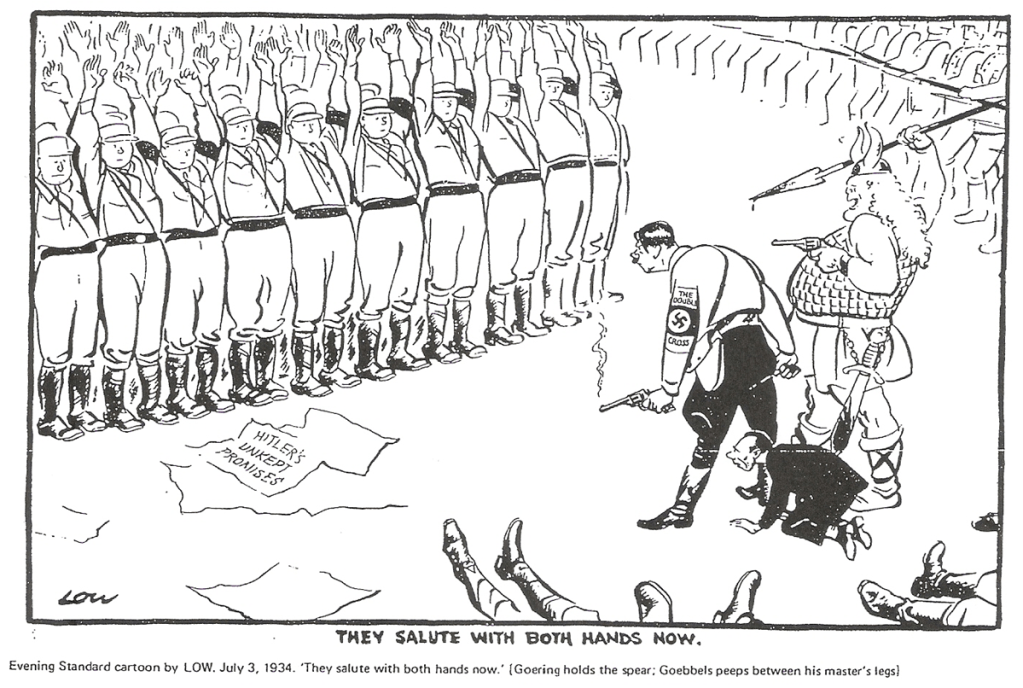
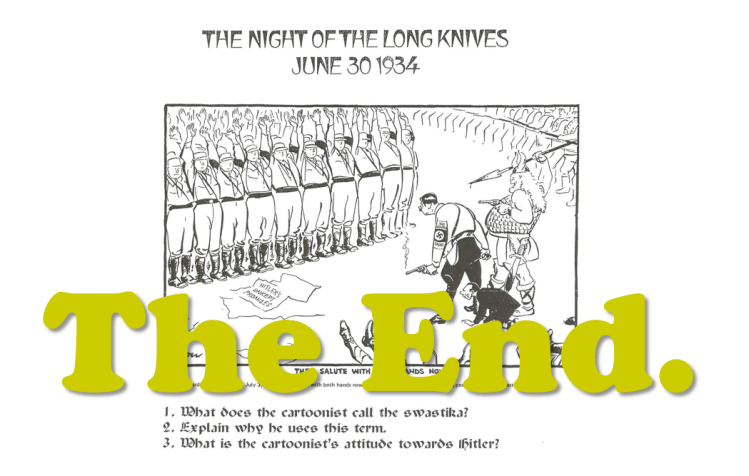
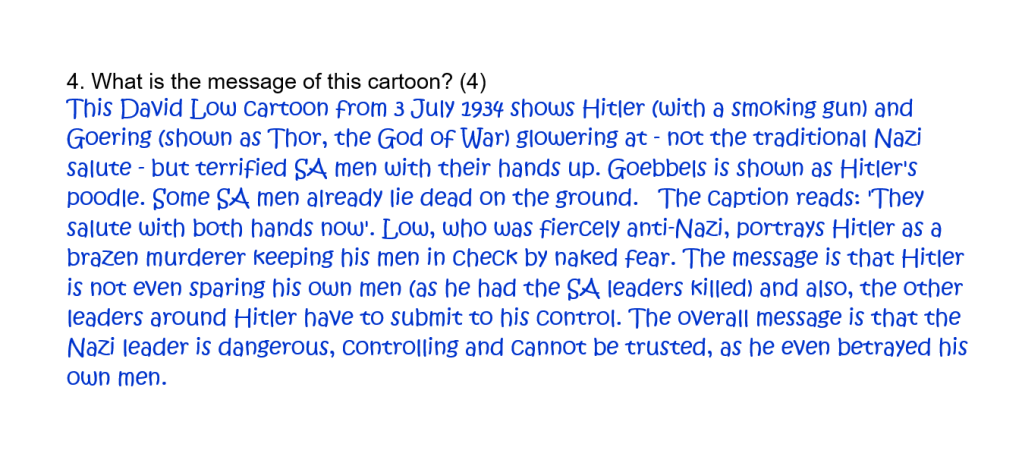
Here is a reminder of what the Night of the Long Knives was…
Night of the Long Knives | Khan Academy. (3:45 minutes long)
8.
p.21
Examine the cartoon carefully to consider what it is trying to say…
9.
Now complete the Questions on the “Night of the Long Knives”, p.21.
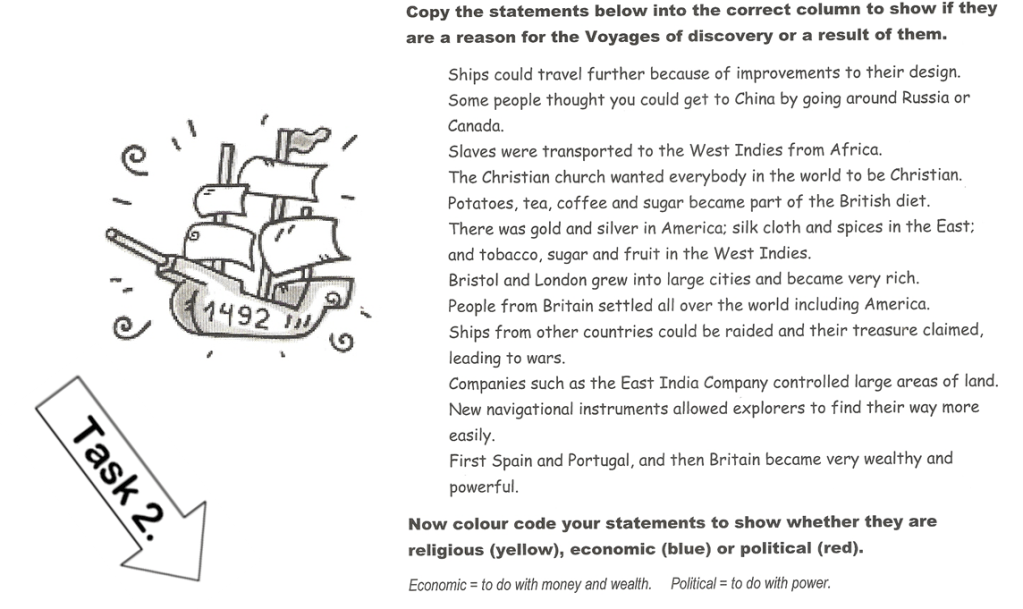
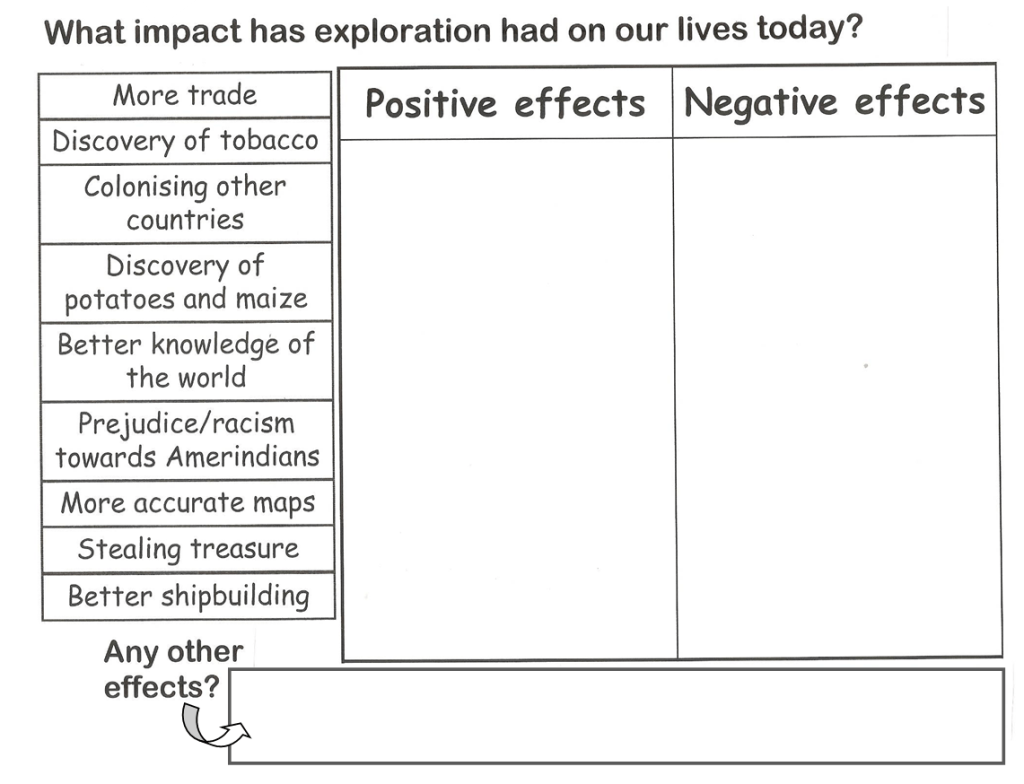
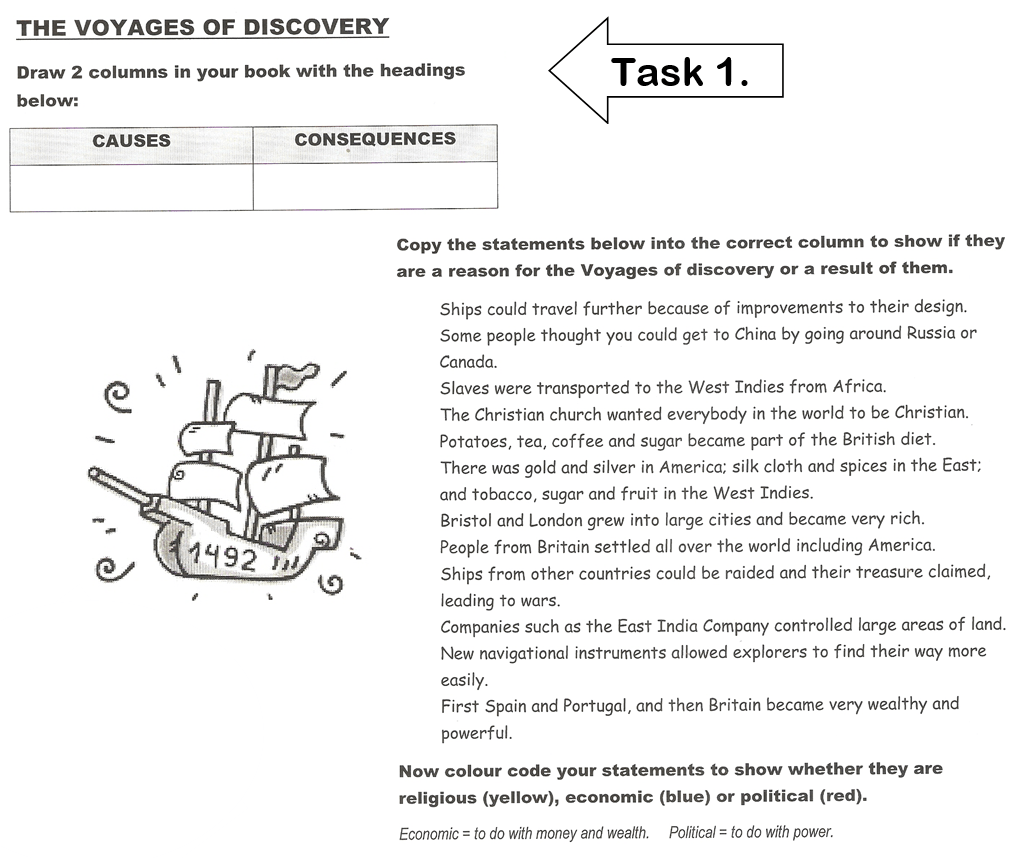
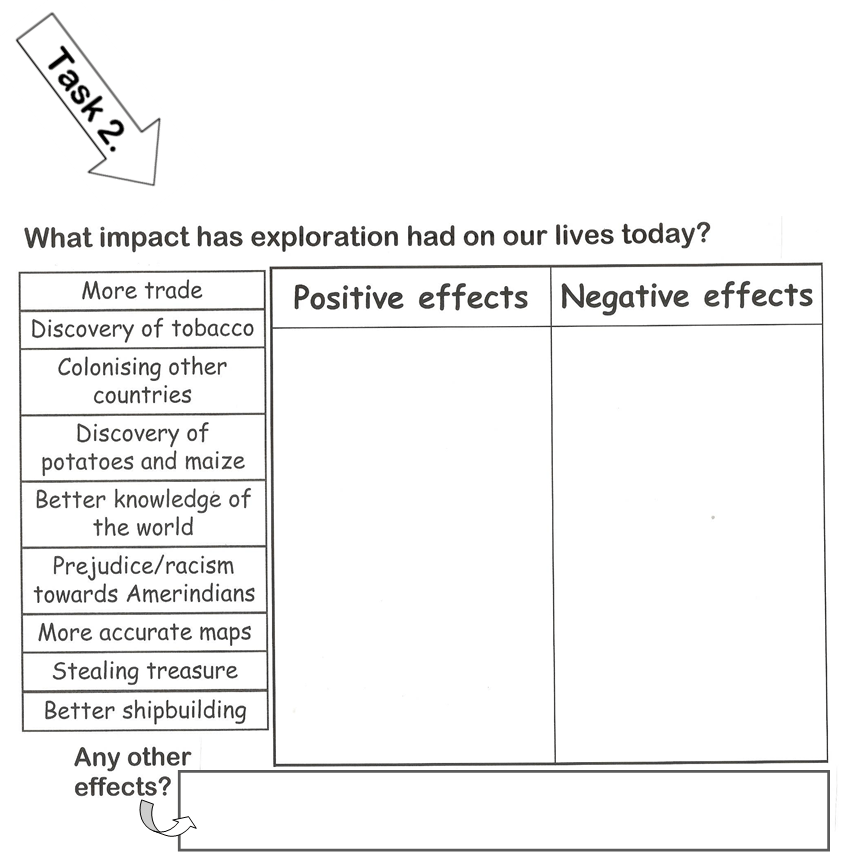
In the previous lesson we started the two tasks on p.42 of your Workbook to examine the impact that exploration had in more detail.
Have you completed these tasks? If not, complete (and also mark) them now in class.
Here is what you have to do for Task 1:
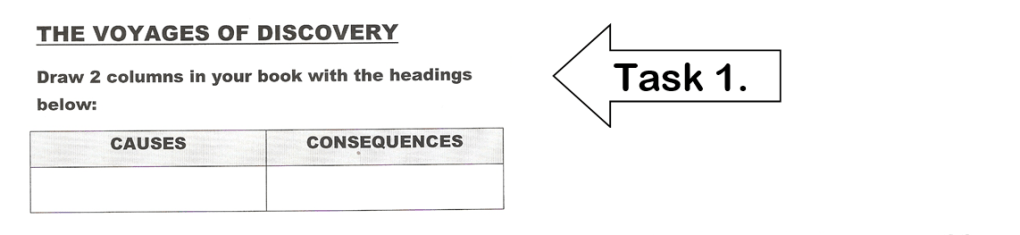
“The voyages of discovery, p.42”
Draw 2 columns in your exercise book. Use these headings: CAUSES and CONSEQUENCES.
Copy the statements in Task 1 (p.42) into the correct column, to show if the statement is a reason for the Voyages of discovery or a result of them.
Remember to also colour-code your statements, to show whether they are religious (yellow) , economic (blue) or political (red)!
Here is what you have to do for Task 2:
Look at the effects in the column on the left – they show the impact of exploration on our lives today. Identify the positive and negative effects and write them in the relevant columns in your Workbook. Finally, also complete the “any other effects” box!
In the previous lesson you filled in the missing information on the notes on p.56.
SOLUTION:
&
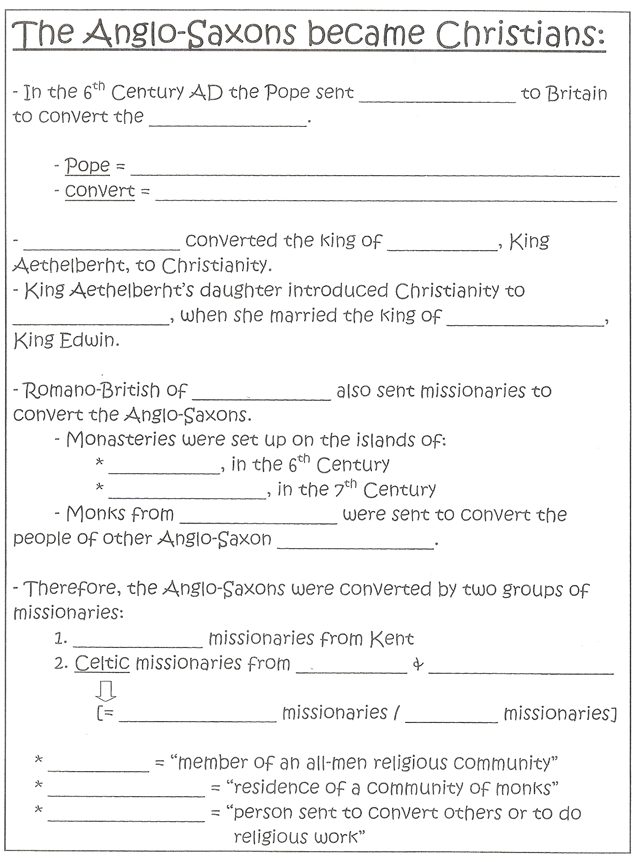
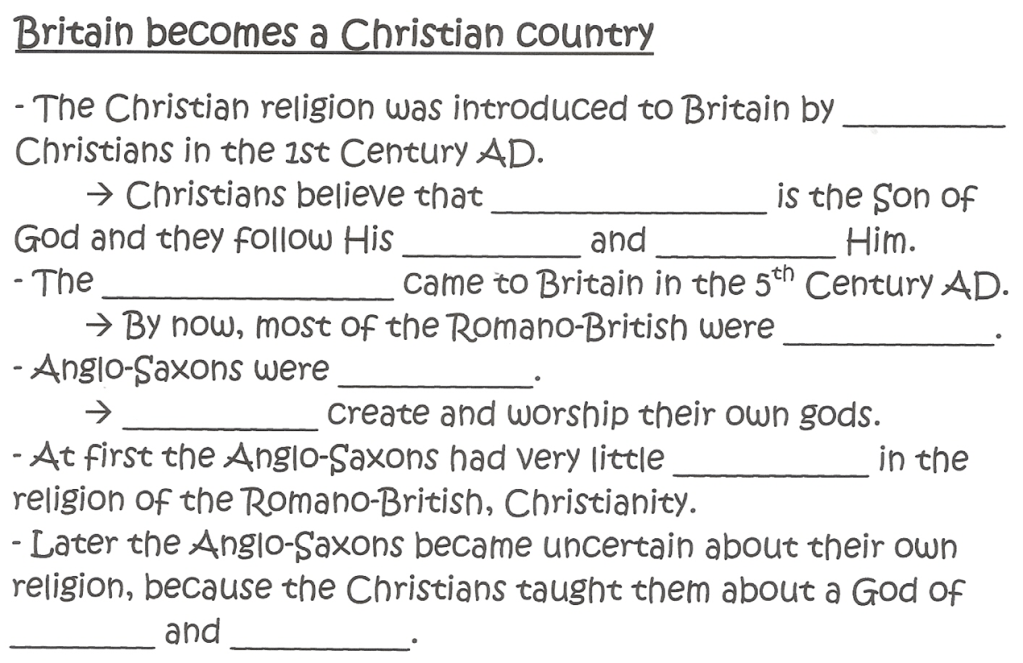
Anglo-Saxons became Christians – fill-in Task. (1:36 minutes long)
4.
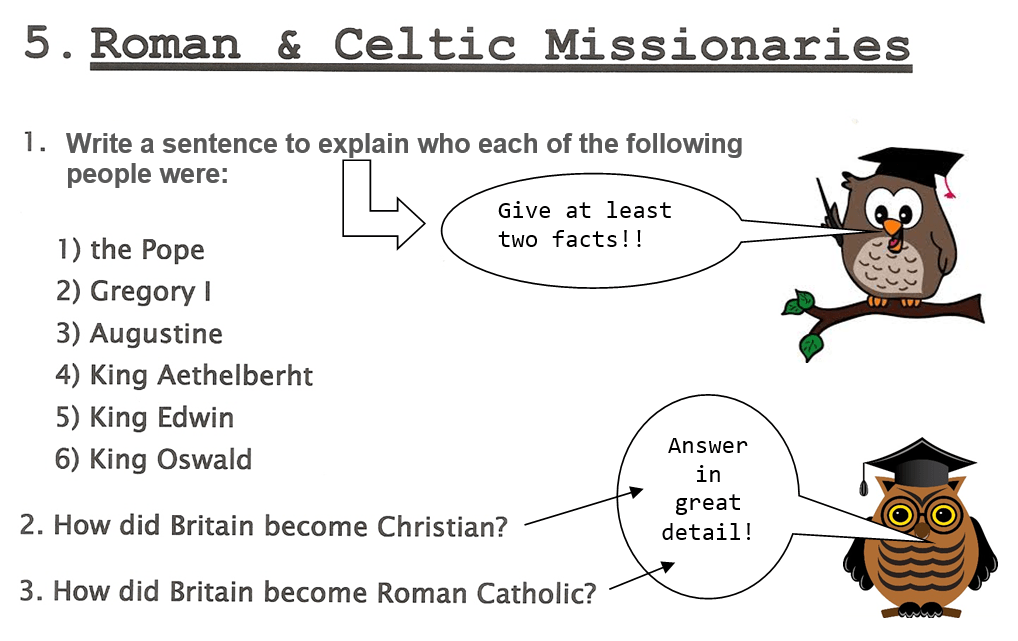
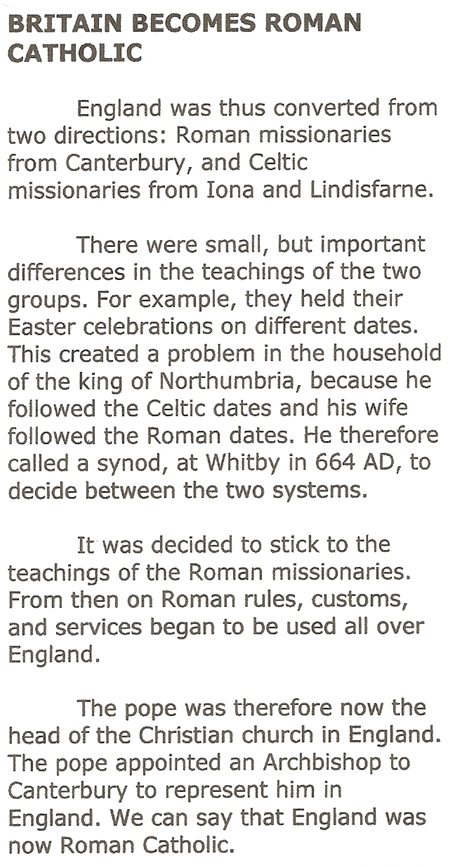
The video below explains how Britain became Roman Catholic in the 7th Century AD. For many centuries after this England remained Roman Catholic and was strongly influenced by the Roman Catholic Church. (It was only in the 16th Century, under King Henry VIII, that England broke away from the Roman Catholic Church.)
Britain became Roman Catholic. (3:09 minutes long)
5.
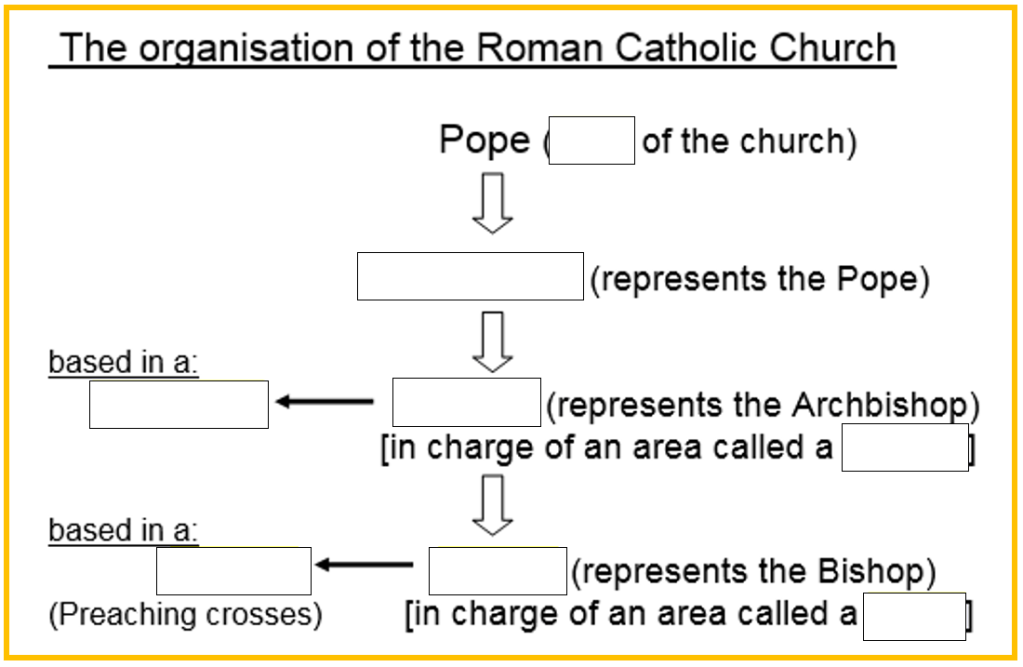
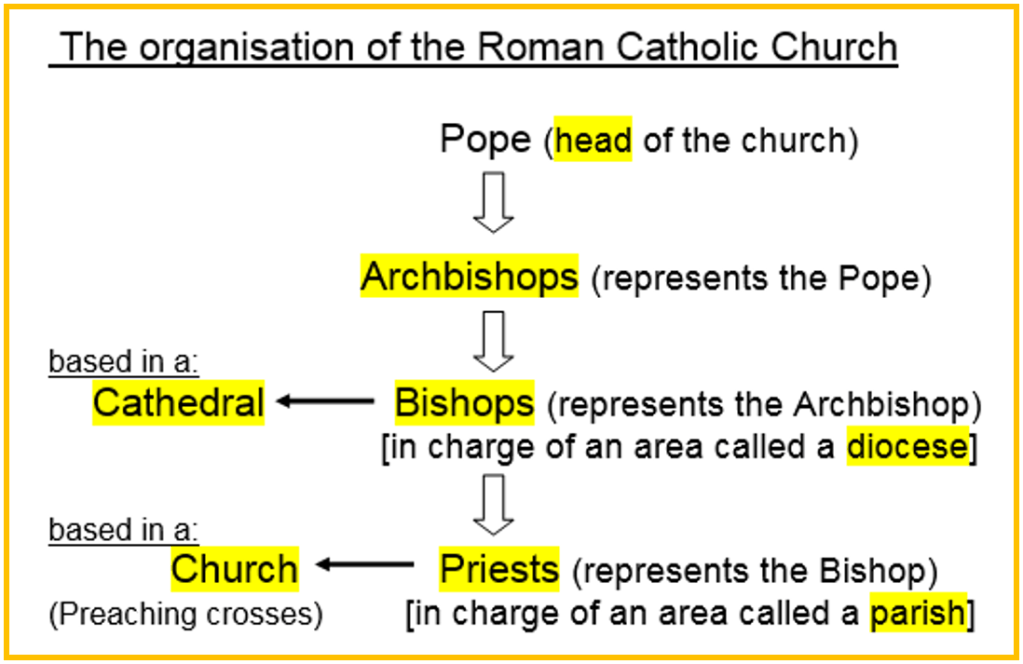
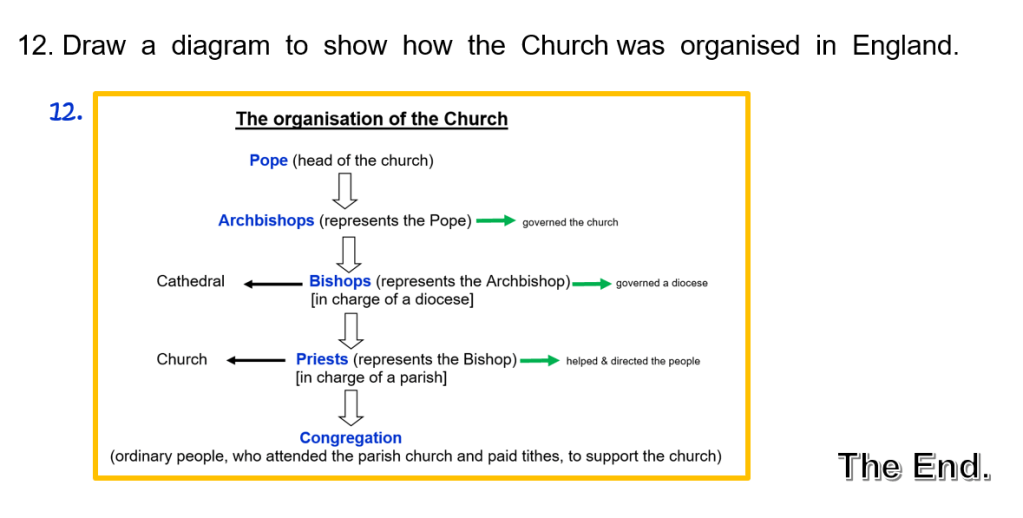
The Roman Catholic Church was represented in many European countries and was organised in a very specific way. Here is how the church was now organised in England:
Church Organisation. (1:00 minutes long)
6.
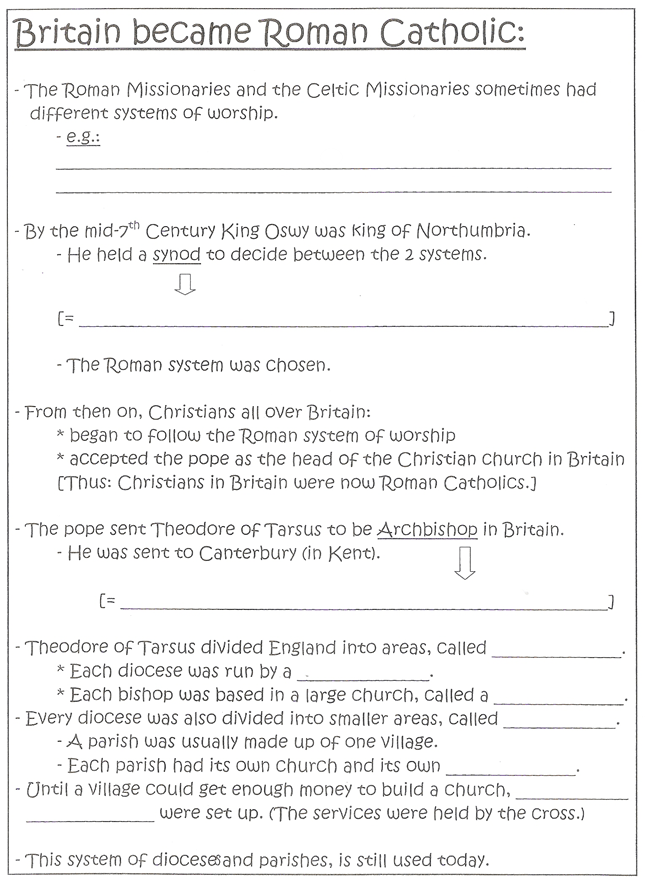
Complete the following worksheet (provided in class) to show how the organisation of the Roman Catholic Church – fill in the missing words:
SOLUTION:
7.
Let’s see what your Workbook can tell you about Britain becoming Roman Catholic…
“Britain becomes Roman Catholic”.
(the second column on p.55)
8.
Fill in the missing words on the notes on p.57.
SOLUTION:
&
Britain became Roman Catholic – fill-in notes. (1:33 minutes long)
Today you are going to learn more about the reformation in England…
Follow the instructions step by step:
1.
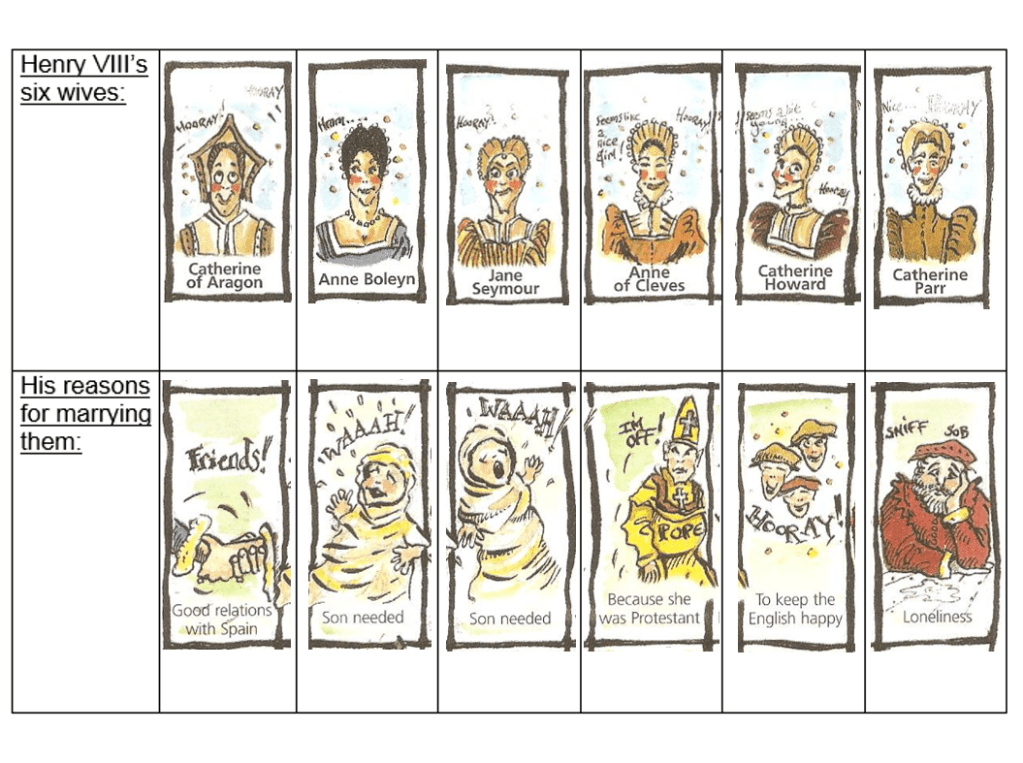
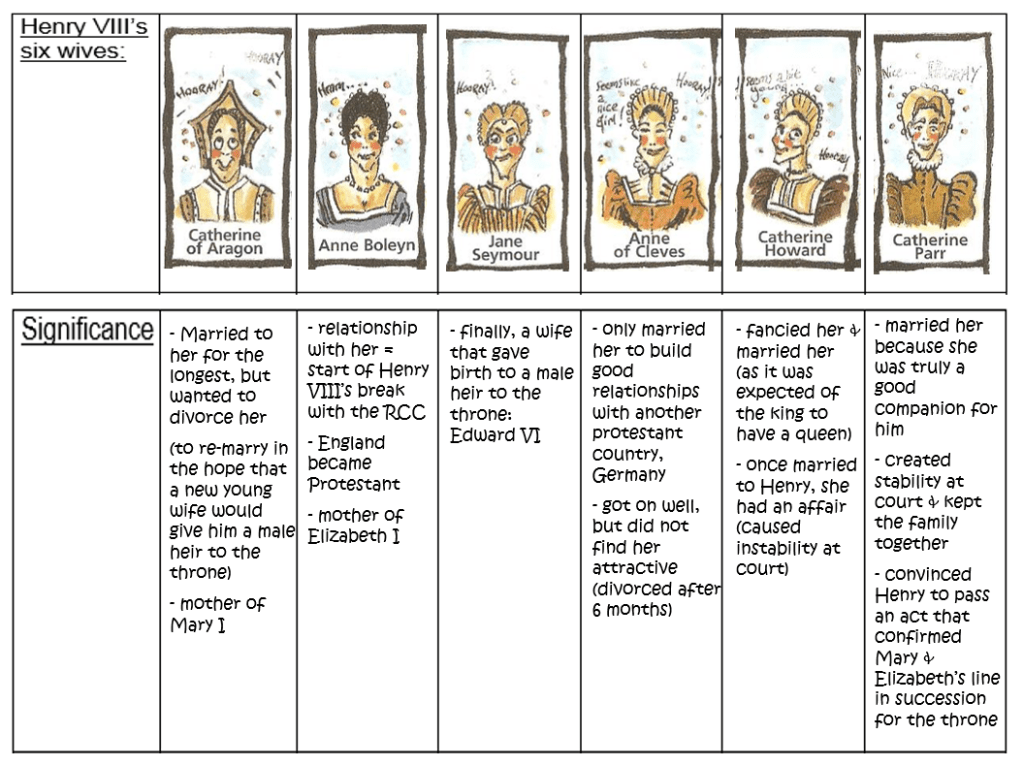
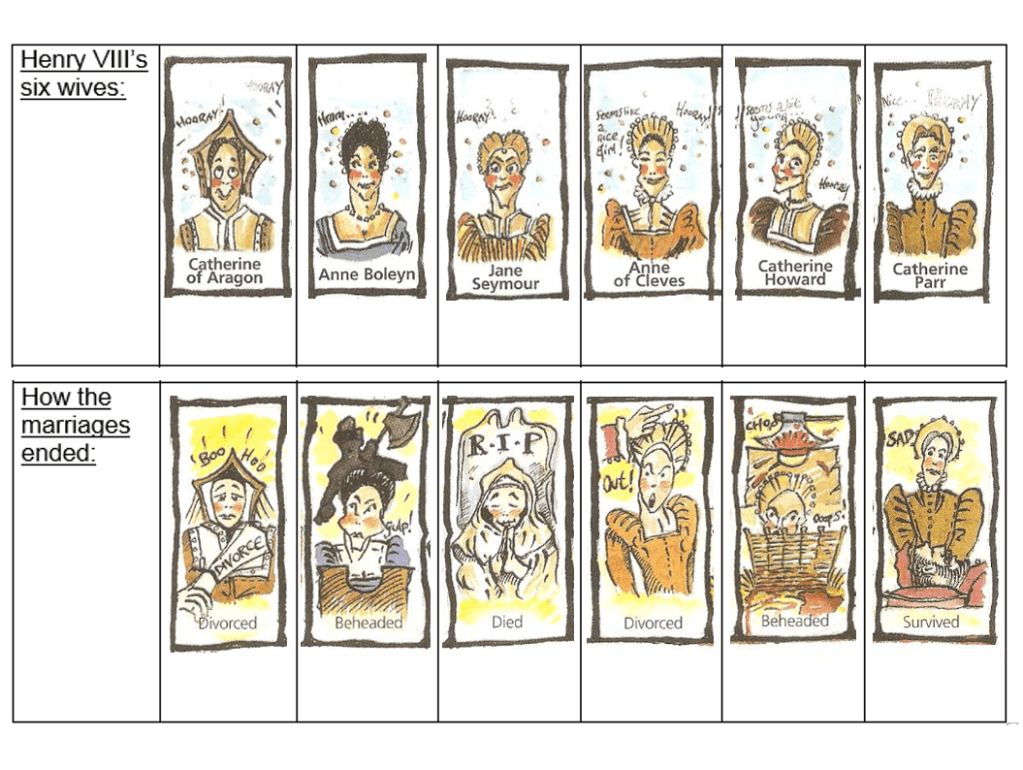
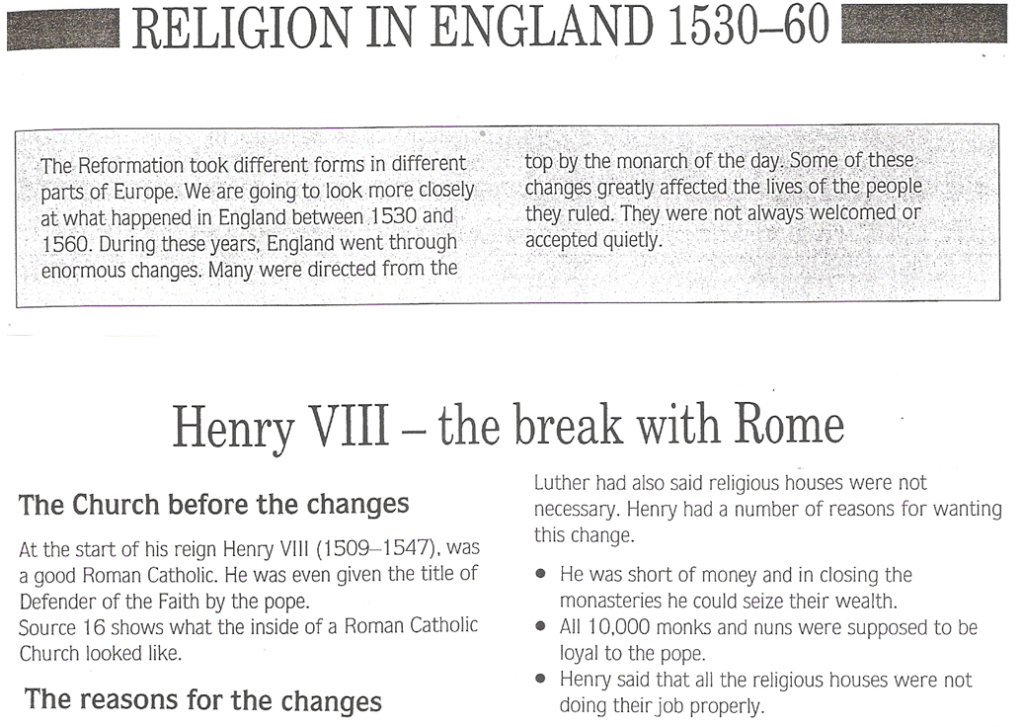
As an introduction, let’s see what we can learn about Henry VIII and his six wives…!!
The Six Wives of Henry VIII Explained 9 Minutes. (9:31 minutes long)
2.
So, what about the Reformation in England? The following video tells you more about the reform of the church in England…
The Reformation in England. (2:16 minutes long)
3.
Read p.47
4.
Also…
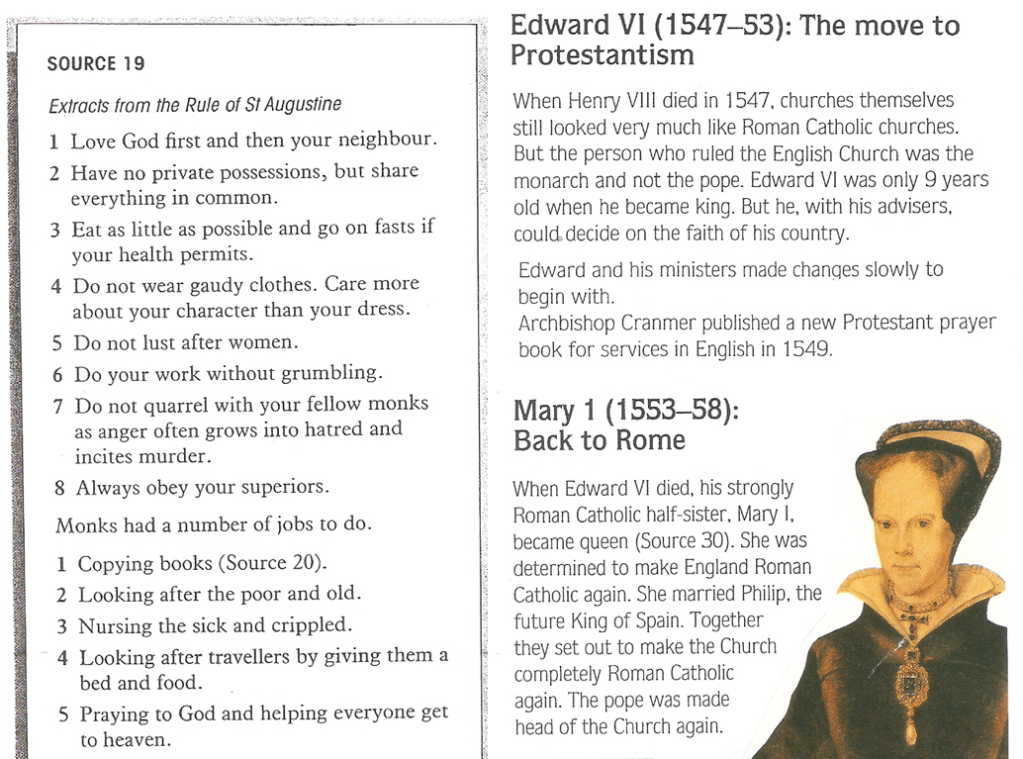
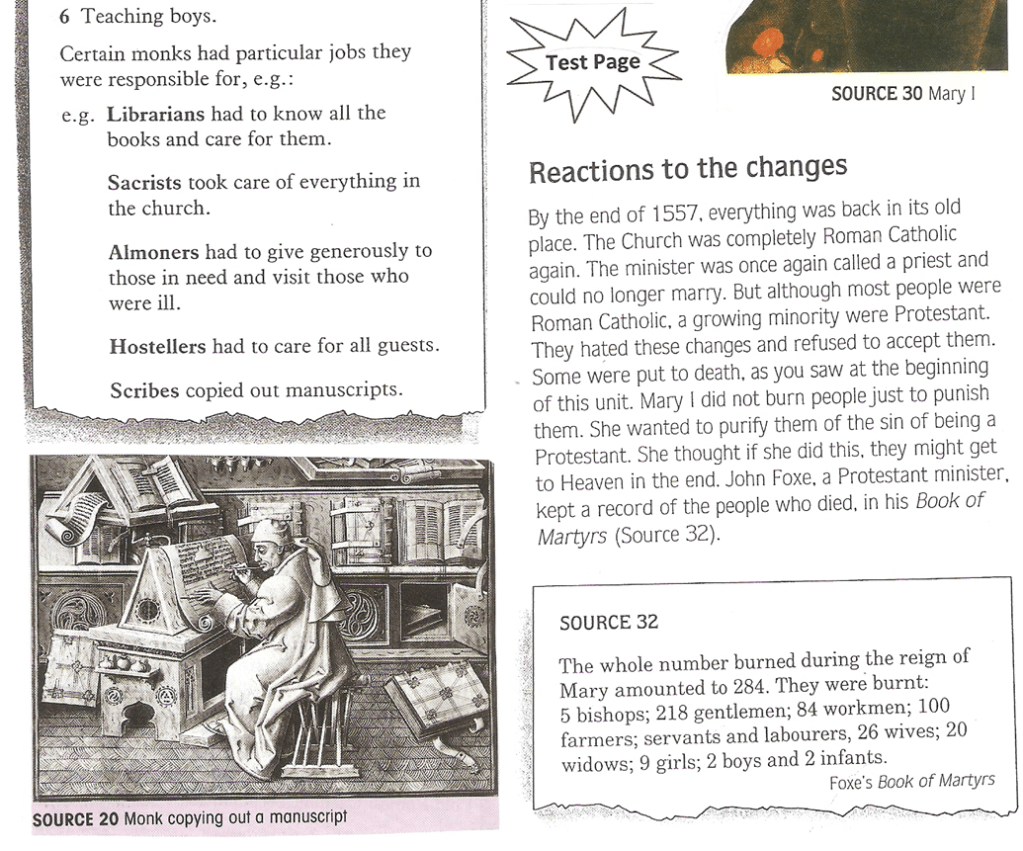
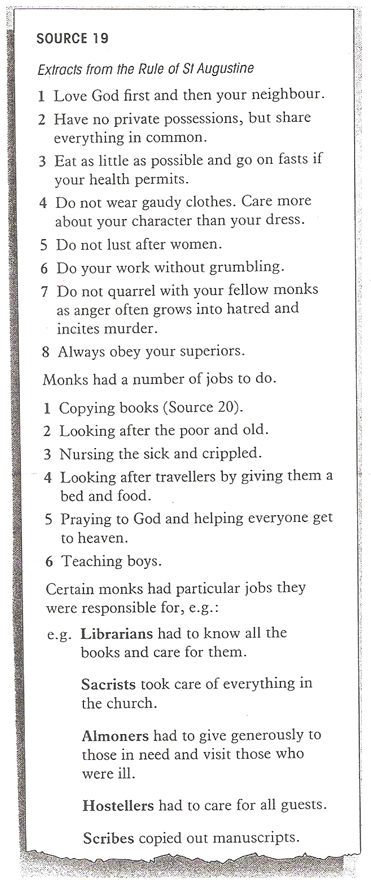
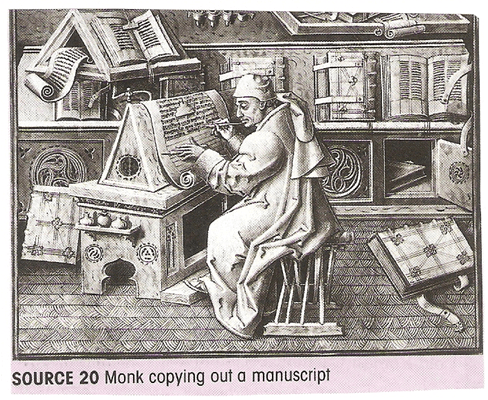
The sources about monks (Sources 19 & 20), p.48
5.
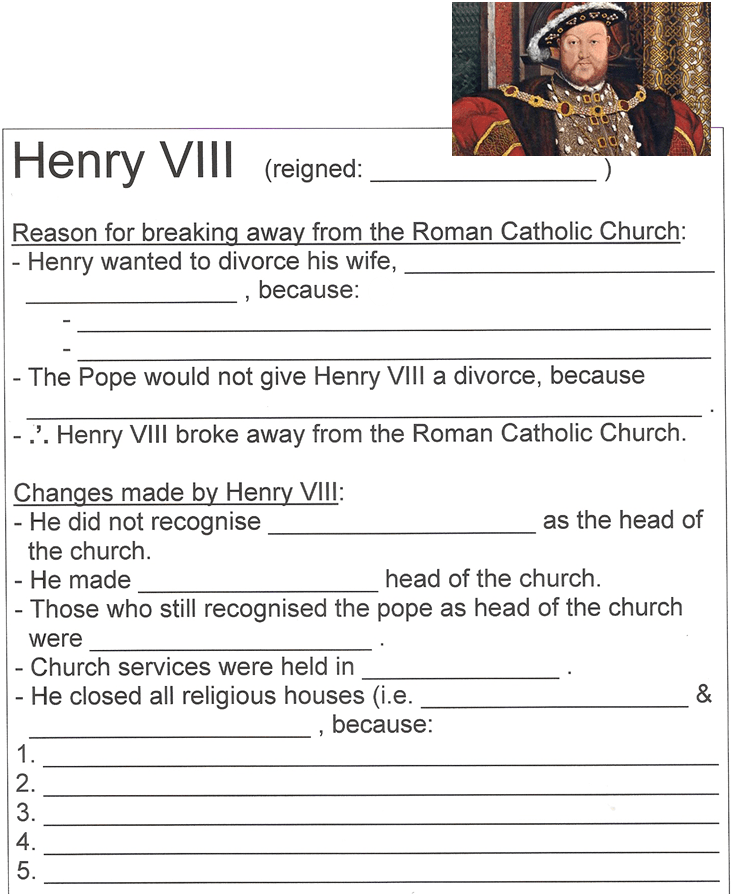
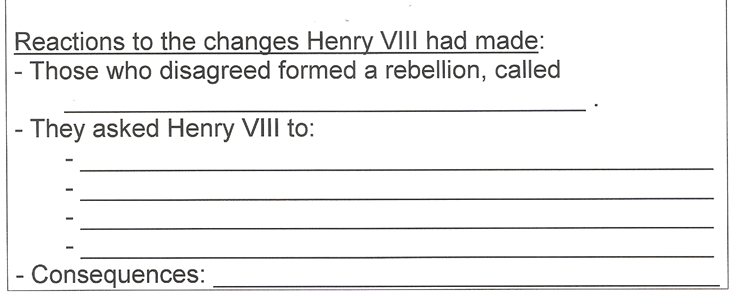
Fill in the missing information on the notes on Henry VIII (p.52).
6.
Mark your fill-in notes on Henry VIII:
&
(2:33 minutes long)
7.
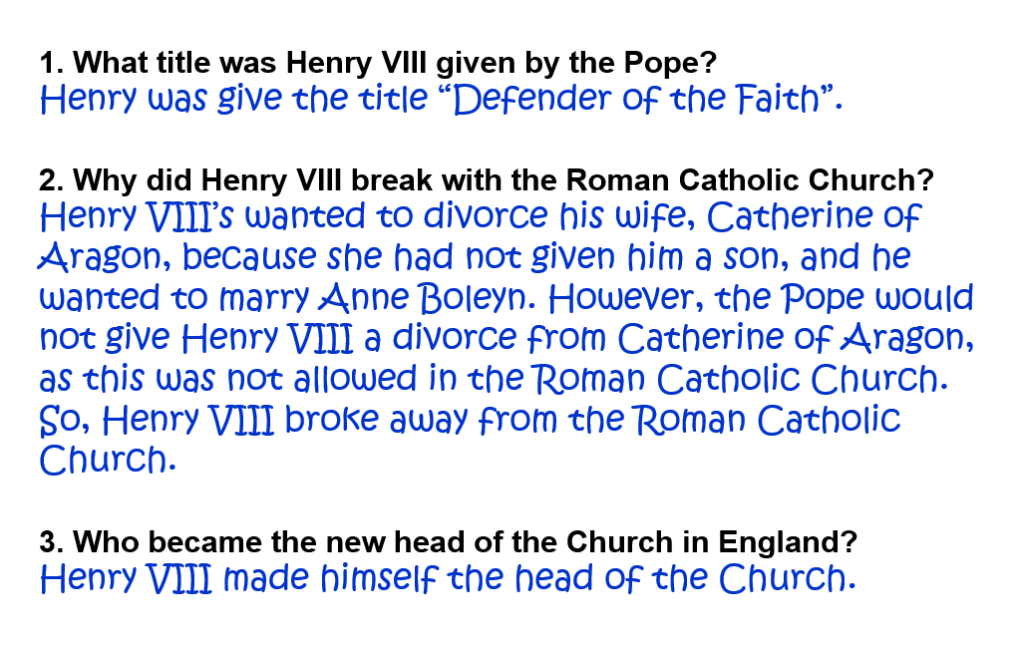
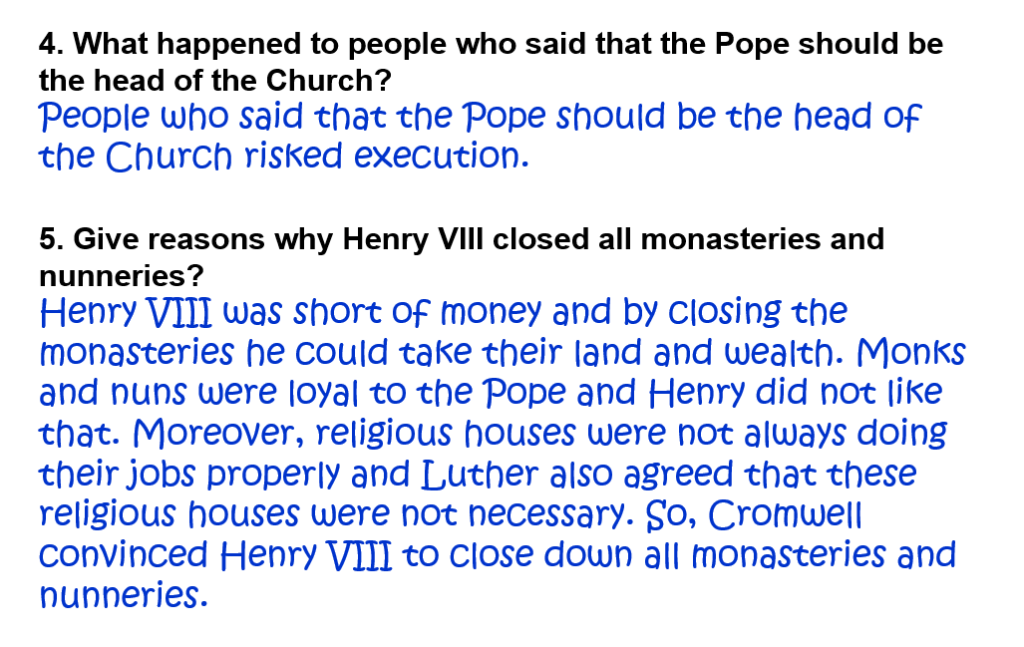
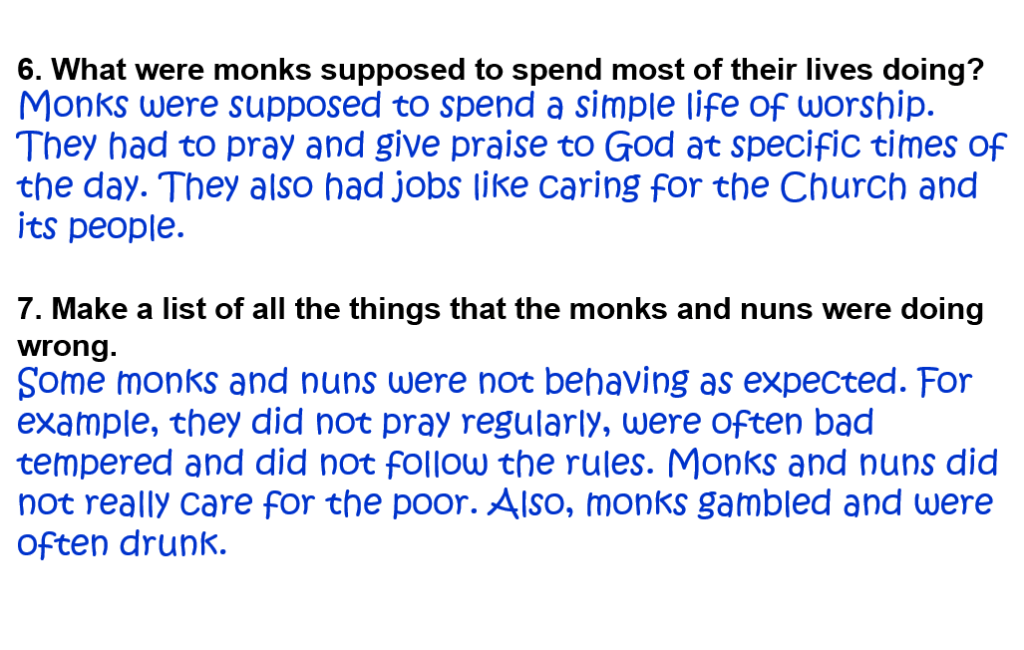
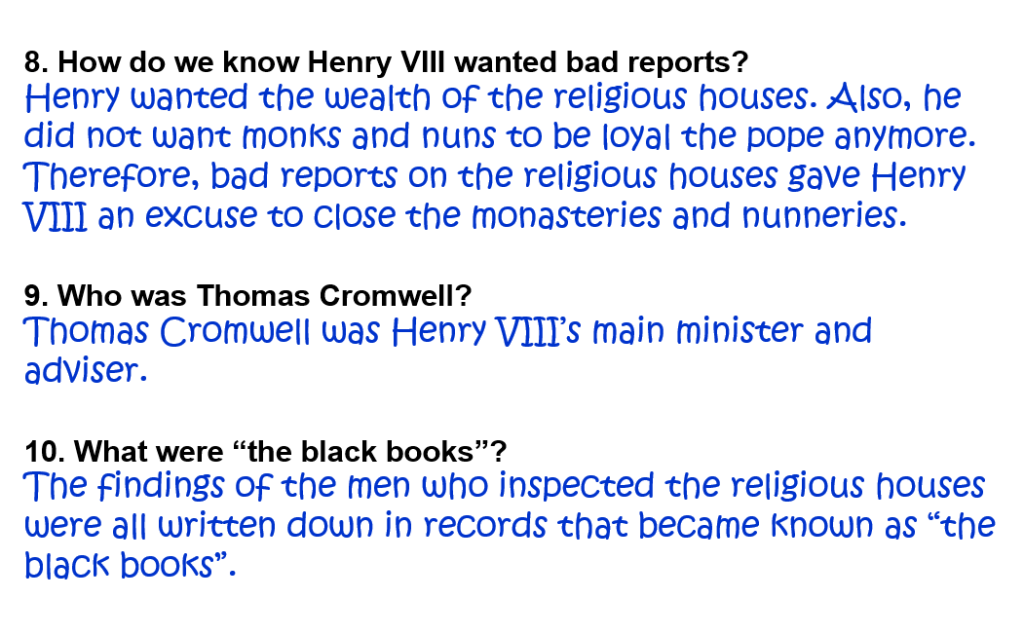
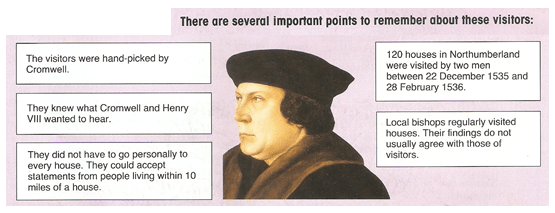
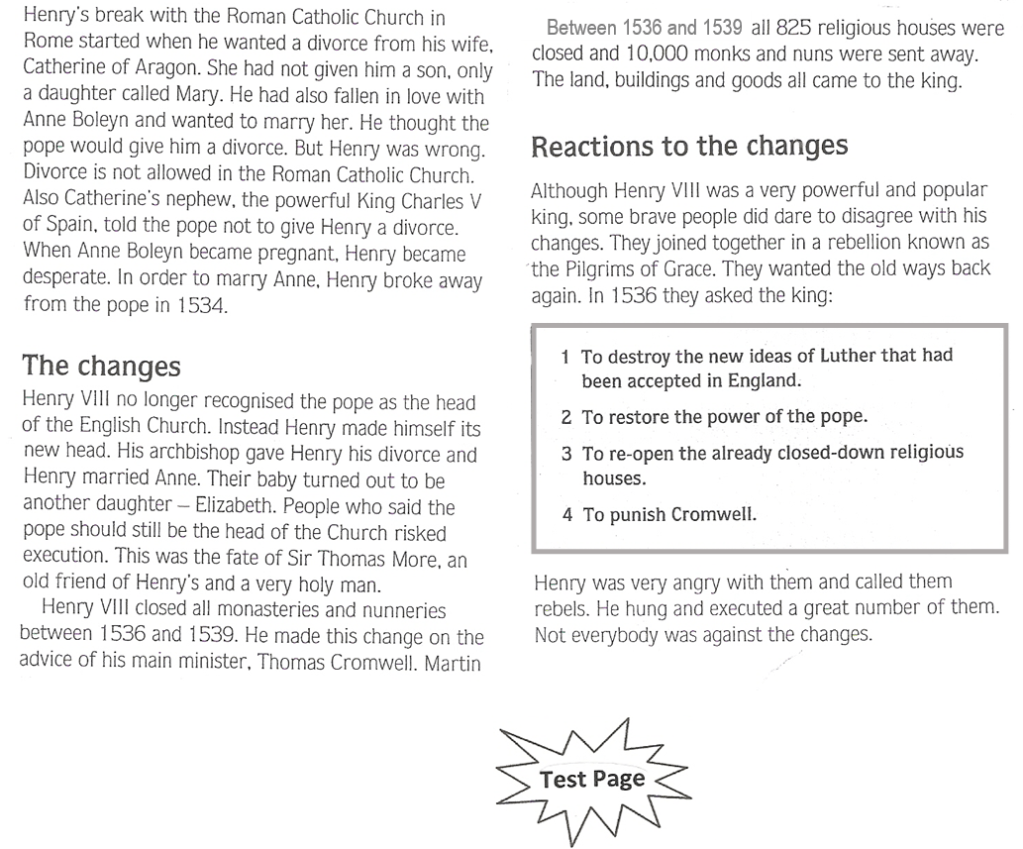
Henry VIII had all monasteries and nunneries closed. He broke away from the Roman Catholic Church and did not want these religious houses to still be loyal to the Pope. Moreover, by closing them, Henry VIII could take the wealth of the religious houses. Here are a few more details regarding the inspection and closure of religious houses during this time. (This information is also on p.59 in your workbook.)
8.
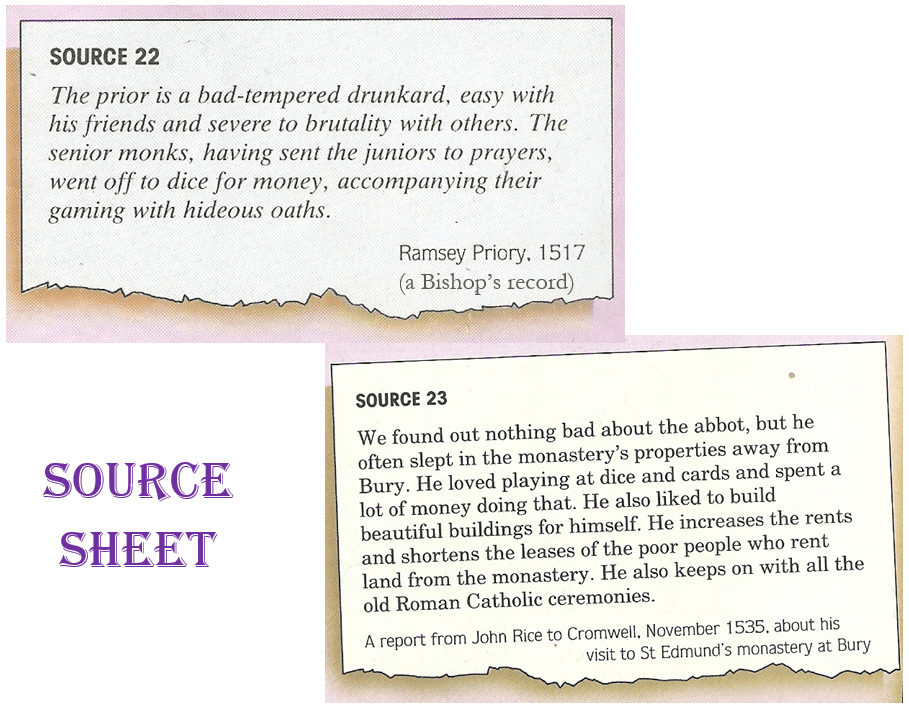
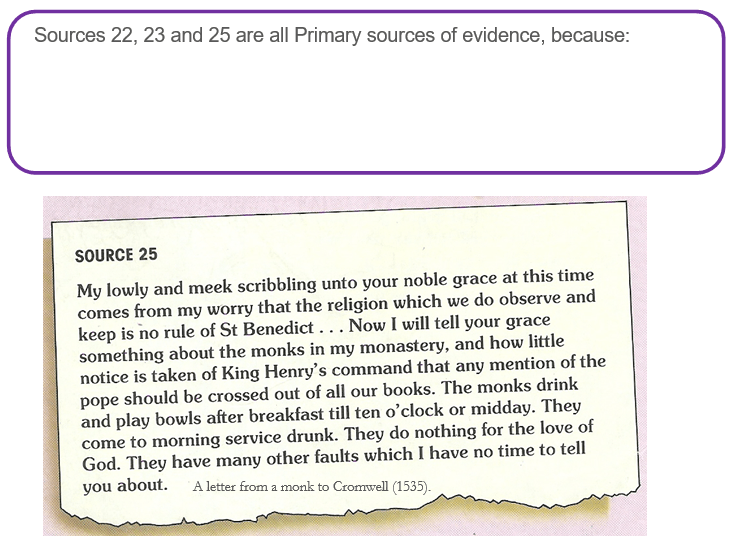
Read the sources on p.57 – they provide additional information about the religious houses. Then complete the box on p.57, to explain why these sources are all Primary sources of evidence.
SOLUTION:
Sources 22, 23 and 25 are Primary sources of evidence, because:these sources originate from the time of the Reformation in England. So, it is evidence gained from the period being studied.
When the Anglo-Saxons started to settle in Britain they were pagans. Over time the Anglo-Saxons became Christian. Let’s see how that happened.
Anglo-Saxons became Christians. (4:50 minutes long)
4.
Let’s see what your Workbook can tell you about religion in Britain…
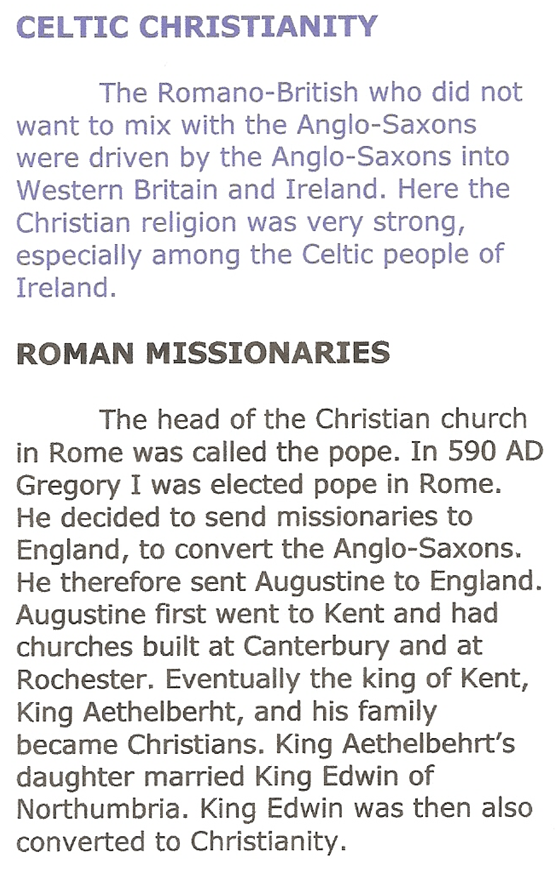
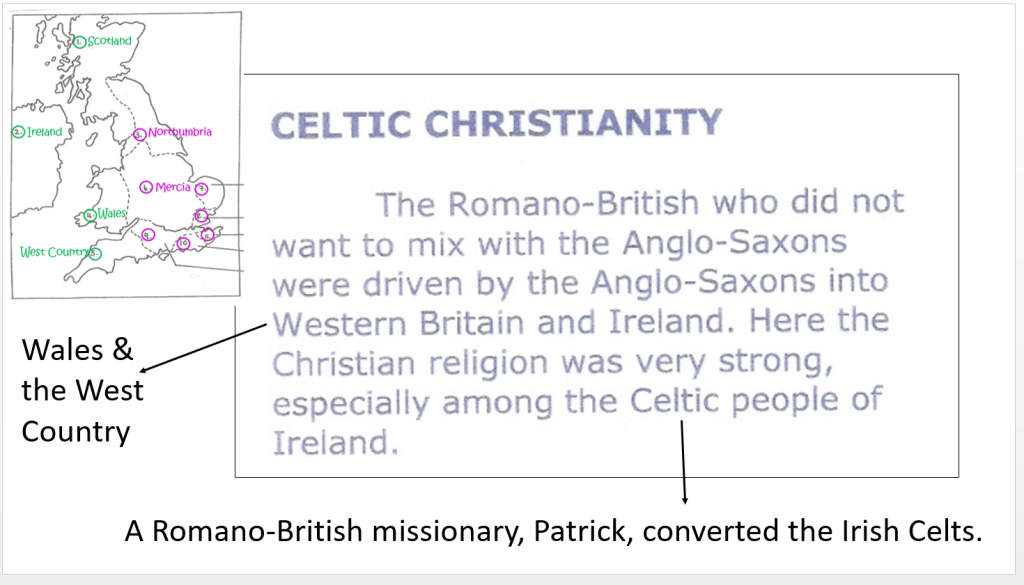
“Celtic Christianity” & “Roman Missionaries”.
(the second column on p.53)
5.
Make sure that you understand what is meant by “Celtic Christianity”:
6.
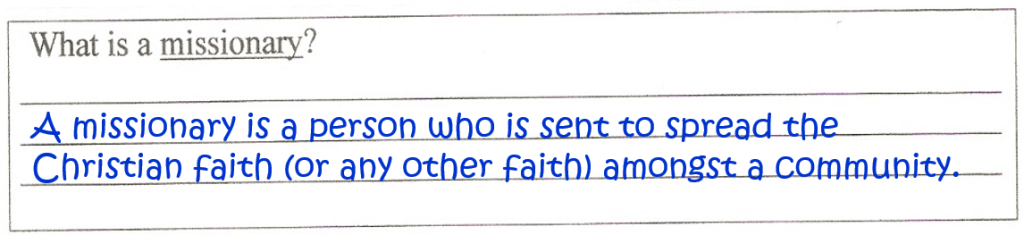
Complete the box on p.53 to explain what is meant by “missionary”.
SOLUTION:
7.
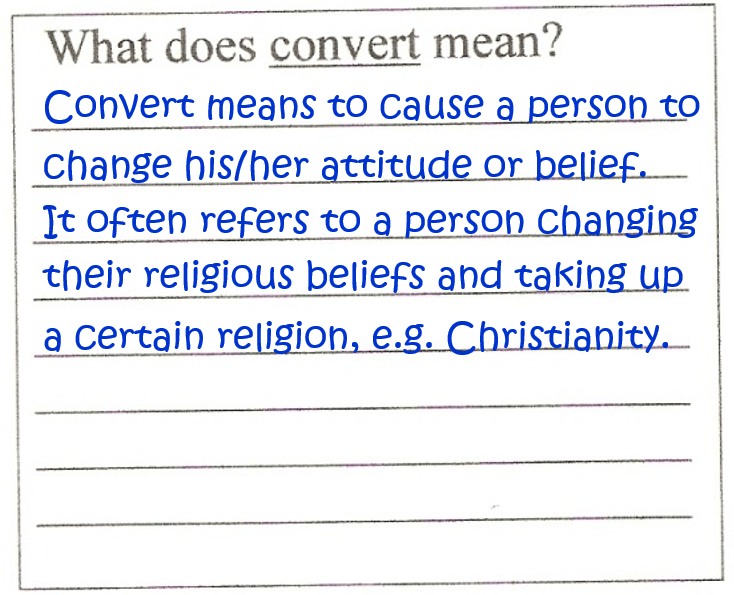
Also complete the box on p.55 to explain what is meant by “convert”.
SOLUTION:
8.
Continue reading…
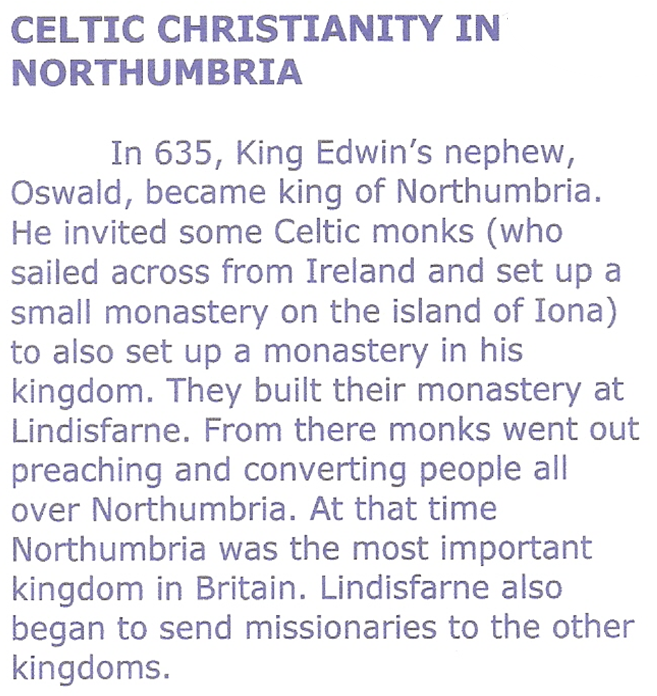
“Celtic Christianity in Northumbria“
(Page 55, first column…)
9.
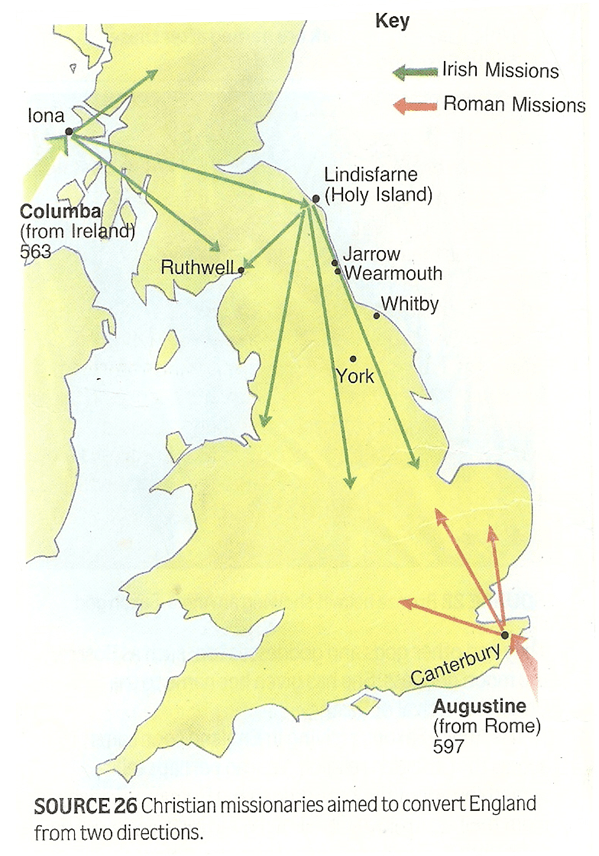
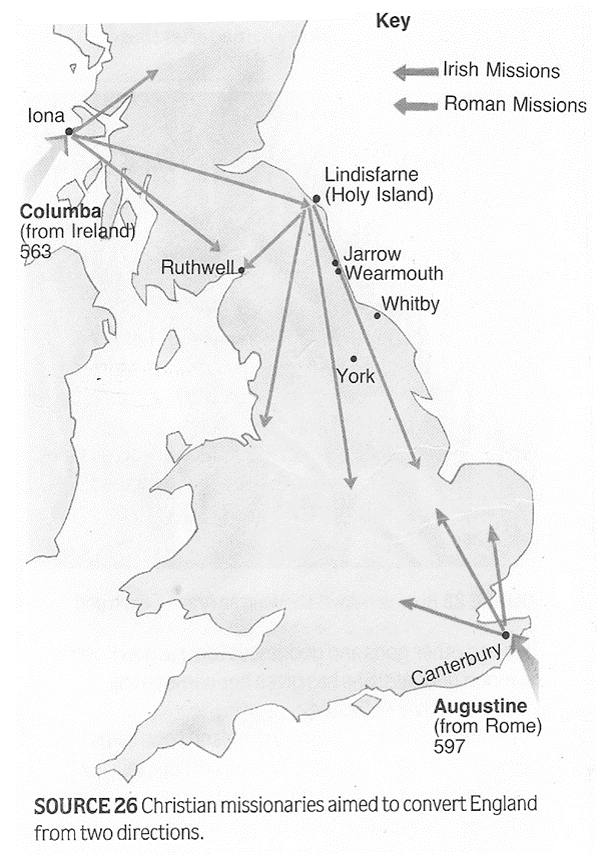
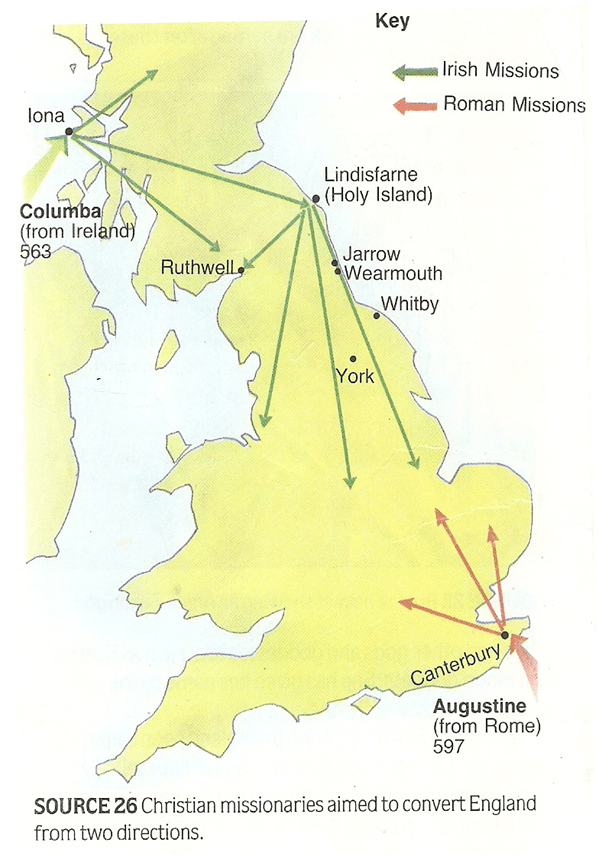
Use two different colours and indicate, in colour, the 2 directions from where England was converted to Christianity (on your black-and-white map, on p.55 in your Workbook). Remember to also add colour to the key of the map!
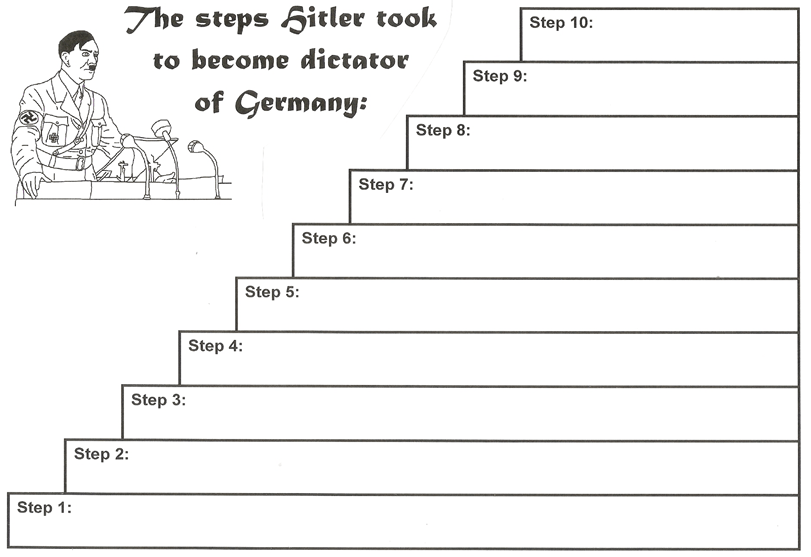
Today you are going to learn how Hitler became Dictator of Germany…
Follow the instructions step by step:
1.
Watch the short video below. It explains “How Hitler became Dictator” of Nazi Germany.
Hitler became Dictator. (1:57 minutes long)
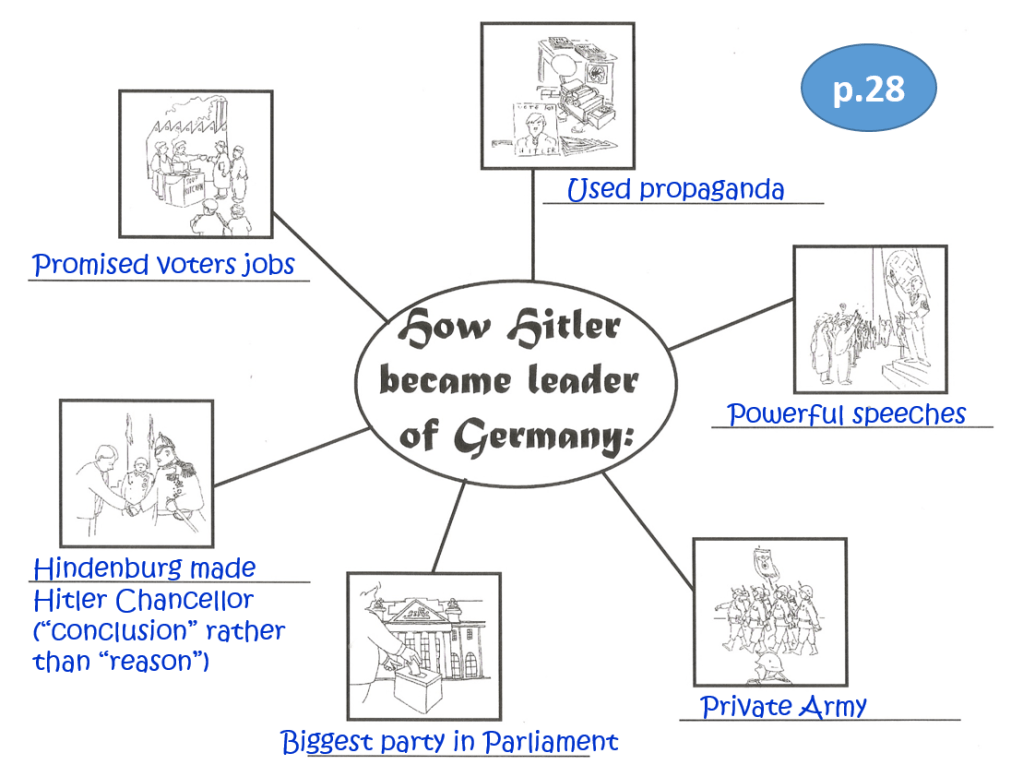
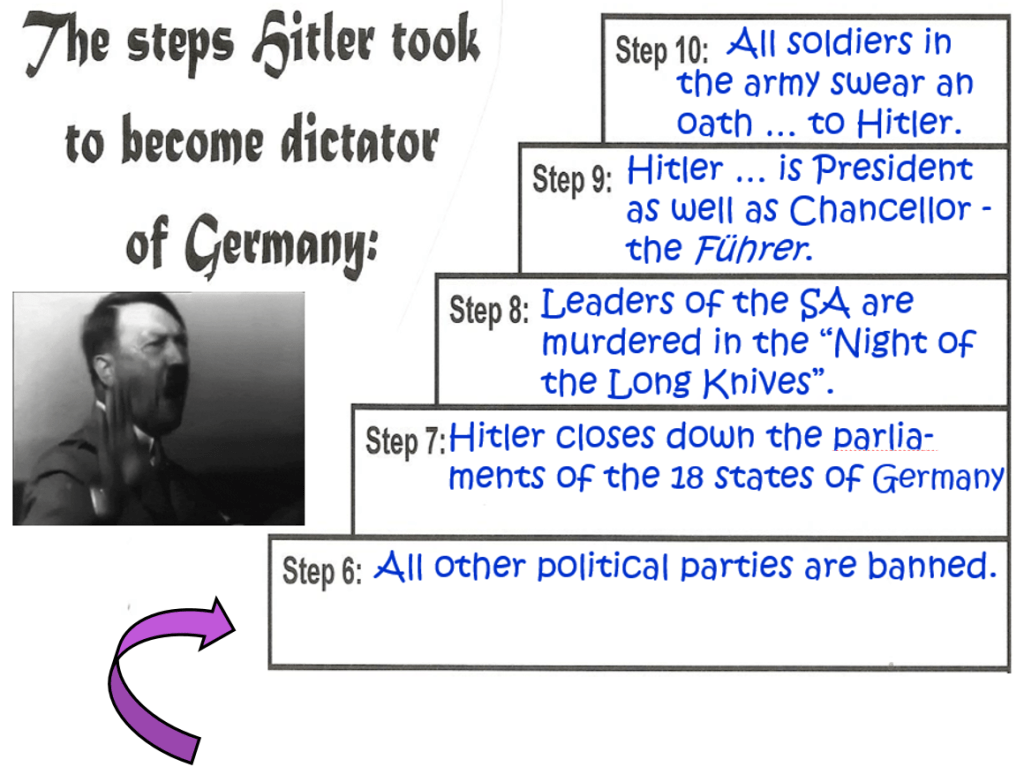
2.
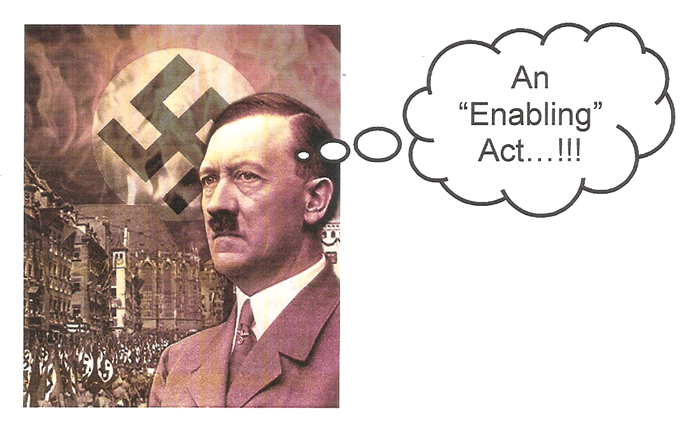
Once he had the Enabling Law passed, Hitler had to make sure that there is no chance that he will ever be removed from his position as dictator. Hitler, therefore, set out to secure his position. The video below explains just how Hitler did that and how he became führer of Germany.
Hitler became Führer. (2:42 minutes long)
3.
Now, let’s see what your Workbook has to say about how Hitler became dictator and führer of Germany.
p.18-19
4.
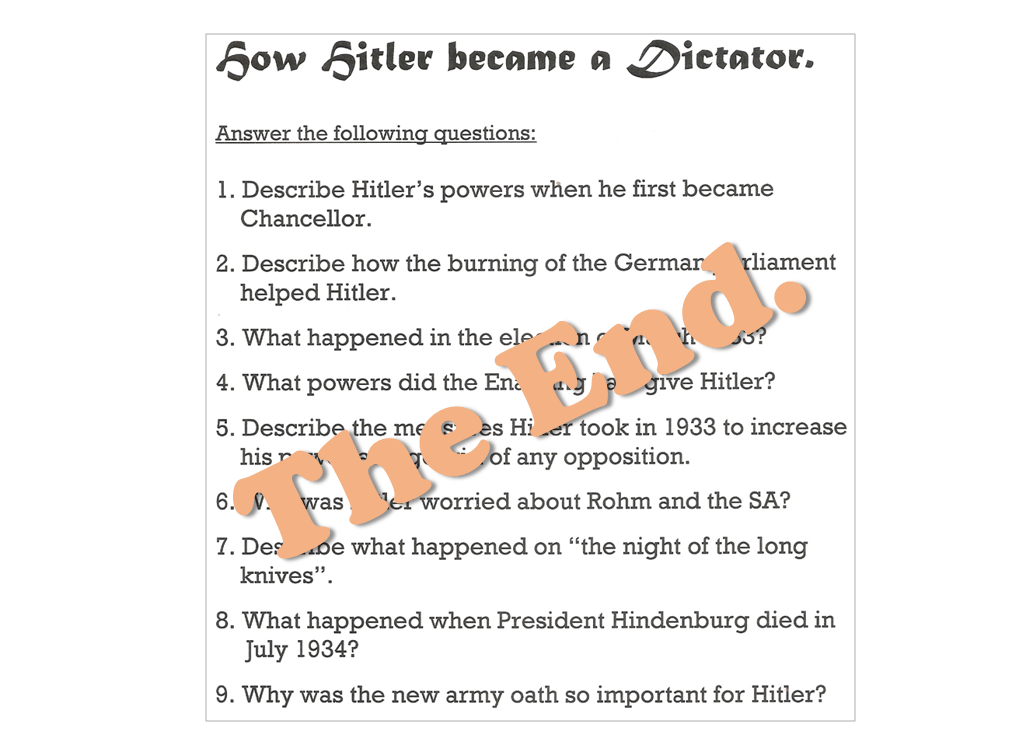
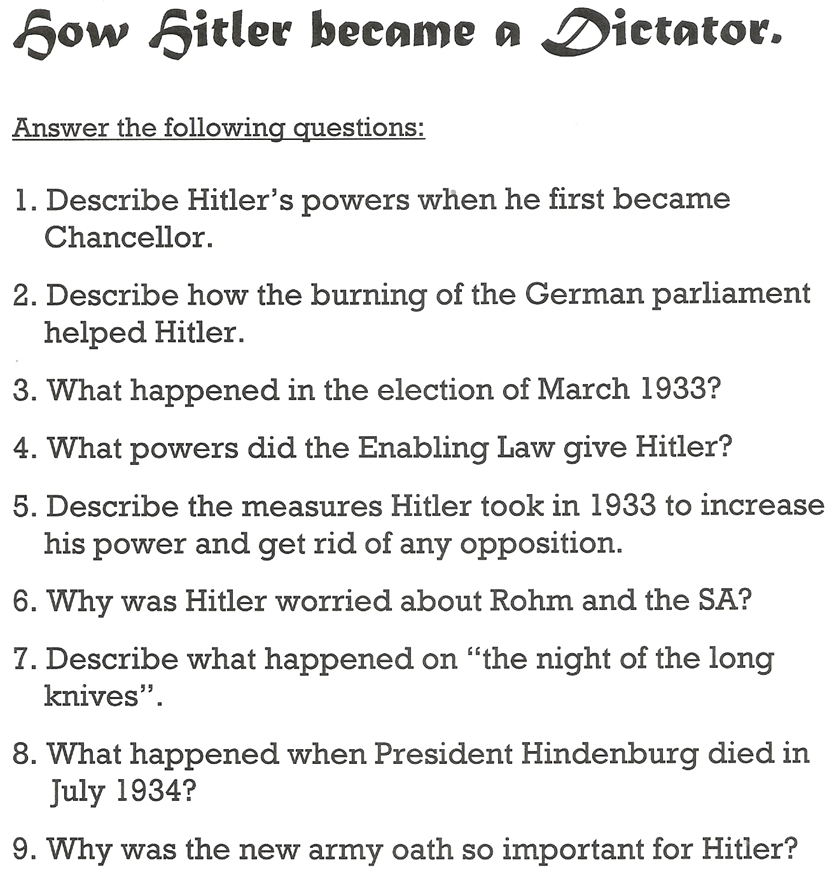
And now for a few questions to test your knowledge and understanding…
Today you are going to continue looking at the Nazi Party, how they campaigned to increase their numbers and how they made use of propaganda…
Follow the instructions step by step:
1.
First revise the information about the Nazi Party from the previous lesson…
p.6-9
2.
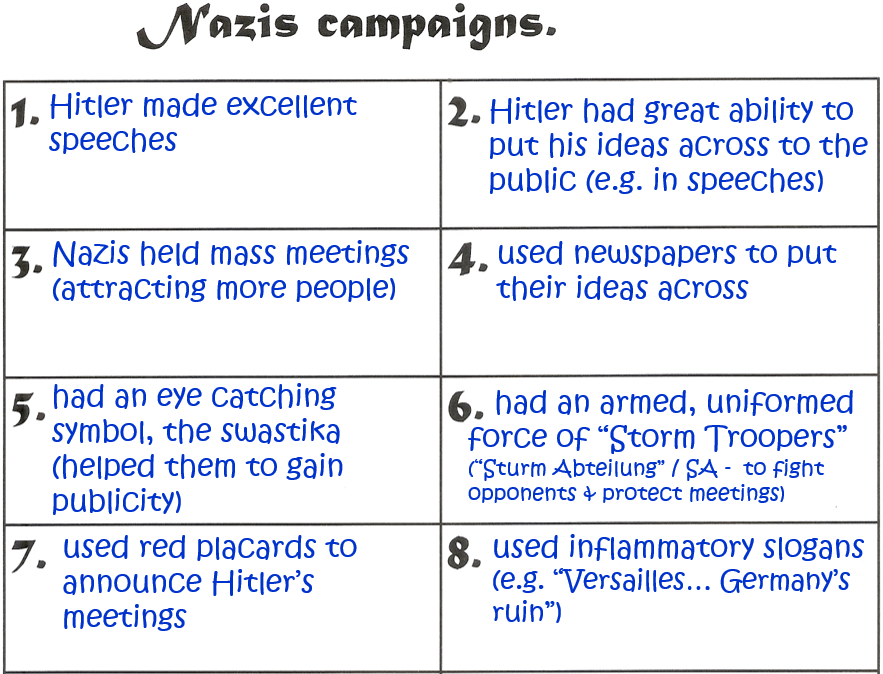
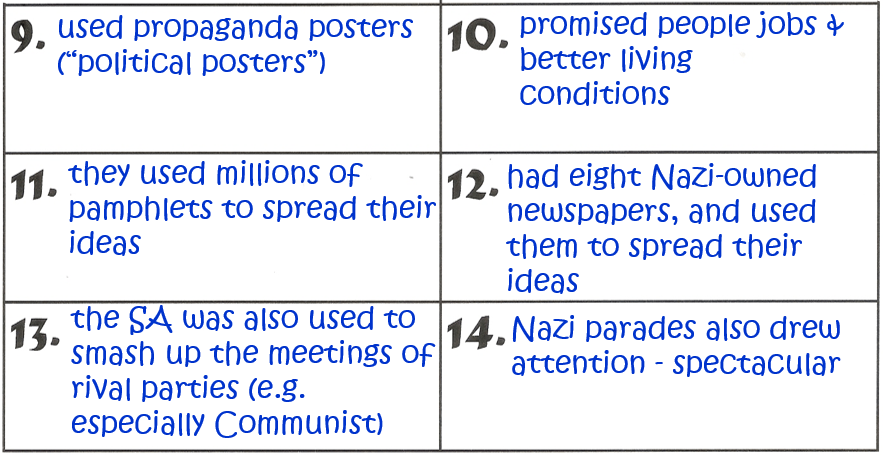
The Nazis used various methods to increase support for their party. Look again at pages 6-9 and identify ways in which the Nazis campaigned and increased their support. Use the table on page 10 to complete this task.
SOLUTION:
3.
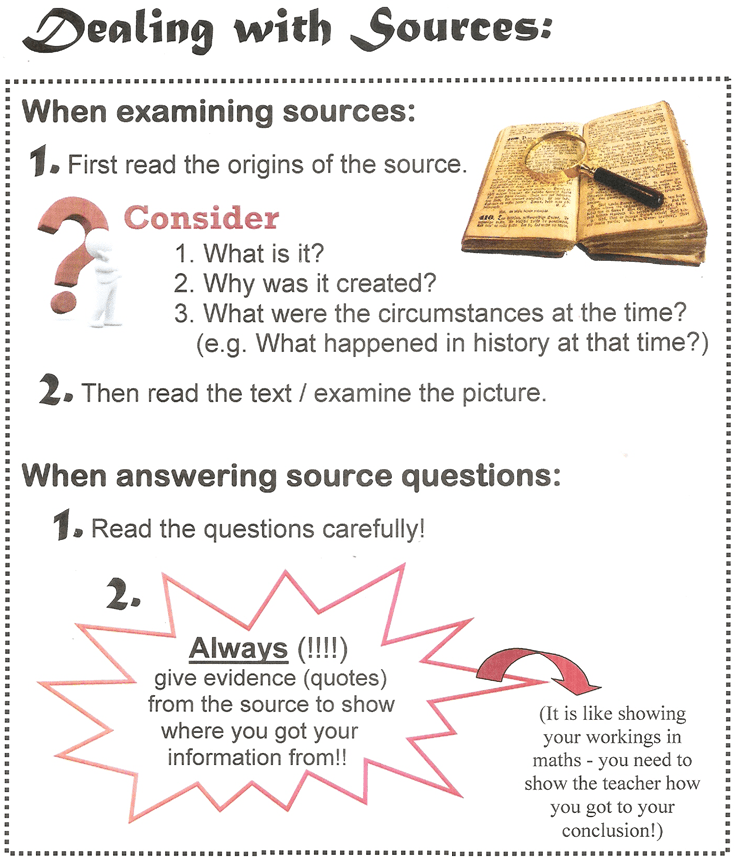
Here is an important reminder about how to deal with sources…
(p.11 of Workbook 2)
4.
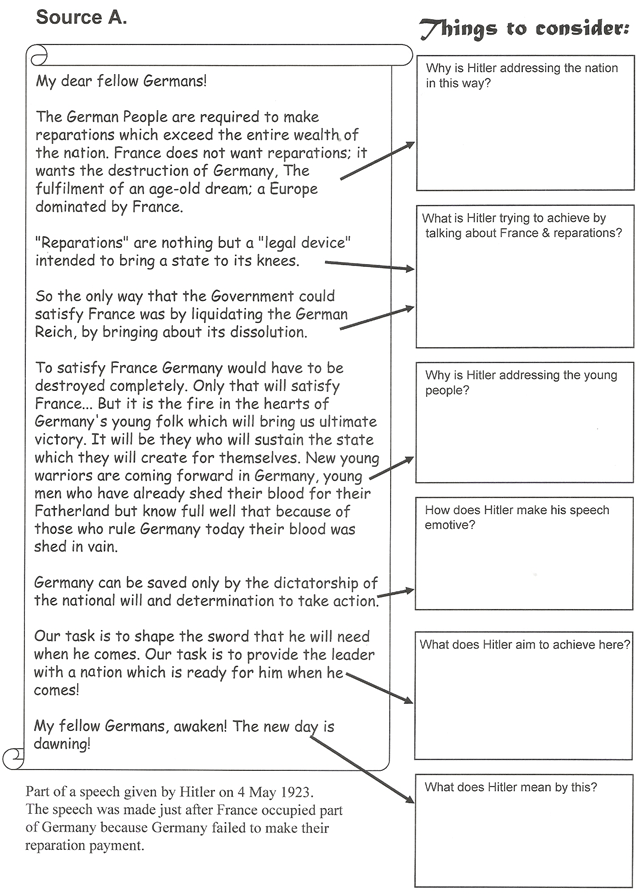
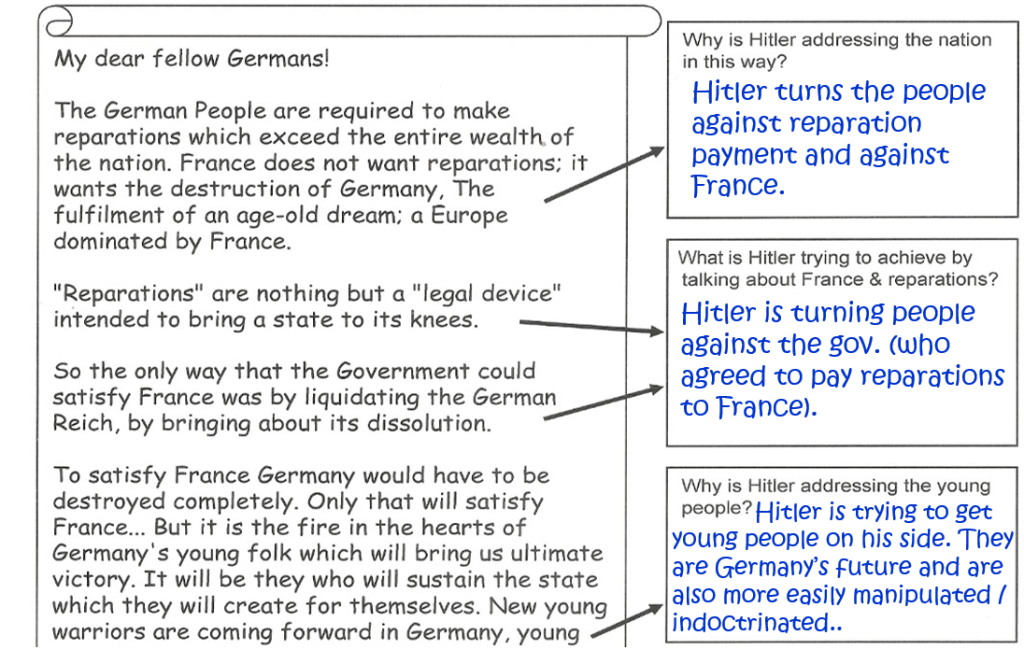
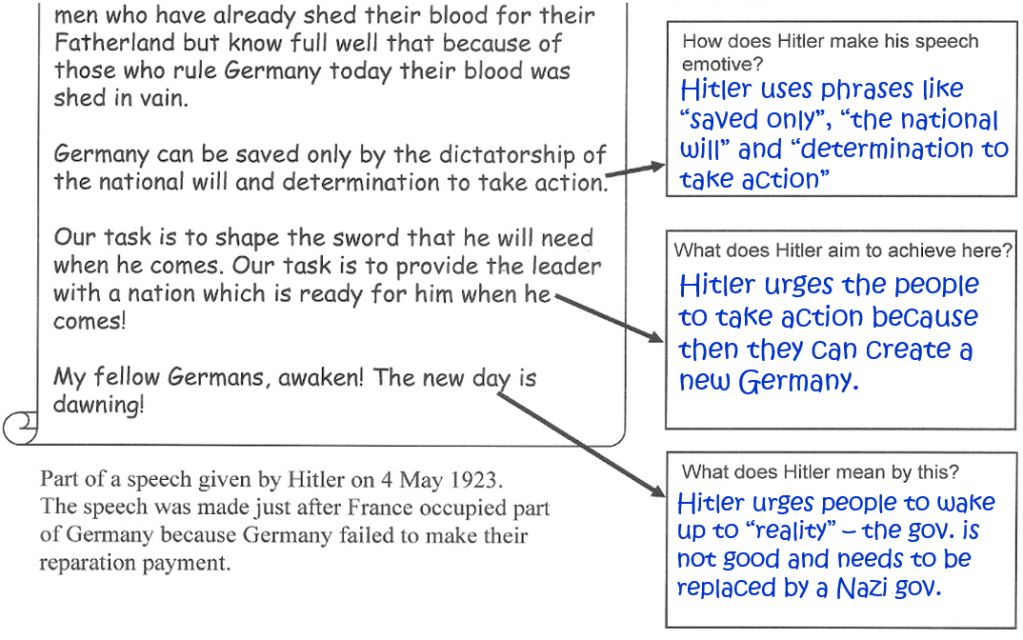
Let’s examine the following speech of Hitler to see how Hitler incited the crowds in his speeches.
Page 12
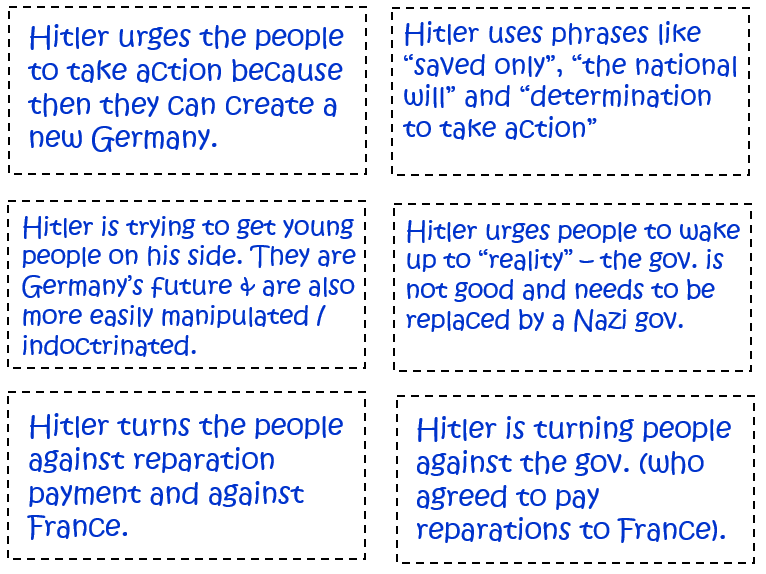
5.
Now match the answers (below) to the questions asked in the boxes to the right of the speech.
SOLUTION:
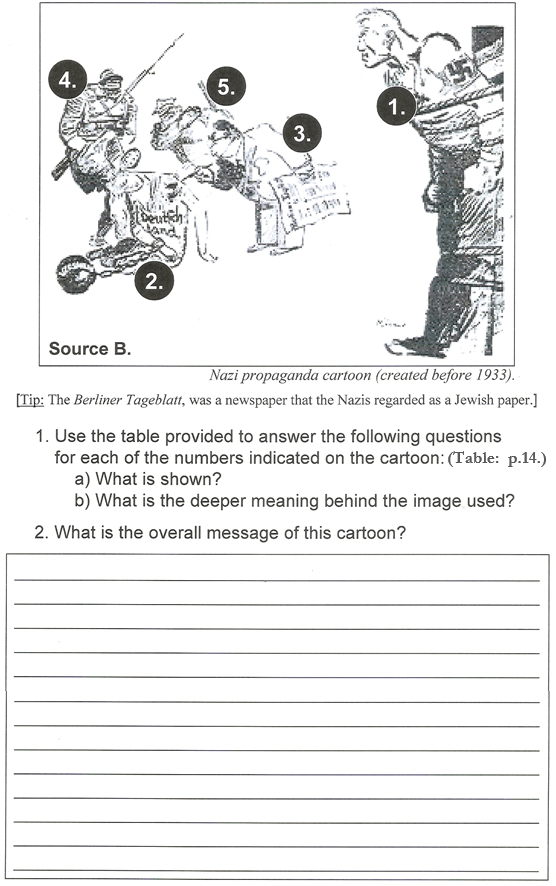
6.
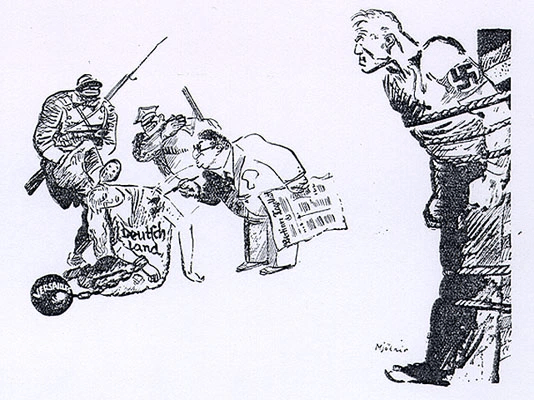
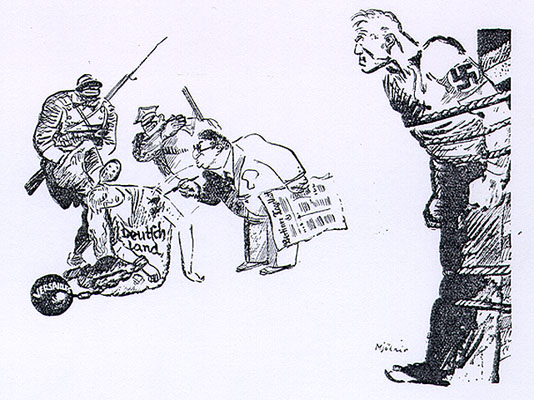
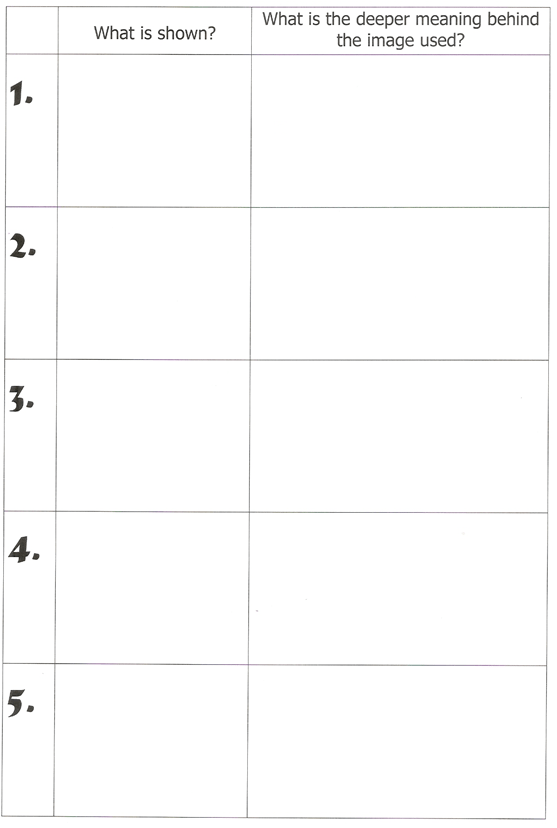
Carefully look at the Nazi propaganda cartoon on p.13 and complete the table on p.14, to consider what the meaning of the cartoon may be.
7.
Here is a little bit of help with the interpretation:
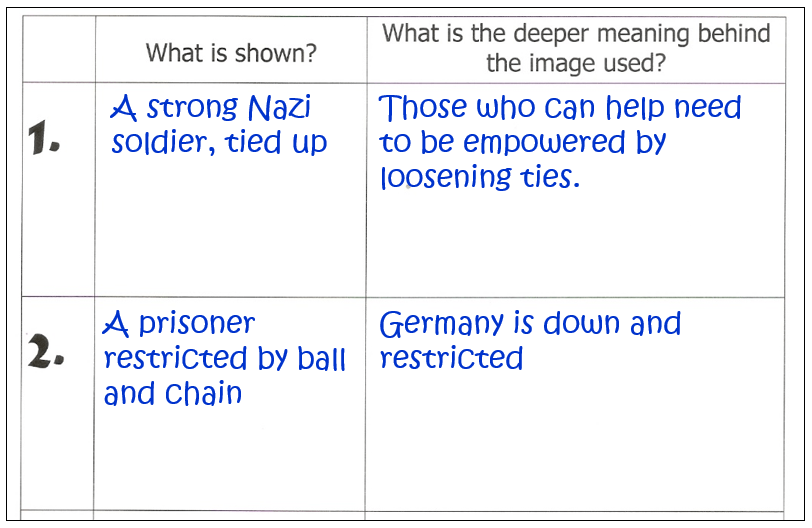
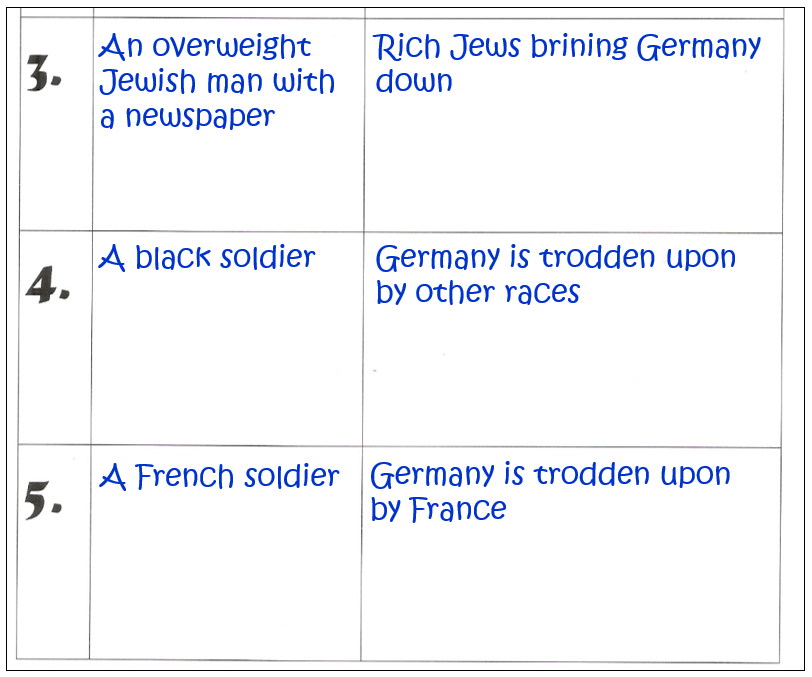
“A tied-up Nazi watches while a Jew holding the Berliner Tageblatt, which the Nazis accused of being a Jewish paper, mistreats a Germany chained to the Treaty of Versailles. The Jew is probably supposed to be a journalist, since he is smearing Gemany with his pen. A Black French colonial soldier and a policeman assist. The policeman is likely Polish” or French (“since Germany lost territory to Poland” and France “as a result of the Treaty of Versailles)”.Those Damned Nazis (1932) (calvin.edu)
8.
Now, complete the table on Page 14:
SOLUTION:
9.
Now, complete the box on p.13 to summarize what the overall message of the cartoon is.
Assignment:
You may be asked to look in the Schoology Assignment Folder and do the following: You have to complete this box (p13.) and submit it as an assignment for grading, in Schoology…
10.
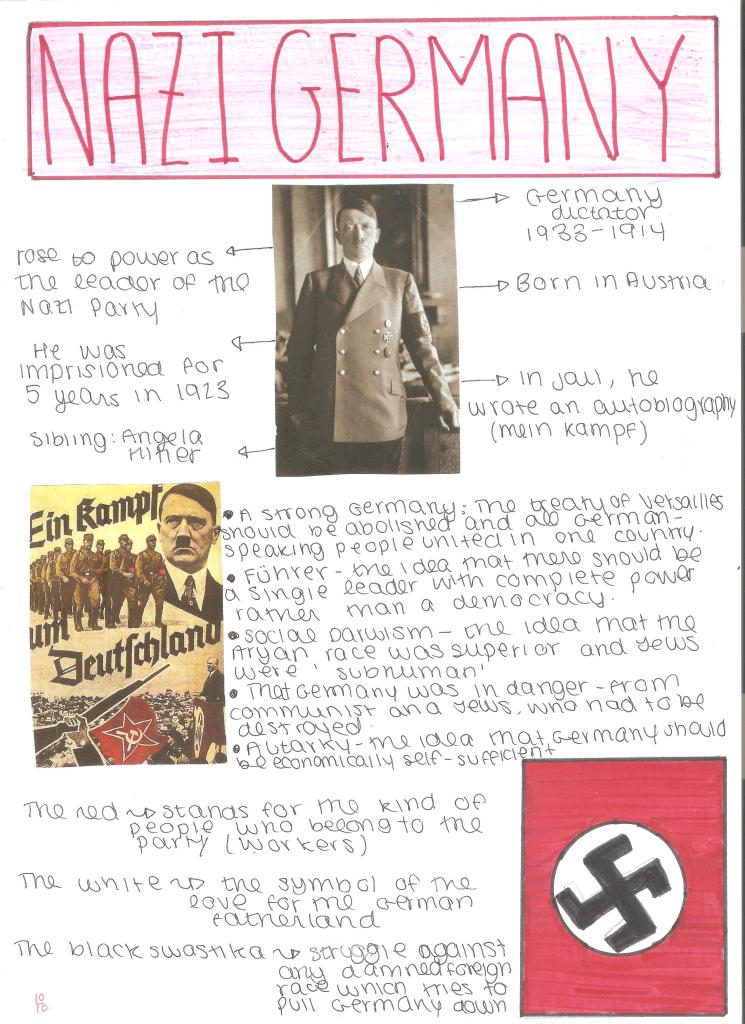
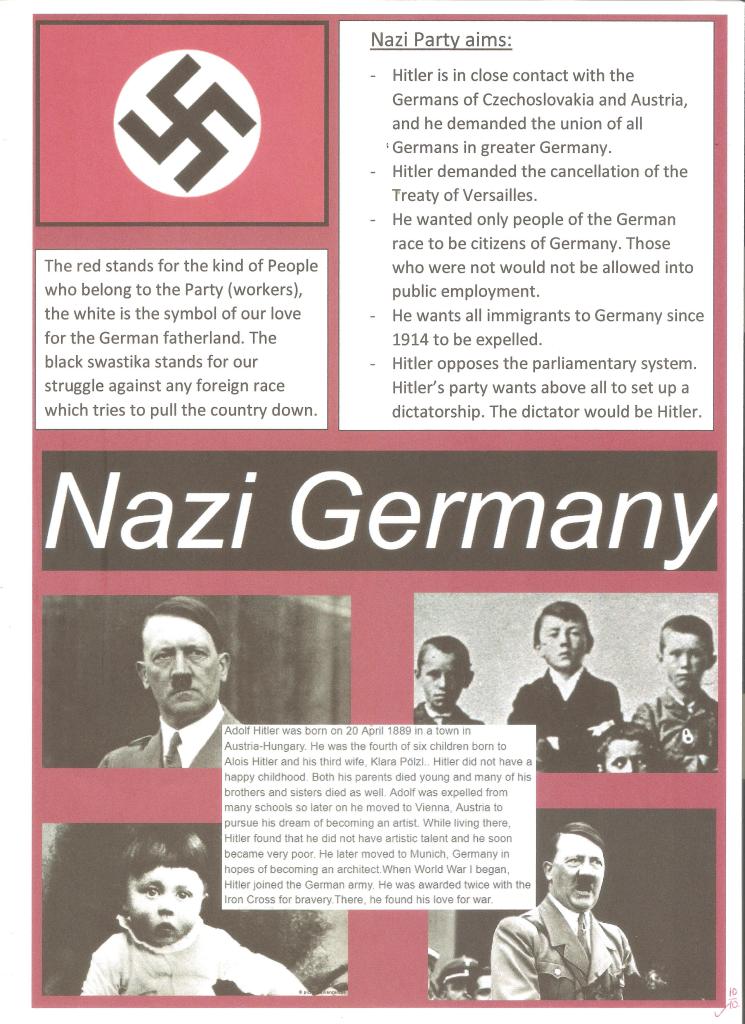
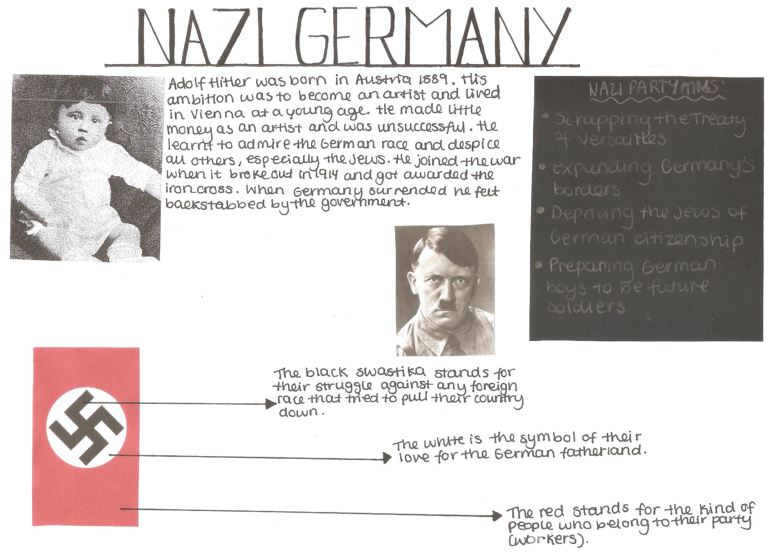
Finally, make a title page for our topic on Nazi Germany. Use an A4 paper for this task. (Hand in your title page for marking. Only after it has been returned to you may you stick the title page into your purple book.)
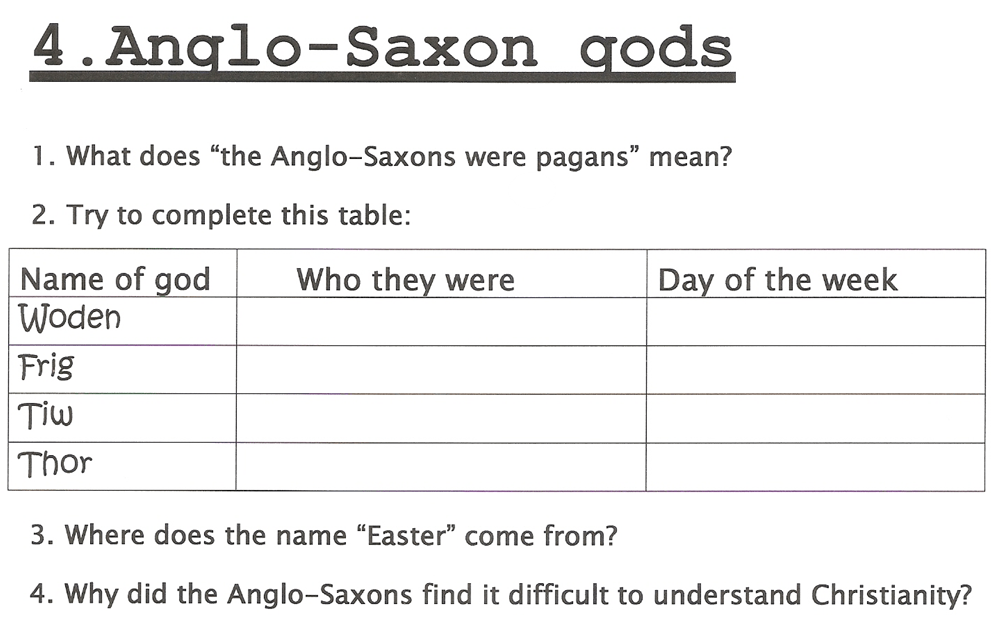
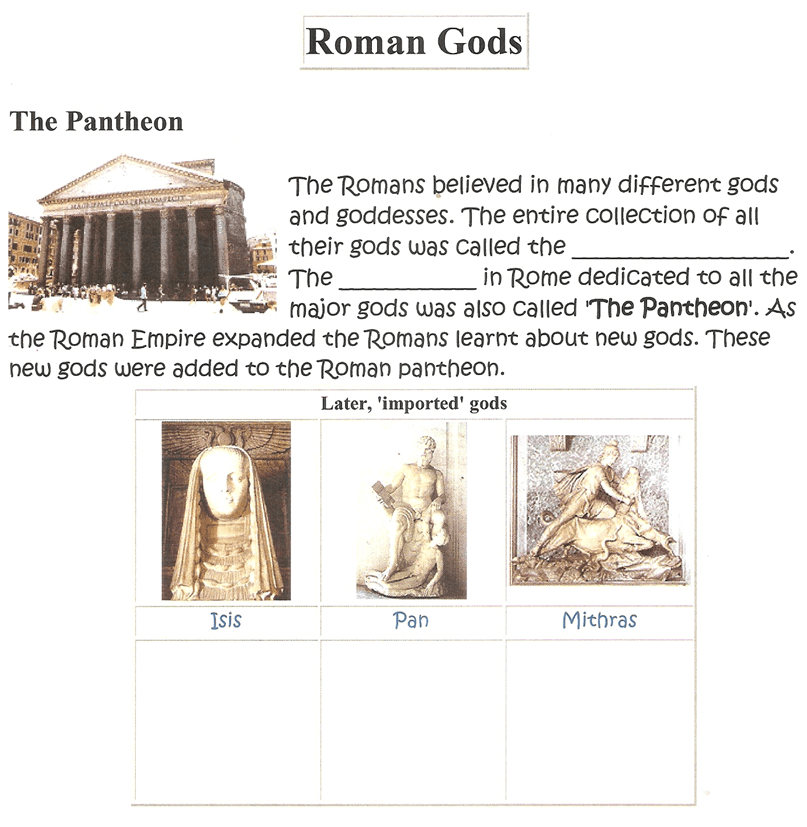
We have looked at Roman gods and the Roman religion in the previous lesson. Now, let’s look at the Anglo-Saxon religion.
Anglo-Saxon gods. (3:49 minutes long)
3.
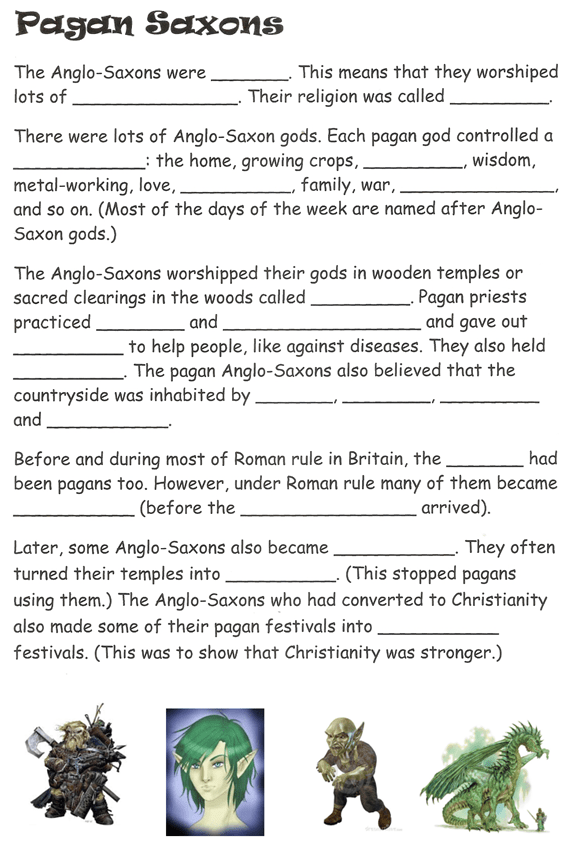
Fill in the missing words on the text on p.52.
SOLUTION:
(1:45 minutes long)
4.
Now, complete the cut-&-paste task on p.50-51 of your Workbook.
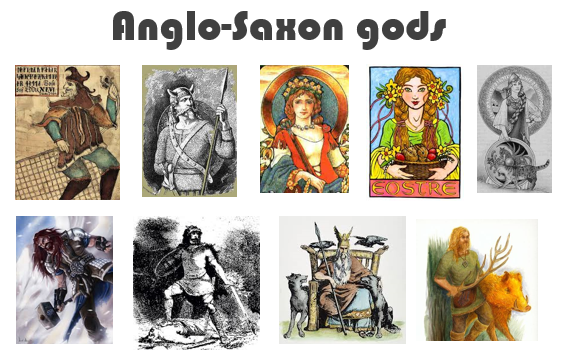
You have to stick the pictures of the Anglo-Saxon gods in the correct boxes, next to the description of each Anglo-Saxon god. (The pictures below will be handed out in class for you to use.)
If you search on Google for information, make sure that you understand what you read. Do not just copy down information if you do not really understand how the Church was organised. If you do not understand, do further research into the organisation of the Church!
Today you are going to look at Anglo-Saxon religion…
Follow the instructions step by step:
1.
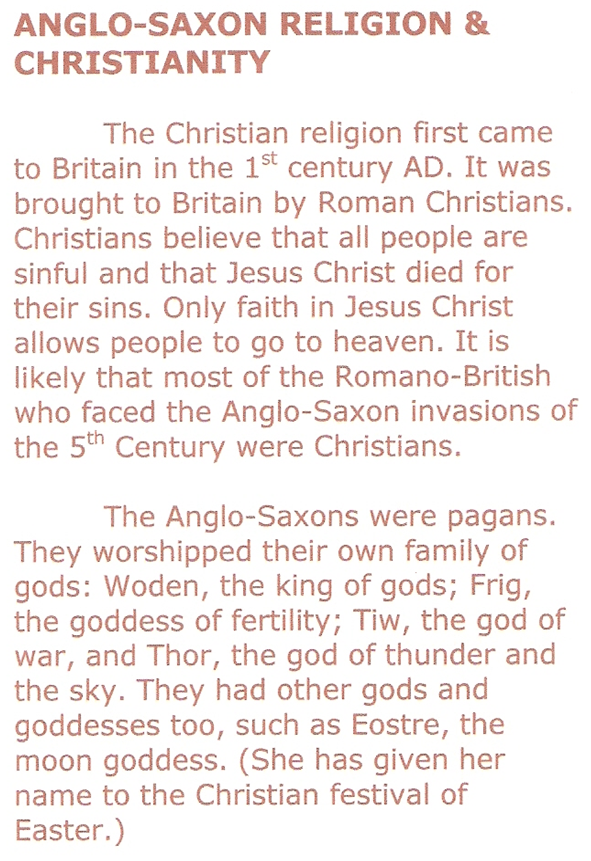
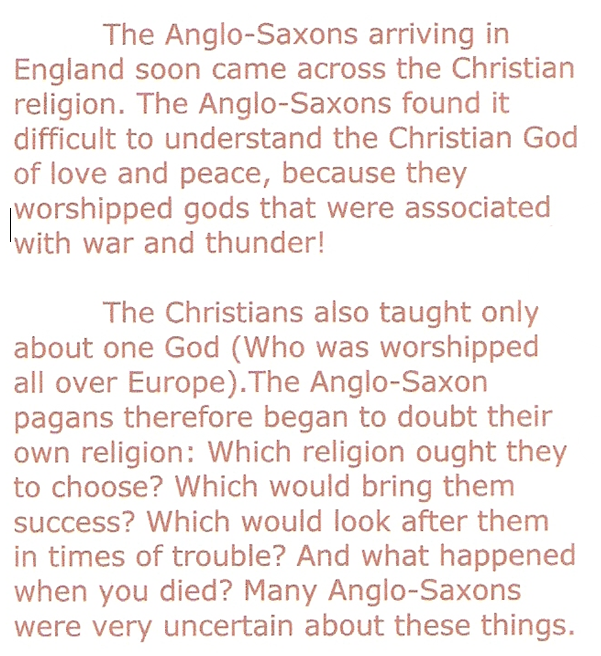
“Anglo-Saxons & Religion”, p.47
2.
The text mentions St. Patrick. For interest’s sake, let’s look at two short video clips to see who he was…
A Brief History of St. Patrick’s Day. (1:47 minutes long)
St. Patrick’s Day: Bet You didn’t Know. (2:34 minutes long)
3.
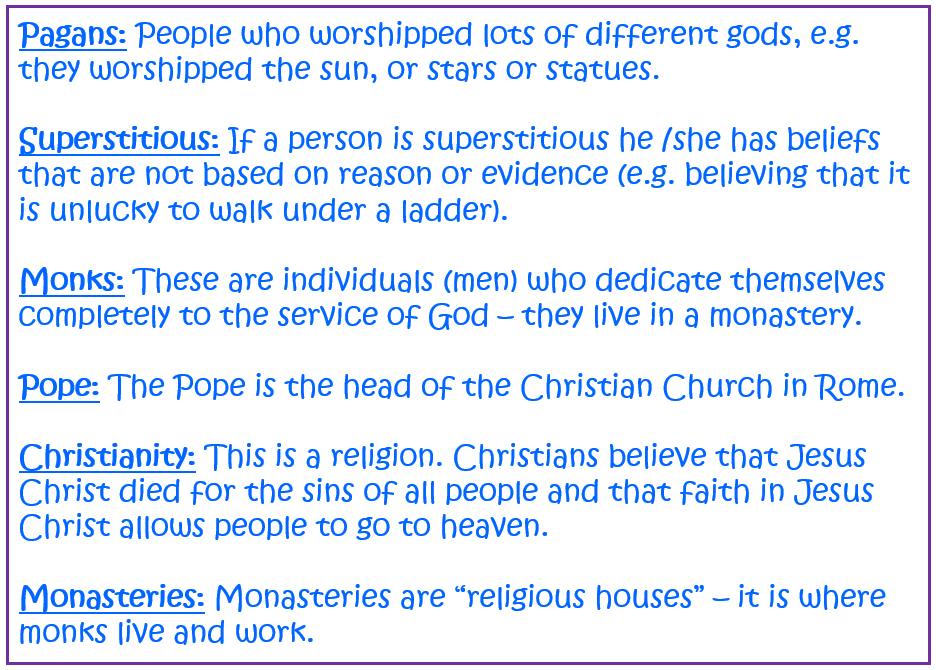
Let’s make sure that you also understand the following words mentioned in the article on “Anglo-Saxons and Religion”:
4.
Fill in the meanings of the vocabulary on page 47.
(You need to write the meanings of the words into the boxes on page 47.)
5.
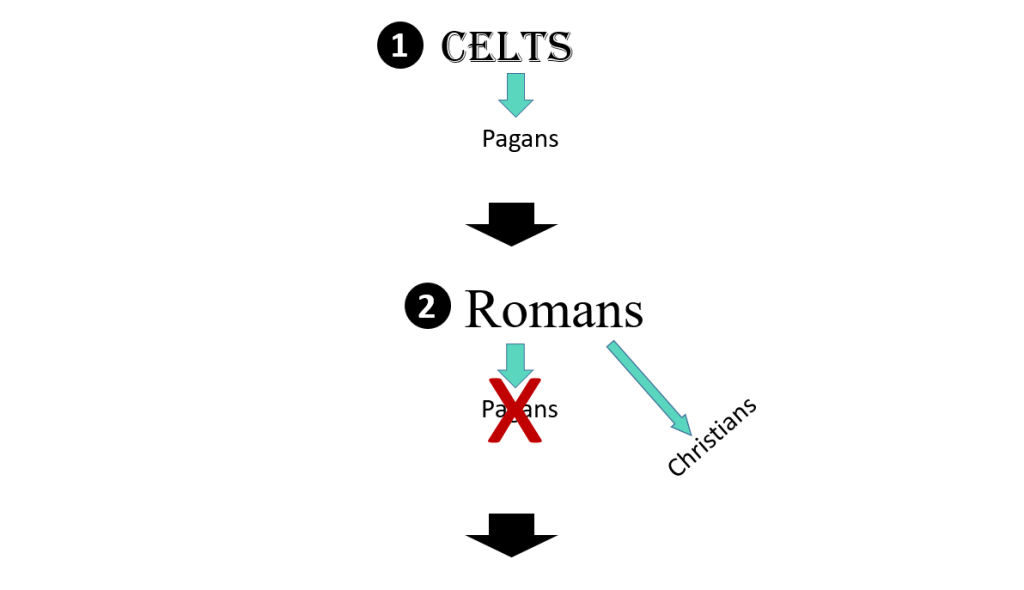
Examine the diagram below. It gives an overview of religion in Britain from Celtic times to Anglo-Saxon times…
The diagram shows that the Celts were mainly pagans; The Romans were first pagans and then became Christians; The Romano-British were mainly Christians; The Anglo-Saxons were mainly pagans and then became Christians.
You are going to learn how the pagan Anglo-Saxons became Christians and what impact these Anglo-Saxons had on religion in England.
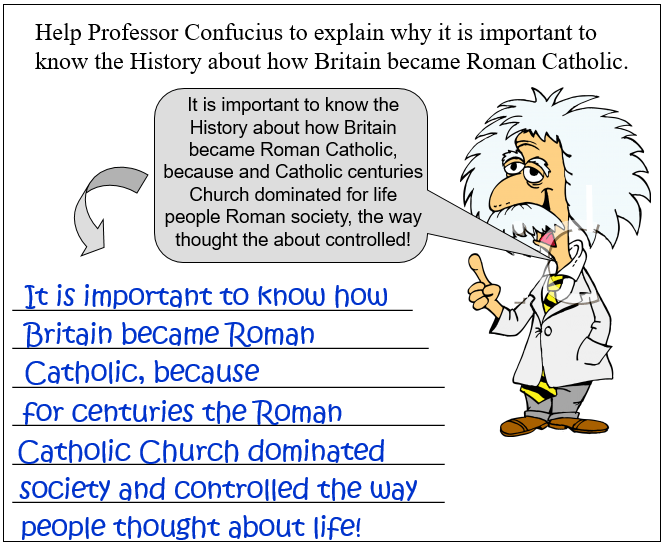
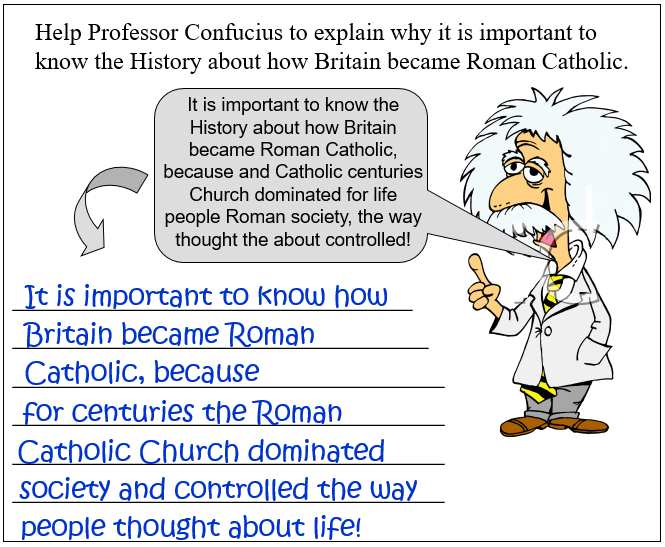
WHY?
It is important to know how the people of Britain became Christian, because for centuries the Church dominated society and controlled the way people thought about life!
6.
Before we look at Anglo-Saxon Religion, let’s go back to Roman times and look at the Roman religion first.
Roman gods. (3:48 minutes long)
7.
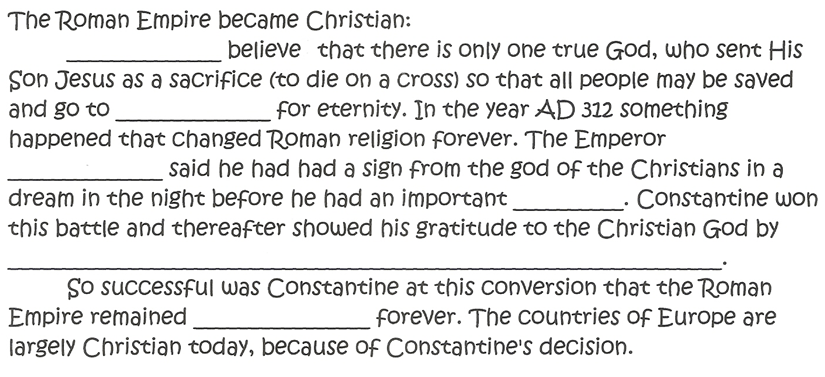
Fill in the missing words on the text on p.48.
SOLUTION:
(1:41 minutes long)
8.
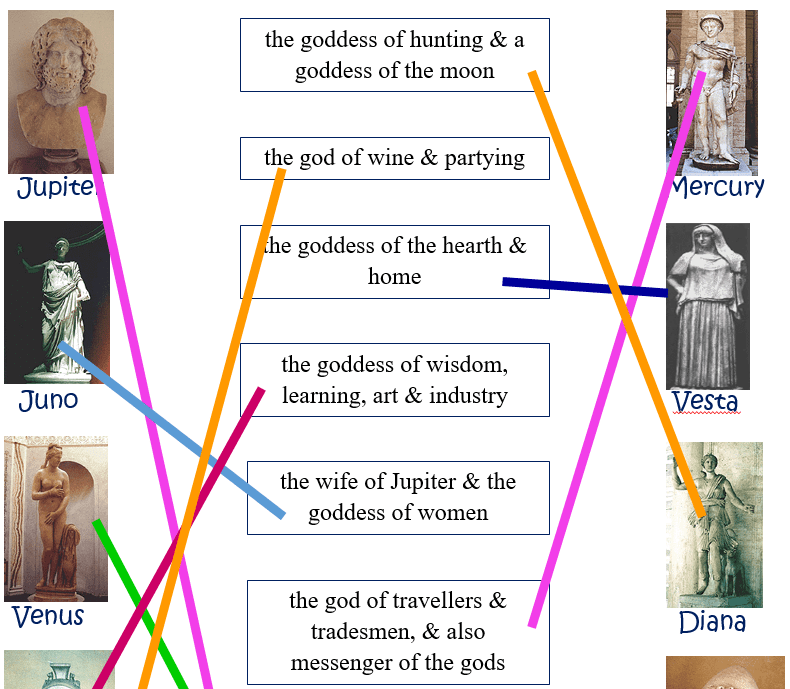
Now, complete the Task on p.49. You have to match the names of the Roman gods with the descriptions in the center of the page. (You can draw lines to connect the names and descriptions, or use different highlighters to show which names belong to which descriptions.)
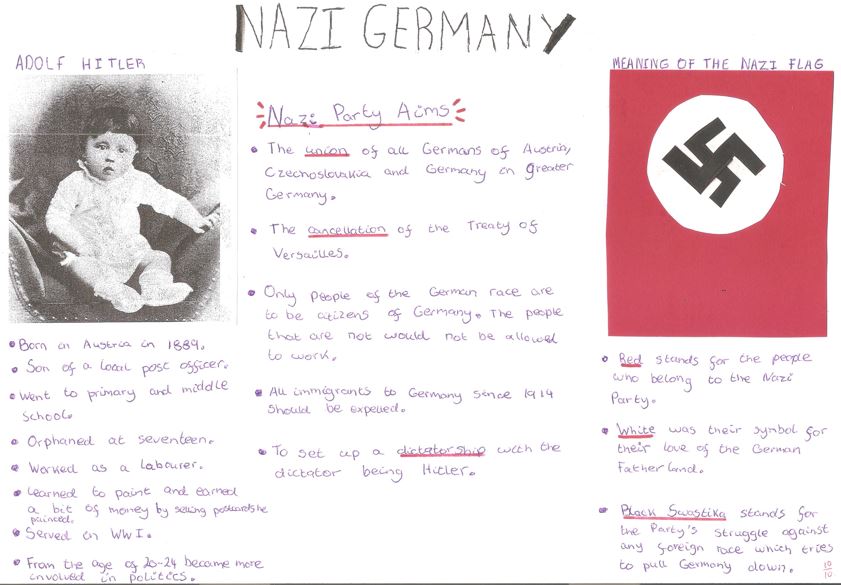
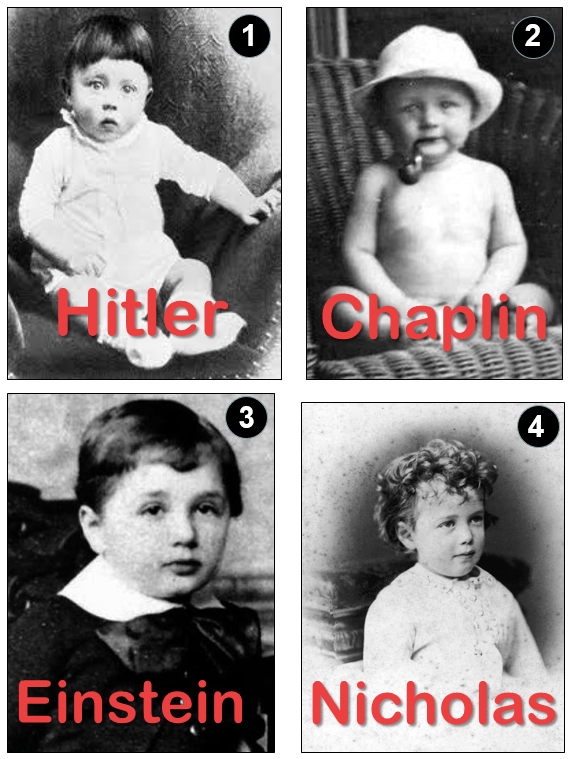
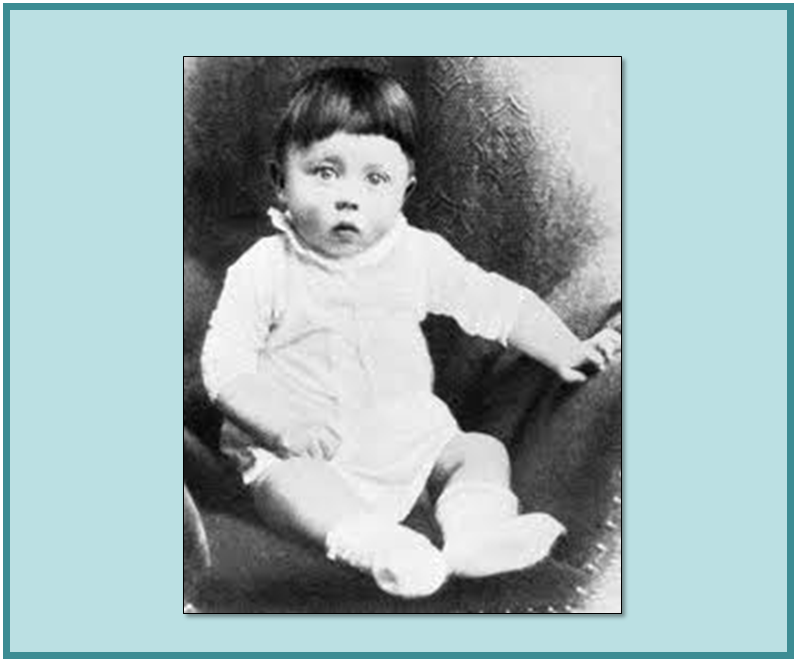
How is it possible that such an innocent looking child can become such an evil dictator?
3.
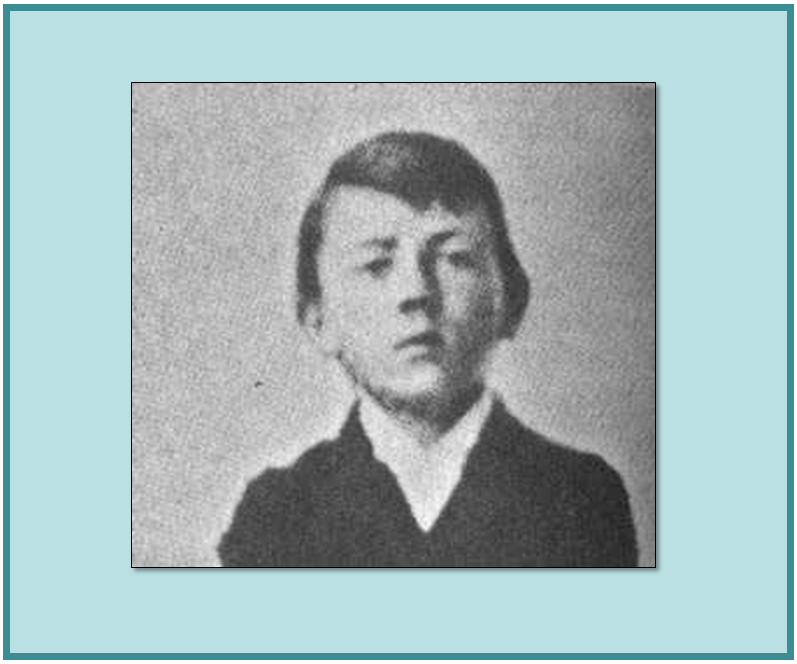
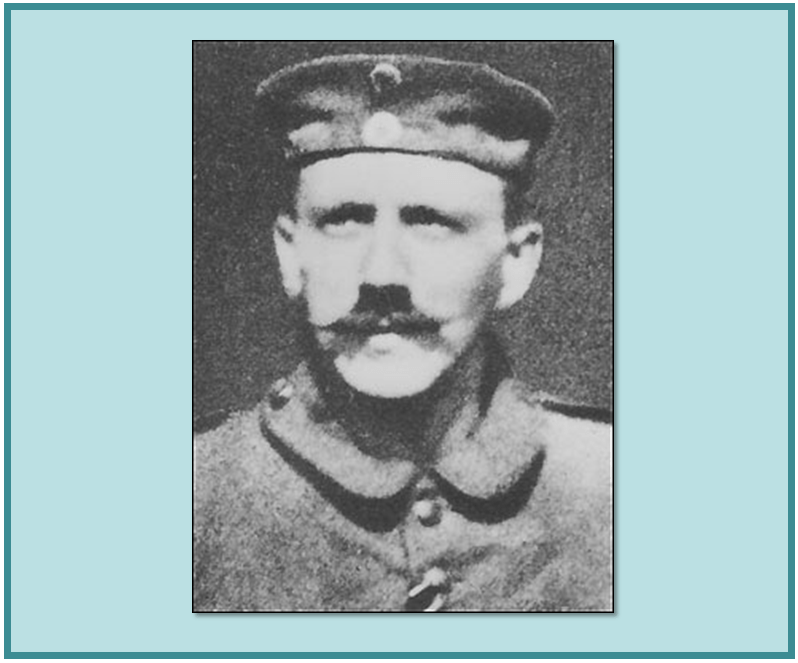
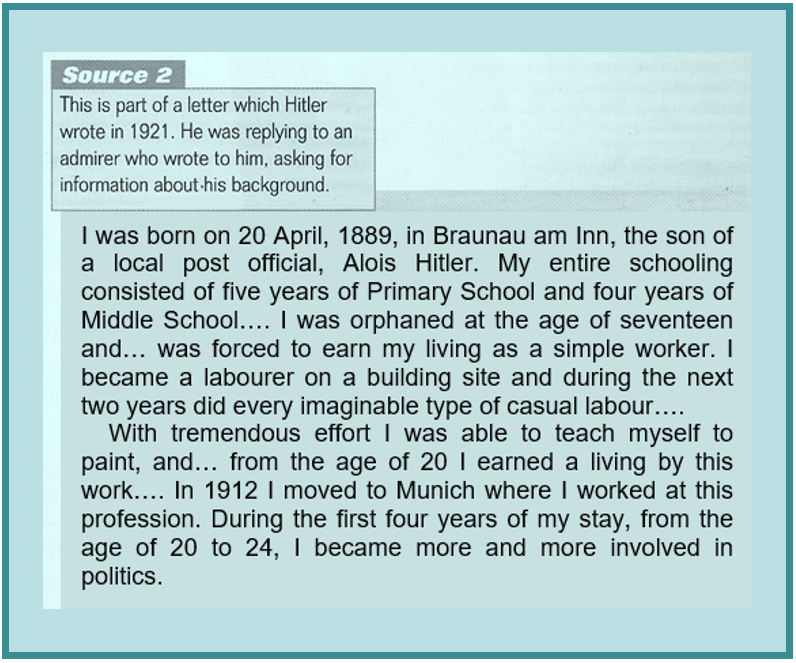
Below is a brief background History of the Nazi leader, a man who somehow succeeded in deceiving his followers to accept and support his evil warped ideas, as if they were completely normal. Go through the slides to see how Hitler grow up and to learn a bit about his childhood:
4.
This short video clip is an old documentary that also tells you a little about the young Hitler…
The Rise and Fall of the Third Reich. (2:54 minutes long)
5.
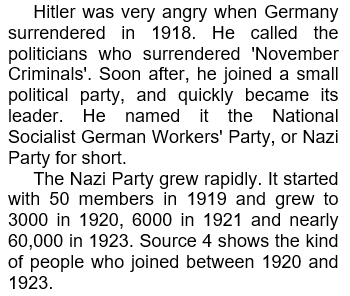
So, how did the Nazi Party come into existence? The following information comes from your Workbook on Nazi Germany, page 7.
The kind of people who joined the Nazi Party was working class people…
6.
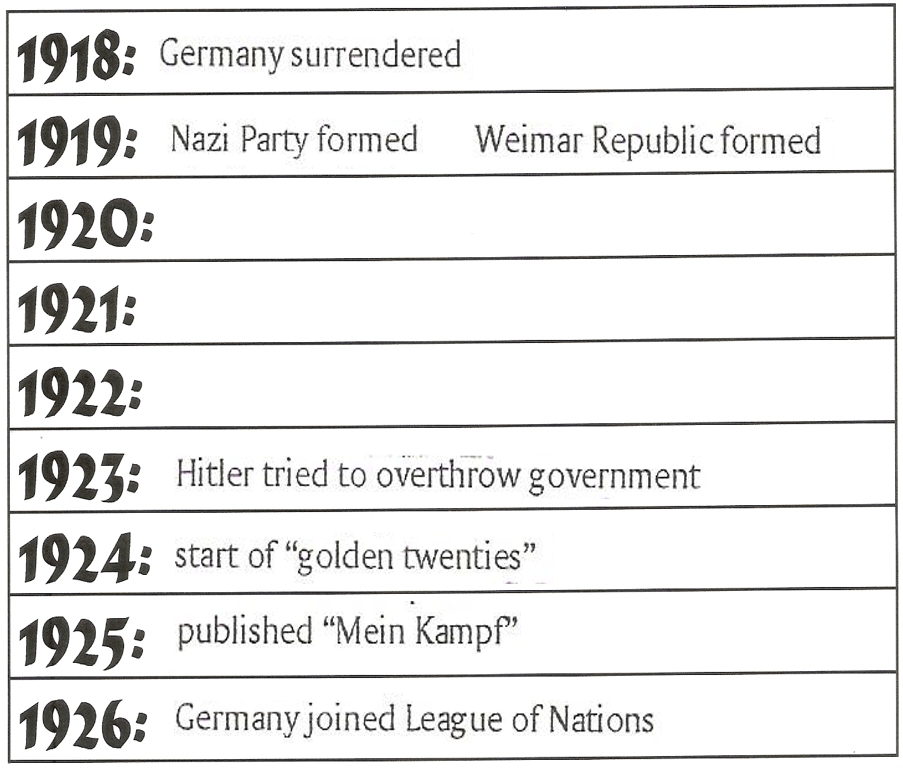
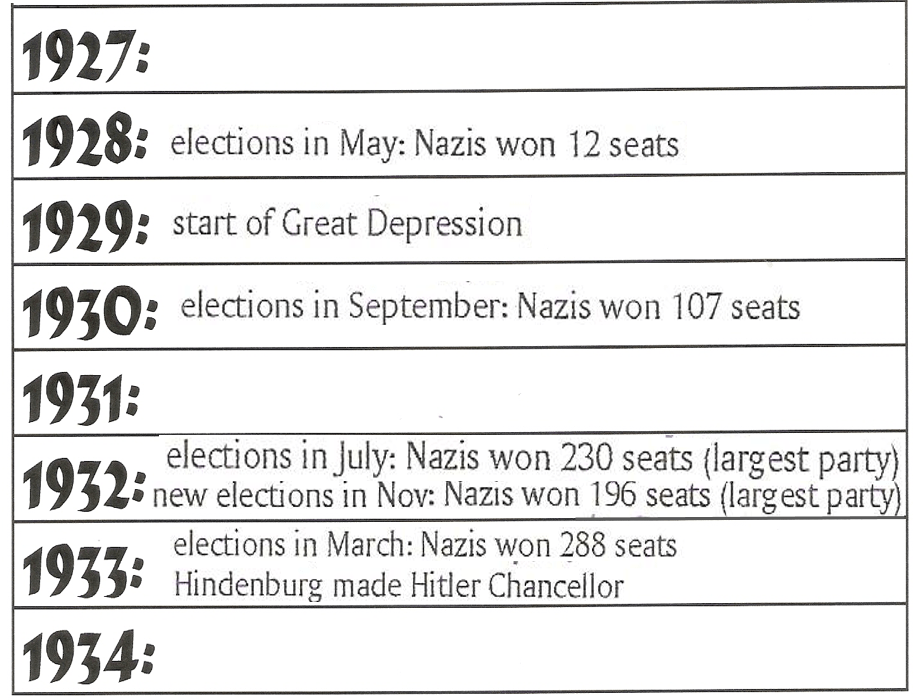
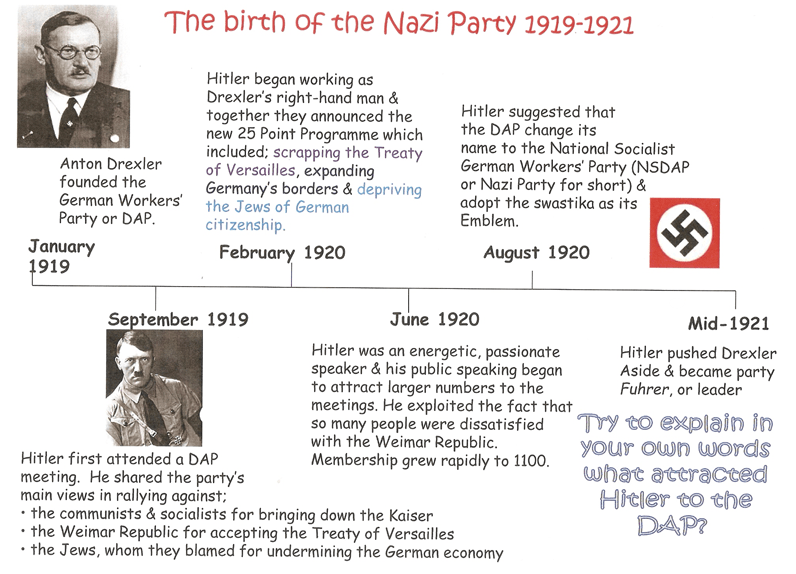
The timeline on p.3…
It gives more details about the origins of the Nazi Party.
(This diagram is on p.3 of your Workbook on Nazi Germany.)
7.
Here is another short overview of the Nazi’s rise to power.
Rise of the Nazi Party. (3:13 minutes long)
8.
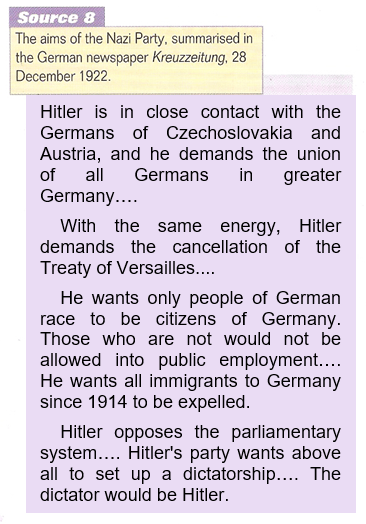
What were the aims of the Nazi Party?
Union of all Germans into Greater Germany
Cancellation of the Treaty of Versailles
Only German race to be German citizens
Expel all immigrants to Germany
Set up a dictatorship
Make Hitler the dictator
9.
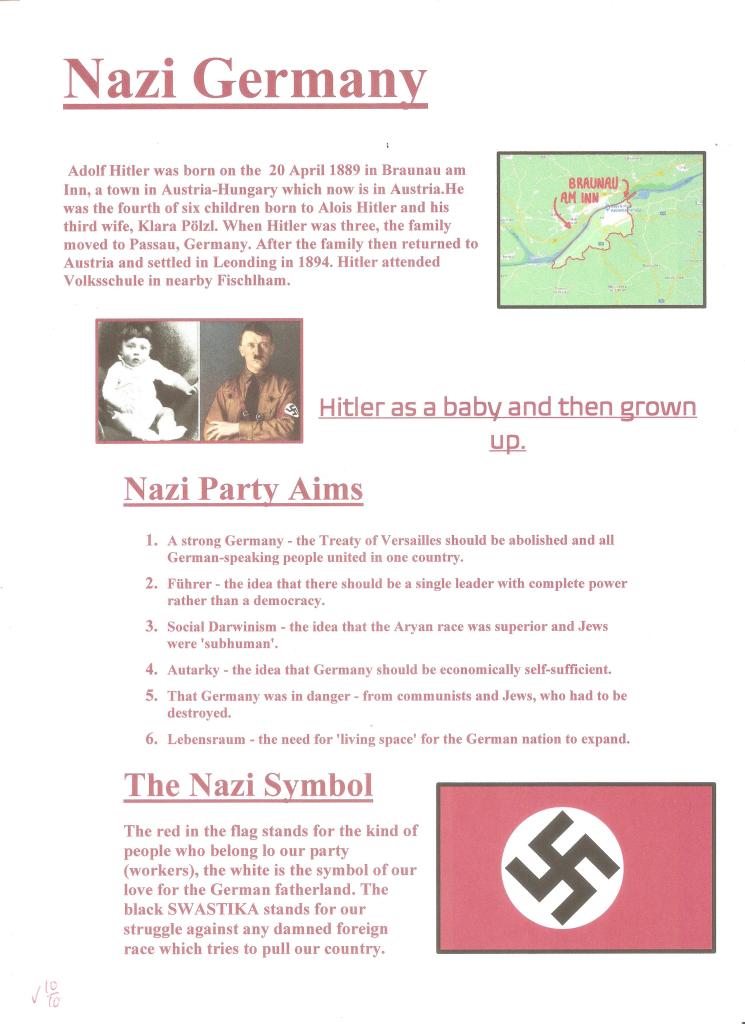
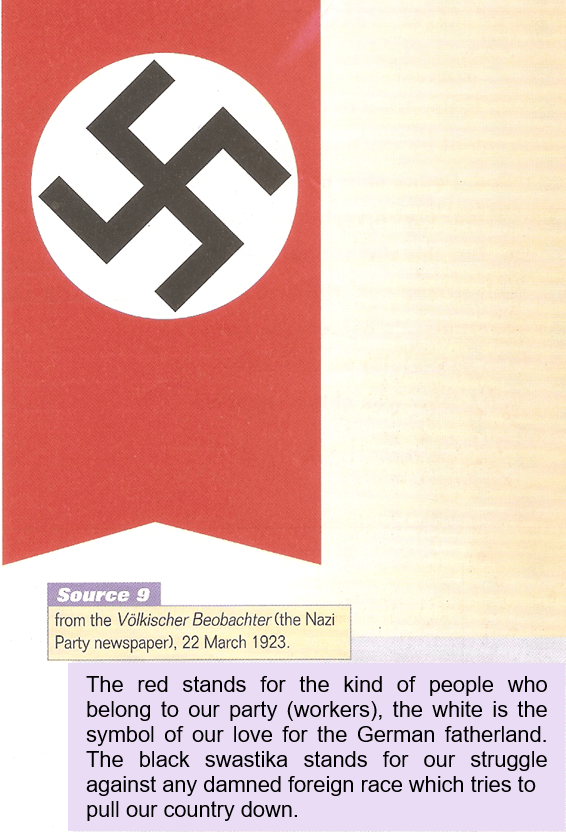
The Nazi Party had an eye catching symbol. Sadly, the swastika symbol was taken from other cultures and tarnished by the Nazi Party. Today, in Western cultures, the swastika is synonymous with extreme right politics and racism.
For our study on Nazi Germany, we are particularly interested in the meaning of the symbol, as the Nazi’s interpreted it. In Source 9, they explained their view of it .
10.
The two video clips below give an overview of the original swastika symbol, before Nazis adopted it as their Party symbol.
The History of the Swastika. (1:14 minutes long)
The swastika was a symbol of peace until Hitler stole it. (1:36 minutes long)
11.
Let’s see what else you can learn from your Workbook about Hitler and the Nazis…
p.6-9
12.
Page 6 in your Workbook on Nazi Germany mentions that, once Hitler came to power, people all over Nazi Germany regularly greeted each other with the Nazi salute.
Below is a short history of the Nazi salute. Due to the crimes committed against millions in Europe, by Hitler and the Nazis, the Hitler Salute is now a symbolic reminder of a terrible regime. In fact, doing the Nazi Salute is banned in some countries.








































































































































 Best study methods