Today you are going to start with the topic on The Reformation…
Follow the instructions step by step:
1.
Task 7 on p.25.
2.
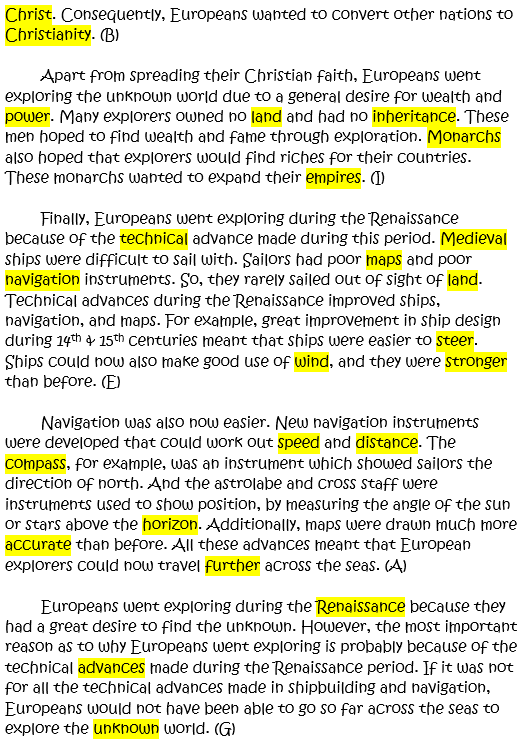
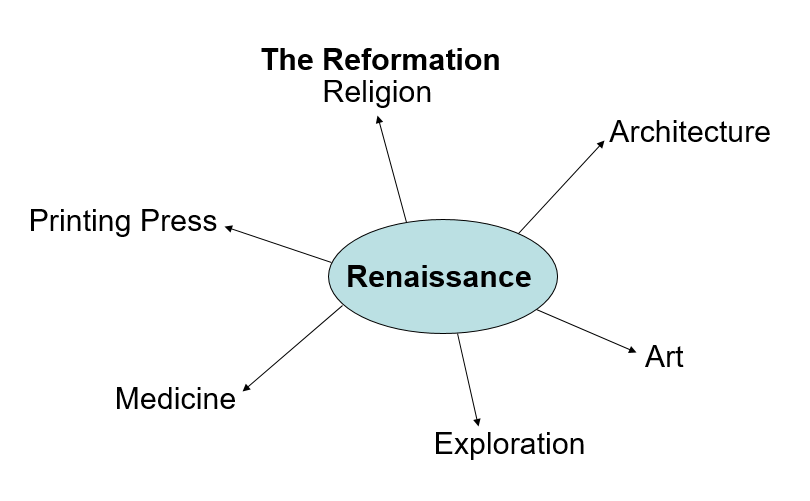
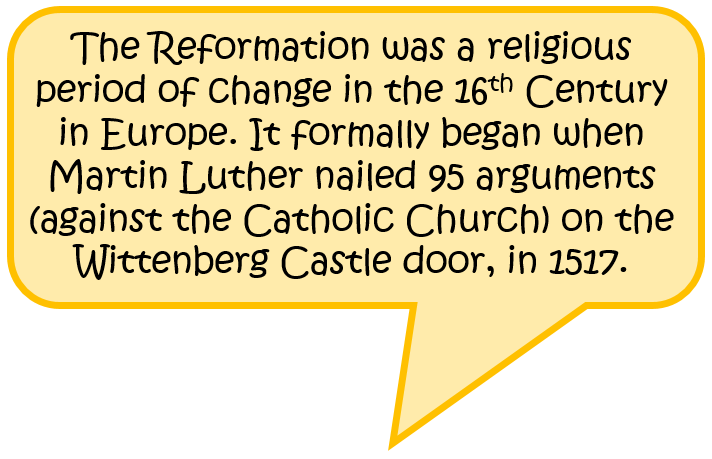
The Renaissance brought many changes – one of whom involved religious changes – the so-called Reformation.
3.
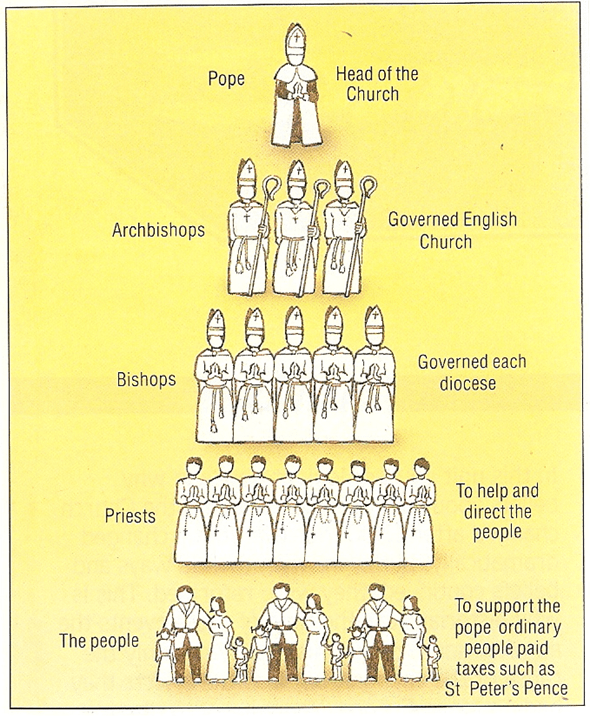
We will first familiarize ourselves with some background information about religion, simply because it will help us to understand this period of history better. Let’s start with a video about the history of the Christian church.
Today you are going to familiarize yourself with typical exam questions about Stalin’s Russia!
(a) How did Stalin control the USSR? (4)
(b) Why did Stalin create a “cult of personality”? (6)
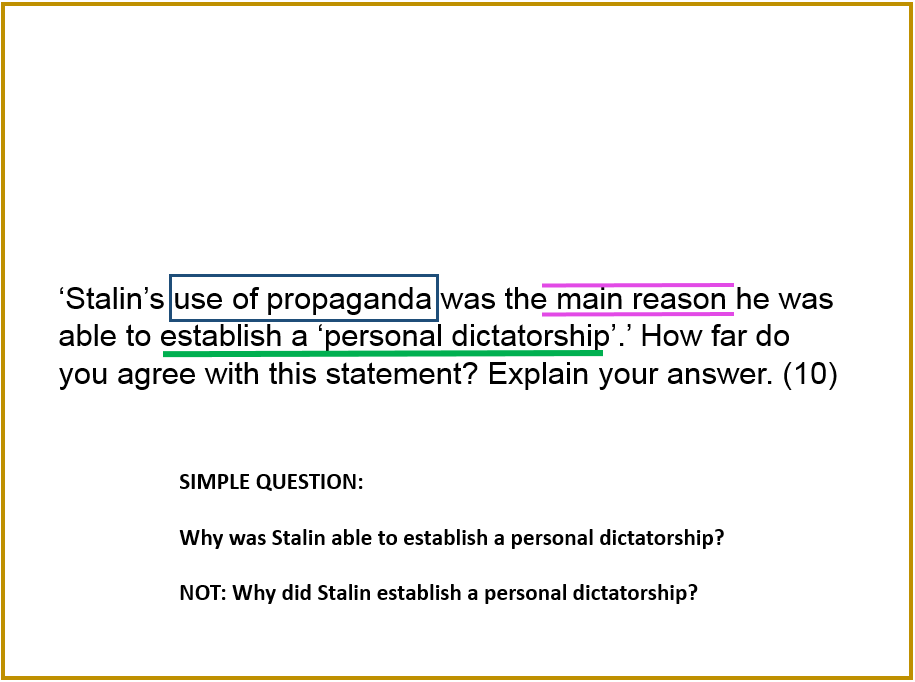
(c) ‘Stalin’s use of propaganda was the main reason he was able to establish a ‘personal dictatorship’.’ How far do you agree with this statement? Explain your answer. (10)
(Use your essay-writing book for today’s tasks.)
1.
Let’s first look at a typical 4-mark question….
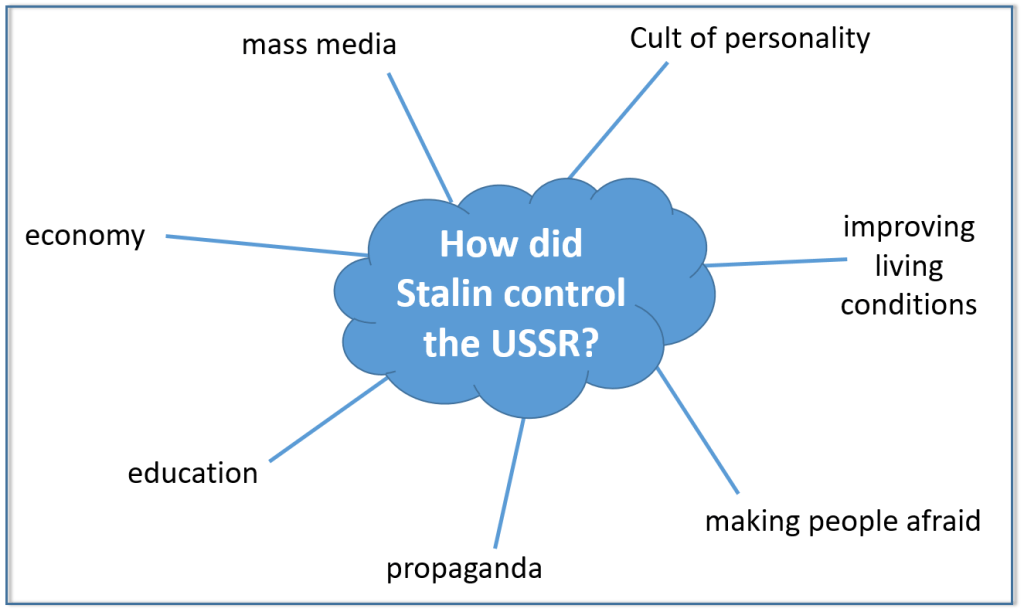
How did Stalin control the USSR? (4)
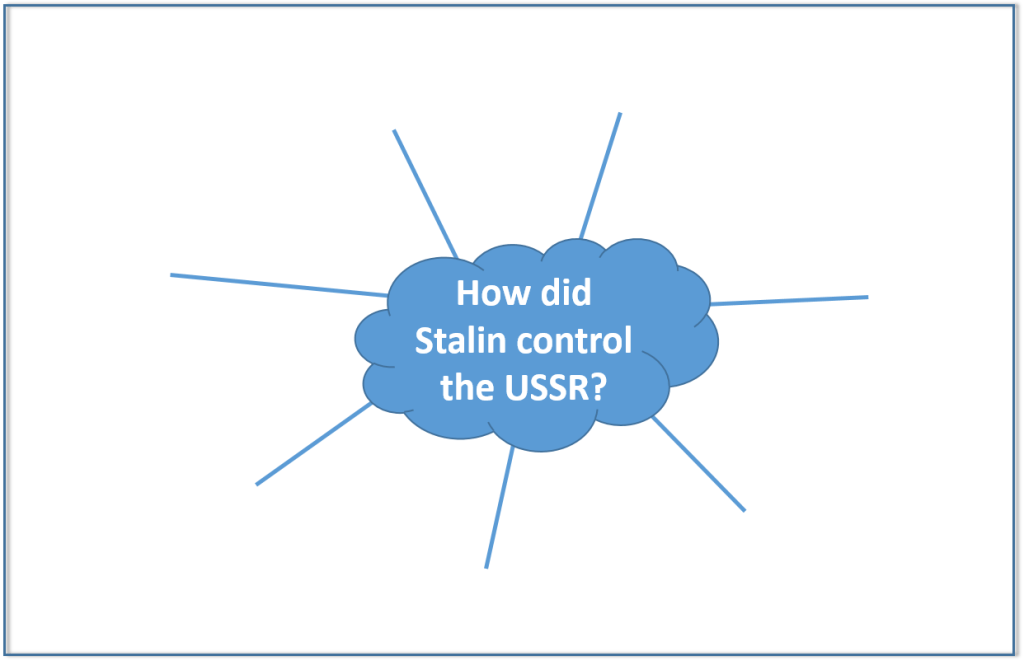
Make a spider diagram with some ideas as to how Stalin controlled the USSR.
SOLUTION
2.
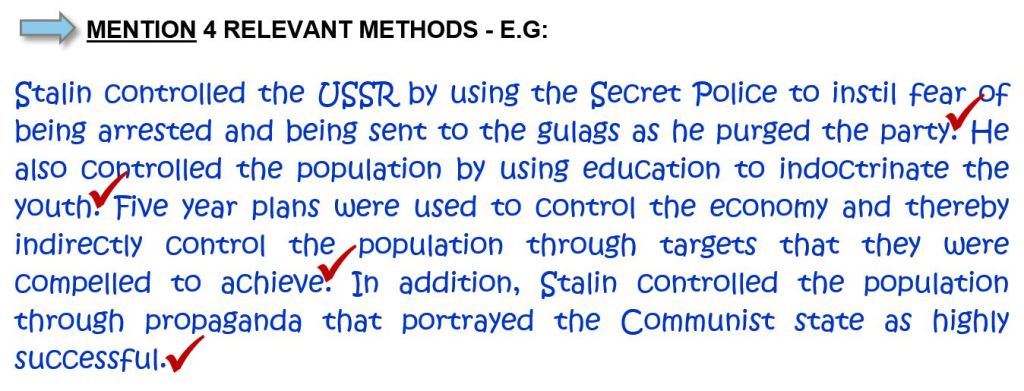
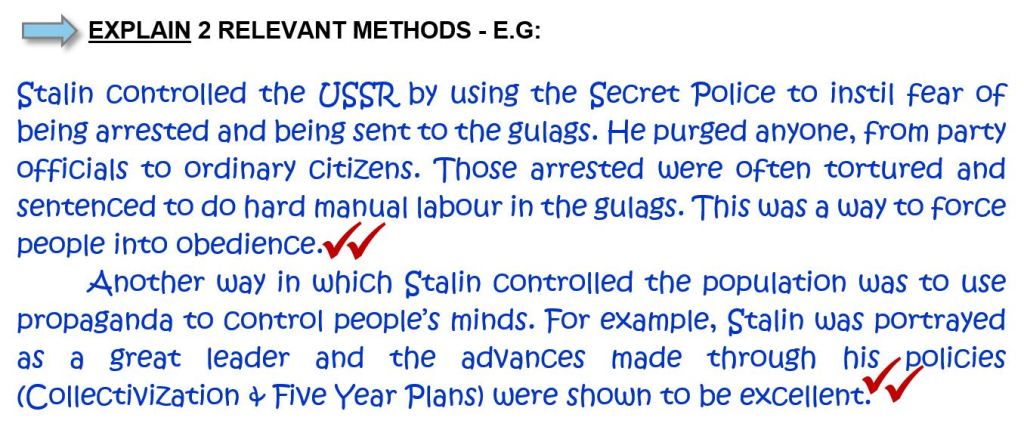
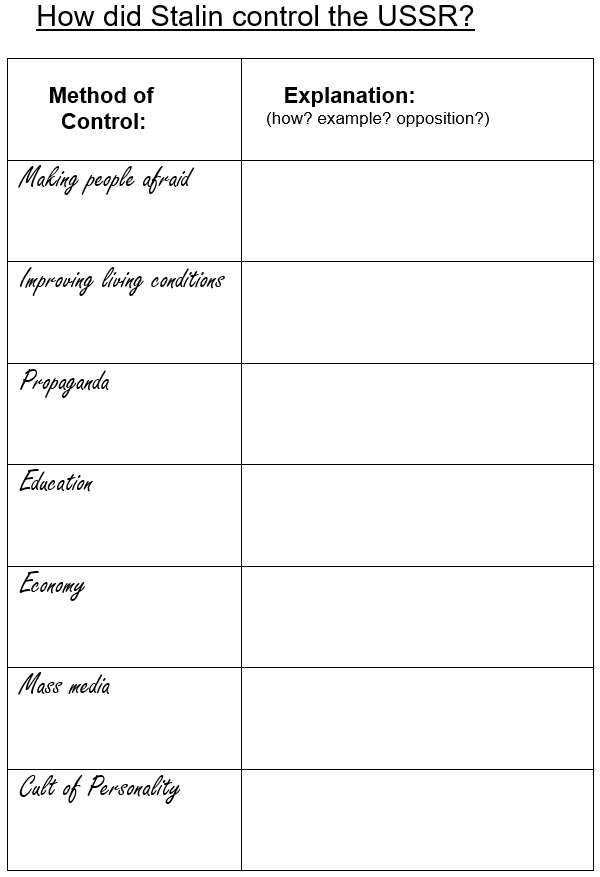
If you explain two of the methods (on the table below) in detail, you will get 4 marks. Or, if you mention four of the methods, you may also get 4 marks. (To be on the safe side, explain 3 methods, or mention 5 methods!)
METHODS
EXAMPLE:
OR:
3.
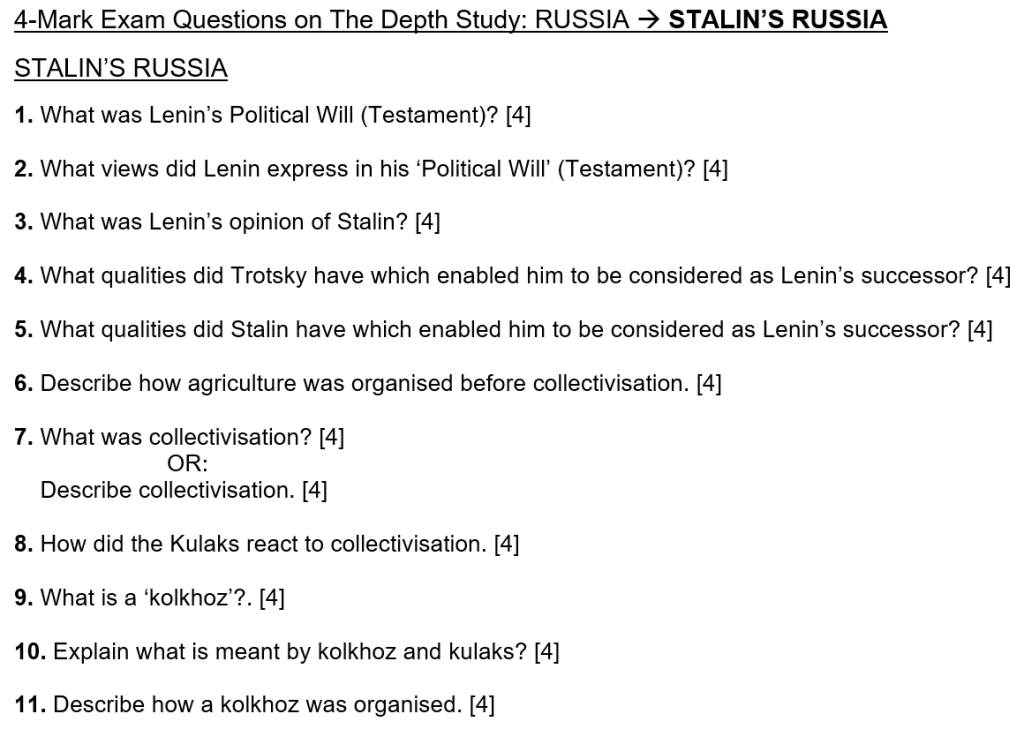
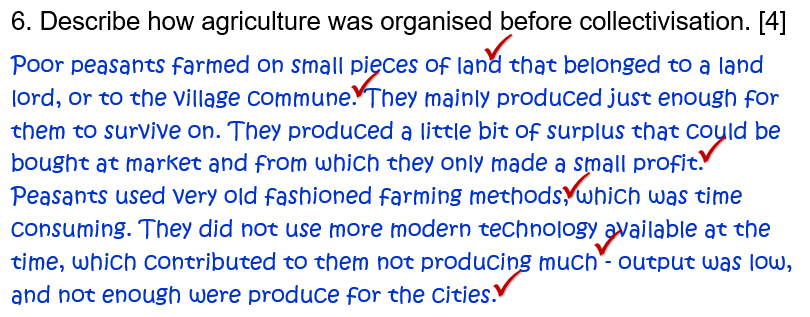
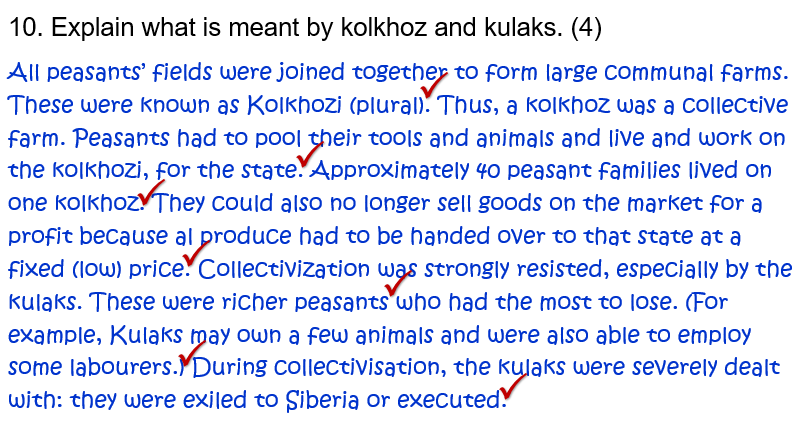
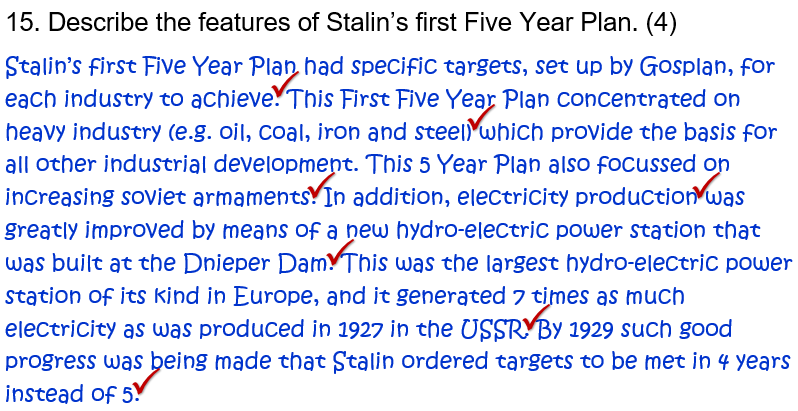
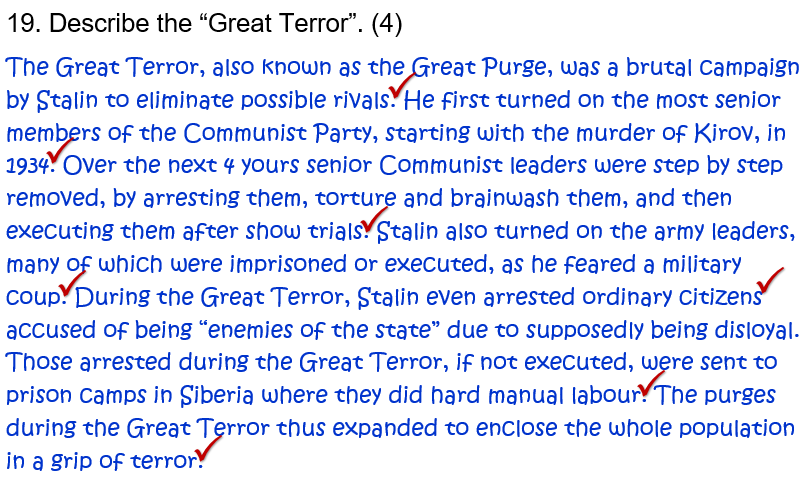
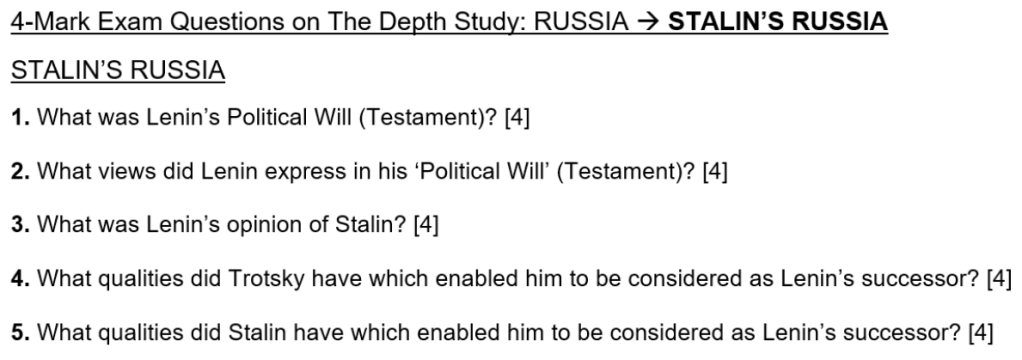
Below is a complete list of 4-mark exam questions on Stalin’s Russia. You should be able to answer any of them!
SOME ANSWERS:
4.
Let’s now also look at a typical 6-mark question.
Why did Stalin create a “cult of personality”? (6)
As you should know by now, these are usually “why-questions” and require you to give (and explain) clear reasons…
On a new page in your essay-writing book, write the question down and then make a list of possible reasons as to why Stalin created the cult of personality.
IDEAS:
Stalin created the cult of personality so that he could advocate himself as a great leader to the people of the USSR.
Stalin also aimed to gain (and keep) the support of the Soviet people by the creation of the cult of personality.
Stalin introduced the Cult of Personality because he wanted to be popular and liked and therefore ensured that he is fully supported.
In addition, Stalin aimed to influence the youth and indoctrinate them to insure the support of future generations.
Finally, by getting people to worship him as leader he would be perceived as popular and greatly supported (even though this was forced on the people) and so, Stalin could also ensure continued support.
5.
Finally, let’s look at a typical 10-mark question:
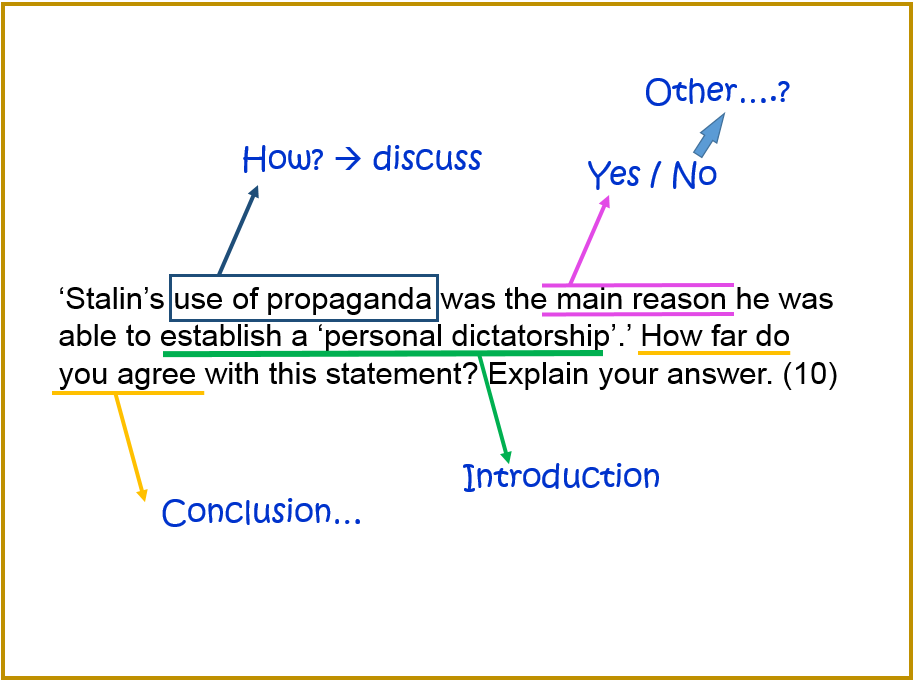
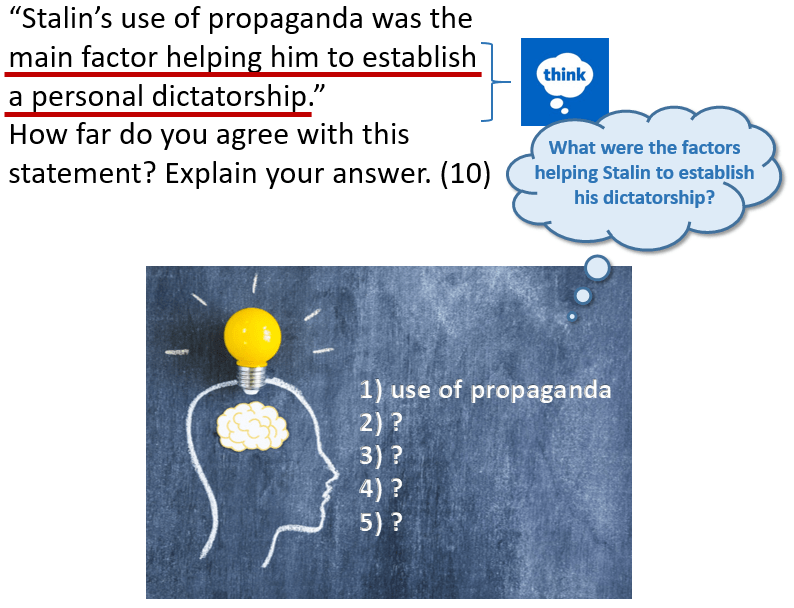
‘Stalin’s use of propaganda was the main reason he was able to establish a ‘personal dictatorship’.’ How far do you agree with this statement? Explain your answer. (10)
Remember, a 10-mark question requires you to give both sides of the argument and then reach your own conclusions…
Now, use your essay-writing book, and do the following:
write the question in the middle of a new page
analyse the question,
plan the question,
write the essay answer
ANALYSIS:
ESSAY PLAN TIP:
The information on the “How did Stalin control the USSR?” table (above), is also relevant to the 10-mark question…
(See feedback on this essay question in Lesson 11.)
Also, the question below is similar but just slightly differently worded – this may be useful to guide you too:
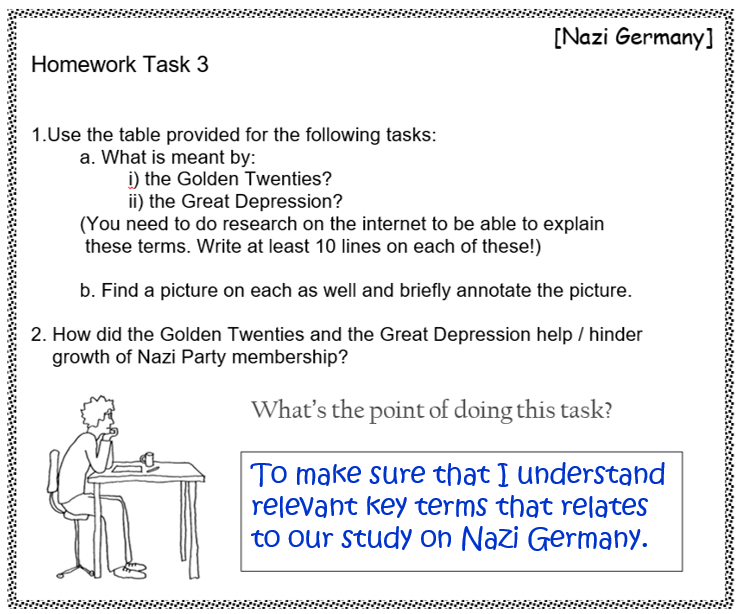
The work that you did on the Golden Twenties and on the Great Depression from the blue Workbook, on “The First World War & its Consequences”, may also be very useful…
Complete the “mood-o-metre” (on p.42) to show how you feel about the topic on “The Consequences of WW1” …! (Feel free to also make any other relevant comments about this topic.)
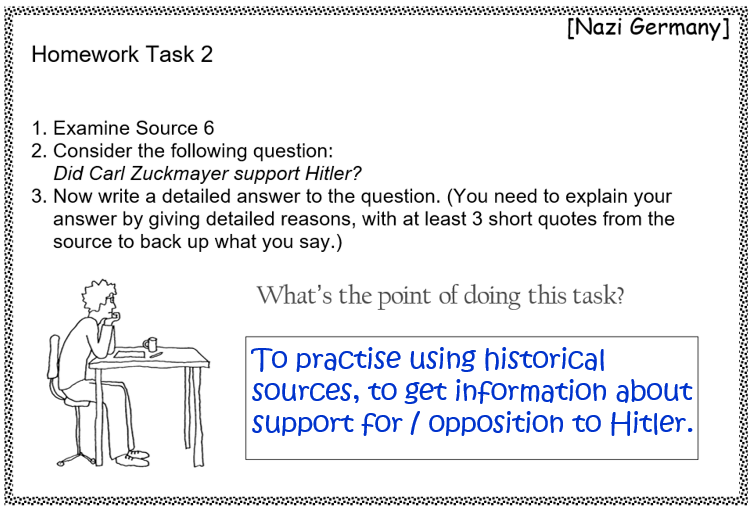
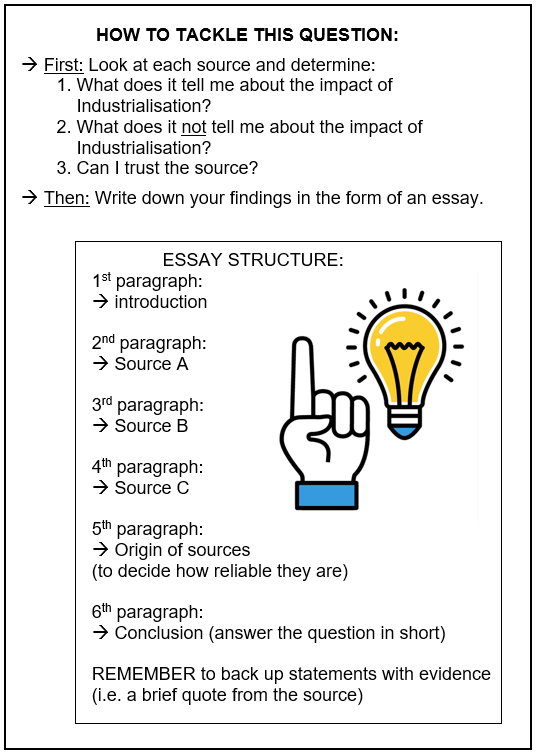
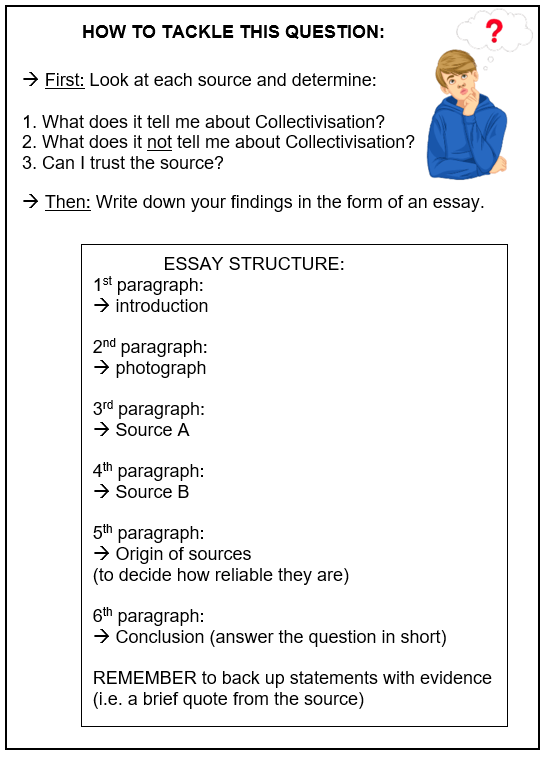
Always give evidence from the source, in the form of a short quote.
8.
FEEDBACK:
Well done Year 9!! Some excellent projects were submitted! You can access your grades and also individual feedback on Schoology. Here are the top video, top poem and top essay, with some feedback as to why they were considered “top”!
Top Video…
Excellent attempt to tell the story of McBride!
Very thoughtful & careful selection of relevant images.
Great editing – a smooth production.
A lot of thought went into the selection of images, showing good understanding.
Well done!
Project: Video. (4:47 minutes long)
Top Poem…
Well written poem!
Effective use of rhythmic pattern.
Shows understanding of the individual’s experience fighting in WW1.
Imaginative, with dramatic build-up.
Reveals sadness & harshness of war.
Shows futility of WW1.
Well done!
The solider
The solider, taken from home The solider, taken for his life away to fight The soldier, still only young,made instantly into a man The solider, now a war machine not just a young boy that he once was The solider, that could be wounded by war must keep on fighting until the end The soldier, trying to survive in the name of his country and life The soldier, not trying to get caught, crippled in his thoughts The soldier, tortured by his own mind caring for life but made into a cold blooded murderer The solider, legs so tired with pain,but kept on running The solider, day after day,week after week,month after month never seeing the end The soldier, not knowing where the light at the end of the tunnel will be or will ever be The soldier, think of home while sleeping on the dirt next his wounded friends beside him The solider, hearing everyday screams, shouts, moans, explosions and shots, whilst covering his ears trying to escape the pain The solider, surrounded by thousands,felling totally alone The solider, his fingers now in pain,his feet now in pain,his life fading away,the cold eating away at his soul The soldier, his heart bleeding with his compassion for the job he has to do The soldier, whose eyes are sore from all the obscenities,had to keep looking The solider, he thinks stalemate,just go away and lets just give up The soldier, moved to the front line getting deeper and deeper into the fire knowing the end is near The soldier, By now his ears burning with noise of death and destroction The soldier, getting called to push out and attack running screaming like a raged animal The soldier, Shot… The soldier, on the ground everything buzzing and thinking of home,filling his mind The soldier, another casualty… another death… and for what? The soldier, the fight is over,his life is over,the battle is over,who has won this time?? leave him to die….
Top Essay…
Good introduction making explicit reference to the length of the war.
Well written essay-body that mentions clear reasons and explain them, each in a clear paragraph. All relevant reasons were mentioned and explained.
Good conclusion that answers the question in short and also points out the most important reason.
Essay writing advice was perfectly followed, resulting in a great answer! Well done!
Why did WW1 last so long?
WW1 started in July 1914, when a serbian gunman murdered the heir of the Austo-hungarian throne (Archduke Franz Ferdinand). Most people thought war would be over in months, but because of different reasons, it became a long war, which did not end until November 1918. When the USA joined, Germany ended up surrendering to the Allies and signed an armistice. The peace terms were signed in June 1919 with The Treaty of Versailles.
WW1 lasted so long for many reasons. One of them was because war plans failed. In 1914, Germany’s plan was to defeat France in six weeks, by invading at high speed through Belgium. Then the German army would be taken east, to fight Russia. This was called the schlieffen plan. The schlieffen plan failed. The Belgian army, helped by a British Expeditionary Force(BEF), put up a strong defence which slowed the German advance. By the time they were ready to attack Paris, a million French and British troops stood in their way in the River Marne, they halted the German advance.
Also another factor that made war last longer was that stalemate developed on the western-front and on the eastern-front. As stalemate developed, both armies tried to outflank each other. The army that did this would then be able to attack the enemy army from behind. Both armies marched north, hoping to outflank each other before they reached the channel. Neither side succeeded. All they could do now was dig trenches to stop the other from advancing. The war plans also failed in eastern Europe. A Russian attack on Germany was halted in two major battles. A massive Austrian attack on Russia was turned back. So the Germans, Austrians and Russians could only dig trenches to stop the enemy from advancing.
Furthermore, in 1915 the Allies Attempted to break stalemate on the western front by attacking Turkey. A large army, mainly from Austria, New Zealand and France invaded Gallipoli, in Turkey. But the Turks were waiting for them. Both sides dug trenches to stop the other from advancing, so a stalemate resulted. It lasted until the allies withdrew at the end of 1915.
The Allies also failed on the Somme, in 1916. The Allied generals pinned their hopes on making massive attacks on the German trenches. The biggest attack took place in 1916 along the river Somme in France. The Germans found out, and they put up extra barbed wire and they dug underground shelters. The Allies bombarded the German trenches for 5 days. The aim was to destroy German trenches. But when the bombardment started, the Germans got into their deep shelters. The bombardment failed to destroy the barbed wire. When the bombardment was over, 200,000 British troops advanced towards the German trenches, thinking they had been destroyed. As they advanced, the Germans came out of their shelters bringing machine guns with them. The British were cut down by machine-gun fire. Thousands were trapped in barbed wire. By the end of the battle the British and French had lost 620,000 men, and had advanced only 15 km at the furthest point.
Another factor was that there was also stalemate in the war at sea. Britain and Germany had the largest and most powerful navies of the world, but Britain did not want to risk losing it because it needed it to protect its empires, supply Britain with food as it is an island, and keep a constant supply of materials. Germany’s navy was virtually trapped in its ports because of minefields in the channel and the North Sea.
Moreover, another war plan failed, and that was that German U-boats failed to starve Britain into surrender. In February 1915 German submarines (U-boats) began sinking ships in the seas around Britain. Their aim was to starve Britain into surrender. To combat the U-boats, the British laid huge minefields in the Channel and the North sea. So German minesweepers came out to clear them away. Gradually the Germans gained the upper hand. Defeat was avoided by the British when they started using a convoy system. Merchant ships sailed in large groups protected by submarine-destroyer ships of the Royal Navy. The number of sinkings dropped to one in a hundred.
Consequently, the war lasted so long due to many factors. The most important one was that the Schlieffen plan failed, because if it had worked out correctly, the central powers would have won the war very quickly, probably within a few months.
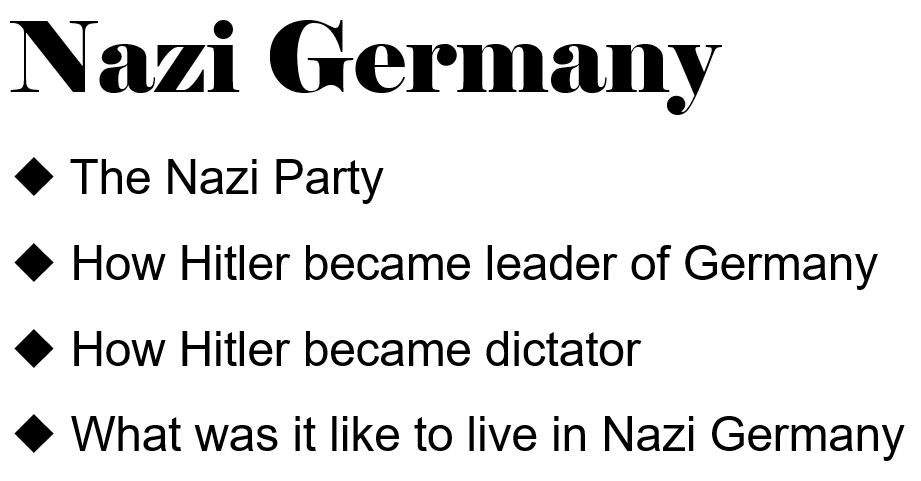
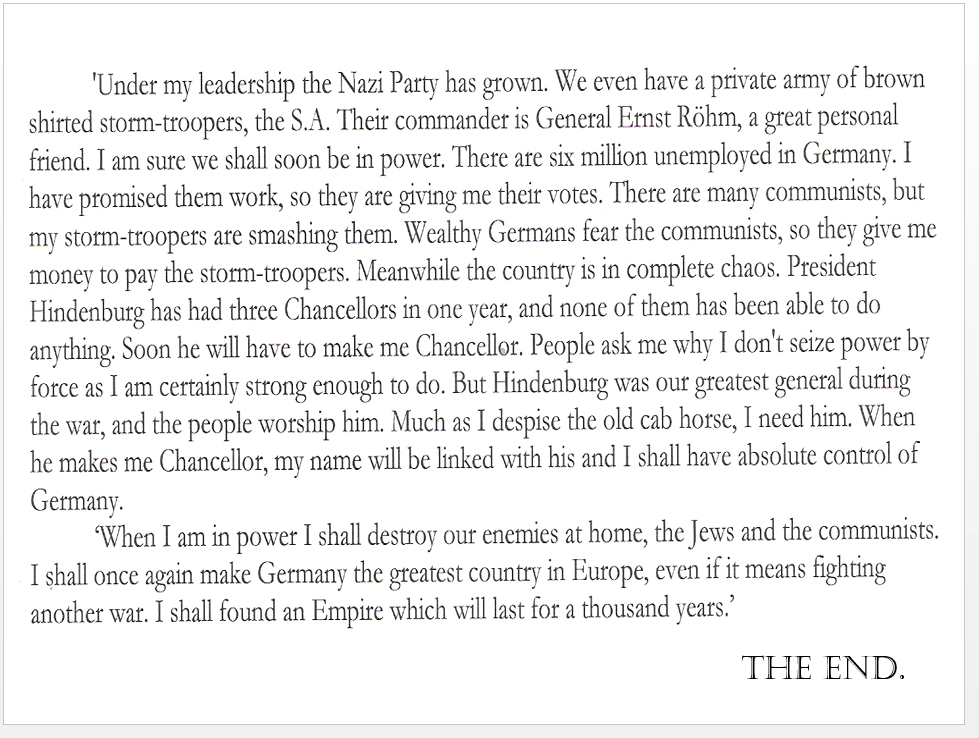
Today you are going to start your topic on Nazi Germany!
In this topic we will be looking at:
the creation of the Nazi Party
Hitler’s rise to power
Life in Nazi Germany
Hitler sings Scatman. (0:27 min long)
On a more serious note:
“Nazi Germany” is a sensitive topic. In the History class we learn about the events that occurred in the past with the aim of not being ignorant, but truly knowledgeable and critical. Be aware that, in our quest not to be ignorant, we may need to deal with issues that some may view as offensive.
Follow the instructions step by step:
1.
First, look at your test result (Homework-6) and also see where you have perhaps lost marks:
Let’s start by looking at an overview of Nazi Germany.
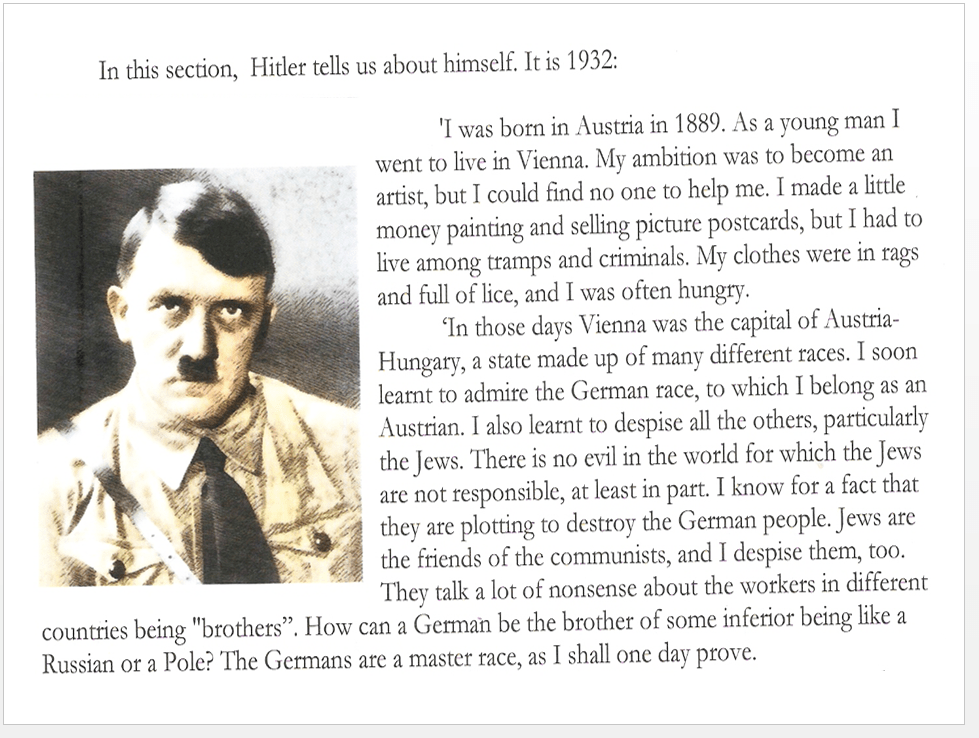
Read the article called “Hitler Speaks” from pages 4-5.
The same information can also be read from the slides below:
3.
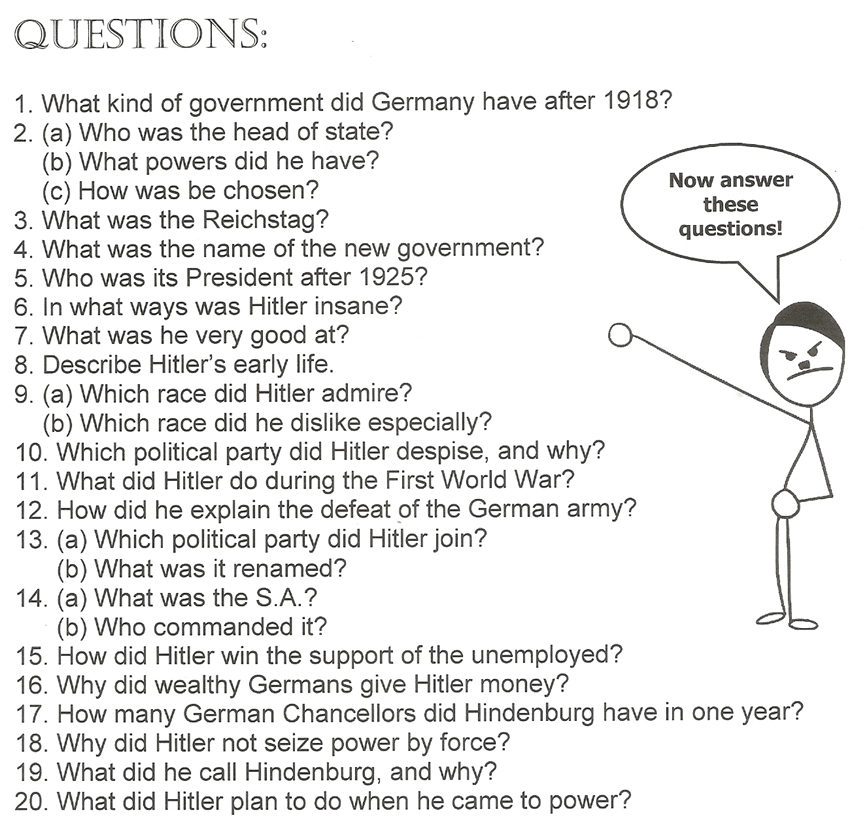
Instruction for the rest of this lesson: On paper, half of the class makes a multiple choice quiz of Q.1-10, and the other half do the same for Q.11-20. (These quiz questions will eventually be made into a Scoology Quiz, to be completed on mobiles, in class.)
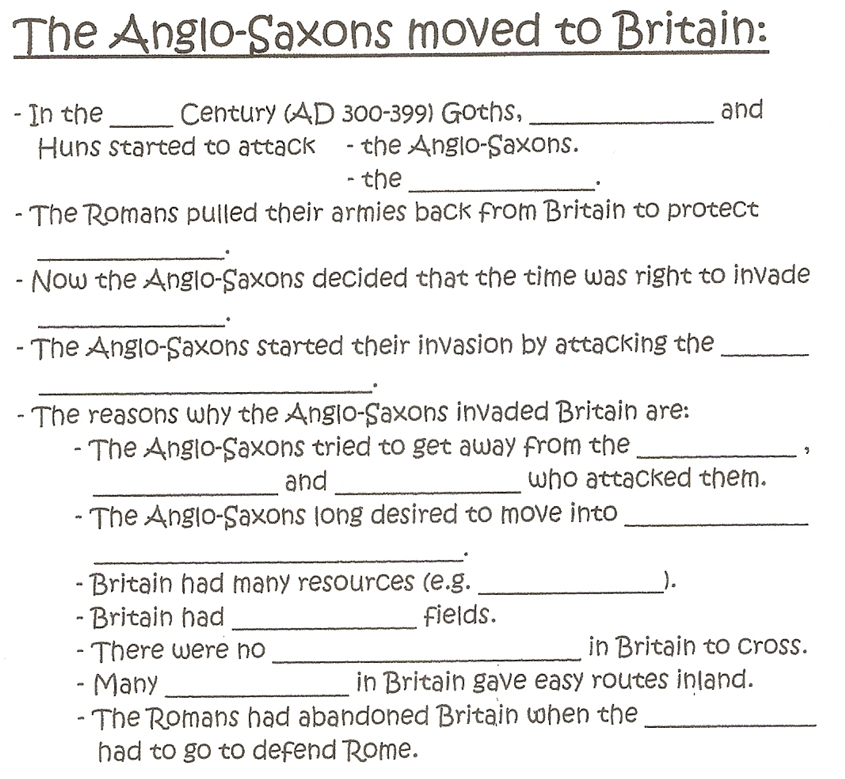
Looked at Sutton Hoo in previous lesson – here is a reminder… (This will also help with HW-4…)
Sutton Hoo Details. (5:45 minutes long)
3.
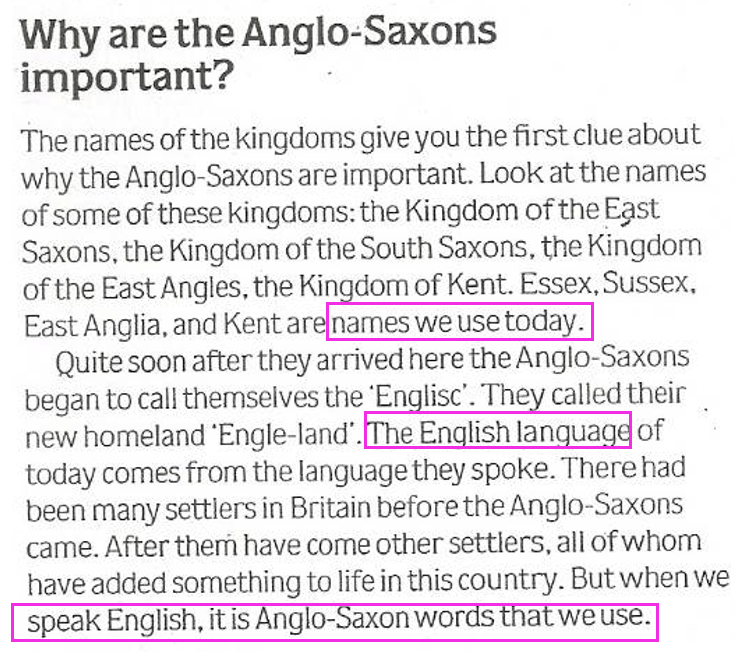
Read “Why are the Anglo-Saxons Important?”, from p.40.
4.
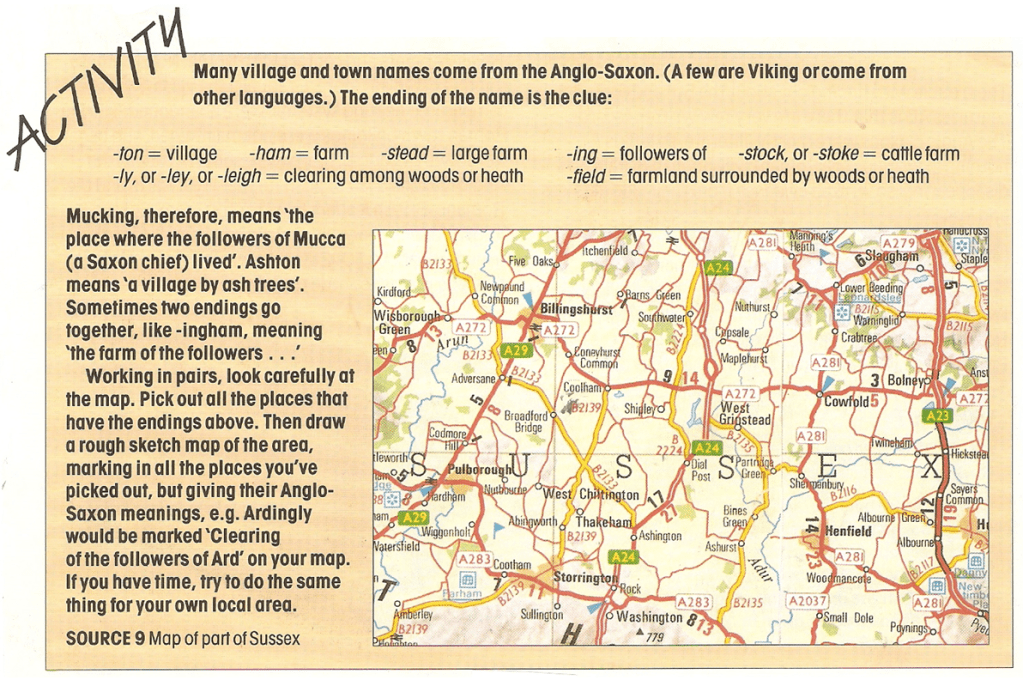
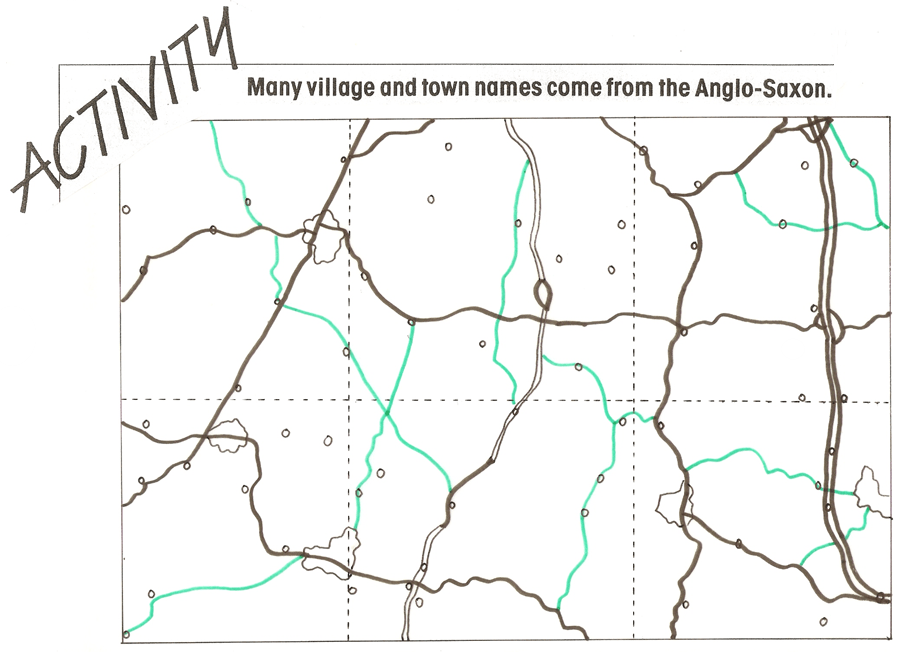
Now, examine the Activity on p.40… Carefully look at the word endings and see if you can find a few examples of these names on the map.
Find the following place names and highlight them…
Sullington Lower Beeding
Ashington Poynings
Coolham Shipley
Thakeham Amberley
West Grinstead Itchenfield
Hickstead Watersfield
5.
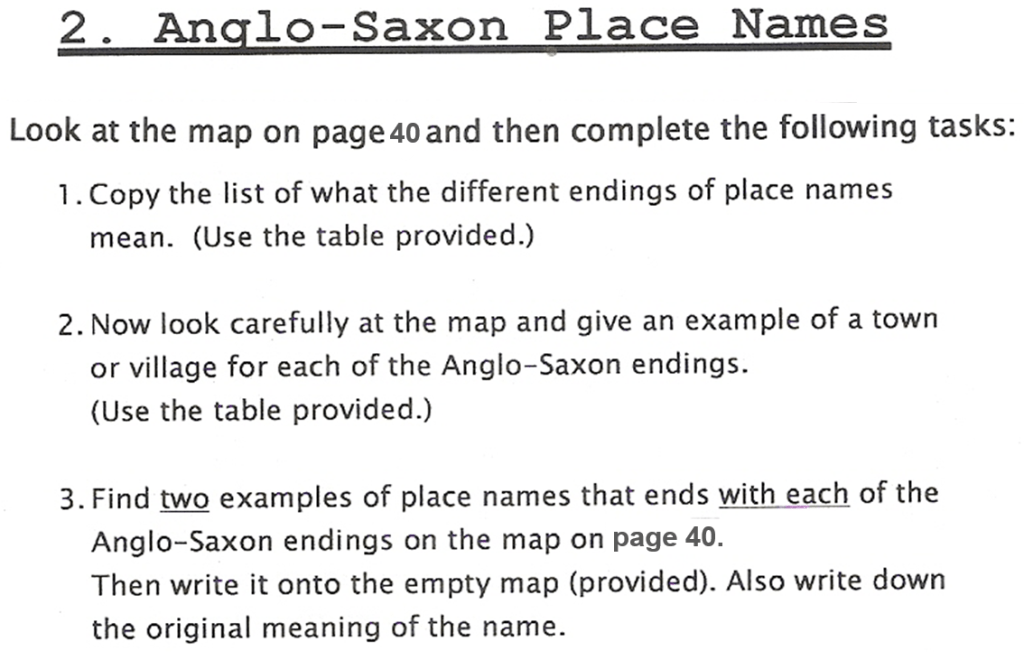
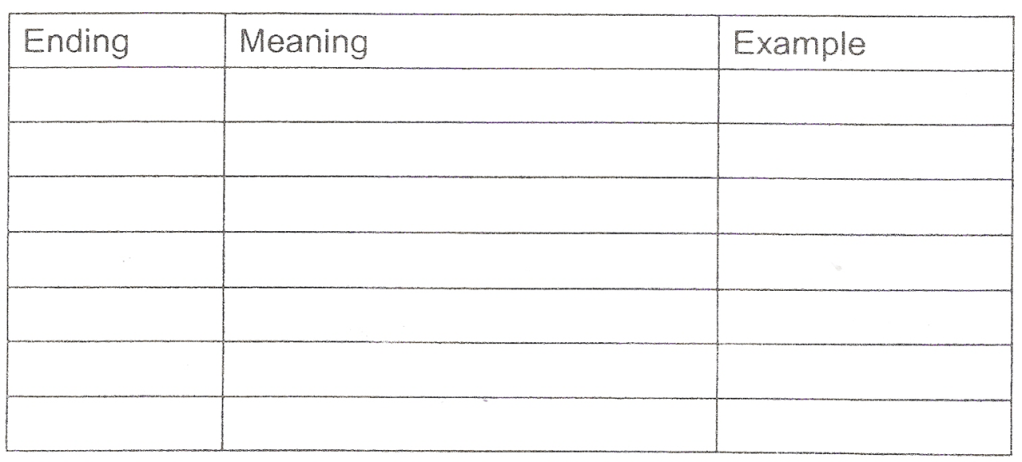
Do the task on “Anglo-Saxons Place Names” on p.44-45 of your Workbook. (If you scroll down, you will find slides that will take you step by step through the task!)
Page 44
Page 45
6.
The slides below take you through the entire task, step by step…
Today you are going to continue to investigate what the Anglo-Saxons were like…
Follow the instructions step by step:
1.
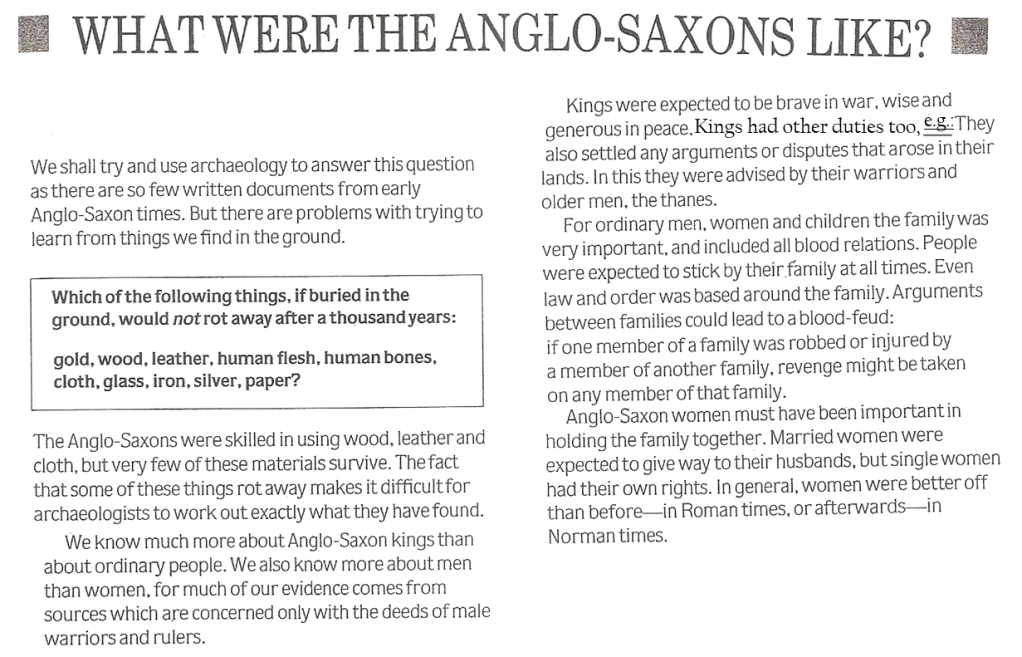
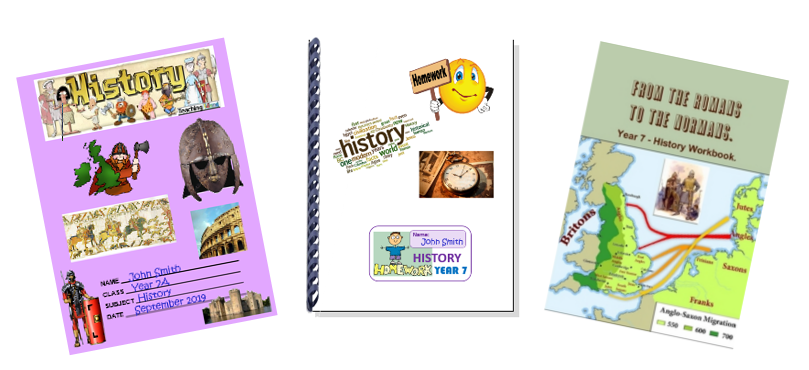
Page 41: “What were the Anglo-Saxons like?”
2.
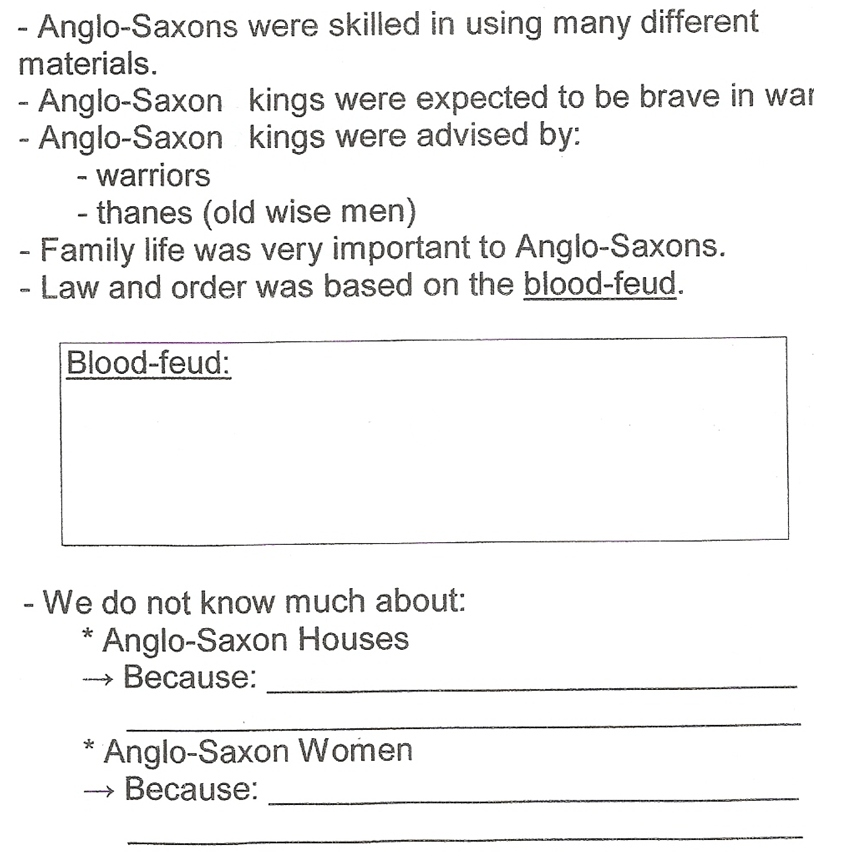
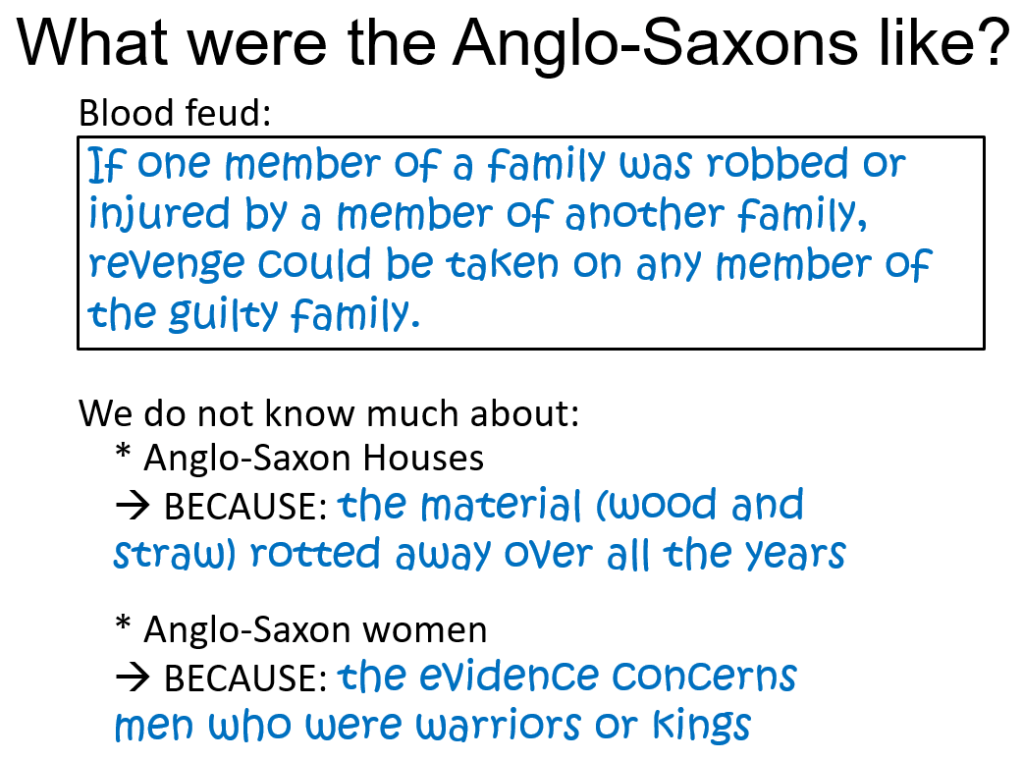
Fill in the missing words on the notes about Anglo-Saxon living, p.14.
SOLUTION:
3.
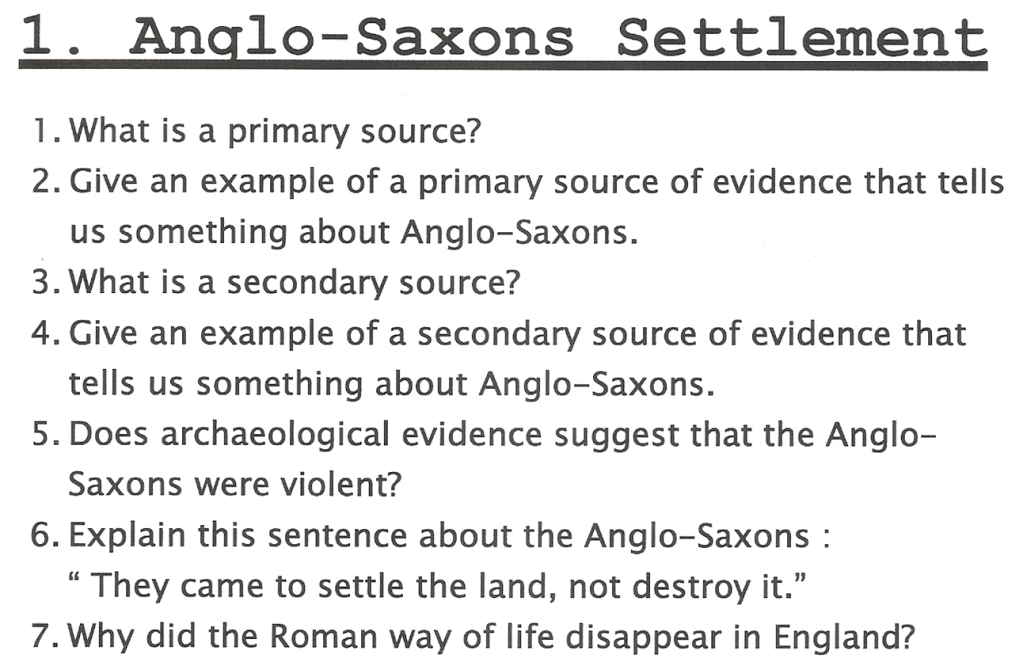
Are all your books up to date? Have you completed the questions on “Anglo-Saxon Settlement” (p-44) from the previous lesson?? If not complete the questions now, before you continue with the next task.
4.
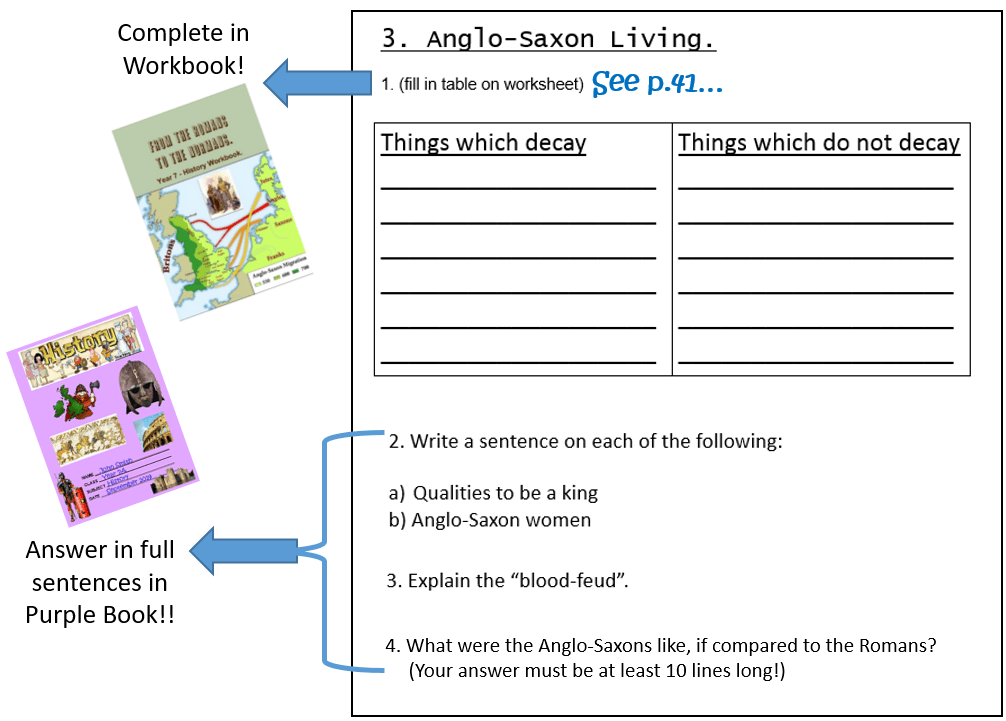
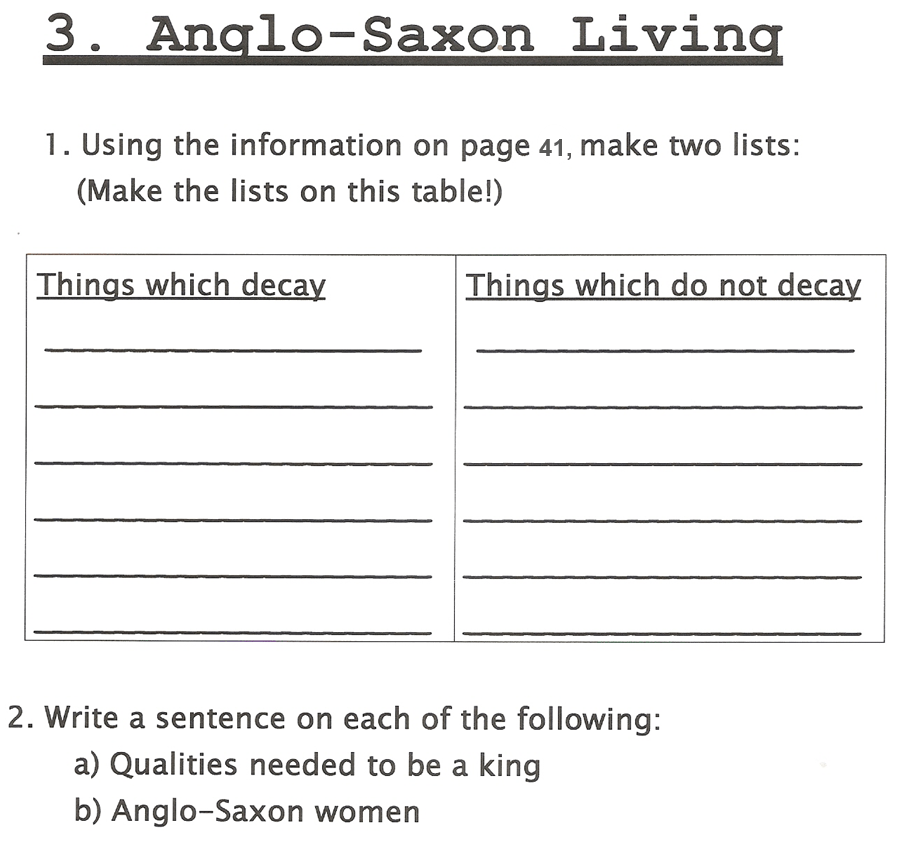
Now, let’s test your knowledge and understanding further… Do the questions on p.46 on “Anglo-Saxon Living”. First, you need to do Part 1 in your Workbook…
5.
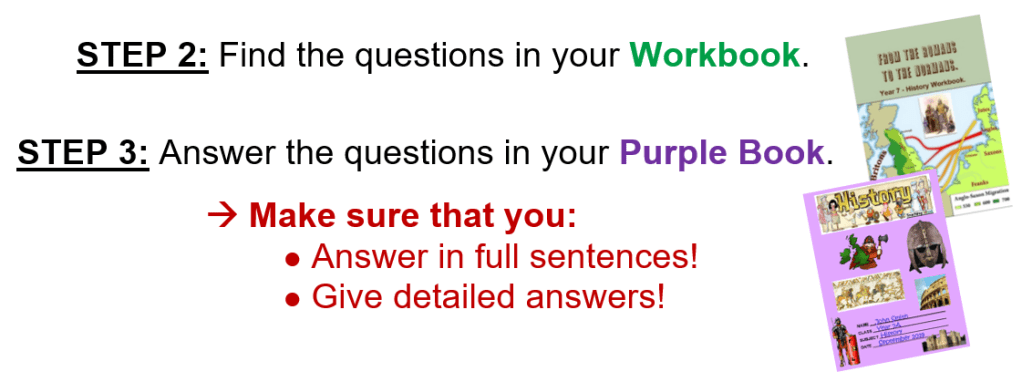
Now, do the rest of the questions in your purple book.
Today you are going to look at Soviet Culture under Stalin.
1.
Let’s see how culture and propaganda were used by Stalin to manipulate and control the population…
Soviet Culture. (3:09 minutes long)
2.
In 1936 a new constitution was set up by Stalin. On paper, it made Russia the world’s most democratic country!
New Soviet Constitution. (2:19 minutes long)
3.
The information about “Propaganda and Official Culture” , “Religion and Nationalities”, “A New Constitution”, all on p.30. (PLUS: “The 1923 Constitution”. It is on p.18, and not p.15 as it says in your booklet…!)
4.
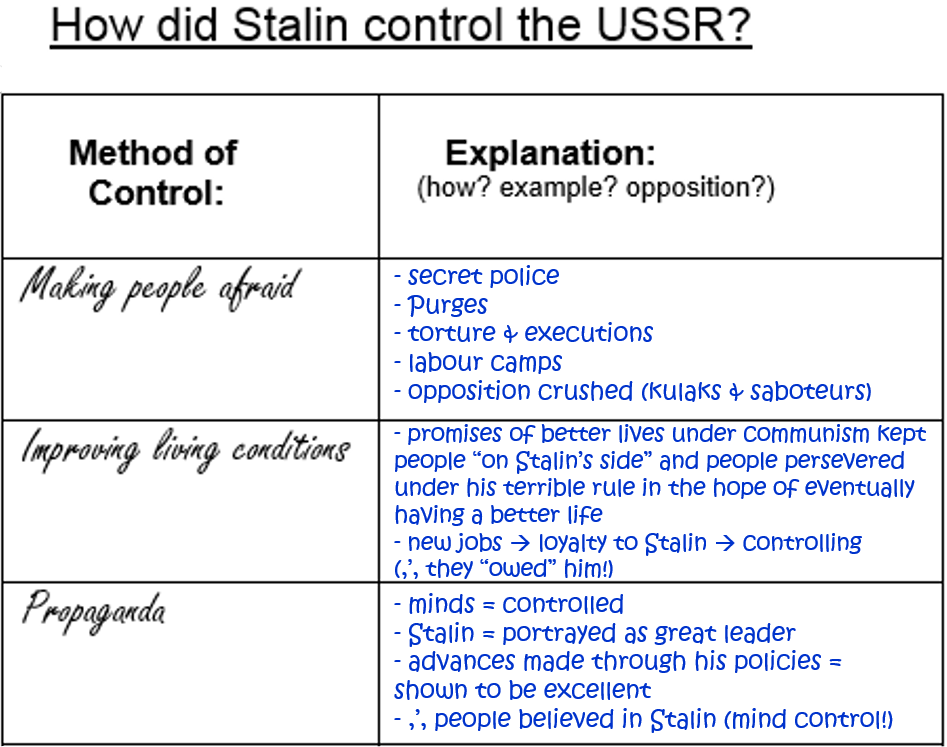
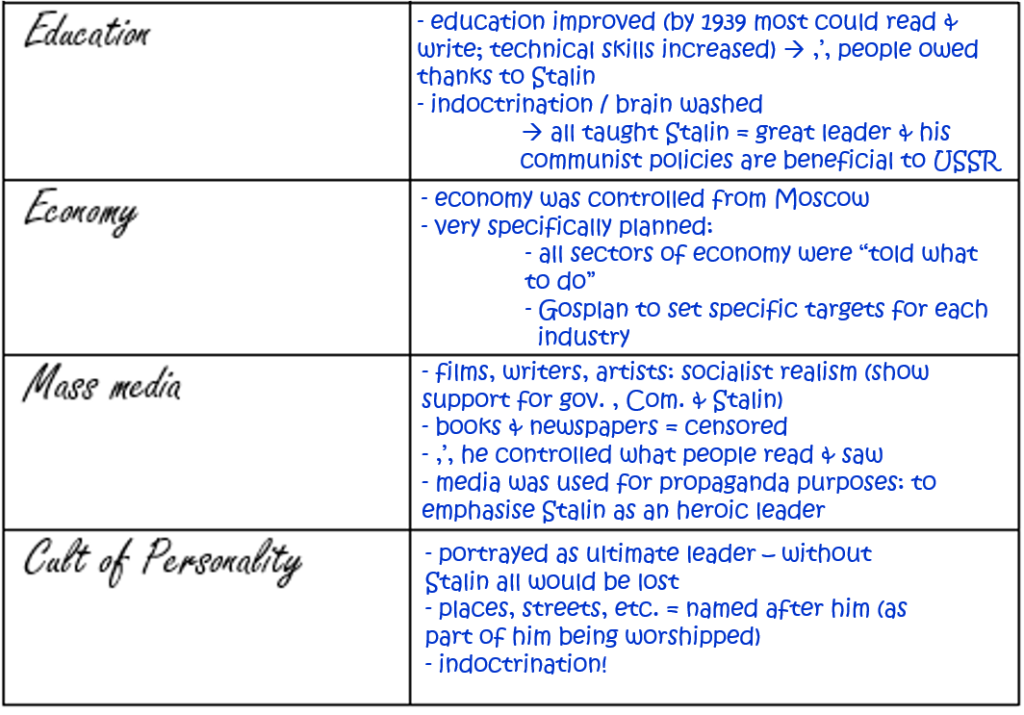
It is clear that Stalin controlled every aspect of life in the Soviet Union. How did he manage to do so. The table below shed light on Stalin’s methods of control.
(Jot down ideas for an explanation of each of the main methods used by Stalin, by using relevant bulleted points.)
SOLUTION
5.
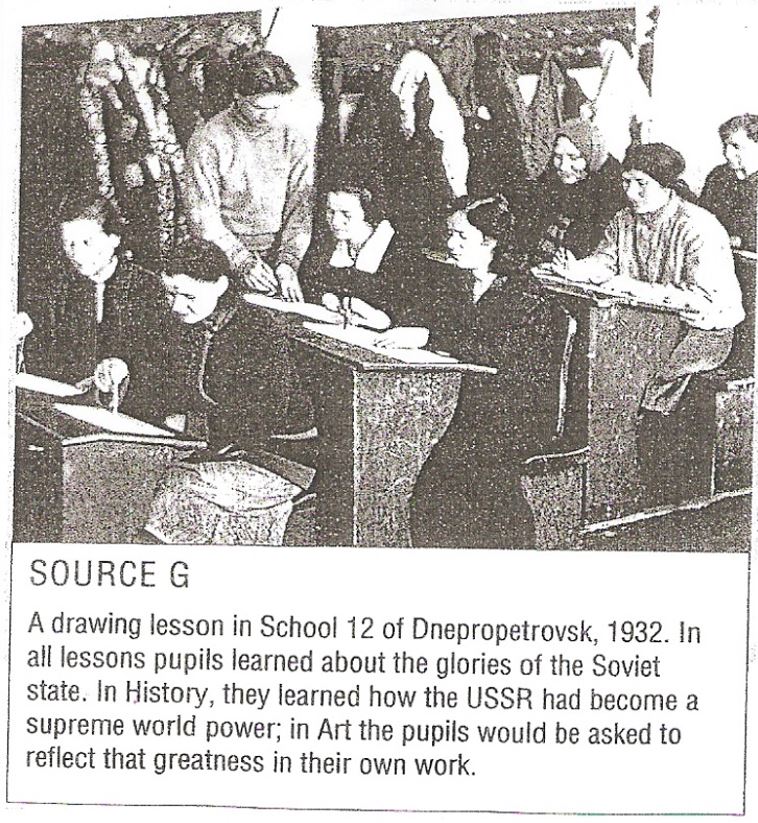
p.46-47: “Communist Society and culture under Stalin’s rule” (Sources with questions…)
6.
“Communist Society and Culture under Stalin’s rule”, p.46-47.
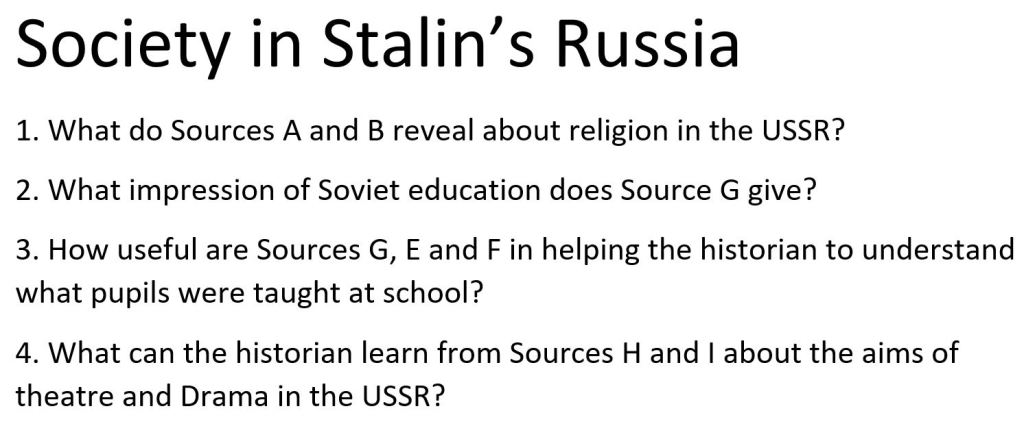
Now answer the following questions:
The tasks on pages 48-52 guide one through the sources. It may be very helpful (in answering the source questions above) to first do the tasks on these pages!
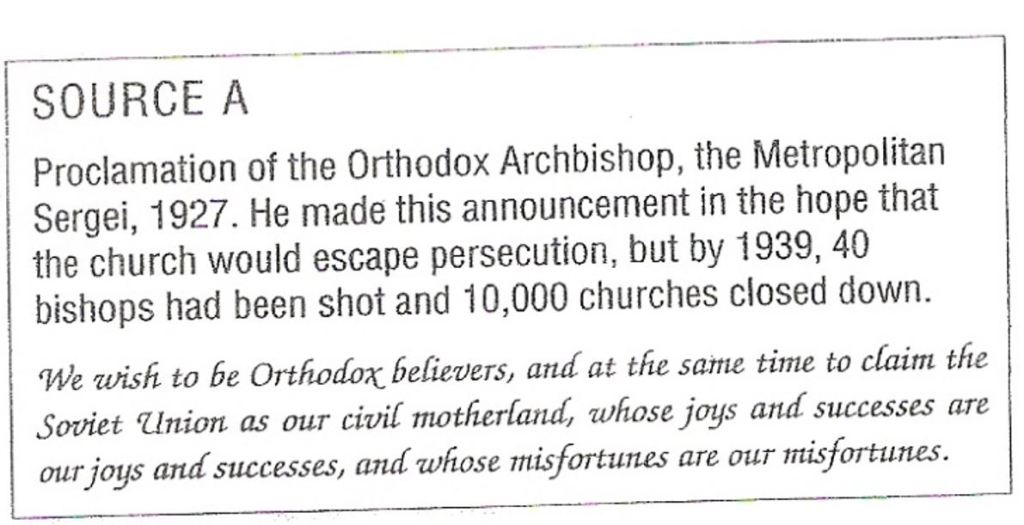
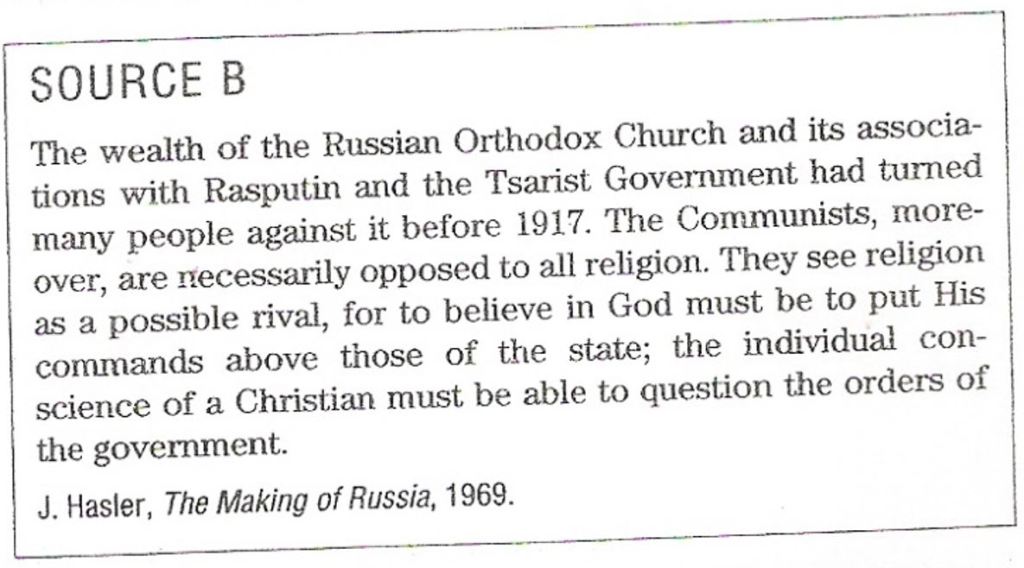
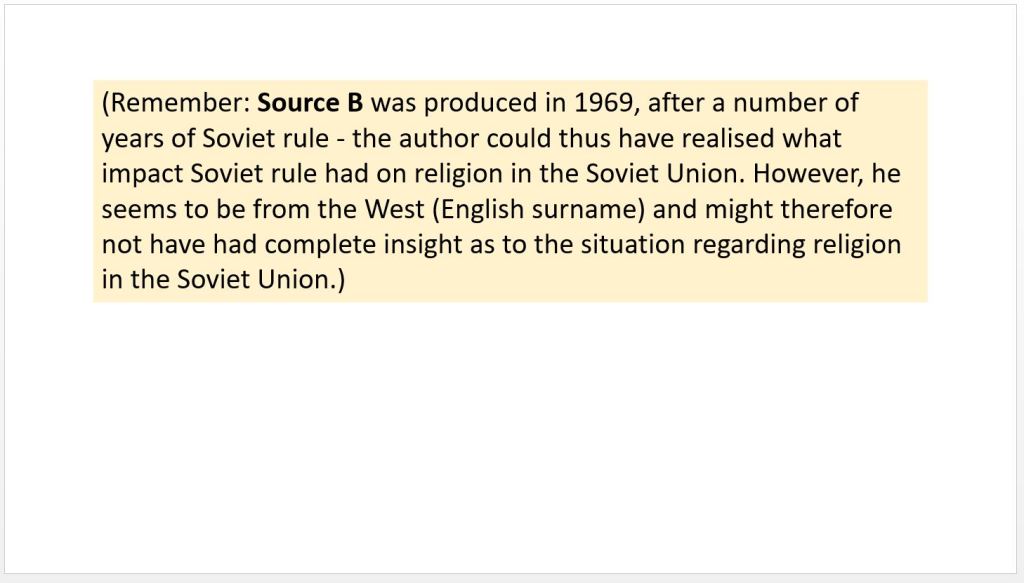
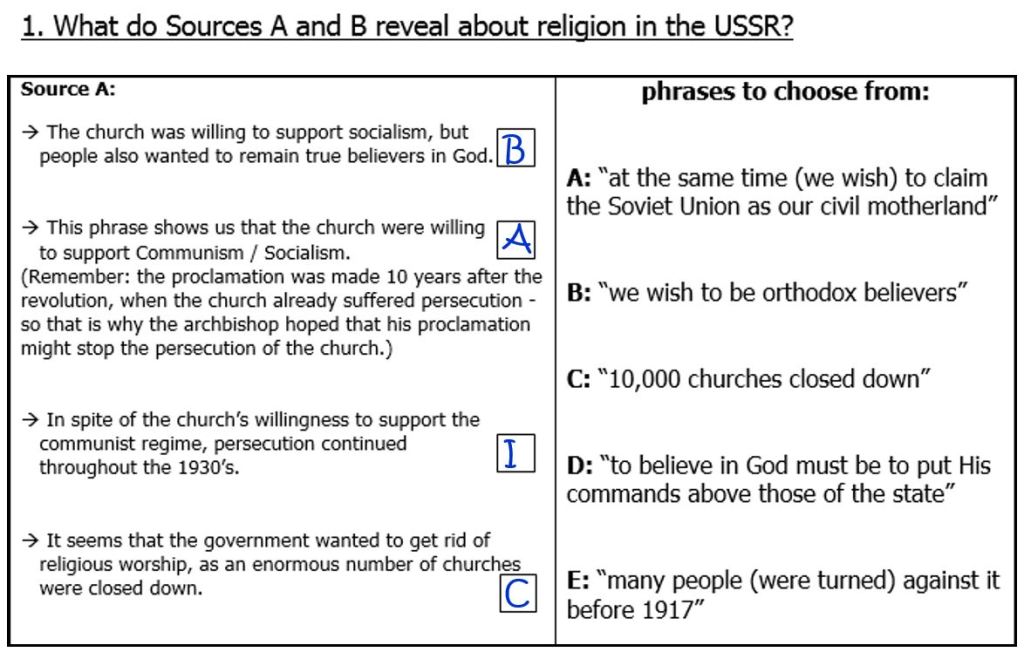
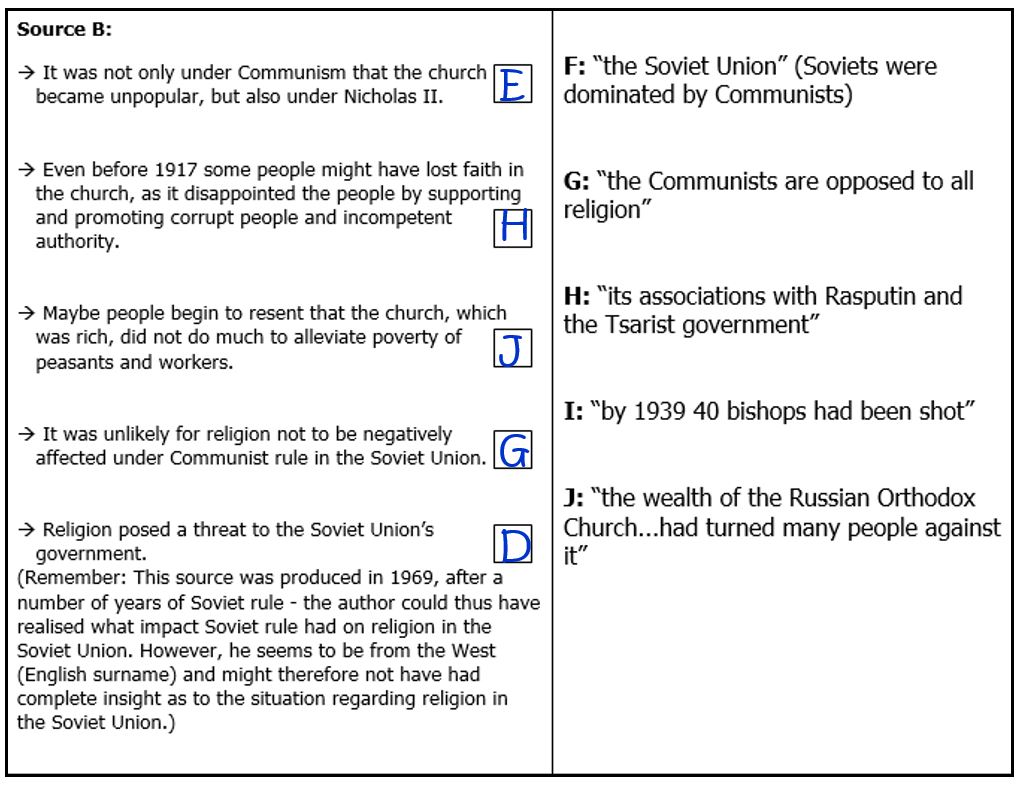
Question 1.
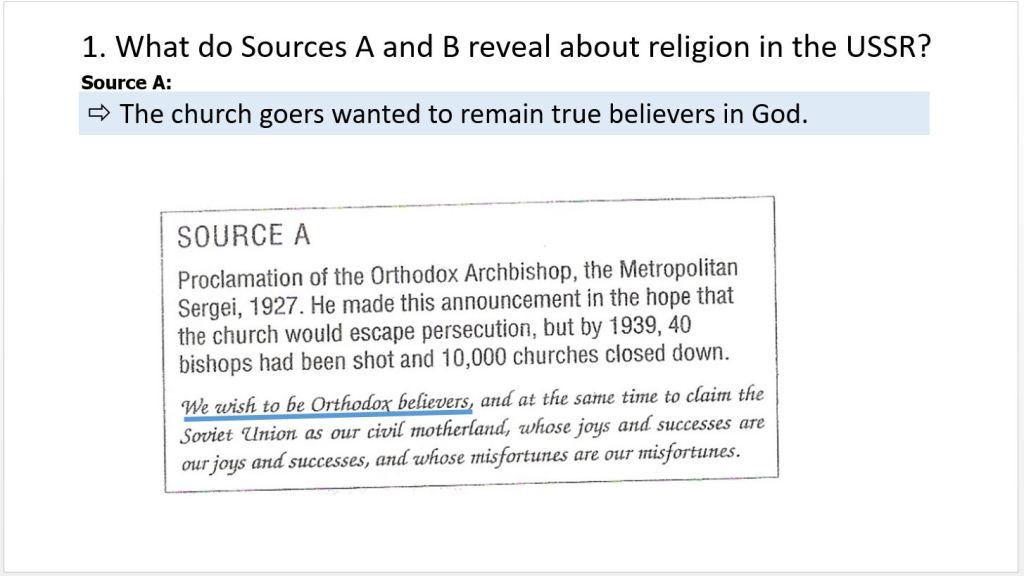
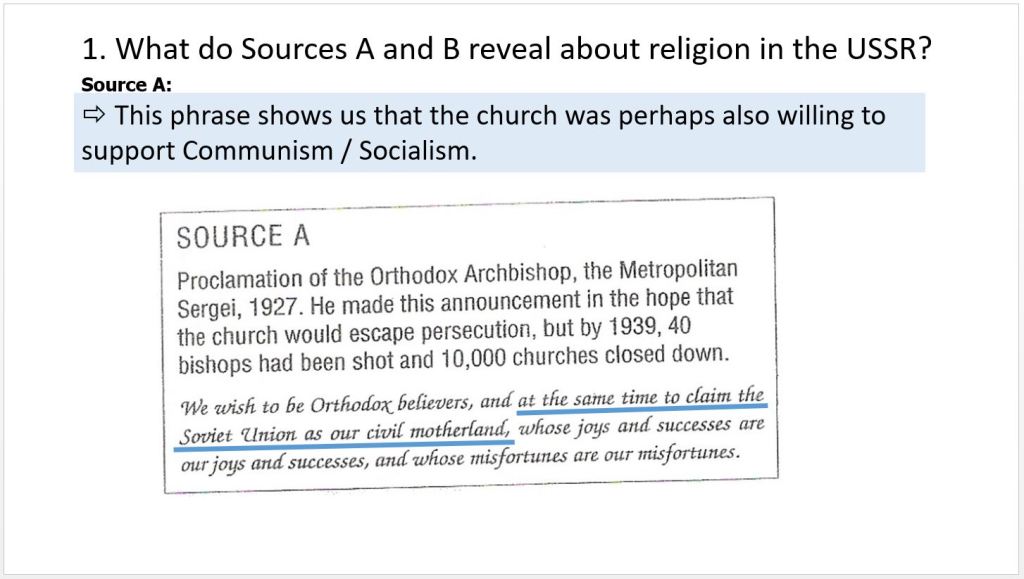
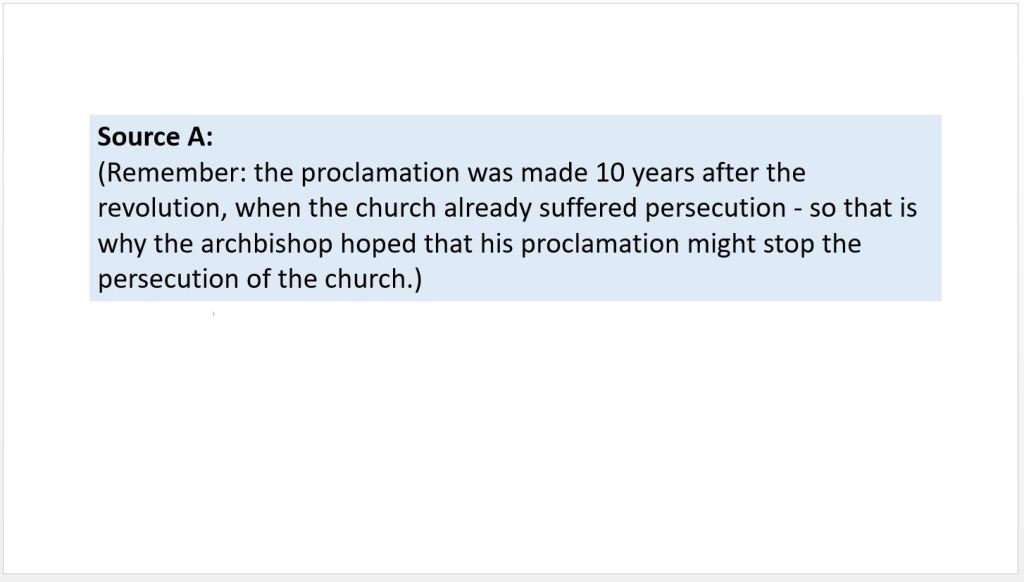
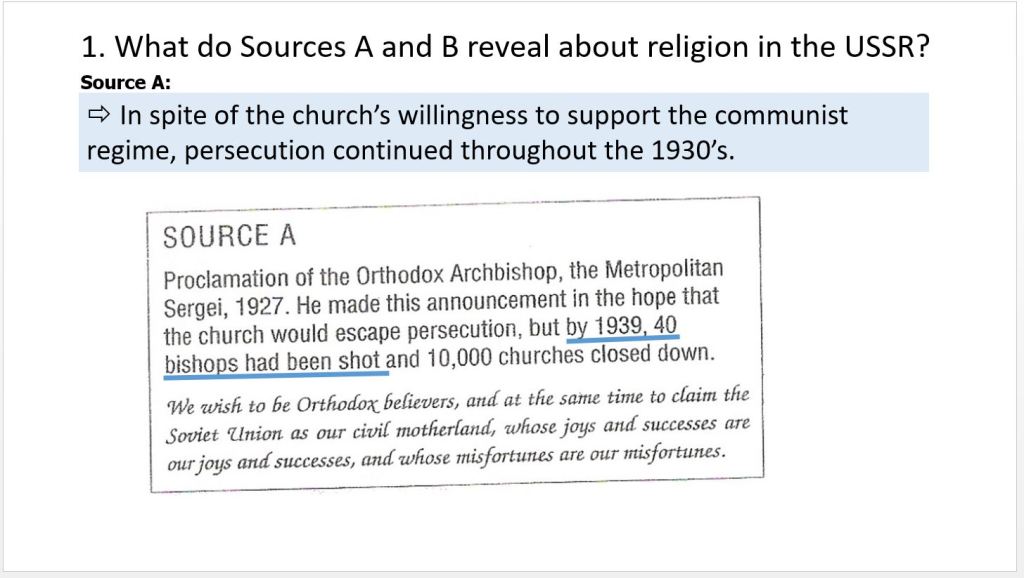
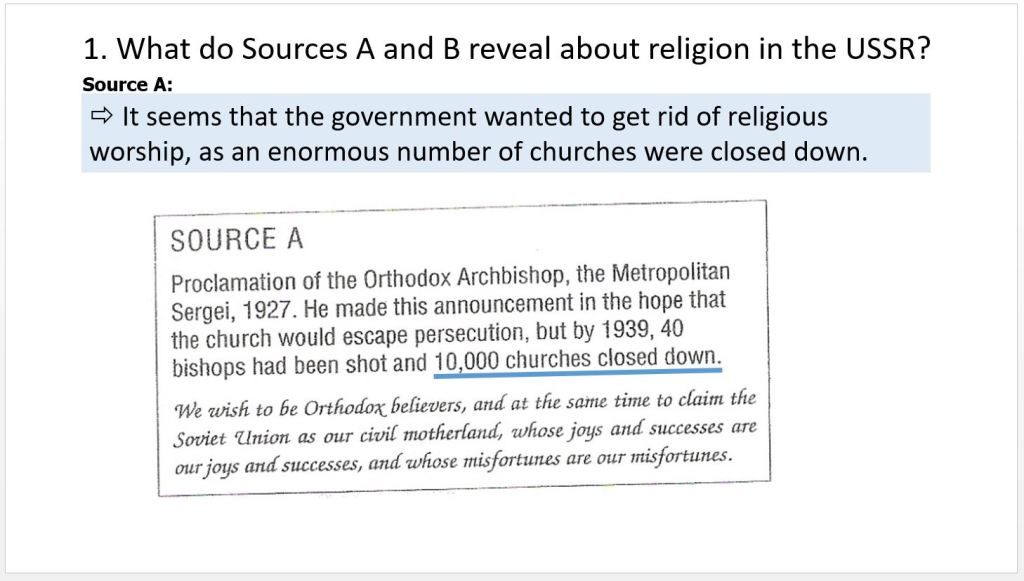
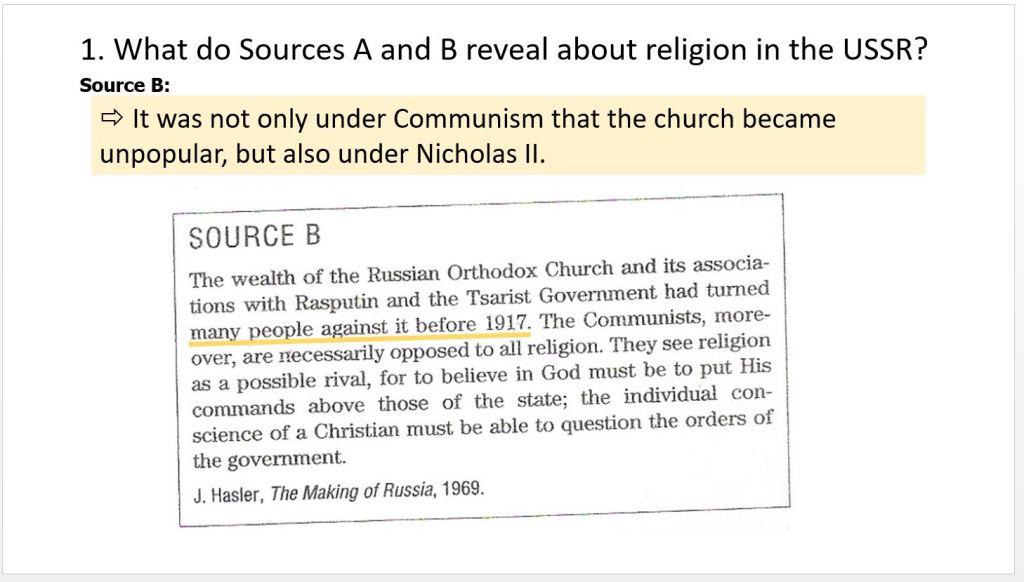
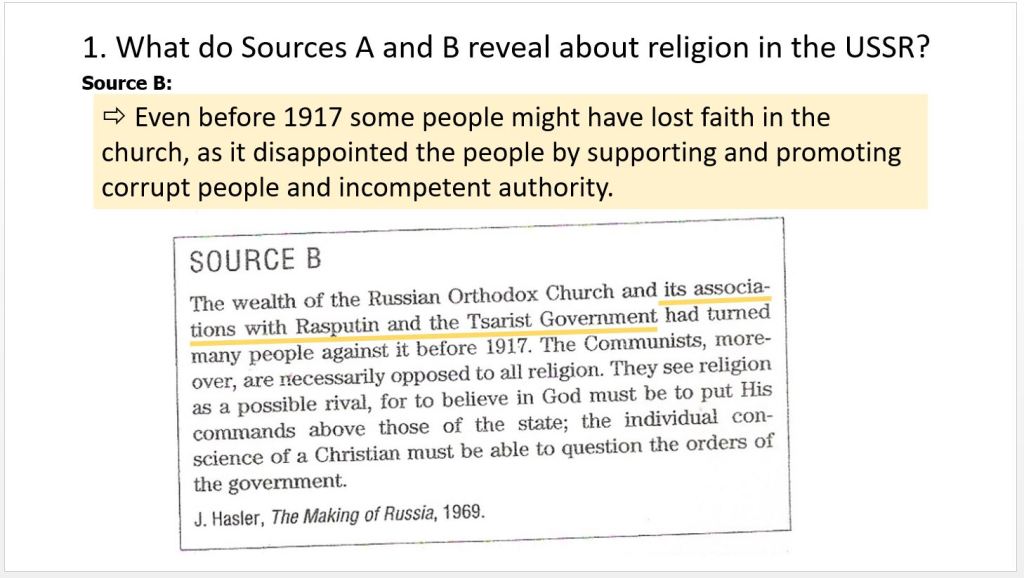
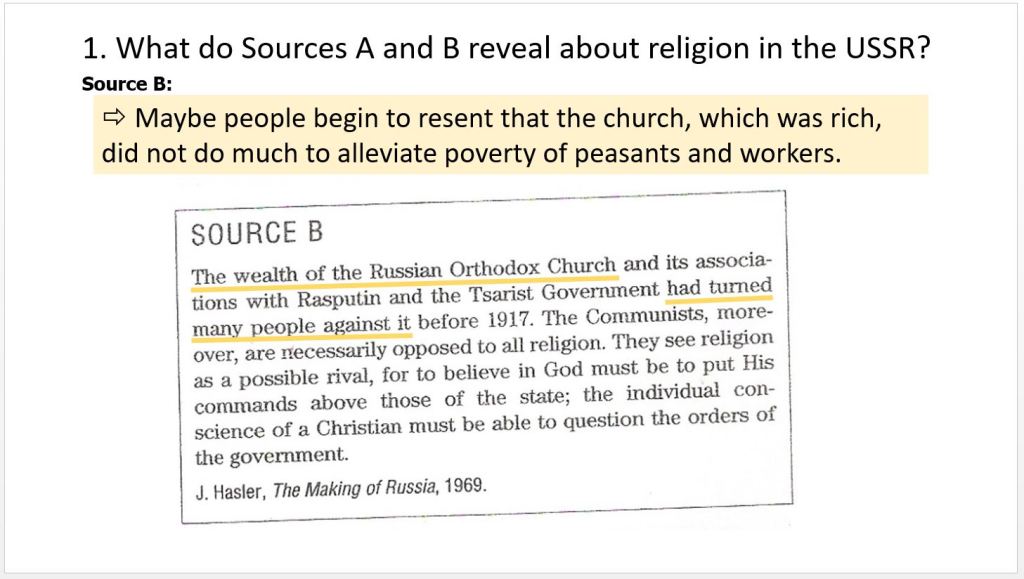
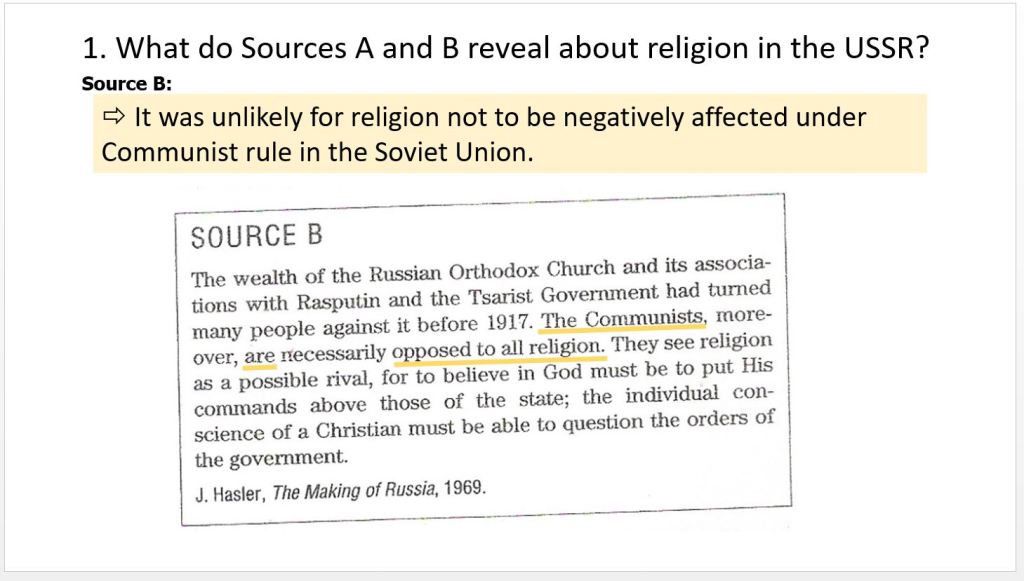
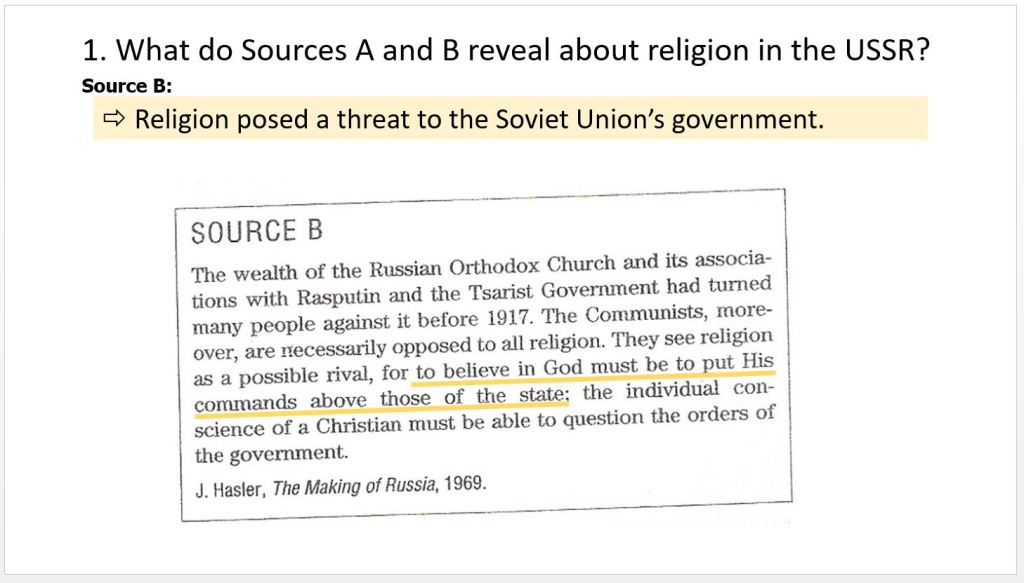
What do Sources A and B reveal about religion in the USSR?
Question 2.
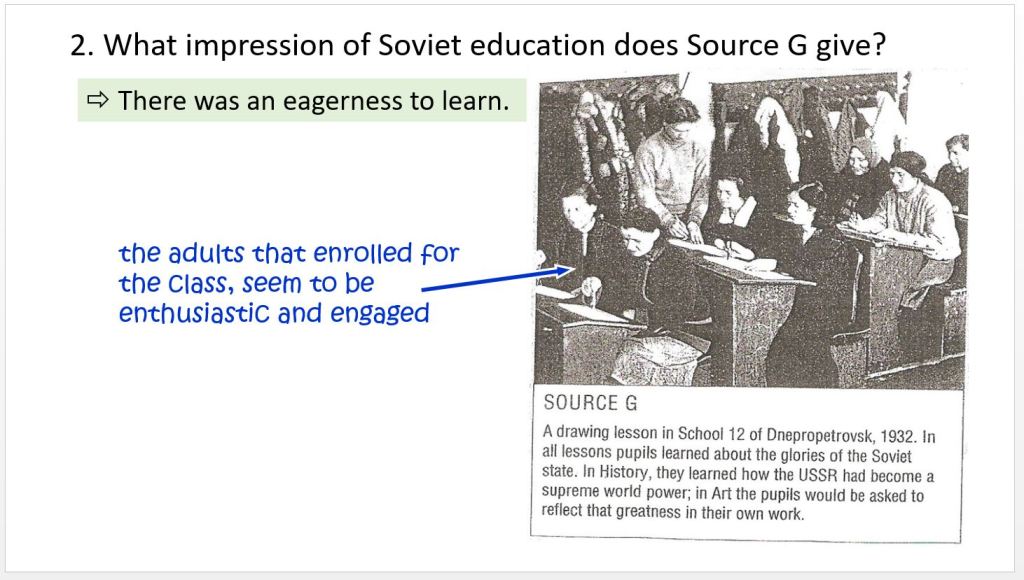
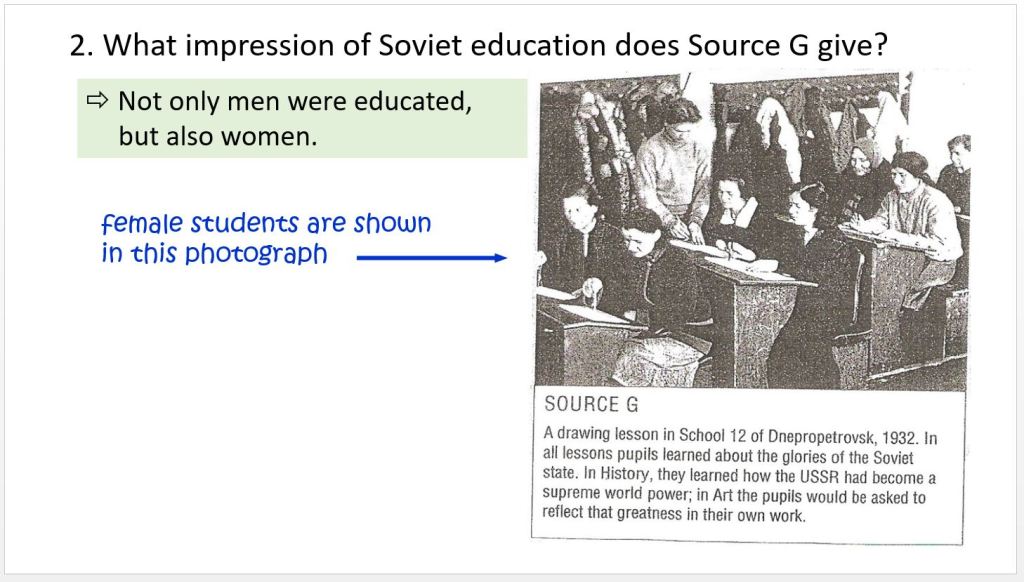
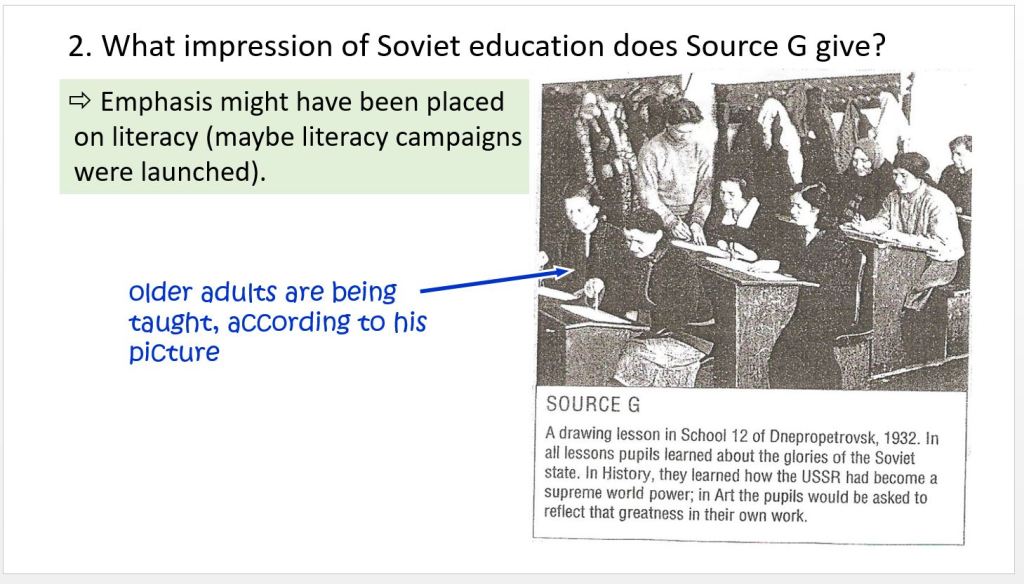
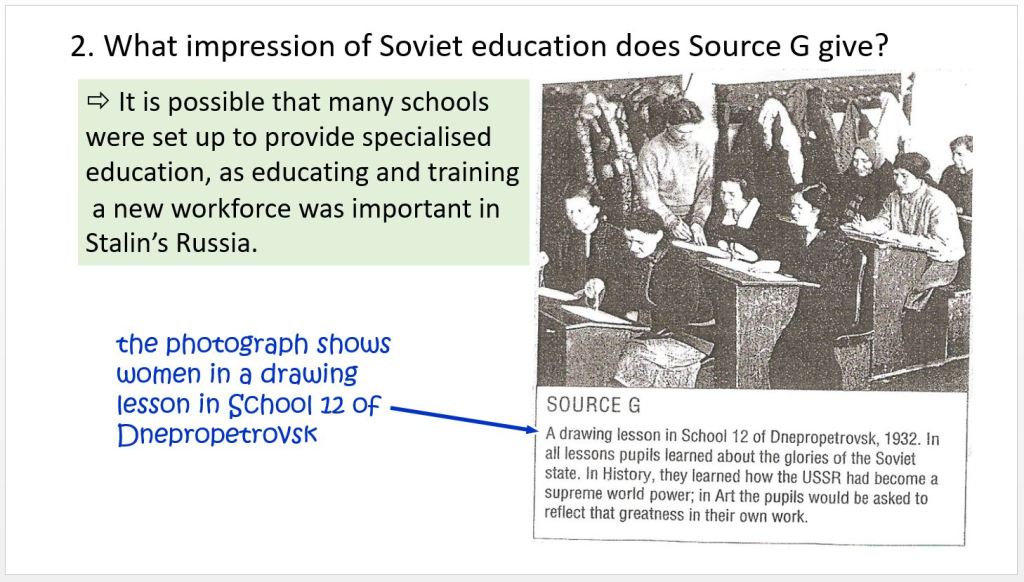
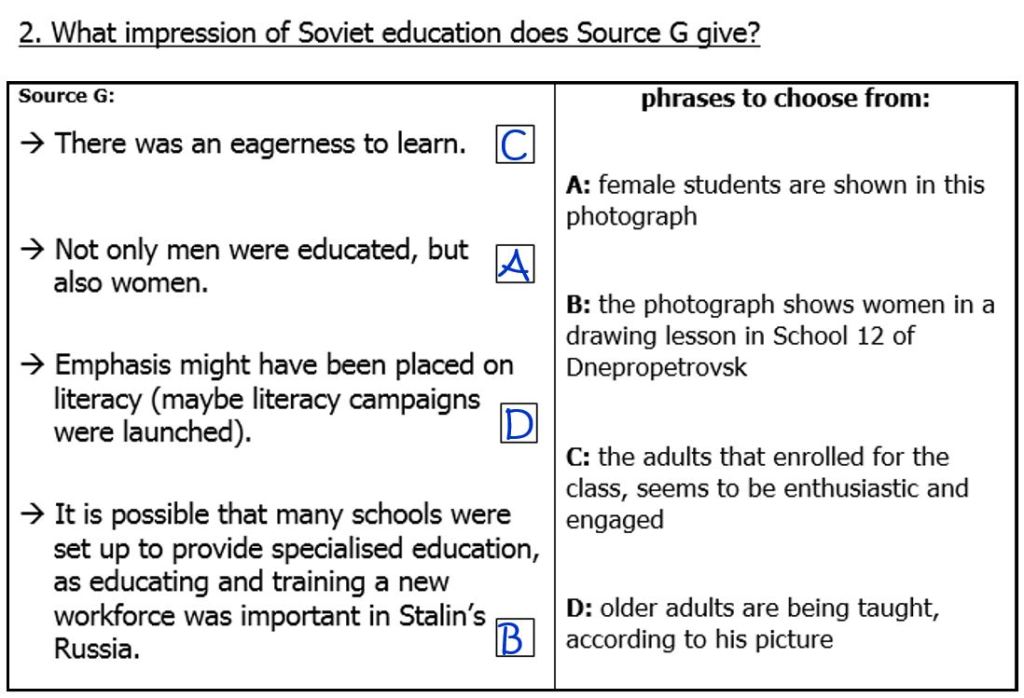
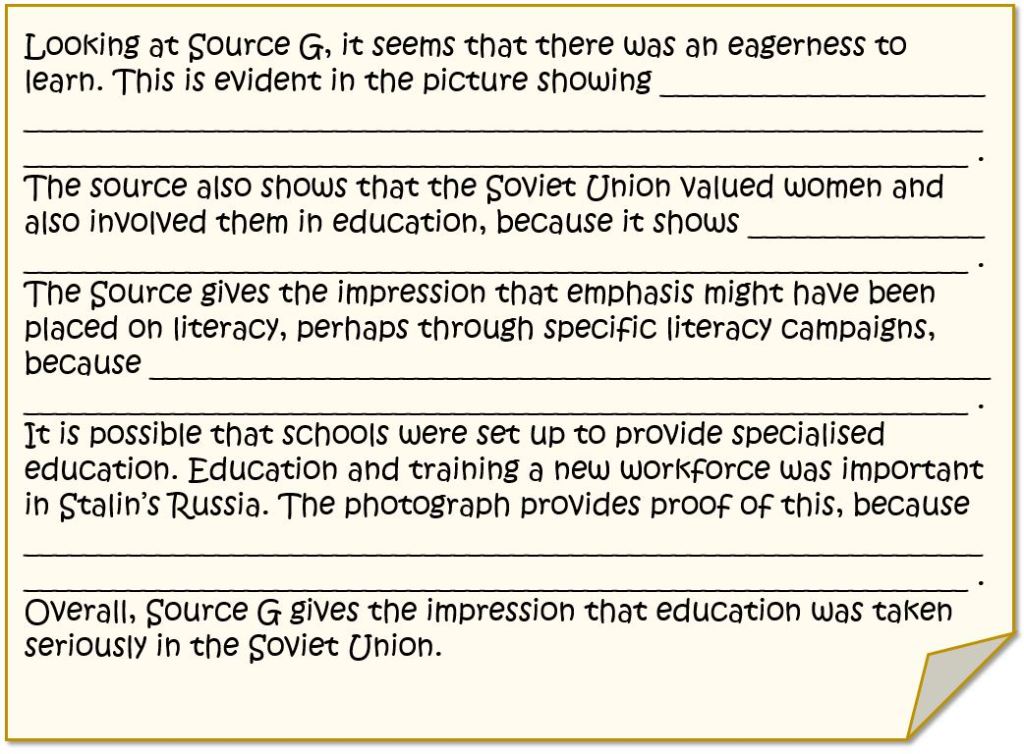
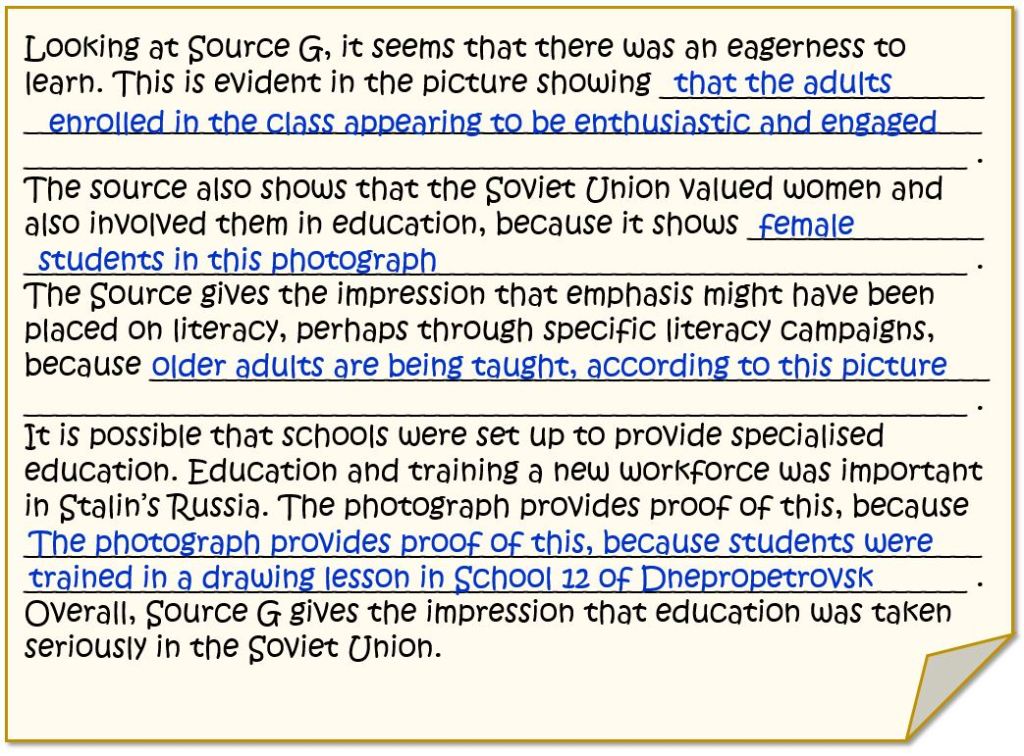
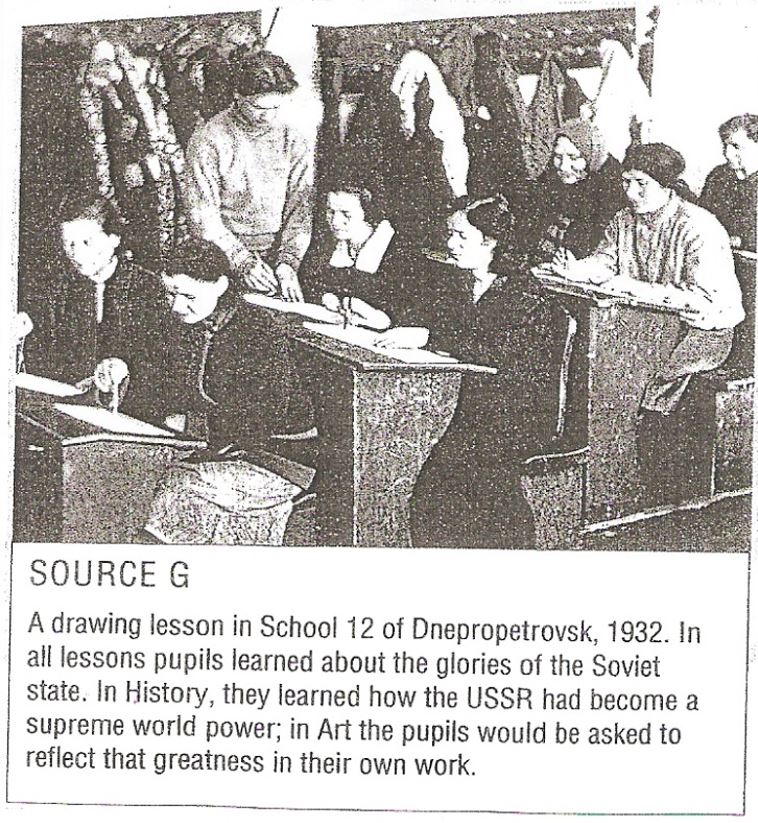
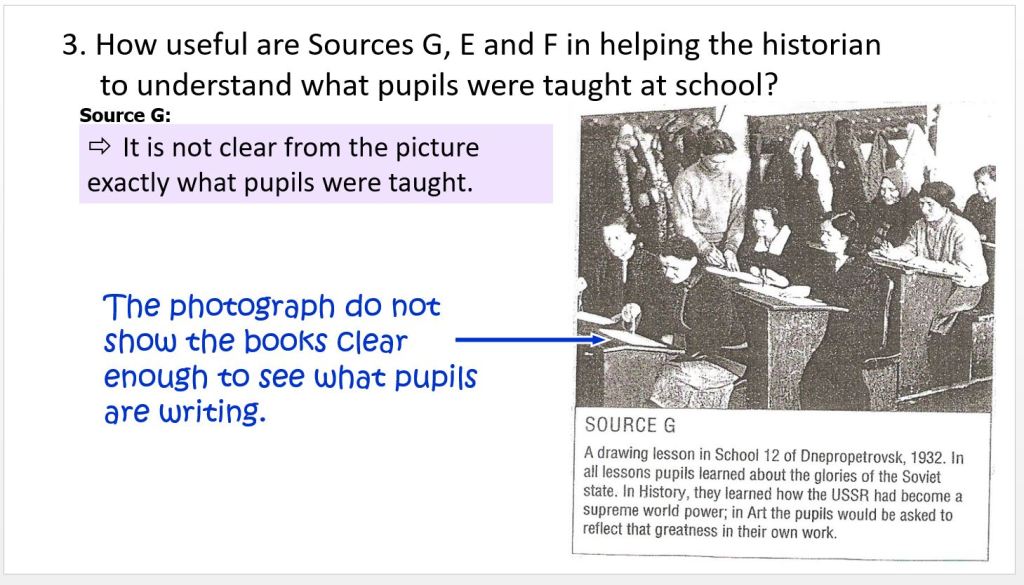
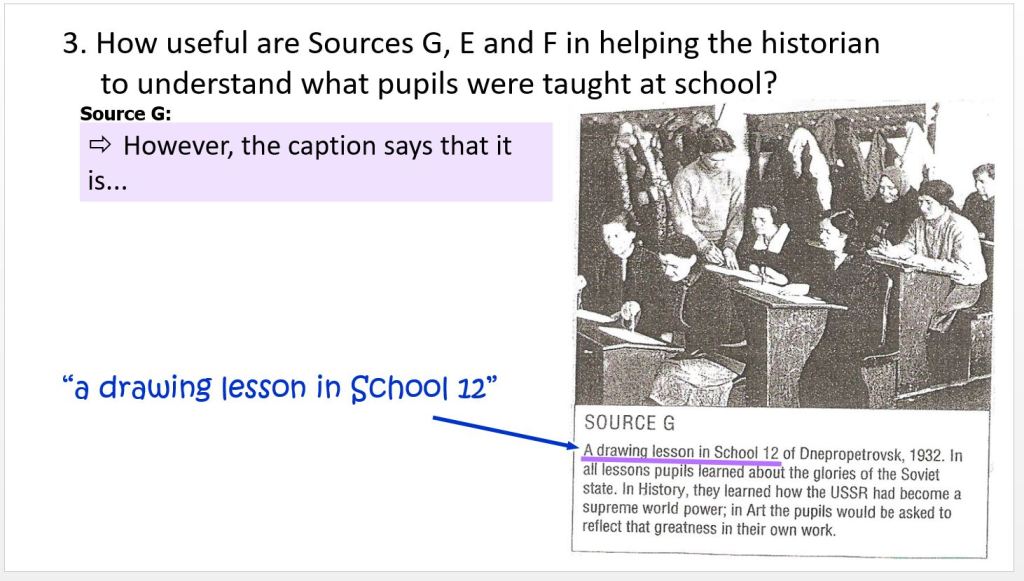
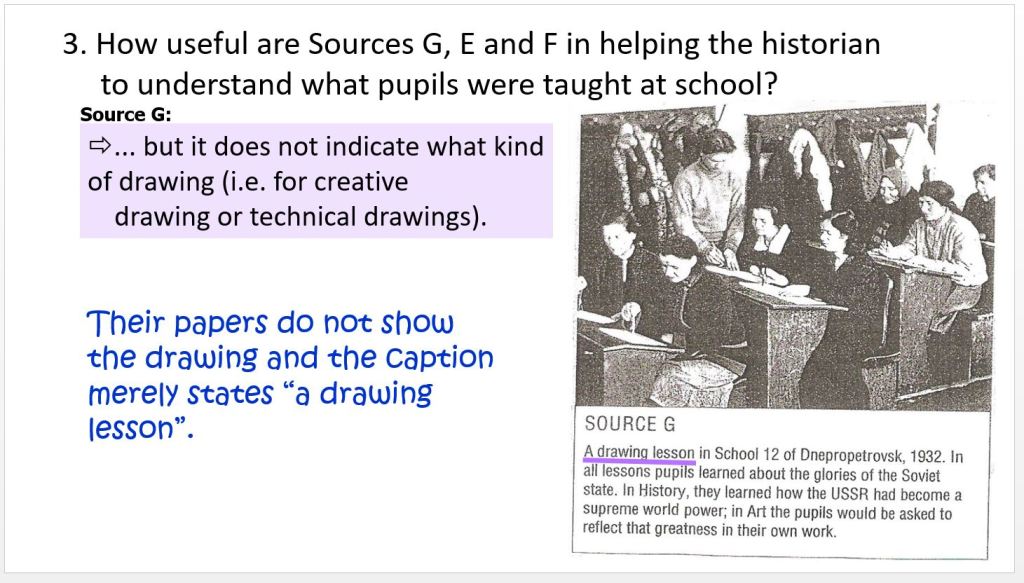
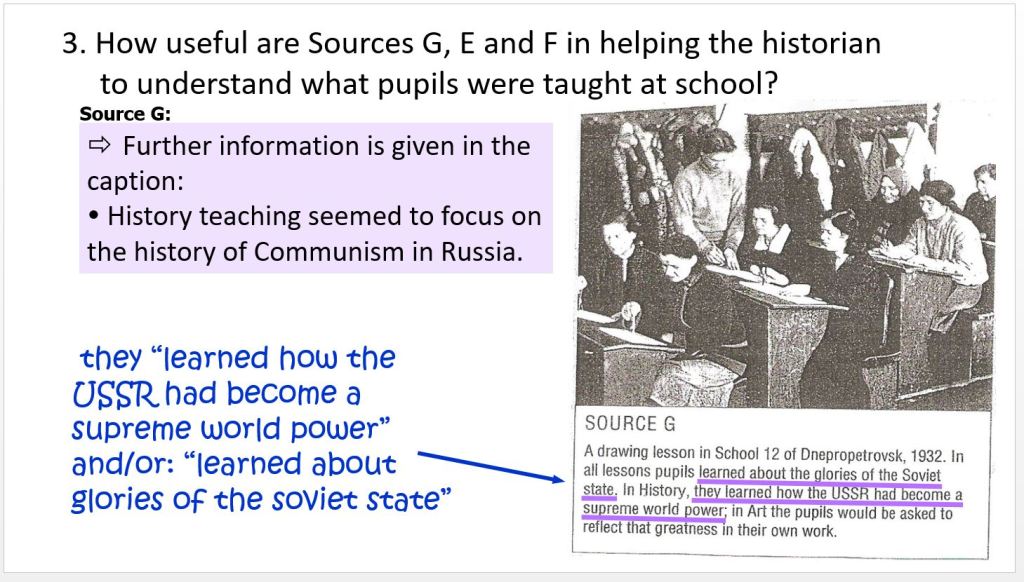
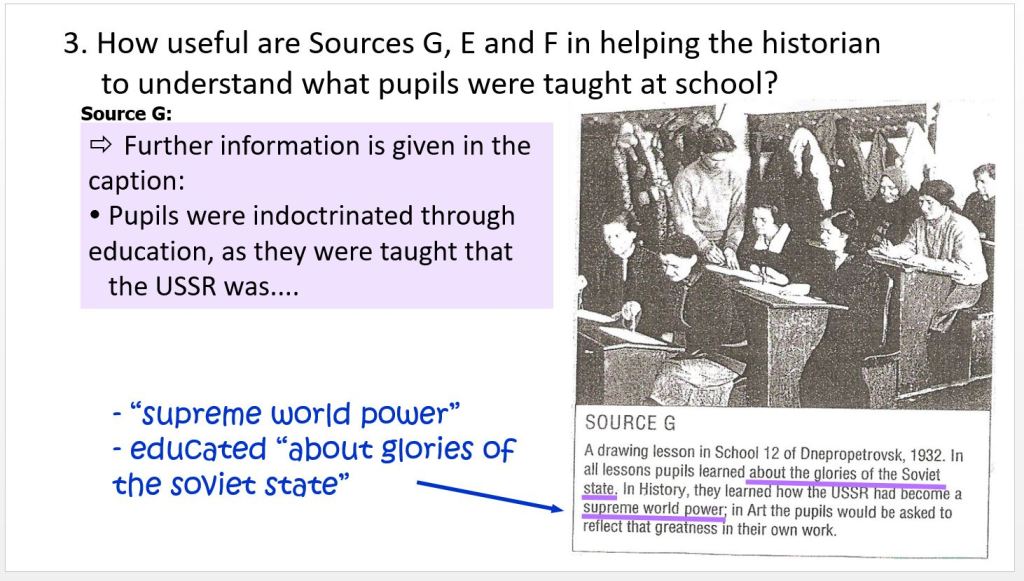
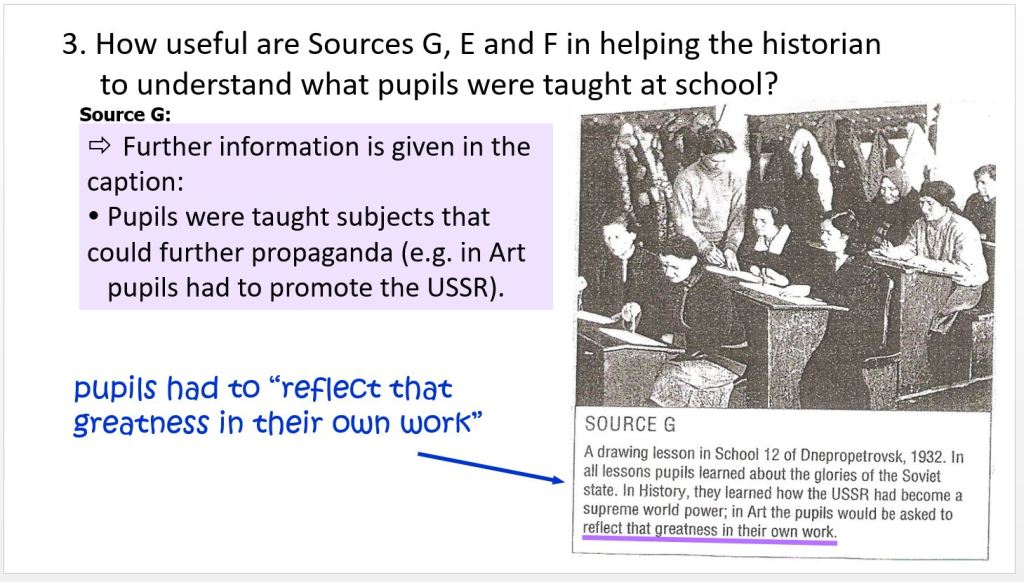
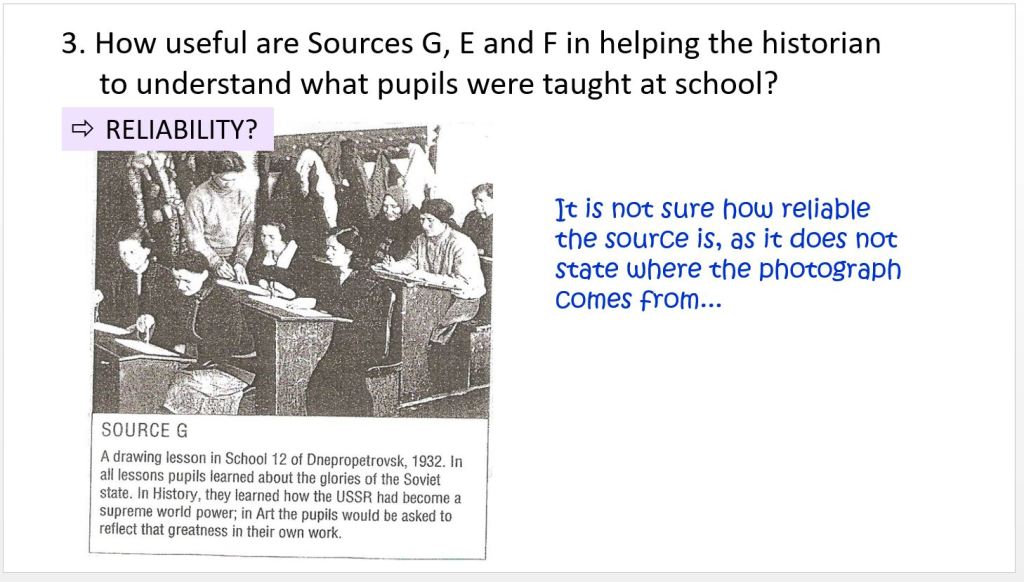
What impression of Soviet education does Source G give?
Question 3.
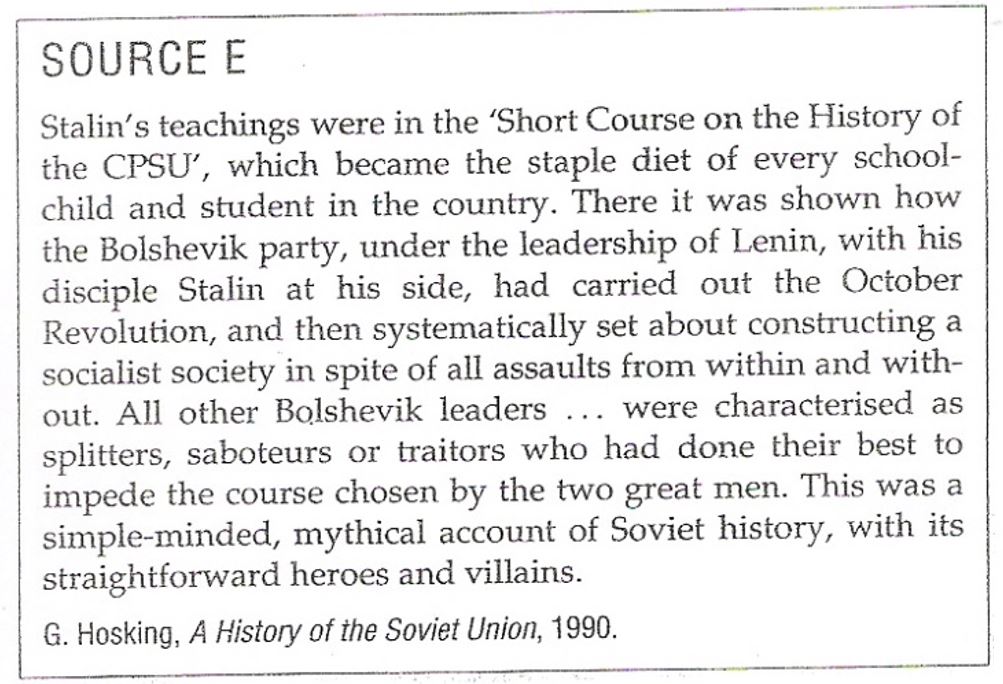
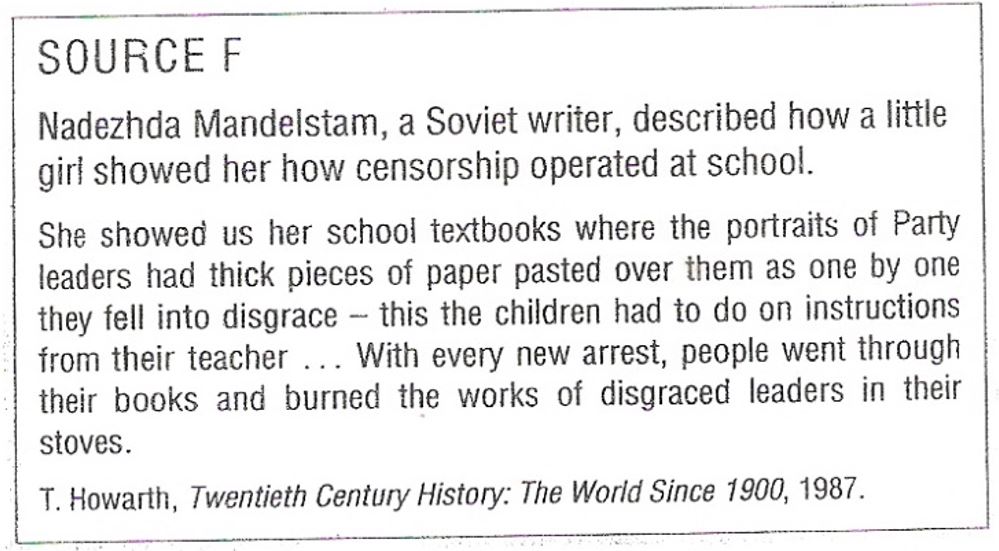
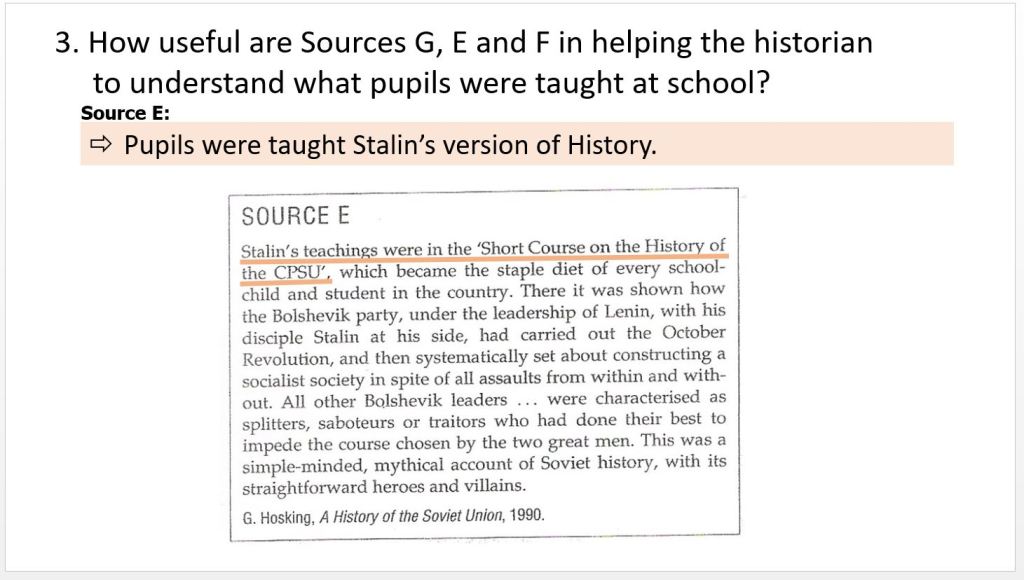
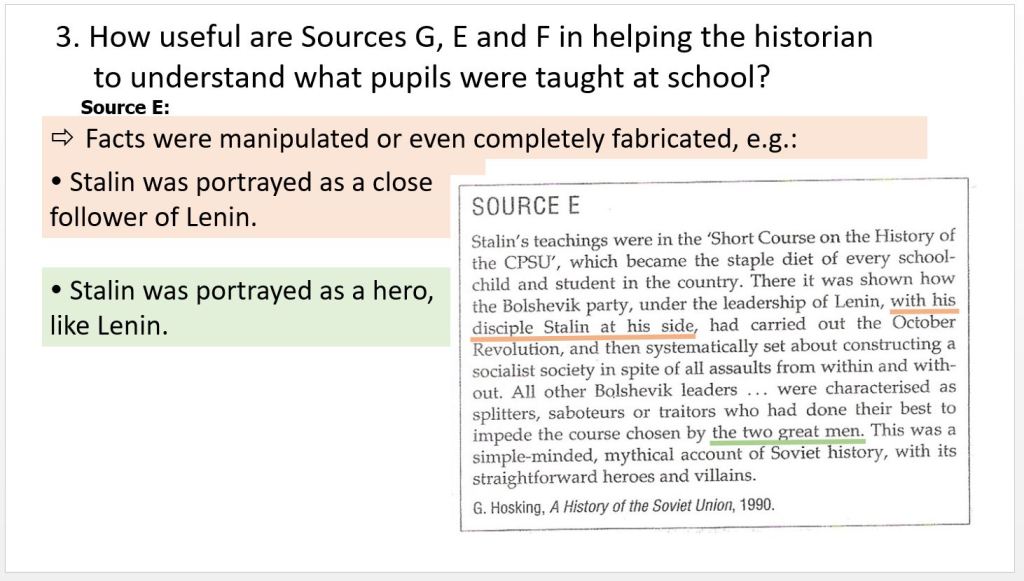
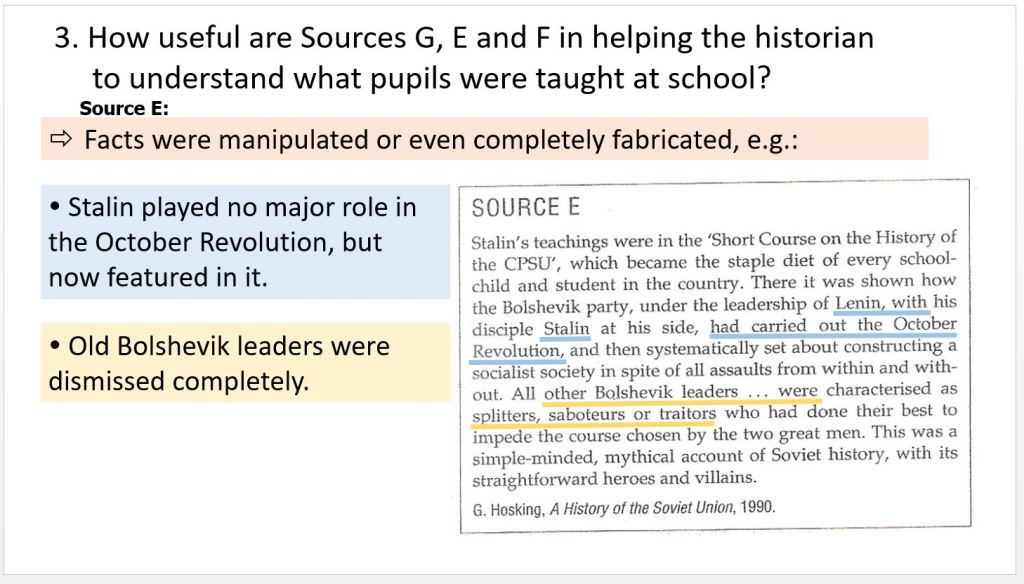
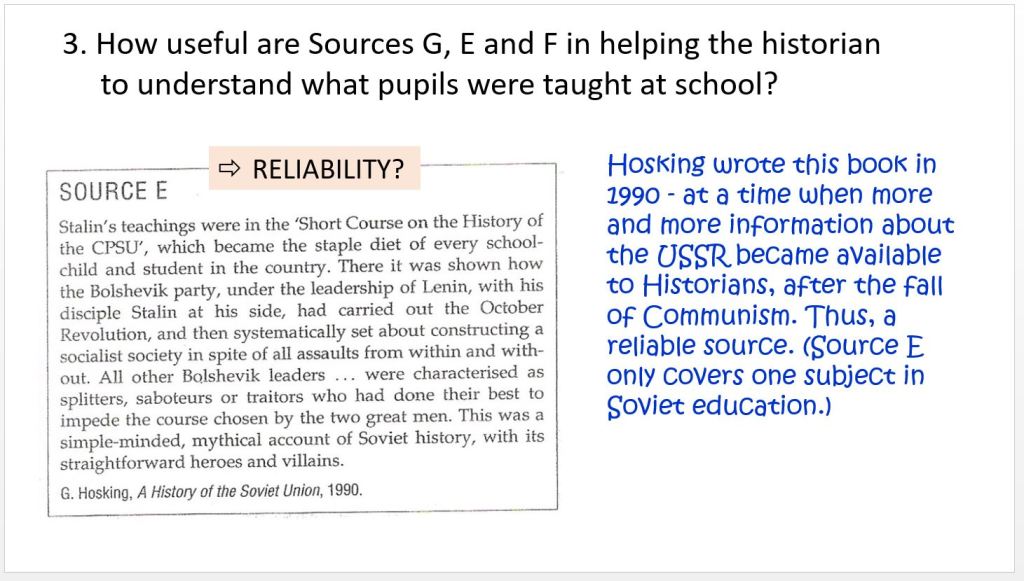
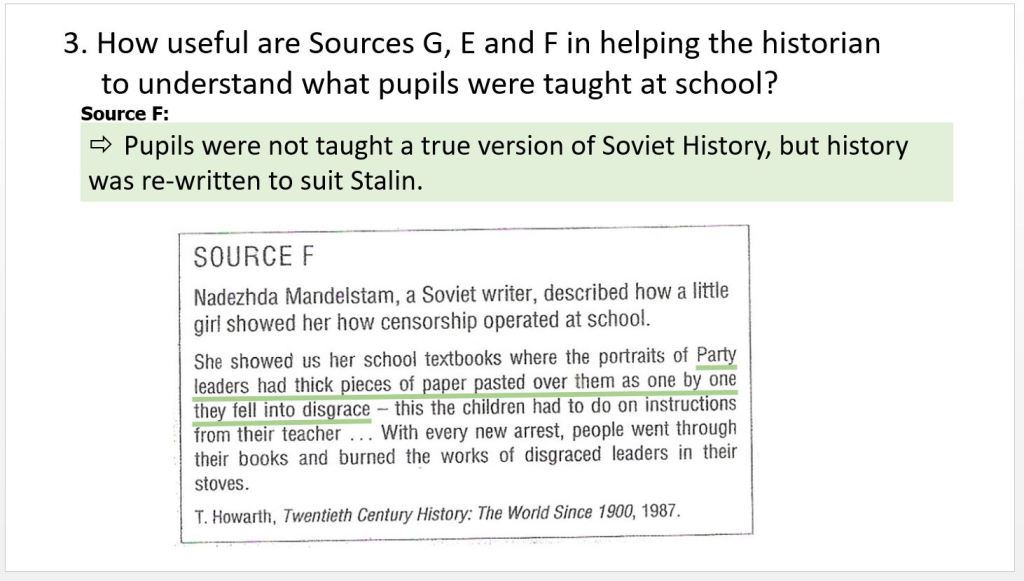
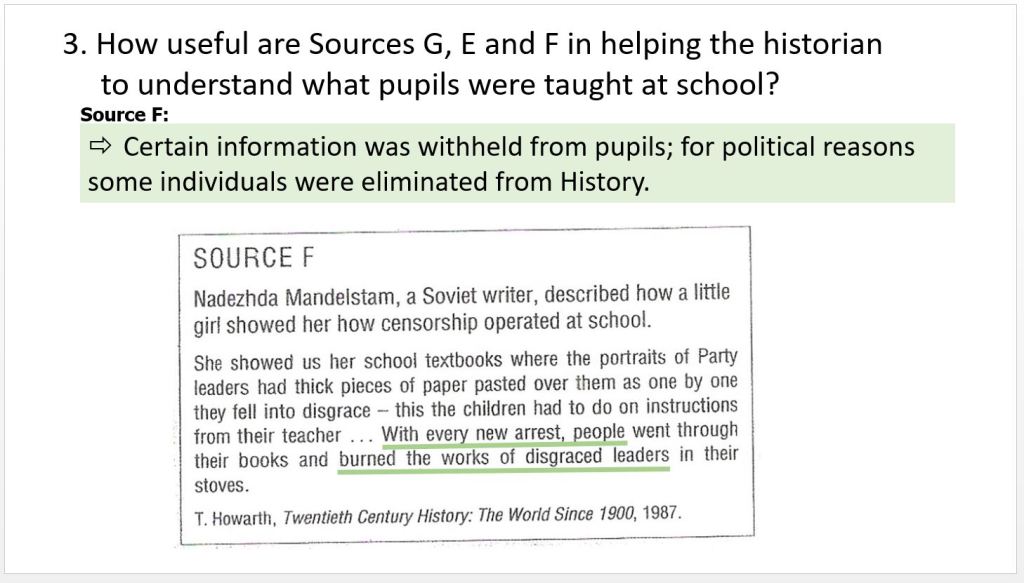
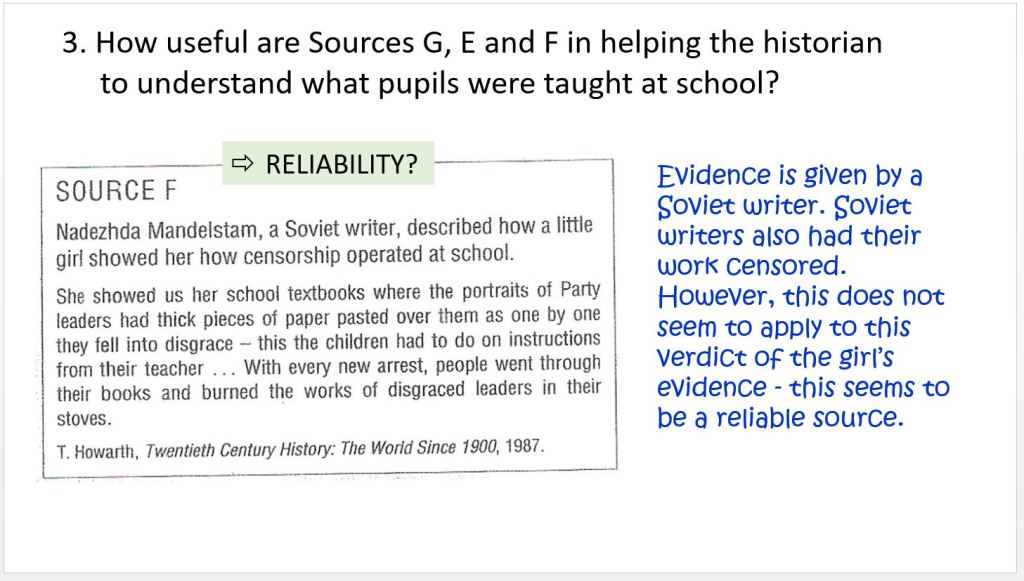
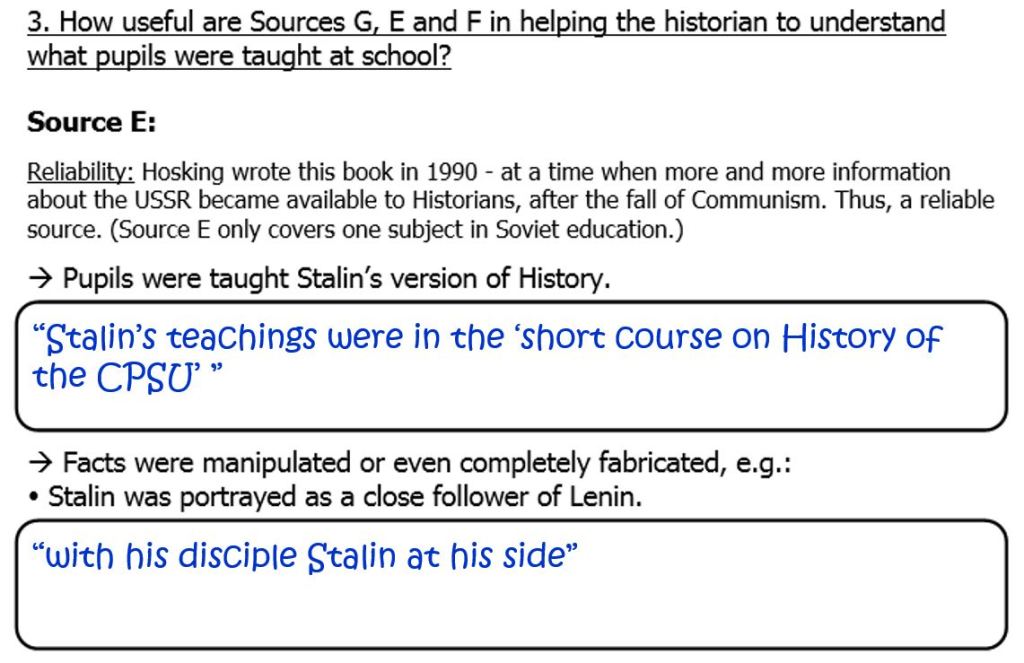
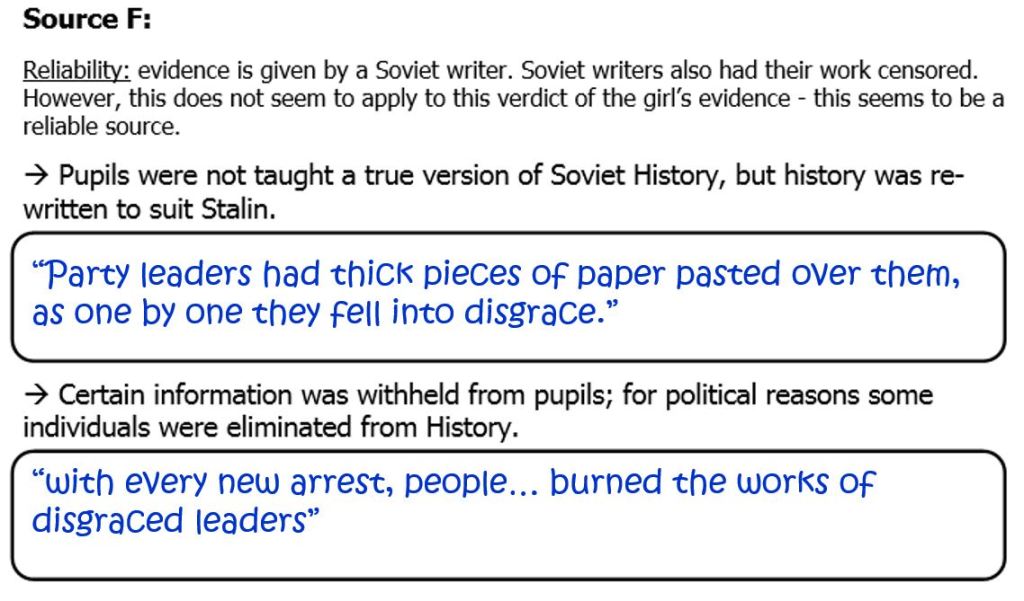
How useful are Sources G, E and F in helping the historian to understand what pupils were taught at school?
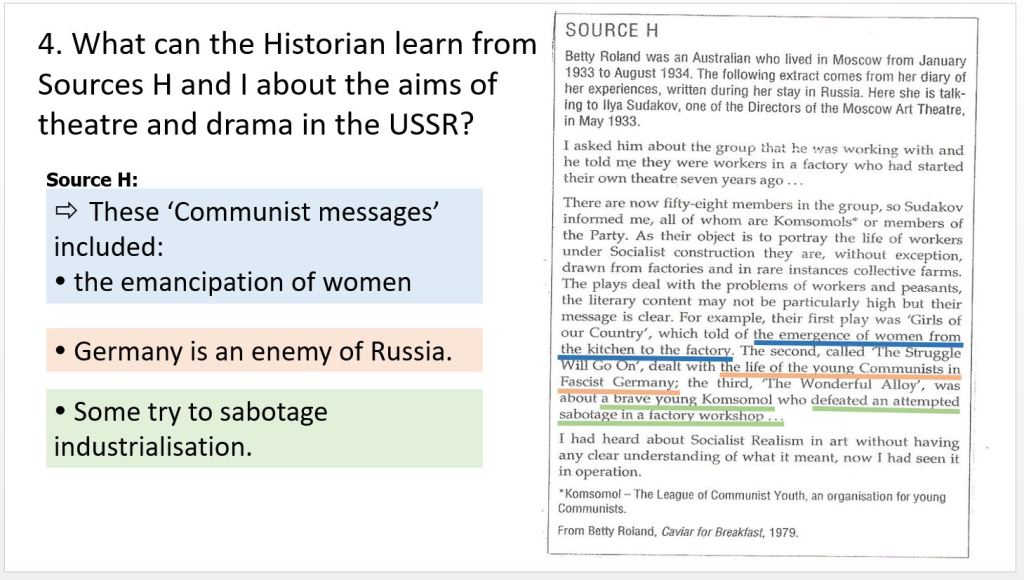
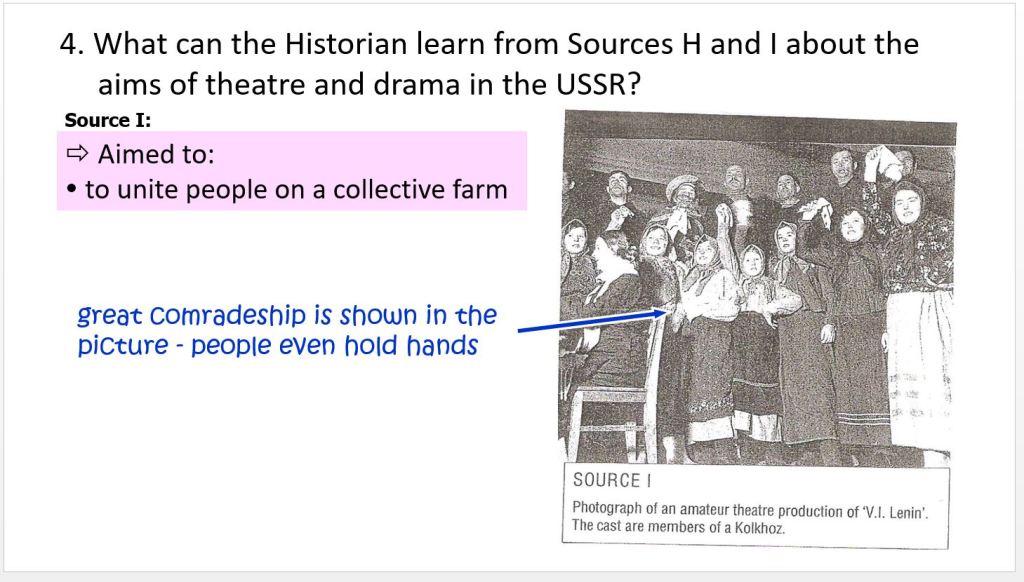
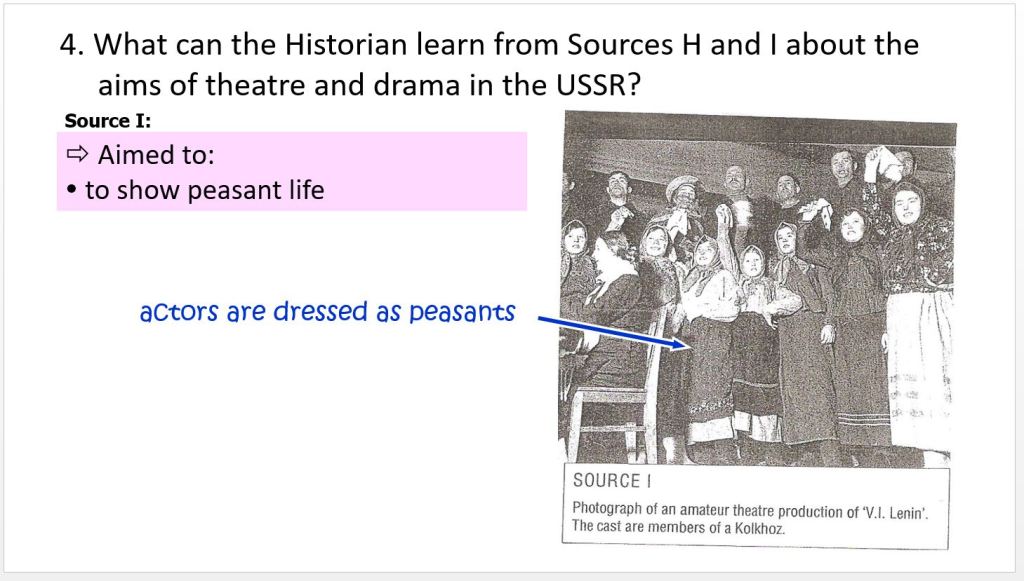
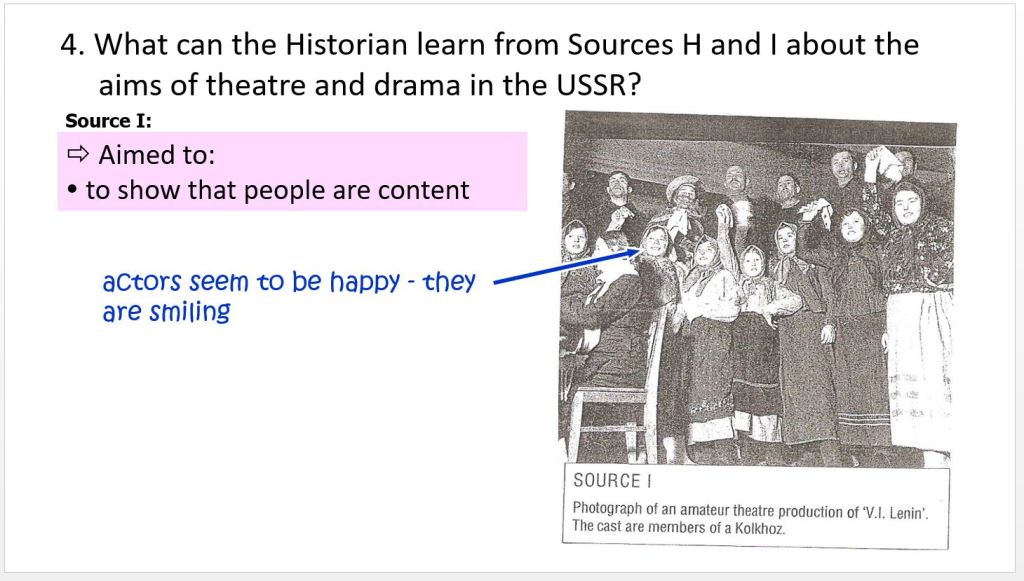
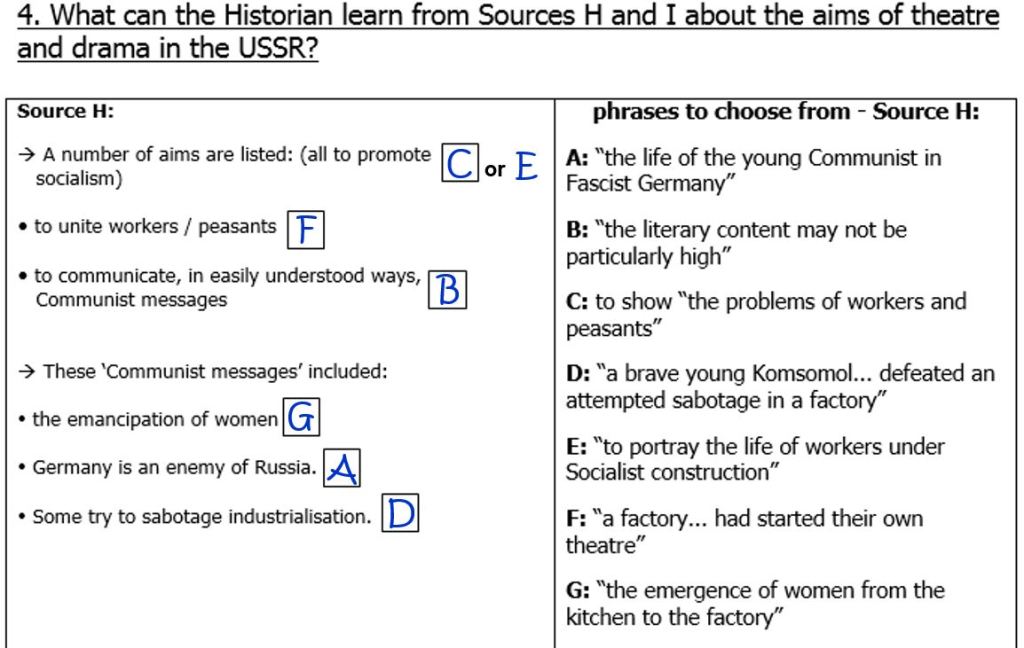
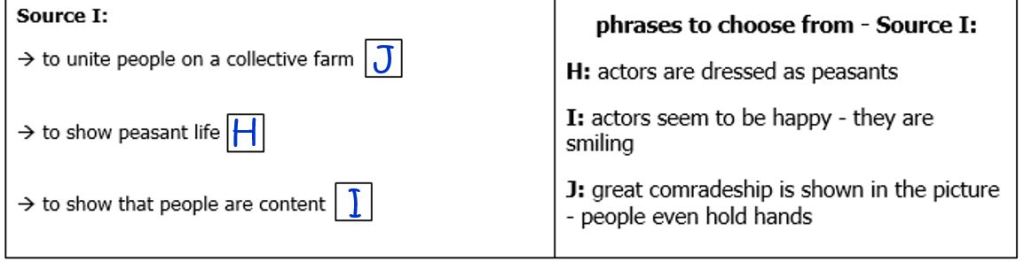
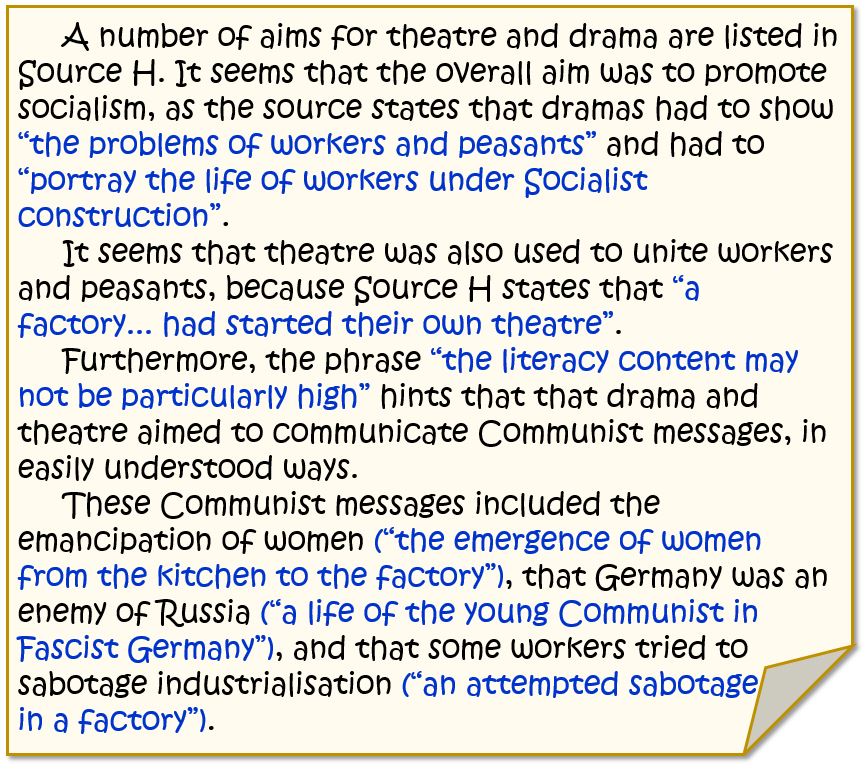
Question 4.
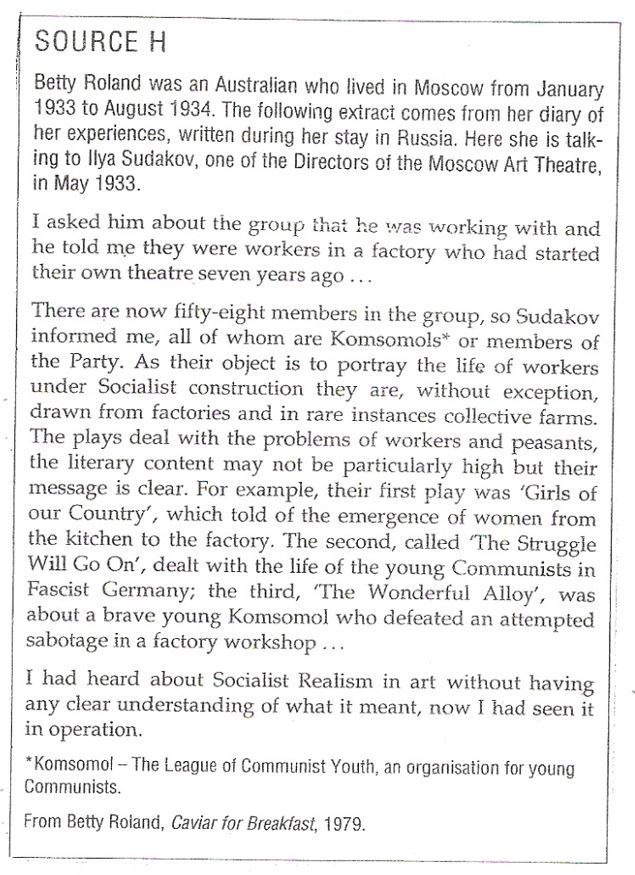
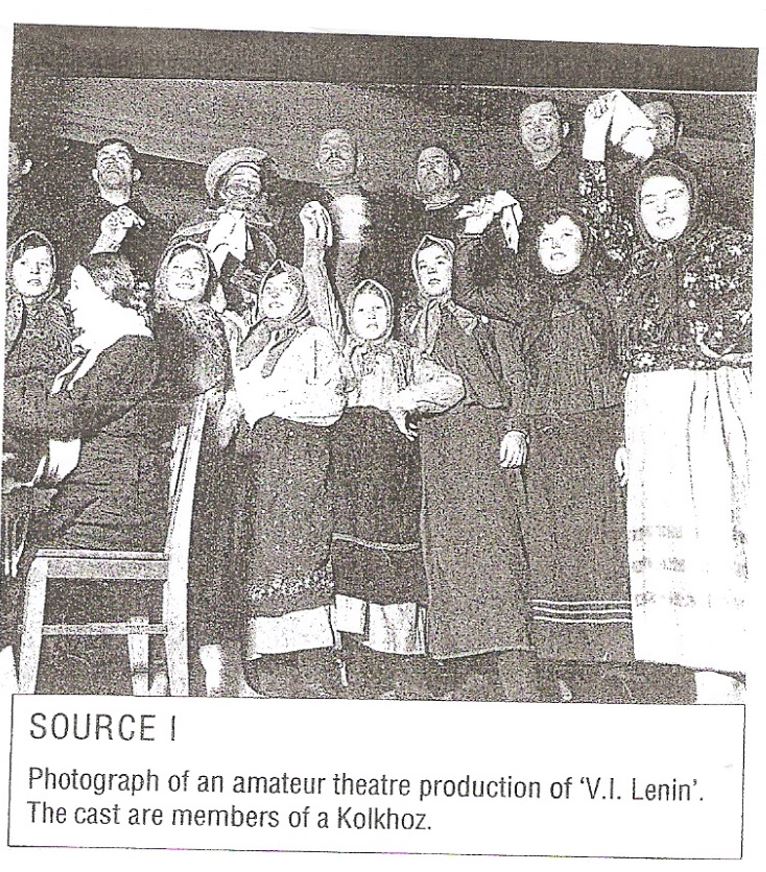
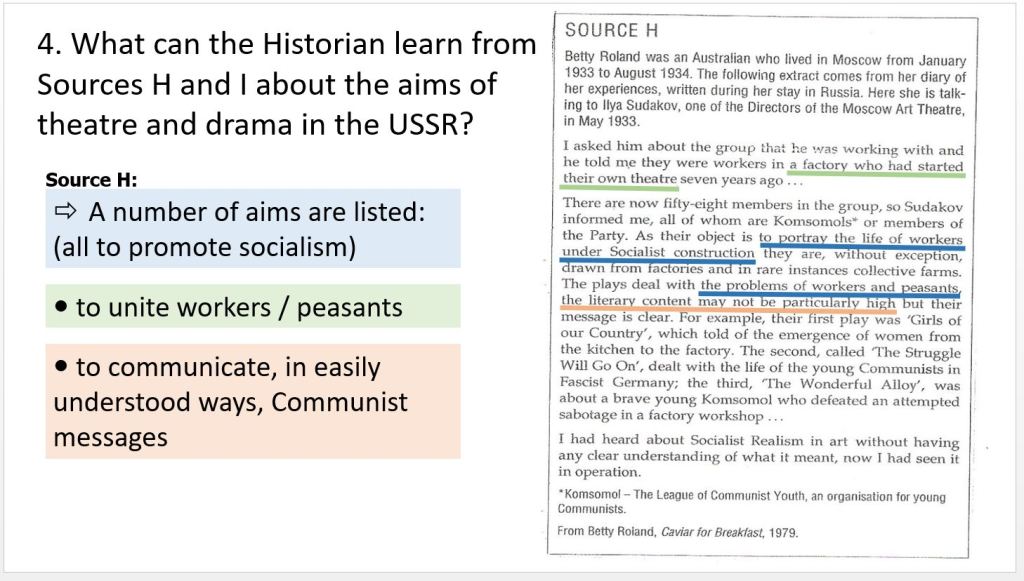
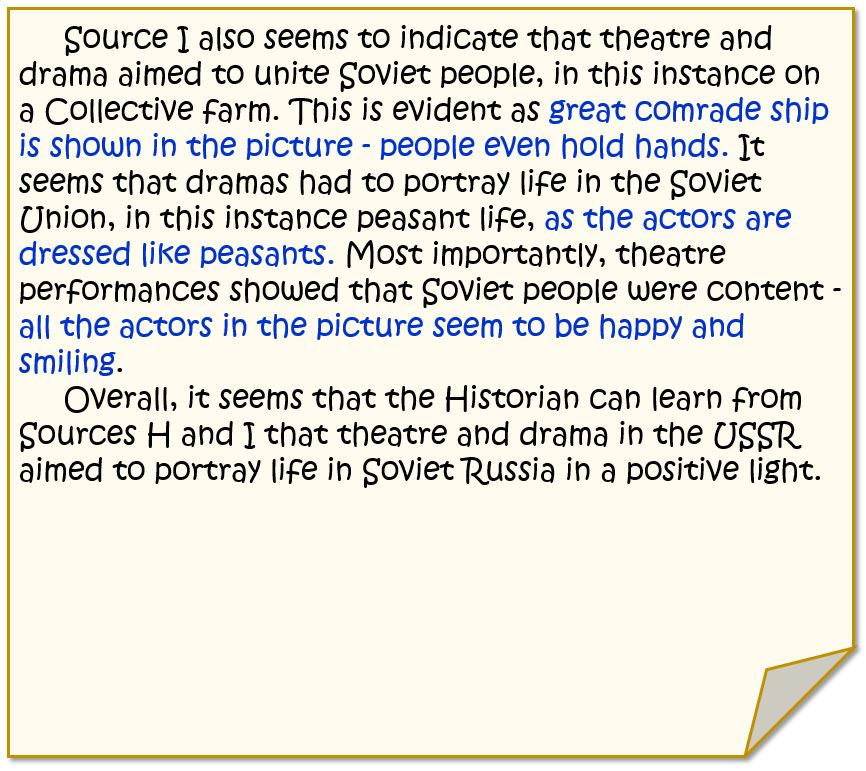
What can the historian learn from Sources H and I about the aims of theater and Drama in the USSR?
Remember to give evidence, in the form of short quotes, to back-up your statements!
7.
Stalin Nostalgia – Russia. (15:26 minutes long)
You can also WATCH THE FOLLOWING VIDEOS to get a better understanding of life in Soviet Russia:
Russian elders describe their life in the USSR. (6:37 minutes long)
The ULTIMATE Truth About The SOVIET UNION! (10:55 minutes long)
10 Brutal Realities of Life in Stalin’s Soviet Union. (13:26 minutes long)
What Life in the Soviet Union was like. (12:31 minutes long)
In a question like this it is important that you show how well you can communicate in History. Express yourself clearly and remember to back up your statements with evidence from the source!
Today you are going to find out more about Stalin’s reign of terror!
1.
Let’s see what we can learn about the purges… (The information in this video is very important for your study on Stalin’s Russia.)
The Purges. (5:13 minutes long)
2.
The information about “Stalin’s Dictatorship” , p.29-30.
3.
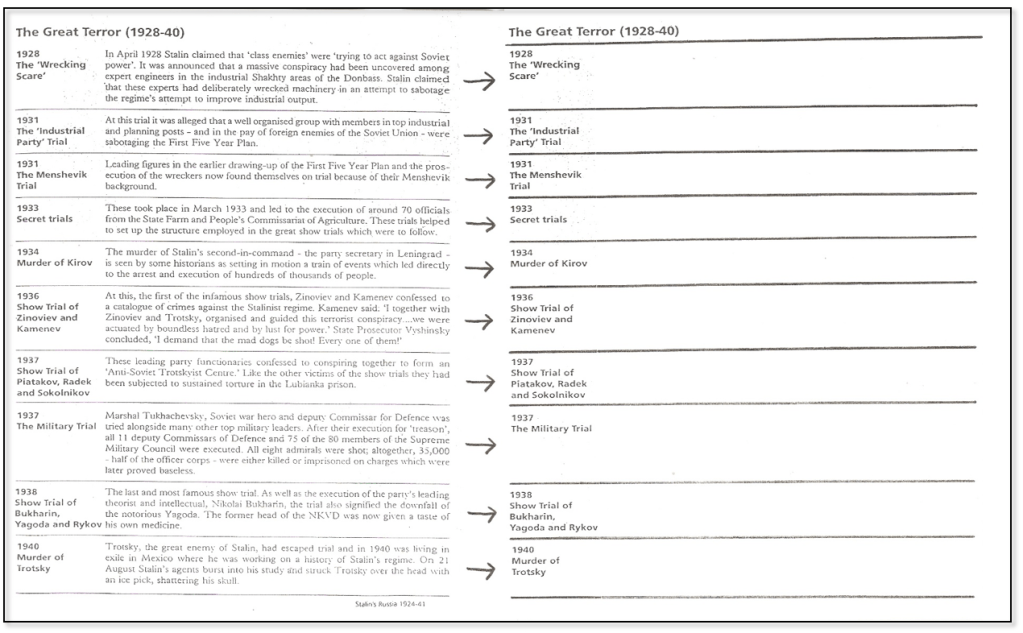
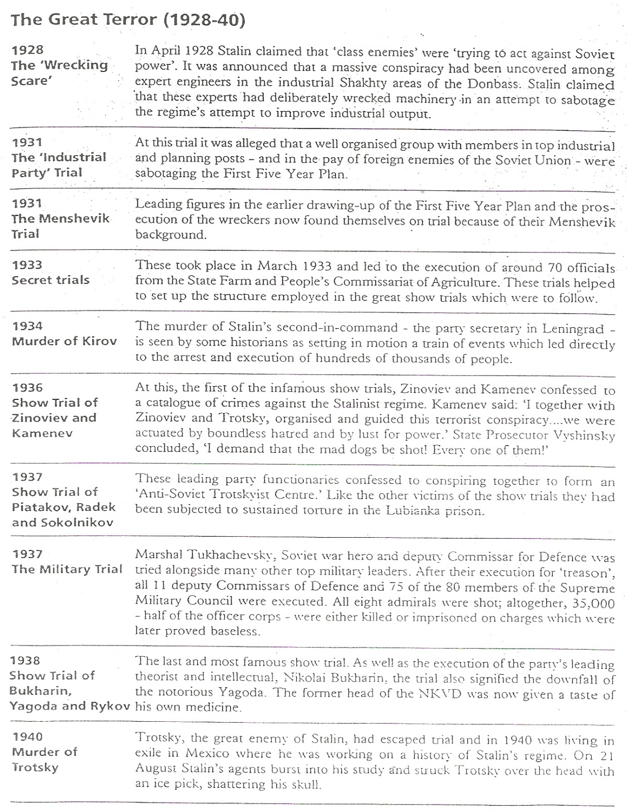
Stick the following worksheet into your book: (It will be handed out in class.)
4.
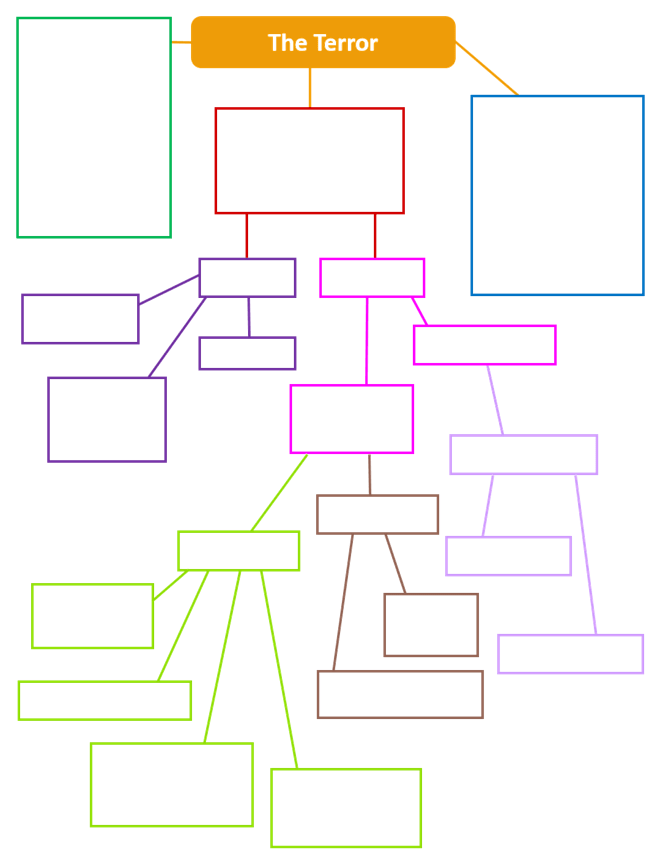
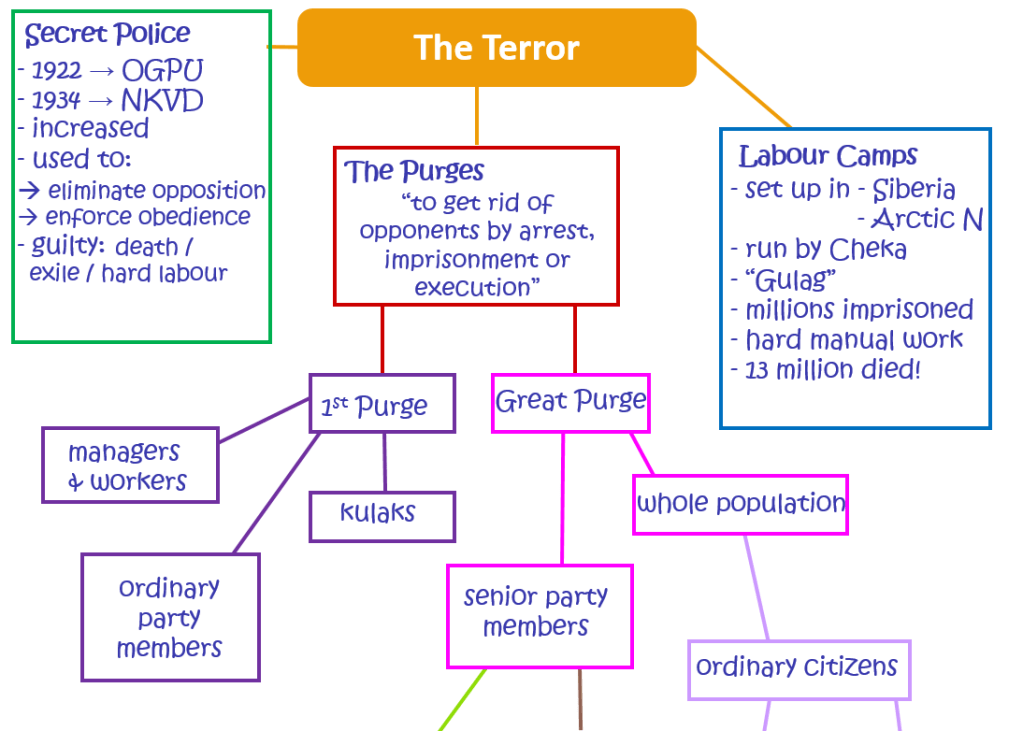
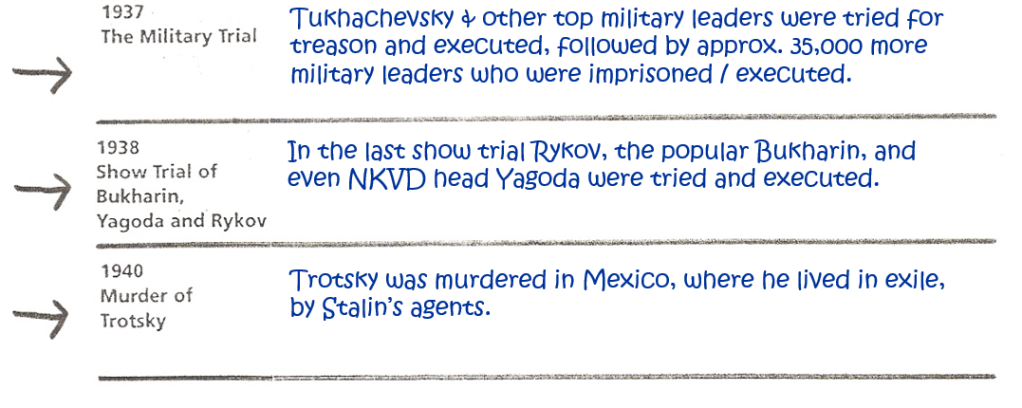
Now copy the diagram below. It gives an overview of Stalin’s reign by terror:
5.
Stick the following worksheet into your book: (It will be handed out in class.)
6.
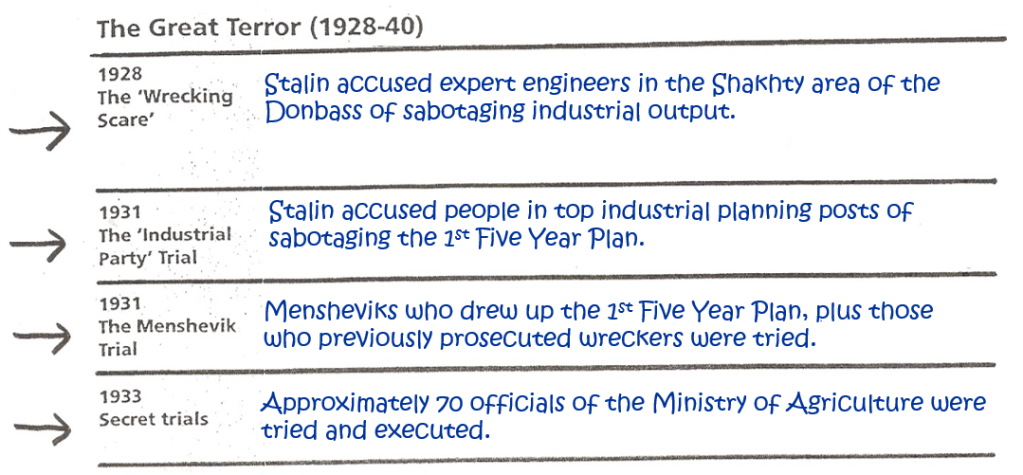
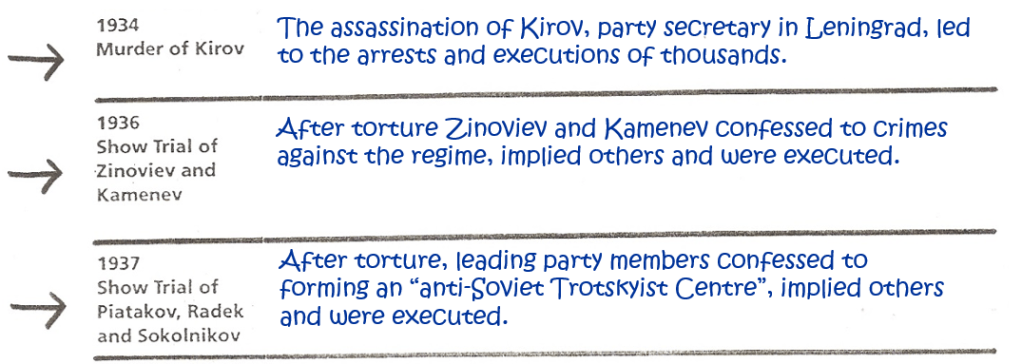
Read the information about “the Great Terror” (on the left) and then summarize each section (on the right), to only include the most essential information (for study purposes).
SOLUTION
OR:
(The slides give the same information as above.)
(2:24 minutes long)
7.
If there is still time in this lesson, do question 2 (on p.50) in your Russian History booklet.
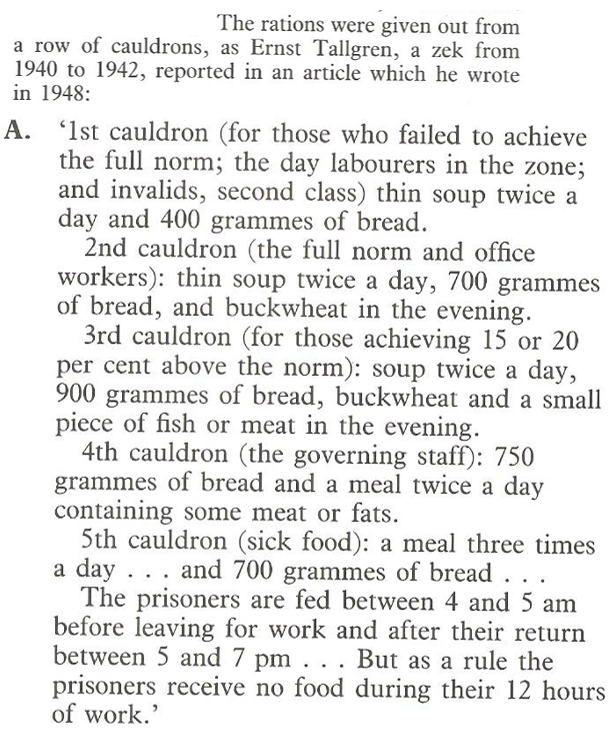
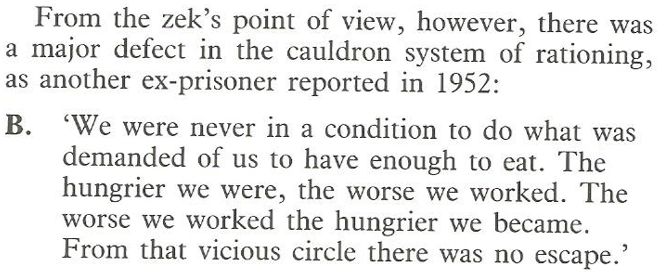
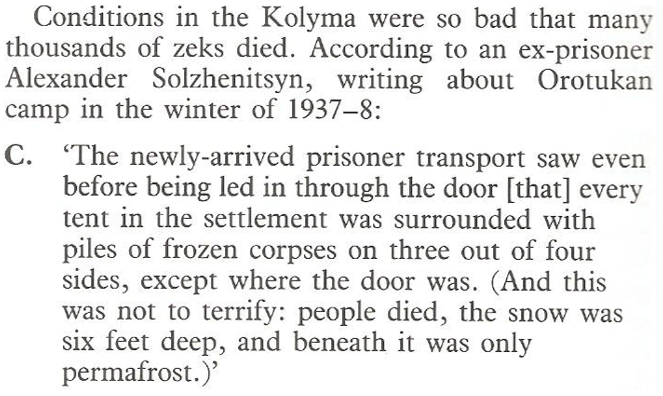
See p.50 – answer the following Source Question:
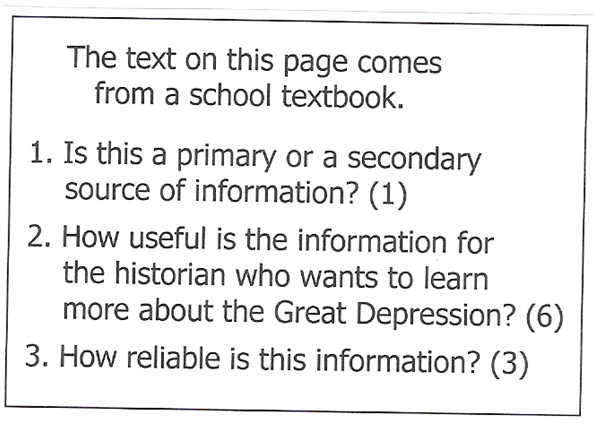
“Study Sources A, B and C How reliable are these sources to an Historian studying Soviet Labour Camps?” (5)
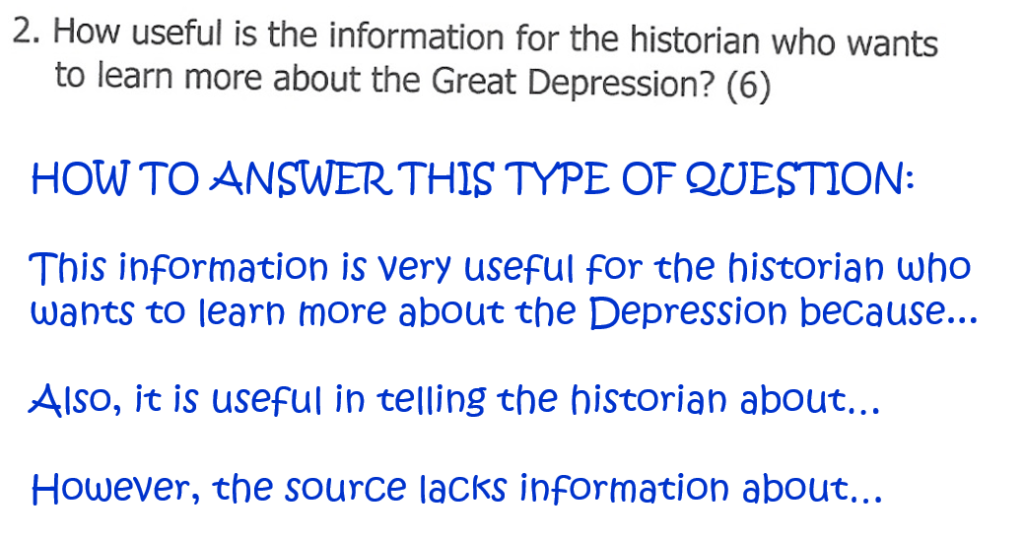
Here is some useful advice:
SOLUTION
(1.47 minutes long)
8.
Stalin Purges Enemies and Friends Alike. (3:20 minutes long)
The Great Purge: History Matters. (3:33 minutes long)
Life of People in Soviet Gulags. (8:14 minutes long)
Today you are going to examine the Great Depression in more detail!
Follow the instructions step by step:
1.
In the previous lesson we discussed the Great Depression. Here is a quick reminder of what the Great Depression was…
The Great Depression Explained in One minute. (1:29 minutes long)
2.
The effects of the Great Depression were profound… It had a negative impact on world economies, as shown in the diagram below:
3.
This diagram is on p.65 of your Workbook. Let’s also read the rest of the information about the Great Depression on p.65.
“The End of the Golden Twenties”, p.65.
4.
The Great Depression did not only have a negative economic impact. It also had negative political consequences. For example:
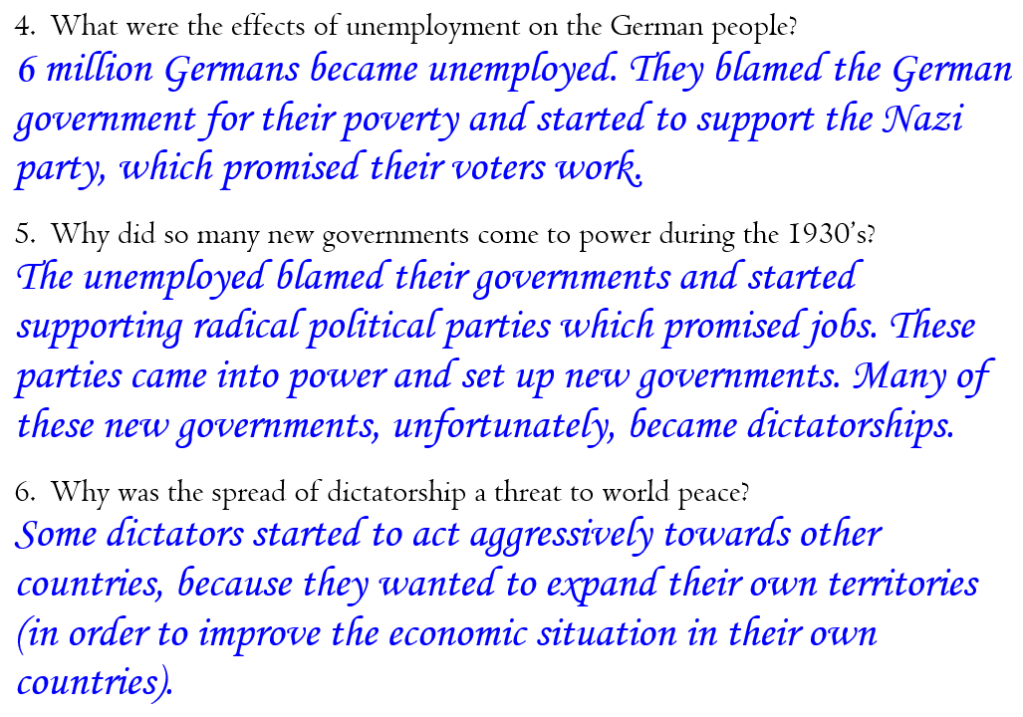
People blamed their governments for their suffering…
People began to support radical political parties…
This gave rise to dictatorships…!
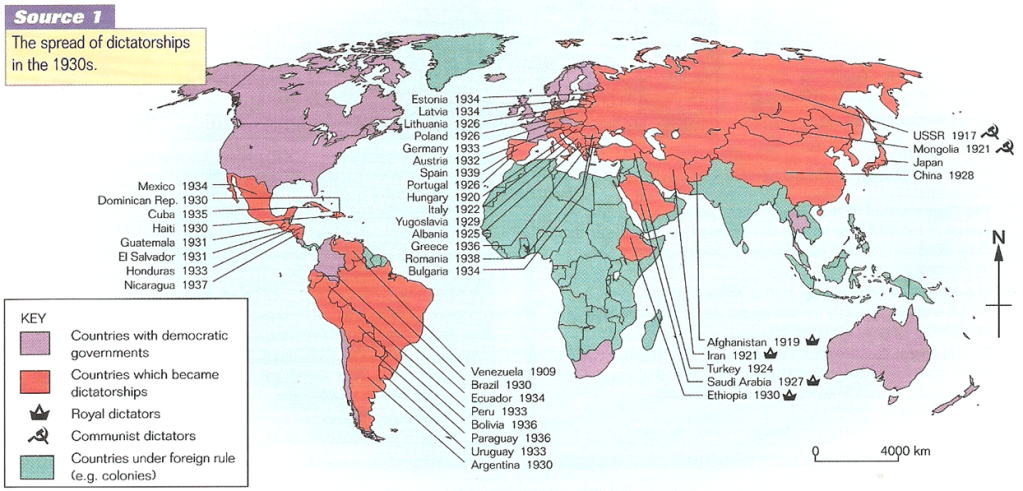
Here you can see how dictatorships spread during the 1930’s, as a direct result of the Great Depression!
(This diagram is on p.66 in your Workbook.)
5.
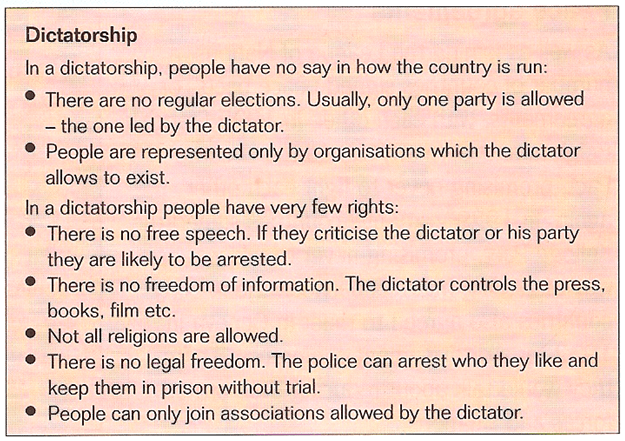
So, what is a dictatorship?
(1:03 minutes long)
Here are the main characteristics of a dictatorship:
6.
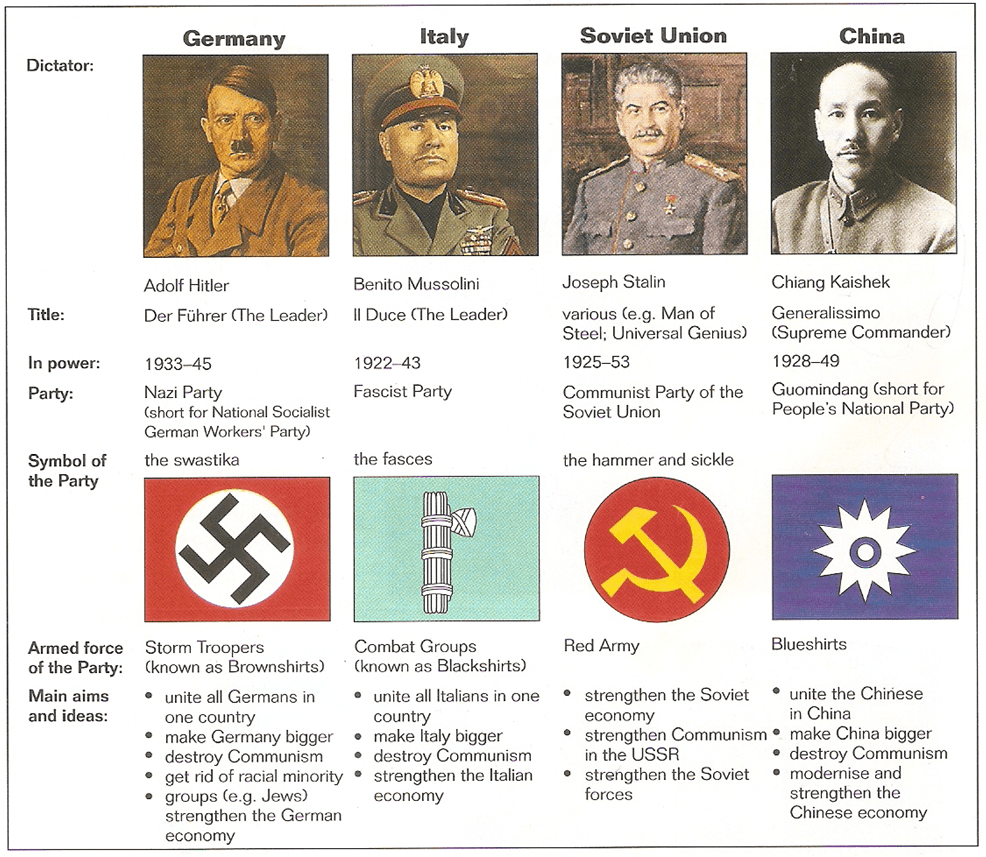
Examine the chart below. It gives brief information about four well known dictatorships of the 1930’s:
(This is Source 2, on p.67 of your Workbook.)
7.
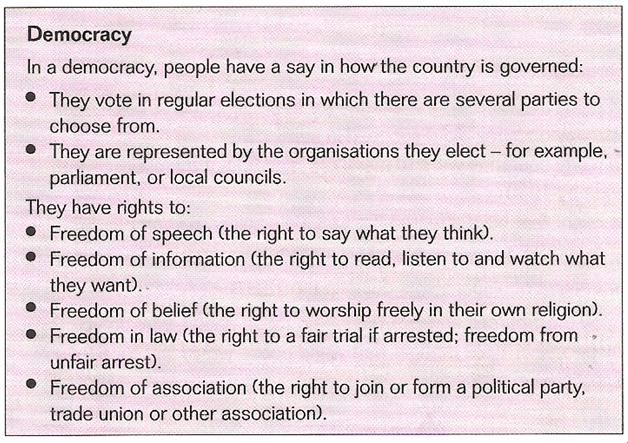
The opposite of a dictatorship is a democracy.
(1:04 minutes long)
Here are the main characteristics of a democracy:
8.
Let’s see what else we can learn about the Great Depression and its effects from your Workbook.
p.66-67
9.
Now, complete the “mood-o-metre” (on p.42) to show how you feel about the topic on “The Consequences of WW1” …! (Feel free to also make any other relevant comments about this topic.)
10.
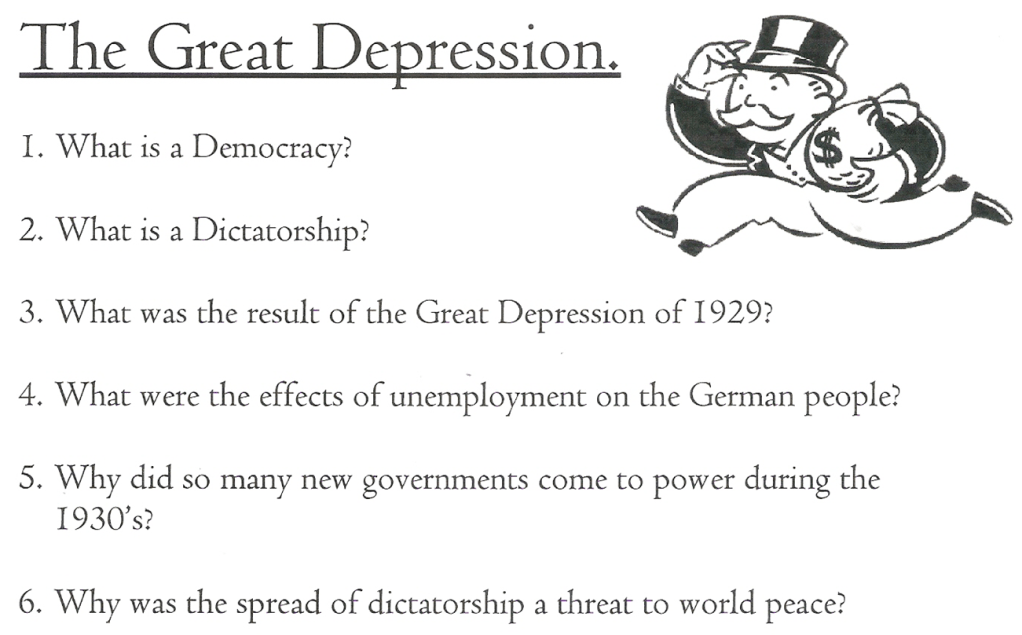
Finally, let’s test your knowledge and understanding of the Great Depression and its impact by answering the questions on p.64 in your Workbook.
“The Great Depression, p.64”
SOLUTION:
11.
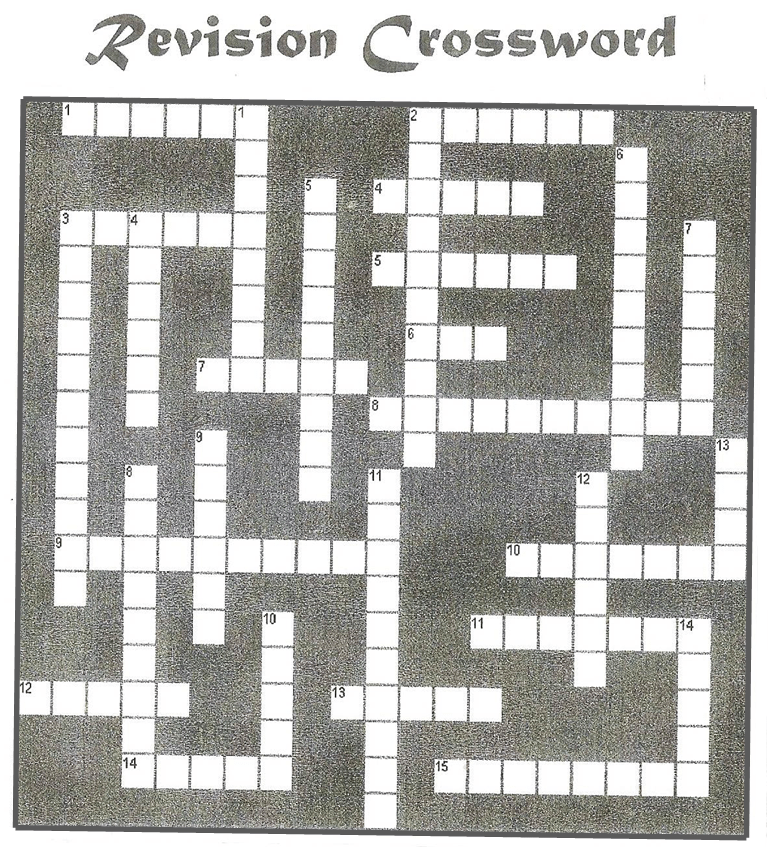
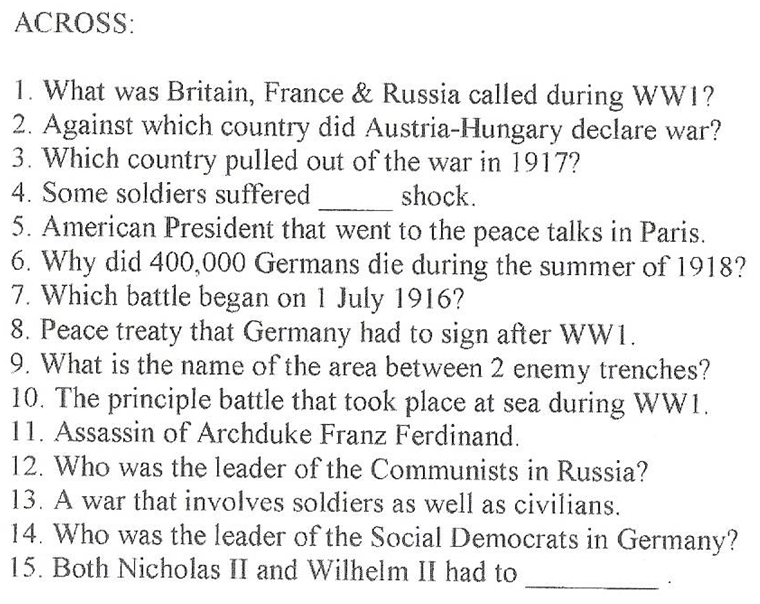
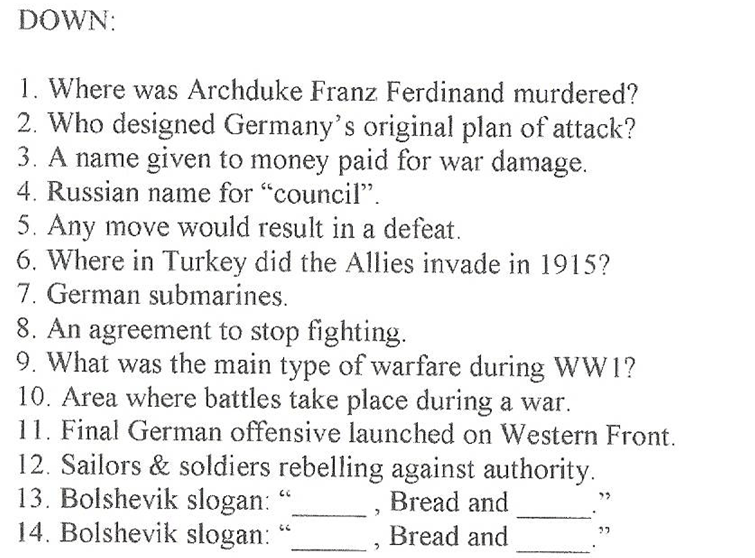
If there is still time, complete the crossword puzzle on p.70-71 of your Workbook.
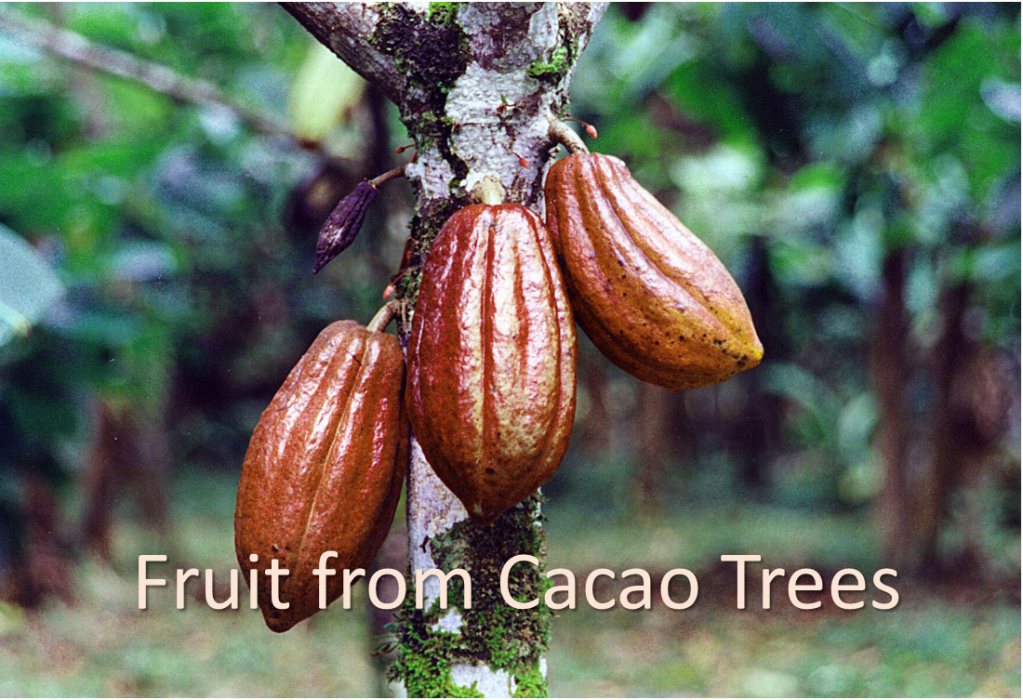
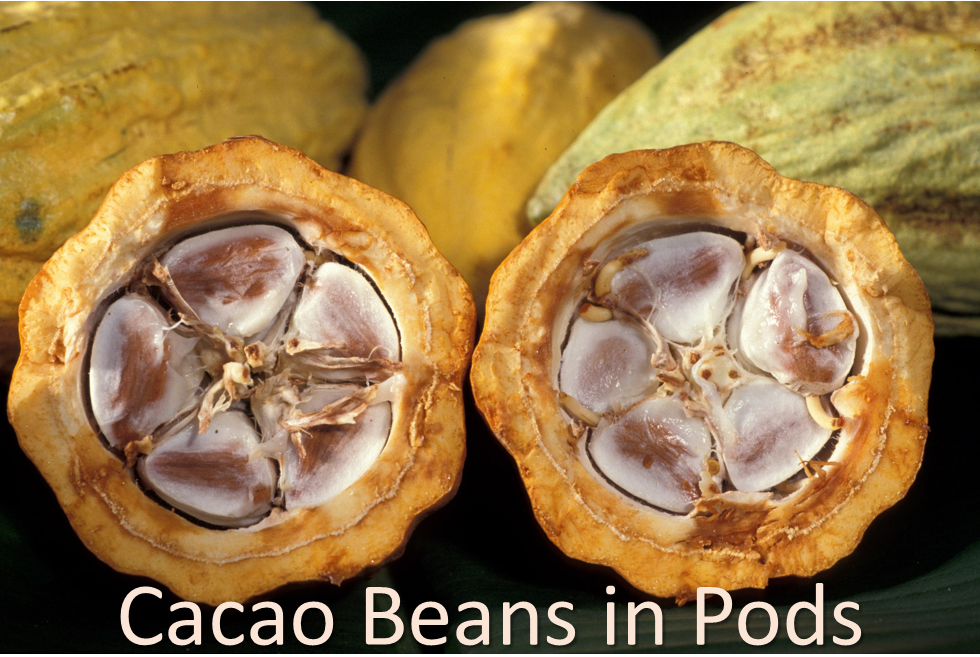
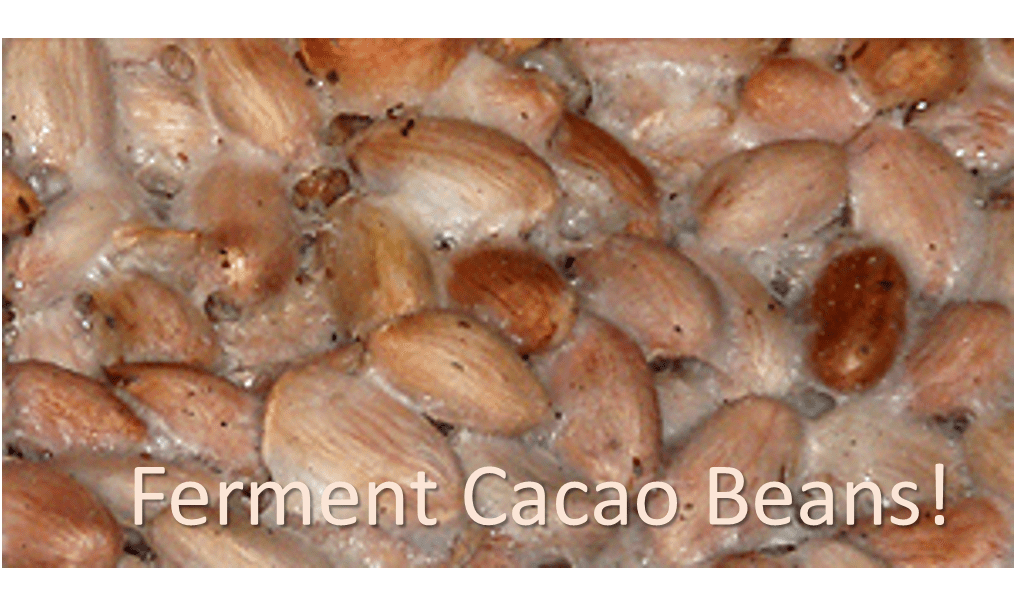
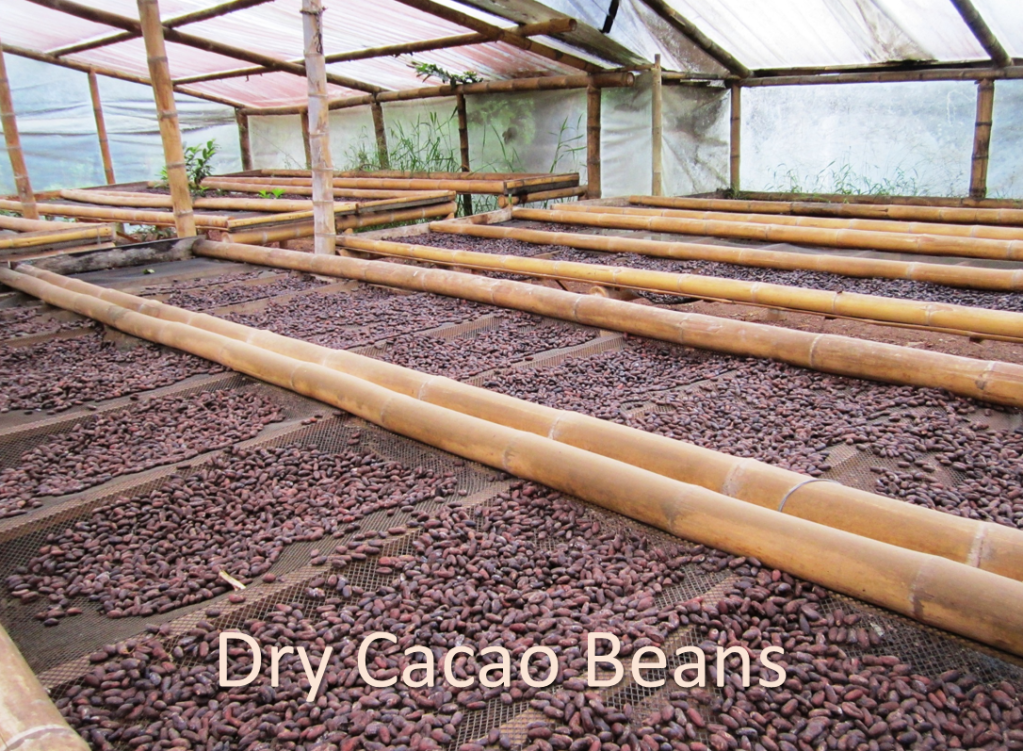
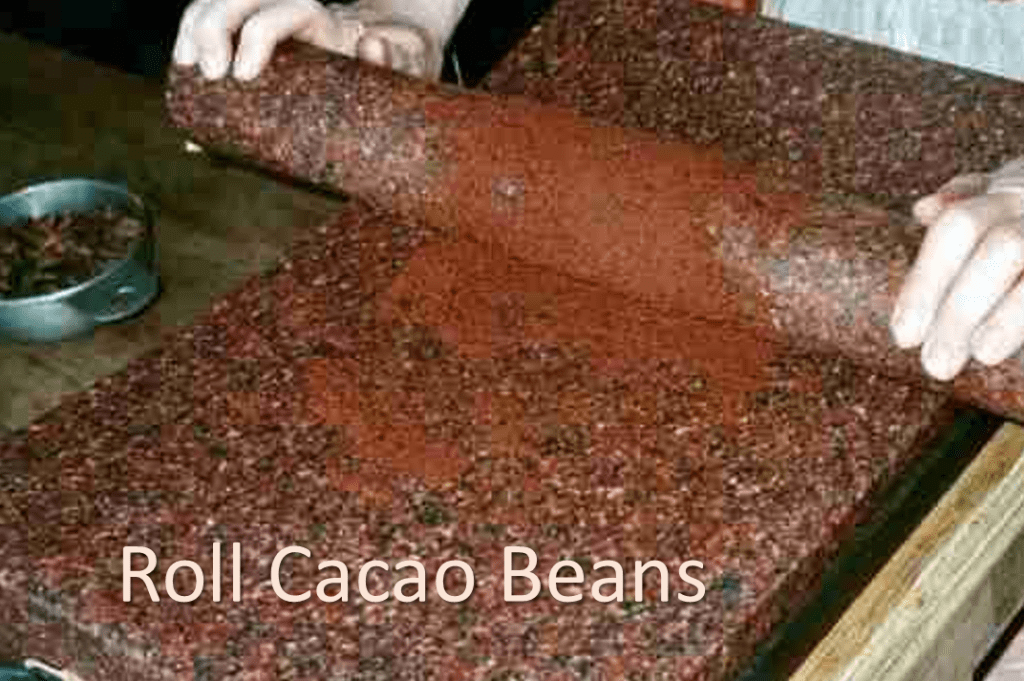
Go through the slideshow below and you will see how Chocolate is made… The slides take you through the process, from the cacao beans to a lovely box of chocolates!
3.
No, lets look at the following videos that explain in more detail how chocolate is made.
The history of chocolate – Deanna Pucciarelli. (4:40 minutes long)
How chocolate is made. (4:34 minutes long)
The Story of Chocolate. (8:02 minutes long)
4.
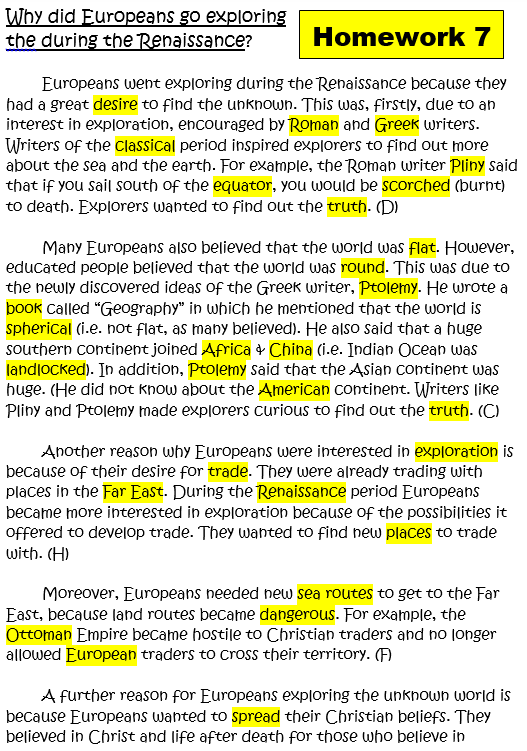
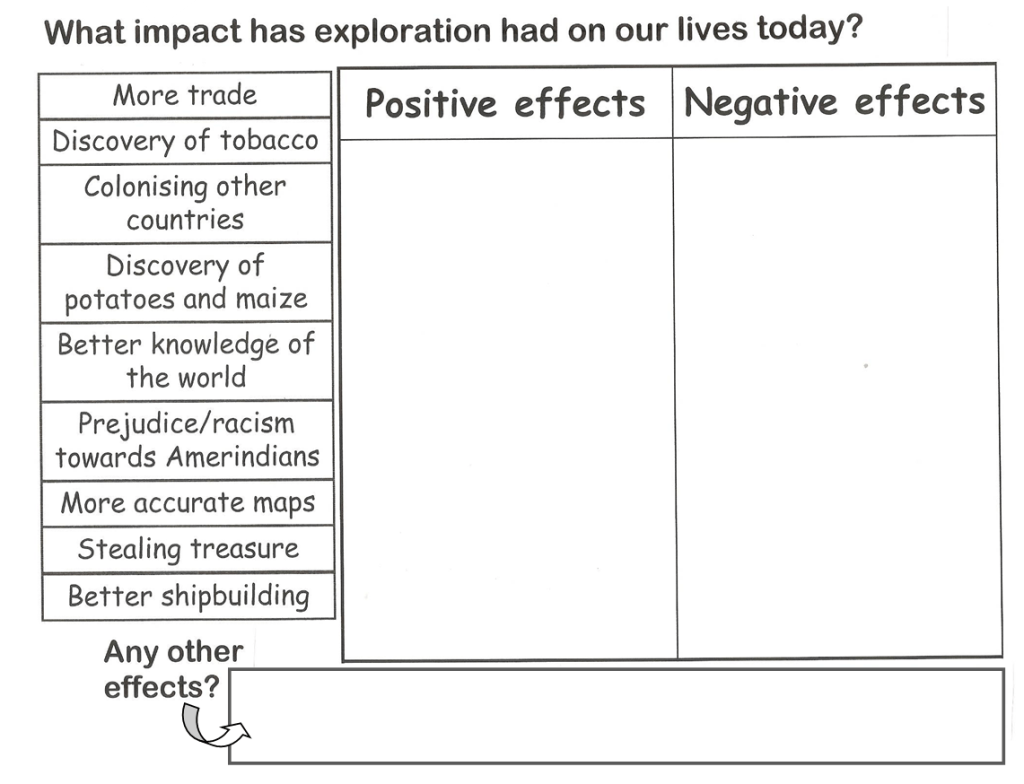
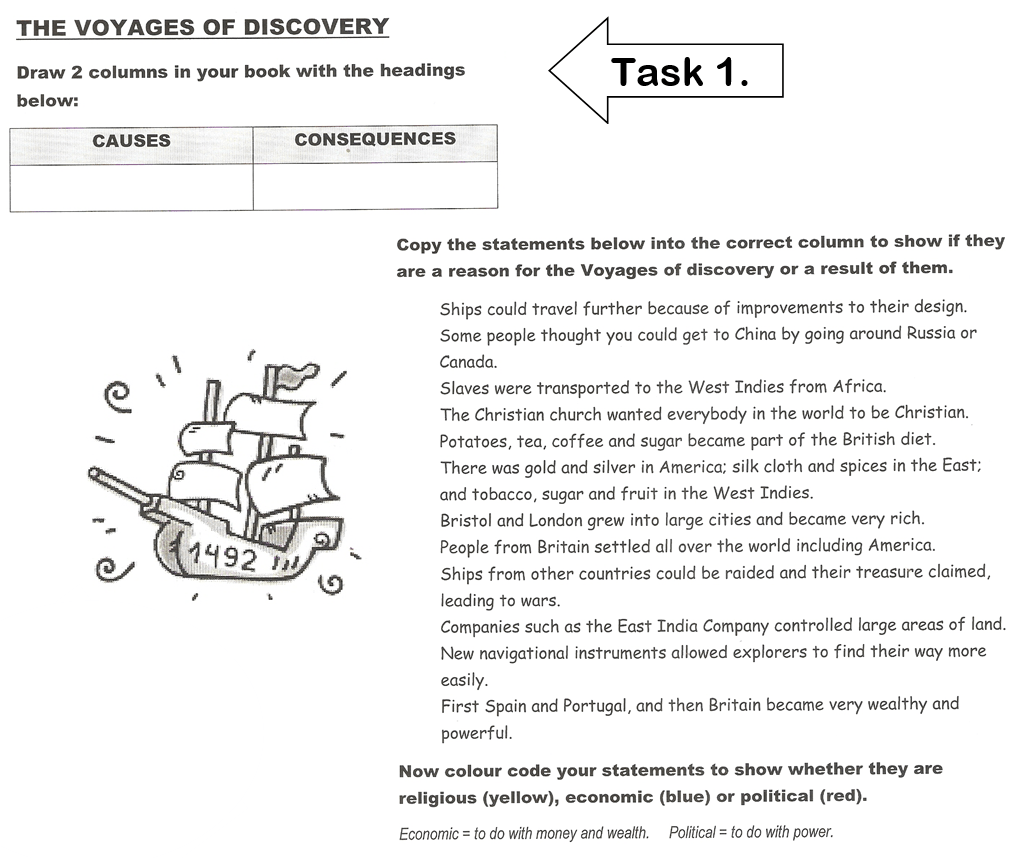
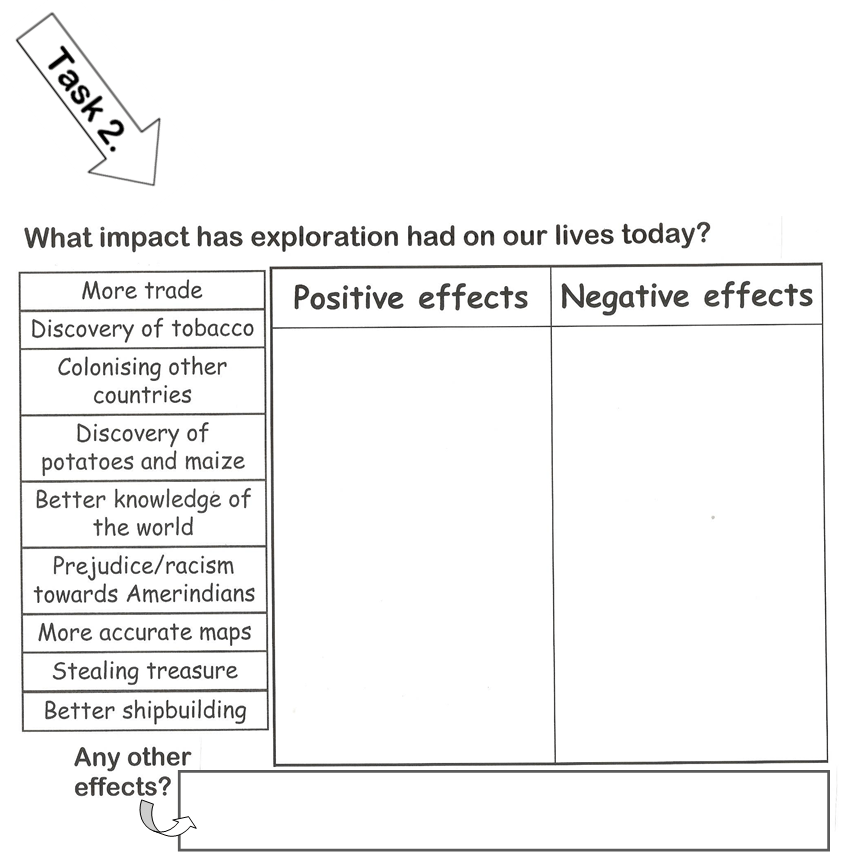
So, “chocolate” gives us a clue as to what one of the impacts of exploration was. The are more… Complete the two tasks on p.42 of your Workbook to examine the impact that exploration had in more detail.
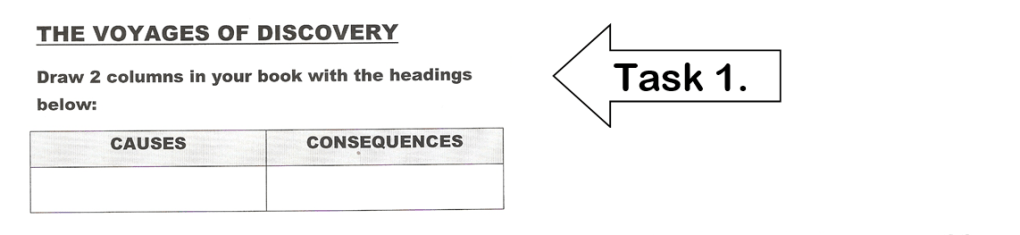
Here is what you have to do for Task 1:
“The voyages of discovery, p.42”
Draw 2 columns in your exercise book. Use these headings: CAUSES and CONSEQUENCES.
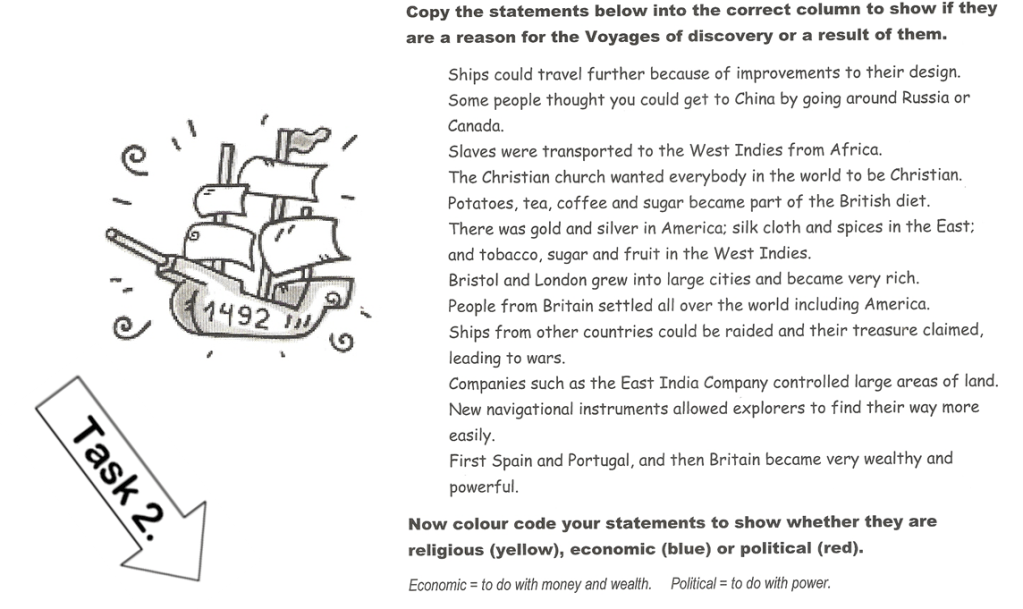
Copy the statements in Task 1 (p.42) into the correct column, to show if the statement is a reason for the Voyages of discovery or a result of them.
Remember to also colour-code your statements, to show whether they are religious (yellow) , economic (blue) or political (red)!
Here is what you have to do for Task 2:
Look at the effects in the column on the left – they show the impact of exploration on our lives today. Identify the positive and negative effects and write them in the relevant columns in your Workbook. Finally, also complete the “any other effects” box!
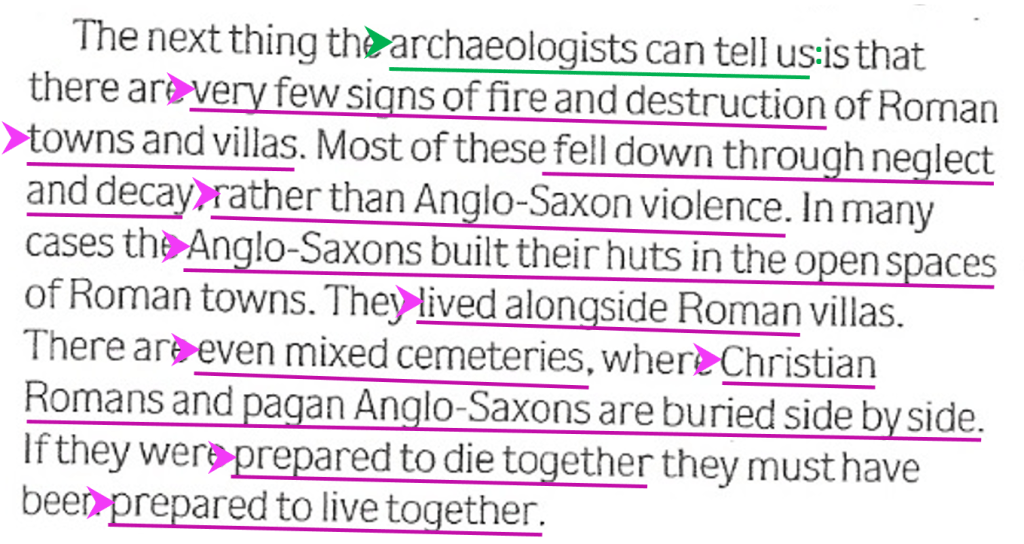
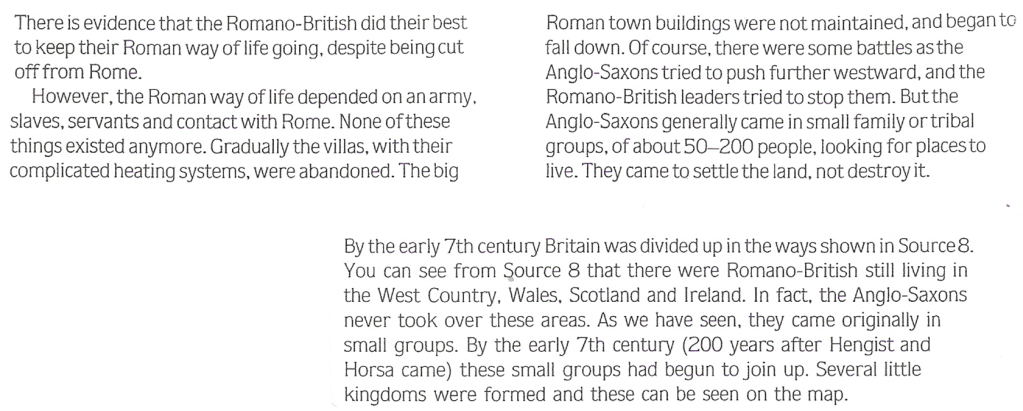
In the previous lesson, we looked at archaeological evidence and we also learnt the following:
4.
You also learnt that:
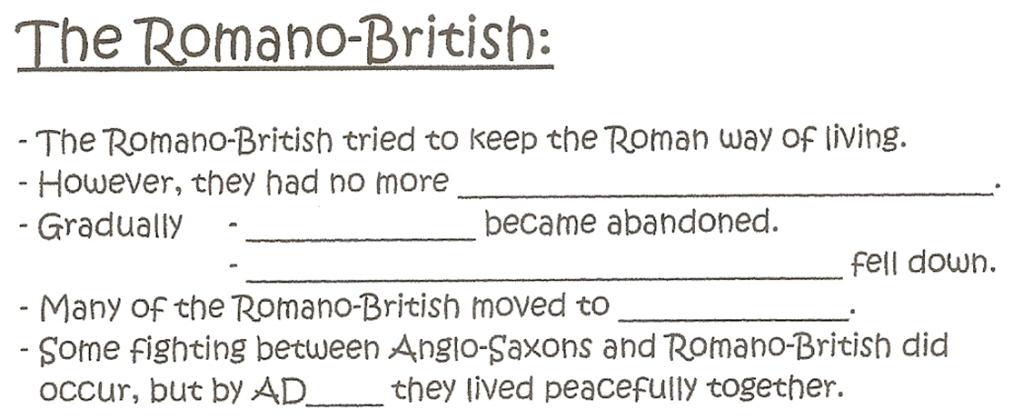
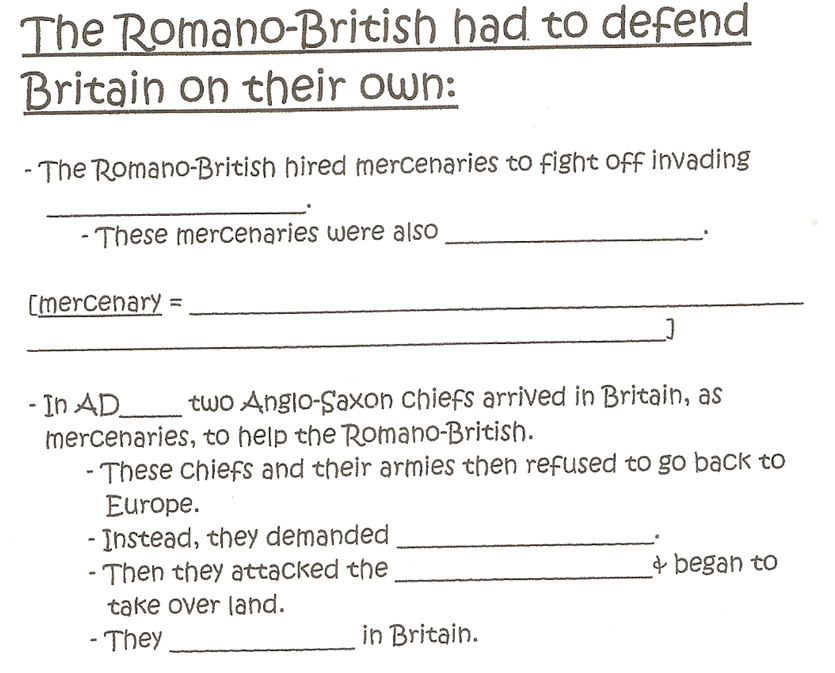
By 600 AD the Romano-British and the Anglo-Saxons lived peacefully together and those who did not want to live with the Anglo-Saxons moved away…
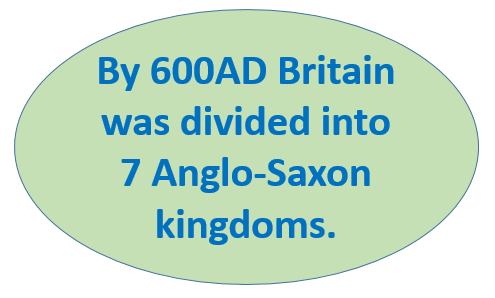
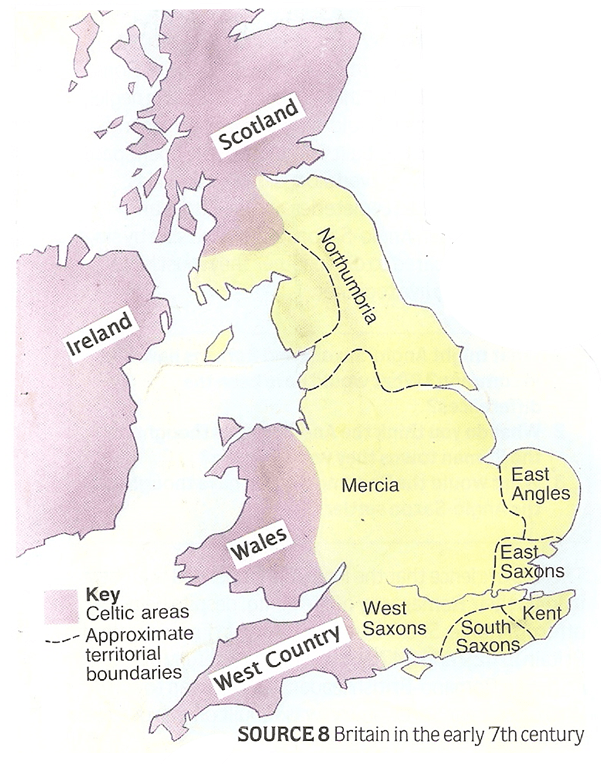
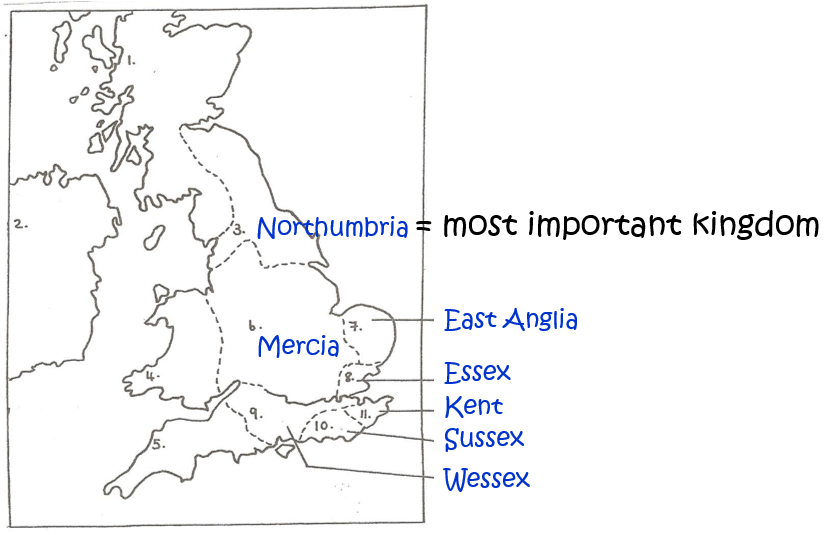
By the early 7th Century (so, by around 600 AD) Britain was divided into 7 Anglo-Saxon kingdoms. (This was about 200 years after the 1st Anglo-Saxons arrived in Britain!)
Here you can also see the seven Anglo-Saxon kingdoms:
Northumbria was the most important kingdom.
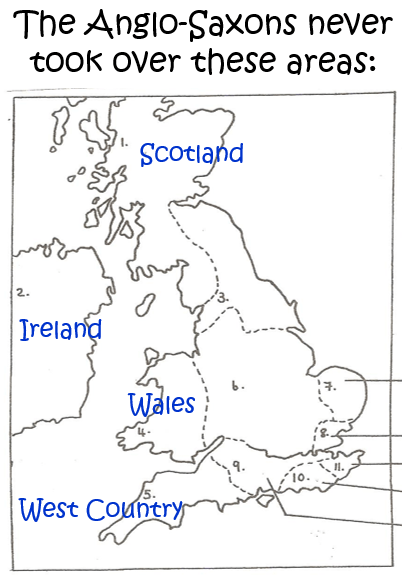
Many of the Romano British lived in Scotland, Ireland, Wales, and the West Country. Here you can see the areas that some Romano-British moved to:
5.
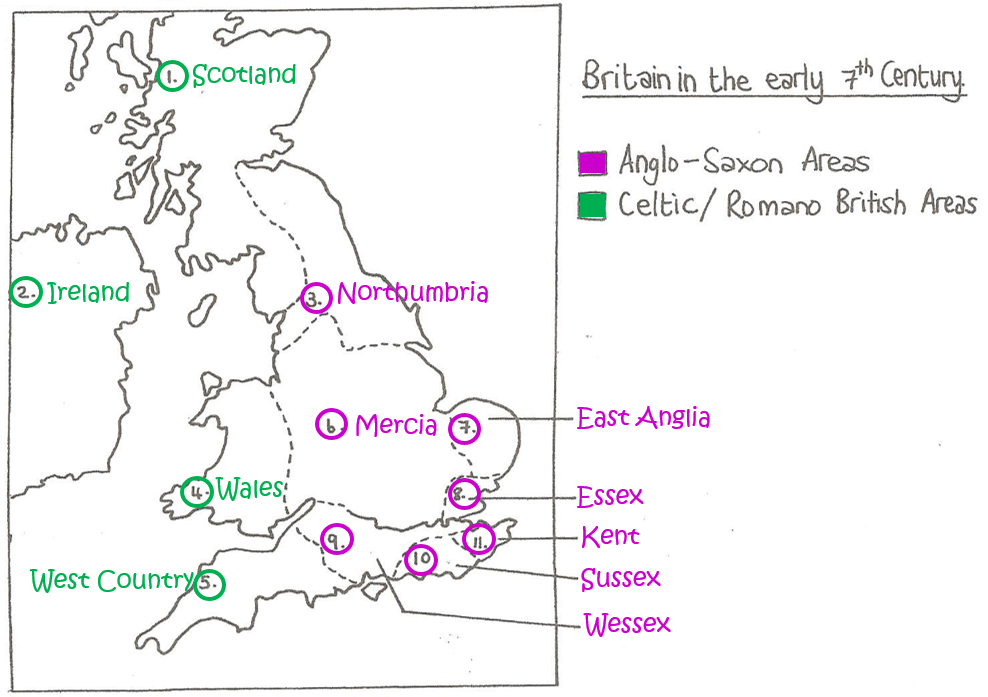
Now, complete the map on p.43 of your Workbook, to show the Anglo-Saxon kingdoms and the Romano-British areas (also sometimes known as the Celtic areas):
SOLUTION:
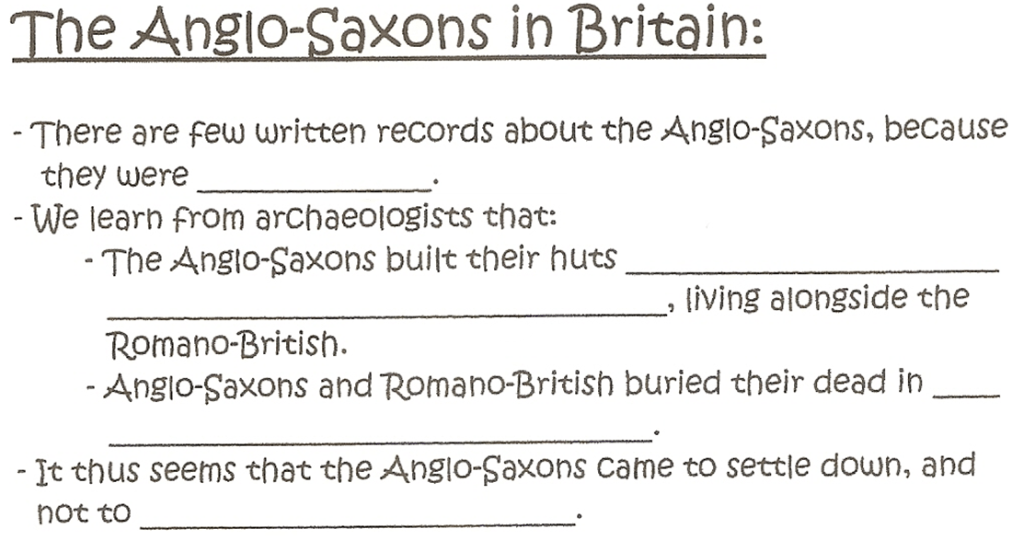
6.
Now also complete the fill-in notes on p.43, on “The Anglo-Saxons in Britain” and on “The Romano-British”.
SOLUTION:
(1:27 minutes long)
7.
Finally, finish the questions on “Anglo-Saxon Settlement, p.44” that you started in the previous lesson.
Today you are going to examine the Great Depression in more detail!
Follow the instructions step by step:
1.
We will first do the test…
Complete the test!
(This is a test on The Consequences of WW1, p.43-53)
2.
In the previous lesson we talked about the Great Depression. Let’s do a bit of extra reading on this topic, to remind ourselves what the Great Depression was…
“The End of the Golden Twenties”, p.65.
3.
The effects of the Great Depression were profound… It had a negative impact on world economies, as shown in the diagram below:
4.
However, the Great Depression did not only have a negative economic impact. It also had negative political consequences. For example:
People blamed their governments for their suffering…
People began to support radical political parties…
This gave rise to dictatorships…!
Here you can see how dictatorships spread during the 1930’s, as a direct result of the Great Depression!
(This diagram is on p.66 in your Workbook.)
We will continue to look at negative political consequences of the Great Depression in the next lesson…
5.
If there is still time in this lesson you may start doing the crossword puzzle on p.70-71 of your Workbook.
Today you are going to examine how historians gather information about Anglo-Saxons settlement in Britain.
Follow the instructions step by step:
1.
Historians rely a lot on archaeology to learn more about the Anglo-Saxon settlement in Britain.
Anglo-Saxon Settlement and Archaeology. (4:08 minutes long)
2.
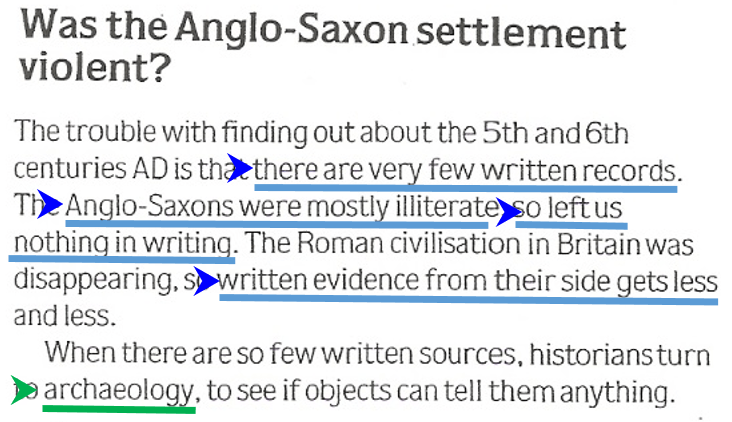
Here is more information about what archaeology can tell historians about Anglo-Saxon settlement…
(p.39, 2nd Column)
“Was the Anglo-Saxon Settlement violent?”
3.
We will look at the Sutton Hoo ship burial as an example of archaeological evidence about the Anglo-Saxons.
(This video will be added soon.)
4.
Let’s also see what we can learn about the Sutton Hoo ship burial from the following selection of videos…
In Focus: Sutton Hoo. (4:20 minutes long) SPEED UP TO 1.25!!!
Digging the dirt on Sutton Hoo – your questions answered. (2:59 minutes long)
5.
Not too long ago a film was made about the excavation of the Sutton Hoo ship. This film is called “The Dig” and it is on Netflix. If you are interested, watch this film in your own time at home. Below is a trailer of “The Dig”.
THE DIG, starring Carey Mulligan & Ralph Fiennes. (2:22 minutes long)
6.
Page 40
(up to, but not including, “Why are the Anglo-Saxons important?”)
7.
To test your knowledge and understanding, answer the questions on “Anglo-Saxon Settlement” – it is on p.44 in your Workbook.
Today we are going to finish off some tasks on our topic on Exploration.
Follow the instructions step by step:
1.
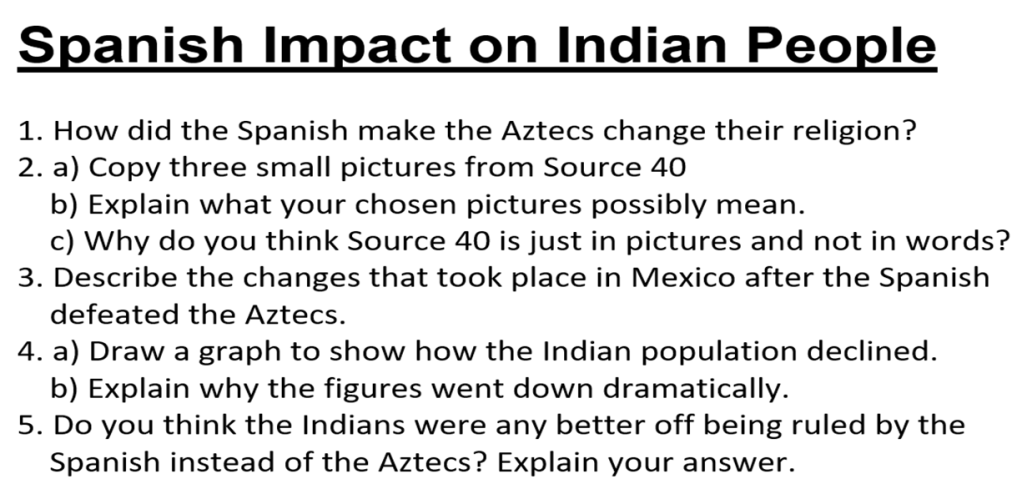
If you have not completed (or started) the task below, complete it now. (The questions test your knowledge and understanding of the “Spanish Impact on Indian People”.)
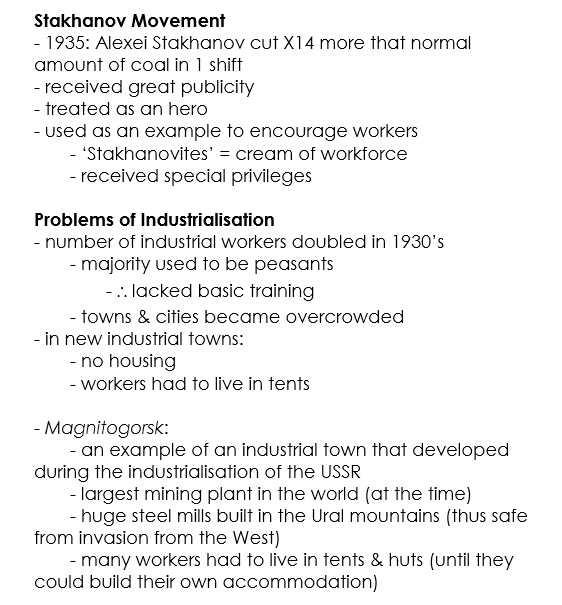
Today you are going to continue looking at the industrialization of Soviet Russia.
1.
A reminder…
2.
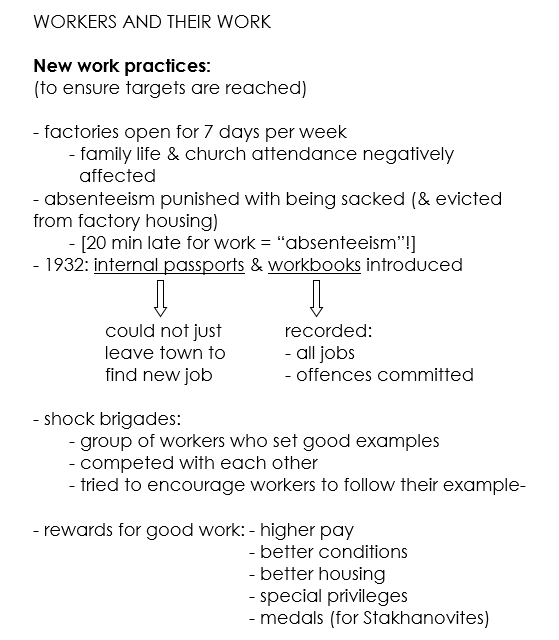
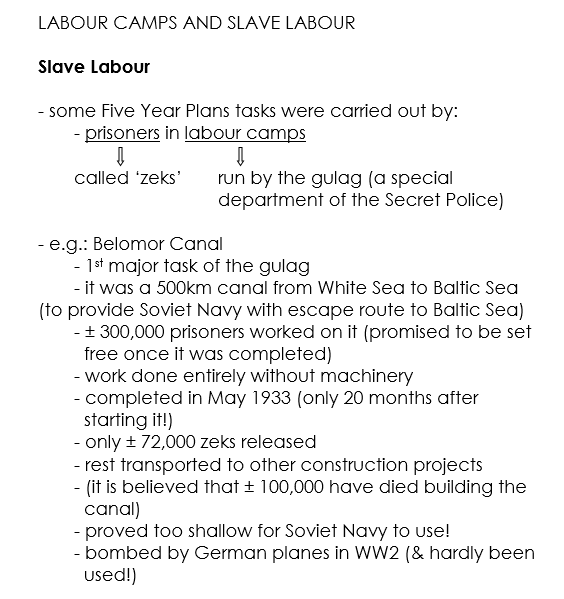
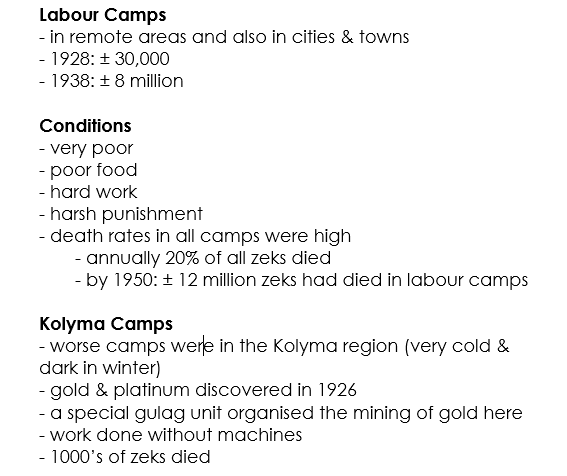
Let’s hear what your classmates can tell you about Workers & their Work… and also about Labour Camps & Slave Labour…
Presentation on:
Workers & their work.
and…
Presentation on:
Labour Camps & Slave Labour.
3.
Let’s see if the most important content has been discussed….
and also…
4.
Complete the following Task on Workers & their Work (p.13)…
Do Task A (p.13)
5.
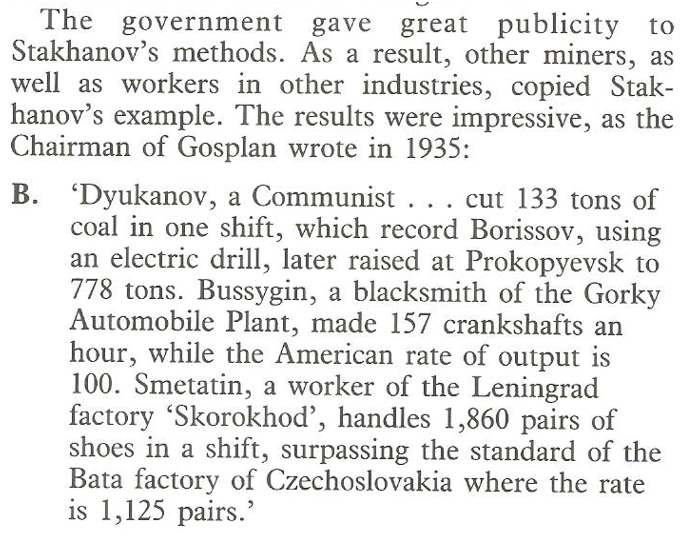
See p.37 – answer the following Source Question:
“Study Sources A, B and C, as well as the Poster on p.13. Which of these sources is the most useful to an Historian studying the impact of Industrialization on the Soviet people?”(8)
Here is some useful advice:
SOLUTION
(1.05 minutes long)
6.
Complete the following Task on Labour Camps & Slave Labour (p.15)…
Do Task A (p.15)
7.
See p.38 – answer the following Source Question:
“Study Sources A, B and C How reliable are these sources to an Historian studying Soviet Labour Camps?” (5)
In 1919 the peacemakers who met at the Palace of Versailles (to draw up a peace treaty) also set up a League of Nations. The League of Nations was set up to settle any disputes between countries, keep worldwide peace and make the world a better place to live in.
The Roaring Twenties
The 1920’s was a period of hope.
People were looking forward to rebuild their countries after World War One, and there was general peace and prosperity during the 1920’s. Entertainment, technology & economy flourished – worldwide!
The Great Depression
Then, in 1929, everything changed again, when there was a worldwide economic depression…Hundreds of banks closed down. Thousand of companies went out of business. Millions of people lost their jobs.
Trade between nations dropped. All this had devastating consequences for the 1930’s! People started to blame their governments and world co-operation was now forgotten!
3.
For now, let’s focus on the prosperous years of the 1920’s!
We will first examine the League of Nations from a little closer:
League of Nations. (1:29 minutes long)
4.
p.62-63
5.
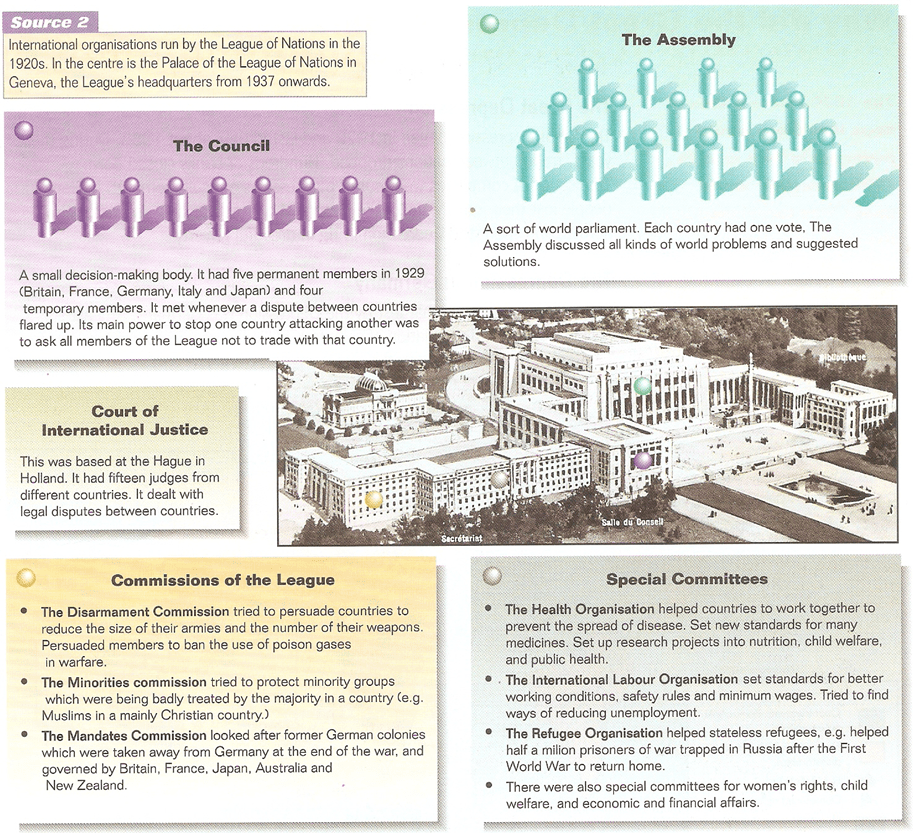
The diagram below shows how the League of Nations was structured – examine this diagram closely. (This is Source 2, p.63.)
6.
Let’s also see what is meant by “the roaring twenties”… The video below tells us what life was like in the USA during the 1920’s. However, entertainment, technology & economy flourished worldwide during “the roaring twenties”!
Roaring Twenties. (2:10 minutes long)
(This video deals with the USA – but Europe experienced a similar period of prosperity.)
7.
Unfortunately, “the roaring twenties” came to an abrupt end in October 1929, when the stock market crashed and millions of investors were wiped out. Over the next few years, consumer spending and investment dropped, as companies struggled and people lost their jobs.
So, how did this all start?
Stock Market Crash. (2:01 minutes long)
The Great Depression – 5 Minute History Lesson. (5:40 minutes long)
(You may need to slow down the speed of this video to 0.75!)
(The “Dow Jones” is a stock market index that measures the stock performance of 30 large companies listed on stock exchanges in the United States.)
8.
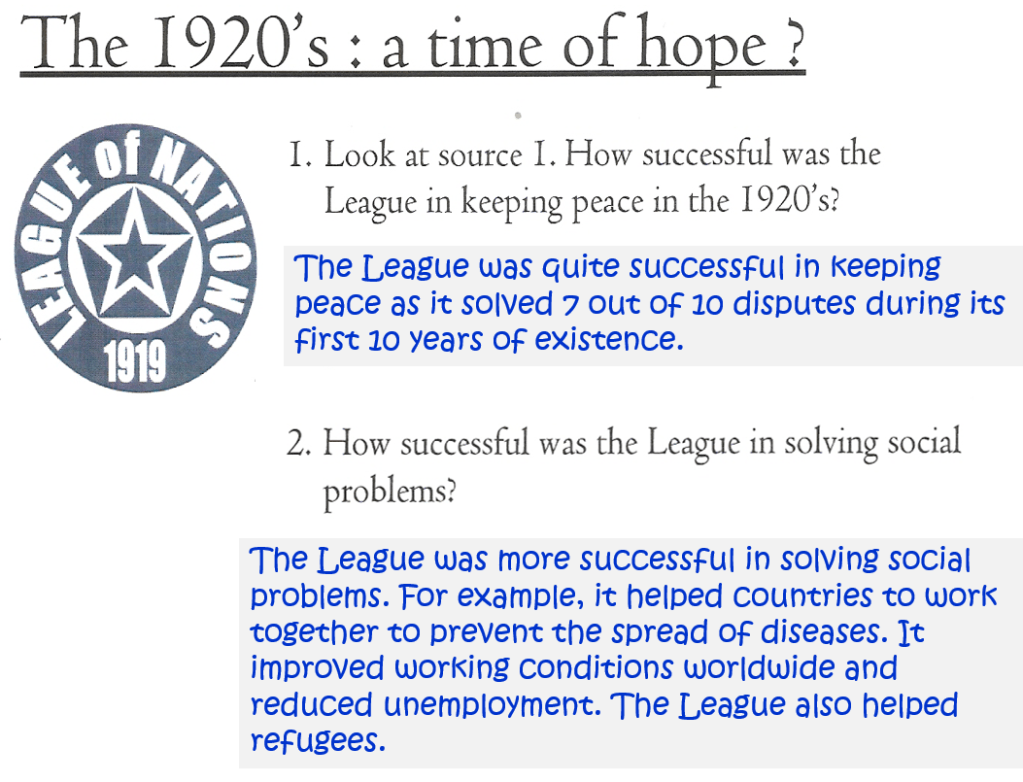
And now, let’s test your knowledge and understanding of the work of the League in the 1920’s. Look at the Questions on p.64
You will each be given one question to do, in rough, and will then be asked to share your answer with the rest of the class…
So, this is how it will work: Row-1 does Question 1, row-2 does Question 2 and row-3 does Question 3.
Your teacher will do Question 4 with you…
SOLUTION:
9.
Write the following heading:
“The 1920’s: a time of hope?, p.64”
And then copy the answers discussed in class into your book. (See above.)
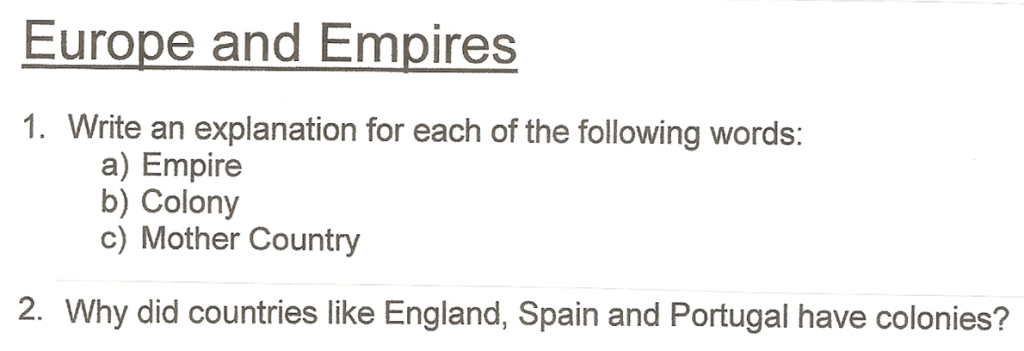
So what was the impact that the Spaniards had on the Indians…
Spanish Impact on Indians. (1:25 minutes long)
4.
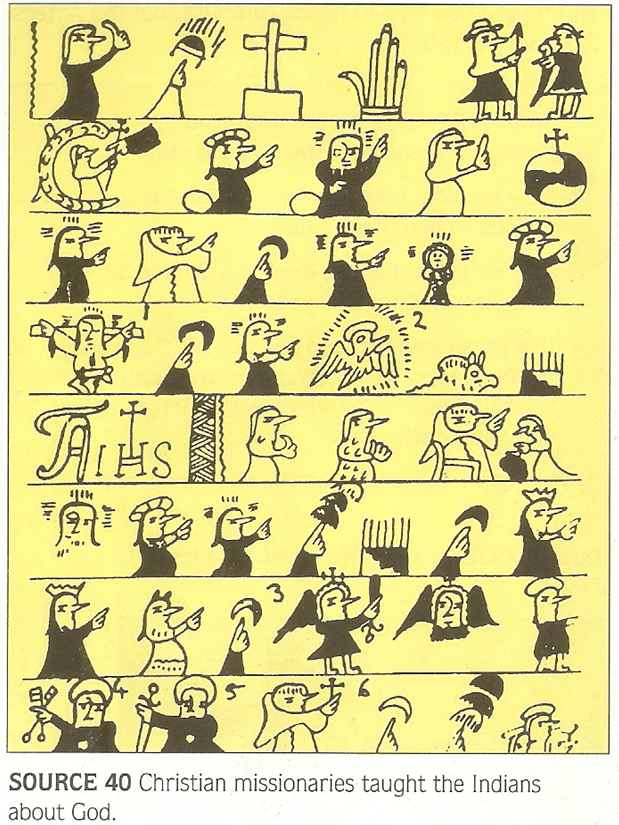
Christian missionaries taught the Indians about God. They used pictures like the ones below. Why do you think pictures like these were used to teach the Indians?
5.
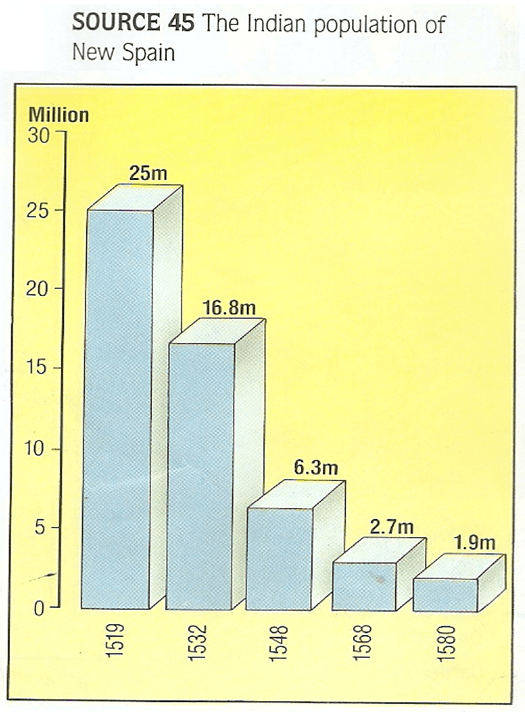
Just look how dramatically the Indian population declined after the Spanish conquest!
6.
Let’s see what else your workbook can tell us about the Spanish impact on the Indians of Central America.
Read p.40
7.
Finally, let’s test your knowledge and understanding of the “Spanish Impact on Indian People”.
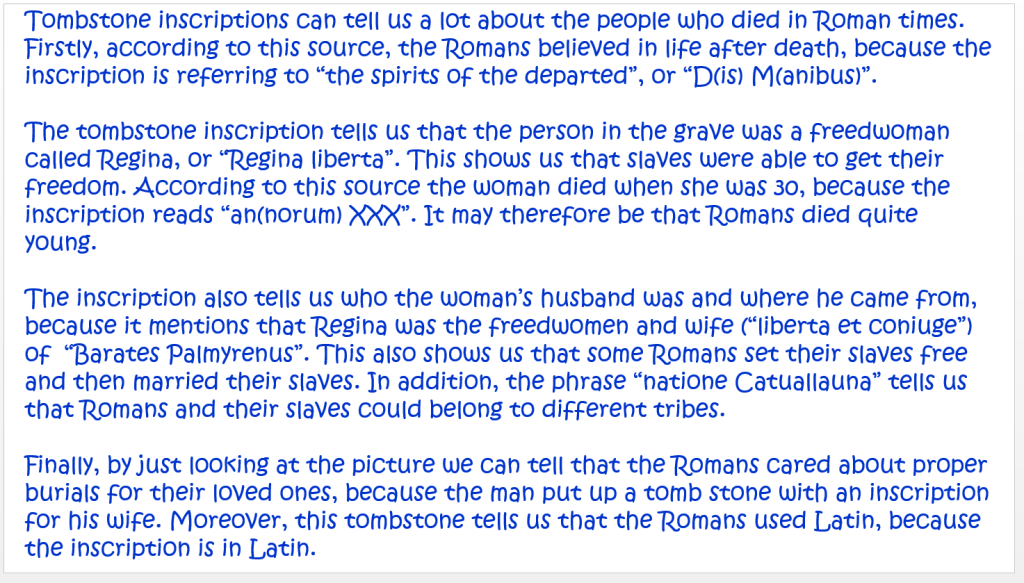
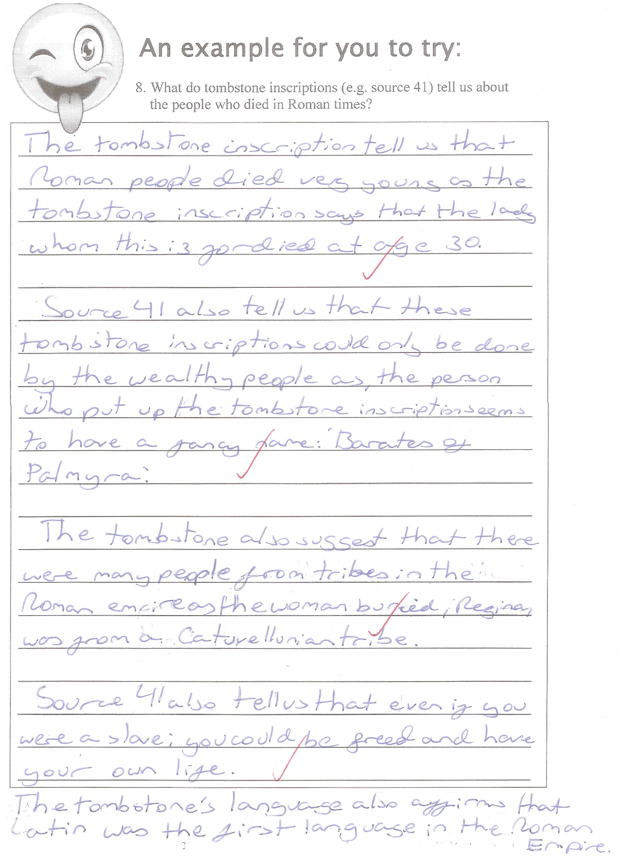
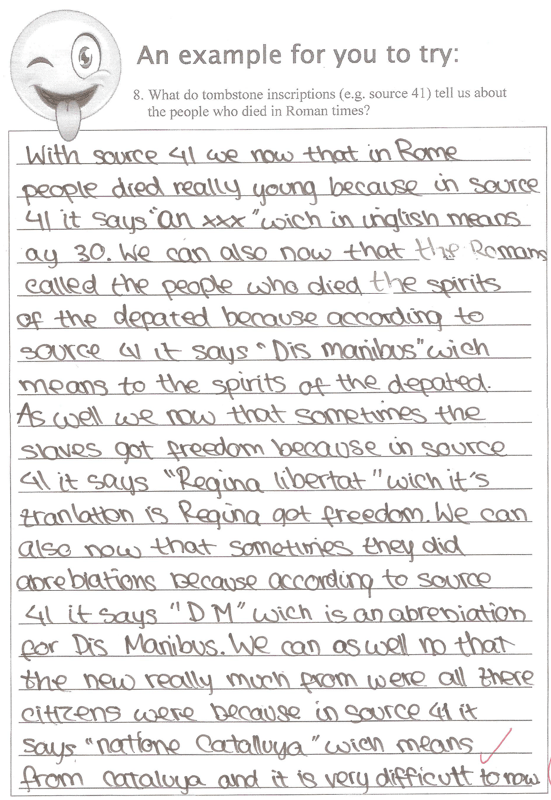
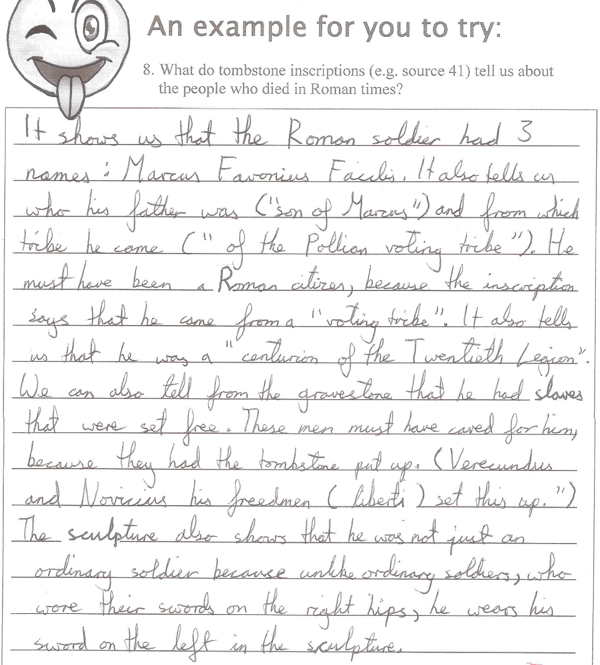
Here is some feedback for the Source Question on tombstone inscriptions (Question 8, on p.36 of your Workbook). How does your answer compare with this example answer?
4.
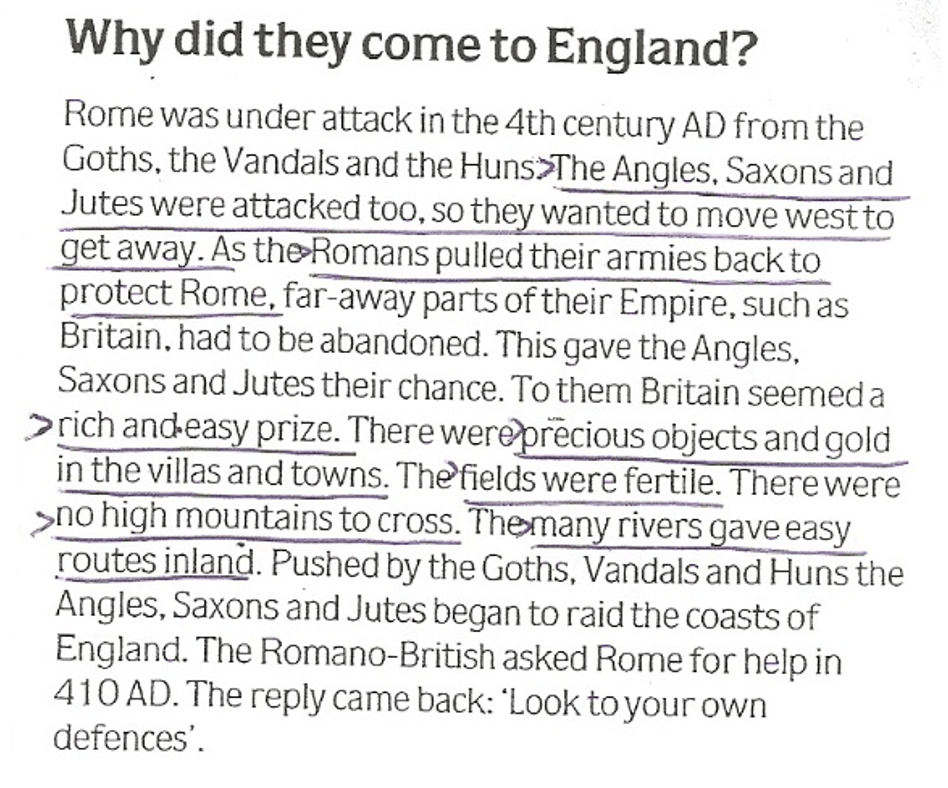
Let’s refresh our memories as to why the Anglo-Saxons went to Britain.
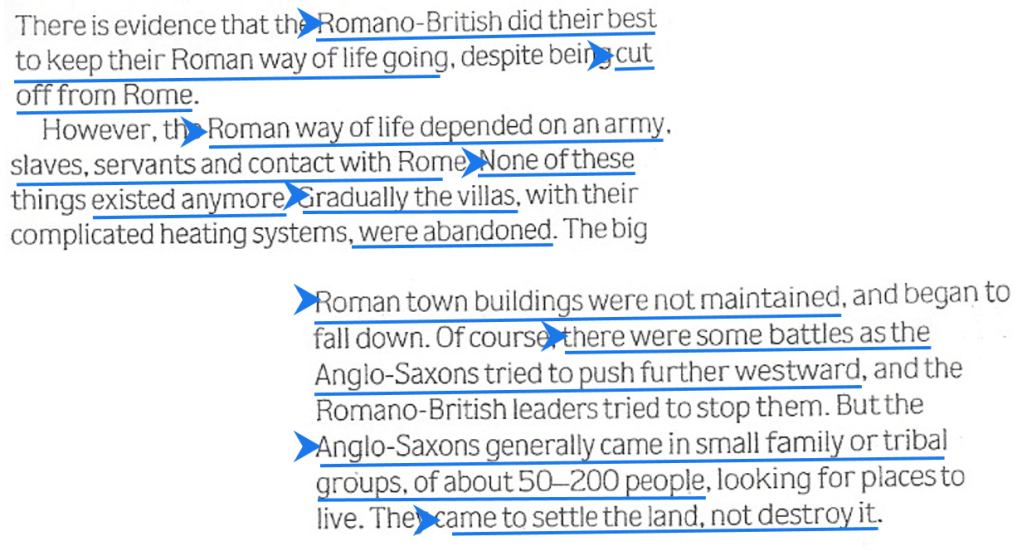
Read the paragraph on p.39 of your Workbook again. This time, underline the reasons as to why the Anglo-Saxons went to Britain.
SOLUTION:
You should have identified and indicated the following reasons:
5.
Now, let’s test your knowledge so far…
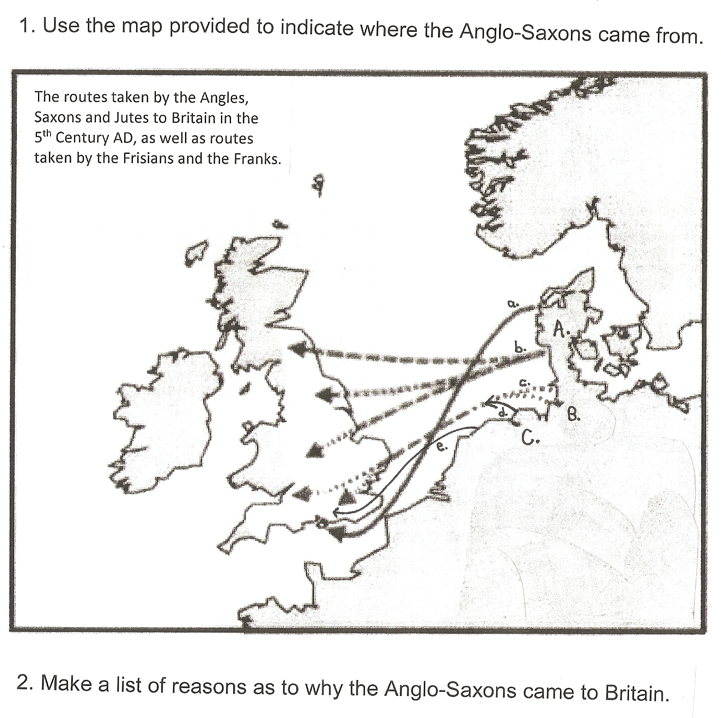
Stick the map-worksheet about the Anglo-Saxons into your purple book.
Where the Anglo-Saxons came from…
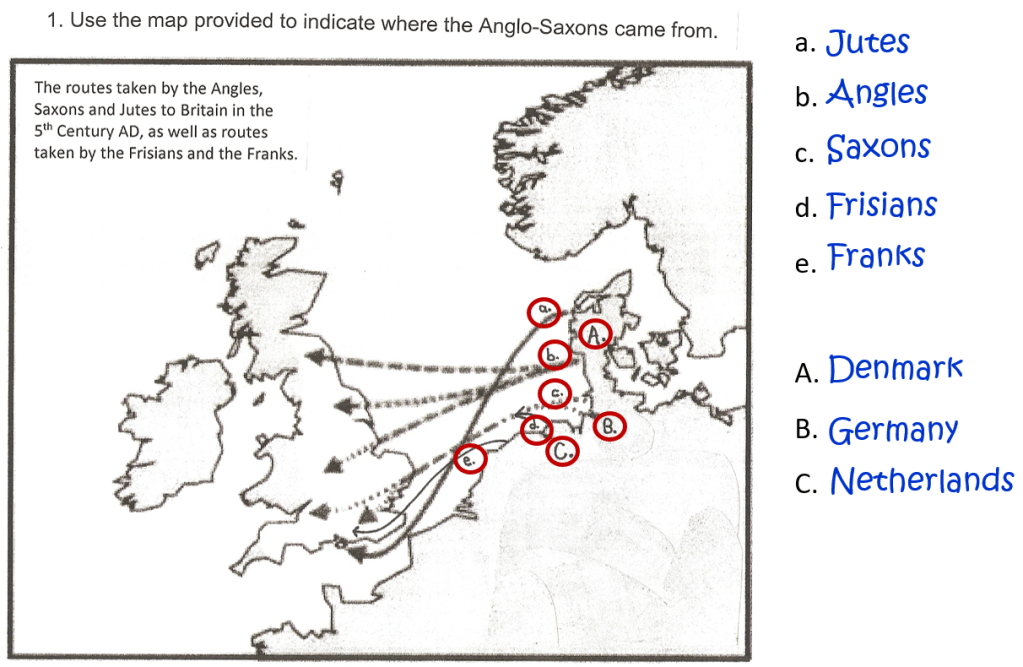
6.
Doing Task 1: The map shows the routes taken by these tribes. You have to use the map provided to show where the Anglo-Saxons came from.
SOLUTION:
7.
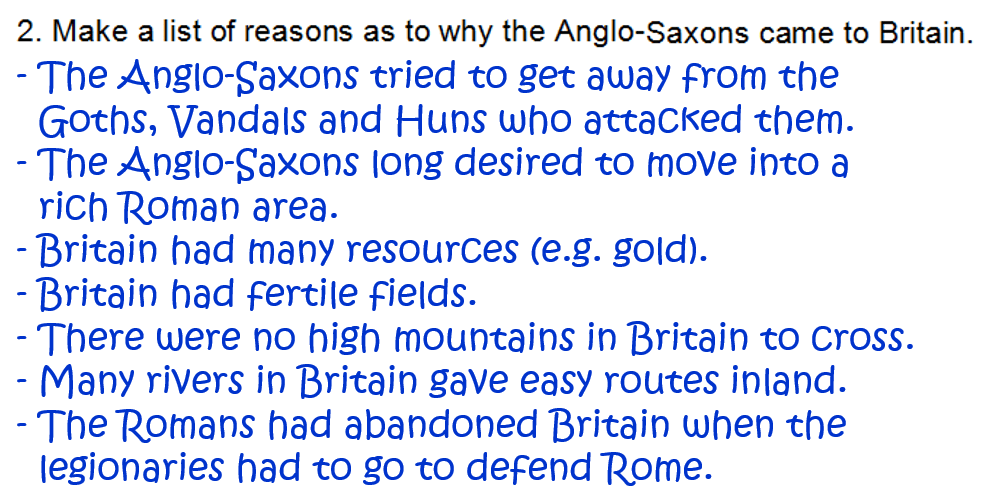
Doing Task 2: Use the information on page 39 in your Workbook to make a list of reasons as to why the Anglo-Saxons moved to Britain.
SOLUTION:
8.
Source Question Task on page 36 of your Workbook.
Below are examples of how this question could have been answered:
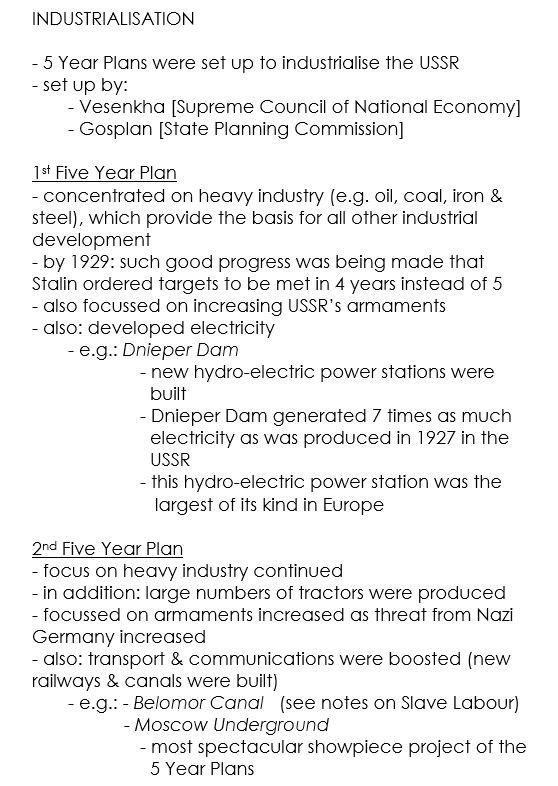
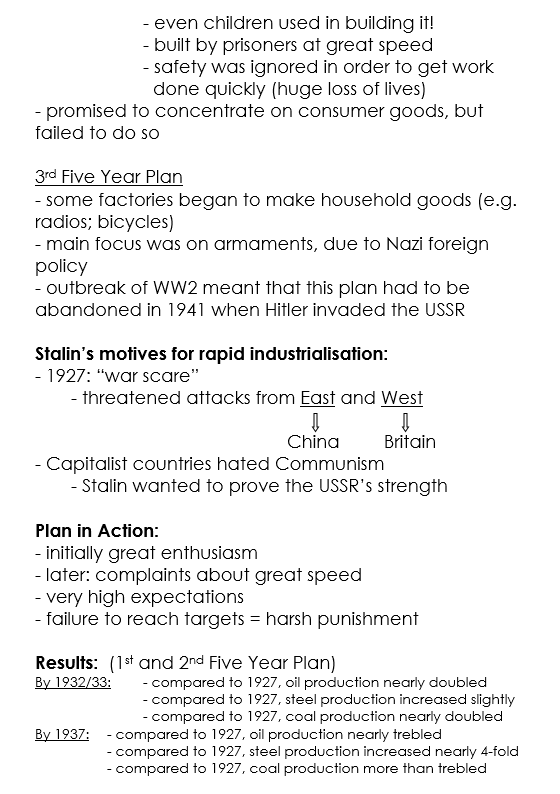
The information about “Industrialization” and its results , p.33-34.
7.
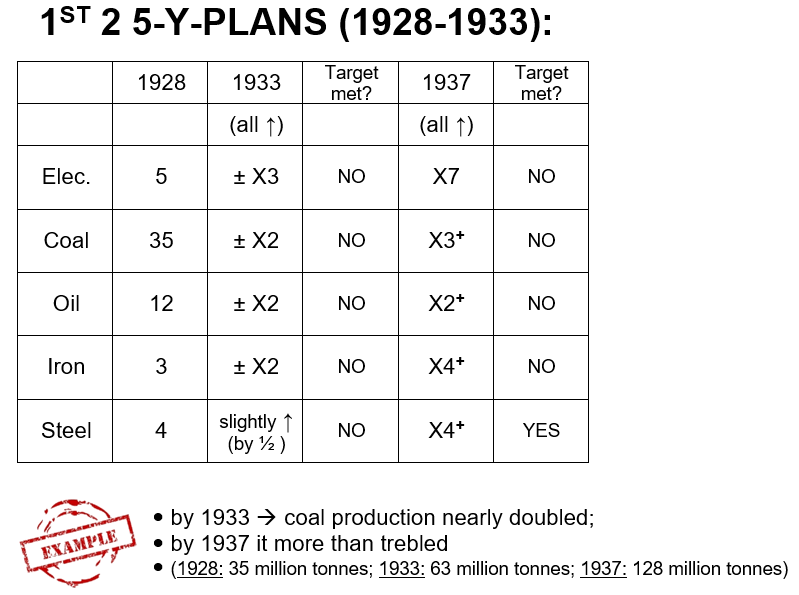
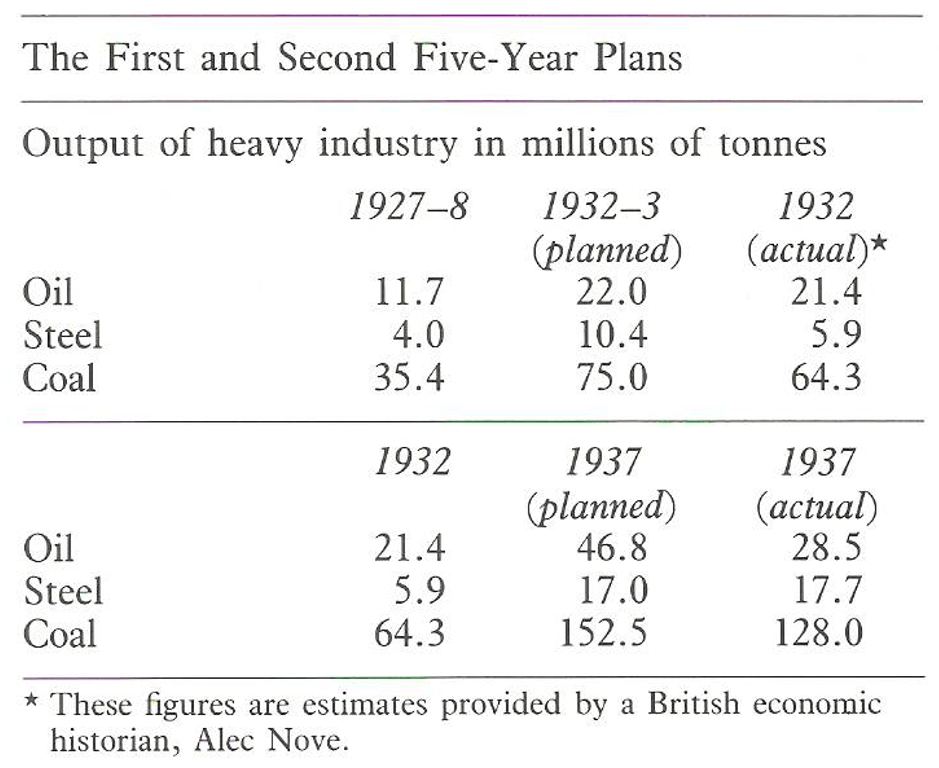
Below is a simplified version of the Five Year Plans results table.
8.
Complete the following Tasks on The Five Year Plans (p.11)…
Do Task A.
9.
See p.35-36 – answer the following Source Questions:
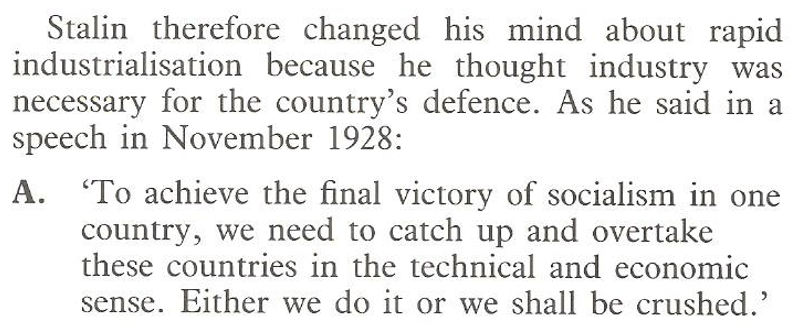
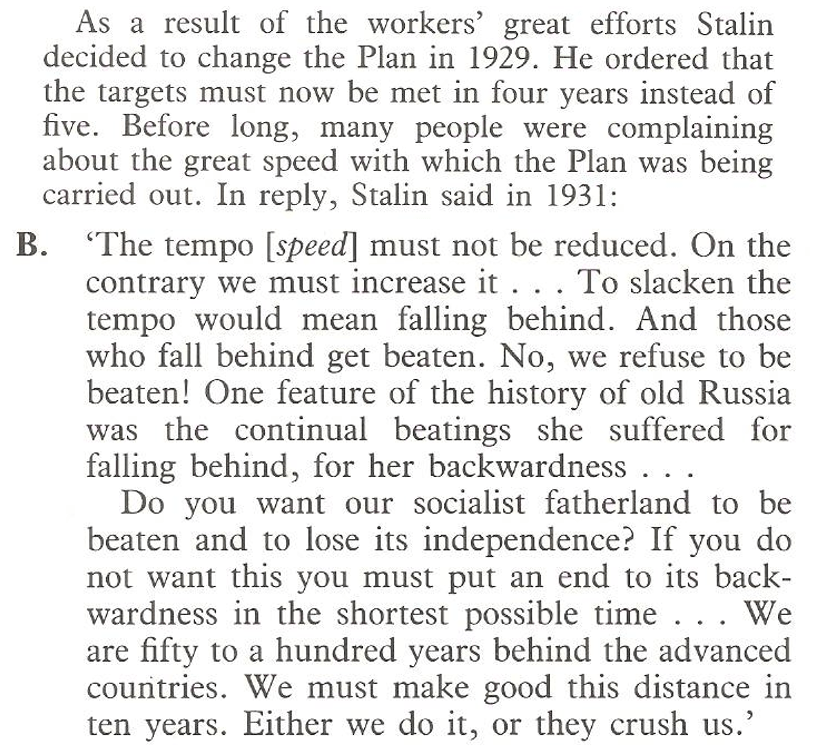
(a) “Study Sources A and B. According to these sources, why did Stalin want to make the USSR into an industrial power as quickly as possible?” (5)
(b) “Study the poster on p.10. What is the message of this poster?” (5)
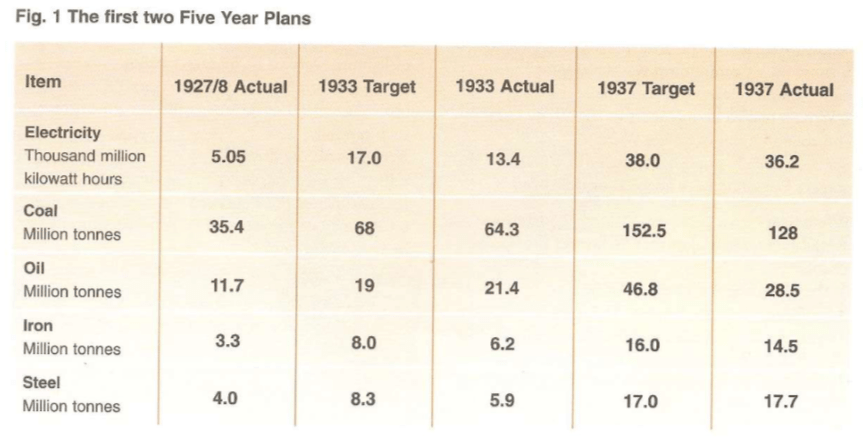
(c) “Study the statistics in the table on p.11. How useful are these statistics to an Historian studying the outcome of the first 2 Five Year Plans?” (5)
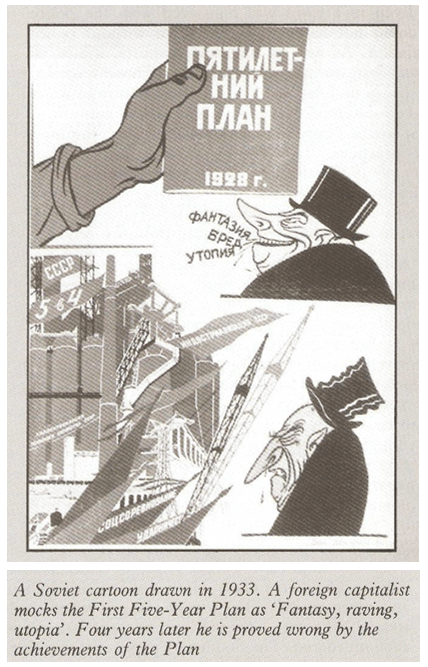
(d) “Study the cartoon on p.11. What is the message of this cartoon?” (5)
Today you are going to learn how Stalin modernized Soviet Agriculture…
1.
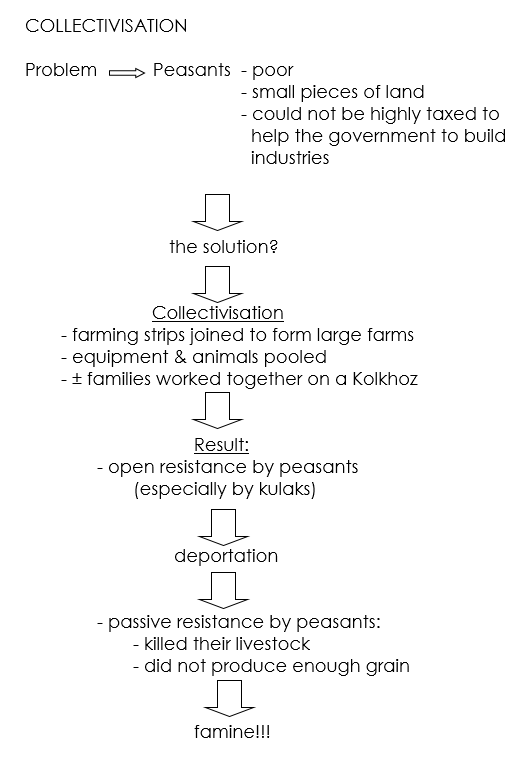
Here is a short reminder of Stalin’s modernization policies:
2.
Now, let’s hear what your classmates can tell you about Collectivization…
Presentation on:
Collectivization!
3.
Let’s see if the most important content has been discussed….
4.
Now, let’s see what else you need to know about the Collectivization of Soviet agriculture.
Collectivization. (3:04 minutes long)
Results of Collectivization. (2:58 minutes long)
5.
The information about “Collectivization” and its results , p.39-40.
6.
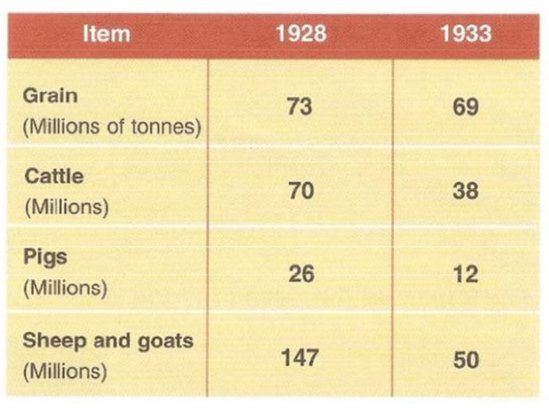
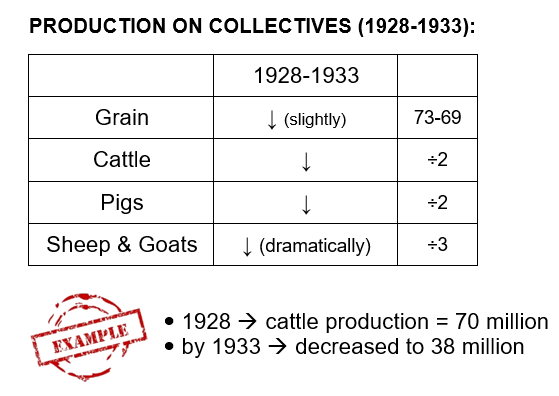
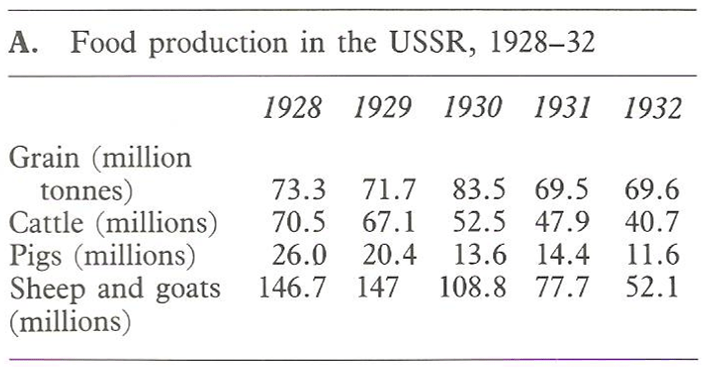
Below is a simplified version of the Collectivisation results table.
7.
Complete the following Task on Collectivization (p.9)…
Do Task A.
8.
See p.45 – answer the following Source Question:
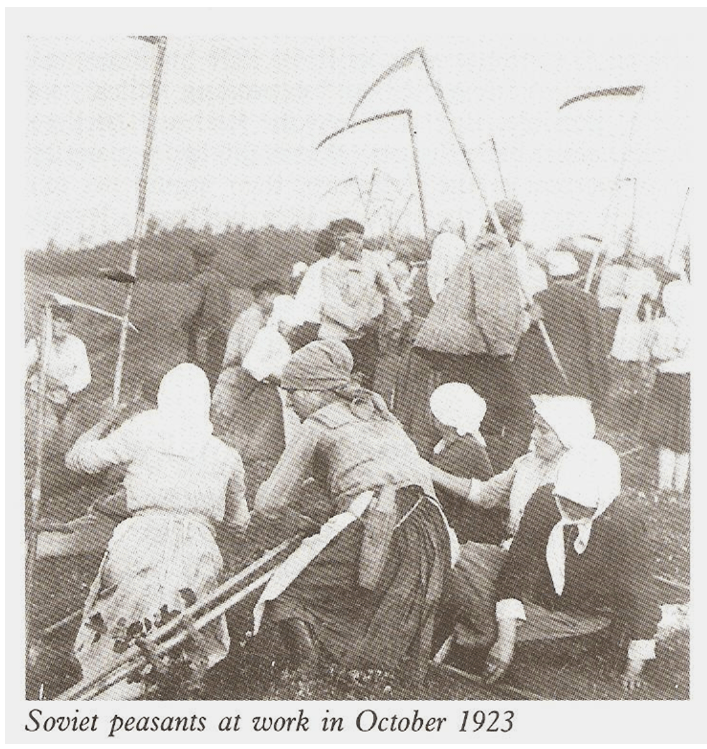
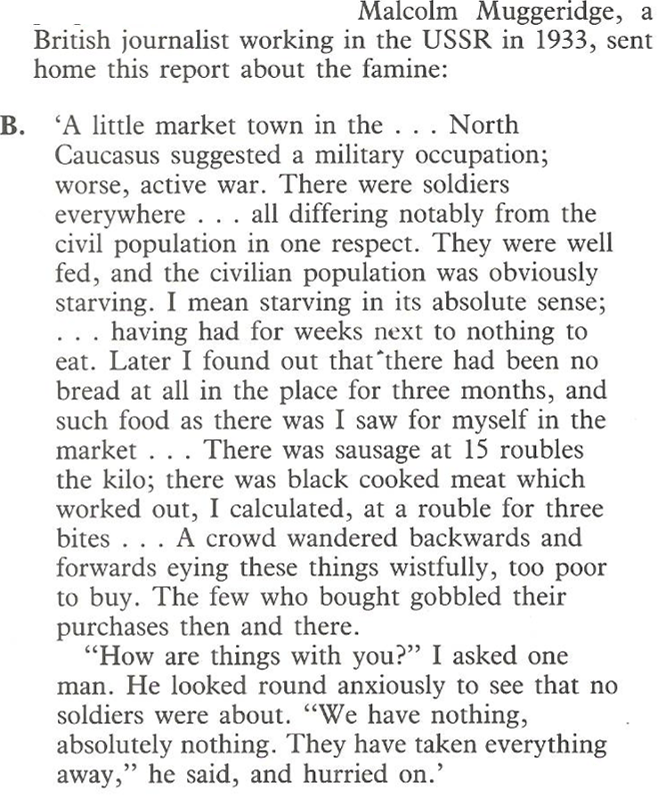
“Study Sources A and B (on p.9) as well as the photograph (on p.8). How useful are these sources to an Historian studying Collectivization?” (8)
Here is some useful advice:
SOLUTION
(1.11 minutes long)
9.
p.41-44
10.
In this video you will see Russian grannies singing at the 2012 Eurovision Song Contest. They took part in the competition to raise funds for the restoration of a church that was used as a grain store during Stalin’s reign.
Party For Everybody – Eurovision 2012. (3:31 minutes long)
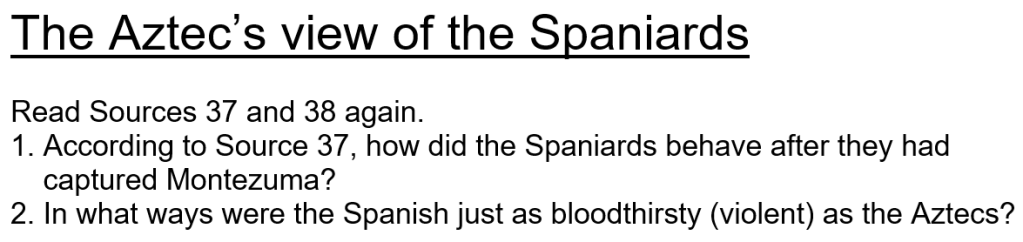
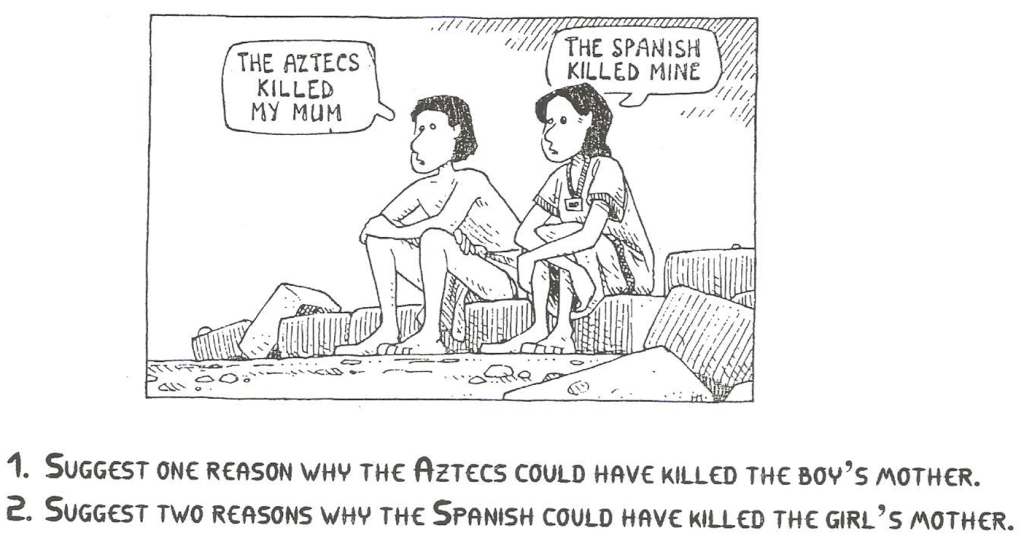
Now, continue with the self-study project on Cortes and the Aztecs. From the self study booklet, answer the questions on p.8 & p.9.
Page 8.
Page 9.
Please note: The booklet on “Cortes & the Aztecs” must be handed in at the end of this lesson. So, make sure that you have completed all the tasks by the end of the lesson!
See why Stalin (and not Trotsky) emerged as Soviet leader
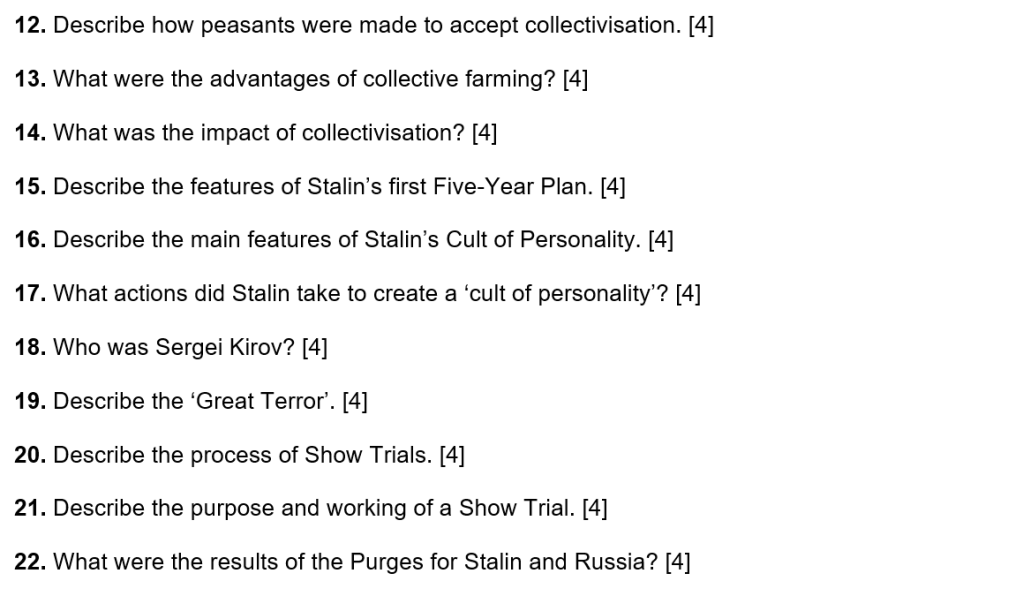
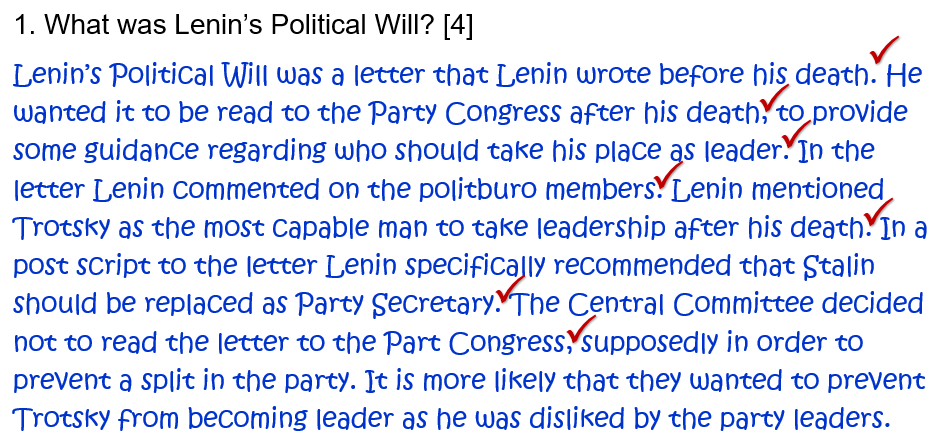
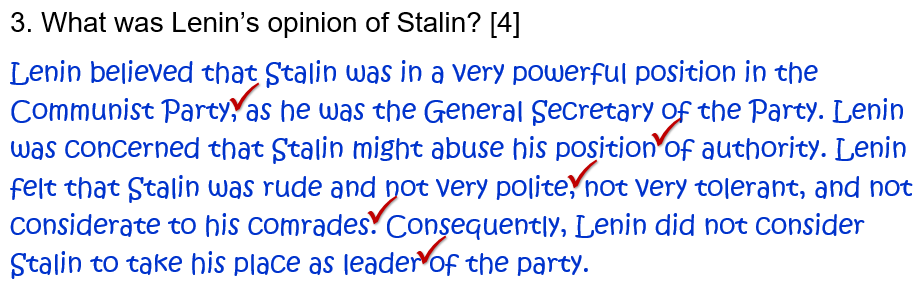
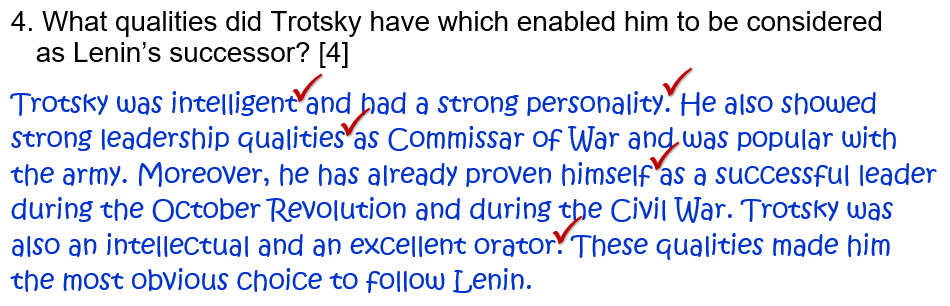
complete 4-mark exam questions about the power struggle that occurred after Lenin’s death
1.
By 1929, Stalin emerged as the sole leader of the USSR!
How did he manage to do so?
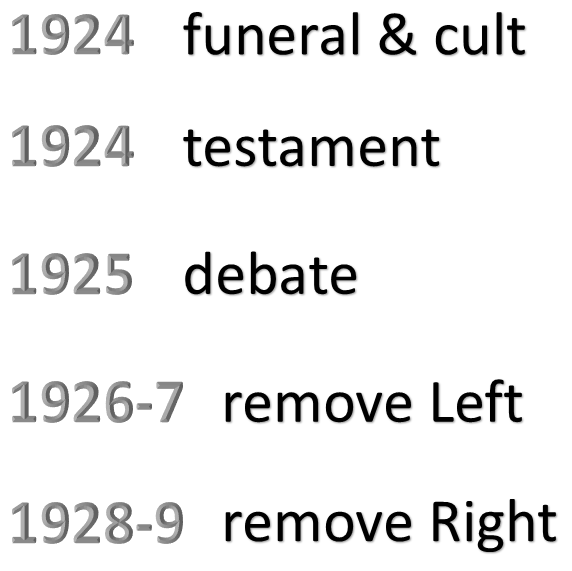
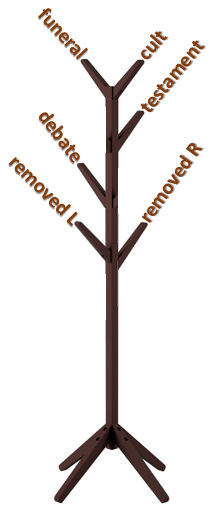
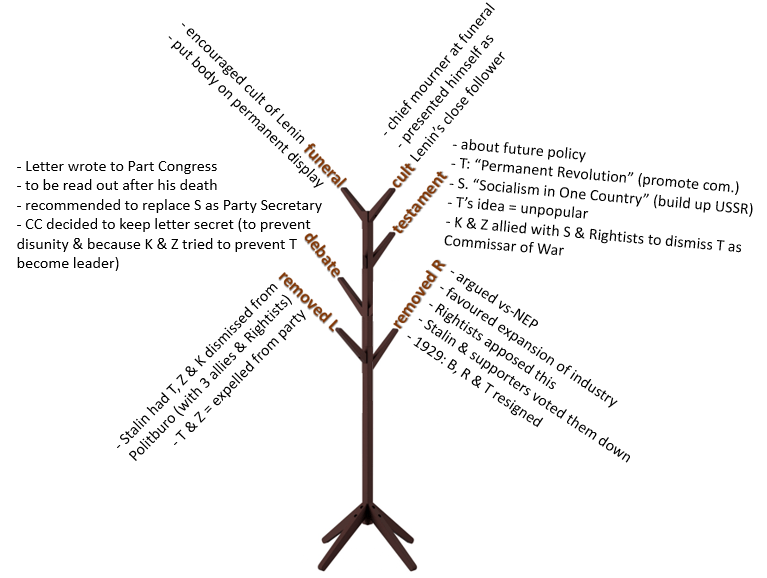
Stalin used Lenin’s funeral as an opportunity to show himself to be Lenin’s closest follower.
Stalin encouraged the cult of Lenin.
Stalin “survived” Lenin’s Testament!
Stalin’s ideas proved popular with the Party members (more so than Trotsky’s).
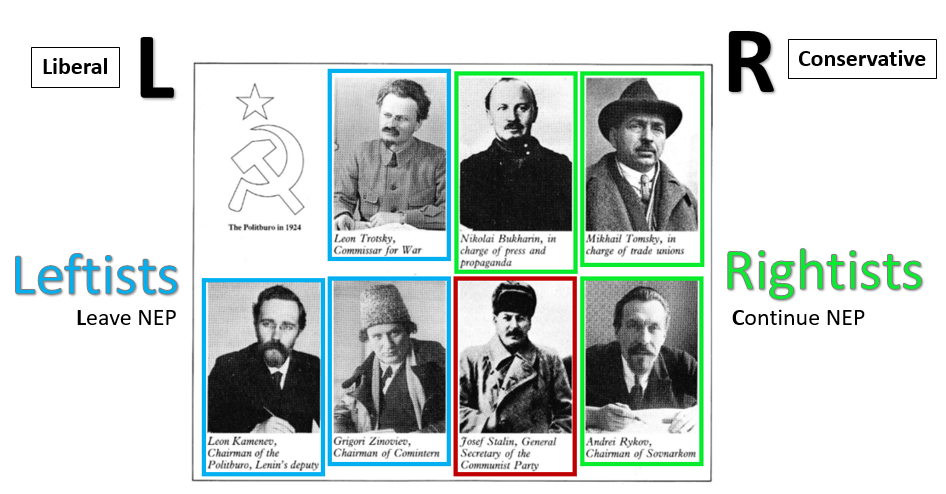
Stalin managed to eliminated rivals for power, on the Left.
Stalin managed to eliminated rivals for power, on the Right.
Remember the relevant dates!
The key words above are like “hooks” on a coat rack… Memorise these key words, and then “hang” more “items” onto the hooks…
2.
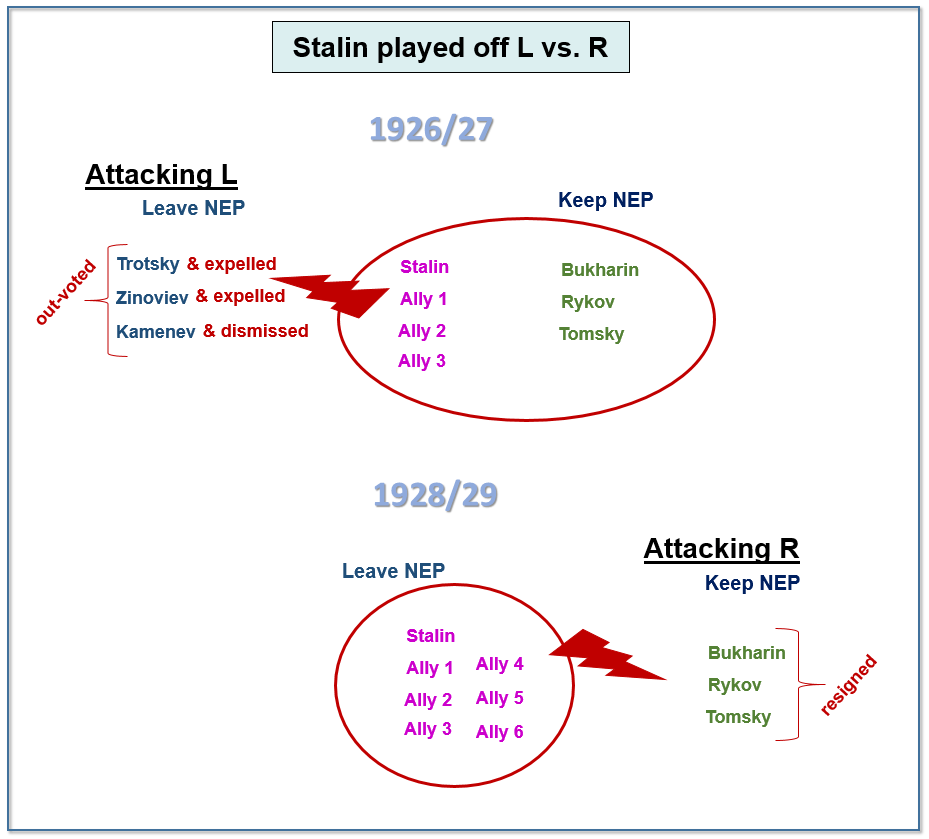
Stalin played off L vs R in the politburo to eliminate his rivals!
How?
By first siding with the Left, and then siding with the Right!
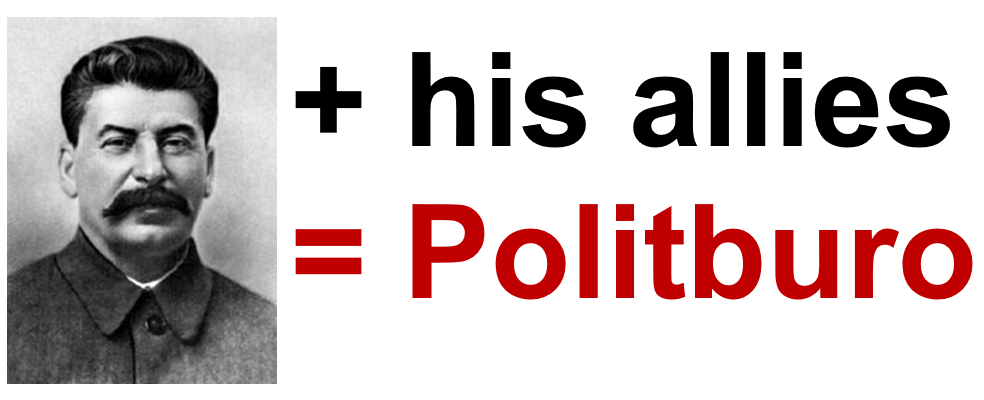
Once Stalin eliminated rivals for power on the Left, he worked to replace these Politburo members with Party members who owed their loyalty to him, Stalin.
Stalin then worked to eliminate the Right, and replace all these Politburo members with Party members who owed their loyalty to him too.
This is how Stalin was able to play off the Leftists and the Rightists in the Politburo… Stalin was able to systematically replace the old Politburo members with people who were loyal to himself.
3.
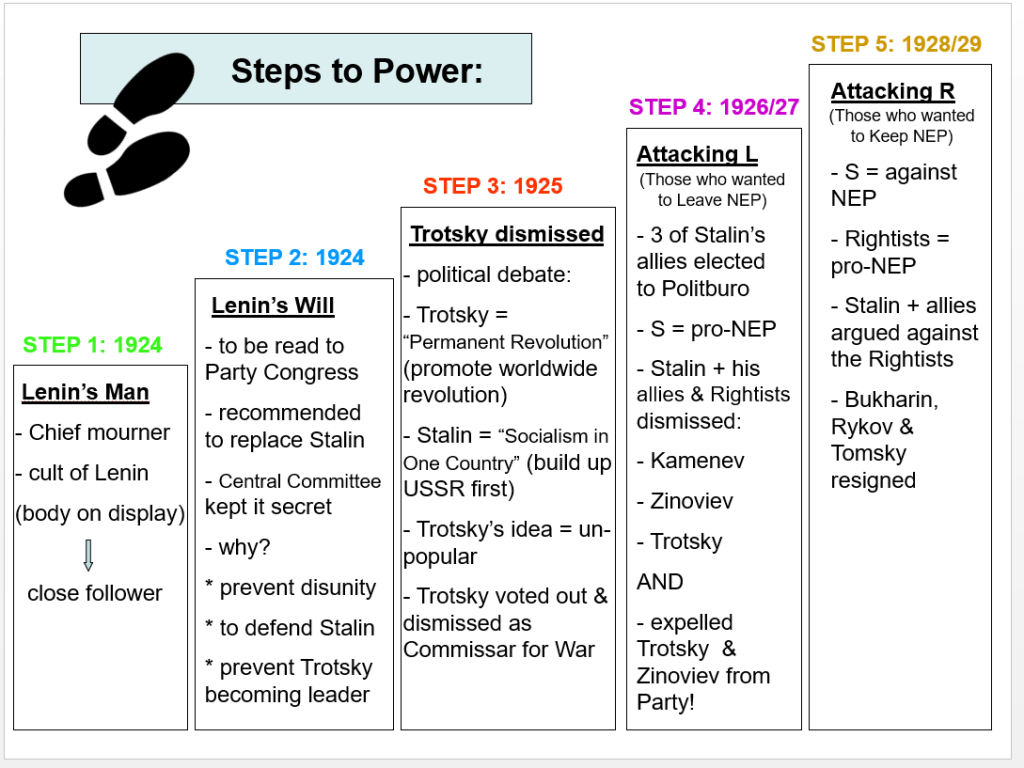
One can summarize Stalin’s rise to power in the following way:
4.
The video below gives a short overview as to why Stalin, and not Trotsky, succeeded Lenin.
Why Stalin, and not Trotsky? (1:11 minutes long)
5.
The table on “How Stalin achieved power” and also the information about “Why did Stalin and not Trotsky emerge as leader?” , p.25.
6.
You should be able to answer any of the questions below. Do you have difficulties with any of them?
Stalin vs. Trotsky In Under 128 Seconds. (2:08 minutes long)
Why didn’t Trotsky take over the USSR after Lenin? (3:27 minutes long)
Power Struggle Between Stalin and Trotsky. (4:10 minutes long)
8.
Lenin’s Testament – Article:
“Lenin’s Testament is the name given to a document dictated by Vladimir Lenin in the final weeks of 1922 and the first week of 1923. In the testament, Lenin proposed changes to the structure of the Soviet governing bodies. Sensing his impending death, he also gave criticism of Bolshevik leaders Zinoviev, Kamenev, Trotsky, Bukharin, Pyatakov and Stalin. He warned of the possibility of a split developing in the party leadership between Trotsky and Stalin if proper measures were not taken to prevent it. In a post-script he also suggested Joseph Stalin be removed from his position as General Secretary of the Russian Communist Party’s Central Committee.
Scholars have actively discussed the circumstances surrounding the creation of the testament and how these circumstances may have impacted the document. These include Lenin’s conflict with Stalin and his declining physical health, deteriorating mental state, and emotional frustration with his condition.
Lenin wanted the testament to be read out at the 12th Party Congress of the Communist Party of the Soviet Union, to be held in April 1923. However, after Lenin’s third stroke in March 1923 that left him paralyzed and unable to speak, the testament was kept secret by his wife, Nadezhda Krupskaya, in the hope of Lenin’s eventual recovery. She possessed four copies while Maria Ulyanova, Lenin’s sister, had one. It was only after Lenin’s death, on January 21, 1924, that she turned the document over to the Communist Party Central Committee Secretariat and asked for it to be made available to the delegates of the 13th Party Congress in May 1924. Krupskaya wanted the document circulated as widely as possible, in hopes of humiliating Stalin.”
It was only in 1956 that “the document was finally published officially by the Soviet government. The original letter is in a museum dedicated to Lenin.”


































































































































 Best study methods