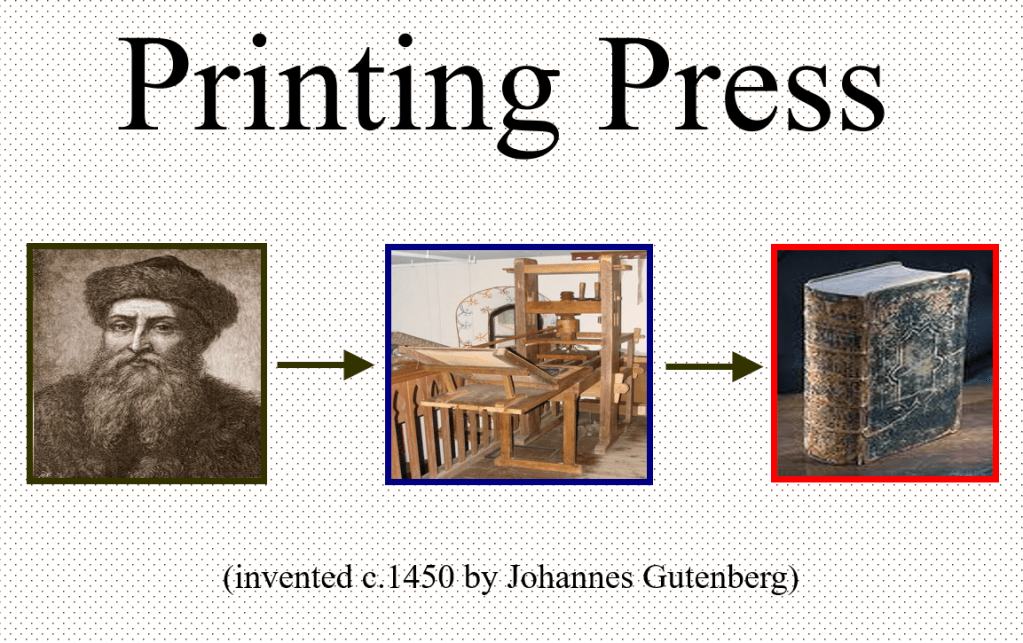
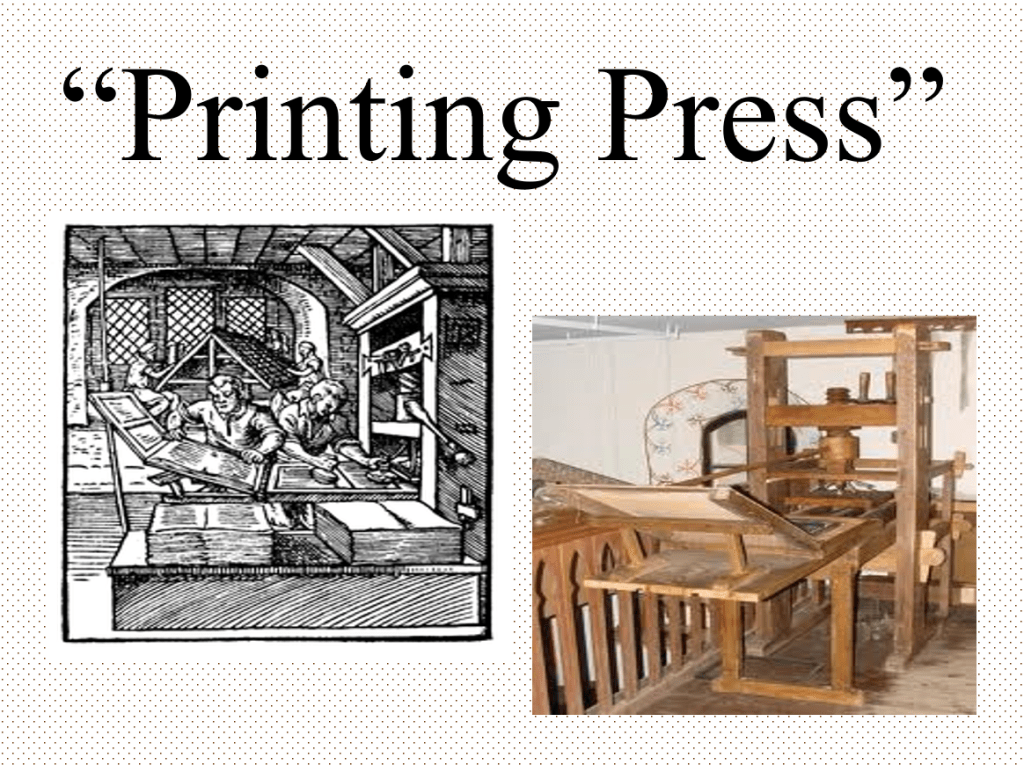
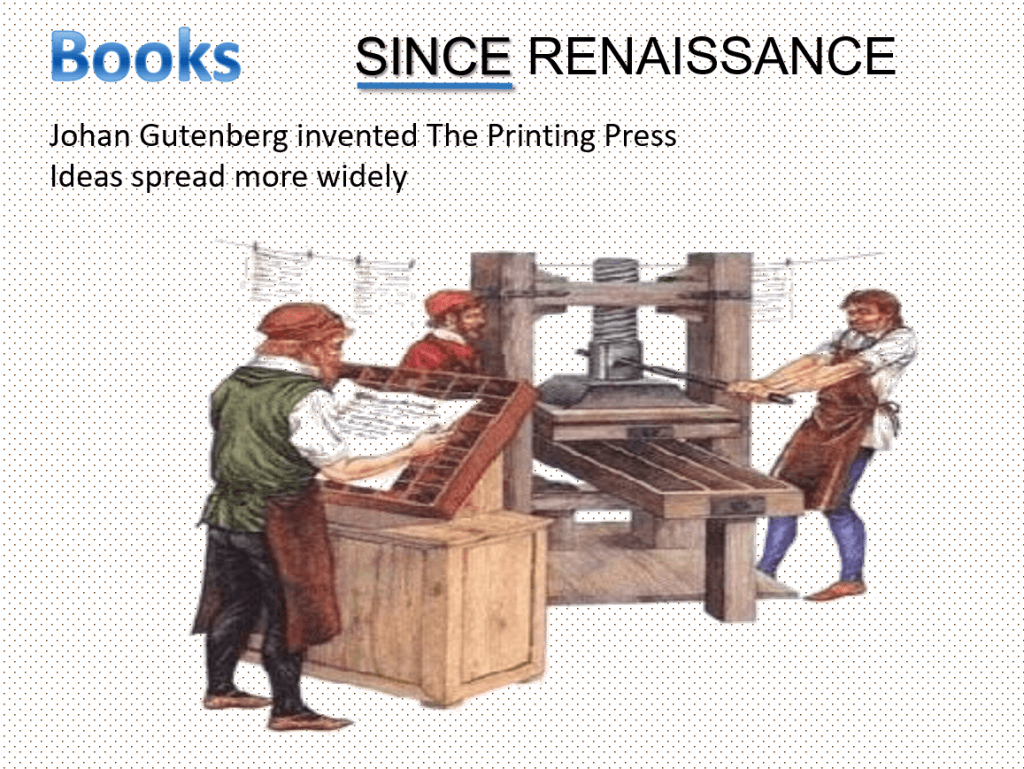
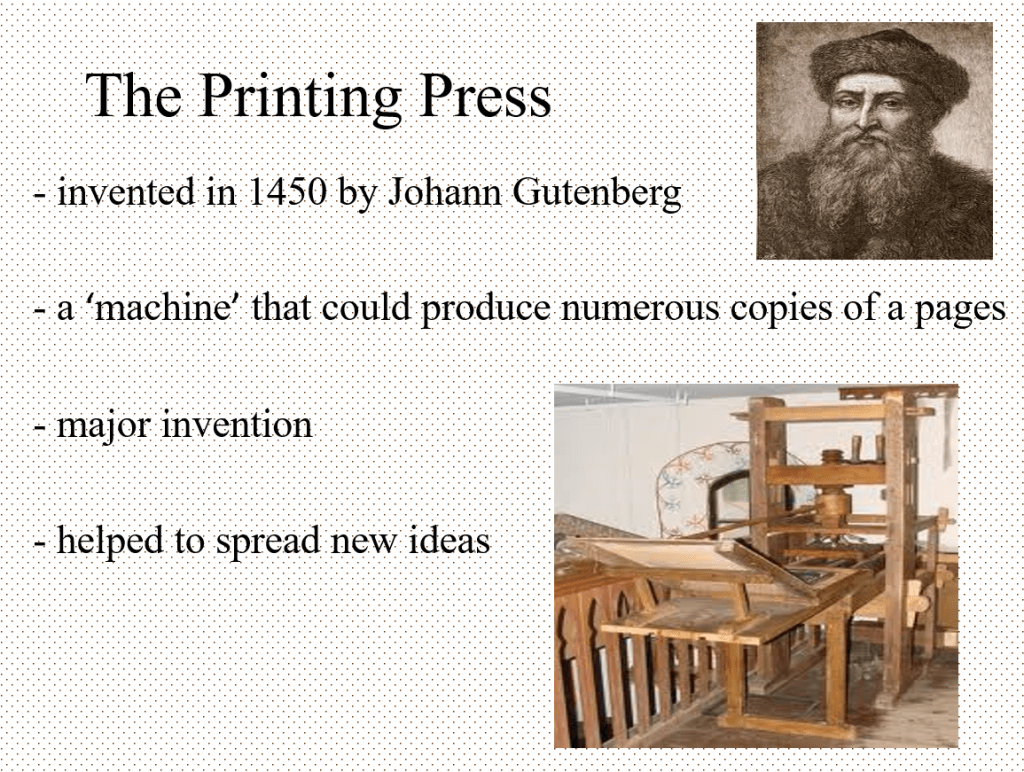
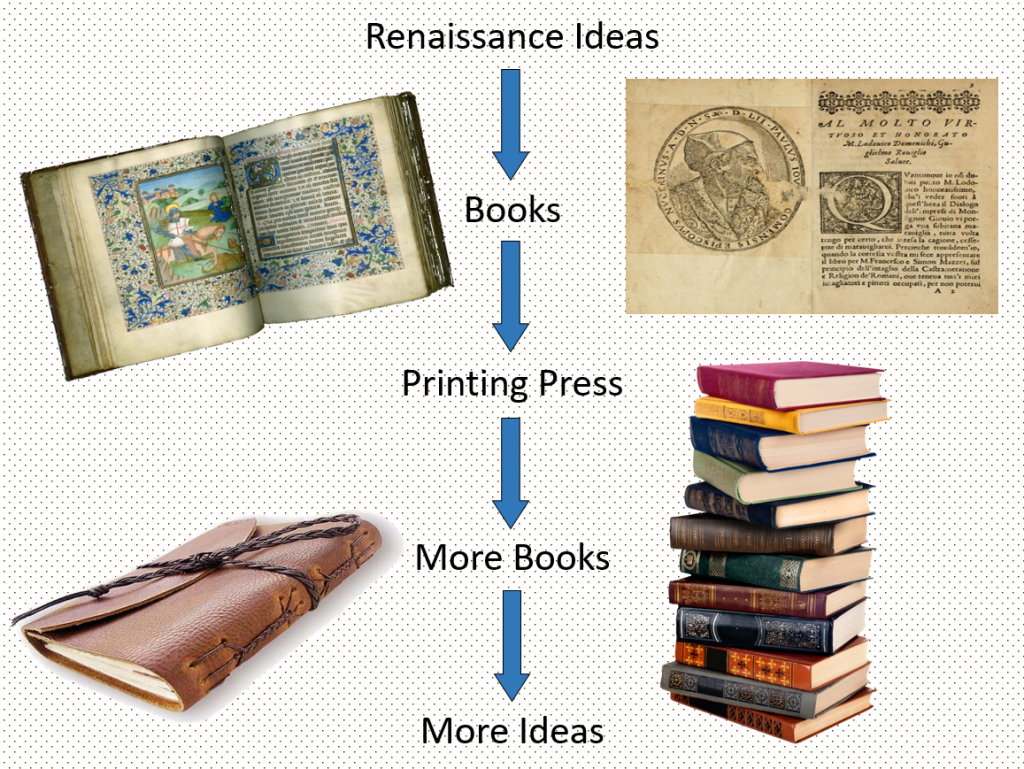
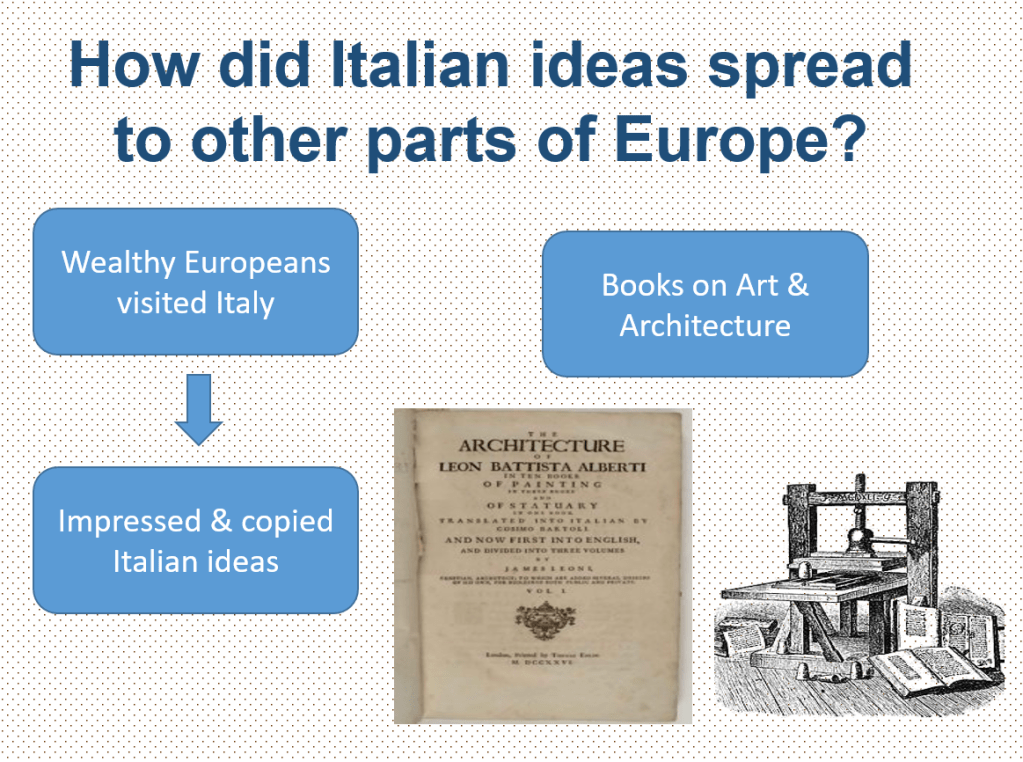
Once a way of mass producing books was discovered, new ideas related to art, architecture and science quickly spread across Europe. This happened round about 1450, when a German man invented the so-called printing press!
To get a better idea of how it worked, watch the following videos about the printing press…
Gutenberg’s Printing Press and Bible. (9:16 minutes long)
This Week in History – Gutenberg Launches the Renaissance. (3:18 minutes long)
6.
Use the rest of the lesson to make sure that your books are up-to-date! (You may then start with your History homework for next week!)
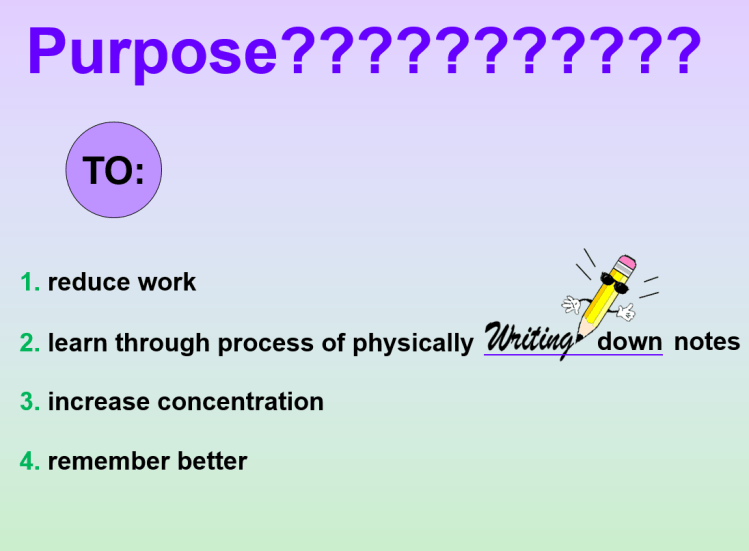
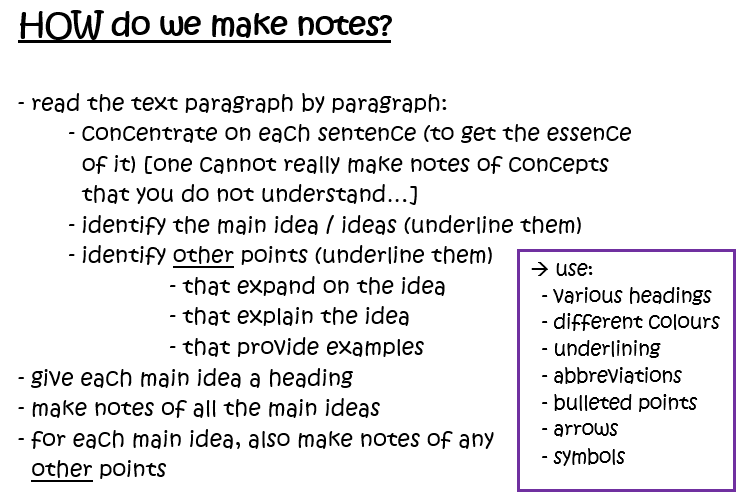
It is very important to know how to study. So pay close attention to the information in this lesson!
Making Notes. (5:34 minutes long)
3.
4.
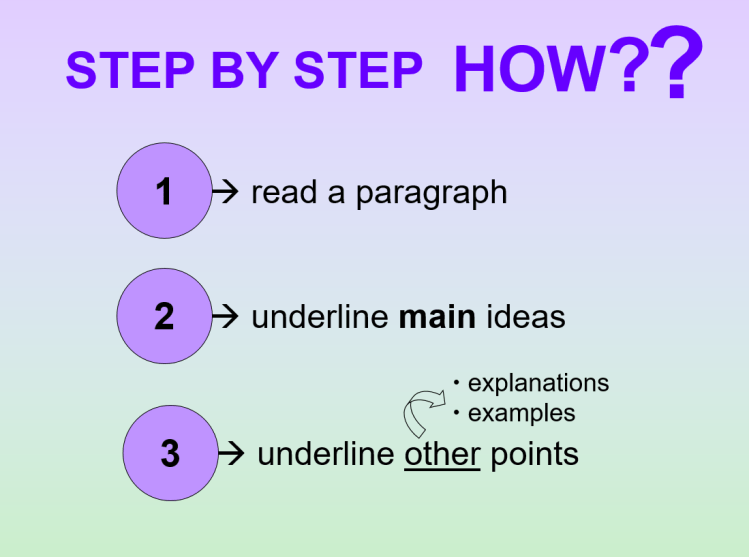
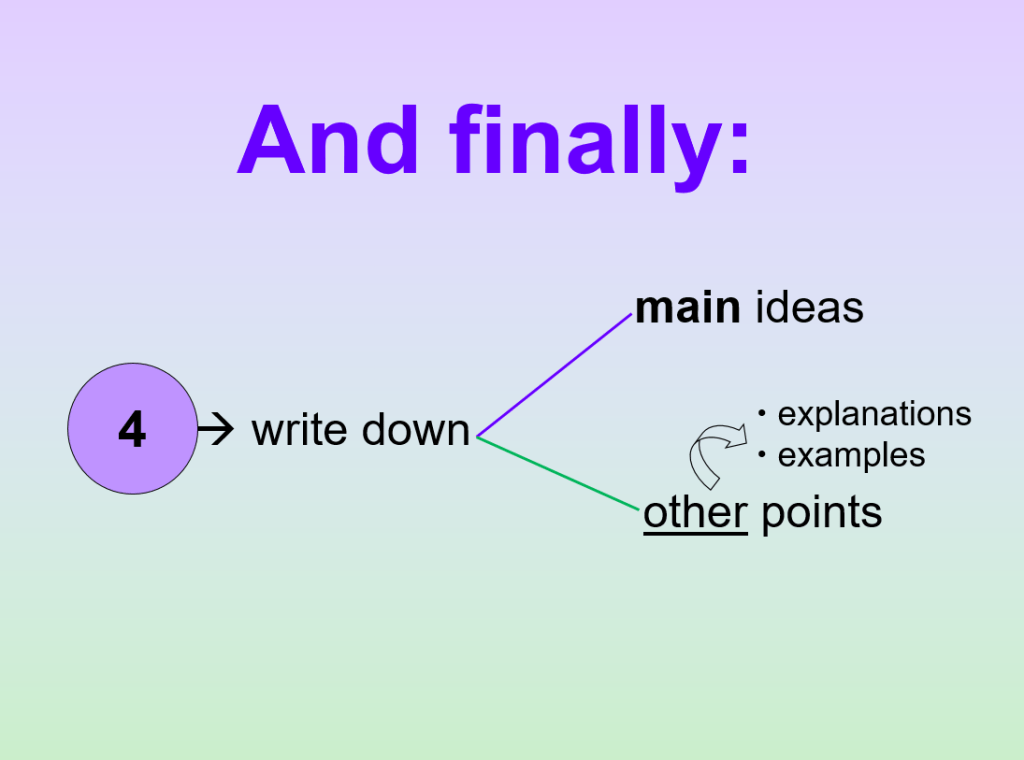
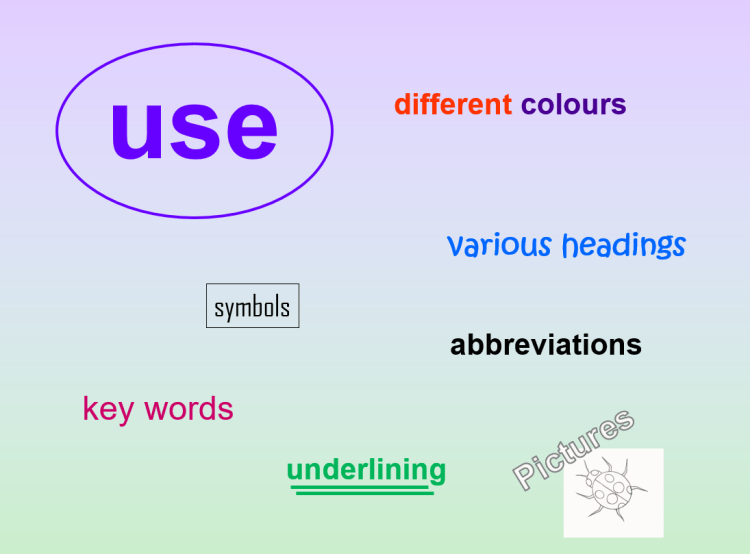
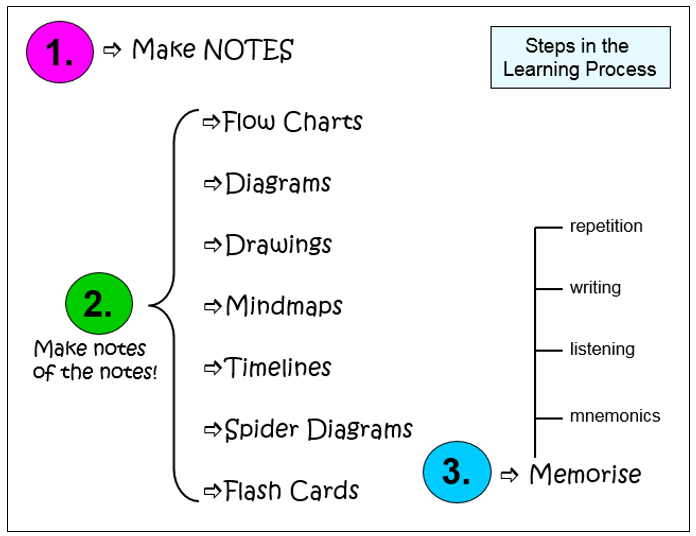
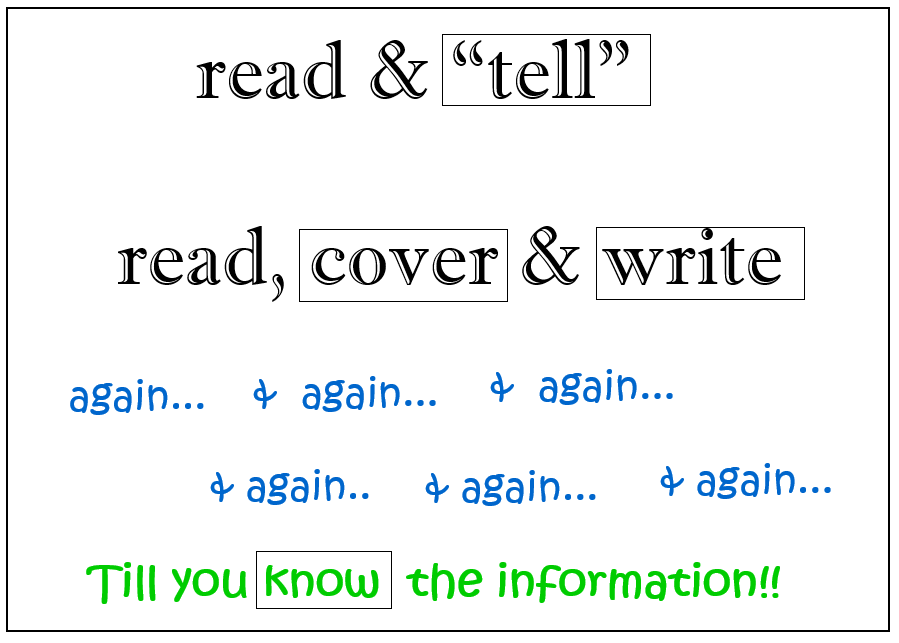
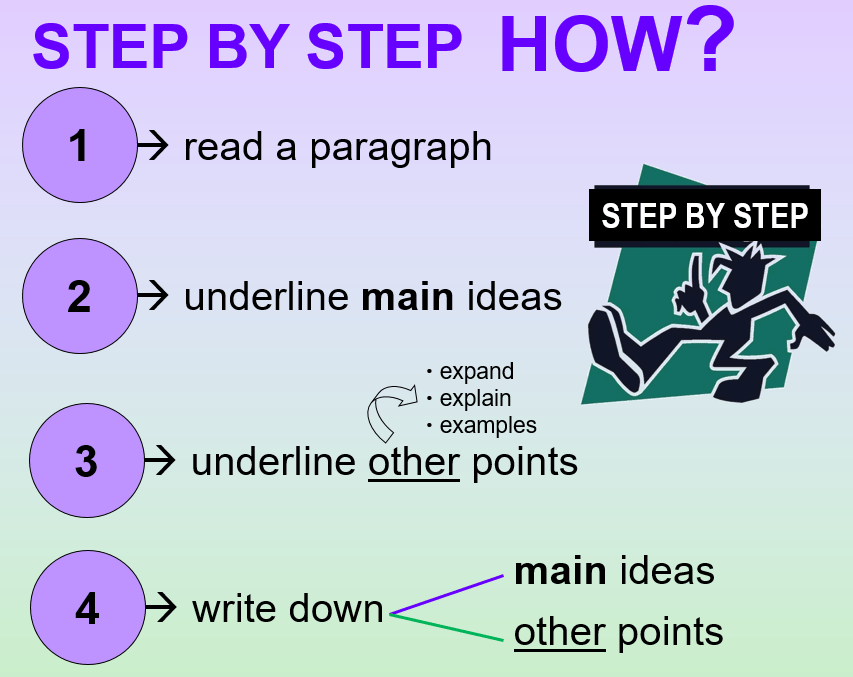
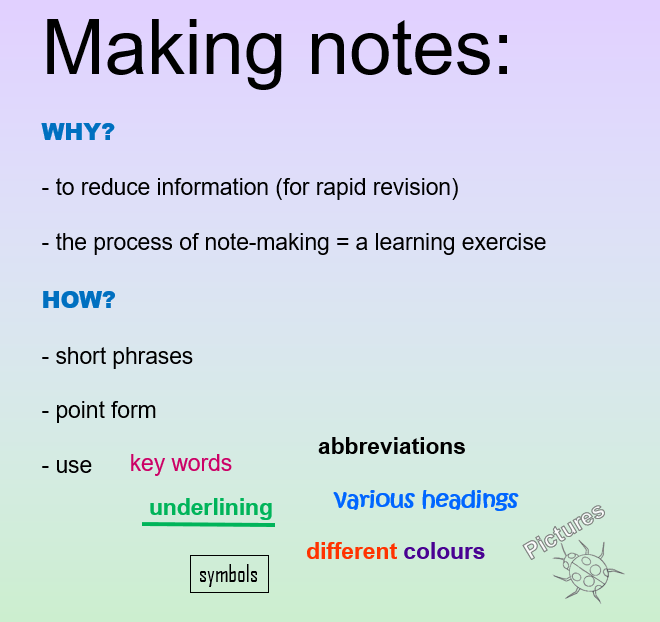
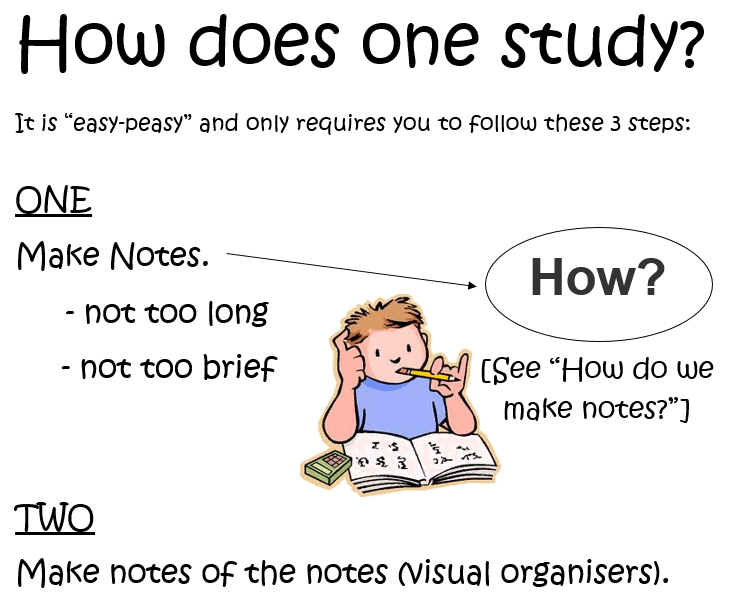
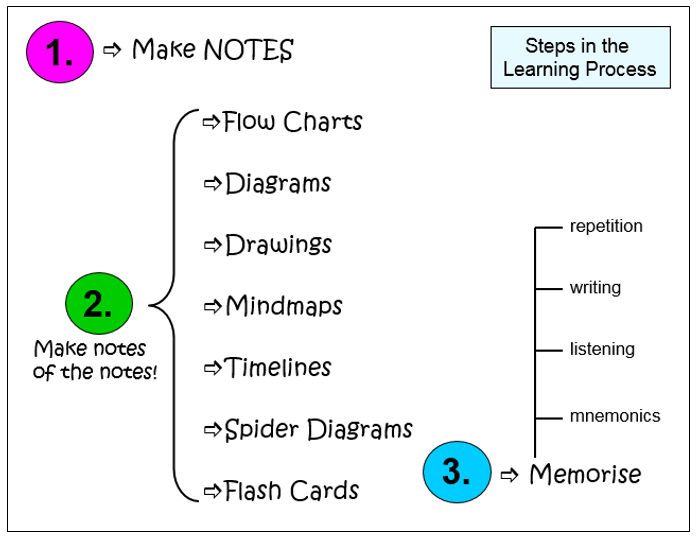
So, this is how we study:
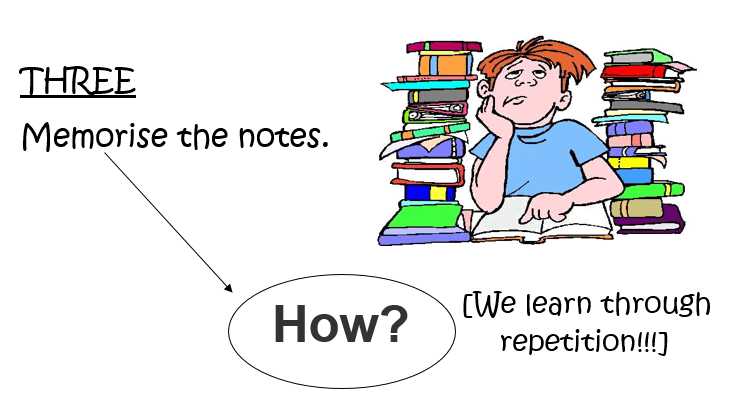
THROUGH: repetition!!
(writing & talking & listening)
5.
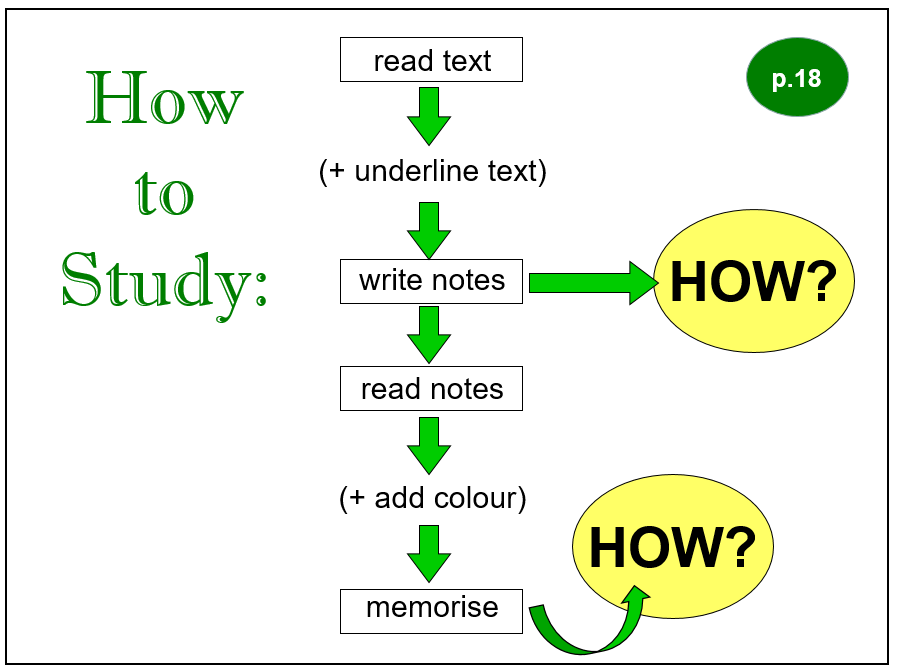
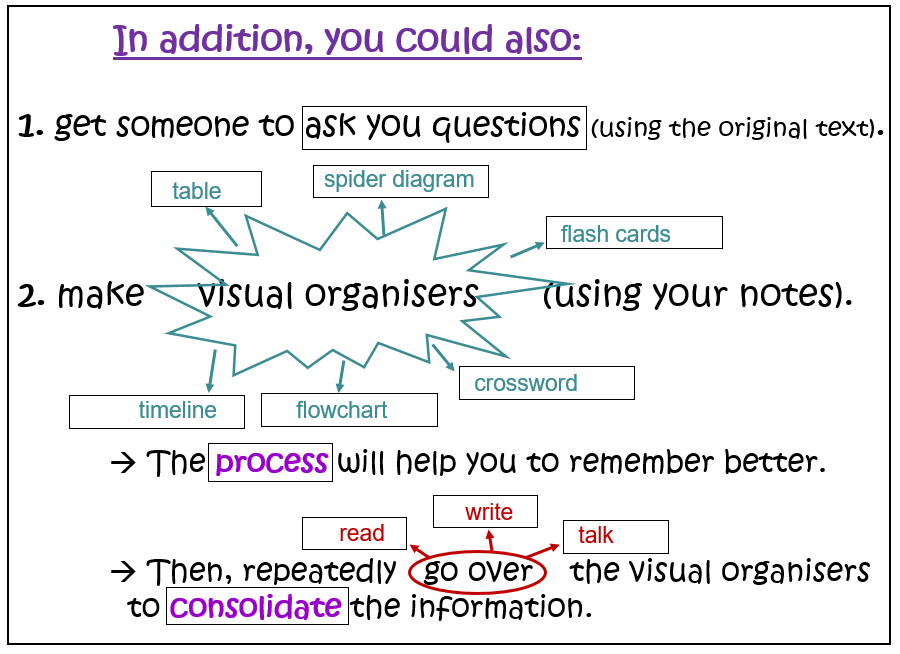
To make sure that you understand, also go over the slides below!
How to Study. (3:39 minutes long)
6.
… just to make 100% sure that you did not miss some important information about how to study!
7.
Fill in the missing words on the notes about studying on p.18. If you struggle, scroll down to find the answers…
SOLUTION:
8.
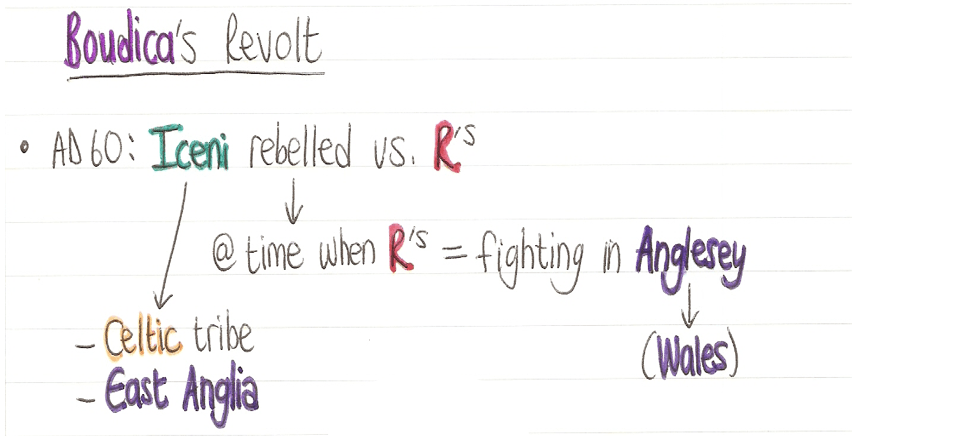
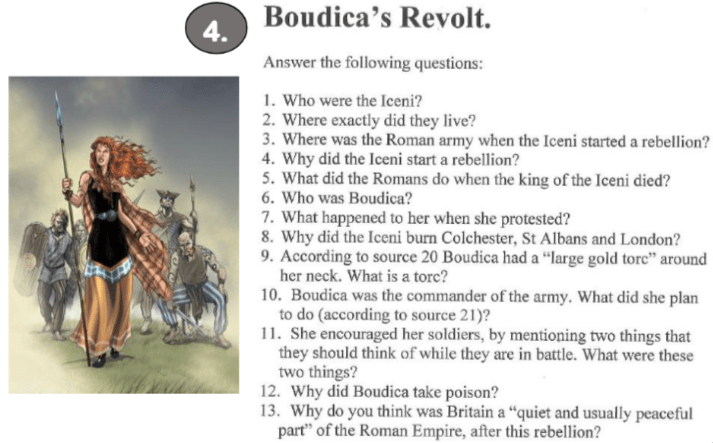
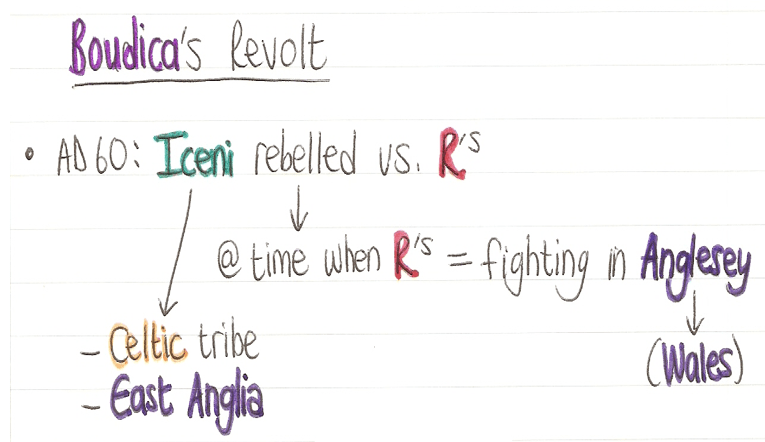
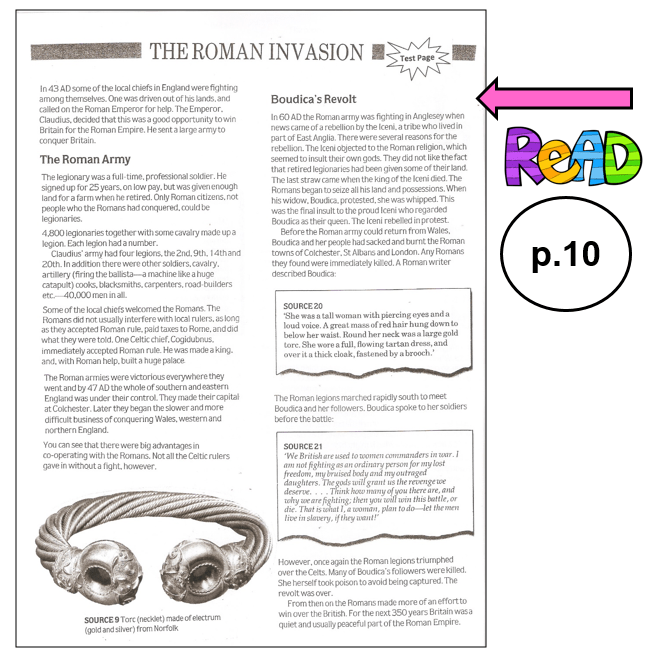
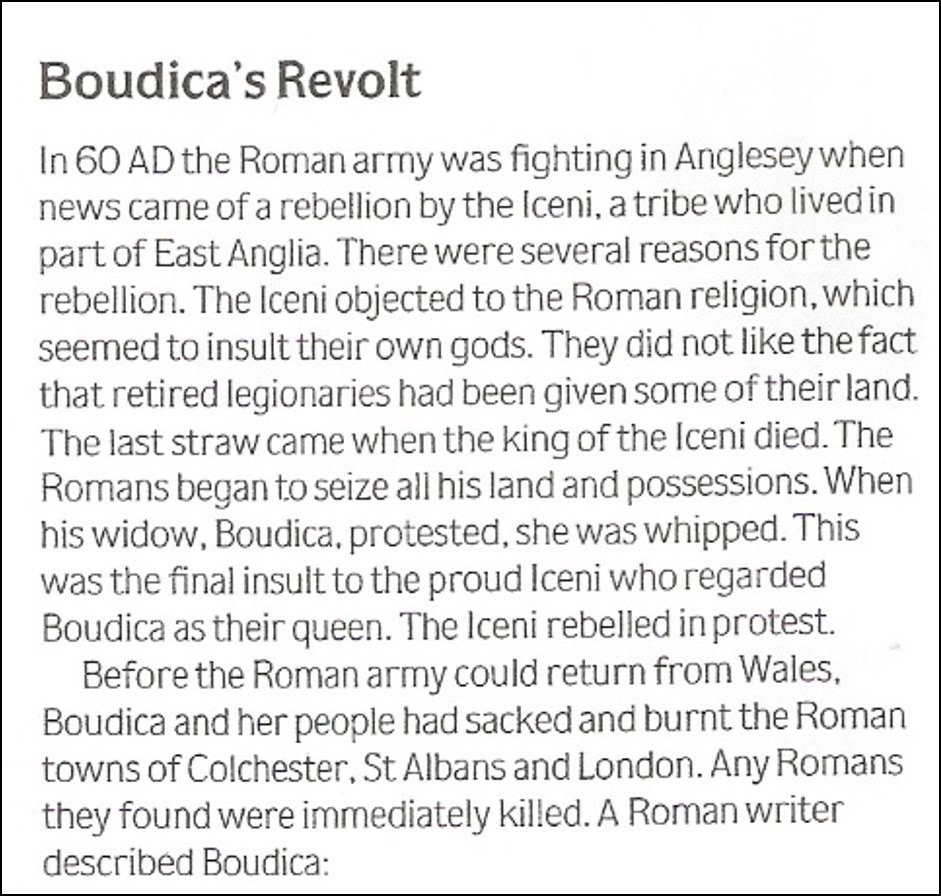
Let’s put what you have learnt today into practice. Make notes on Boudica’s Revolt, from page 10 in your workbook.
This is to make sure that you know how to make study notes. (Usually you will do this on your own paper and not in your exercise book. Only this one time you need to make the notes in your purple book, so that it can be assessed.)
“Boudica’s Revolt (p.10) – my own study notes”
Now make notes, according to the advice shared in today’s lesson! You may use the example given to start with…
9.
… if you want to make sure that you did not miss some important information about how to study!
Today you are going to examine the Printing Press in more detail, as it played a major part in the spread of new ideas! (You will be watching a lot of videos during this lesson to learn about the Spread of new Ideas – pay close attention!)
Follow the instructions step by step:
1.
First, watch this video that explains more about how new ideas spread across Europe:
Spread of New Ideas in Europe. (4:00 minutes long)
2.
3.
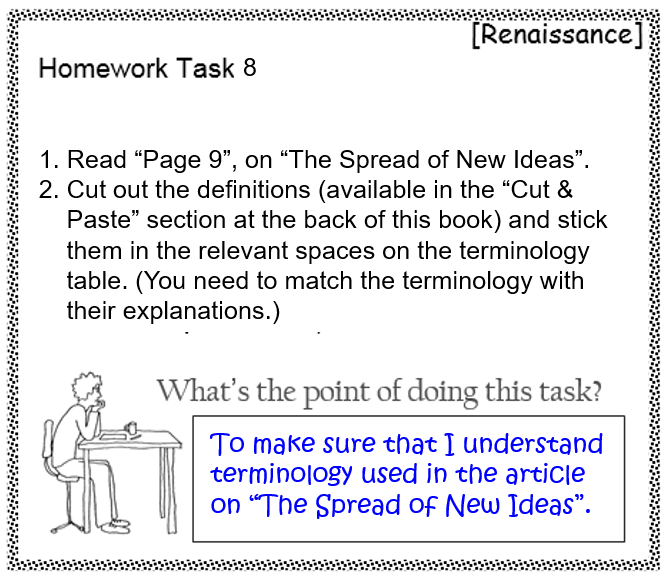
Here is an explanation of some printing press terminology:
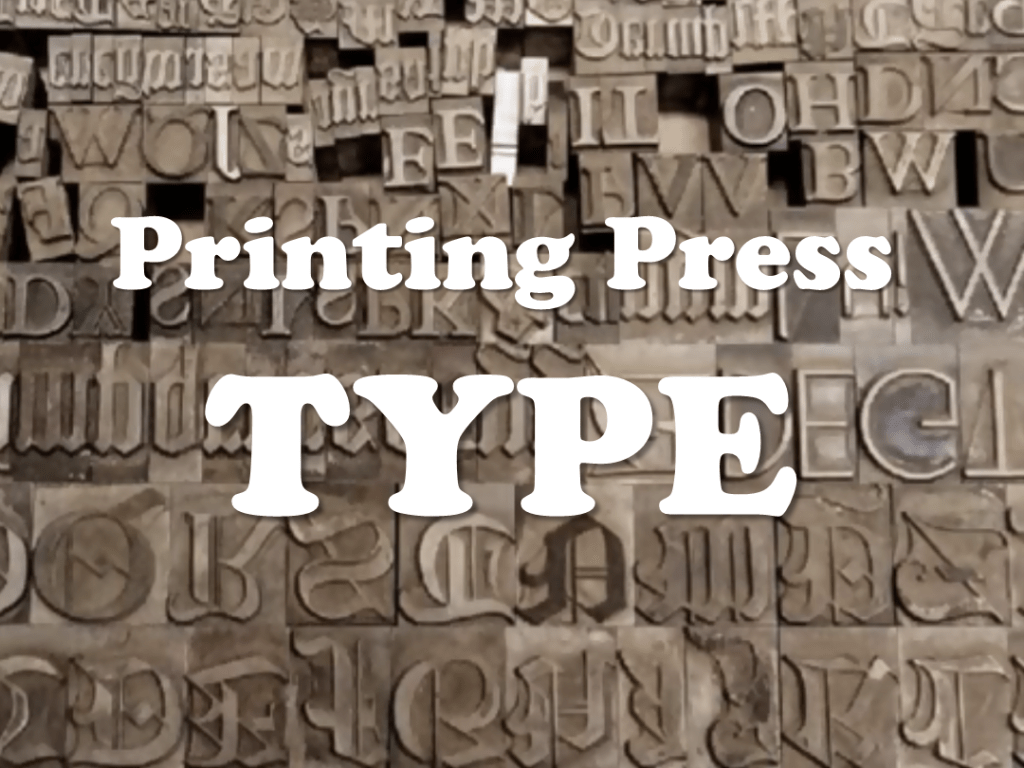
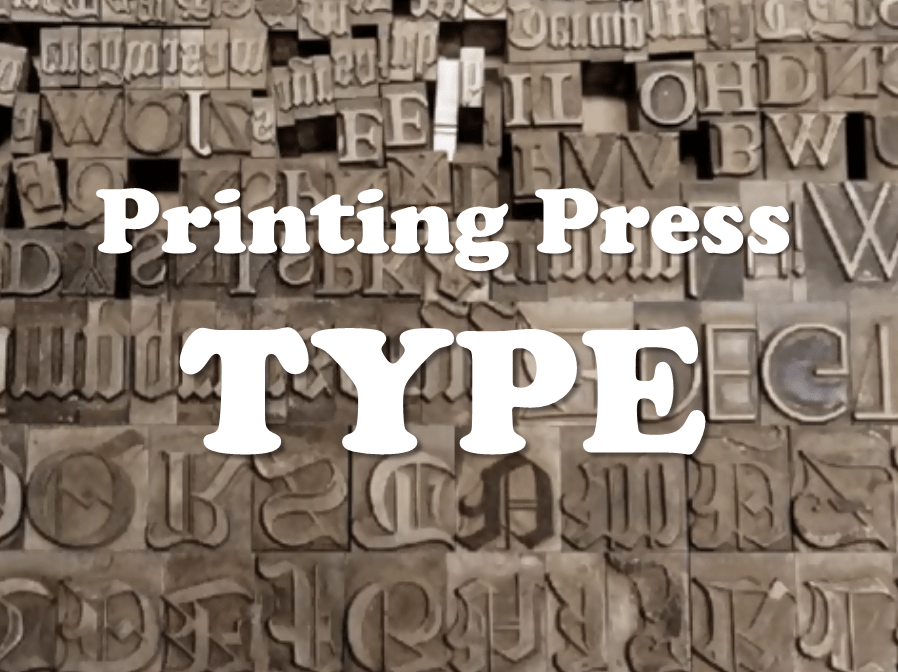
This is the letters used to make words, sentences and paragraphs (to ultimately form the pages of text of a book!) were called “the type”.
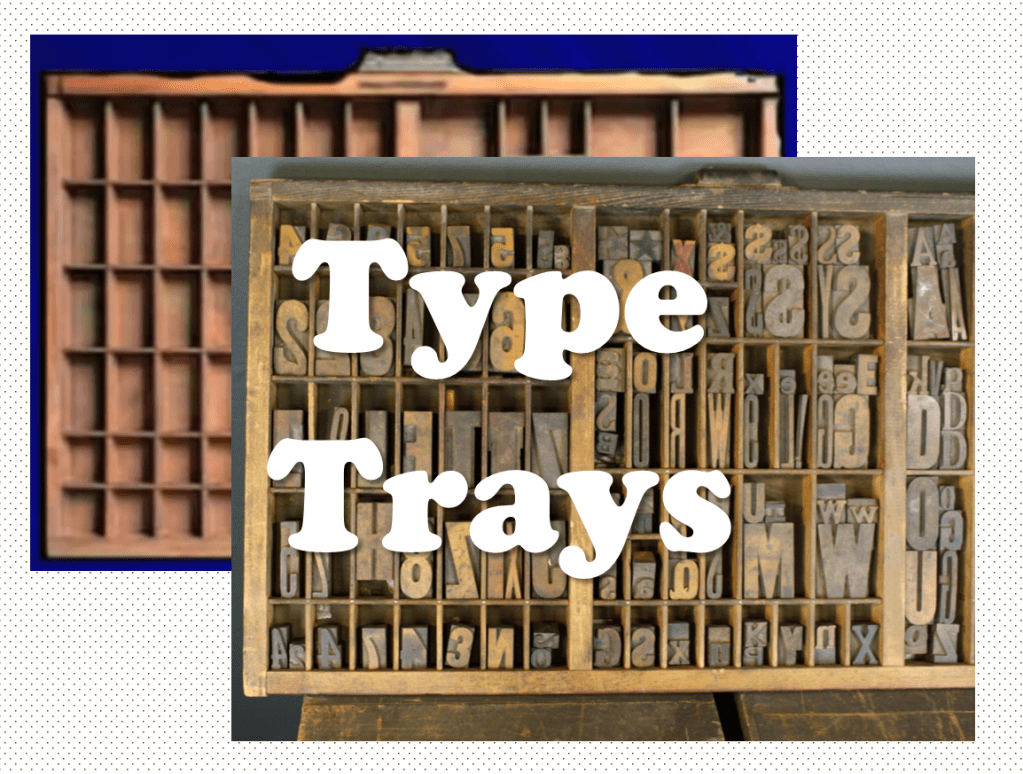
The type (or letters) were kept in special trays, also known as “printers’ trays”. (These are now collectors’ items!)
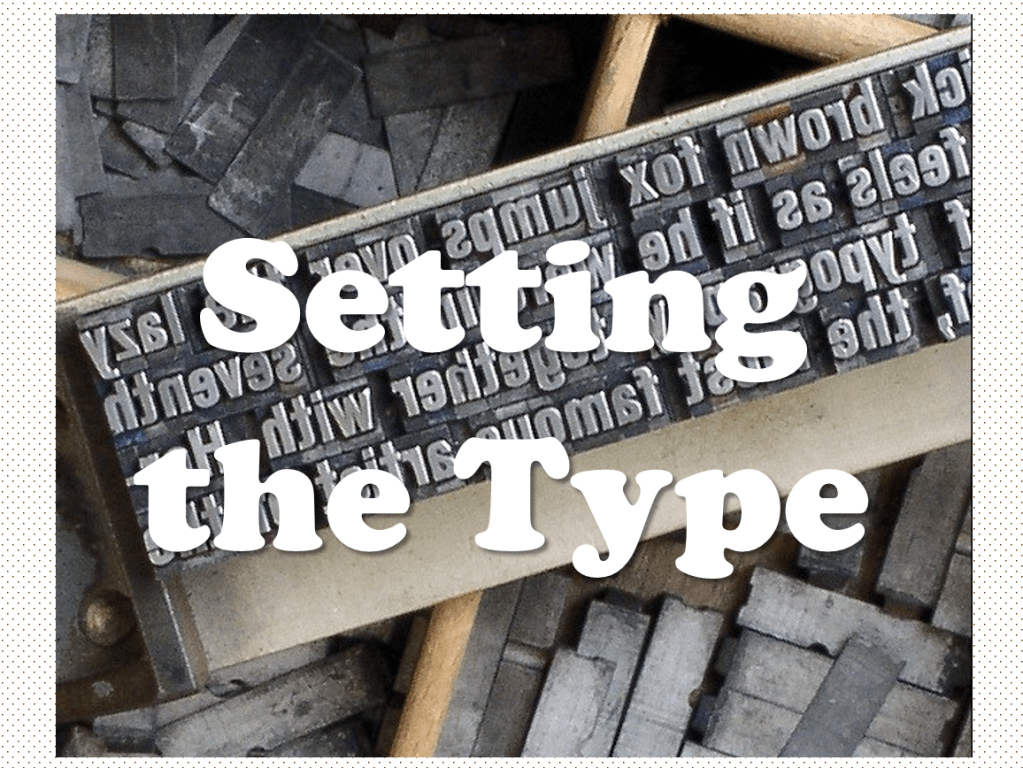
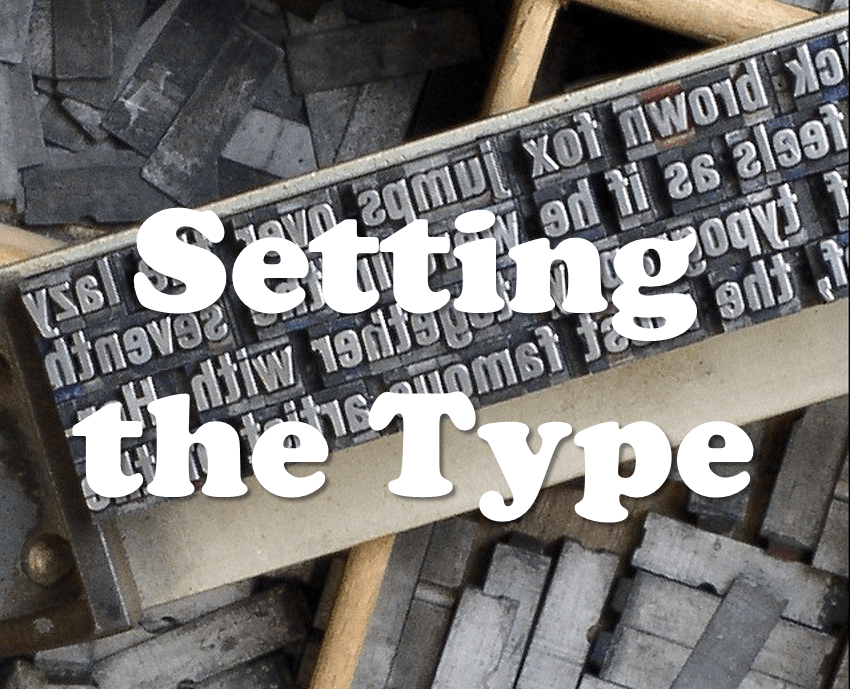
“Setting the type” refers the process of putting the letters in the correct order to make words, sentences, paragraphs – and ultimately to form the pages of a book!
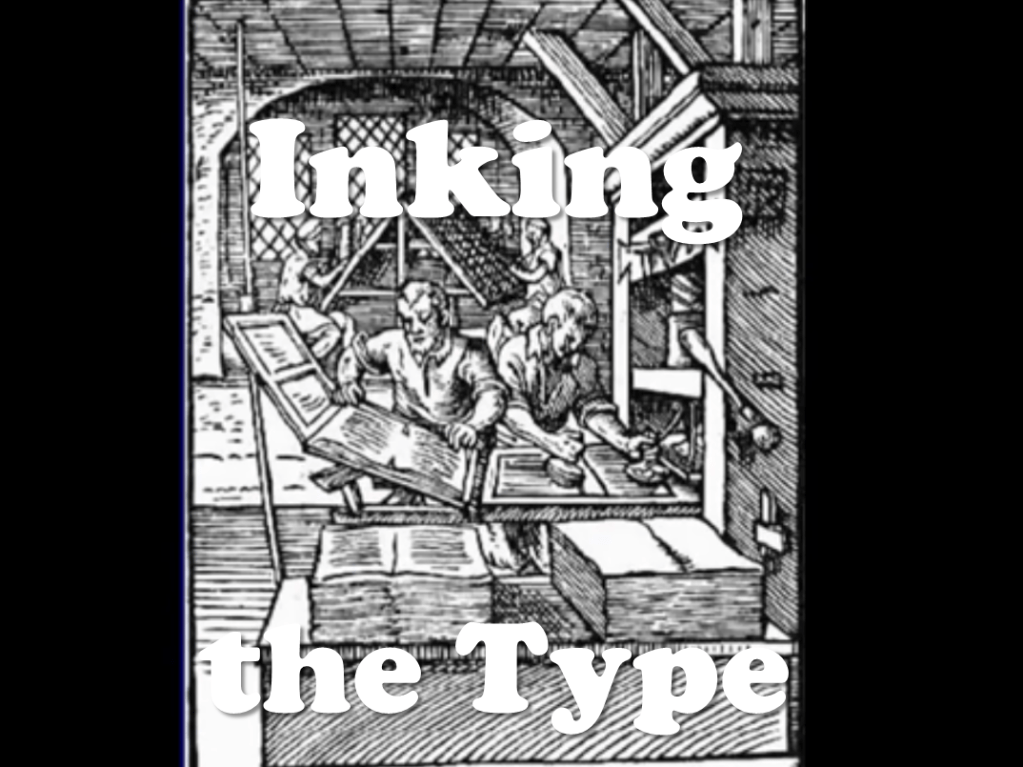
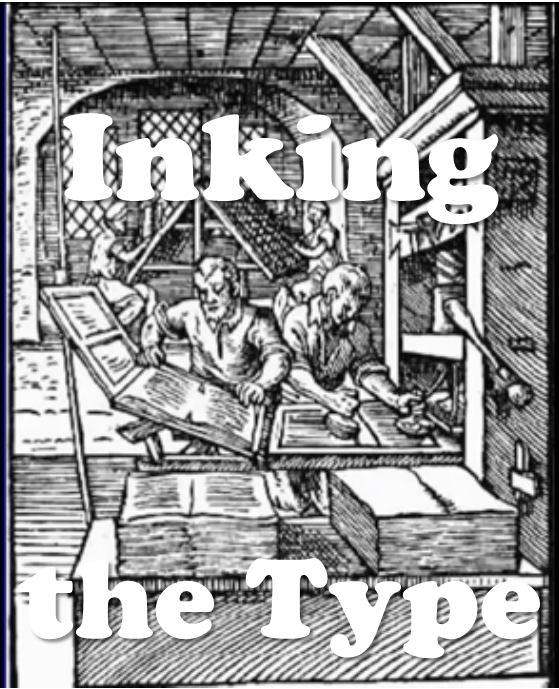
“Inking the type” refers to the process whereby balls of ink were used to put ink on the letters, in order to “print” multiple copies of the pages.
4.
Now, watch the following video that tells you more about the invention of the Printing Press.
Printing Press History. (2:00 minutes long)
5.
Also watch the following videos that tells you more about how the Printing Press worked:
Printing Press Demo. (1:58 minutes long)
This video is showing a grandpa demonstrating how the Printing Press worked:
Gutenberg Press. (6:45 minutes long)
6.
And now just for a bit of fun:
A related comic-video…
Histeria! The Printing Press. (4:30 minutes long)
And a related song-video…
Gutenberg song. (2:48 minutes long)
7.
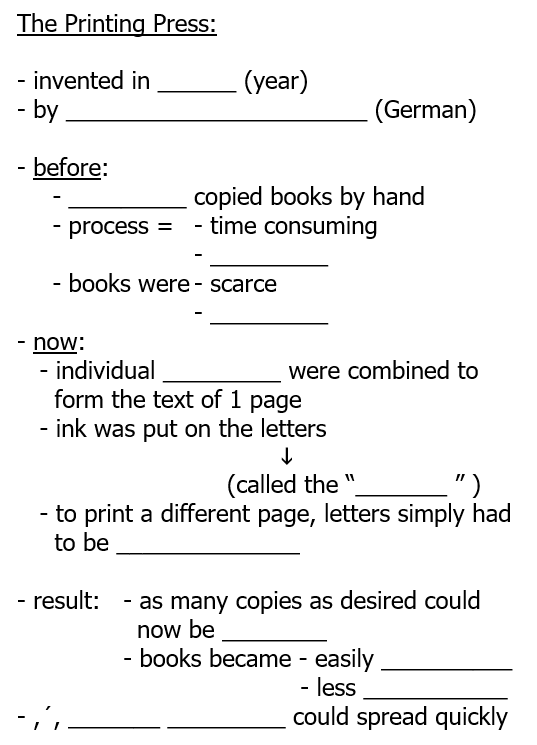
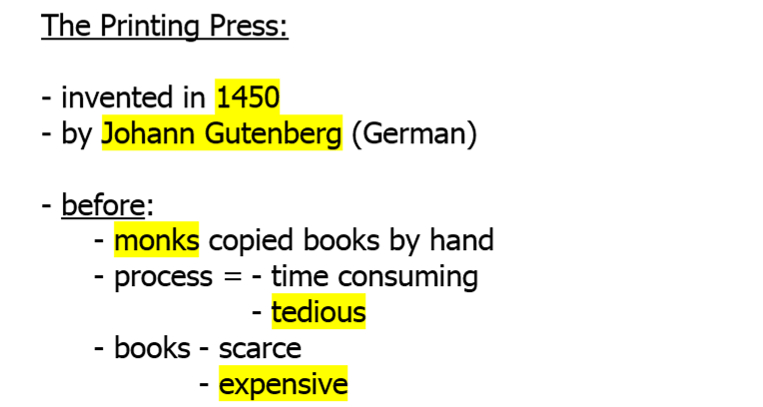
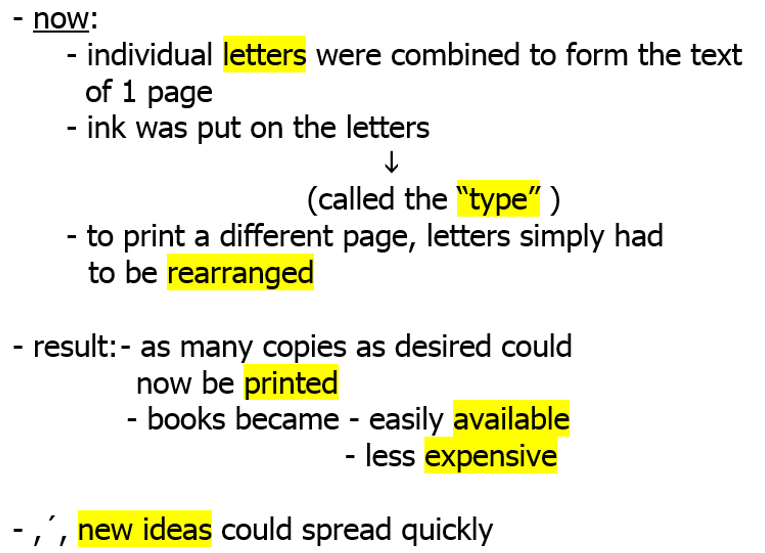
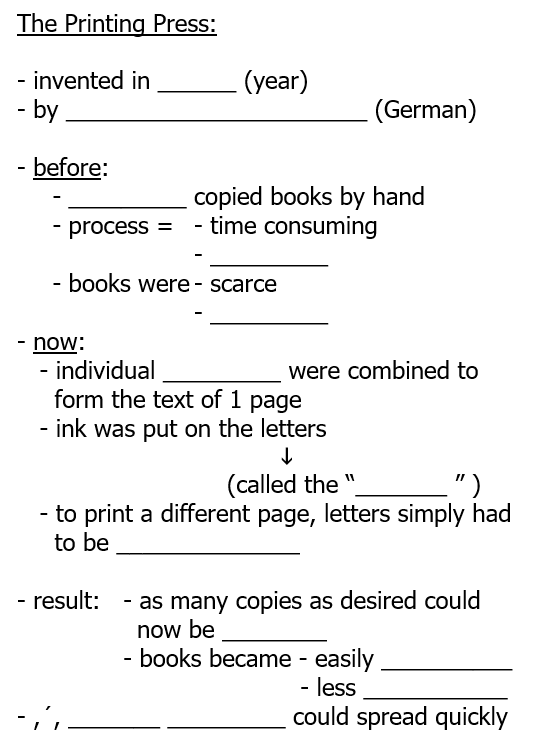
Now, complete the following notes about the Printing Press by filling in the missing information:
Here are some clues:
(You may use words more than once…)
SOLUTION:
8.
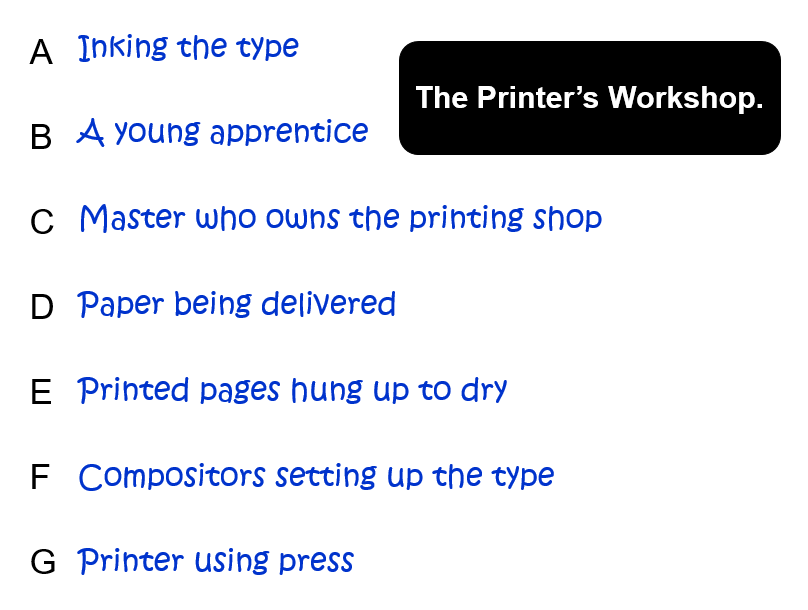
Finally, do “The Printer’s Workshop”, p.19 (matching task).
SOLUTION:
You can mark both tasks by watching the following slides…
(1:35 minutes long)
9.
Johannes Gutenberg and the Printing Press. (13:41 minutes long)
Today we are going to look in detail how to make use of sources of information in History.
Follow the instructions step by step:
1.
Evidence Examples. (1:27 minutes long)
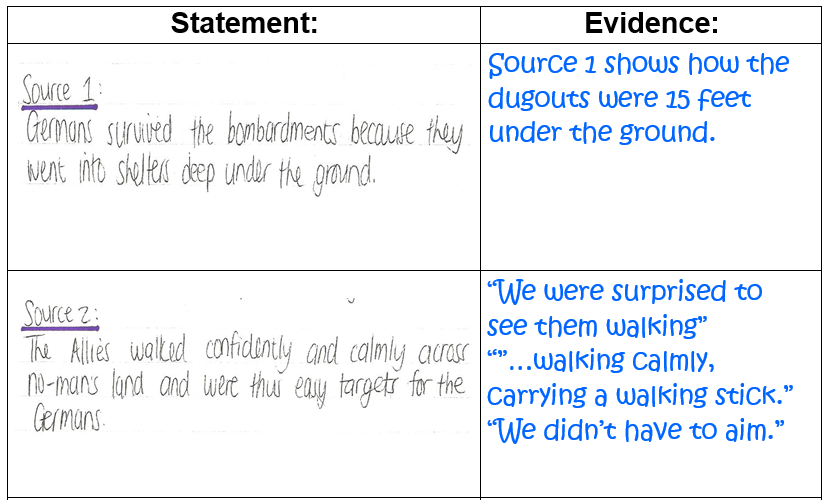
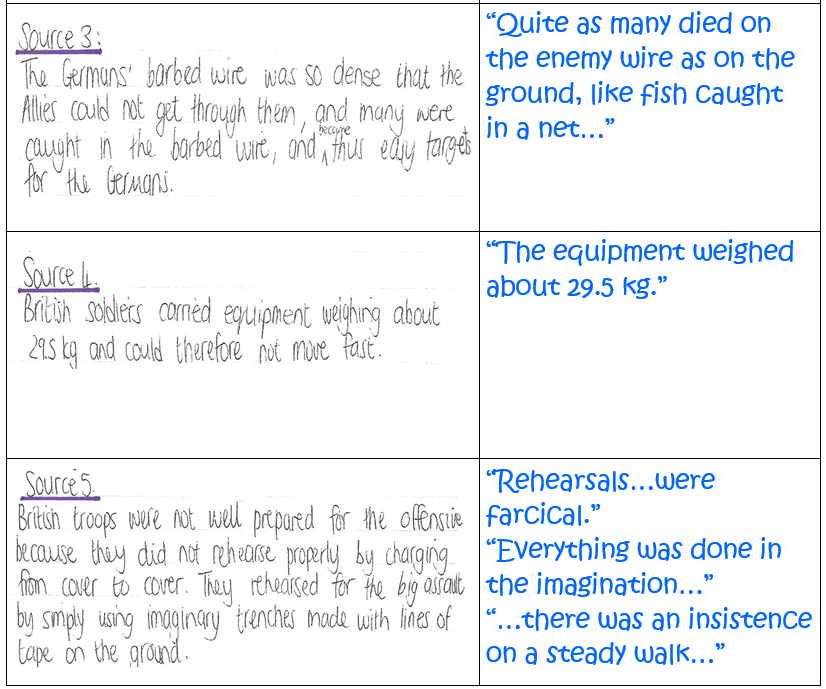
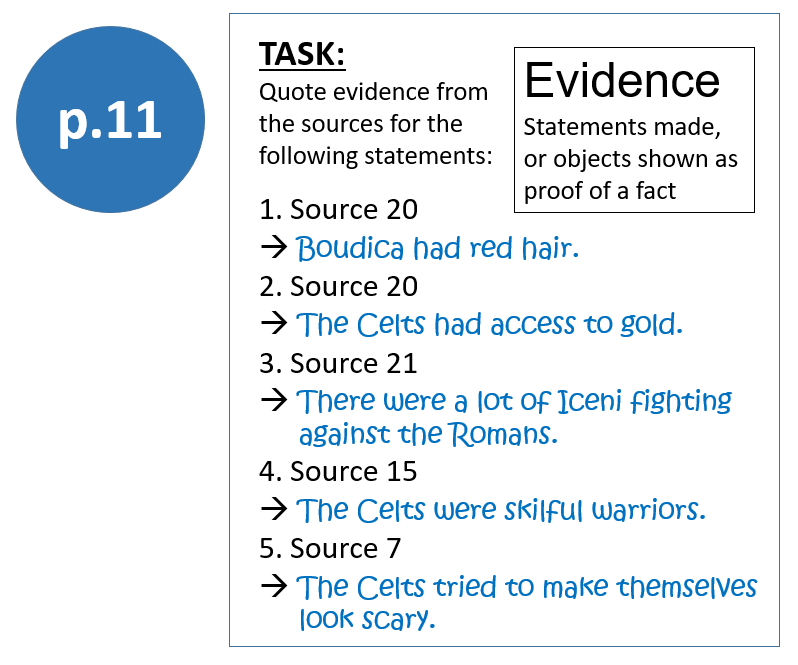
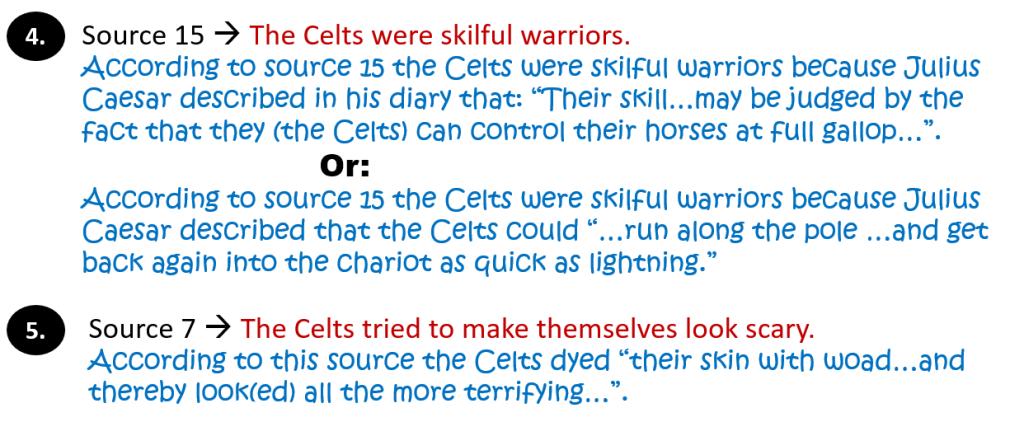
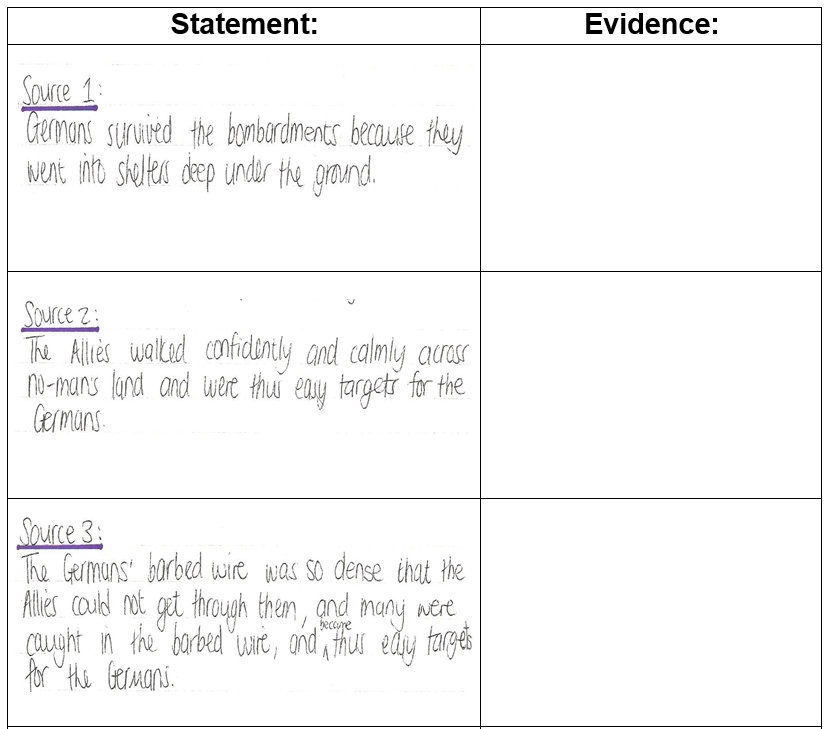
When using sources it is very important to always “back-up” statements made with evidence from the source. You write down evidence from a source in the form of a short quote! (Remember to use quotation marks!!)
2.
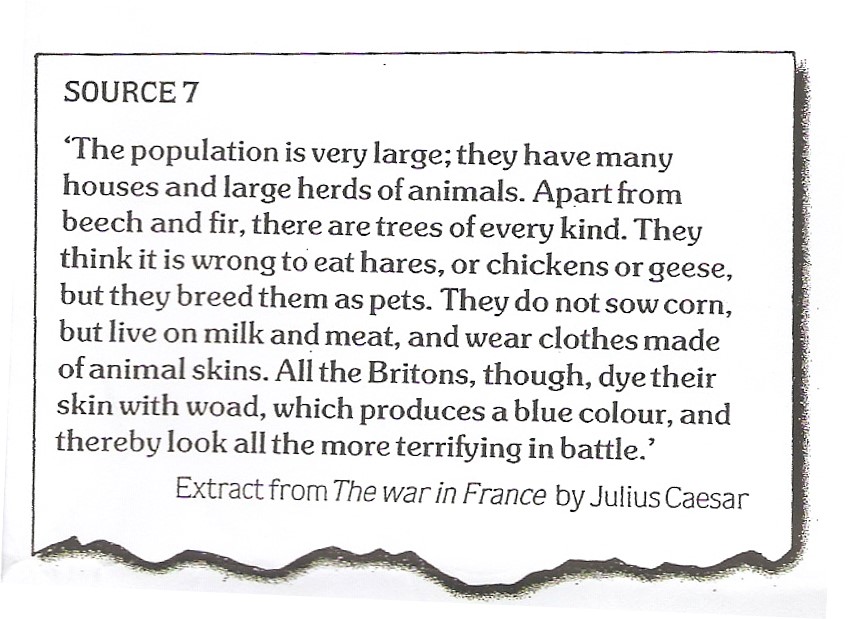
Source 7, on page 8
3.
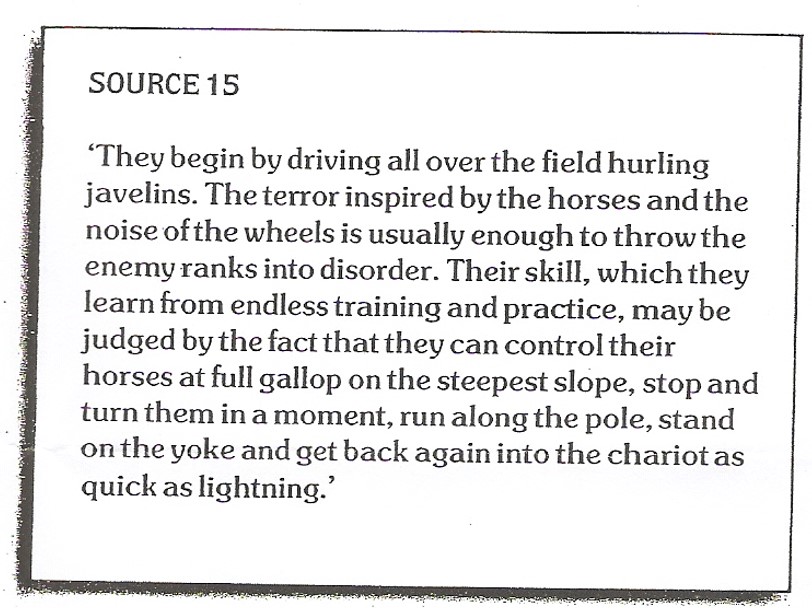
Source 15, on page 9
4.
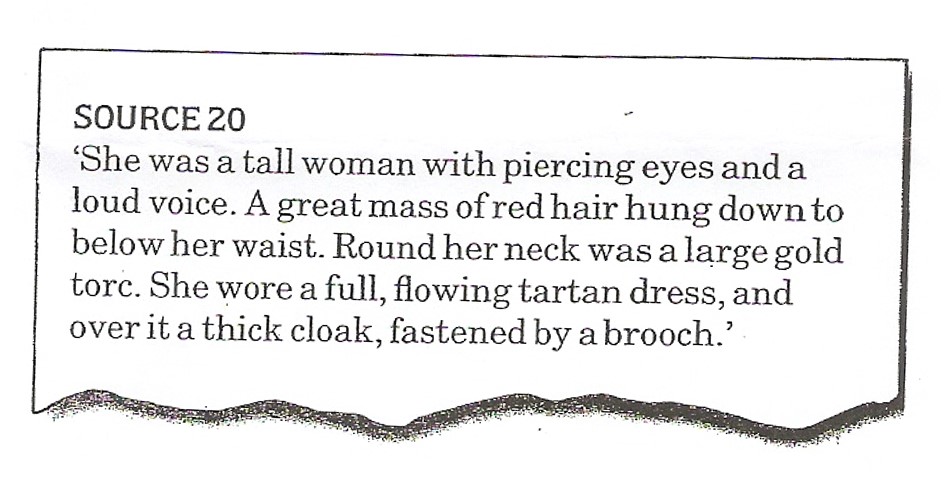
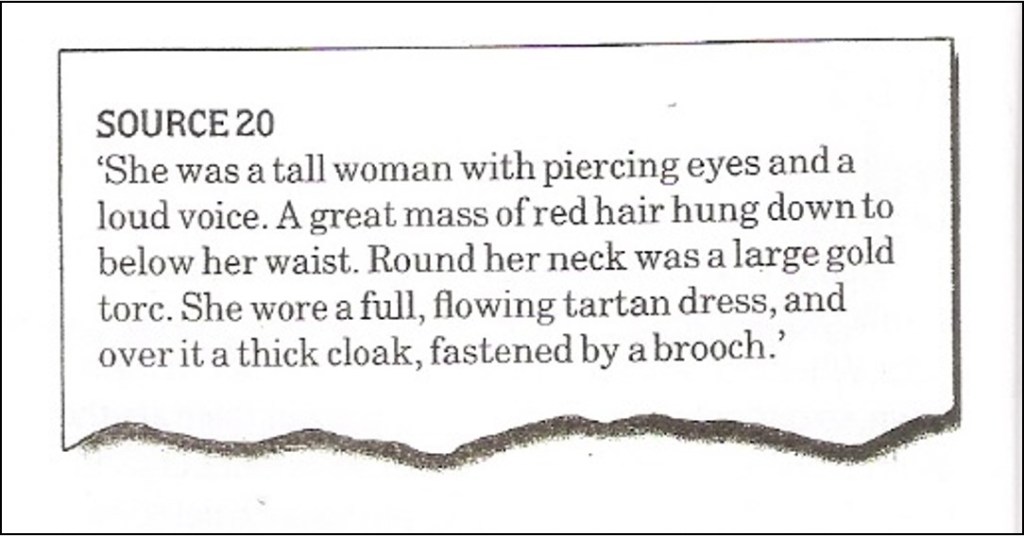
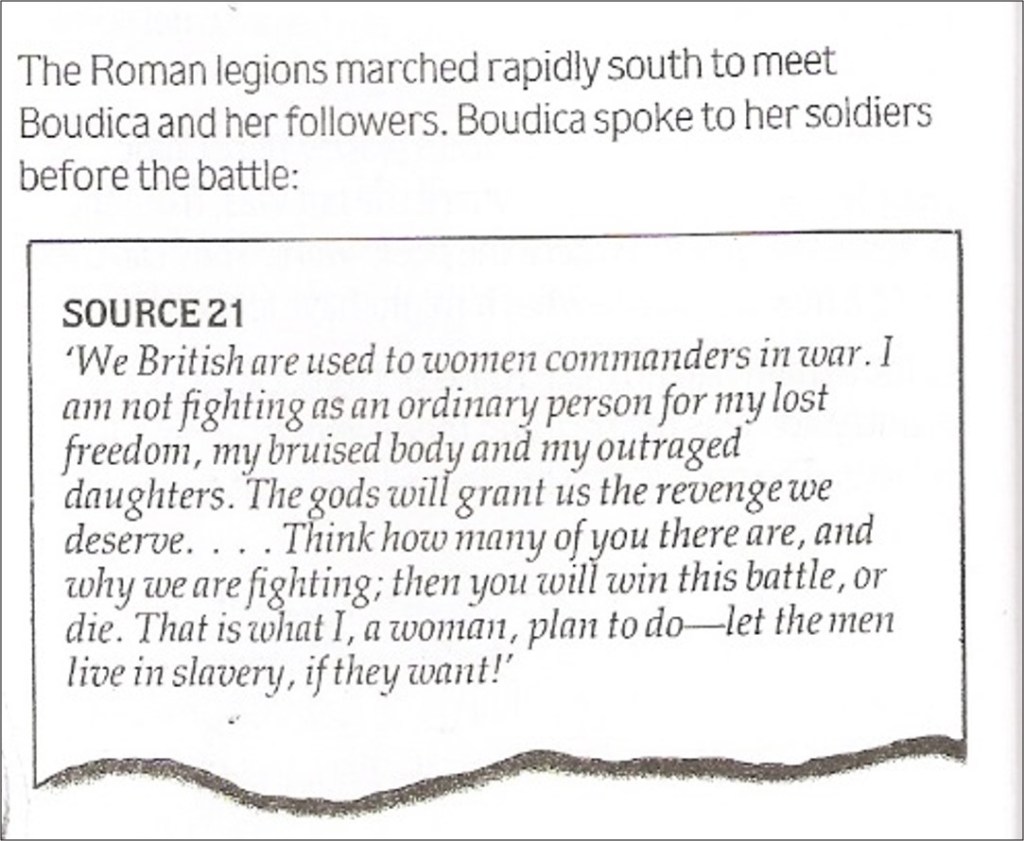
Sources 20 & 21, on page 10
5.
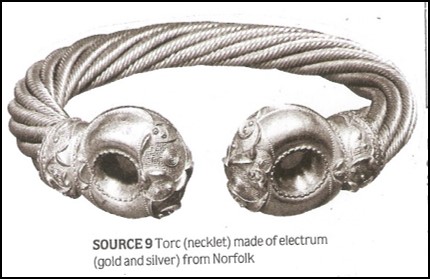
Now look how these sources can be used to provide evidence about the Celts and about Boudica:
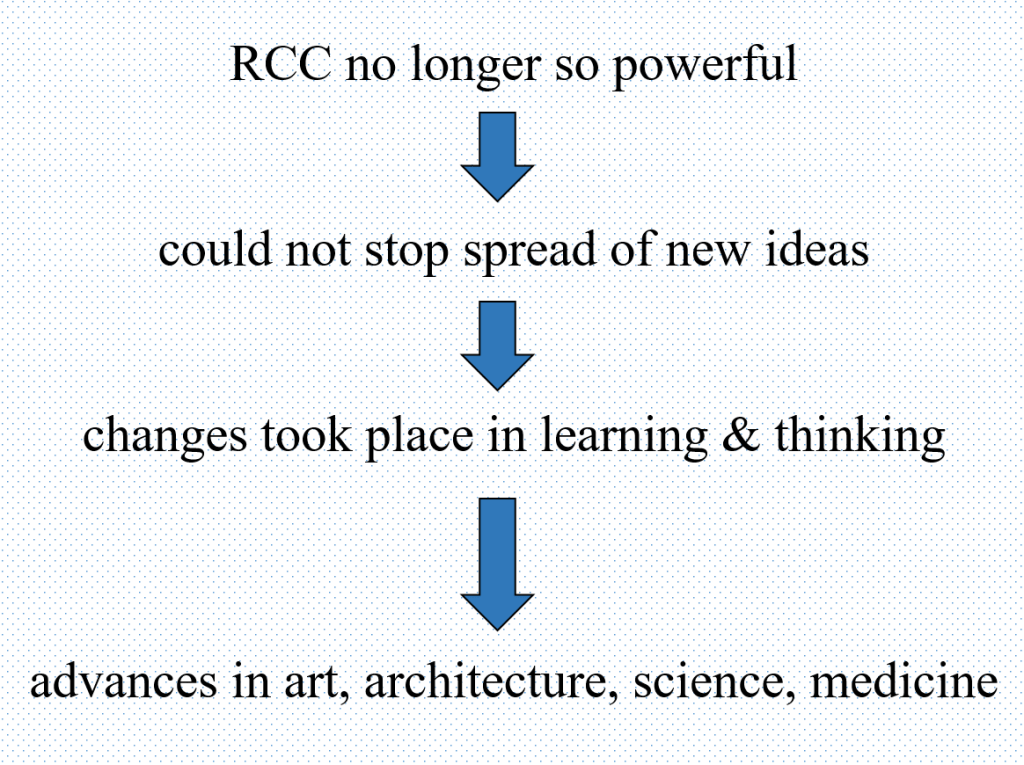
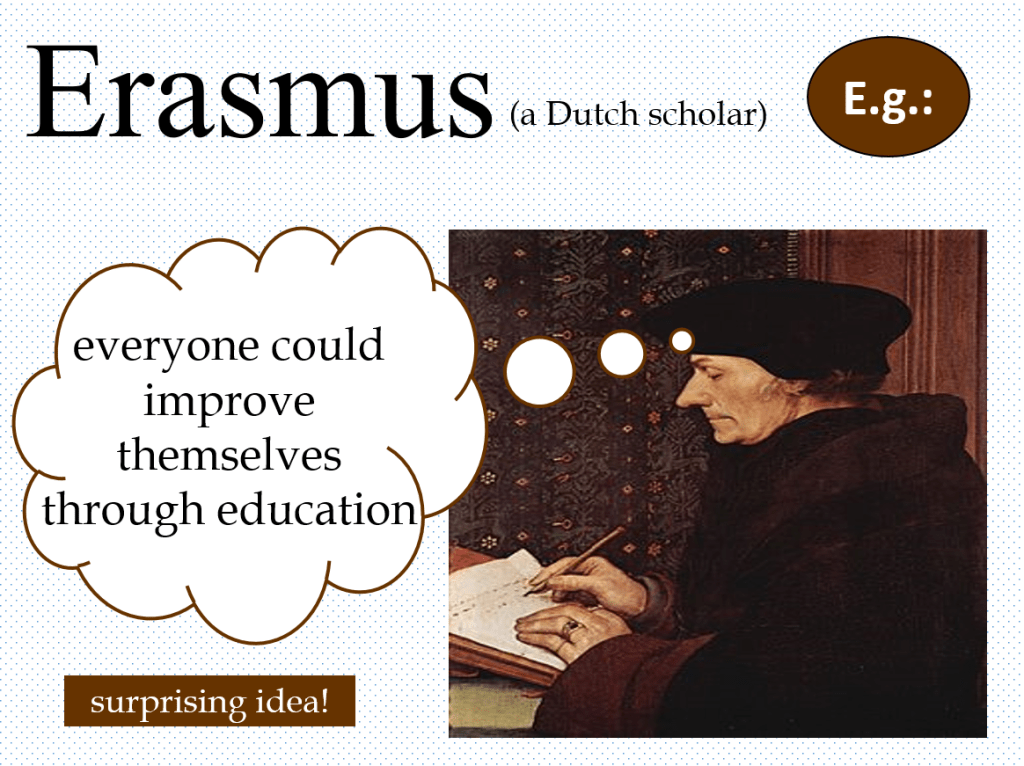
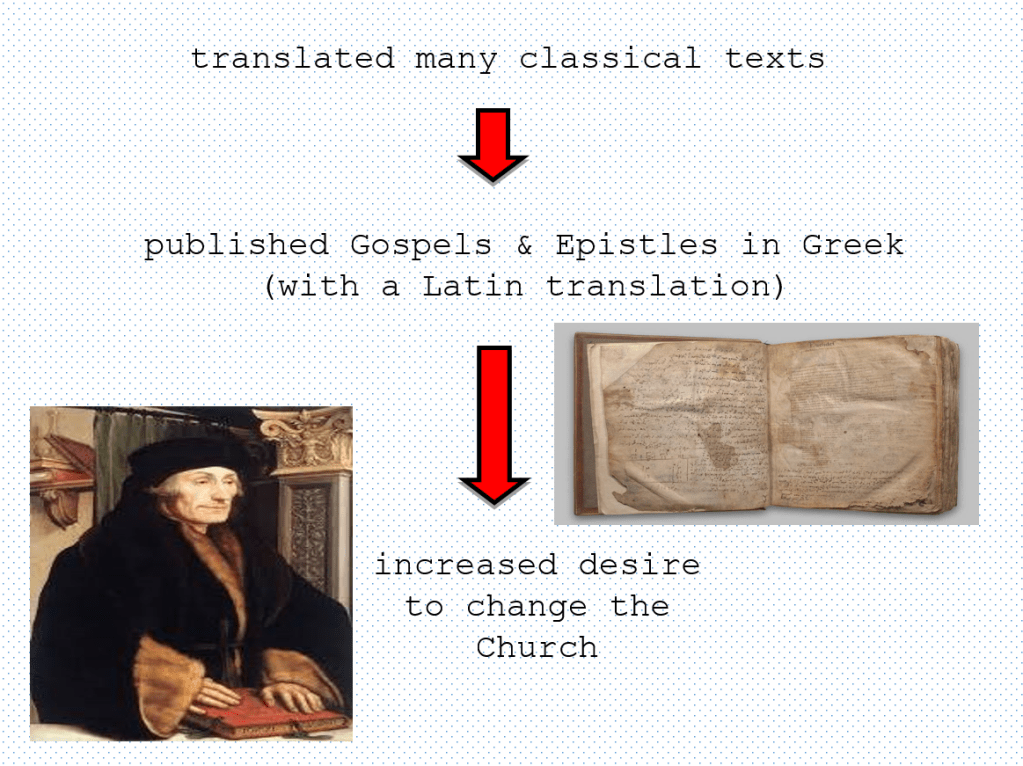
Today you are going to learn about the spread of new Italian Renaissance ideas… thanks to the invention of the printing press! (You will be watching some videos during this lesson to learn about the Spread of new Ideas – pay close attention!)
Follow the instructions step by step:
1.
First, look at your test result (Homework-6) and also see where you have perhaps lost marks:
Once a way of mass producing books was discovered, new ideas related to art, architecture and science quickly spread across Europe. This happened round about 1450, when a German man invented the so-called printing press!
4.
To get a better idea of how it worked, watch the following videos about the printing press…
Gutenberg’s Printing Press and Bible. (9:16 minutes long)
This Week in History – Gutenberg Launches the Renaissance. (3:18 minutes long)
5.
Finally, copy the following definitions into your purple book:
Definitions
Renaissance Man: “a cultured man of the Renaissance who was knowledgeable, educated, or proficient in a wide range of fields”
Golden Age: “a period of time during which art, architecture or the economy flourishes”
Miniature: “a very small portrait painting that could be worn as an ornament by men or women, like a brooch”
Printing Press: “an invention that could produce numerous copies of a page – it could therefore mass produce printed books”
6.
Here is an explanation of some printing press terminology:
This is the letters used to make words, sentences and paragraphs (to ultimately form the pages of text of a book!) were called “the type”.
The type (or letters) were kept in special trays, also known as “printers’ trays”. (These are now collectors’ items!)
“Setting the type” refers the process of putting the letters in the correct order to make words, sentences, paragraphs – and ultimately to form the pages of a book!
“Inking the type” refers to the process whereby balls of ink were used to put ink on the letters, in order to “print” multiple copies of the pages.
7.
Now, complete the following notes about the Printing Press by filling in the missing information:
Here are some clues:
(You may use words more than once…)
SOLUTION:
8.
Revision
Look at the following video to see how new knowledge and ideas spread across Europe…
Spread of New Ideas about Learning. (3:36 minutes long)
9.
10.
Knew ideas developed thanks to the very talented Renaissance men. Watch this video that shows examples of great Renaissance men.
Renaissance Man – from History Teachers. (3:01 minutes long)
11.
In the next lesson we will look at the impact that this new invention had. The Printing Press played a major part in the spread of new ideas!
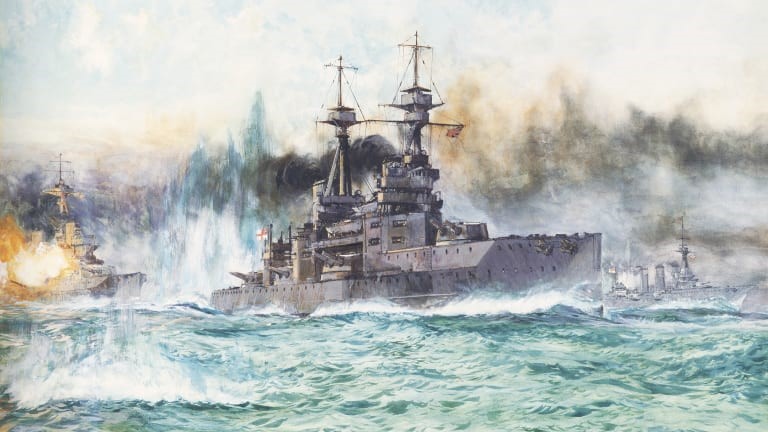
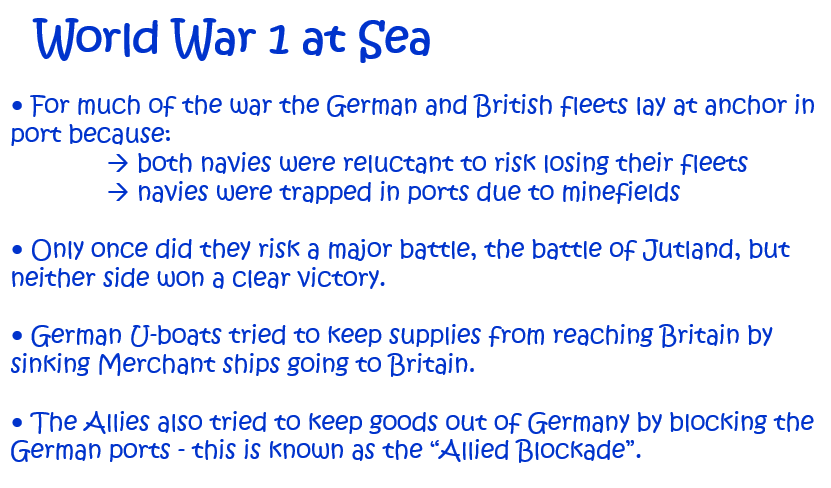
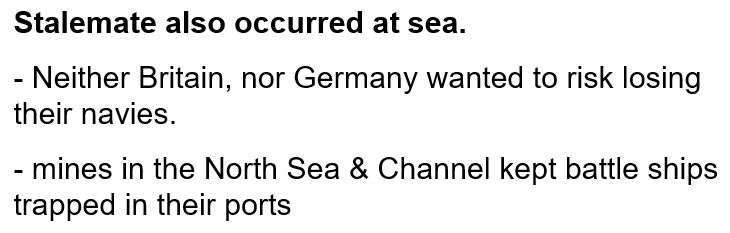
Today you are going to examine the Battle of Jutland as an example of Stalemate at Sea…
Follow the instructions step by step:
1.
Let’s examine this in more detail!
It tells you about “Stalemate at Sea”. (You can follow the content in your Workbook on p.28.)
(1:39 minutes long)
2.
They tell you more about the Battle of Jutland.
The Battle of Jutland. (1:57 minutes long)
The Battle of Jutland pushed Britain to the limit. (3:57 minutes long)
3.
Stick the flowchart into your book and copy the missing information to show the main events of the Battle of Jutland.
4.
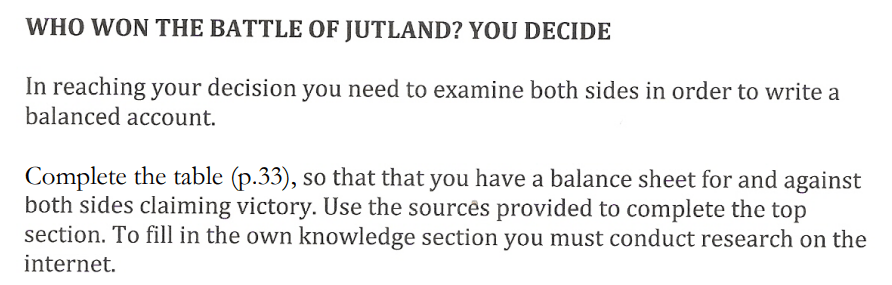
First…the instructions at the top of p.32.
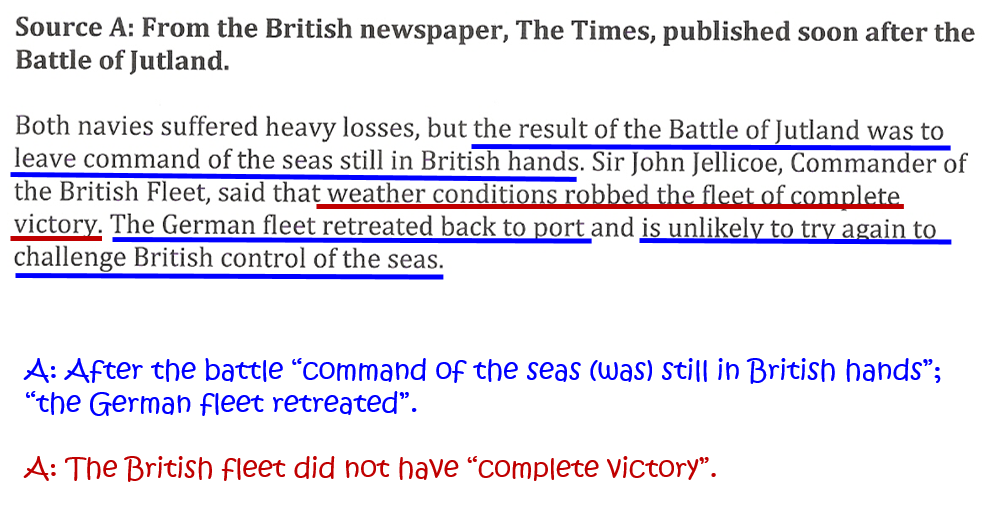
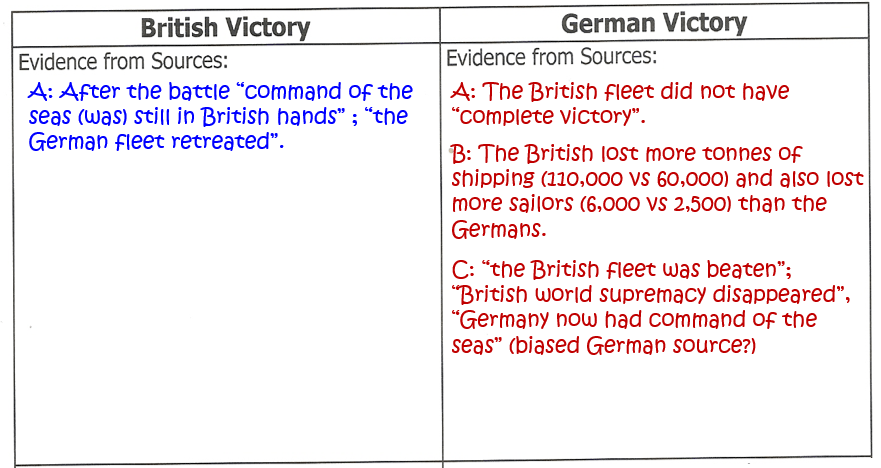
So, what have you learnt so far about the Battle of Jutland, that can be used in a debate about who won the Battle of Jutland? (Write down this “own knowledge information” on the table on p.33.)
SOLUTION:
5.
…the sources on p.32.
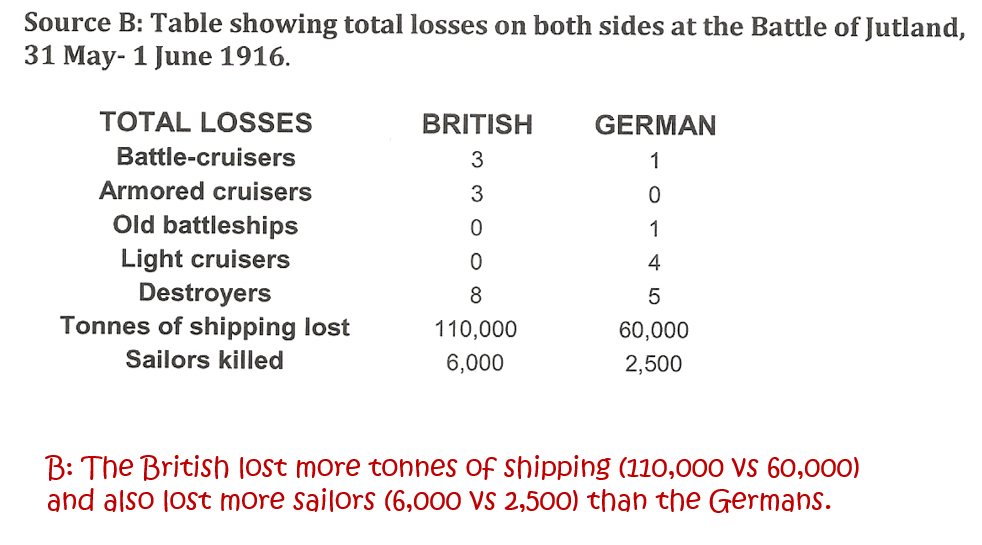
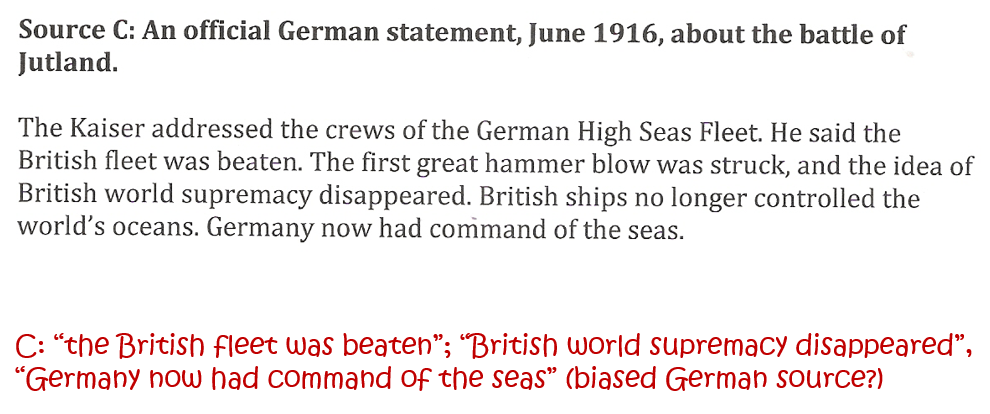
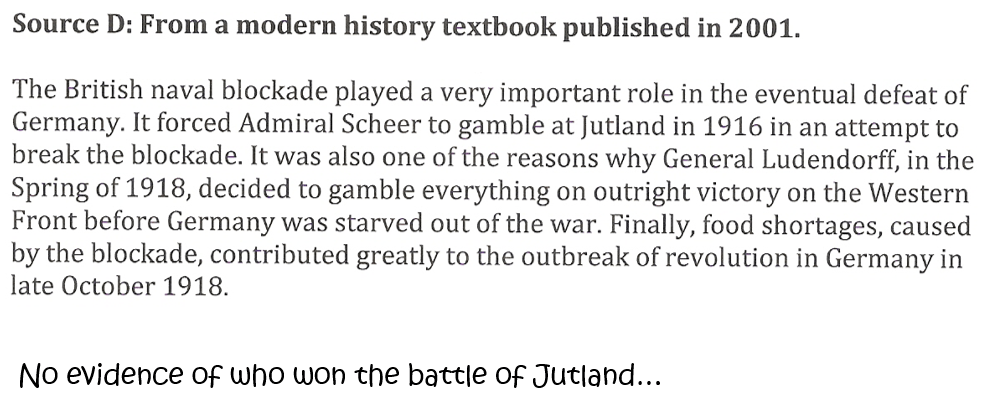
Find evidence (in the sources) that can be used in a debate about who won the Battle of Jutland? (Write down this evidence, in the form of short quotes, on the table on p.33.)
FOR EXAMPLE:
SOLUTION:
6.
Finally, do the last part of the task on “Who won the Battle of Jutland?” by completing the final box on the table (p.33).
7.
WHAT WAS THE BATTLE OF JUTLAND?
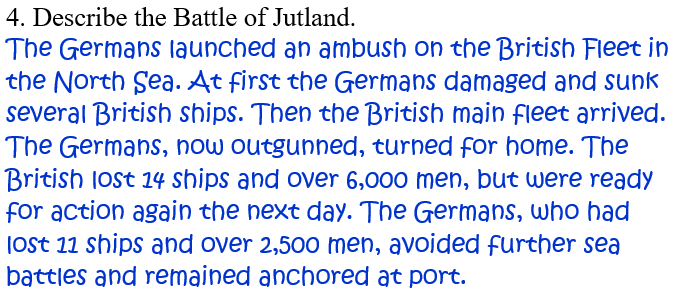
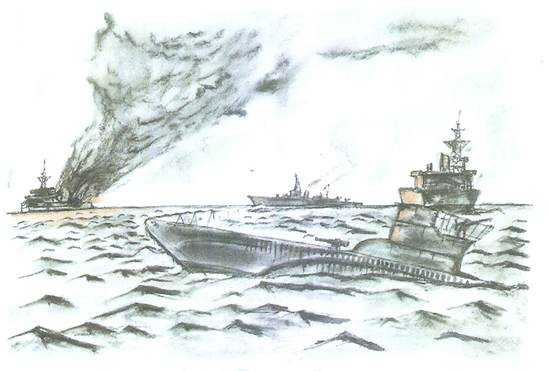
“The Battle of Jutland (31 May – 1 June 1916) was the largest naval battle of the First World War. It was the only time that the British and German fleets of ‘dreadnought’ battleships actually came to blows. The German High Seas Fleet hoped to weaken the Royal Navy by launching an ambush on the British Grand Fleet in the North Sea. German Admiral Reinhard Scheer planned to lure out both Admiral Sir David Beatty’s Battlecruiser Force and Admiral Sir John Jellicoe’s Grand Fleet. Scheer hoped to destroy Beatty’s force before Jellicoe’s arrived, but the British were warned by their codebreakers and put both forces to sea early. Jutland was a confused and bloody action involving 250 ships and around 100,000 men. Initial encounters between Beatty’s force and the German High Seas Fleet resulted in the loss of several ships. The Germans damaged Beatty’s flagship, HMS Lion, and sank HMS Indefatigable and HMS Queen Mary, both of which blew up when German shells hit their ammunition magazines. Beatty withdrew until Jellicoe arrived with the main fleet. The Germans, now outgunned, turned for home. The British lost 14 ships and over 6,000 men, but were ready for action again the next day. The Germans, who had lost 11 ships and over 2,500 men, avoided complete destruction but never again seriously challenged British control of the North Sea. Although it failed to achieve the decisive victory each side hoped for, the Battle of Jutland confirmed British naval dominance and secured its control of shipping lanes, allowing Britain to implement the blockade that would contribute to Germany’s eventual defeat in 1918.”
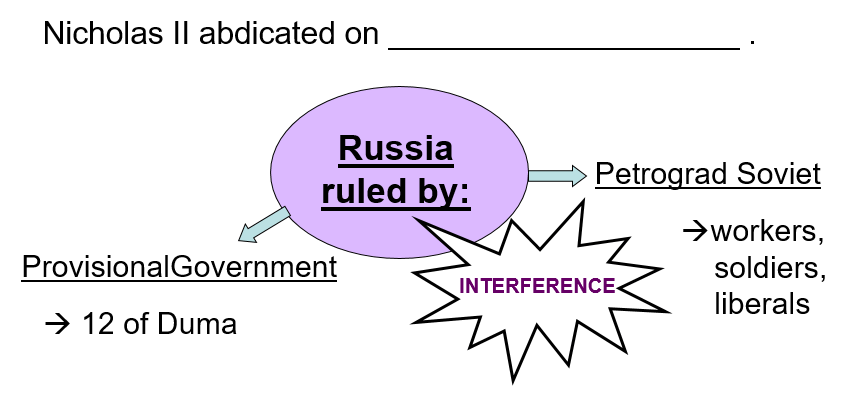
Today you are going to look at the rival claims to power after the abdication of Nicholas II!
1.
Look at the following video-slides. It is a brief explanation of the actions taken by the two rival claims of power in Russia.
Rival Claims to Power. (4:46 minutes long)
2.
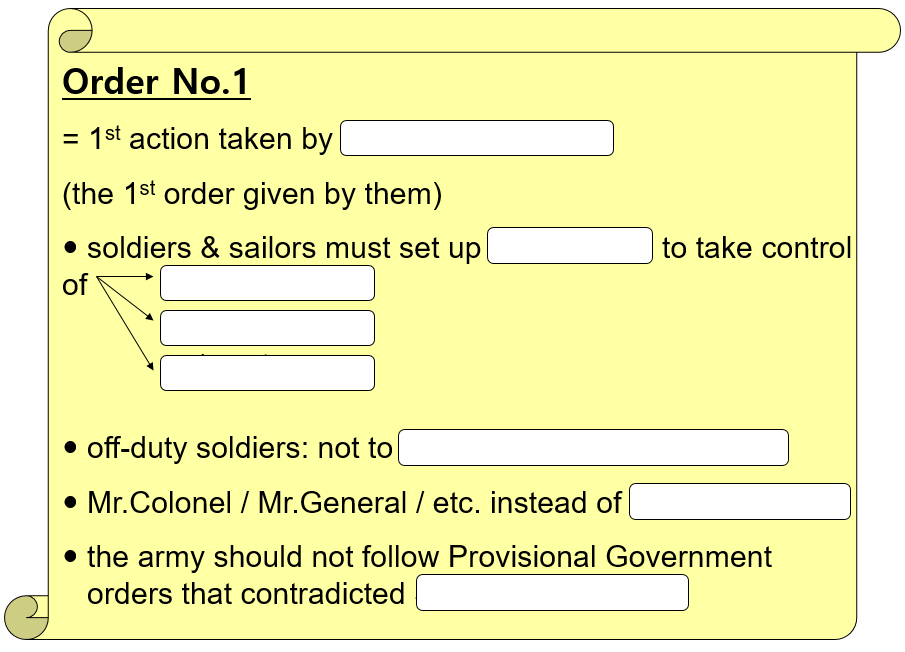
Fill in the missing information on the “Order Number ONE” worksheet and stick it into your book.
SOLUTION
3.
Provisional Government – History of Russia in 100 Minutes. (2:54 minutes long)
4.
The information about “Rival Claims to Power”, p.12 & the table on “The Provisional Government and its problems”, p.13.
5.
Listen carefully – you do not have to know all the detail, but try to absorb as much information as possible!
Alexander Kerensky: The Russian Revolution Before Lenin. (22:44 minutes long)
6.
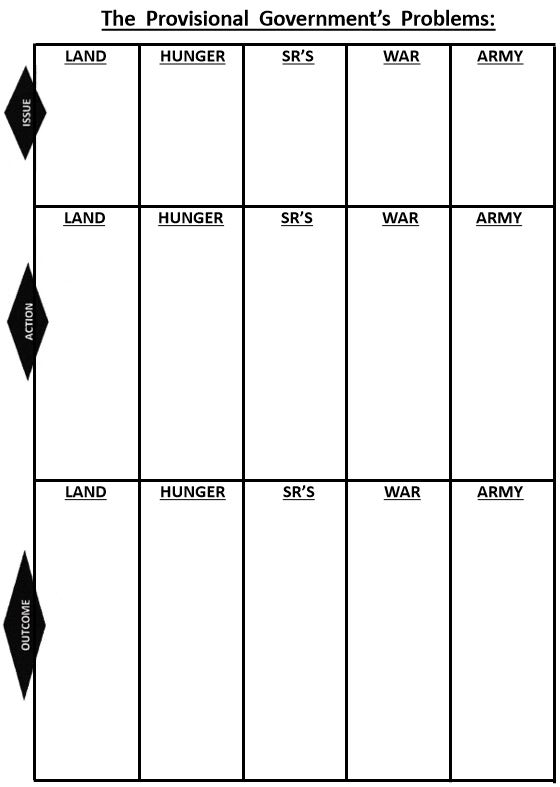
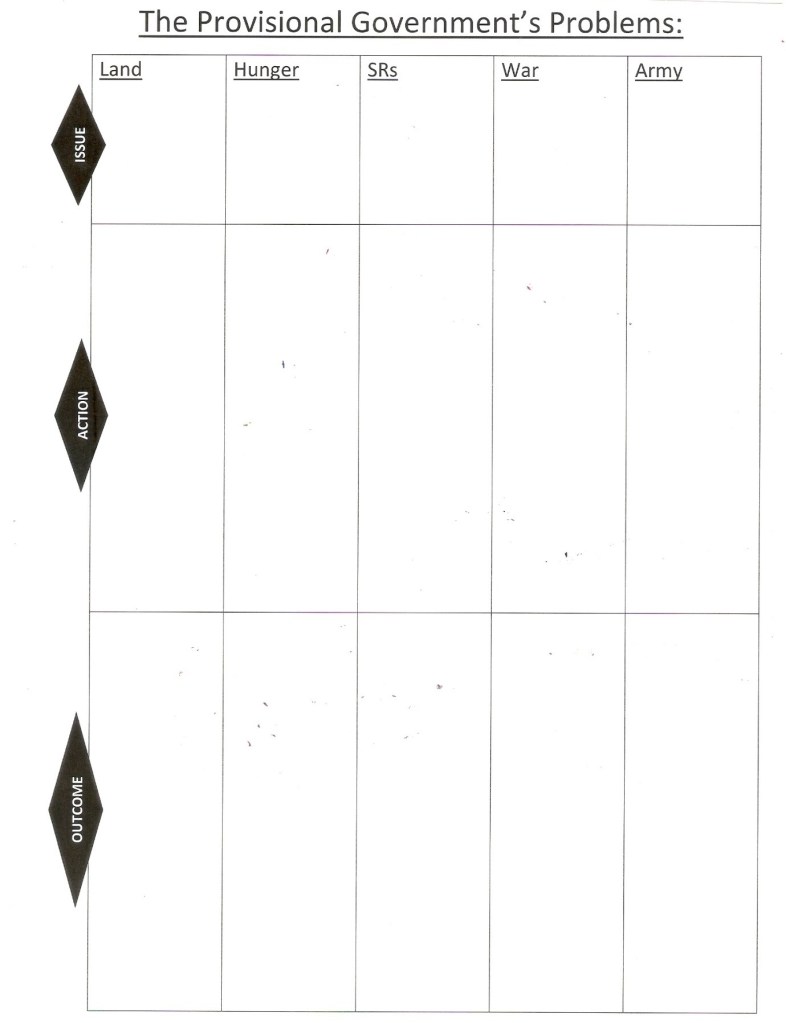
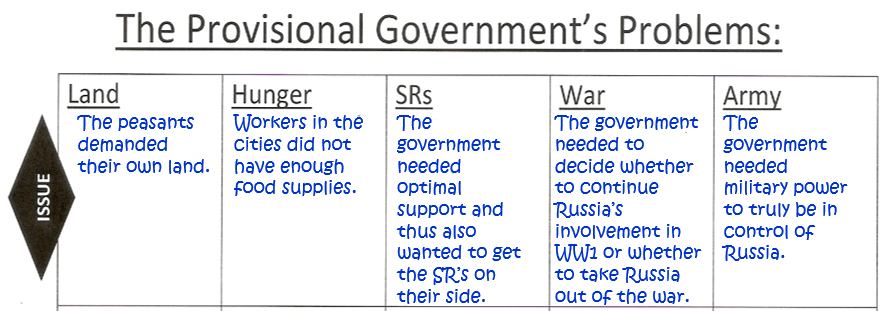
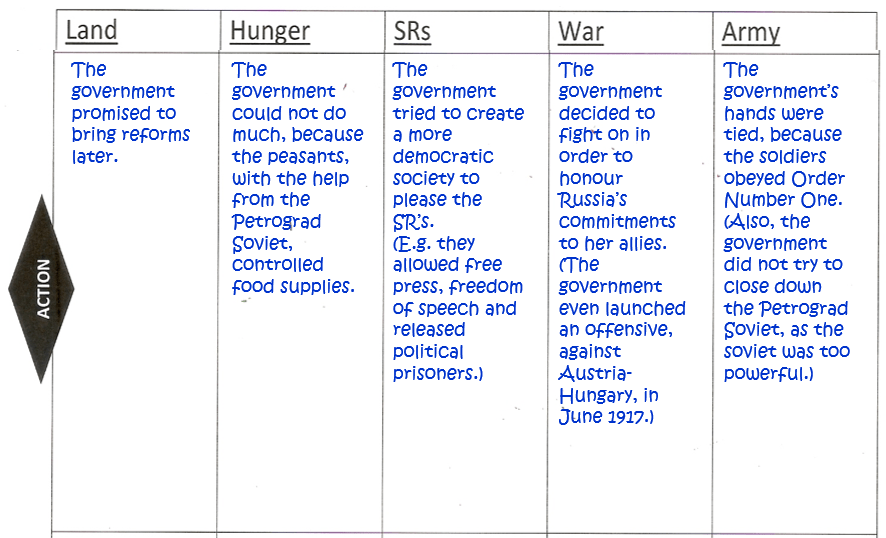
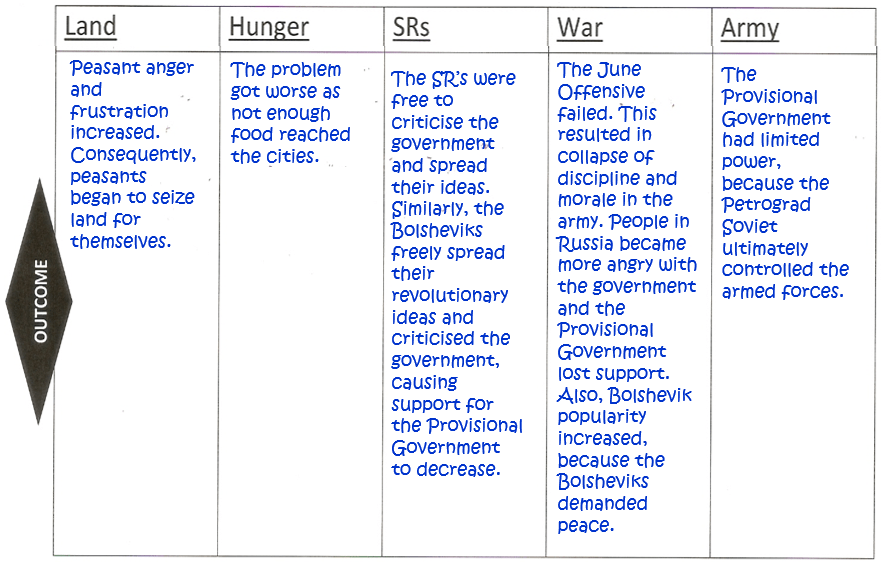
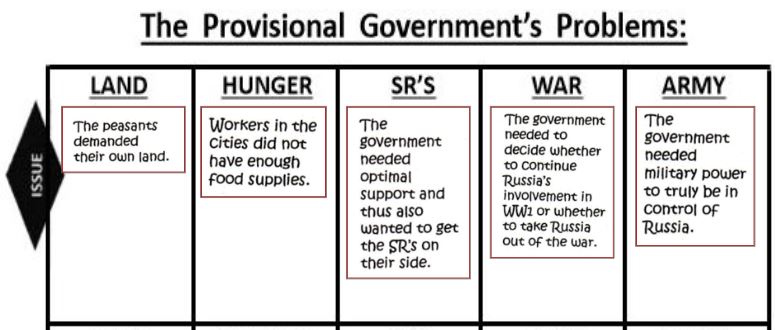
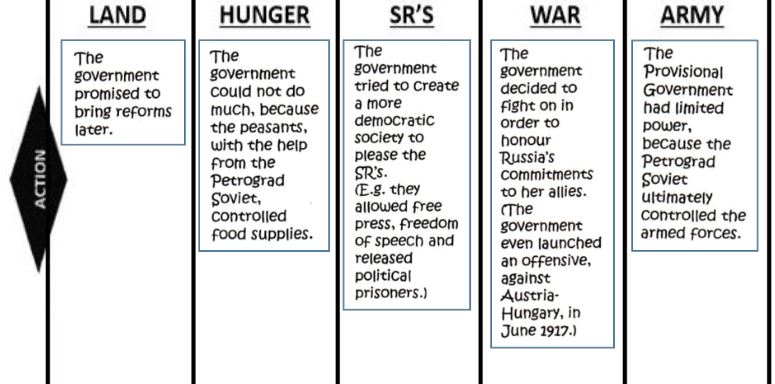
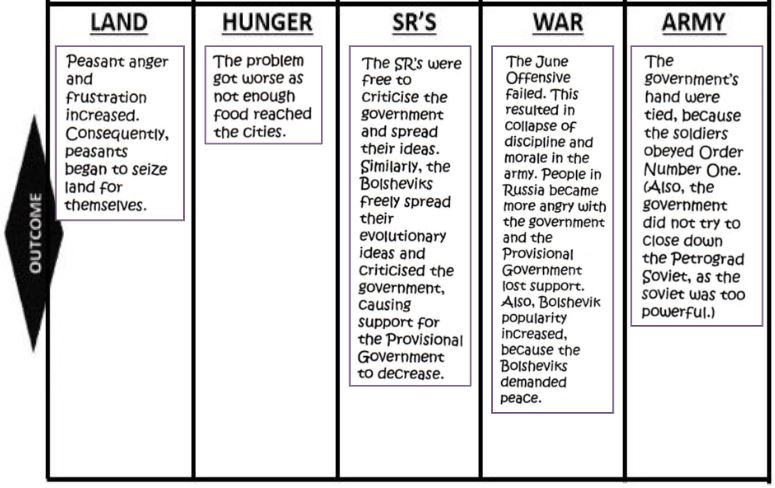
On a new page in your book, draw a table that shows the problems that the Provisional Government had to deal with. For each of the issues, explain the problem, describe the action taken by the Provisional Government and give the result of their actions.
Like this:
(Alternatively, you may be provided with the form, like the one below. Stick it into your book. Or, ask your teacher for an online version of this task.)
Mark the task on p.16-17 (on The Spread of the War).
(You need to mark this even though I have marked some of this for grading. You also need to look the feedback that I have sent to you in Assignments in Schoology.)
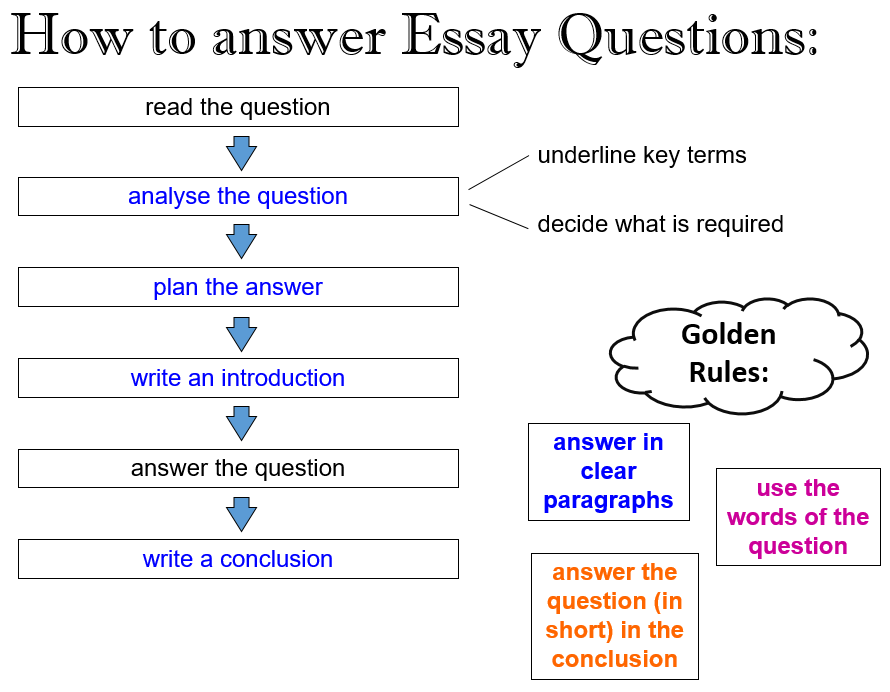
Today you are going to practise more Essay Writing!
1.
Read the questions at the bottom of page 8.
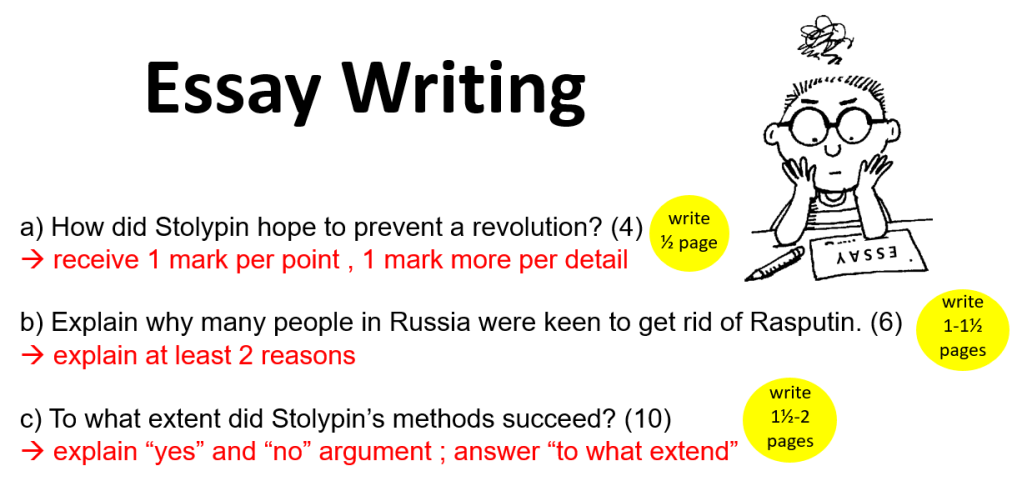
These are typical exam questions. The following applies to each of these questions:
2.
Write the following question at the top of a new page in your Essay Writing book:
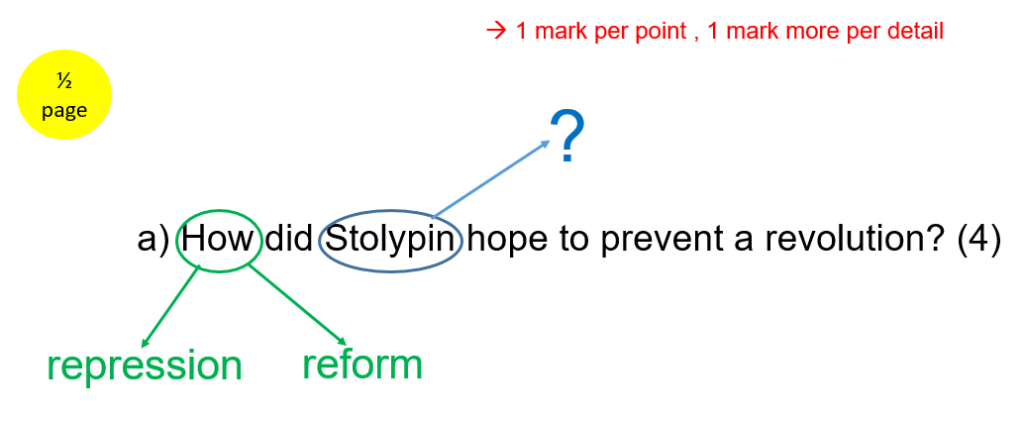
a) How did Stolypin hope to prevent a revolution? (4), p.8
This question does not require much planning – it is a straight forward question. Answer the question in your book now. (Only look at the solution after you have completed the question.)
SOLUTION:
3.
Write the following question in the middle of a new page in your Essay Writing book:
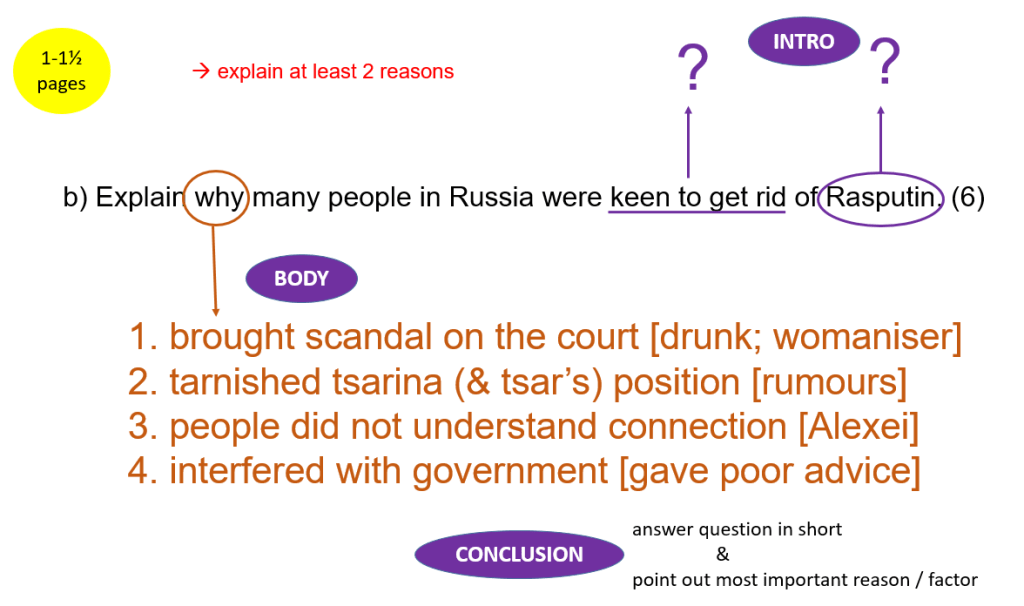
b) Explain why many people in Russia were keen to get rid of Rasputin. (6)
This question requires detailed analysis and planning. Do the analysis and planning now in your book. Remember, this is a “WHY” question! (Only look at the solution after you have completed the analysis and planning.)
SOLUTION:
4.
Write the following question in the middle of a new page in your Essay Writing book:
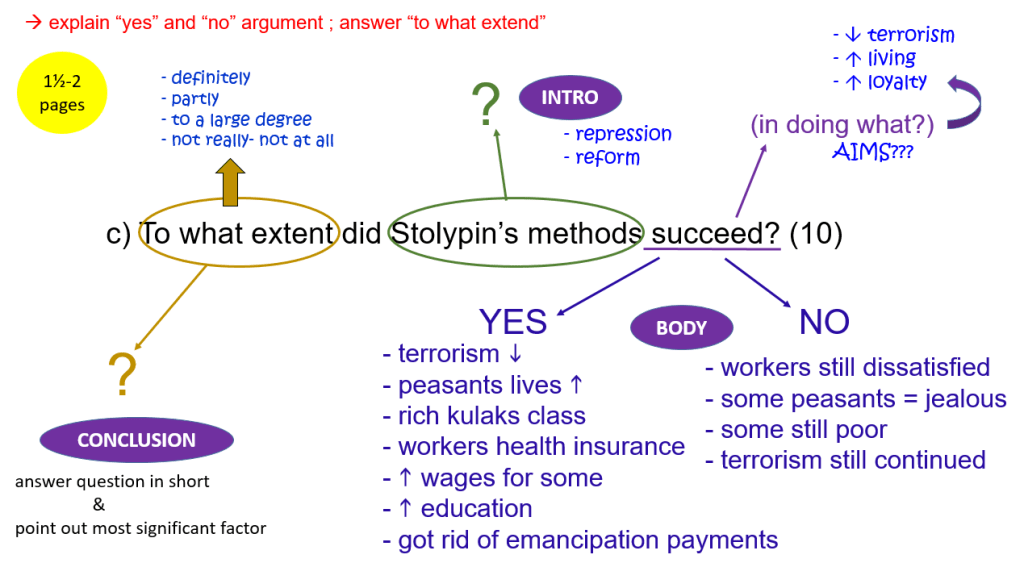
c) To what extent did Stolypin’s methods succeed? (10)
This question requires detailed analysis and planning. It is a typical 10-mark exam question and requires of you to give “both sides of the argument”. So, on the one hand, you have to argue that Stolypin’s methods succeeded. However, you also need to have an argument that shows that Stolypin’s methods did not succeed. In your conclusion you need to point out which argument is the strongest, and answer the question “to what extent” did Stolypin’s methods succeed, in short.
Do the analysis and planning of this question now in your book. (Only look at the solution after you have completed the analysis and planning.)
Today we are going to mark you essay about the rule of Nicholas II!
1.
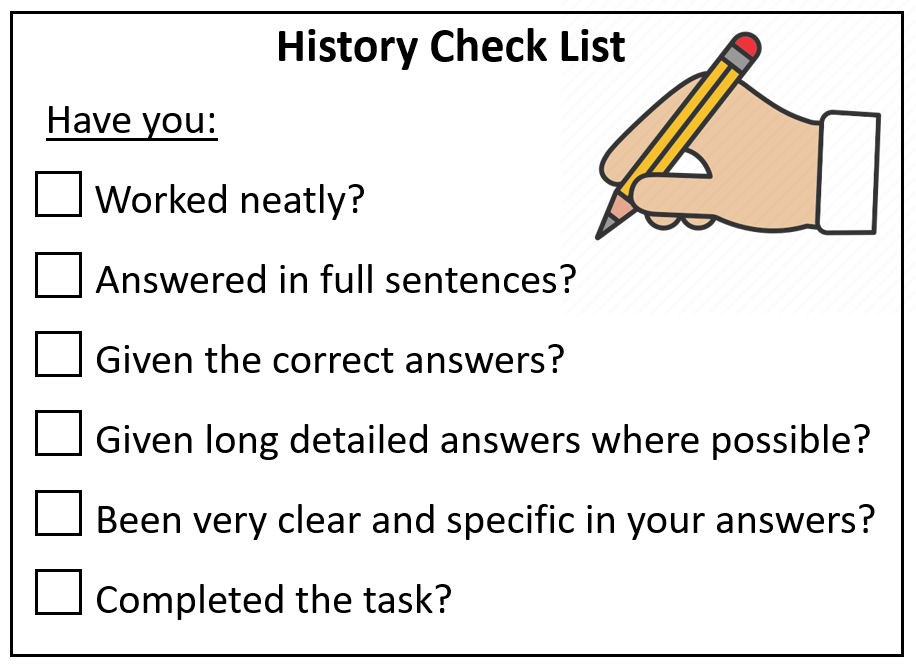
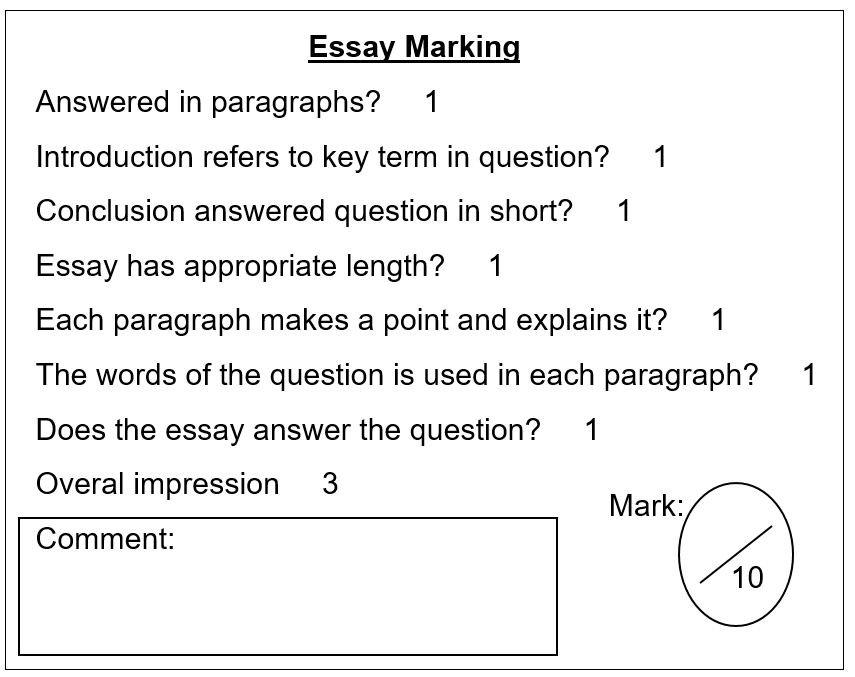
Go over you essay and mark it according to the following criteria:
(If you want you may swap with someone else in the class and mark each others’ essays.)
Here are a few tips for clarification:
2.
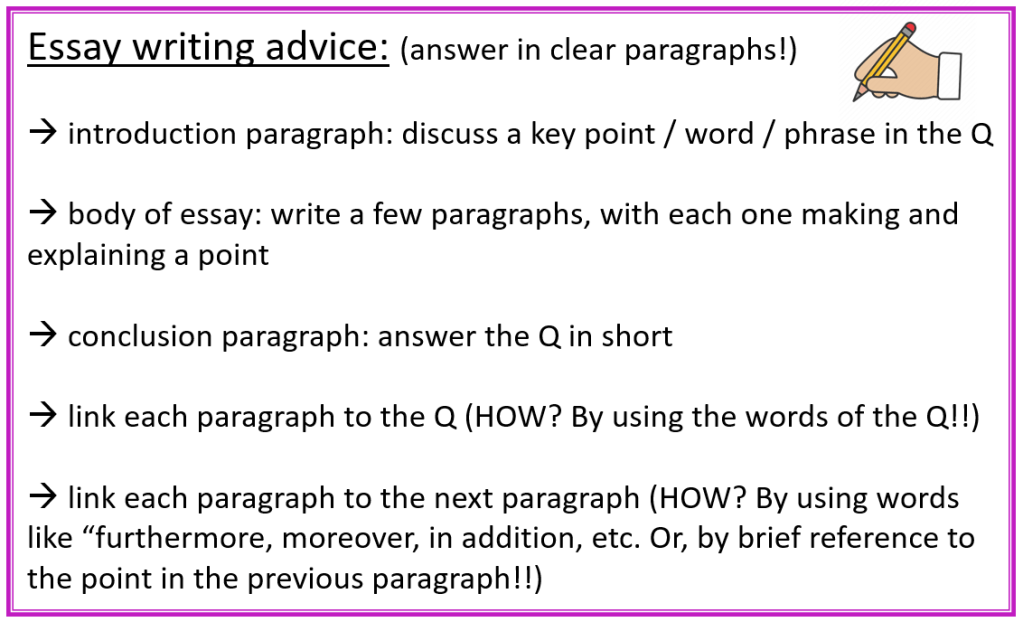
The following essay writing advice is VERY important – read the advice very carefully and make sure that you follow it whenever you have to complete an essay!!
Always think:
Always address the significance or relevance of the points that you make to answer a question.
3.
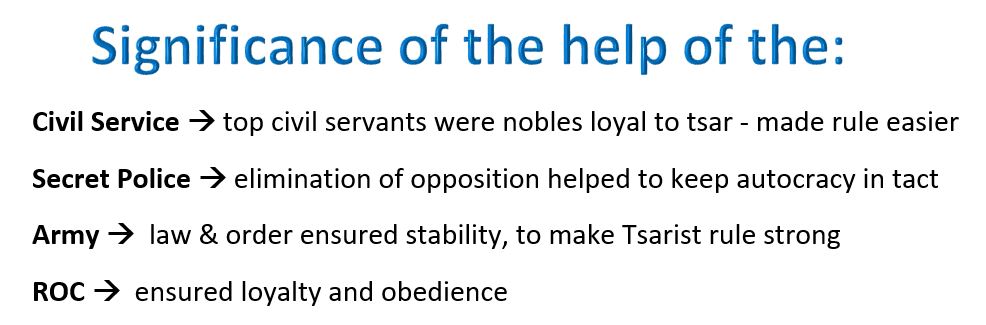
Make sure that your essay also addresses the correct factors involved in the reign of Nicholas II at the beginning of the 1900’s! Your answer could included the following, but must always express the relevance of the information to the specific question:
4.
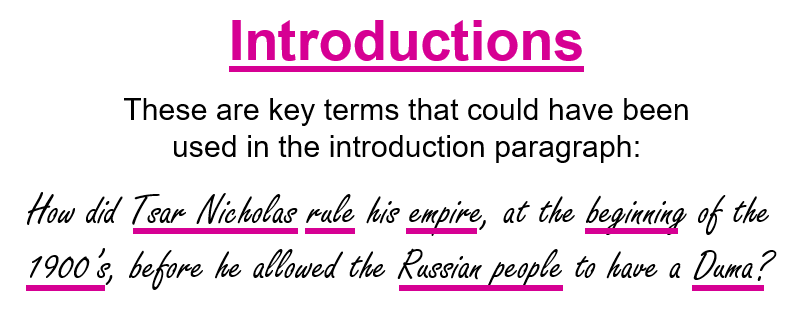
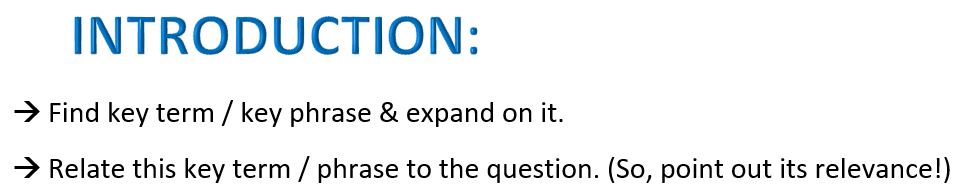
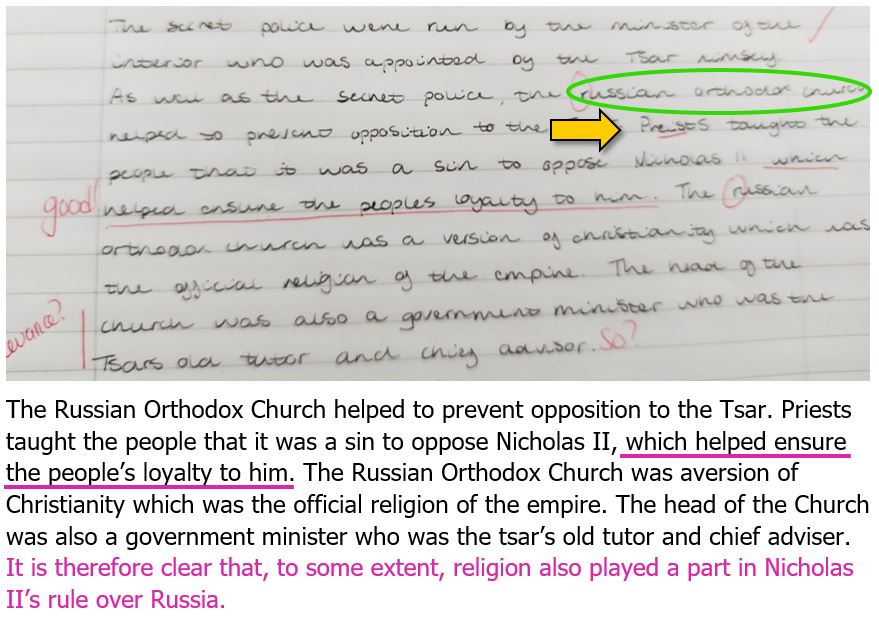
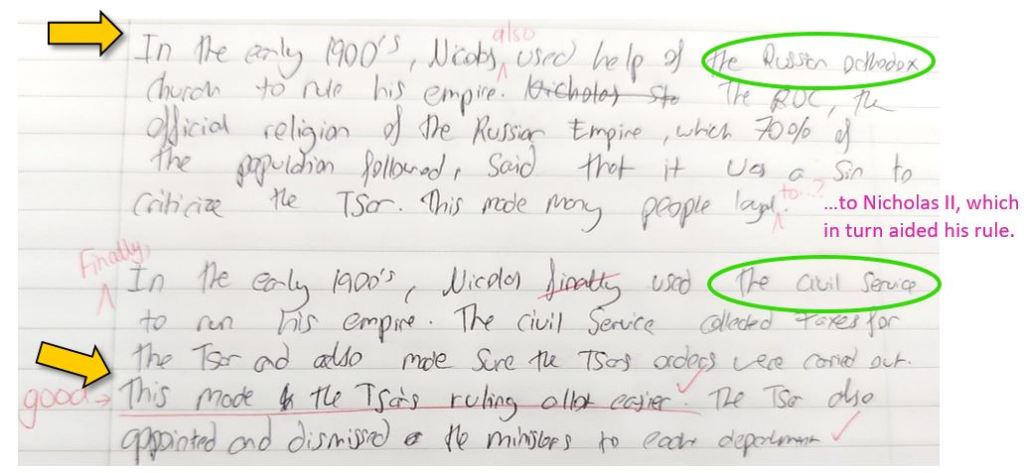
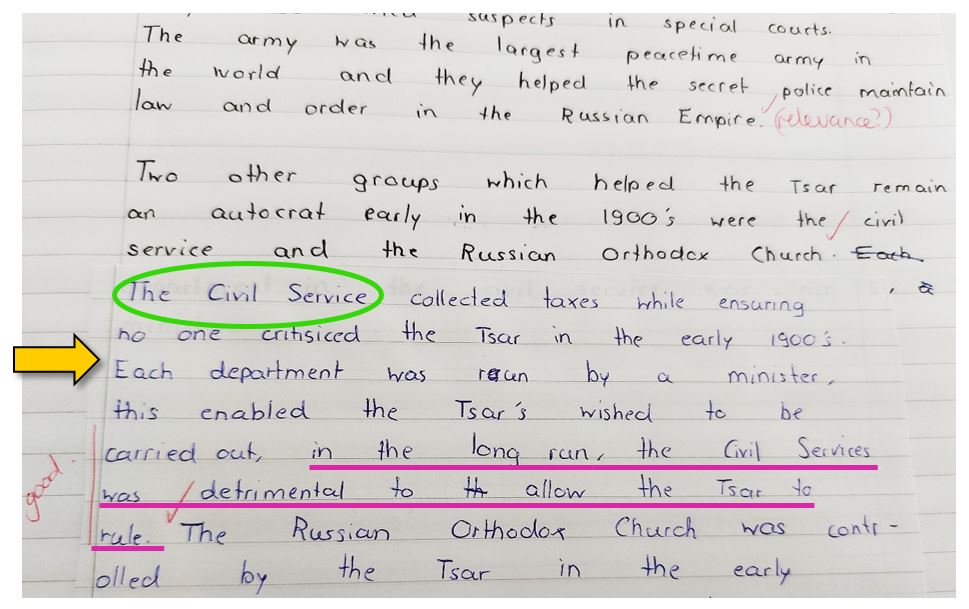
This is how to write a brief introduction:
FOR EXAMPLE:
5.
Remember to always point out significance / relevance! Here are examples of how to do this:
The following should have been in your answer:
6.
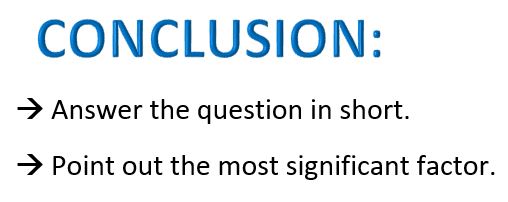
This is how to write the conclusion:
FOR EXAMPLE:
7.
Read the questions at the top of page 7.
Why was the Tsar able to remain in power after the 1905 Revolution?
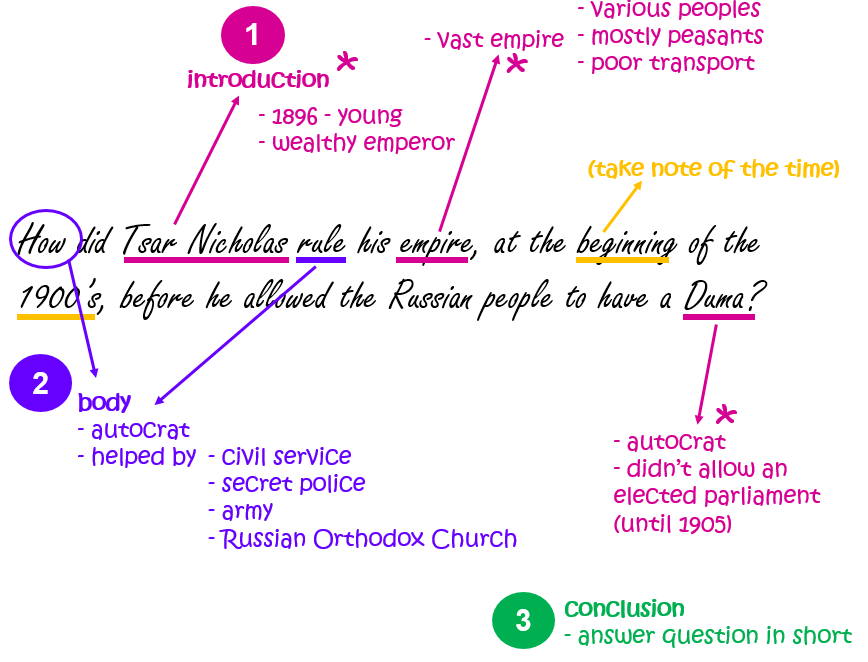
This is a typical 6-mark exam question. It is a “WHY” question and therefore requires you to give and explain reasons! Here is an analysis of what is required in this question:
And here is a plan of the points that is needed to answer this question:
8.
Finally, based on the above question, look at the following as an example of:
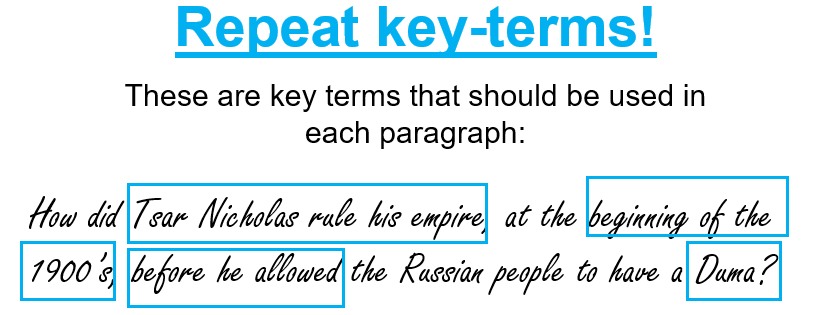
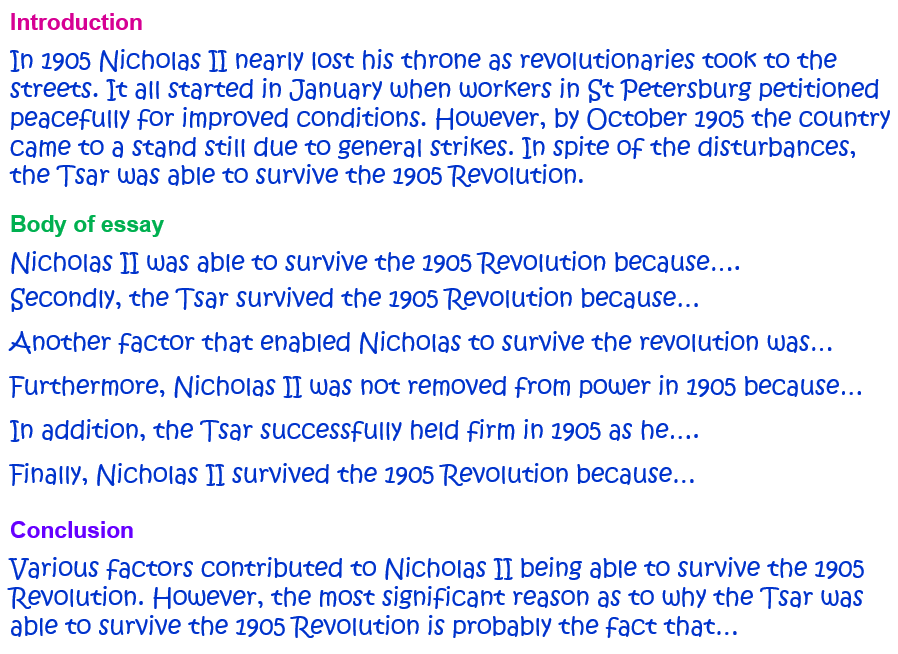
How to write an introduction, using key words in the essay question.
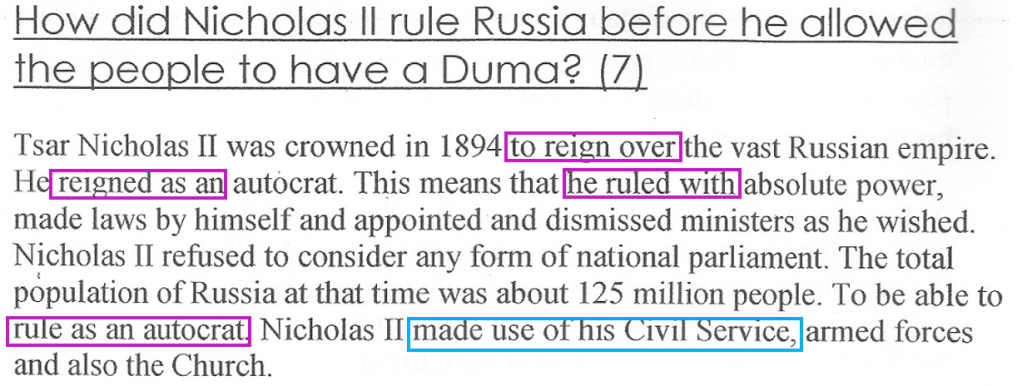
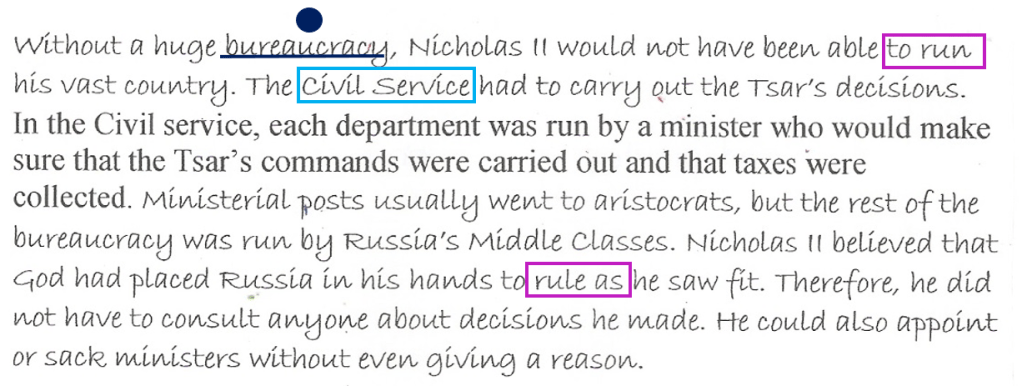
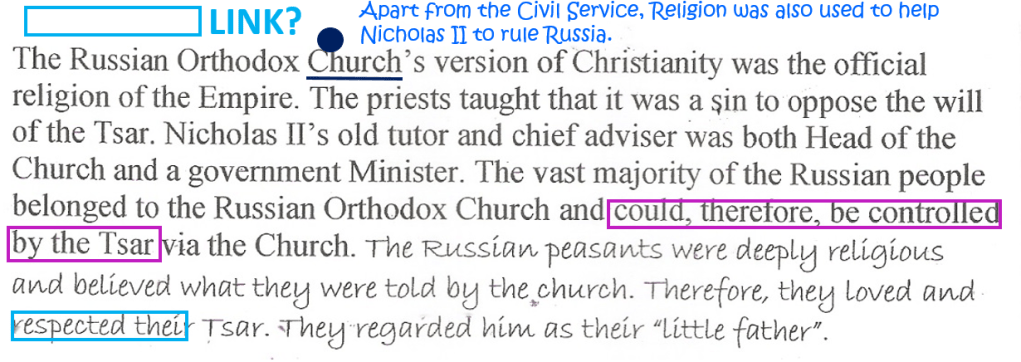
How to link the paragraphs in the body of the essay
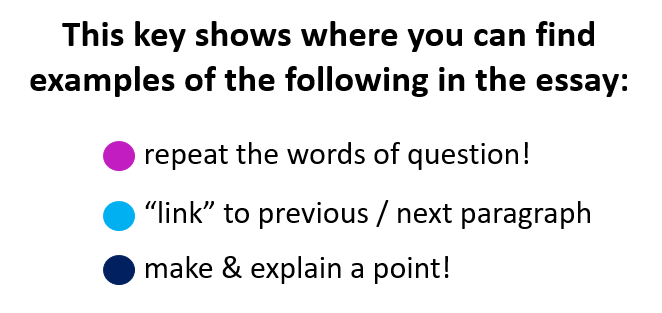
How to repeat the words of the question in each paragraph (This can be made less predictable by slightly changing the way in which you express the same concept.)
How to write a conclusion paragraph, answering the question in short!
9.
Have a careful look at the following example answer. It shows you how paragraphs can be linked to each other and it also shows you how to use the words of the question throughout your answer.
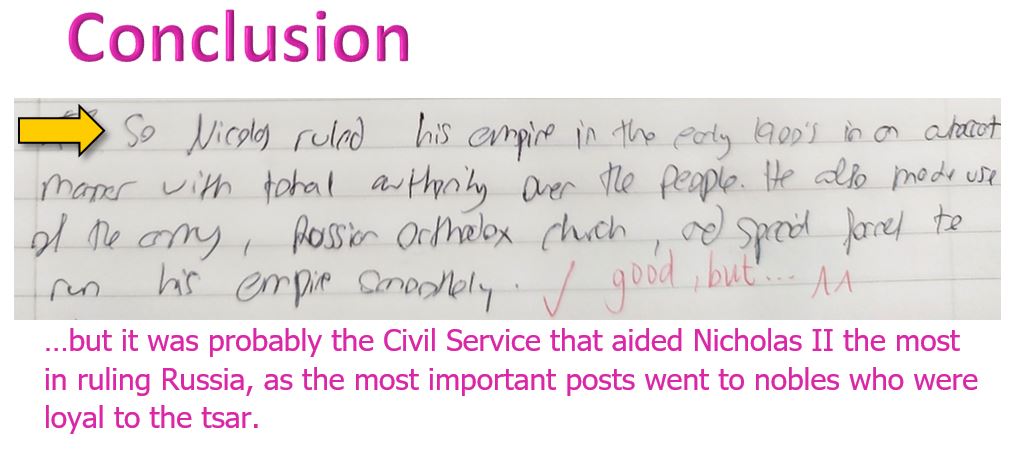
(This conclusion fails to point out the most significant factor.)
Today you are going to look at resistance to Roman rule in Britain. (You will watch quite a bit of video material to see how the Celts resisted Roman rule and how the Romans tried to protect their empire.)
Follow the instructions step by step:
1.
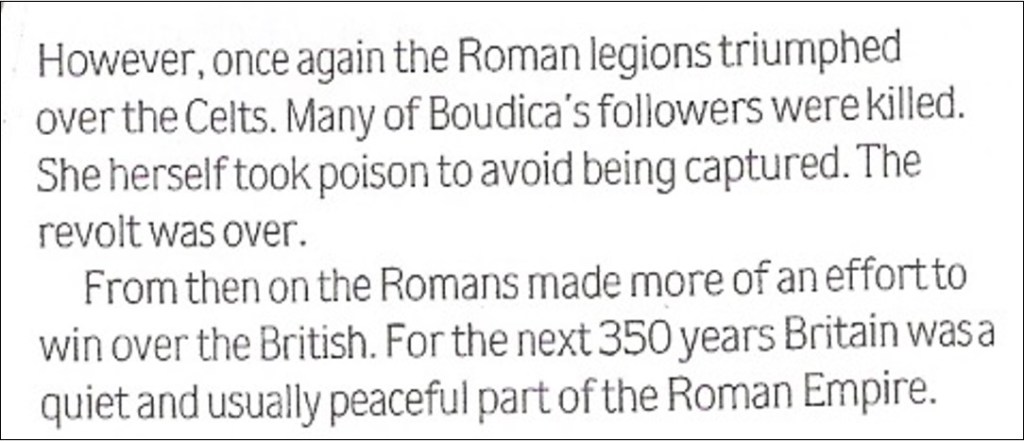
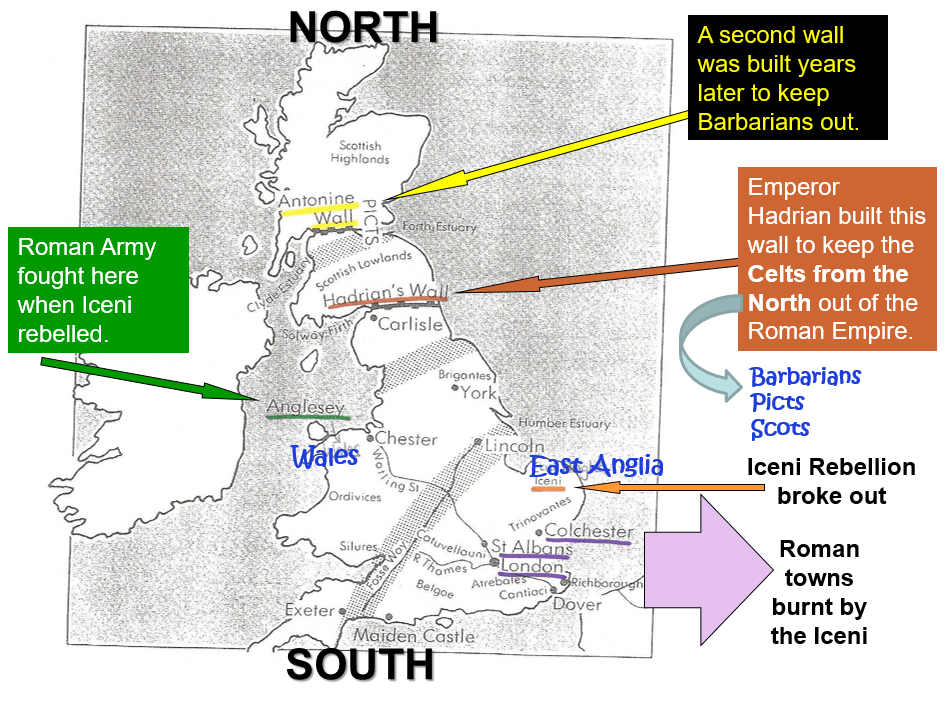
Not all the Celts welcomed Roman rule in Britain. Some Celts moved away from the areas ruled by the Romans. (For example, they moved to the west, to Wales, to Ireland and to Scotland.) Other Celtic tribes fought against the Romans to drive them out of Britain. Unfortunately, these tribes were defeated by the Roman armies. Let’s look at resistance to Roman rule in a bit more detail:
Resistance to Roman Rule. (2:06 minutes long)
2.
Now also watch the following video clip.
This video tell you a bit more about Hadrian’s wall.
Hadrian’s Wall. (1:18 minutes long)
3.
And now for a “very sweet story”…!
The tale of Boudica by British Council . (2:53 minutes long)
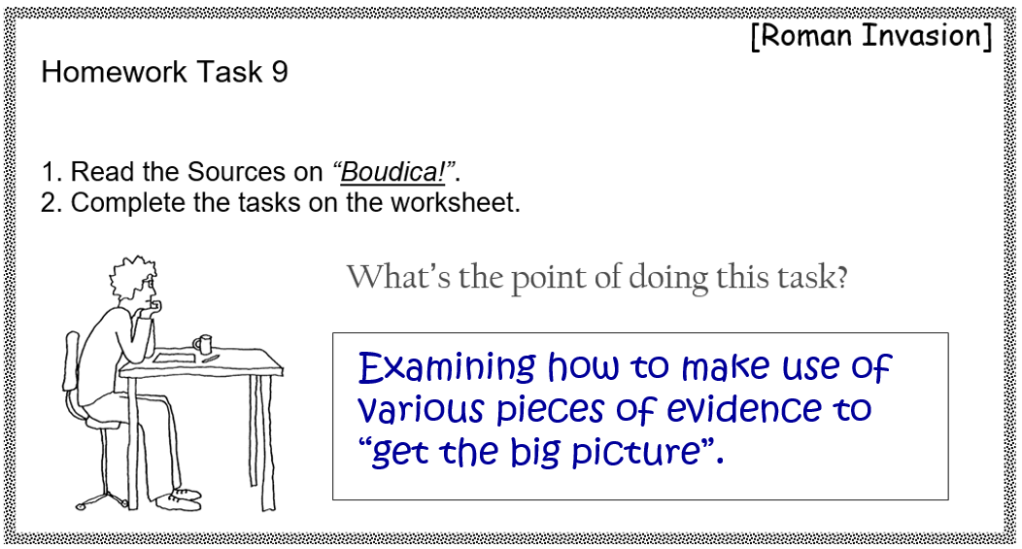
Boudica’s revolt against the Romans is one of the most famous examples of how some of the Celts resisted Roman rule in Britain!
4.
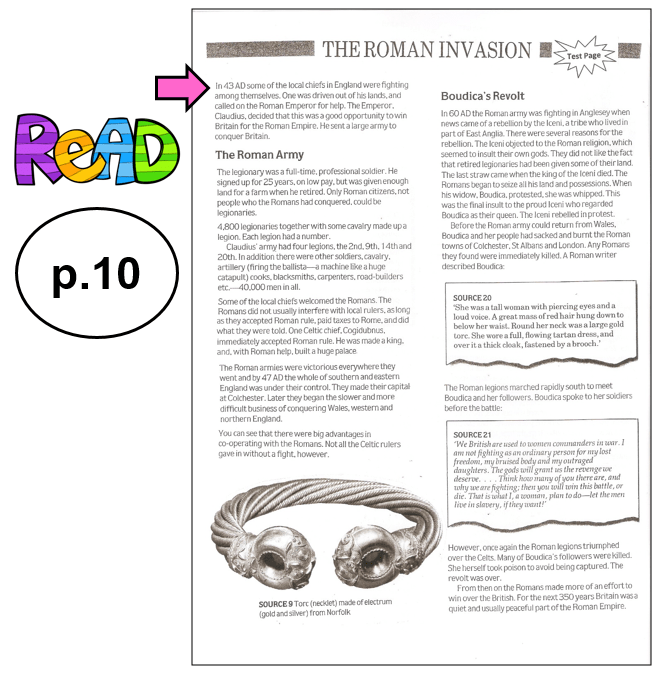
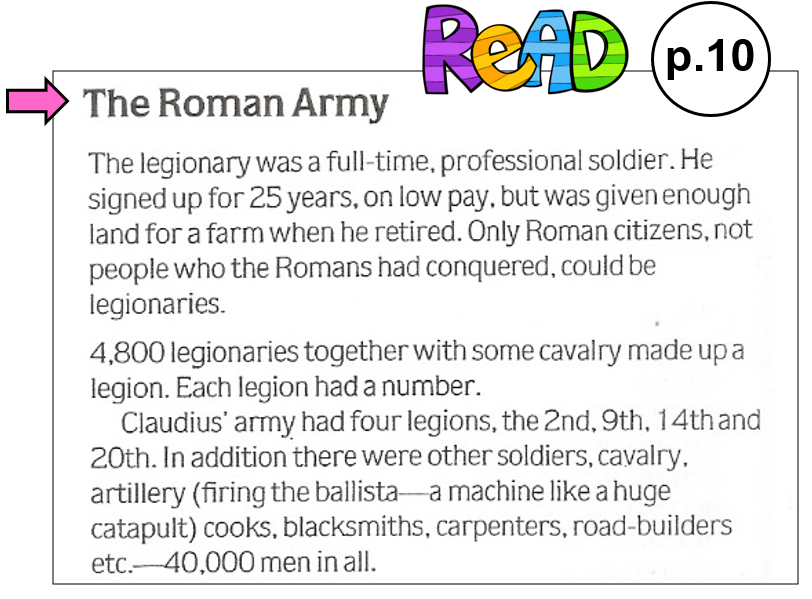
Let’s read the information from your workbook too!
p.10
5.
Here is another, perhaps more realistic, portrayal of Boudica’s revolt:
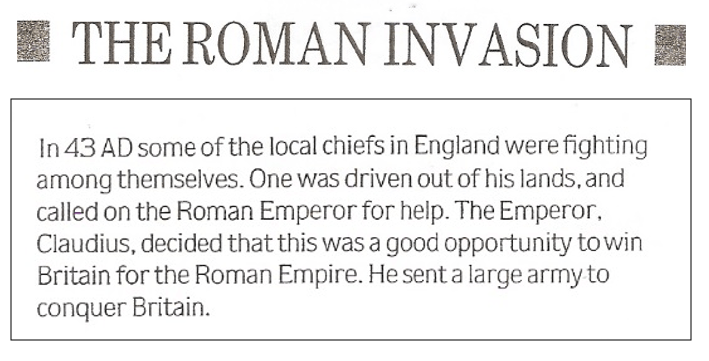
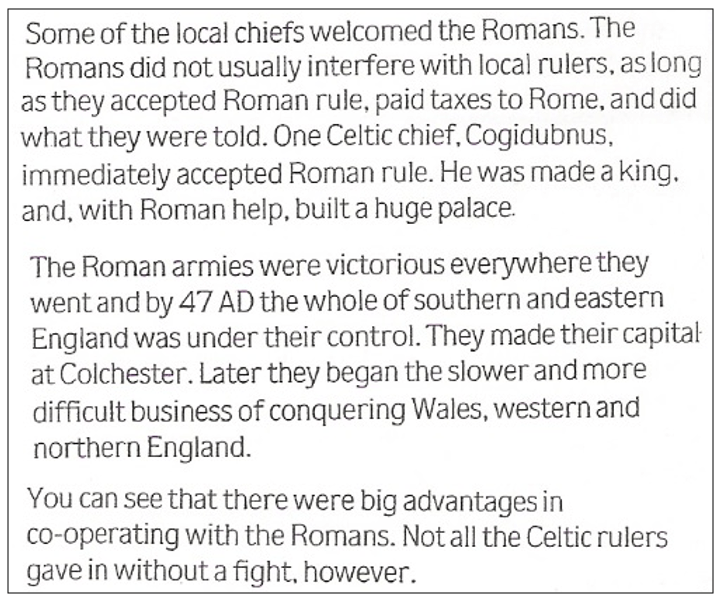
Now, let’s see how the Romans conquered Britain in 43 AD!
Roman Invasion – Claudius. (1:10 minutes long)
3.
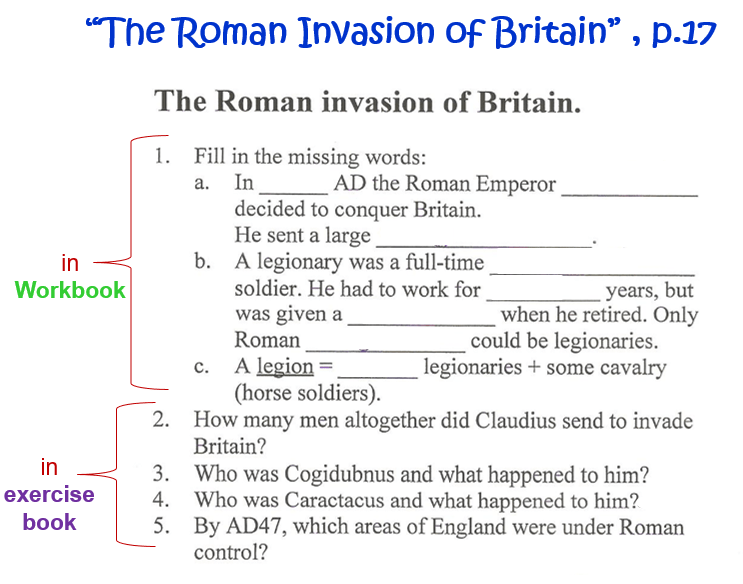
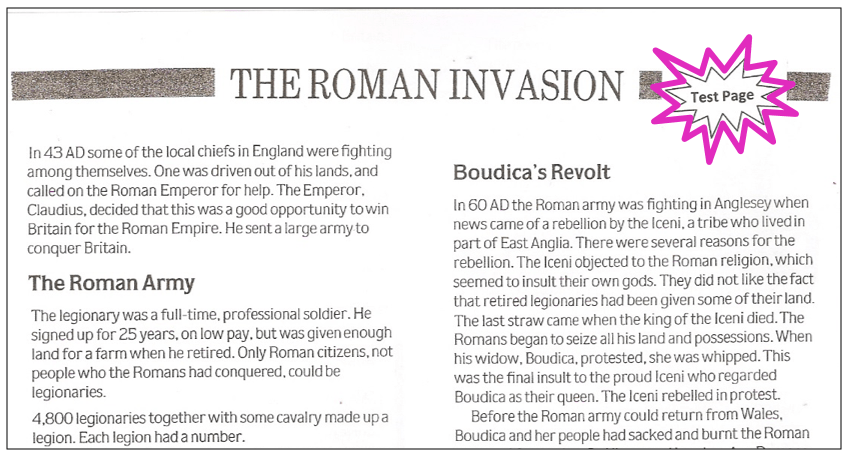
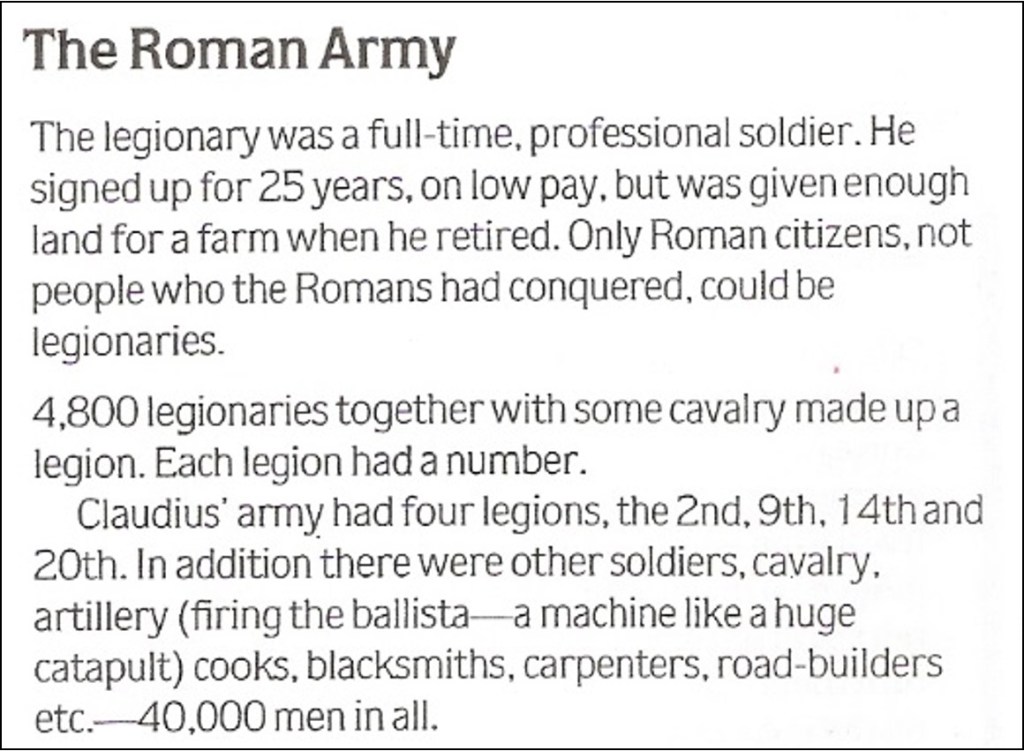
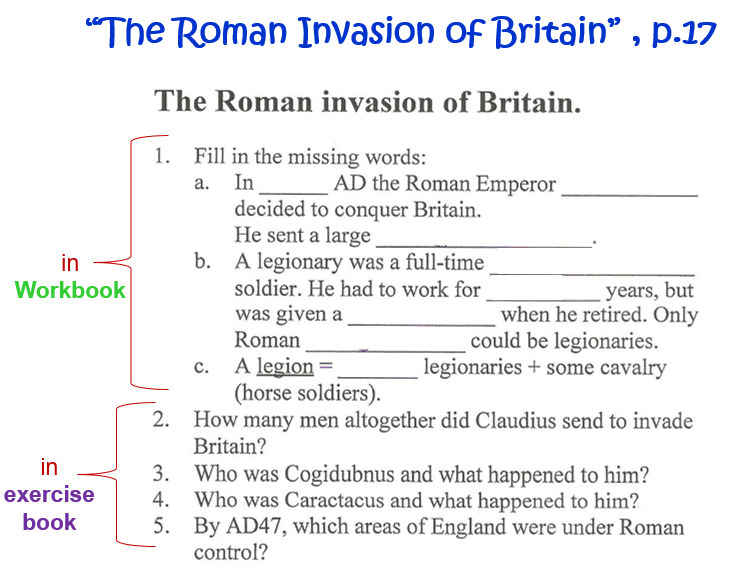
Now read all about the invasion from your History Workbook!
Did you see that this is a test page?
We have already read this short section on the Roman Army, but we will do it again to refresh our memories:
4.
Finally, you will do the following task to test your knowledge and to practise your communication skills:
Please take note: part of this task must be completed in your Workbook and part of it in your purple exercise book. Make sure that you write the following heading (on a new page!) in your purple exercise book:
Then do Questions 2-5 in your purple exercise book.
5.
Here is a little bit of help:
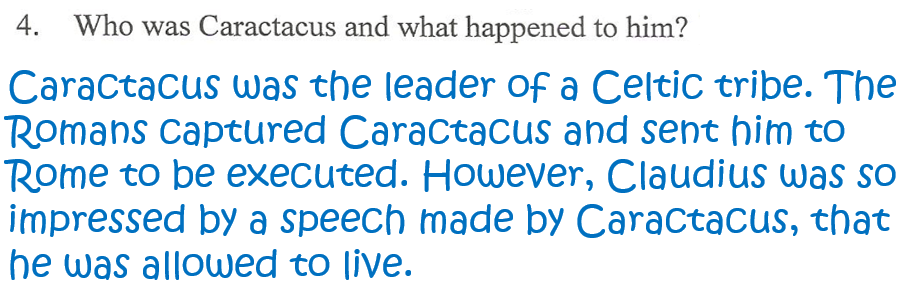
You may copy the answer to question 4 in your book, but first watch this video that tells the remarkable story of Caractacus!
“Caractacus was a A tribal leader of the ancient Britons who found themselves in a struggle against the Romans who were trying to make Britain part of the Roman empire. He was finally defeated and then captured and brought to Rome to face execution. He gave a speech before the Emperor Claudius. This small excerpt is from the series “The Roman Invasion of Britain”. Hosted by Bettany Hughes.”
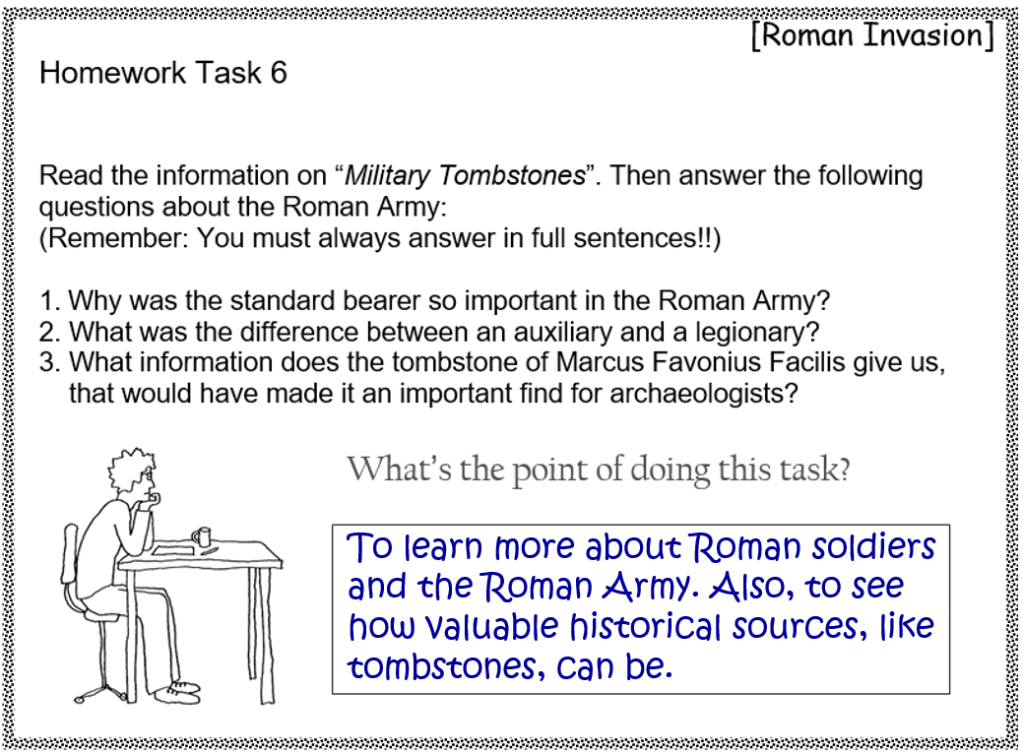
The video below shows an example of how a tombstone inscription can be used to give information about Roman soldiers. This example may be helpful when doing Homework Task 6…
Reading Military Tombstones. (5:50 minutes long)
As an extension task, or perhaps to help you further with this homework task, here is additional information:
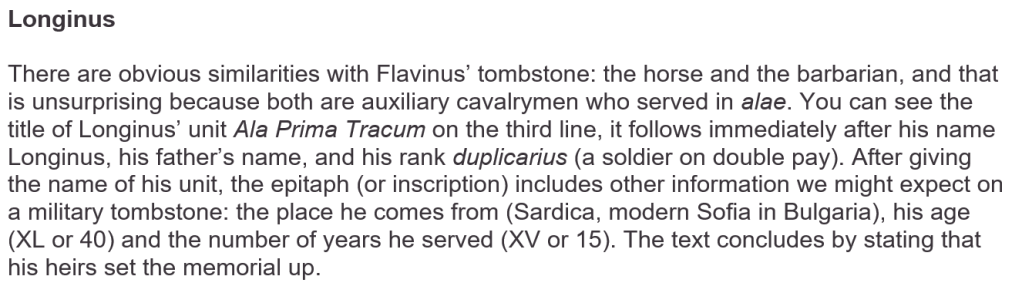
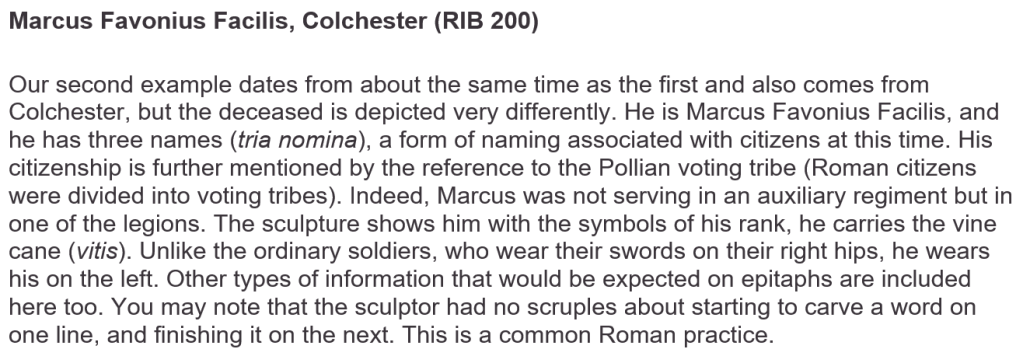
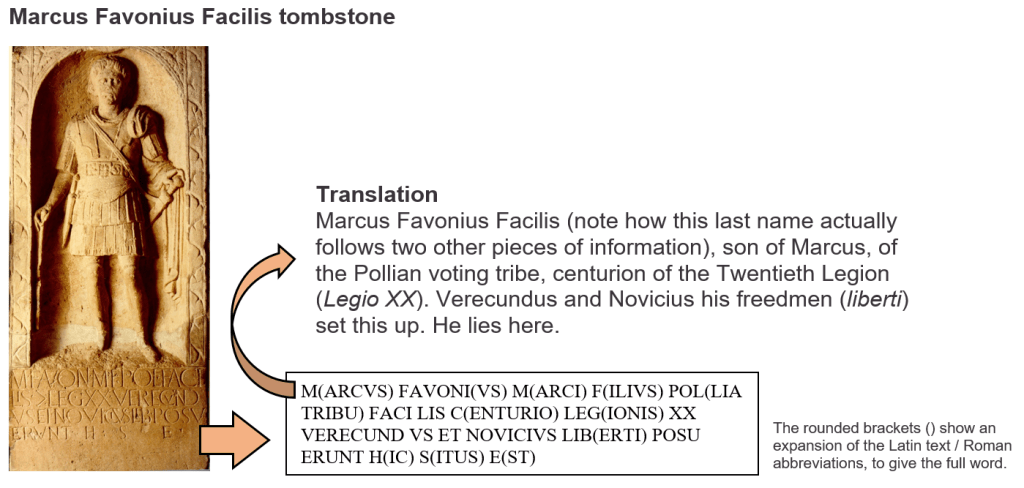
Two examples of Roman Soldier tombstones:
[The video as well as most of the information above comes from the following website: www.futurelearn.com]
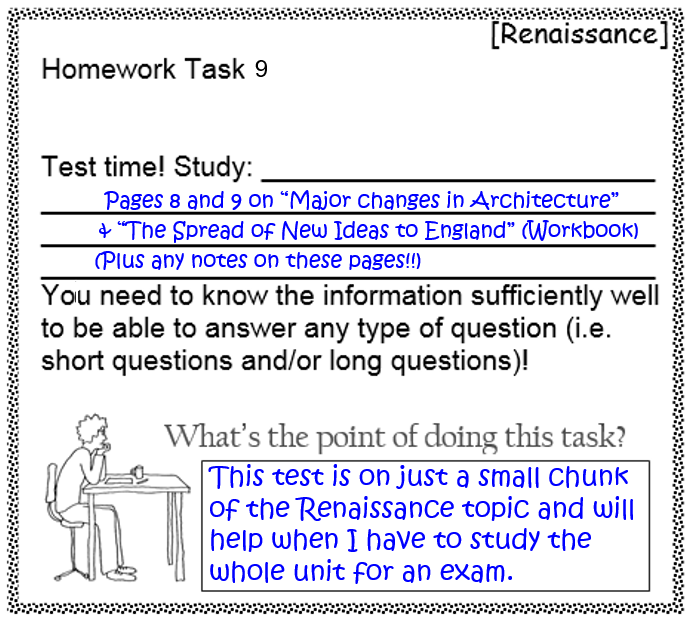
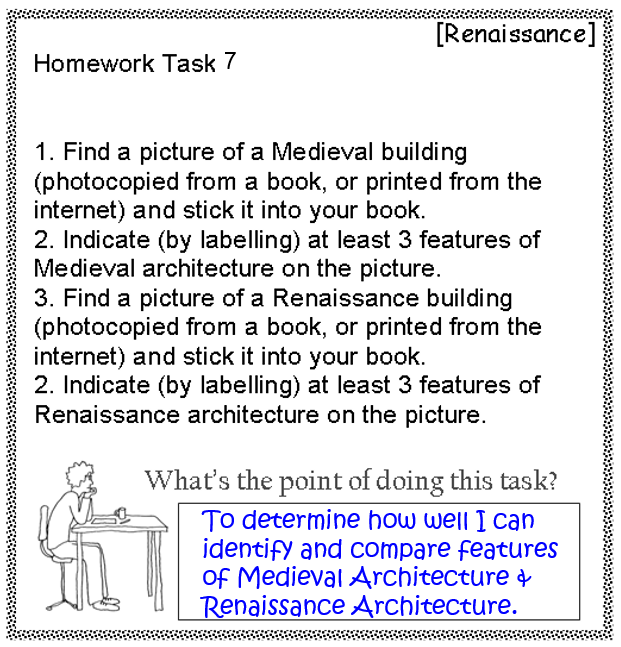
Complete the table on Medieval vs. Renaissance Art (p.14)
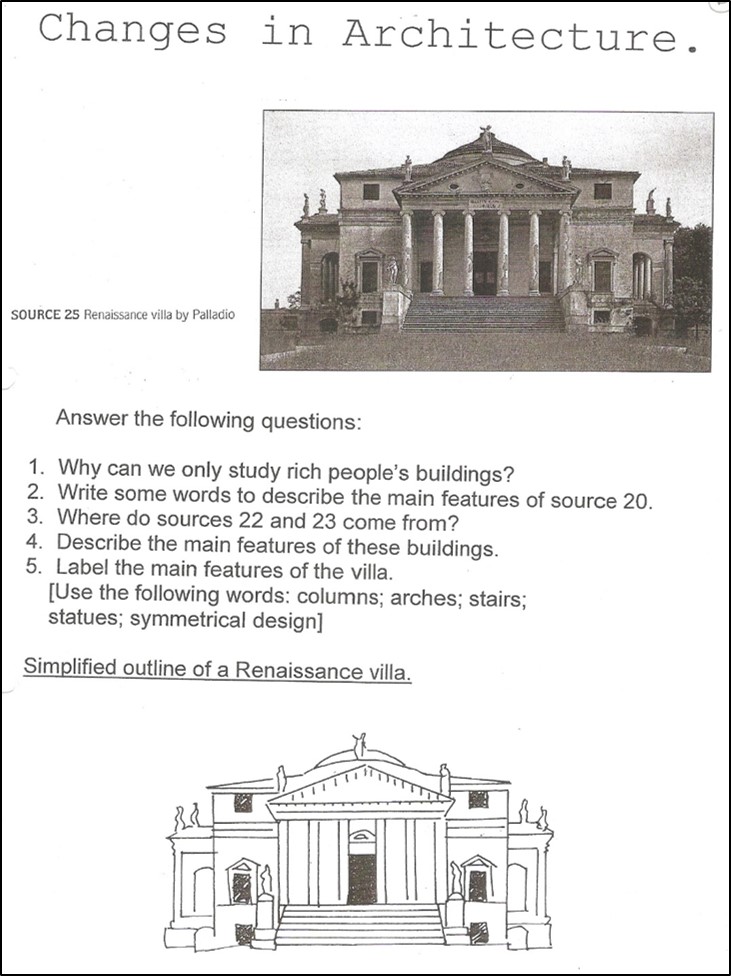
Complete the worksheet on Renaissance Architecture (p.18)
Follow the instructions step by step:
1.
Complete the test!
(This is a test on Why the Renaissance started in Italy….)
2.
Finish the comparison that shows how Medieval Art differs from Renaissance Art.
p.14
(Use the table to compare Medieval Art with Renaissance Art. You have to fill in the missing information on the table, using the various sources, above, of Medieval and Renaissance paintings and drawings.)
3.
Mark the table that you have just completed (p.14).
Finally, make sure that you have completed the worksheet on “Changes in Architecture.” (p.18). You need to do questions 1-4 in your exercise book and do task number 5 in your Workbook – i.e. label the picture in your Workbook.
Watch this video as a quick revision of Renaissance art, architecture and activities.
Exploring the Renaissance. (5:18 minutes long)
4.
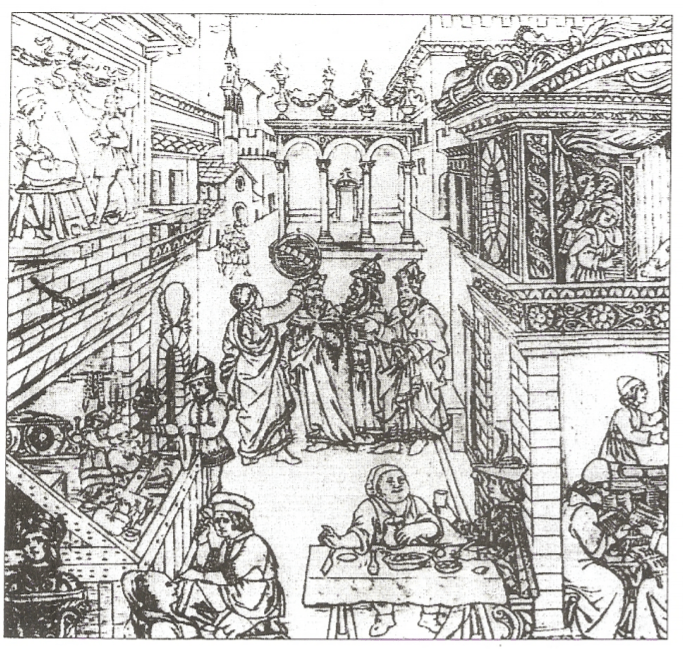
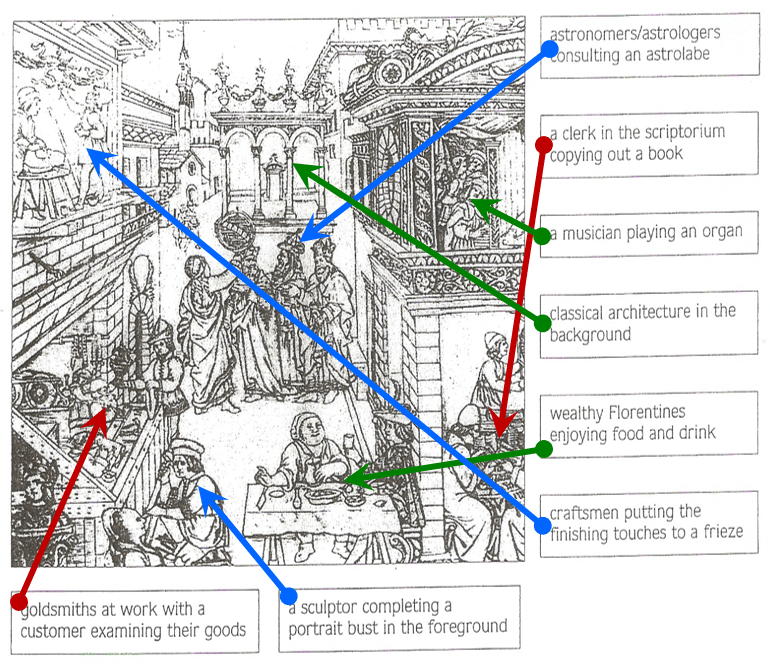
Now complete the two tasks on Florence during the Renaissance.
p.12-13
In the first task you have to label the activities in Florence by making use of colour coding. (For example, highlight the label and highlight the corresponding image in the picture. Then do the same for the next label, but use a different colour.)
This is a frieze:
A frieze is “a broad horizontal band of sculpted or painted decoration, especially on a wall near the ceiling”.
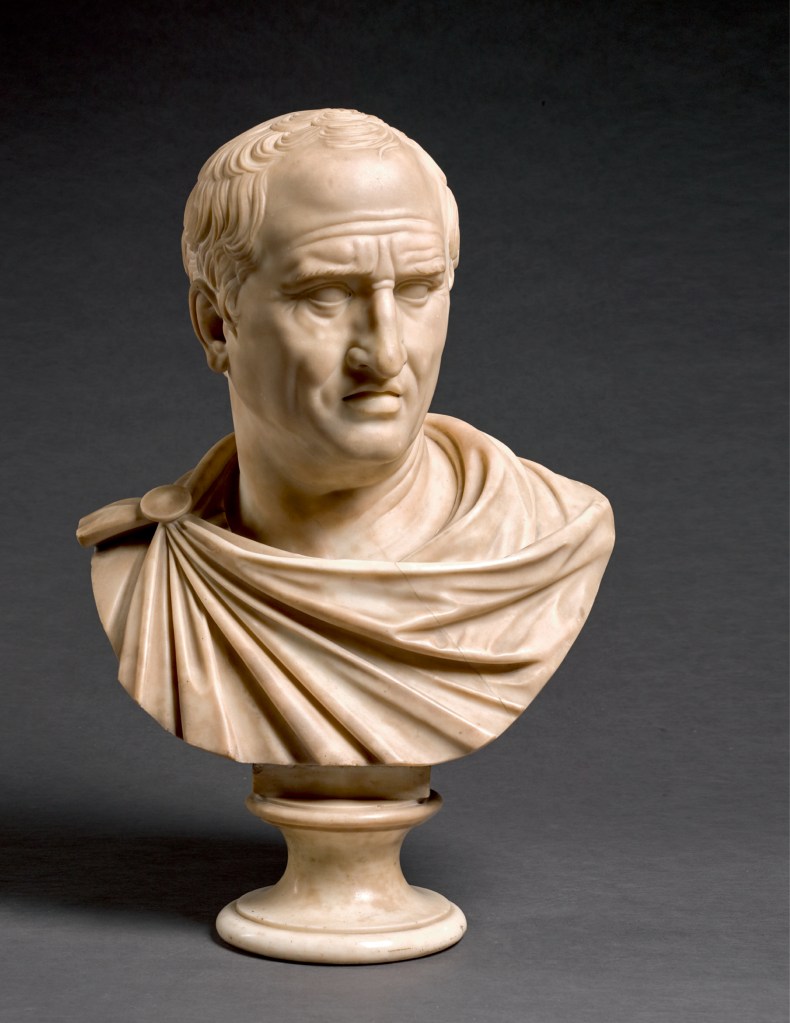
This is a bust:
A bust is a sculpted or cast representation of the upper part of the human figure, depicting a person’s head and neck, and a variable portion of the chest and shoulders.
In the second task you have to explain what the source tells you about life in Florence during the Renaissance. (Make sure that you do this in great detail, with reference to the source – i.e. the picture!)
Remember to use the advice given to you when your answer to Question 2 on “Renaissance Thinking” was marked…
Today you are going to look at the February 1917 Revolution in Russia!
The Russian calendar, until 1918, was 13 days behind that of Western Europe. For example, when it was 7 March in Europe it was 22 February in Russia. We can, therefore, refer to the February Revolution or to the March Revolution.
1.
Look at the following video clip. It is a brief explanation of the Russian Revolution of February 1917 …
March / February Revolution 1917. (3:31 minutes long)
2.
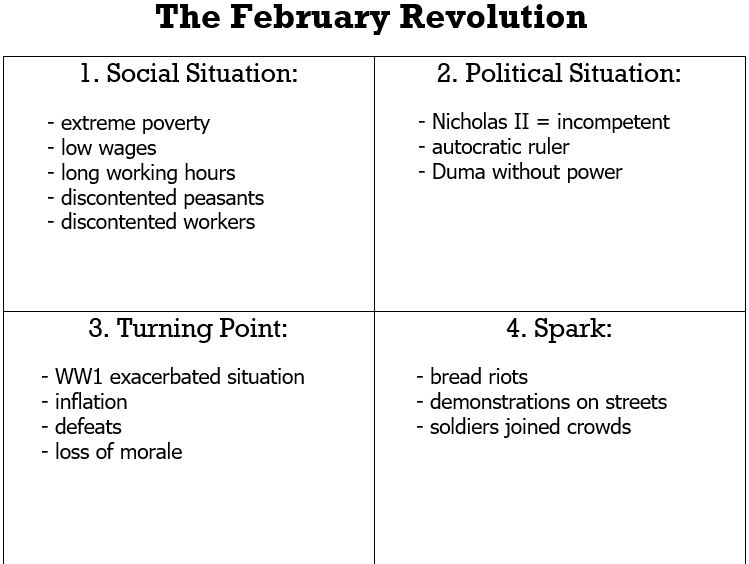
The information about “The February 1917 Revolution”, p.12.
3.
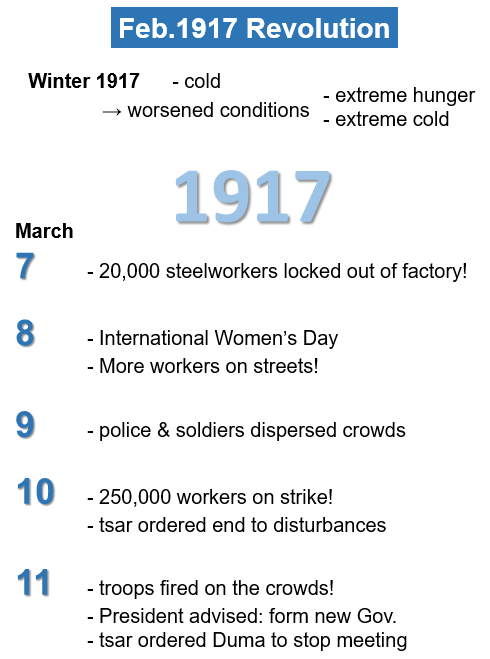
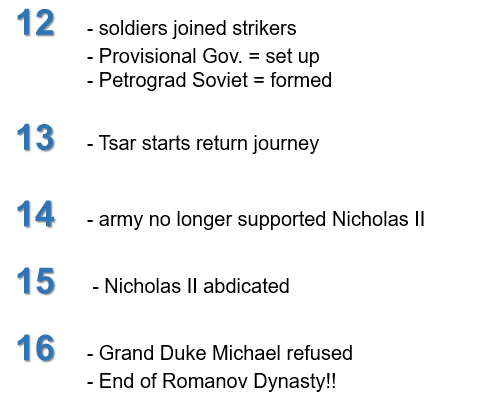
The February / March 1917 Revolution.
The February 1917 Revolution Timeline:
4.
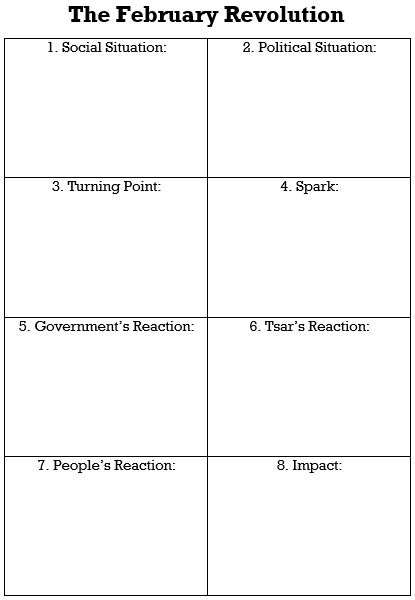
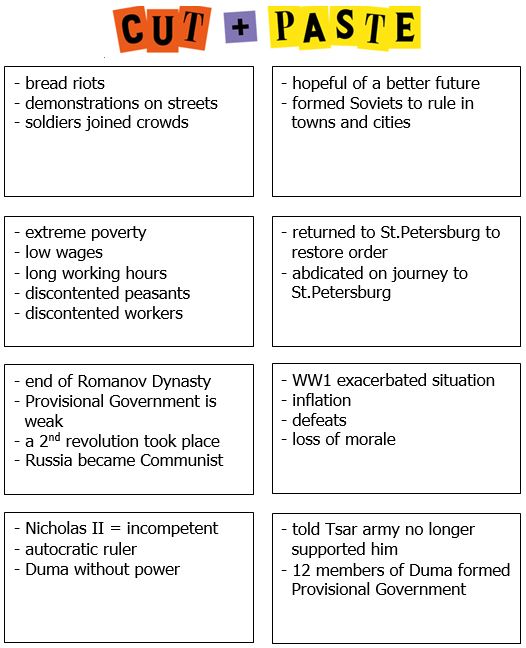
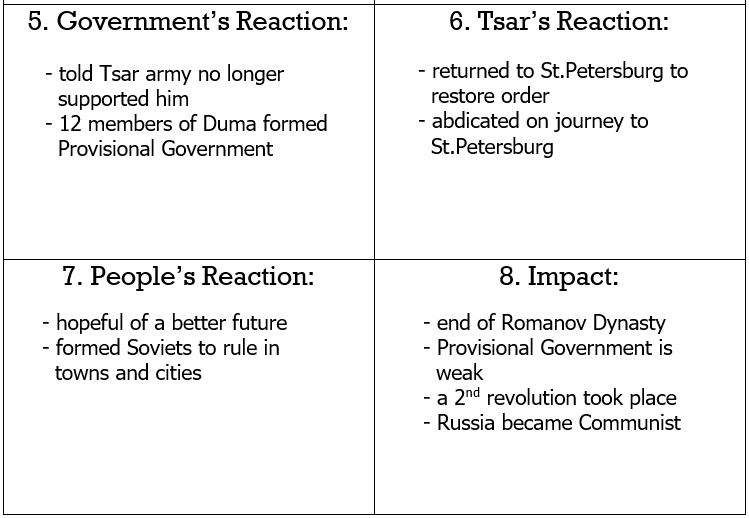
Complete the cut-and-paste task on the February Revolution. You will need the following handouts:
You need to match the elements on the table with the details regarding the February Revolution on the cut-and-paste sheet.
SOLUTION
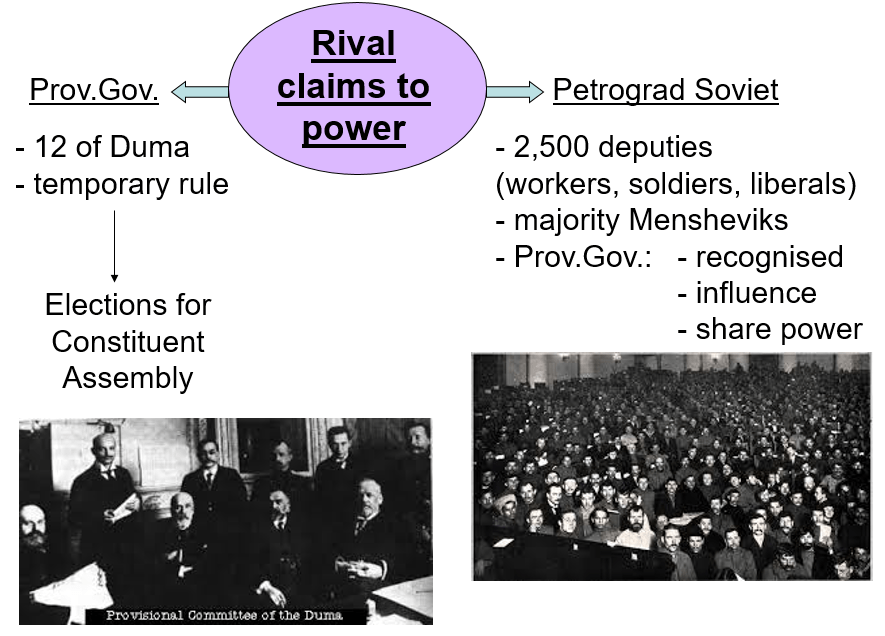
5.
So? Who ruled Russia after the abdication of Nicholas II? There were rival claims to power! Officially it was the Provisional Government who ruled Russia…
6.
And that is it for today! You may use the rest of today’s lesson to work on your next History homework.
Today you are going to look at the impact that WW1 had on Russia!
1.
Let’s first do a little bit of WW1-revision…
Bet you didn’t know: World War 1. (2:14 minutes long)
World War 1, Explained in 5 Minutes! (5:19 minutes long)
2.
The next video tells us about Russia’s involvement in WW1 and how the war impacted on revolutionary events in Russia. The video gives very relevant details for your study. Pay attention as you watch this and absorb as much information as you possibly can!
Russia Before the 1917 Revolution. (8:52 minutes long)
3.
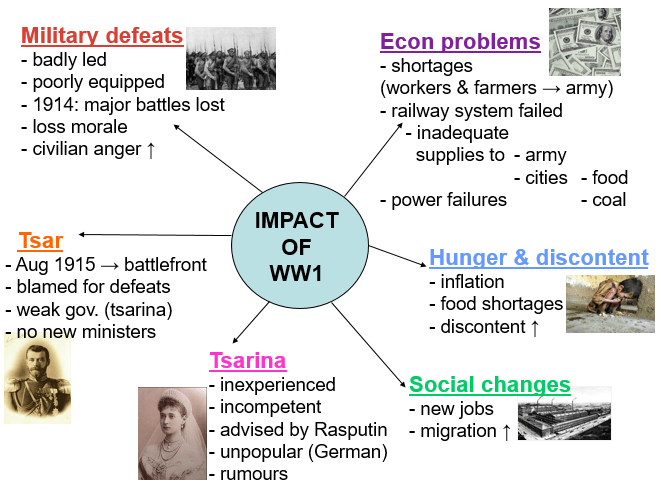
Now, let’s summarise how the First World War affected Russia.
WW1 Impact on Russia. (3:20 minutes long)
4.
The information about “The Impact of WW1” , p.11.
5.
Now do the “cut-and-paste” task, using the material provided, to show how Russia was affected by her involvement in WW1. (You need to cut out the information and arrange it in the form of a spider diagram that shows The Impact of WW1 on Russia.)
Cut-and-Paste sheet:
SOLUTION
6.
The question below is a typical 4-mark exam question. It requires an answer that is a short paragraph long. Copy the question and then complete it on a new page in your exercise book:
How did the first world war weaken the Tsar’s control of Russia?
Firstly, major defeats as well as shortages during the war caused civilian anger, which led to people no longer loyally support Nicholas II. This in itself made it more difficult for Nicholas II to control his subjects. When Nicholas joined the battlefront in August 1915 his control of Russia was further weakened as he was not an experienced military leader and therefore risked to personally get the blame for defeats. This undermined his authority further. In addition, his control of Russia was completely weakened when, joining the battlefront, he left the tsarina in charge of the country. She passed on poor advice, from Rasputin, which Nicholas followed. This contributed to Nicholas’ lack of control of Russia during WW1.
7.
Russia during World War One (1914-1917). (12:45 minutes long)



































































































 Best study methods