
Protected: Y10: 4-20. Peace Treaties – Answers II (Lesson 7-10)
Protected: Y10: 4-19. Peace Treaties – Answers I (Lesson 1-6)
Y10: 4-18. Treaties – Questions
Today you are going to practise some 4-mark Exam Questions!
1.
Here is a list of typical 4-mark exam questions. These questions were taken from previous exam papers. It is very important that you are able to answer all of them.
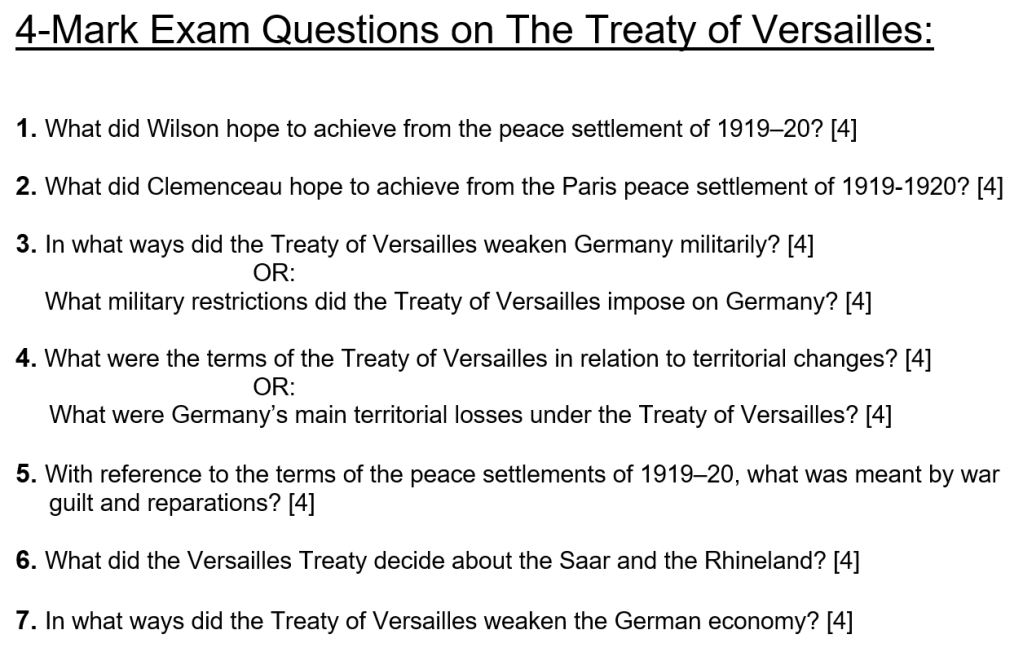
If you know your work perfectly well, it should take you 5-7 minutes to do one of these questions. So, doing all of them, without taking any breaks, should take you about 35-45 minutes…
Don’t worry! You are not going to do all of them now! We will only do a select few for now. It is, however, important to go through the entire list and make sure that you are indeed able to answer any of these questions should you get them in an exam.
2.
So, let’s start by discussing the following questions:
(Share you ideas regarding the answers to these questions with the rest of the class.)
1. What did Wilson hope to achieve from the peace settlement of 1919–1920? [4]
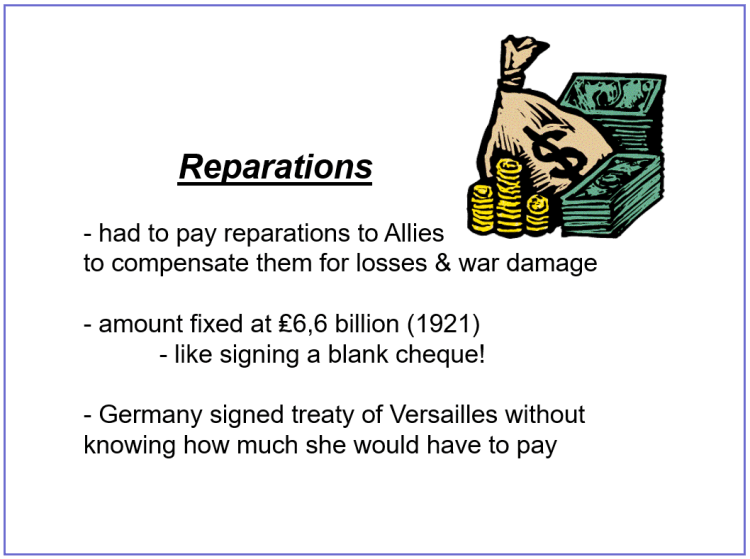
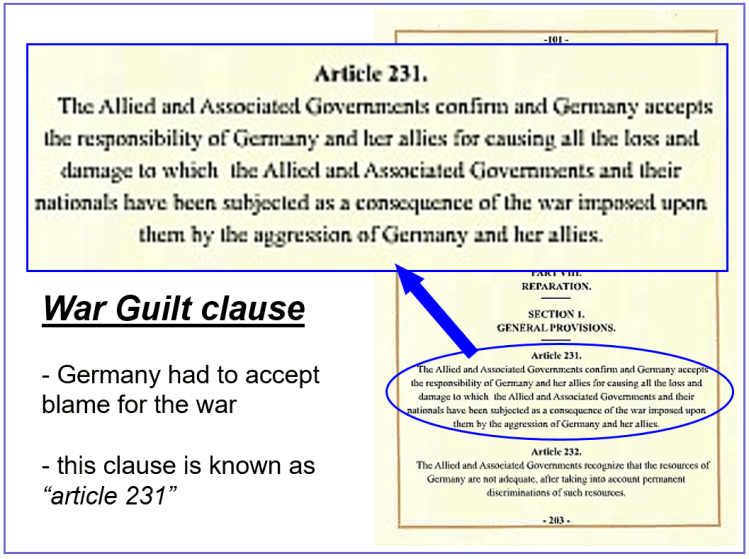
5. With reference to the terms of the peace settlements of 1919–1920, what was meant by war guilt and reparations? [4]
6. What did the Versailles Treaty decide about the Saar and the Rhineland? [4]
3.
Now it is time to do these questions under “timed conditions”:
REMEMBER: If you know your work perfectly well, it should take you 5-7 minutes to do one of these questions!!
So, starting with question 1, work your way through the selection of questions above and answer each one (in a paragraph or two) while timing yourself to see how long it takes to do each question.
4.
Here are the answers to the above questions from the list.


5.

Use the rest of the lesson to study for your next test.
(WordPress advertisements may appear below.)
Y10: 4-17. Justifying the Treaties
Today you are going to examine whether the Treaty of Versailles could be justified at the time, by doing a study task…
1.
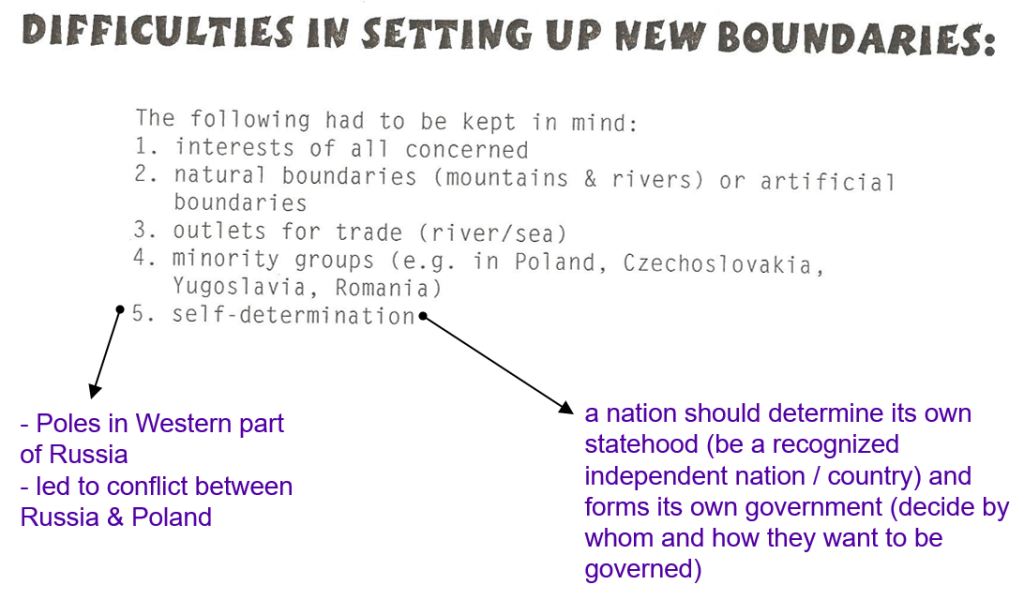
Below is a brief reminder of the difficulties that the peacemakers face in trying to satisfy everyone…

Difficulties in setting up new boundaries. (1:31 minutes long)
2.
The difficulties in setting up new boundaries can be one justification for the terms of the post-war peace treaties.
3.
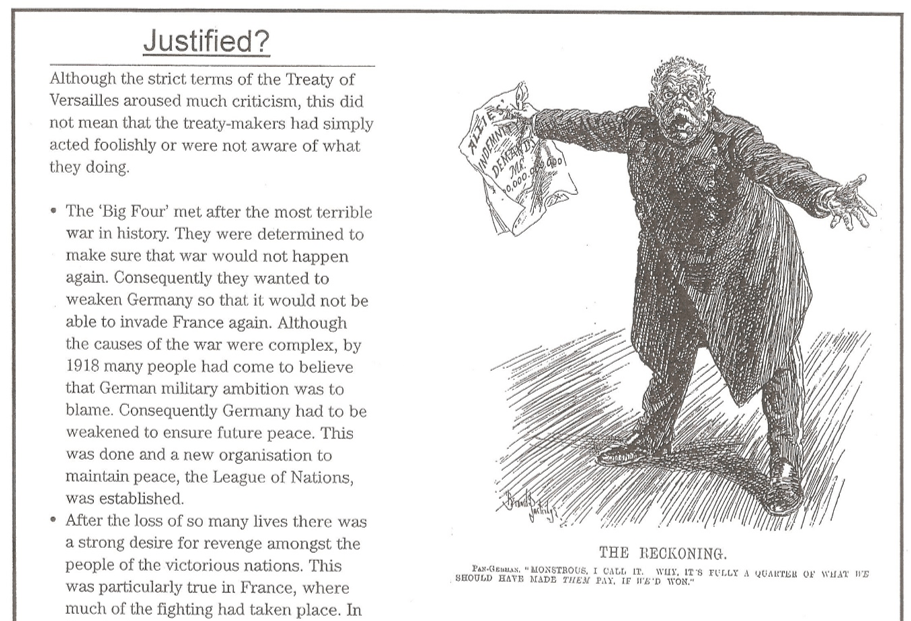
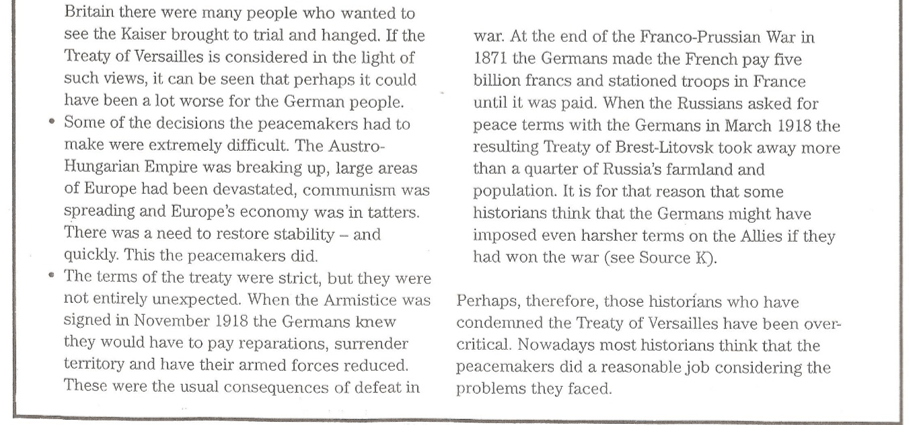
The task below gives more justification for the terms of the Treaty of Versailles:
Complete the summary task on p.36, on:
“Could the treaties be justified at the time?”.
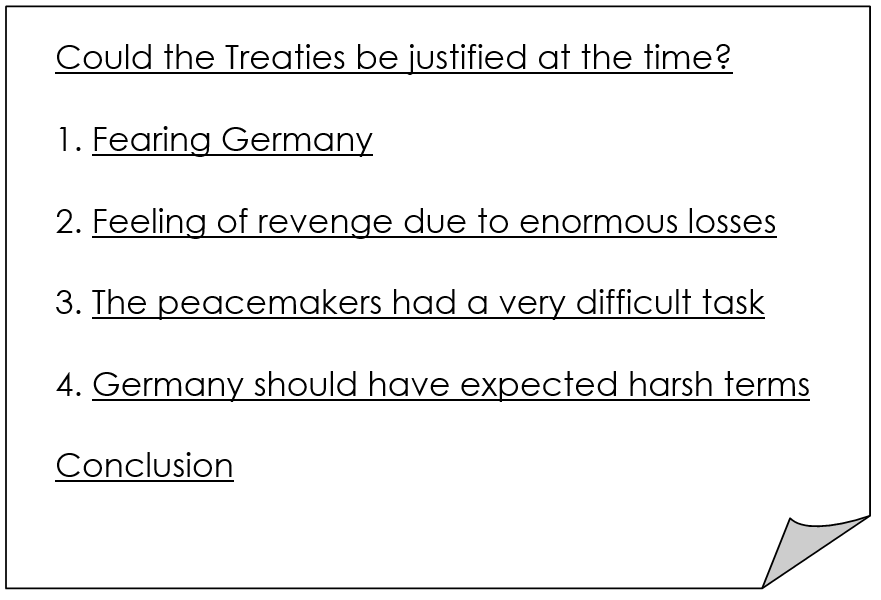
You need to make summarized notes on “Could the treaties be justified at the time?”. Use the headings in the box below to guide you.

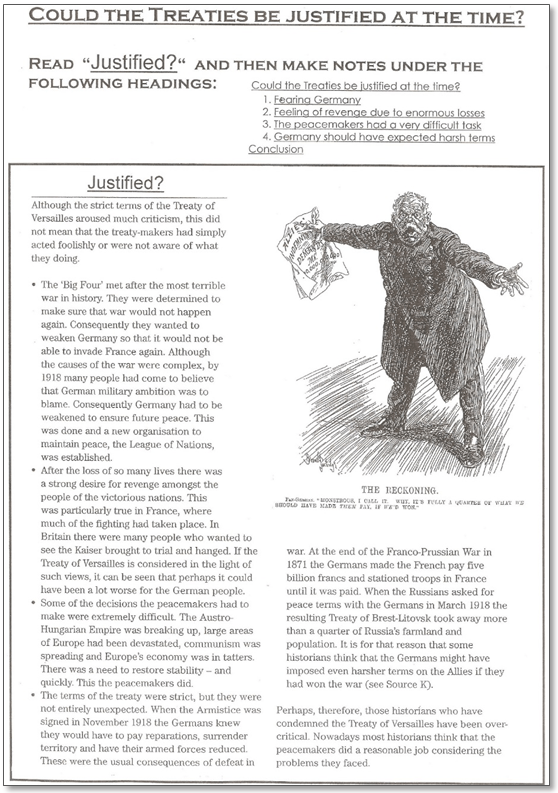

SOLUTION:


4.

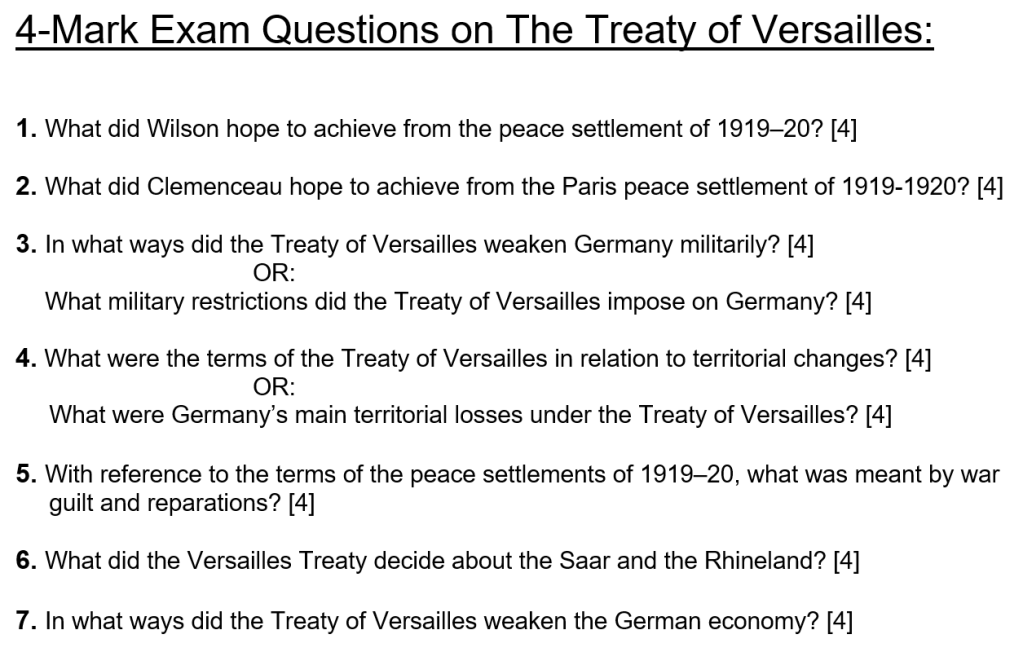
If there is still time, look at the following 4-mark exam questions. Will you be able to answer any of them?
(WordPress advertisements may appear below.)
Y10: 4-16. Criticisms of the Treaty of Versailles II
Today you are going to continue looking at how the Treaty of Versailles was criticized…
1.
You will probably agree that none of the Big Three got what they wanted…
Read the NOTES on: “Why the victors did not get what they wanted”
– p.18 –
2.
Let’s look at a few contemporary views regarding the terms of the post war peace treaties…

Contemporary Views. (1:26 minutes long)
3.
Read the NOTES: “Contemporary Views”.
– p.37 –
4.
So, how would you judge the severity of the terms of the Treaty of Versailles?
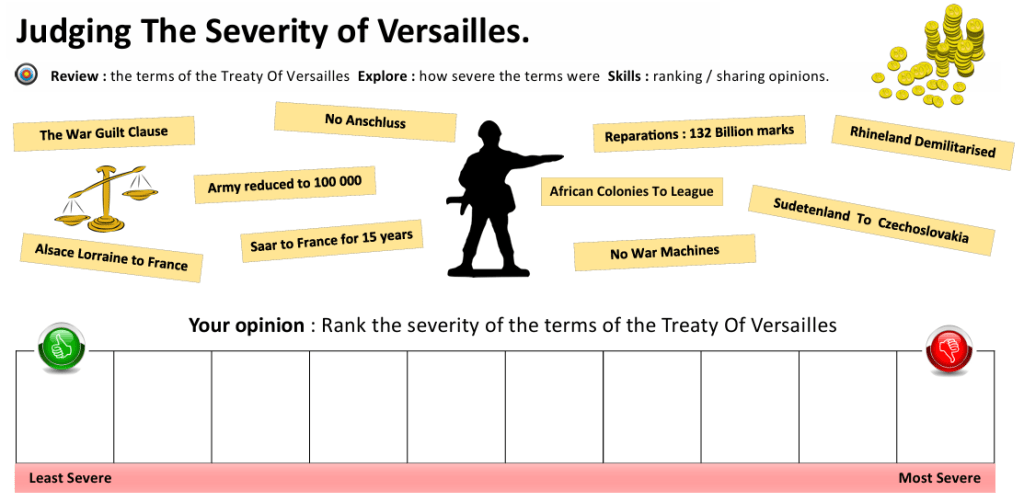
SOLUTION:
Remember, this is a matter of opinion… Below is a possible response. It is important that you are able to convincingly explain your own response.

5.
Taking all that you have learned about the treaties into consideration, do you think that the post-war peace treaties were fair?
Let’s see how fair the Treaty of Versailles was….

7: GCSE History – Was the Treaty Fair? (8:30 minutes long)
(WordPress advertisements may appear below.)
Y10: 4-15. Criticisms of the Treaty of Versailles I
Today you are going investigate how the Treaty of Versailles has been criticized, then in 1919, and since…
1.
The video below gives a brief overview of why the post-war peace treaties have been criticized… (Pay special attention to points that deal with Germany.)

Criticisms of the Treaties. (1:53 minutes long)
2.
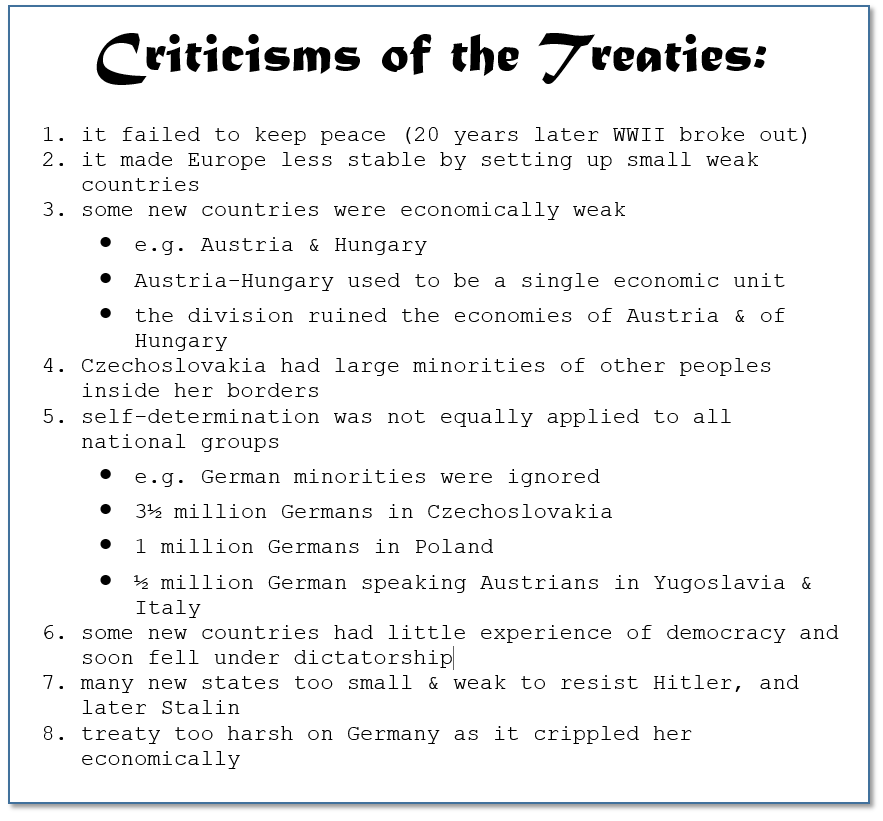
Read the NOTES on “Criticisms of the Treaties” – p.34
Then highlight the points that specifically applies to Germany.
3.
And now for a study task…
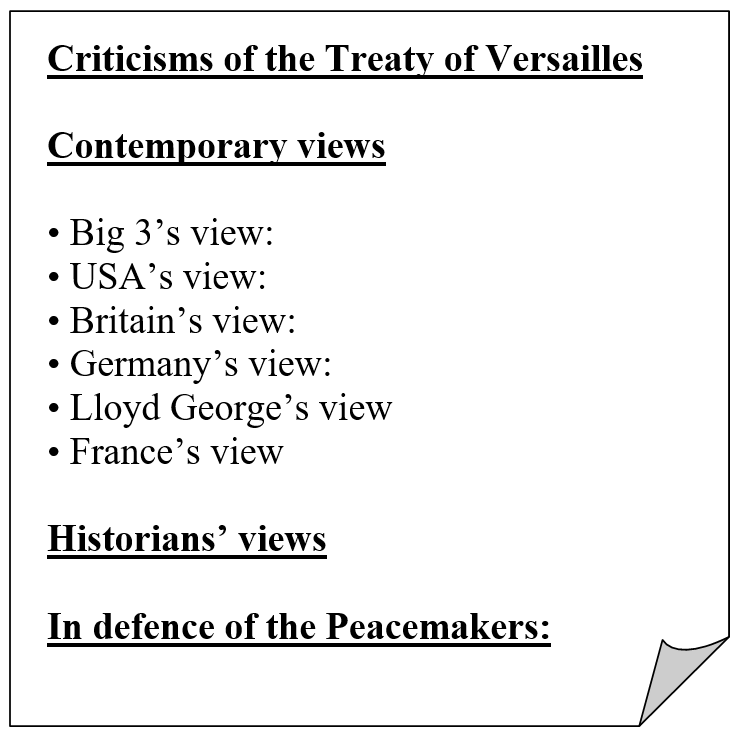
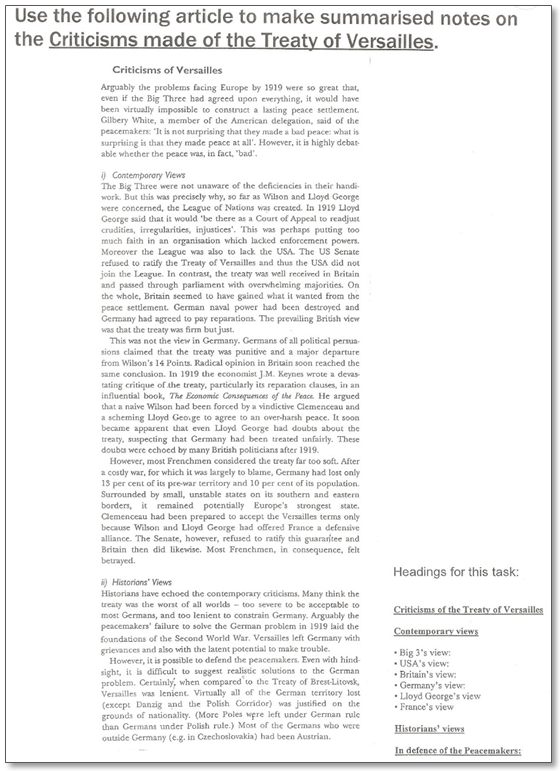
Complete the summary task on p.33, on:
“Criticisms made of the Treaty of Versailles”.
You need to make summarized notes on “Criticisms made of the Treaty of Versailles”. Use the headings in the box below to guide you.
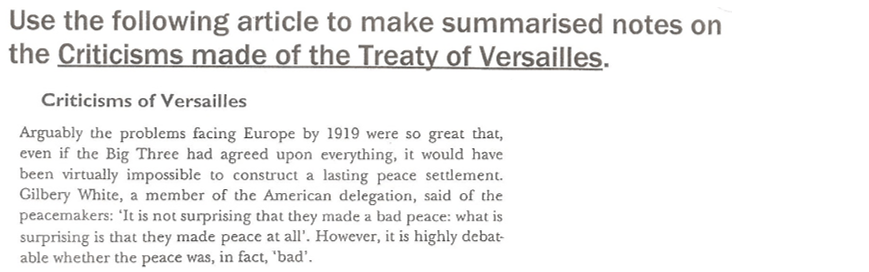
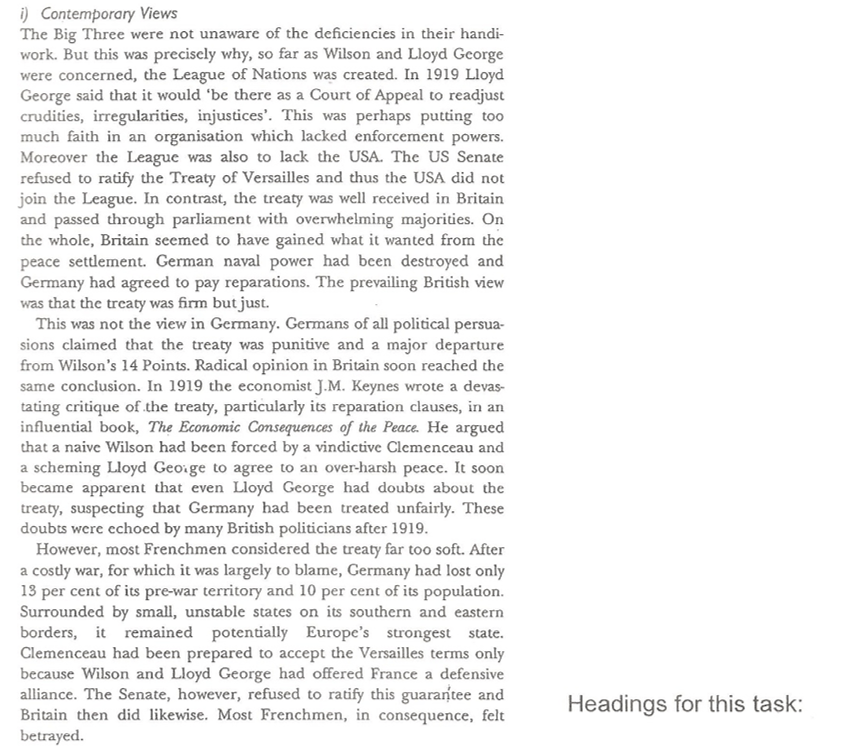
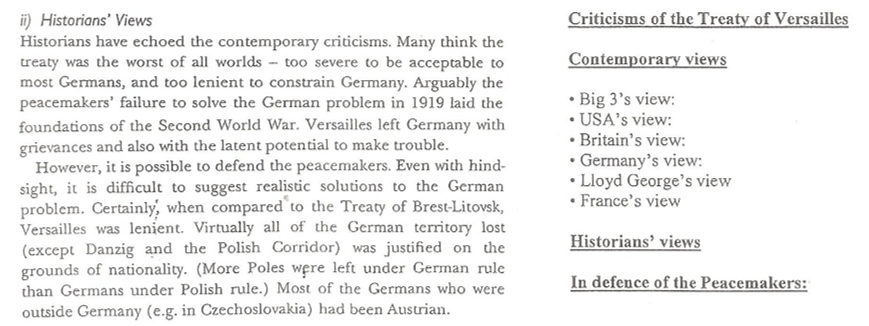
SOLUTION:

4.
Now, let’s see if the treaty was really that bad…
How Harsh was the Treaty of Versailles Really? (3:54 minutes long)
(WordPress advertisements may appear below.)
Y10: 4-14. Economic Impact on Germany
Today you are going to examine the economic impact that the Treaty of Versailles had on Germany…
1.
The Treaty of Versailles had devastating economic effects on Germany. Let’s see what we can learn from the following video…

Economic Impact on Germany. (2:21 minutes long)
2.
“Reparation & Ruin in Germany” (p.25-26)
3.
1923: The French Occupation of the Ruhr. (3:18 minutes long)
4.

Hyper Inflation Crisis in Germany. (1:19 minutes long)
Hyper Inflation in Germany. (0:42 minutes long)
What happened to Reparation payments?. (2:14 minutes long)
5.
The information in the videos above is also in your booklet…
Notes on “The Economic Impact on Germany” (p.27)
6.

(Additional useful information.)
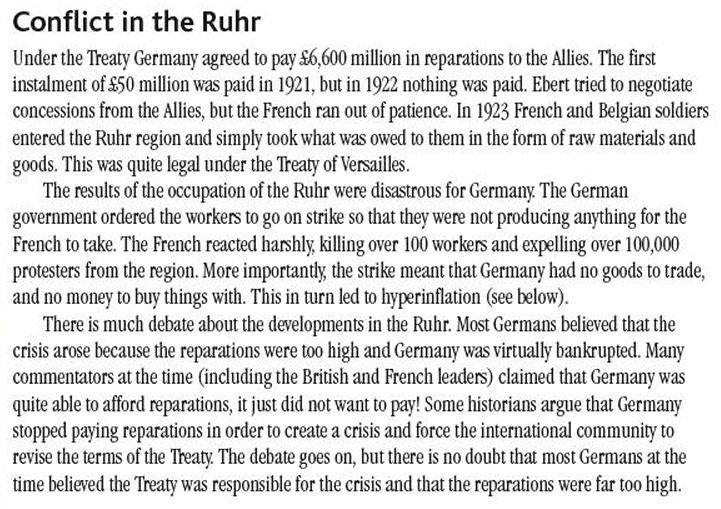
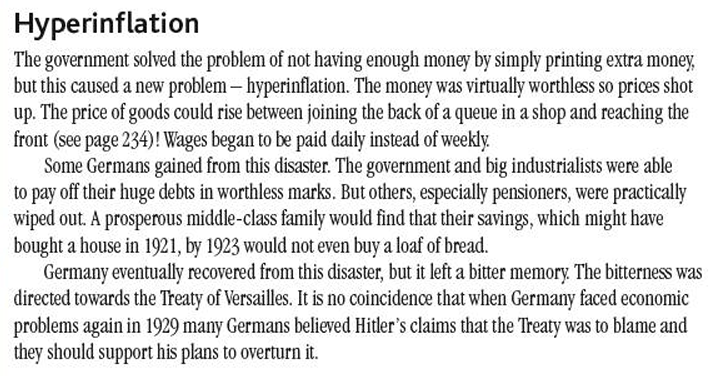
You can access page 234 (referred to in the above text) below:
7.
Complete the following task on the impact of the Treaty of Versailles:
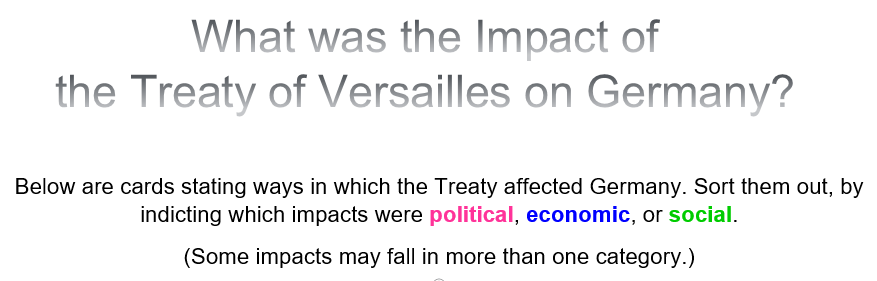
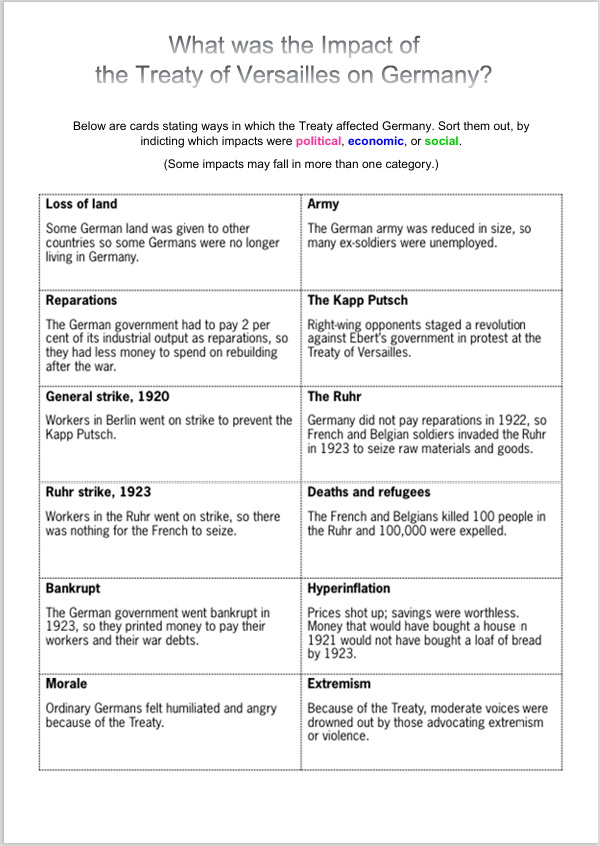
SOLUTION:

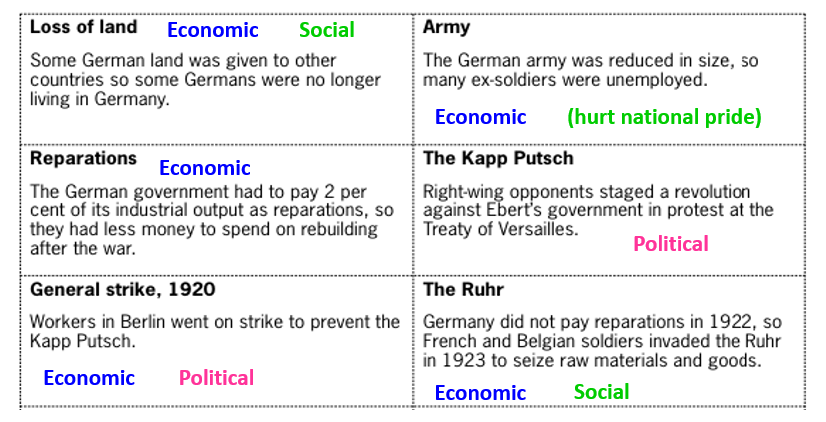
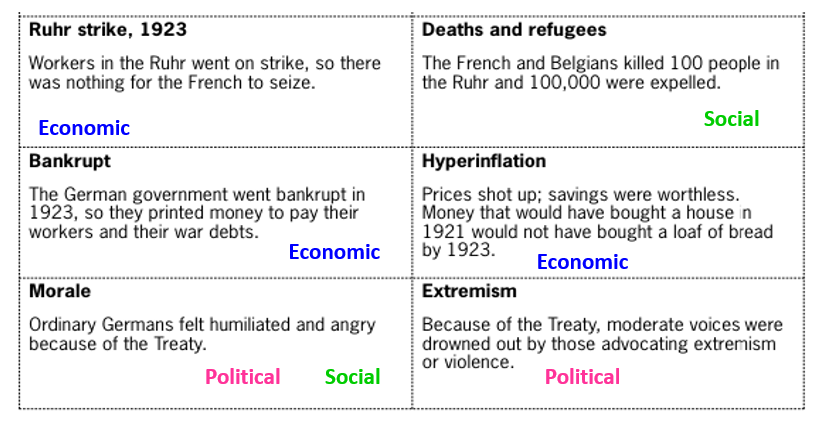
8.
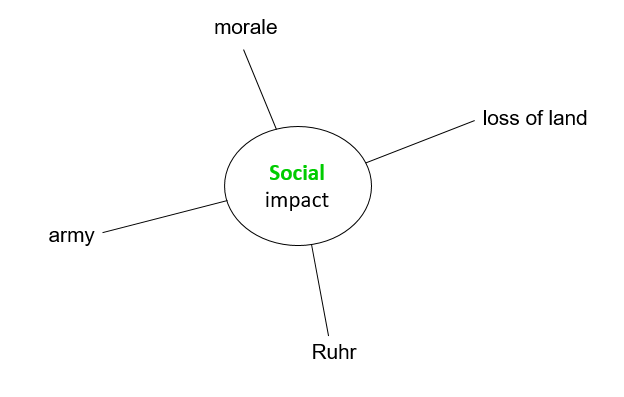
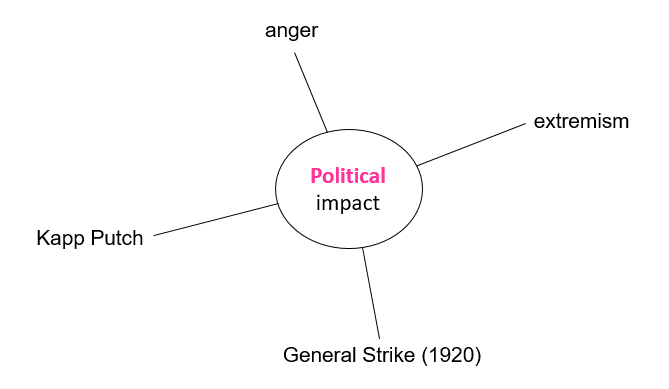
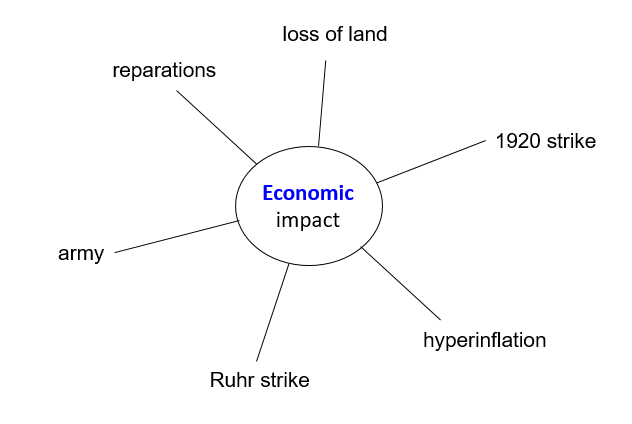
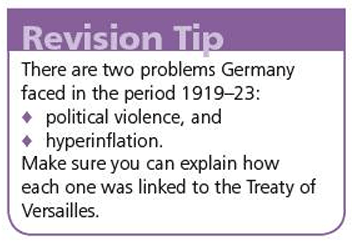
To summarise, here are the social, political and economic impacts of the Treaty of Versailles on Germany:
9.

Complete the “Activity: The impact of the Treaty of Versailles”. It is on p.28-30 of your Peace Treaties booklet. Alternatively, do just one of these questions – it is your choice!
(WordPress advertisements may appear below.)
Y10: 4-13. Impact of the Treaty of Versailles
Today you are going to start examining the impact of the Treaty of Versailles…
1.
Here is a brief reminder of the areas in which Germany was affected by the terms of the Treaty of Versailles. You can remember them by means of this short mnemonic:

TRAWL
- Territory
- Reparations
- Armaments
- War Guilt
- League of Nations
2.
Let’s now see what the immediate impact of the Treaty of Versailles in Germany was.

Immediate Impact of the Treaty on Germany. (2:24 minutes long)
3.
The notes on “The Immediate Impact of the Treaty of Versailles on Germany”, p.25
4.

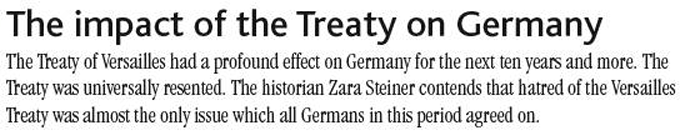
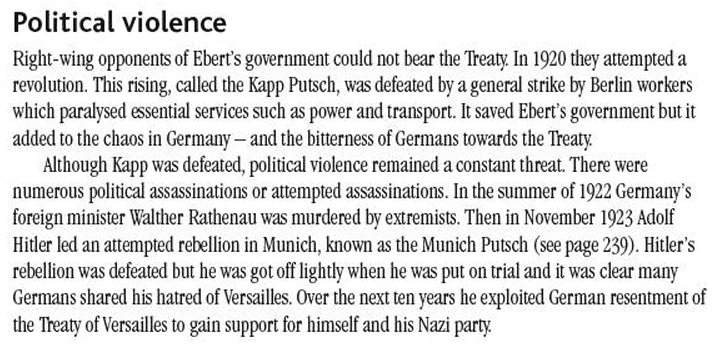
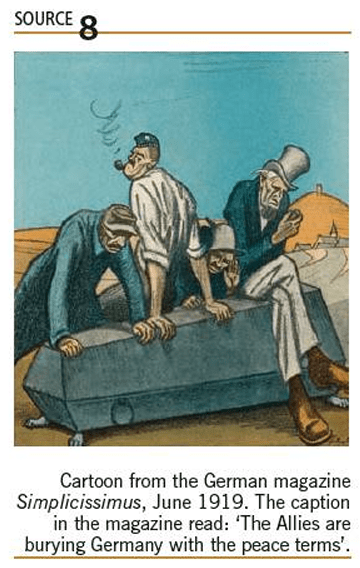
(Additional useful information!)
5.
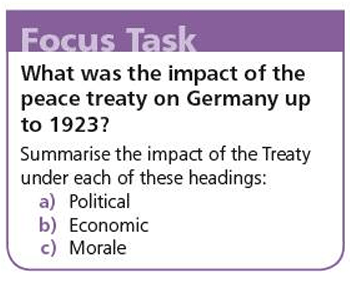
Fill in brief details for the terms of the Treaty of Versailles and its impact:
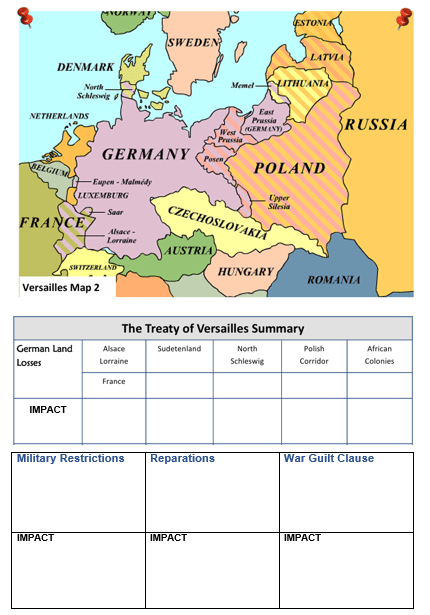
SOLUTION:
6.
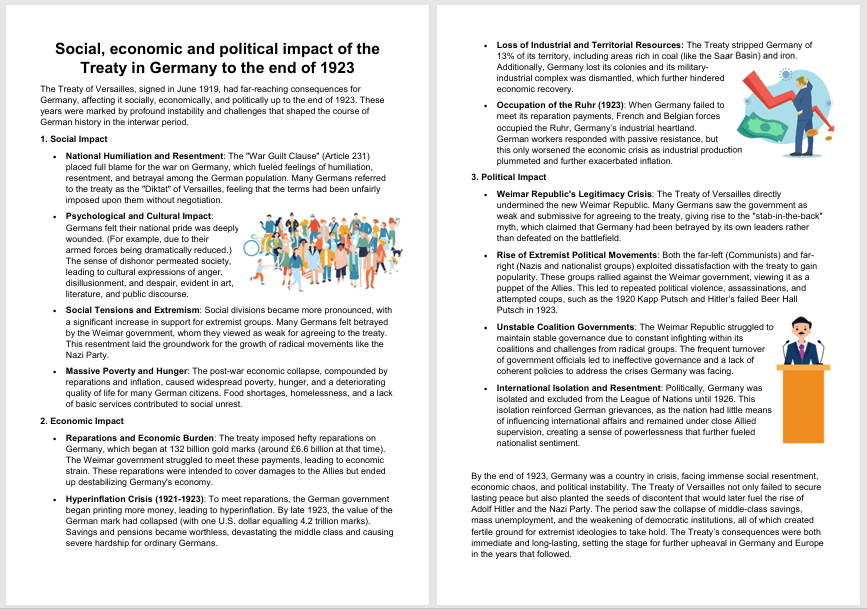
Below is very useful information on the Social, Economic, and Political Impact of the Treaty f Versailles on Germany.

Read it and then make study notes from it.
7.

6: GCSE History: Impact of Versailles on Germany. (14:10 minutes long)
(WordPress advertisements may appear below.)
Y10: 4-12. Other Post-War Peace Treaties
Today you are going to look at the terms of the Other Post-War Peace Treaties…
1.
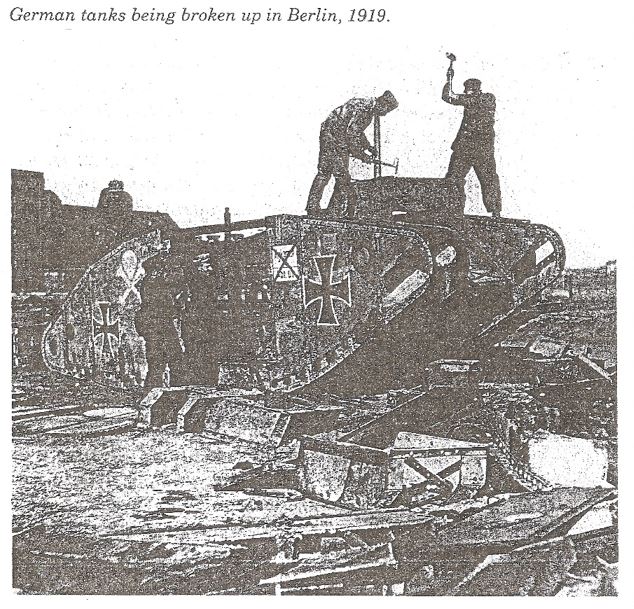
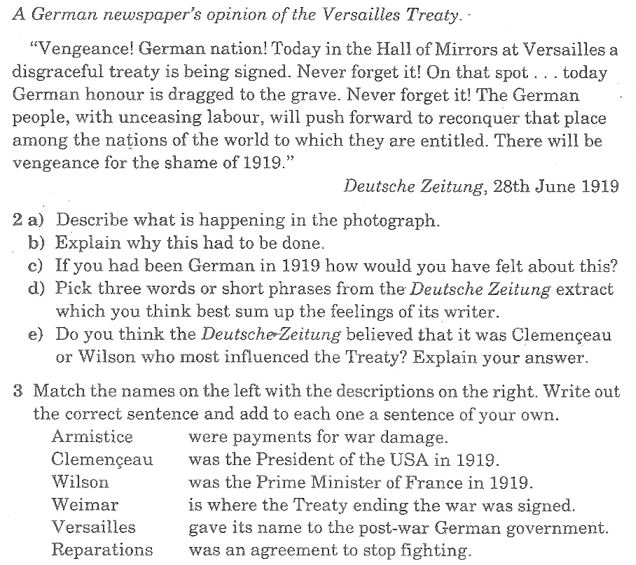
Mark the following tasks:

-Task 1-

SOLUTION:

-Task 2-


-Task 3-
SOLUTION:
2.
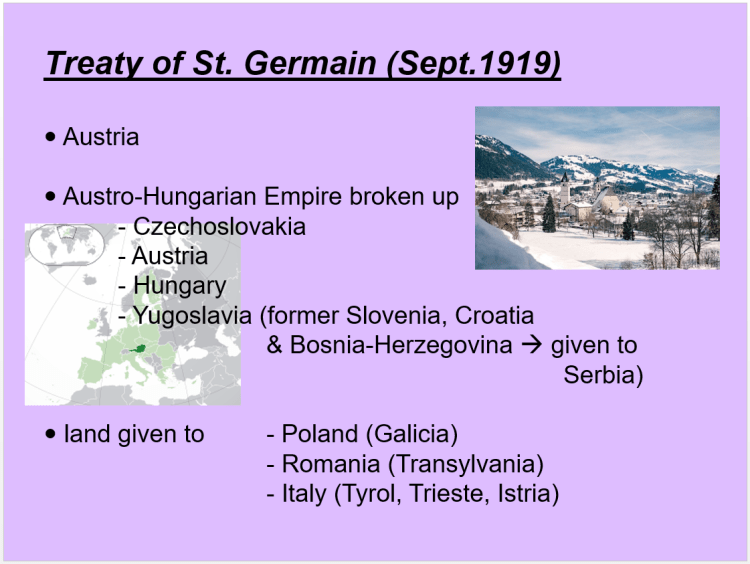
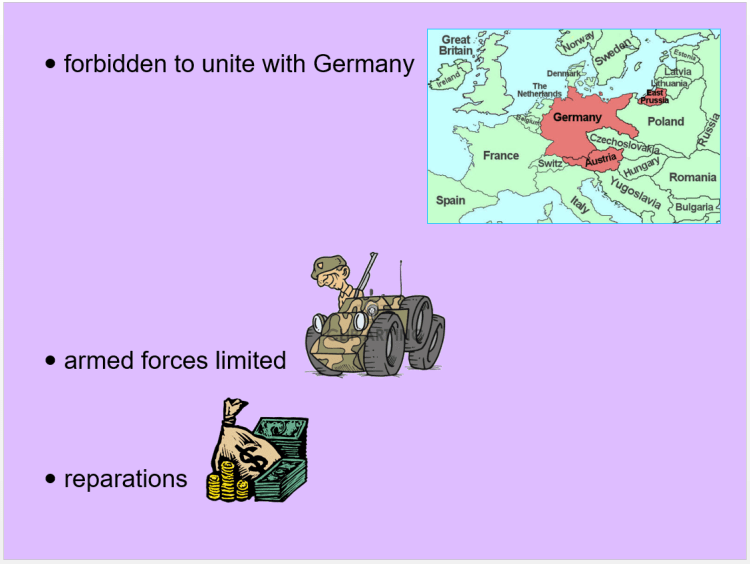
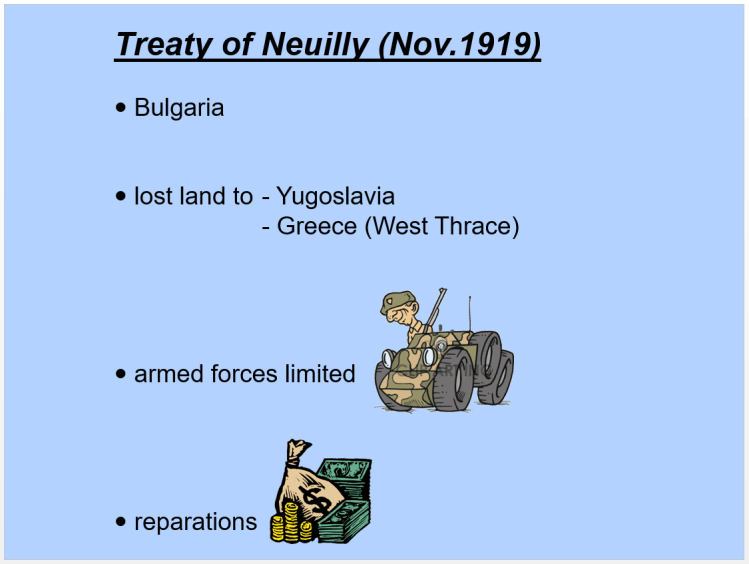
You learnt about the Treaty of Versailles. Now navigate through the slides (by swiping to the left) to also learn more about the terms of the other Post-War Peace Treaties…





3.

…about “The Other Post-War Peace Settlements” …
- “Treaty of St.Germain”(p.21)
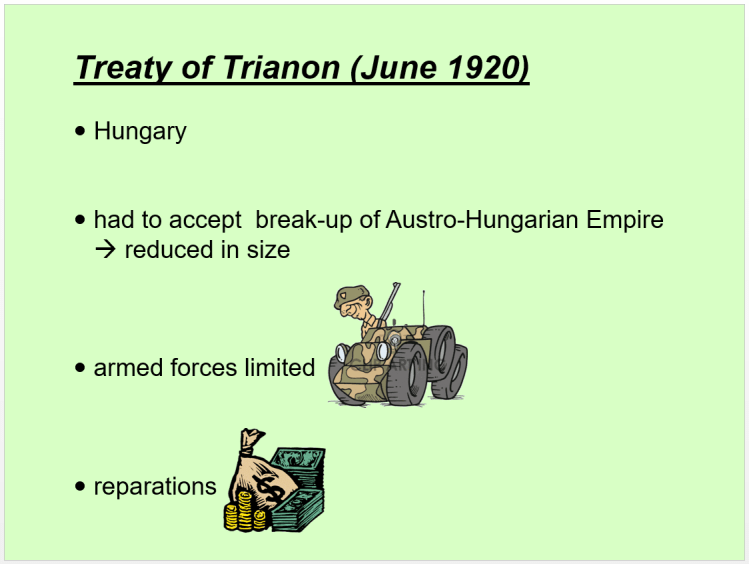
- “Treaty of Trianon” (p.21)
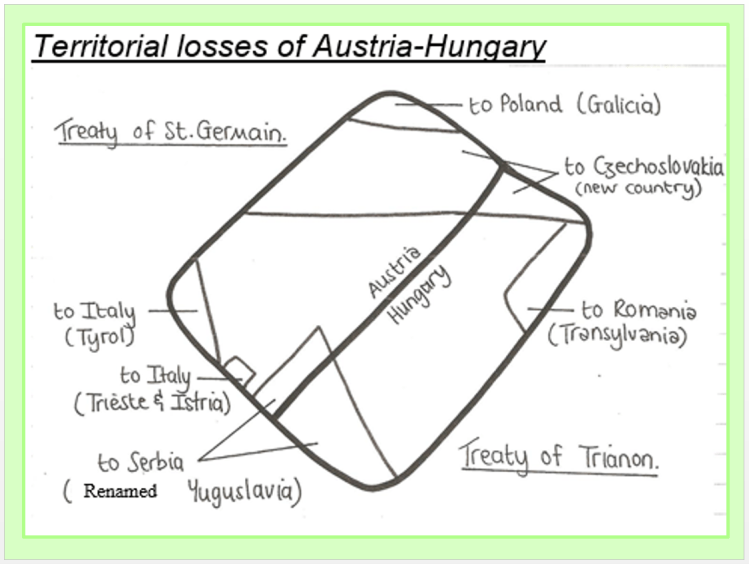
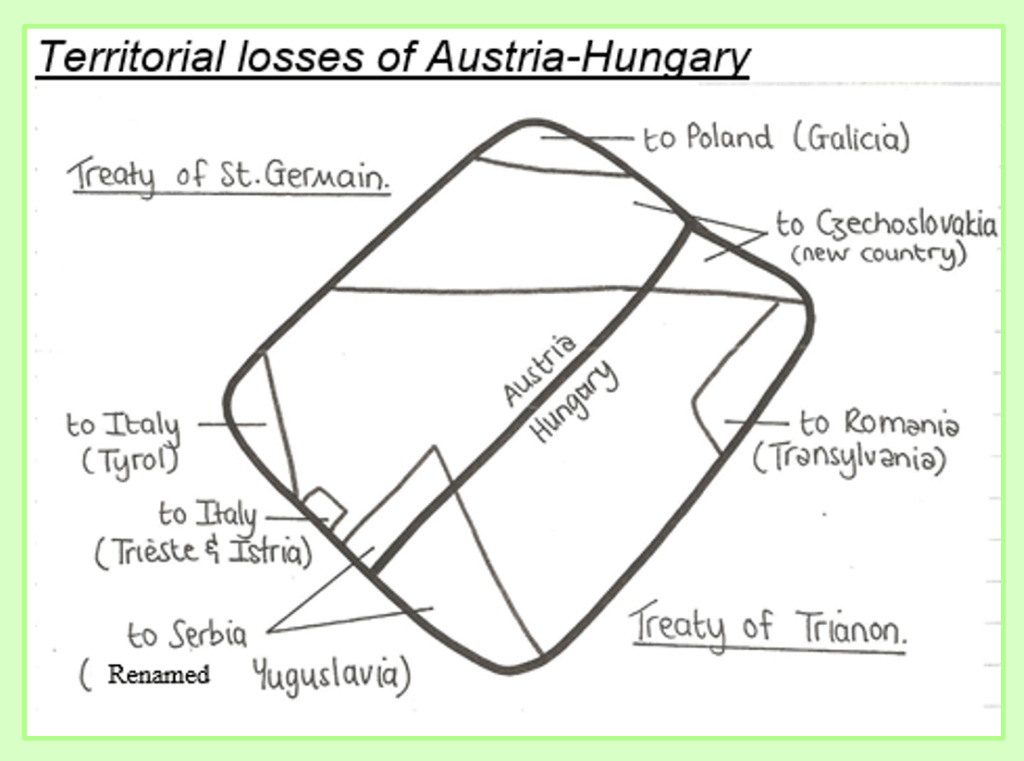
- “Territorial losses of Austria-Hungary” (p.22)
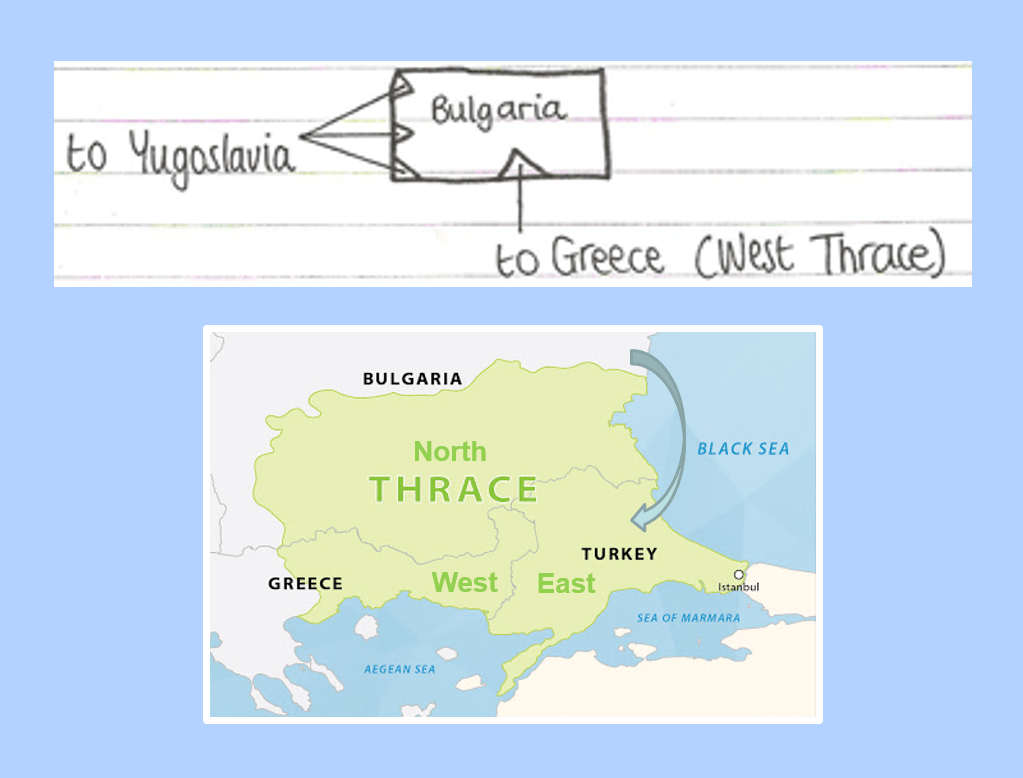
- “Treaty of Neuilly” (p.22)
4.
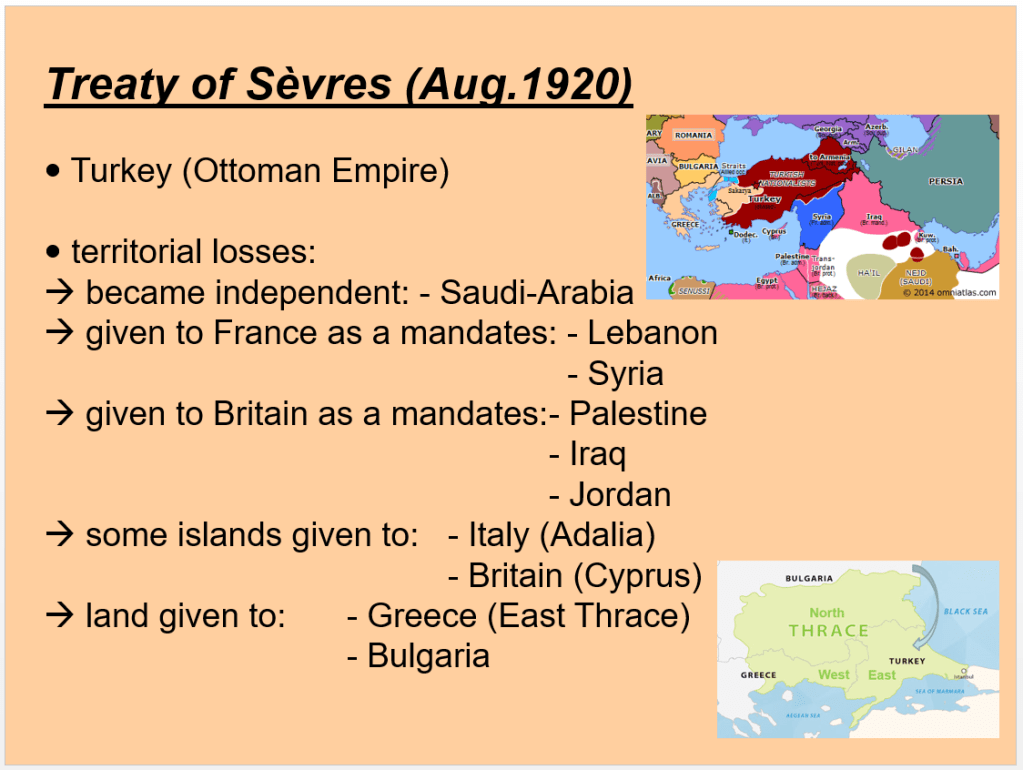
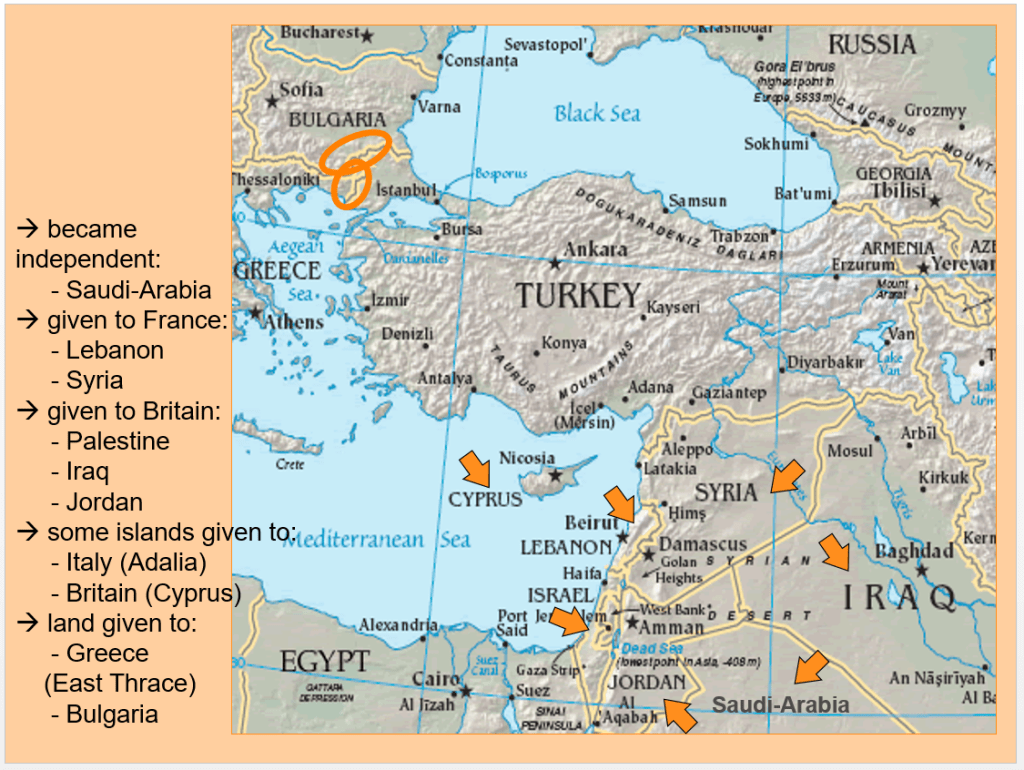
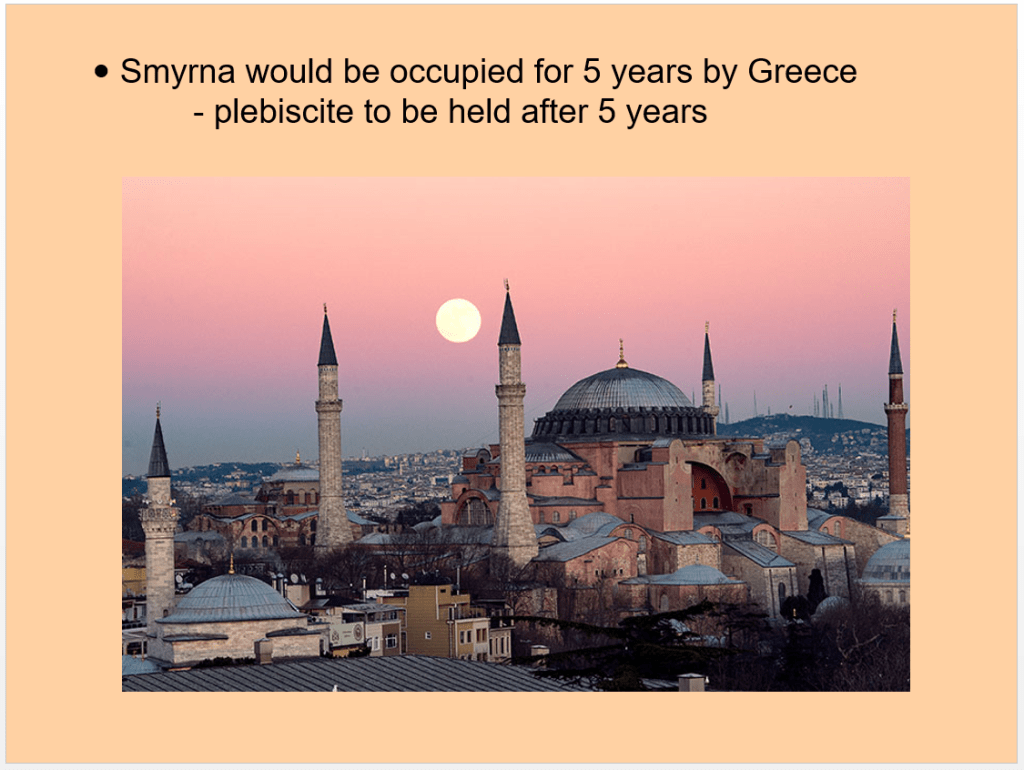
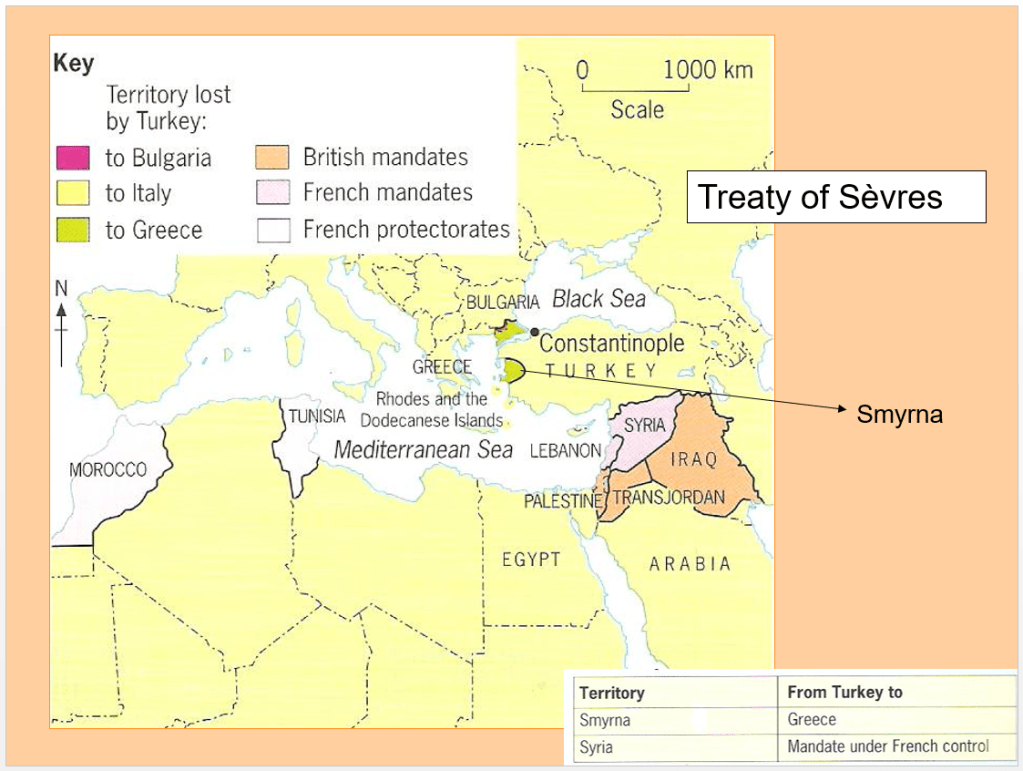
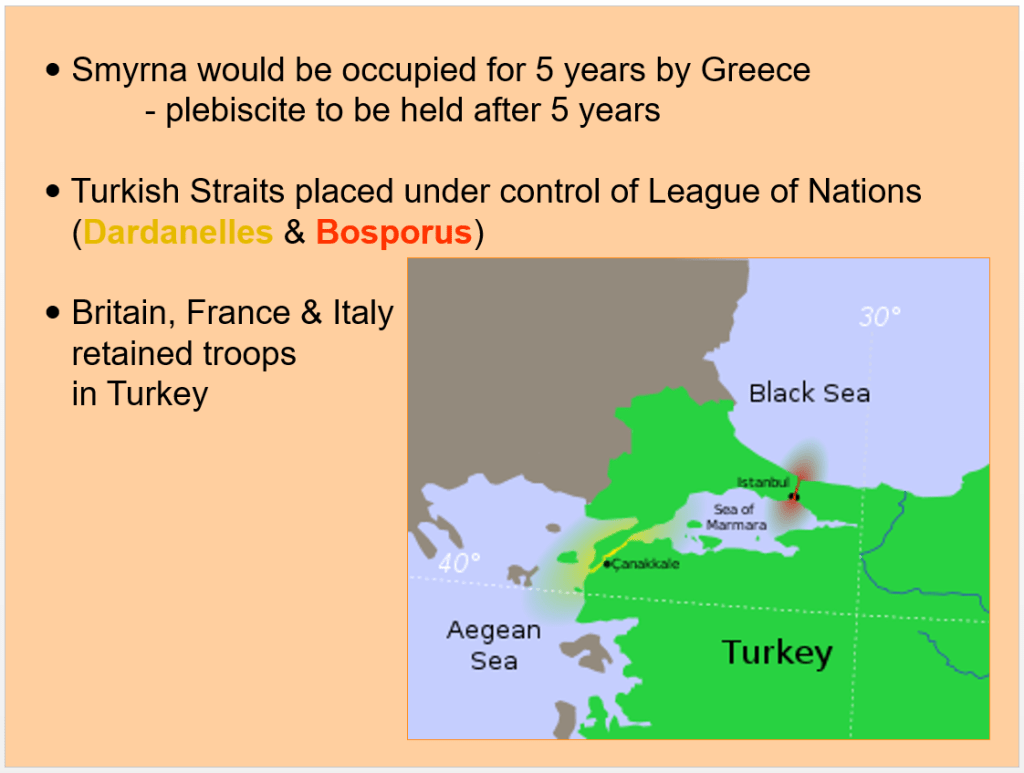
There are more Post-War Peace Treaties! Navigate through the slides (by swiping to the left) to learn more about the terms of these Treaties…

5.
…about “The Other Post-War Peace Settlements” …
- “Treaty of Sevres” (p.23)
- “Treaty of Lausanne” (p.23)
6.


(3:27 minutes long)
7.
Copy the details regarding “Territorial losses of Austria-Hungary” (p.22).

Use the large diagram on page 22.
8.
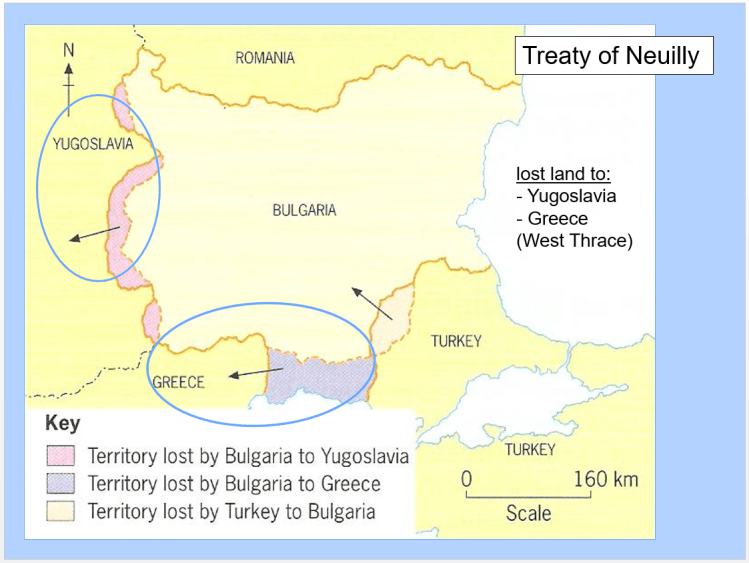
Copy the details regarding territorial losses, suffered by Bulgaria, as specified in the Treaty of Neuilly.
Use the small diagram on page 22.
9.
The article about “Europe re-shaped: The Other Paris Peace Treaties”, p.20.
10.
The ‘Other’ WW1 Peace Treaties. (7:00 minutes long)
(WordPress advertisements may appear below.)
Y10: 4-11. Germany’s Reaction III
Today you are going to continue with tasks about Germany’s reaction to the Treaty of Versailles….
1.
First finish the question on the German cartoon about the reaction to the terms of the Treaty of Versailles (started in the previous lesson).

2.
Now we are going to test your knowledge and understanding of the reaction that Germany had to the Treaty of Versailles, by completing a number of tasks…
-Task 1-
Answer the Questions on the “Germany and Versailles” worksheet (provided).
-Task 2-
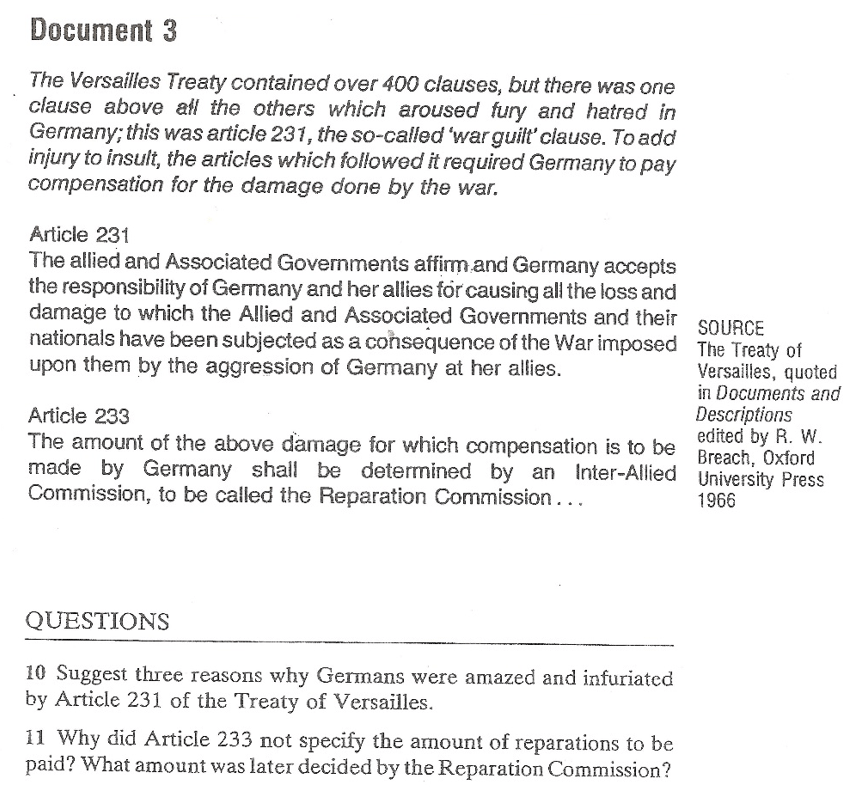
Answer the Questions on the “Document 3” worksheet (provided).
-Task 3-
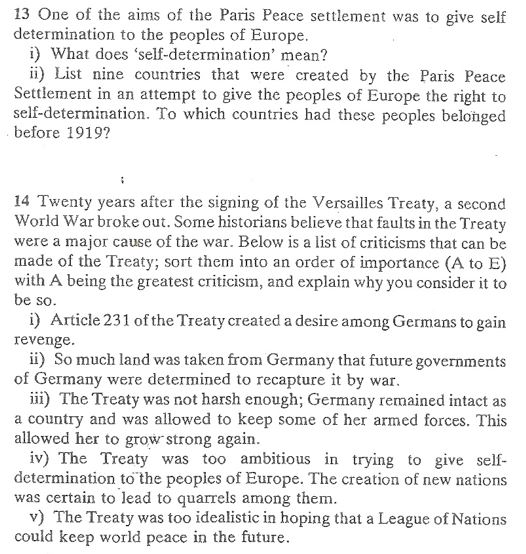
Answer the Questions on, let’s call it the “Questions 13 & 14” worksheet (provided).
3.
Finally, see what you can learn from this video about the German reaction to the terms of the Treaty of Versailles…
Germany’s Dissatisfaction with the Treaty of Versailles. (1:31 minutes long)
(This video was edited from the original on the following YouTube Channel: Miss Gardner – YouTube)

(WordPress advertisements may appear below.)
Y10: 4-10. Germany’s Reaction II
Today you are going to continue with Cartoon analysis tasks about the Treaty of Versailles….
1.
In the previous lesson we looked at cartoons about the Treaty of Versailles and also answered questions using cartoon analysis skills…
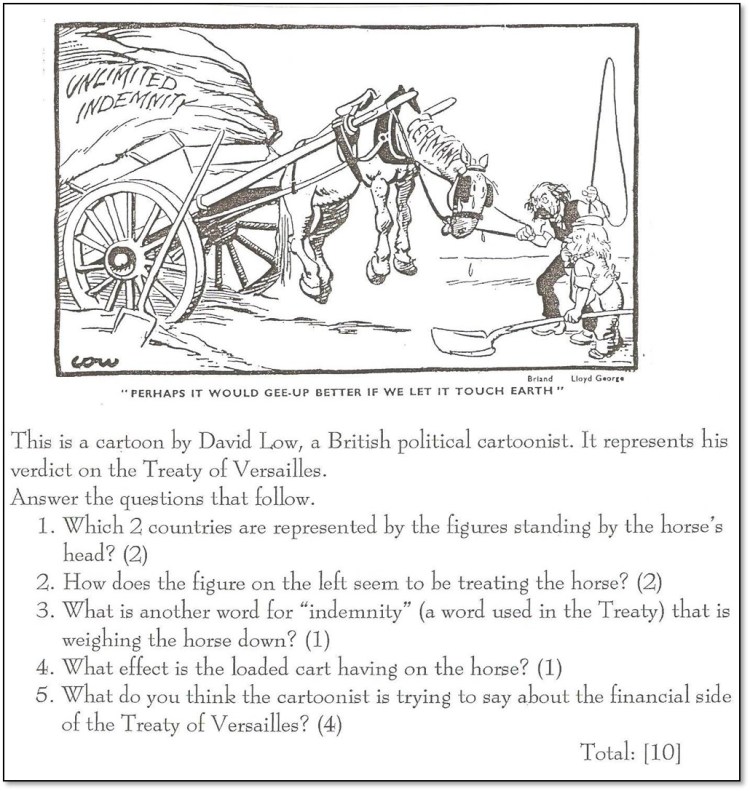
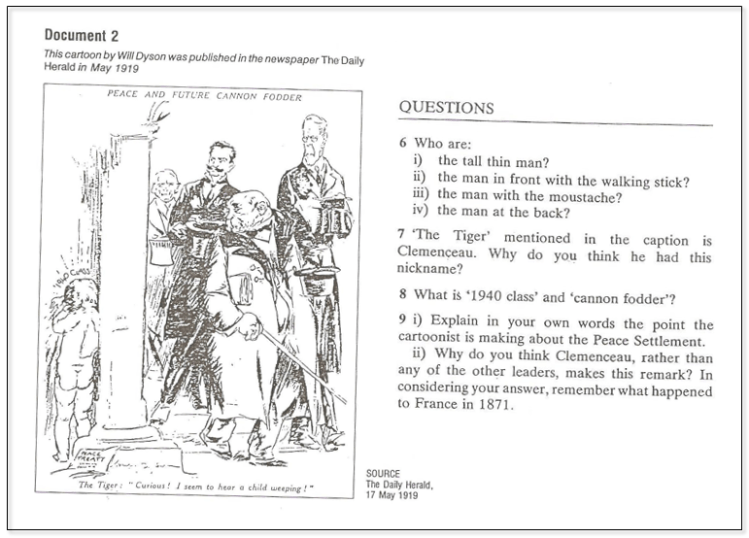
2.
The following cartoon (that shows what the German people thought of the Treaty of Versailles) was also shown in the slides…
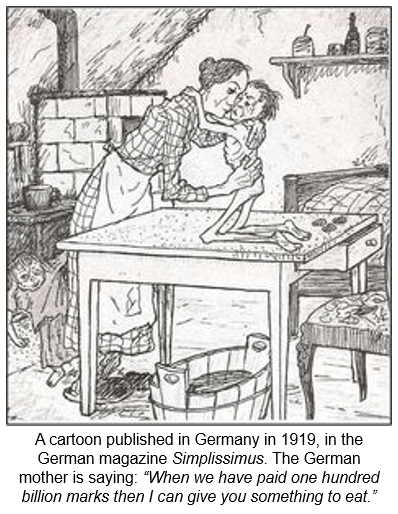
Let’s look at a detailed tutorial about this German cartoon.
Treaty of Versailles – Cartoon Analysis (‘100 billion marks’). (7:43 minutes long)
3.
Now, complete the following question: (provided)
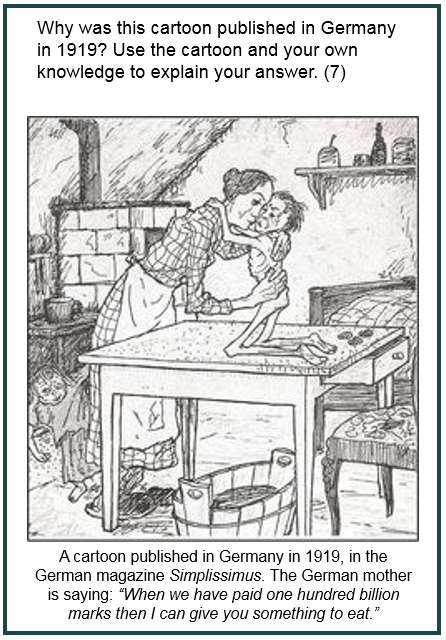

Remember the ideas regarding cartoon analysis on p.17…
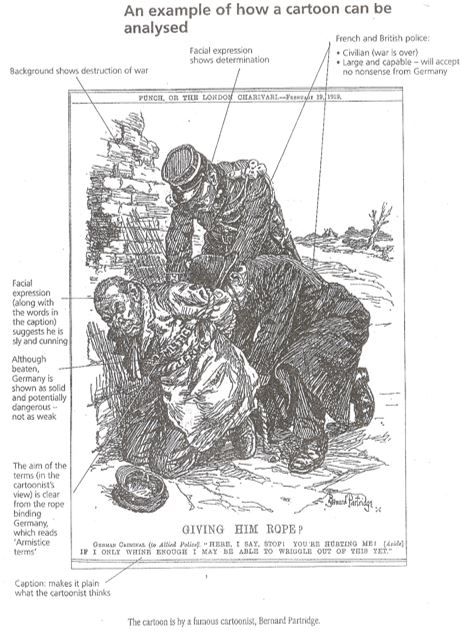
(WordPress advertisements may appear below.)
Y10: 4-9. Germany’s Reaction I
Today you are going to investigate Germany’s reaction to the Treaty of Versailles…
1.
The video below discusses the terms of the Treaty of Versailles in detail. It also tells us why Germany was shocked by the Treaty of Versailles…
Why The Treaty of Versailles Was Such A Shock For Germany? (28:07 minutes long)
2.
The terms of the Treaty of Versailles were extremely harsh. It called for a significant reaction from Germany…
Germany’s Reaction. (1:38 minutes long)
3.
You have the same information in your Booklet on Peace Treaties, on page 16.
“Germany’s Reaction” (p.16)
4.
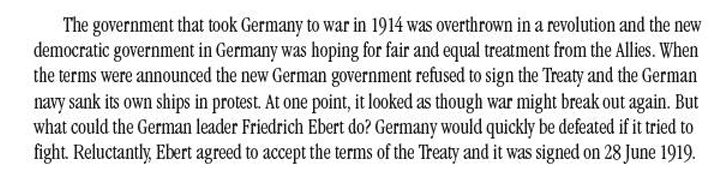
Also read what B.Walsh has to say about Germany’s reaction to specific terms of the Treaty of Versailles:

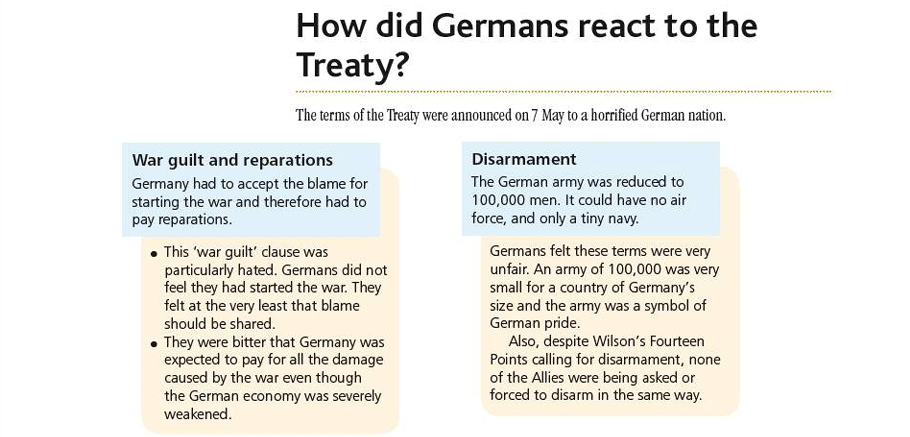
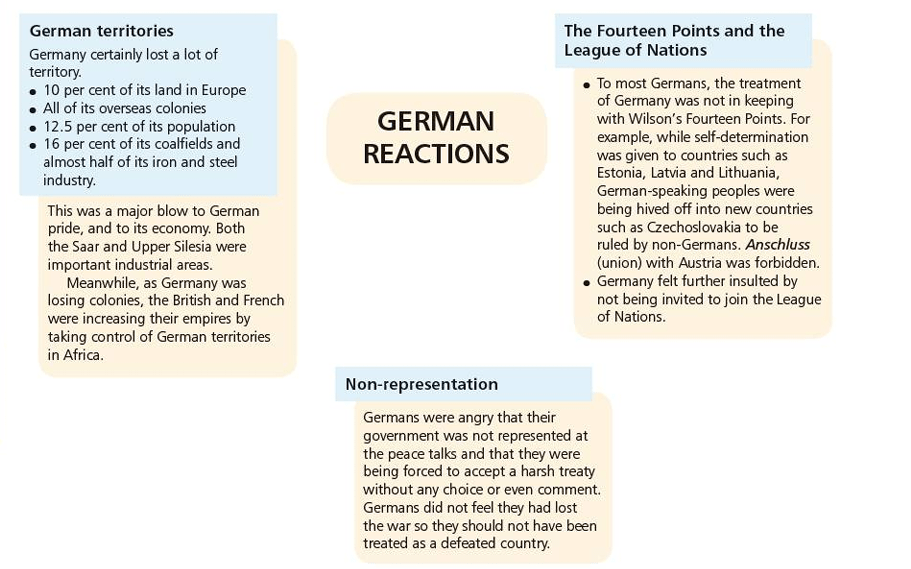
5.
The following cartoon also shows what the German people thought of the Treaty of Versailles… See if you can guess what this cartoon is trying to say about German feelings regarding the Treaty of Versailles.
6.
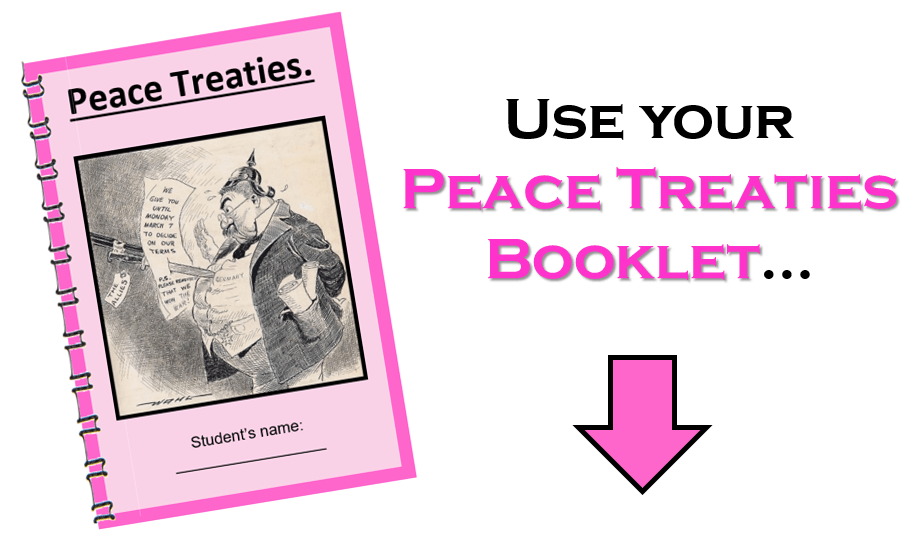
When dealing with political cartoons there are a number of things to look out for. Look at the cartoon analysis advice on p.17 to see what you have to consider when dealing with cartoon analysis / how to analyse a political cartoon…
7.
Would you be able to write a paragraph on each of the following cartoons, explaining what each cartoonist’s message is? Remember that it will be important to make reference to details in the cartoon! (You do not have to write the answers down – simple consider them…)

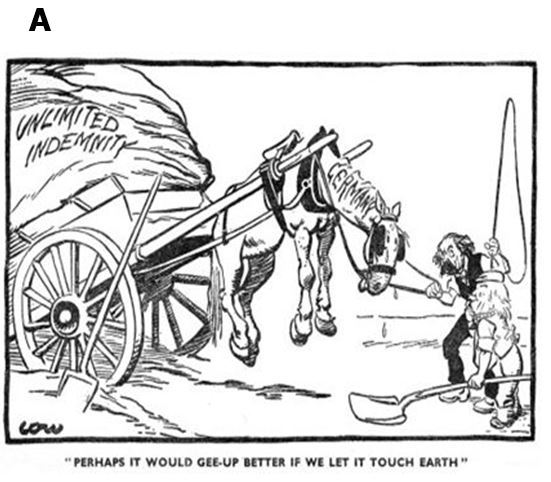
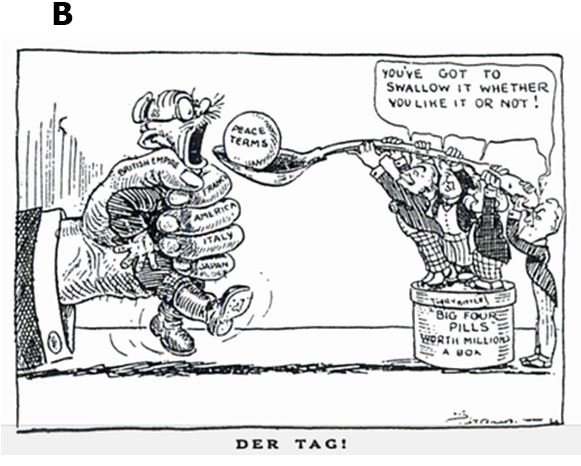
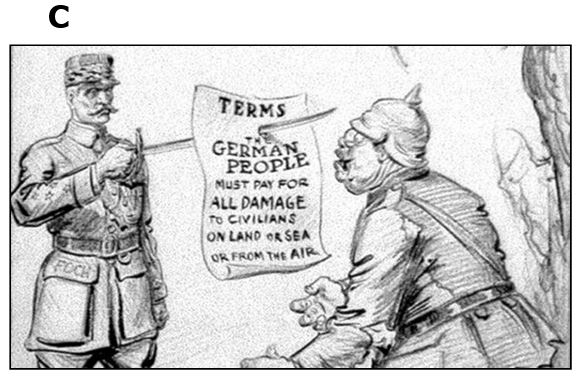
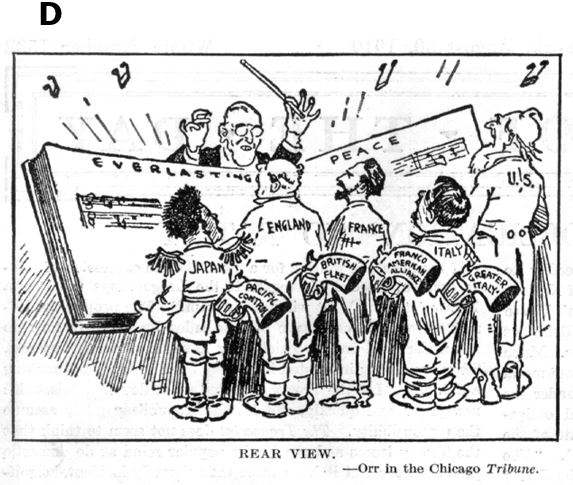
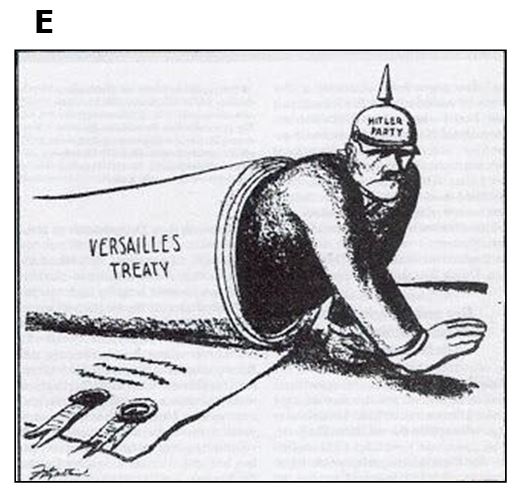
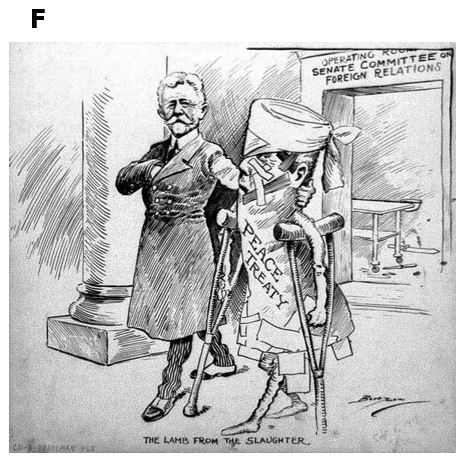
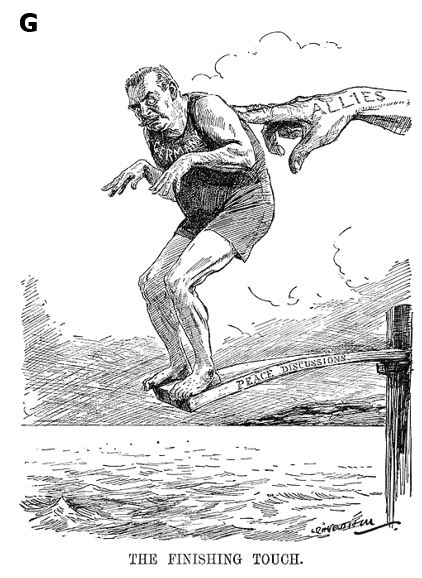
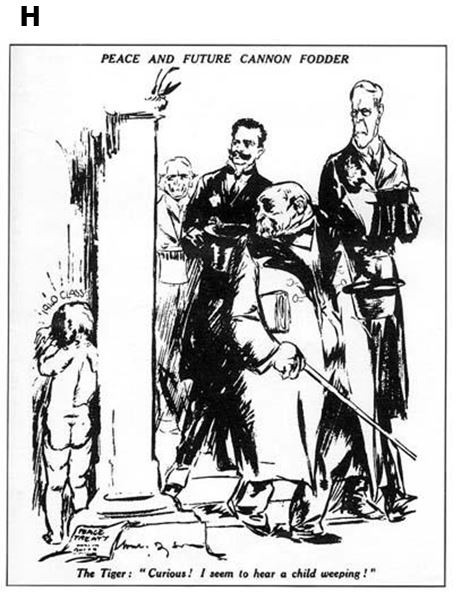
Below is one useful example of how a political cartoon can be analysed.

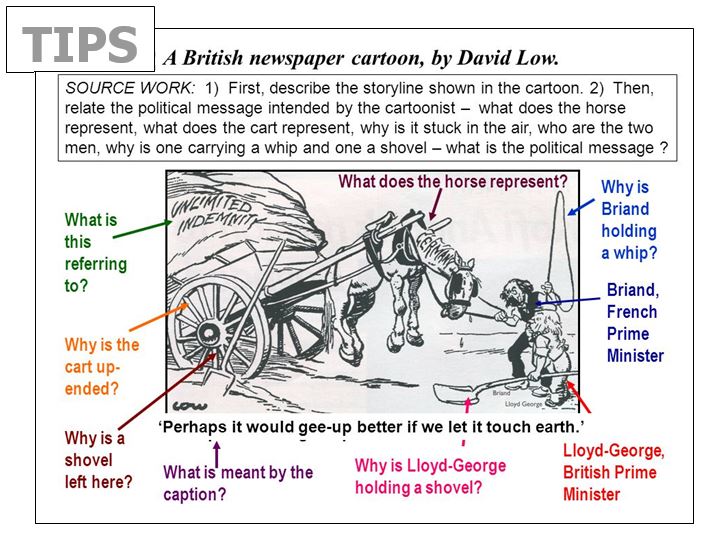
8.
The video below gives very useful information on cartoon analysis!

10 Things To Look For In Cartoons. (7:37 minutes long)
9.
Now, complete the following two worksheets (provided):
-Cartoon 1-
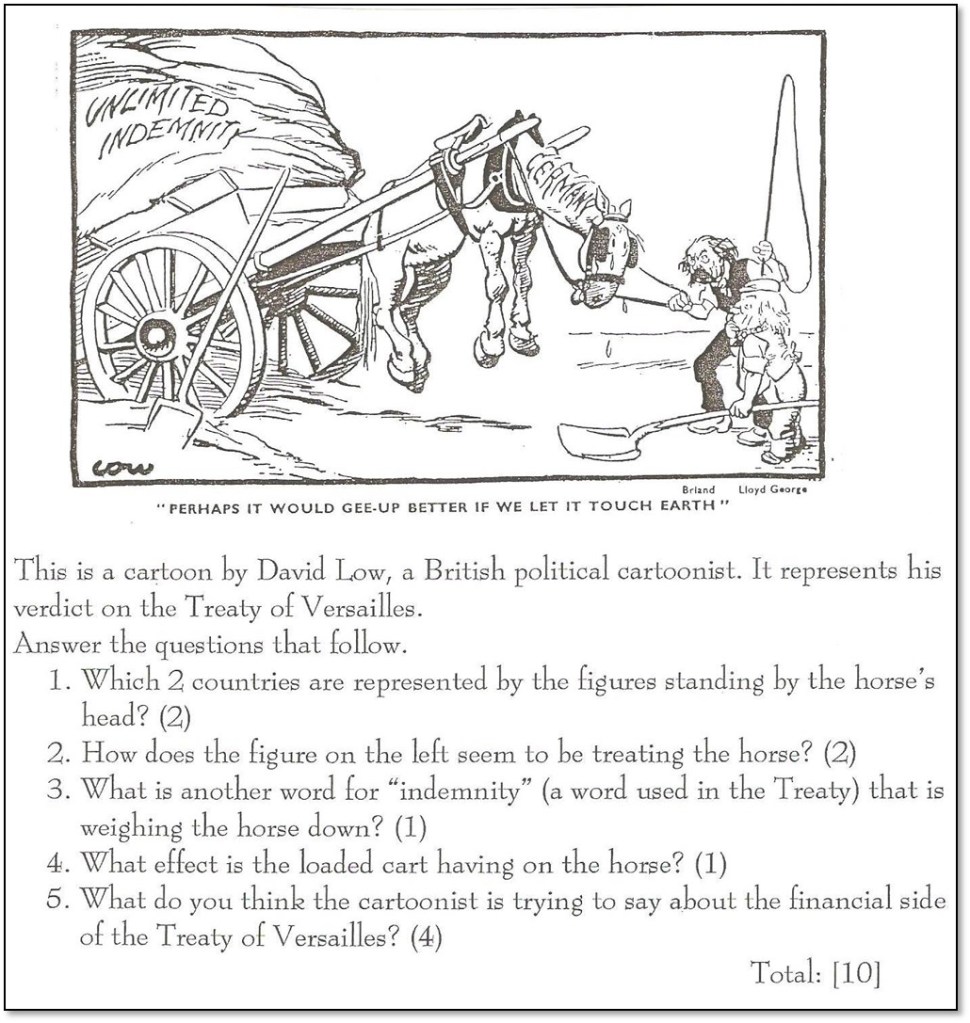
-Cartoon 2-
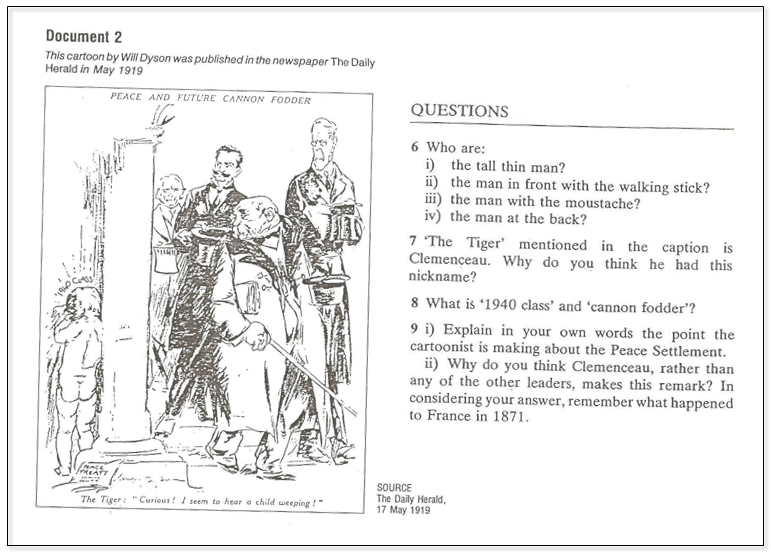
10.

Below are useful videos that explain some of the above political cartoons.
Treaty of Versailles Cartoon – ‘Give Him Rope’ Cartoon. (8:47 minutes long)
Treaty of Versailles – Peace and Future Cannon Fodder. (7:38 minutes long)
Treaty of Versailles Cartoon Analysis (‘Child Weeping’). (9:52 minutes long)
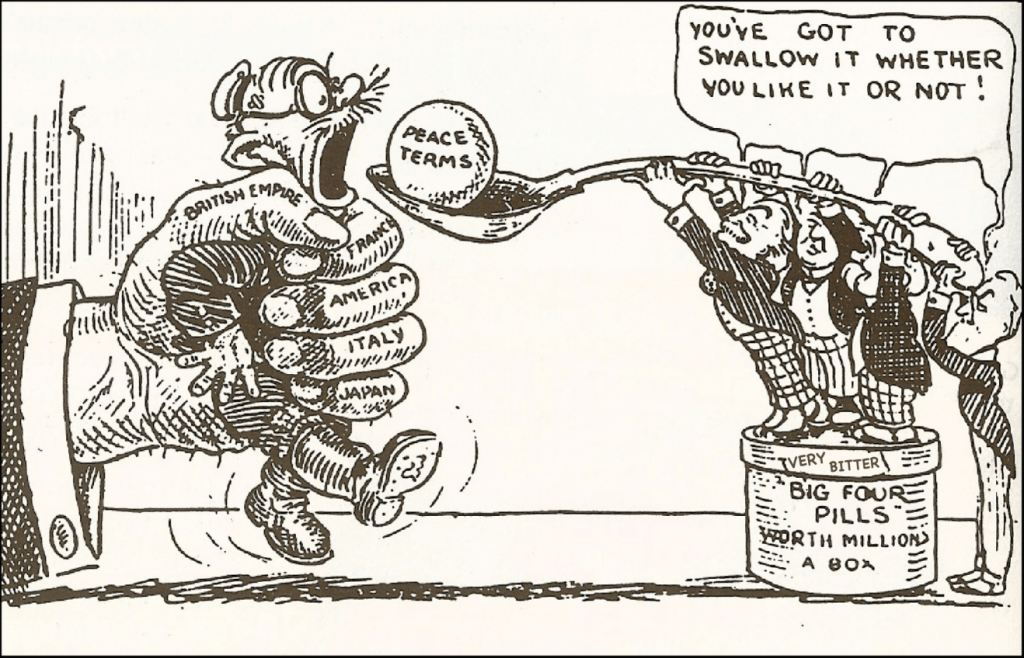
Treaty of Versailles Bitter Pill Cartoon. (6:35 minutes long)
Treaty of Versailles – Cartoon Analysis (‘100 billion marks’). (7:43 minutes long)
(WordPress advertisements may appear below.)
Y10: 4-8. The Big Three – Satisfied?
Today you are going to consider whether the Big Three were satisfied with the terms of the Treaty of Versailles…
1.
Read the relevant details from your booklet, just to make sure that you remember the terms of the Treaty of Versailles…
“Germany re-made – the Treaty of Versailles” , p.15.
2.
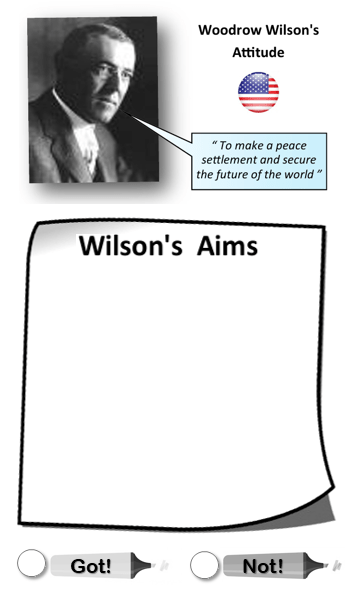
Use worksheet to write down what each of the Big Three wanted. Then highlight to show which of their aims were granted and which of their aims were not realised.

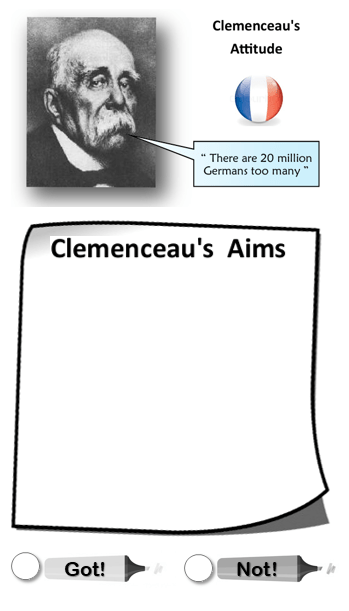
SOLUTION:
3.
Use the worksheets below to consider the terms of the Treaty of Versailles and whether they satisfied the peace makers.
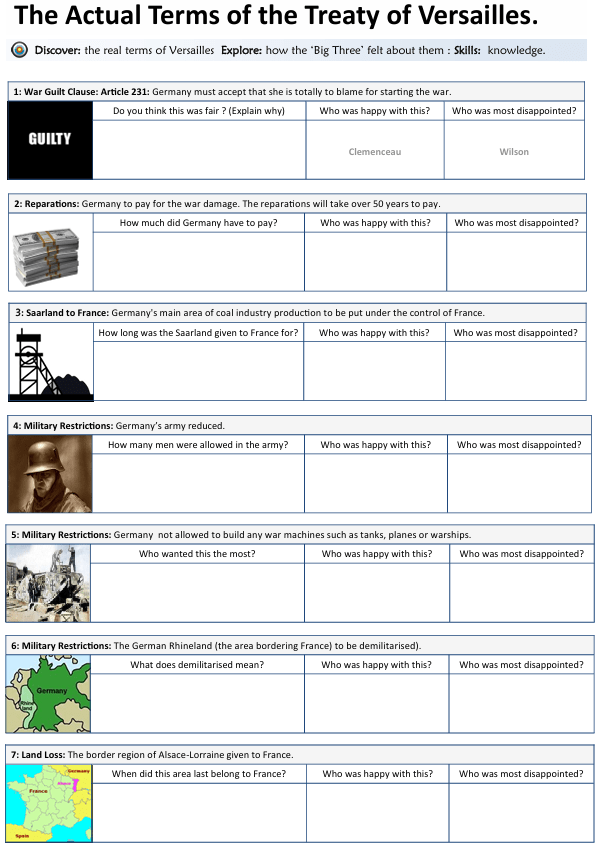
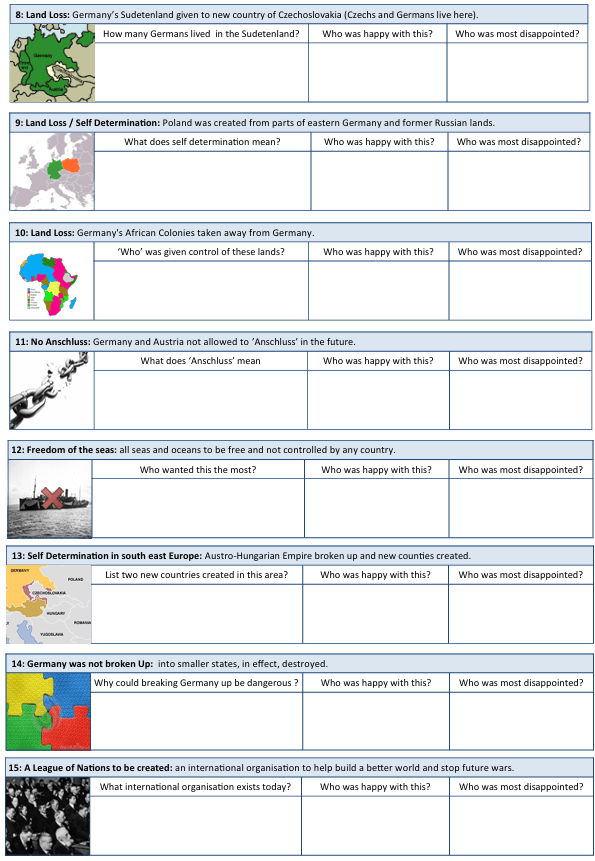
SOLUTION:
(WordPress advertisements may appear below.)
Y10: 4-7. Terms of the Treaty – Tasks
Today you are going to do tasks related to the terms of the Treaty of Versailles, to test your knowledge and understanding….
1.
First complete the task below, to test your knowledge so far. (Stick the task into your book and then complete it…)
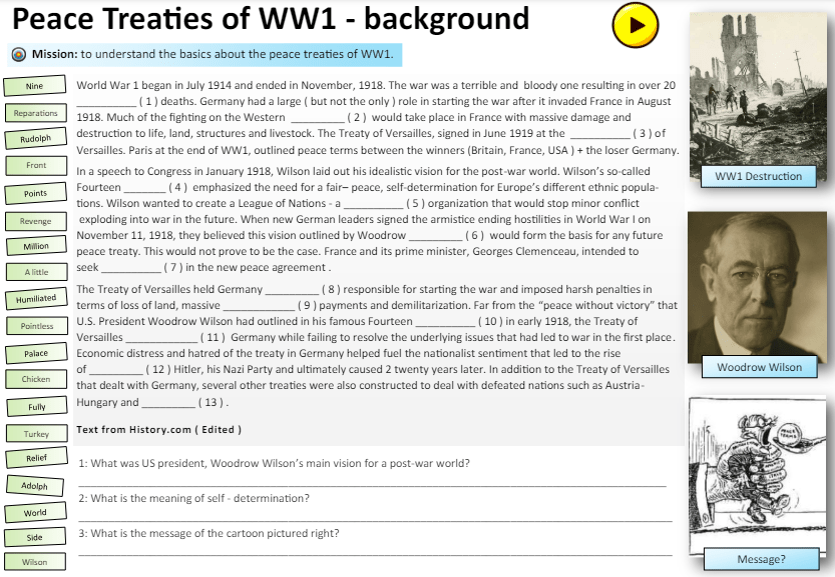
SOLUTION:
2.
Let’s see if you know the following key terms:
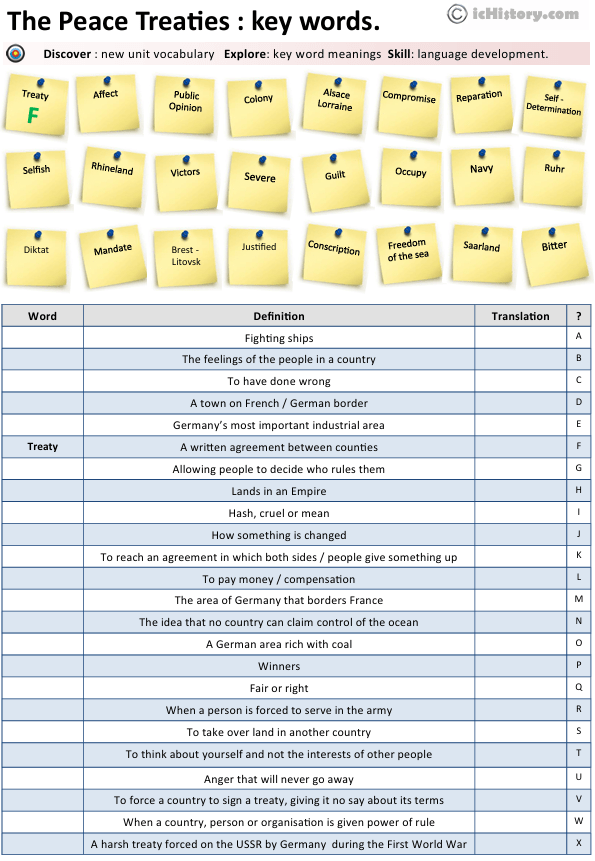
SOLUTION:
3.
If not completed before, do the crossword puzzle below.
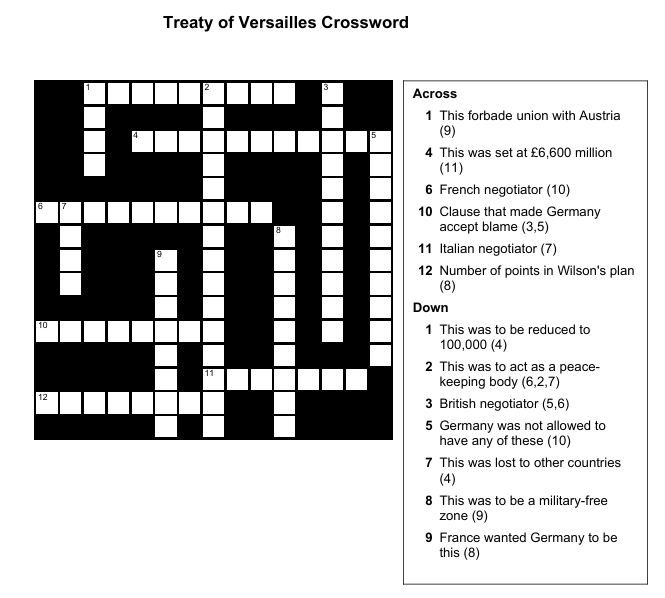
SOLUTION:
6.
The Treaty of Versailles, Terms of the Treaty. (1:53 minutes long)
7.

5: GCSE History – Terms of the Treaty. (11:38 minutes long)
(WordPress advertisements may appear below.)
Y10: 4-6. Treaty of Versailles II
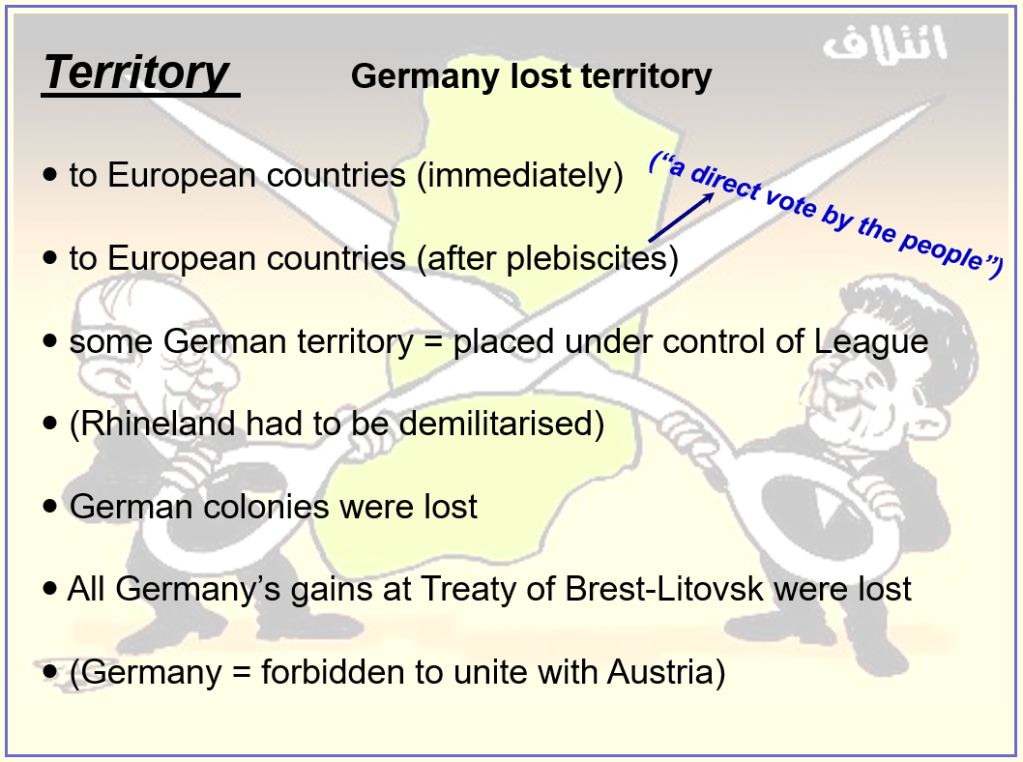
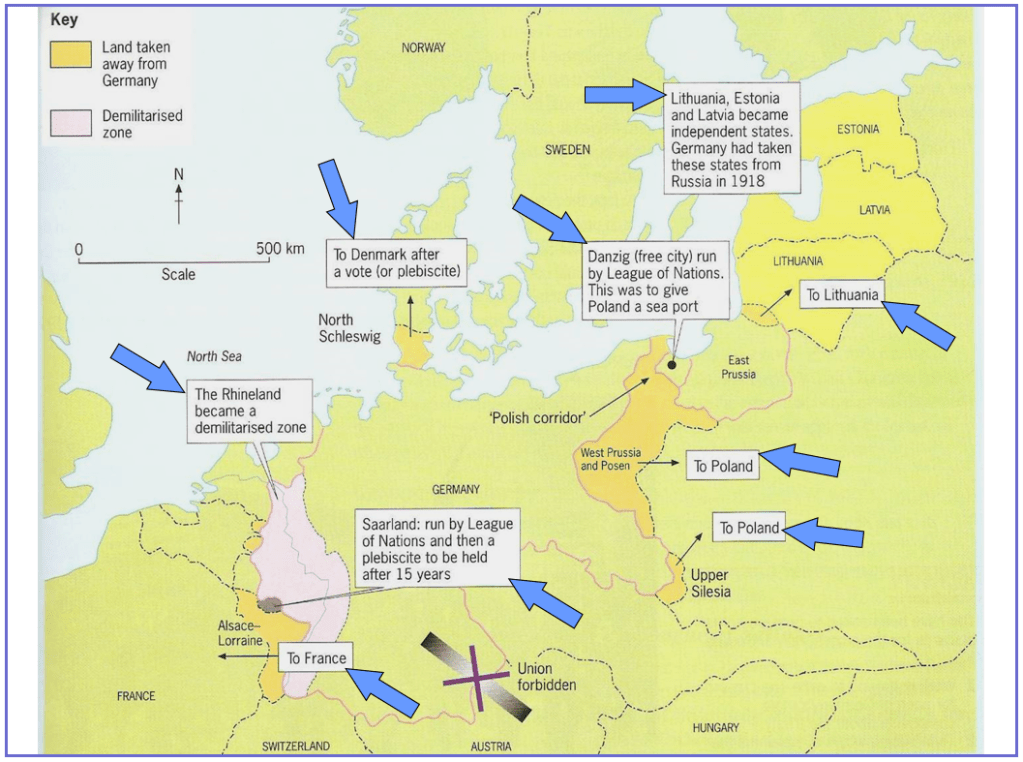
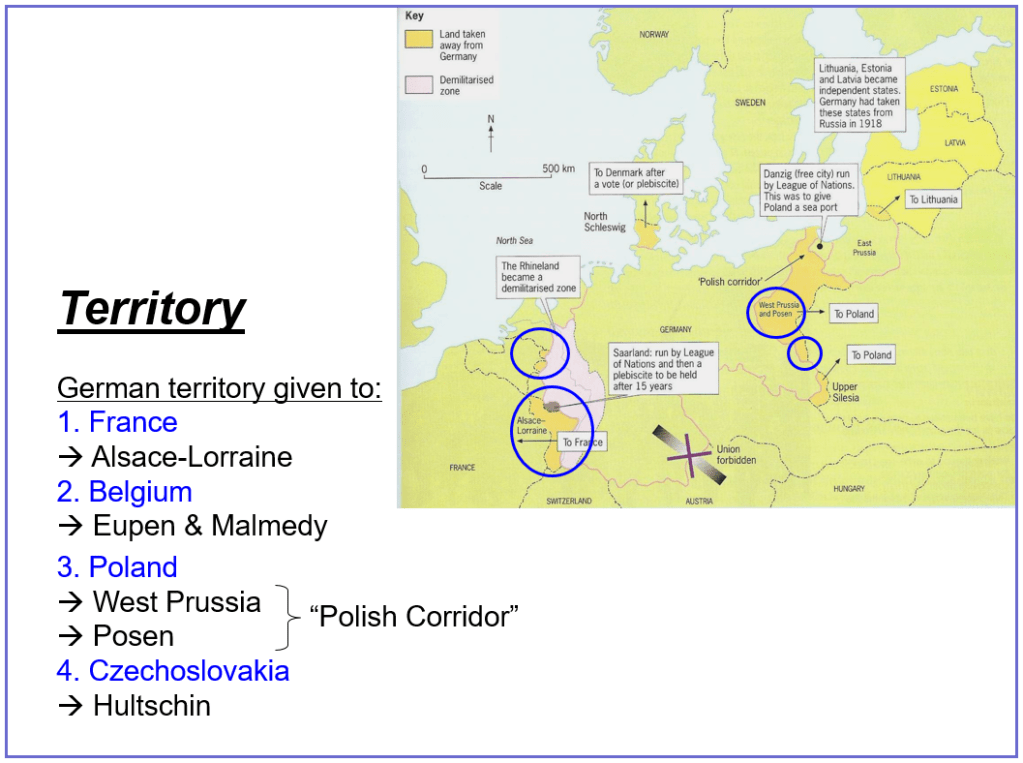
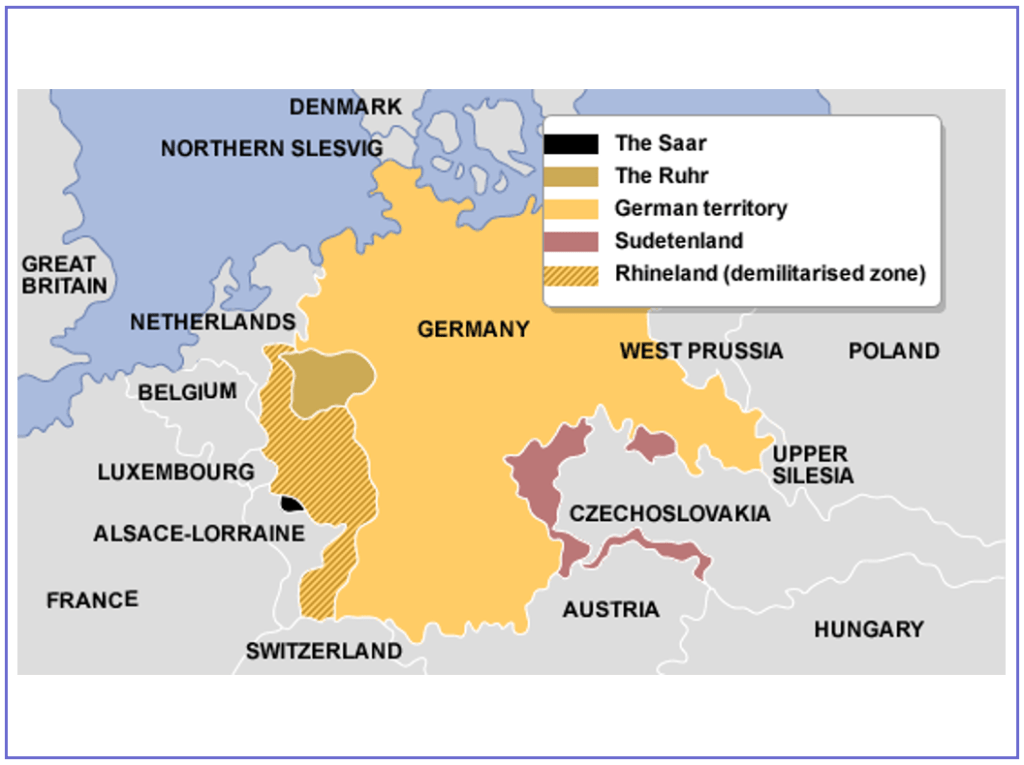
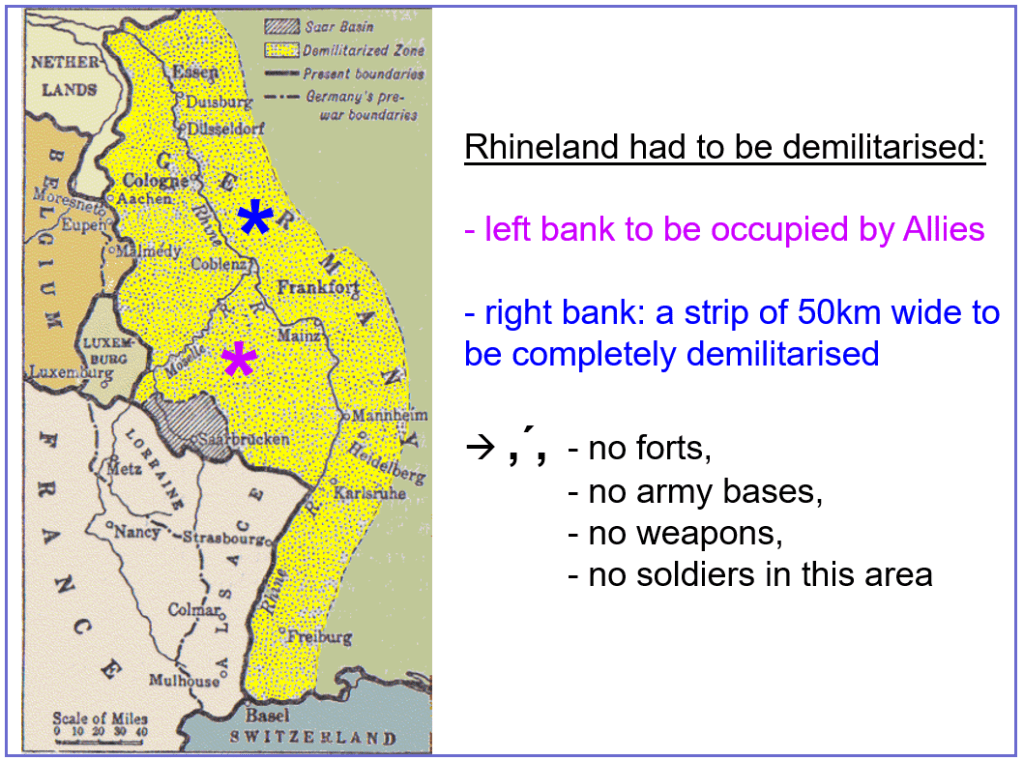
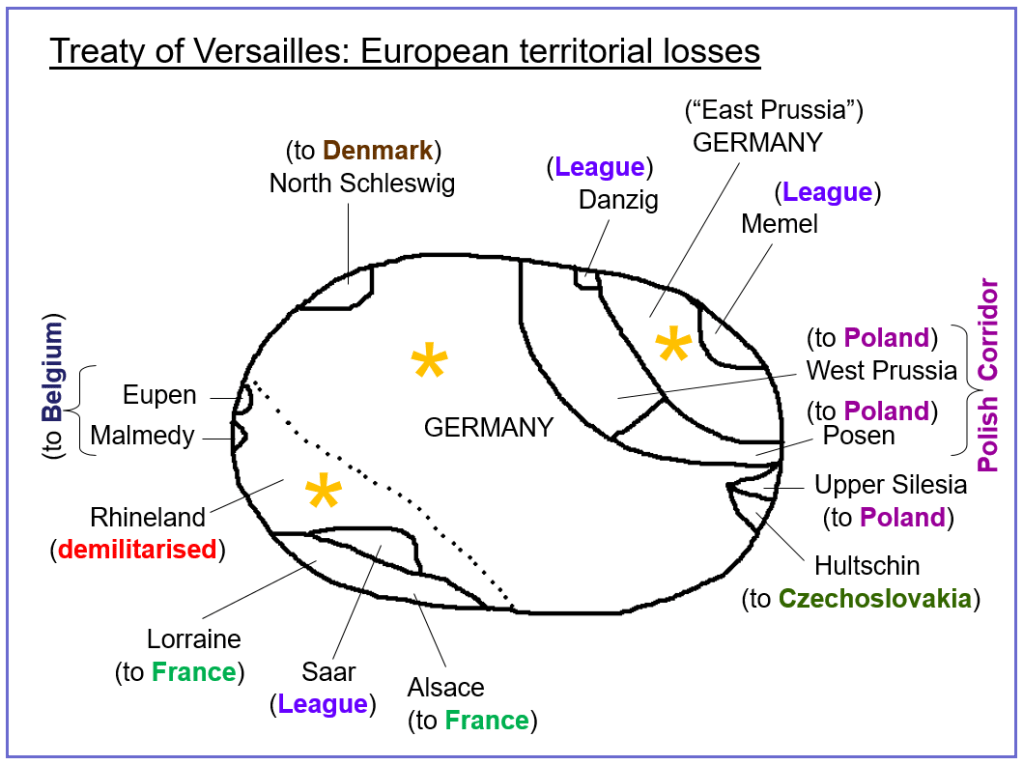
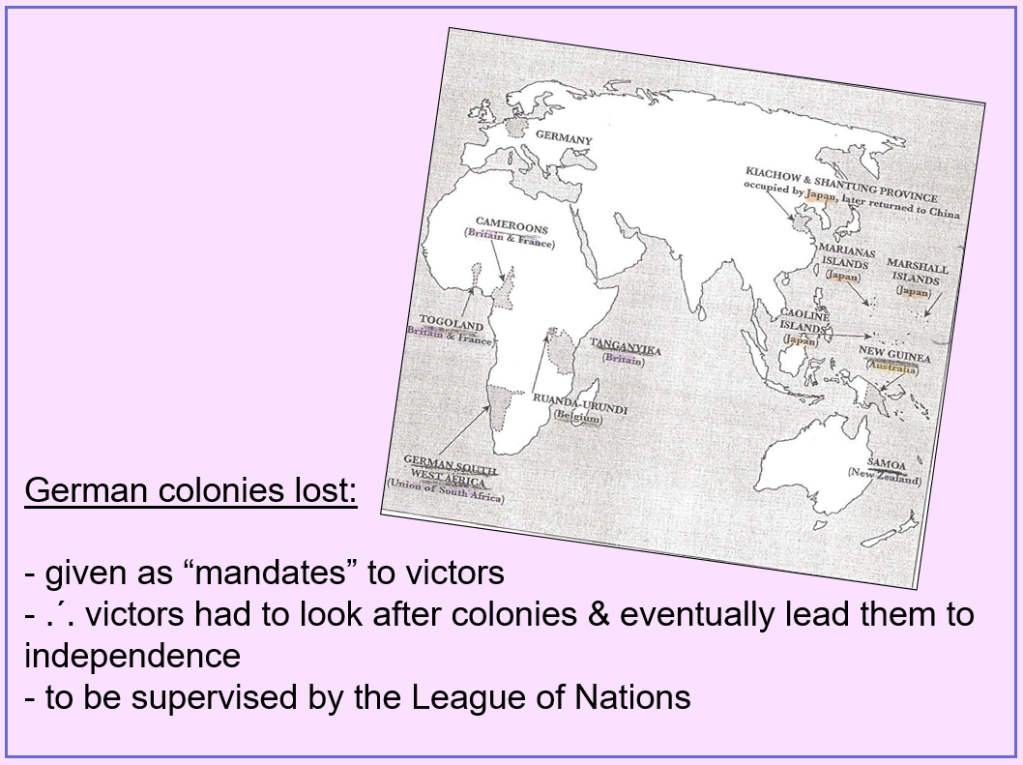
Today you are going to look at the territorial terms of the Treaty of Versailles….
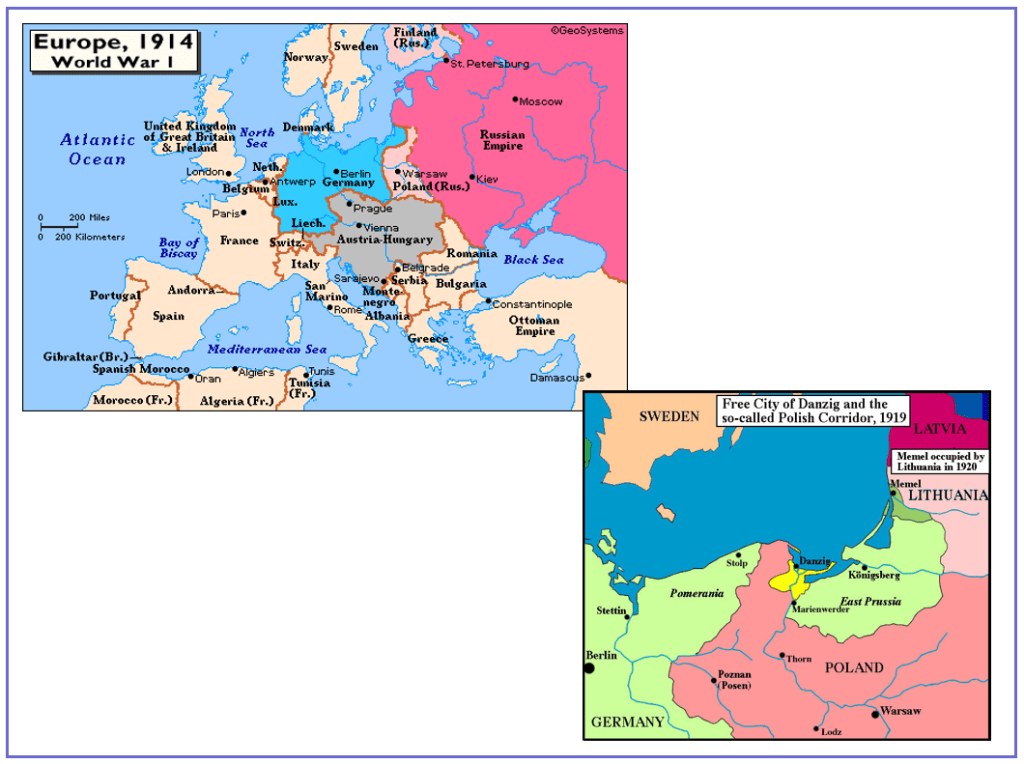
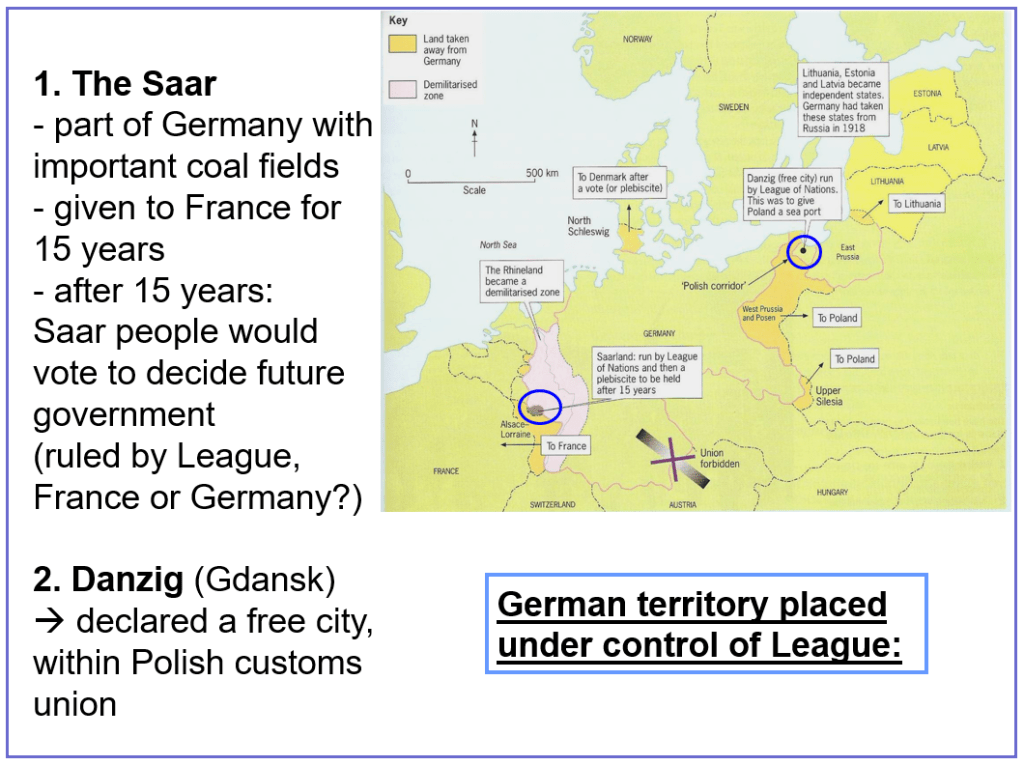
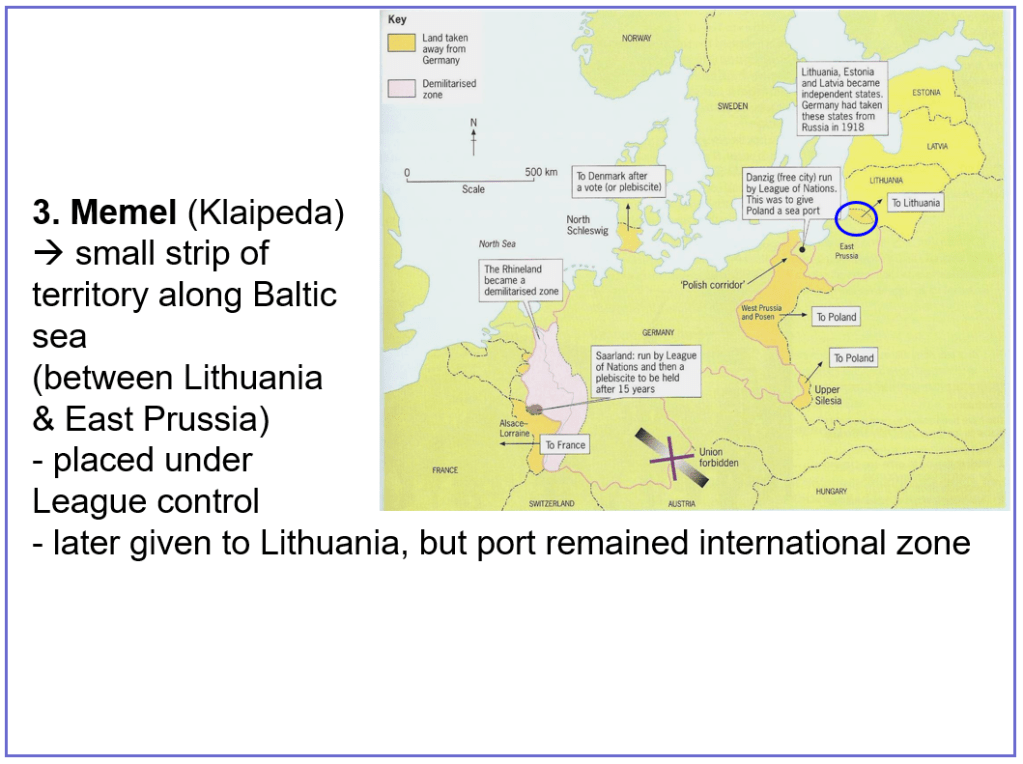
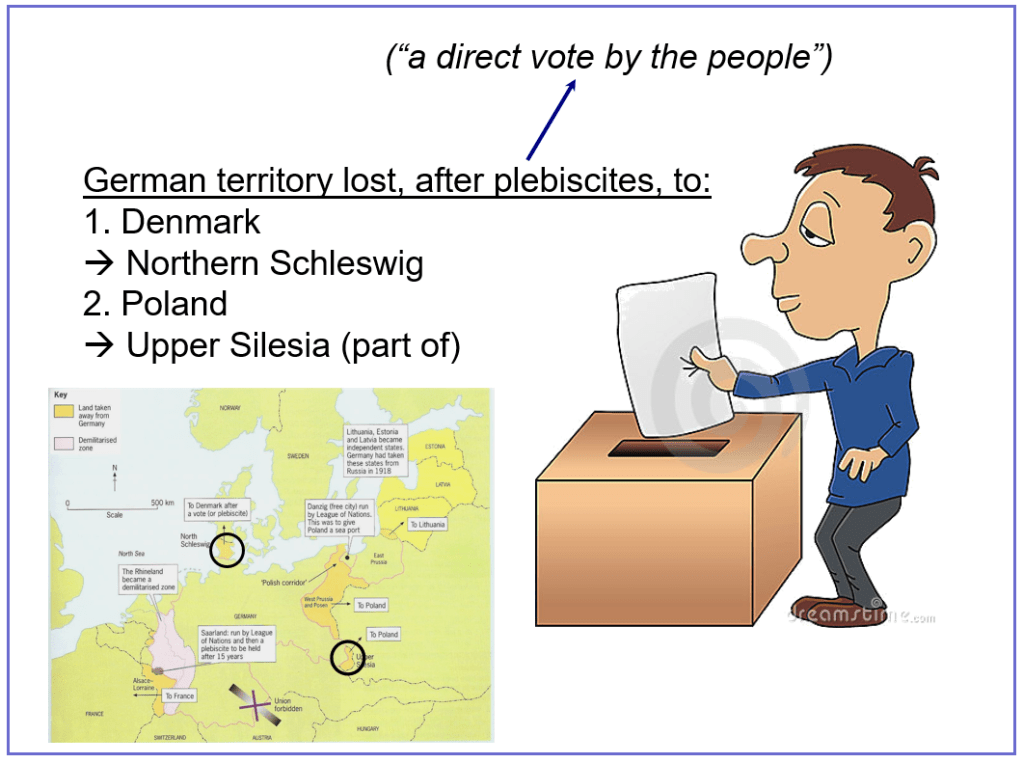
1.
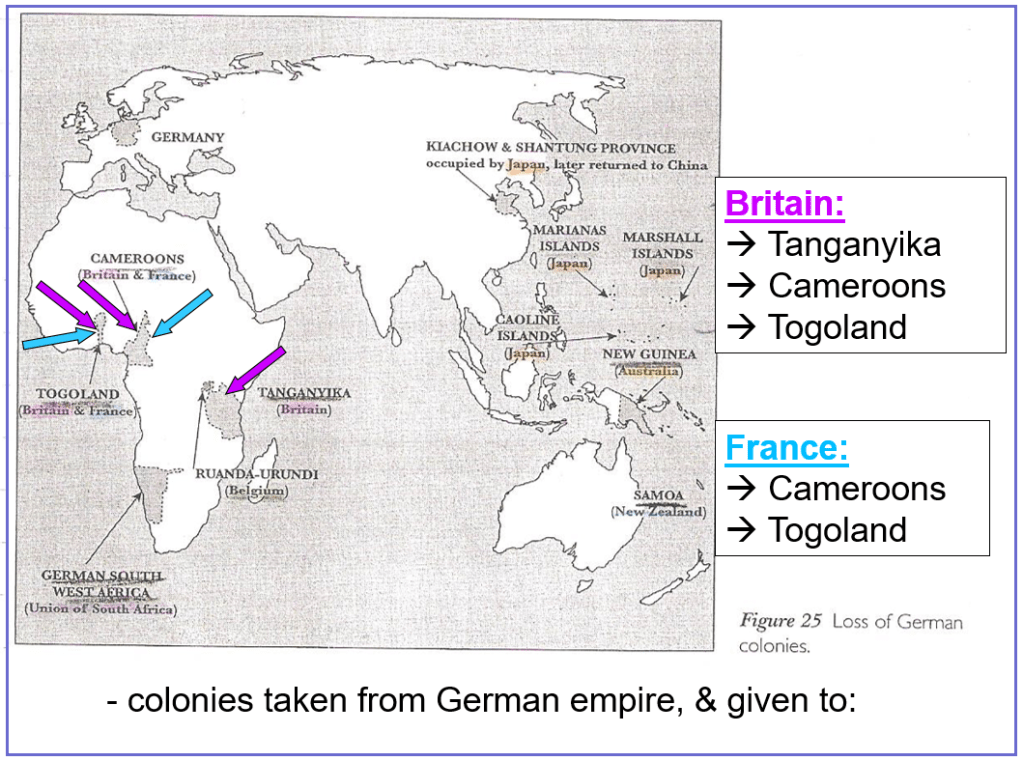
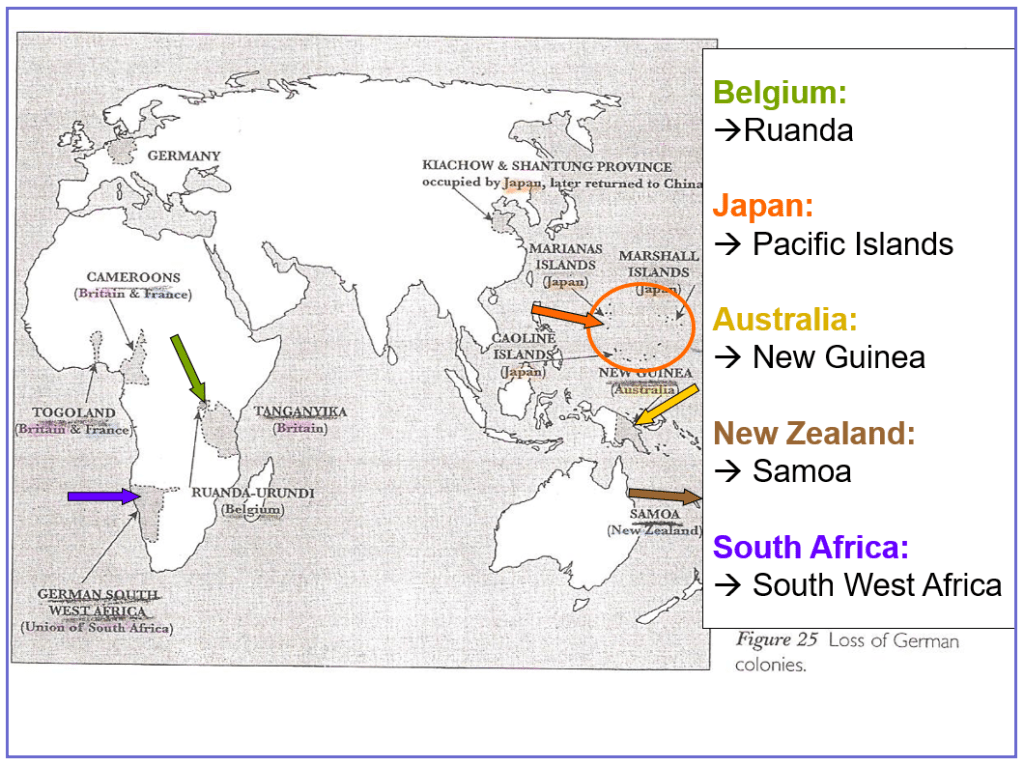
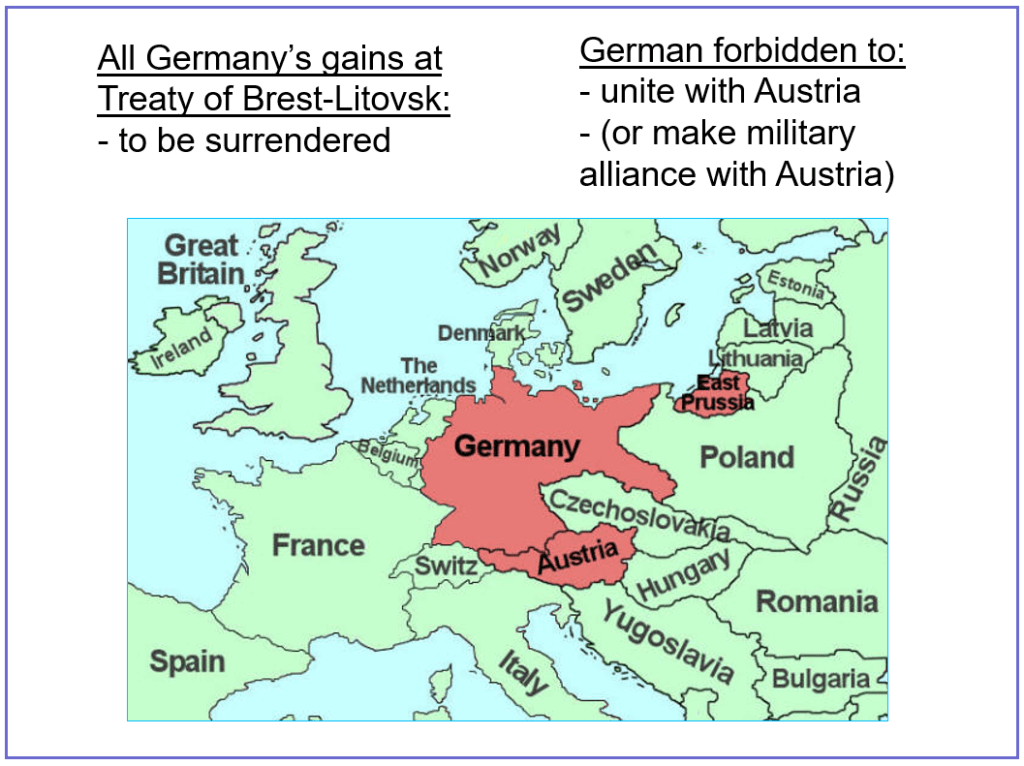
Navigate through the slides (by swiping to the left) to learn more about specific territorial terms included in the Treaty of Versailles…
2.
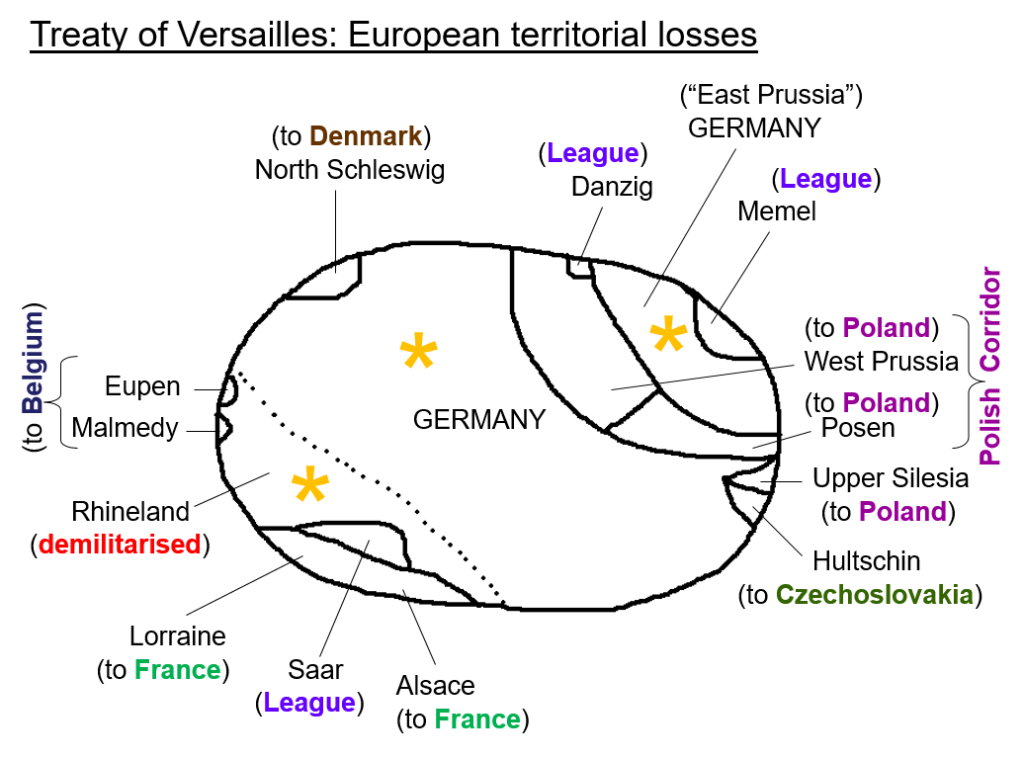
Copy the details regarding territorial losses in Europe, suffered by Germany, as specified in the Treaty of Versailles.
Copy the following diagram (p.13):
3.
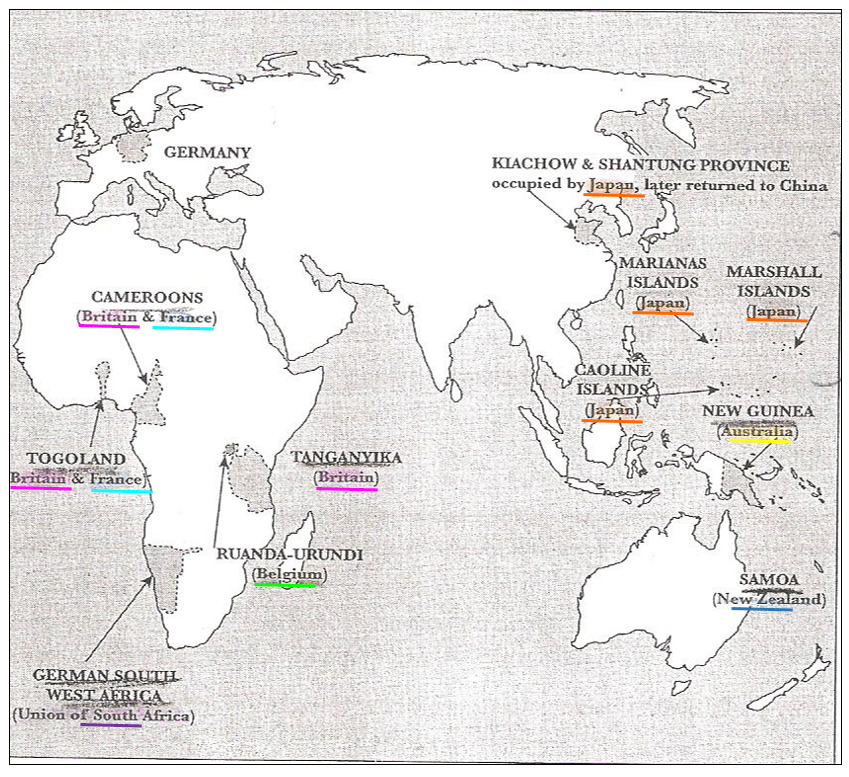
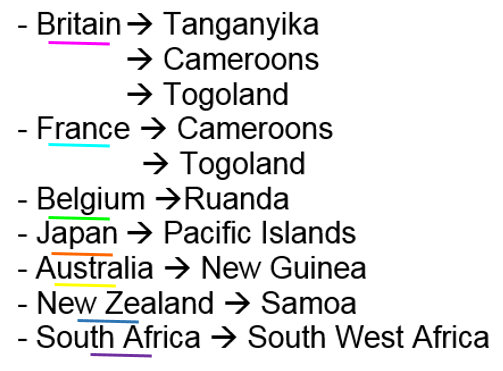
Copy the details regarding colonial losses, suffered by Germany, as specified in the Treaty of Versailles.
Copy the following details onto the map (p.14):
4.
…about Territorial Losses, p.12-14.
5.
Versailles Terms Part 2. (4:39 minutes long)
6.
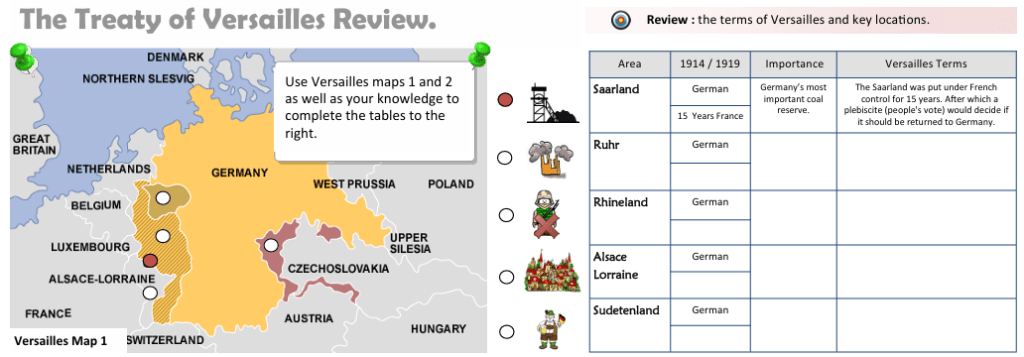
Complete the task below to show the relevance of some the territories mentioned in the Treaty of Versailles.
SOLUTION:
7.
The Treaty of Versailles, Terms of the Treaty. (1:53 minutes long)
8.
5: GCSE History – Terms of the Treaty. (11:38 minutes long)
9.
And finally, here are ALL the fill-in answers to the Terms of the Treaty of Versailles again. For revision purposes, see if you can remember the missing information! (Talk yourself through the terms of the Treaty of Versailles!)
Treaty of Versailles – fill-in Answers. (5:49 minutes long)
(WordPress advertisements may appear below.)
Y10: 4-5. Treaty of Versailles I
Today you are going to look at some of the terms of the Treaty of Versailles….
1.
So, on 28 June 1919 the Treaty of Versailles was signed…
Centenary of signing the Treaty of Versailles. (0:40 minutes long)
2.
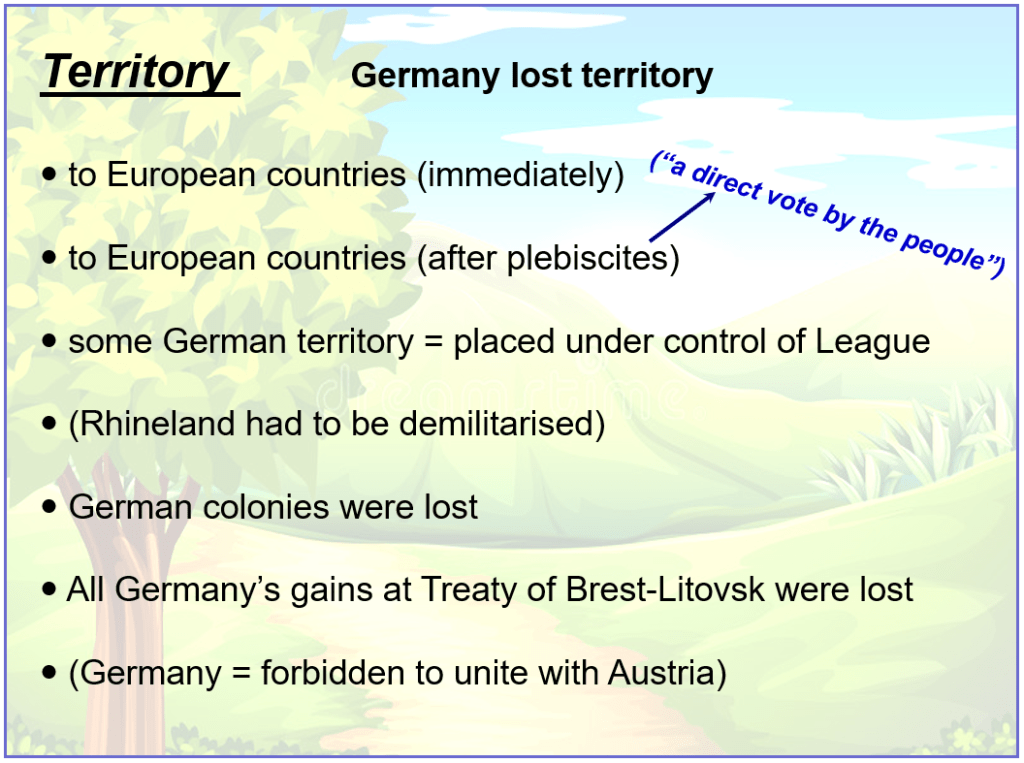
Navigate through the slides (by swiping to the left) to learn more about some of the terms of the Treaty of Versailles…



3.
…about “Terms of the Treaty of Versailles” (p.11 only).
4.
Versailles Terms Part 1. (1:26 minutes long)
5.
The Treaty of Versailles, Terms of the Treaty. (1:53 minutes long)
6.
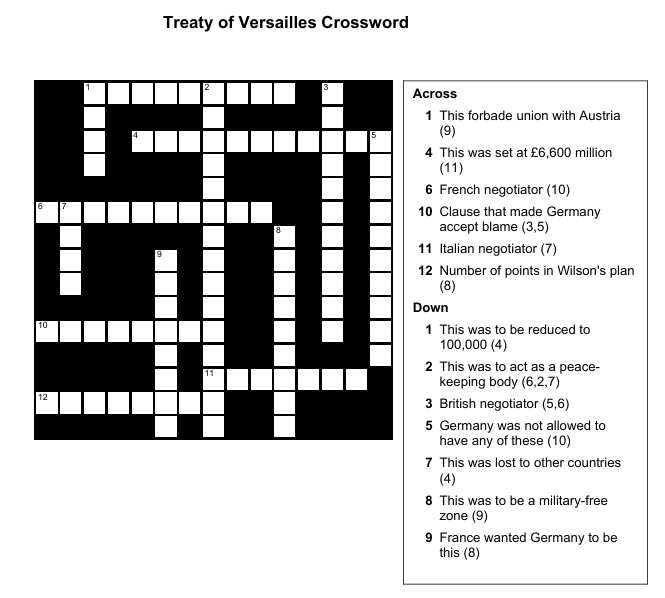
Test your knowledge(so far…) of the terms of the Treaty of Versailles…
SOLUTION:
7.
5: GCSE History – Terms of the Treaty. (11:38 minutes long)
(WordPress advertisements may appear below.)
Y10: 4-4. Difficulties in Making Peace
Today you are going to continue looking at the difficulties that the Big Three faced when drawing up the terms of the Peace Treaties…
1.
Read “Great Expectations” (p.7), to refresh your memory…
2.
It was difficult to draw up the terms of the peace treaties because of the different aims and attitudes of the Big Three. However, there were also other obstacles in the peace making process.
Obstacles in the Peace Making Process. (1:55 minutes long)
3.
You have the same information in your Booklet on Peace Treaties, on page 10. There is also additional information on page 39-40.
Read “Great Expectations” (p.10)
&
Read “Difficulties in Making the Peace” (p.39-40)
4.
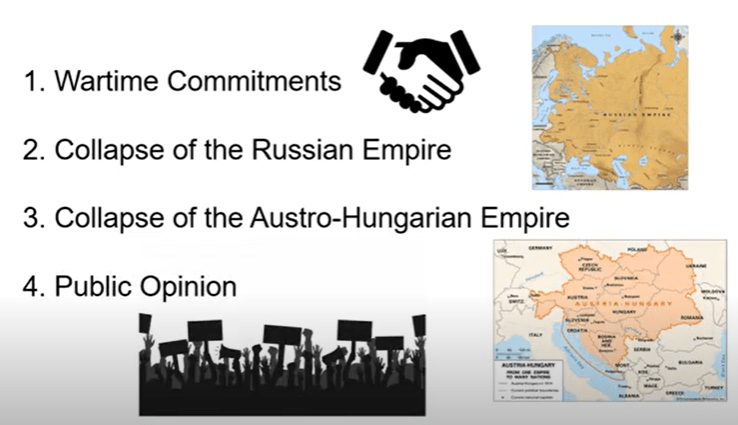
Make a set of slides that explain how one of the points mentioned below made it difficult for the peace makers to draw up the terms of the treaties: (Remember, you will find the relevant details on pages 39-40.)
IMPORTANT: Make sure that you show your understanding by including relevant images!
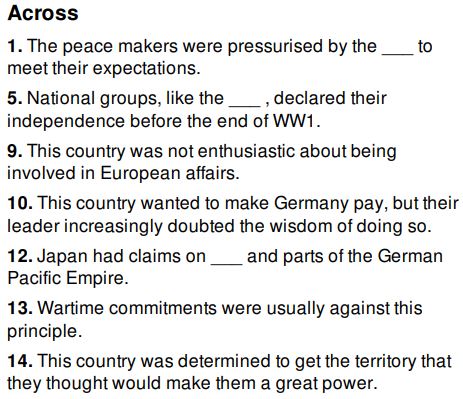
5.
Stick the crossword into your book and then complete it…

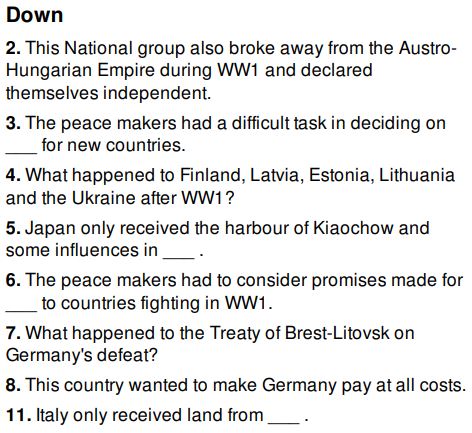
SOLUTION:
&
(WordPress advertisements may appear below.)
Y10: 4-3. Fourteen Points
Today you are going to continue looking at Woodrow Wilson’s Fourteen Points…
1.
Read “Great Expectations” (p.7)
2.
Let’s look again at Wilson’s “Fourteen Points”:
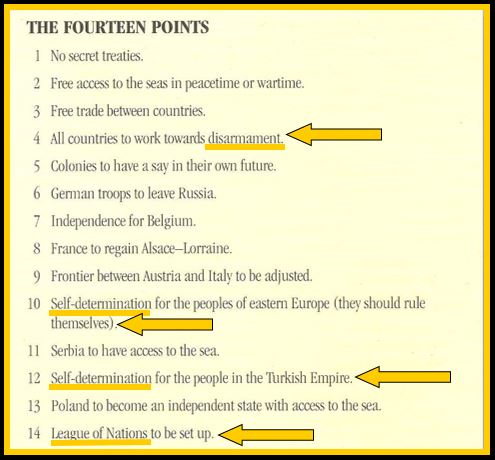
Make sure to memorize the points that are most relevant to your study. They are indicated with yellow arrows.
3.
The following two video clips tells us a bit more about Woodrow Wilson’s “Fourteen Points”:

Woodrow Wilson’s Fourteen Points for Dummies. (2:09 minutes long)
USA in WWI: Wilson’s Fourteen Points. (3:44 minutes long)
4.
Now, use the table on page 8 in your Peace Treaties booklet to show the Big Three’s views on some of the “Fourteen Points”. (Use the cut-out answers provided…)
- In the first column, briefly explain what Wilson intended with the point mentioned.
- In the second column, speculate how Clemenceau might have viewed the point.
- In the last column, speculate how Lloyd George might have viewed the point.
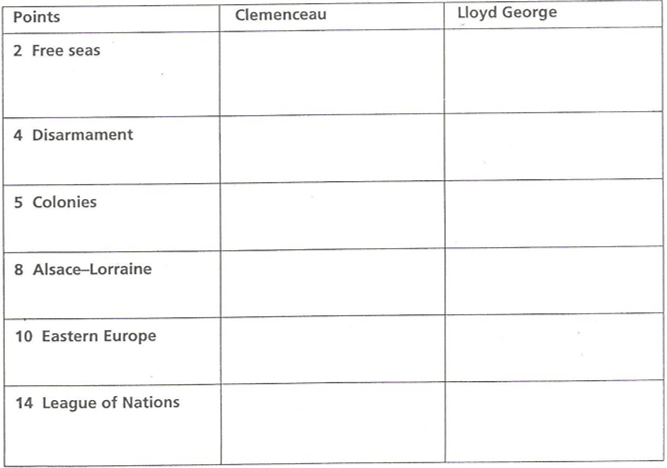
Cut-out answers:
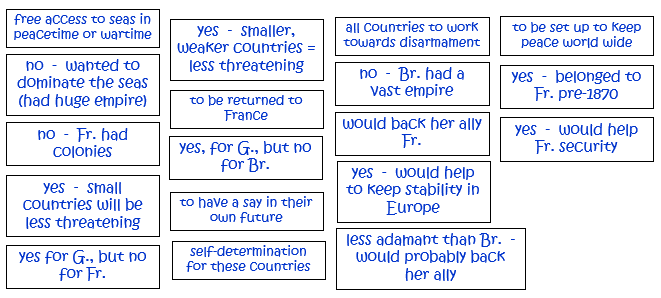
SOLUTION:
5.
The Big Three had a difficult job because they had to satisfy all to victorious countries – an impossible task! Moreover, their different aims and attitudes further complicated the peace making process…
Read the information below from B.Walsh about the different attitudes and aims of the Big Three.

6.

If you are interested in “The Fourteen Points”, read the original text in the document below:
(WordPress advertisements may appear below.)
Y10: 4-2. The Big Three – Aims
Today you are going to get to know the Big Three better…
1.
So, the Big Three met at the Palace of Versailles in January 1919 to discuss the peace terms to be imposed on the defeated countries. However, the three representatives had very different attitudes and aims, which complicated the peace talks…
The Big Three. (5:50 minutes long)
2.
Fill in the missing information on p.4-6, on:
“What the Big Three wanted”.
SOLUTION:

(5:16 minutes long)
3.
See if you know what each of the Big Three wanted. Stick the following task into your book and then complete it…
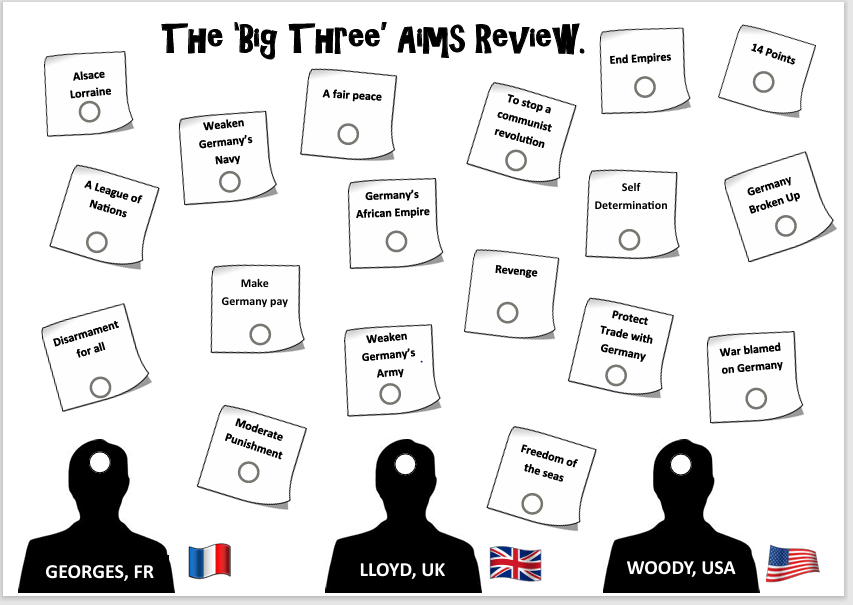
SOLUTION:
4.

Complete the table on page 9 to show “The Aims of the Leaders at the Paris Peace Conference”:
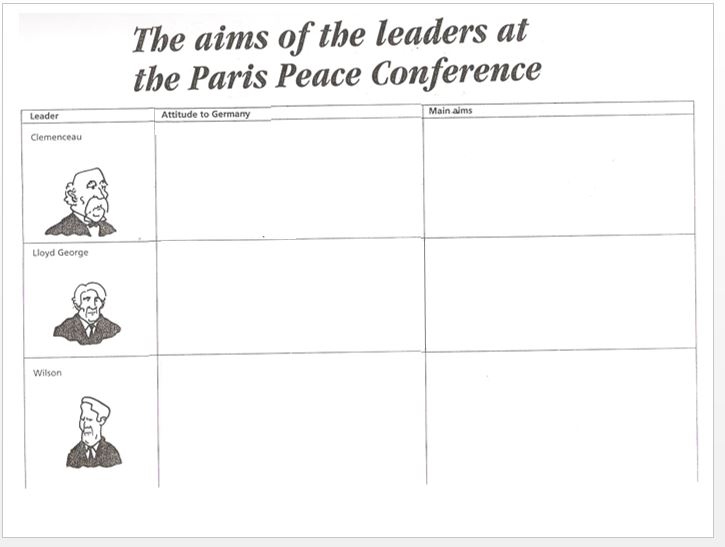
SOLUTION:
5.
The Big Three had a difficult job because they had to satisfy all to victorious countries – an impossible task! Moreover, their different aims and attitudes further complicated the peace making process…
4: GCSE History – The Big Three. (13:59 minutes long)
(WordPress advertisements may appear below.)
Y10: 4-1. Peace Conference
Today you are going to start with the topic on…
Post-war Peace Treaties!
1.
You will use a new exercise book for the Post-War Topic. Stick the following into your new green exercise book:
1-The content page that shows what we will be covering in this topic:
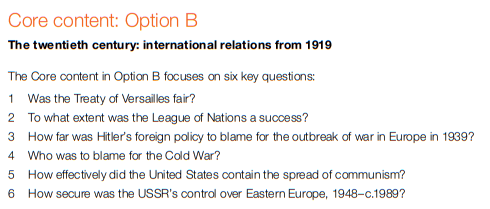
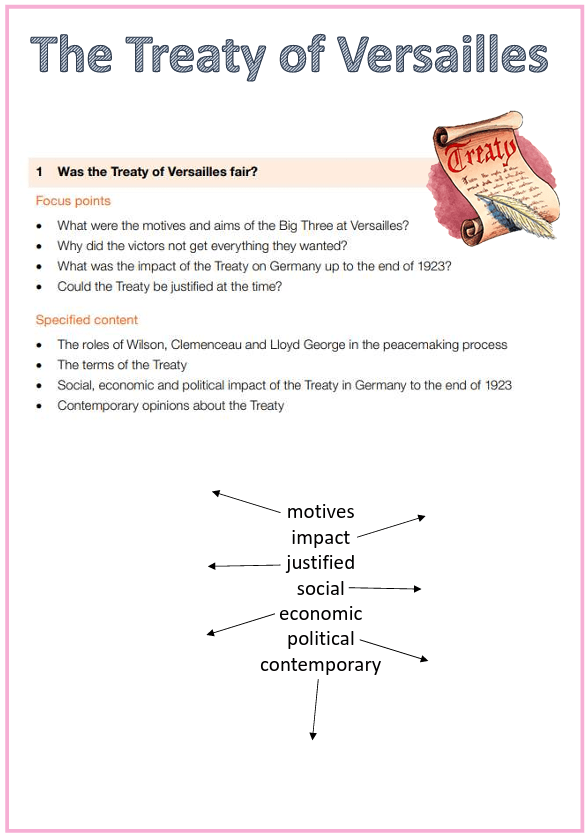
2-The title page to indicate the start of the topic on Post-War Peace Treaties:
2.
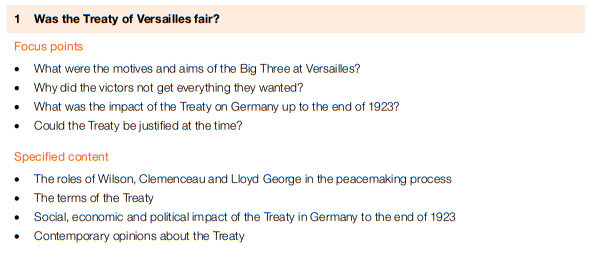
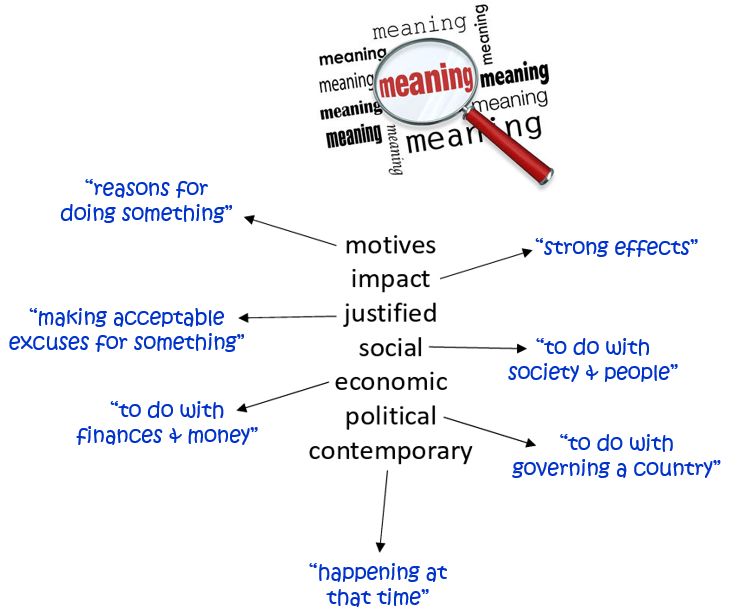
Carefully examine the Specification details for Option B, to determine what we will cover in this topic.
3.
Now, watch the following introduction to the Paris Peace Conference…
Peace Treaties. (2:33 minutes long)
4.
Your booklet on Post-War Peace Treaties shines light on the circumstances that the representatives faced in 1919, with a Europe that was devastated after World War One.
The article about “Great Suffering” , p.1.
5.
Fill in the missing information on p.2-3, on:
“The Peace Conference of 1919”.
SOLUTION:
(2:22 minutes long)
6.
Here is a brief introduction on what the Big Three wanted at the Paris Peace Conference.
The Treaty of Versailles, What Did the Big Three Want? (2:48 minutes long)
(WordPress advertisements may appear below.)
Y10: 7-8. Specification Questions on Russia (1900-1941)
1.
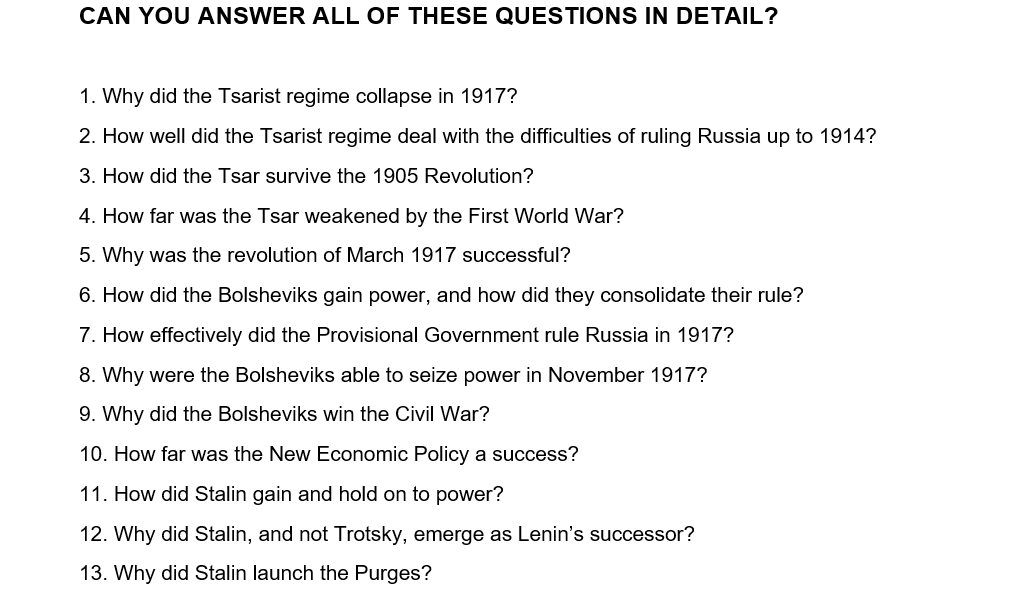
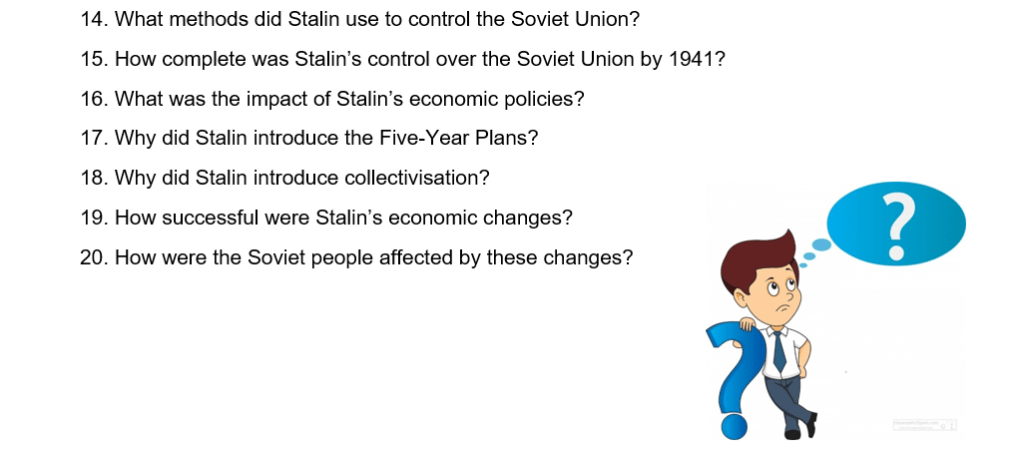
Can you answer all of these questions in detail?
2.
SOLUTIONS

The Collapse of the Tsarist regime.
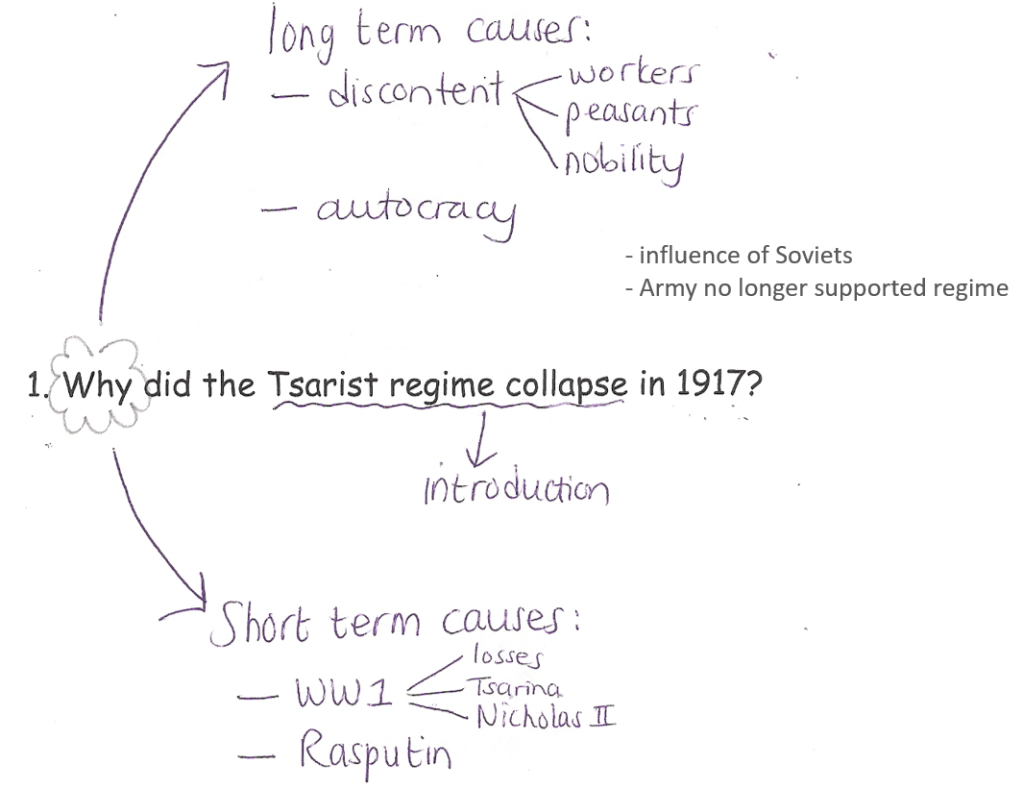
QUESTION 1.
Why did the Tsarist regime collapse in 1917?
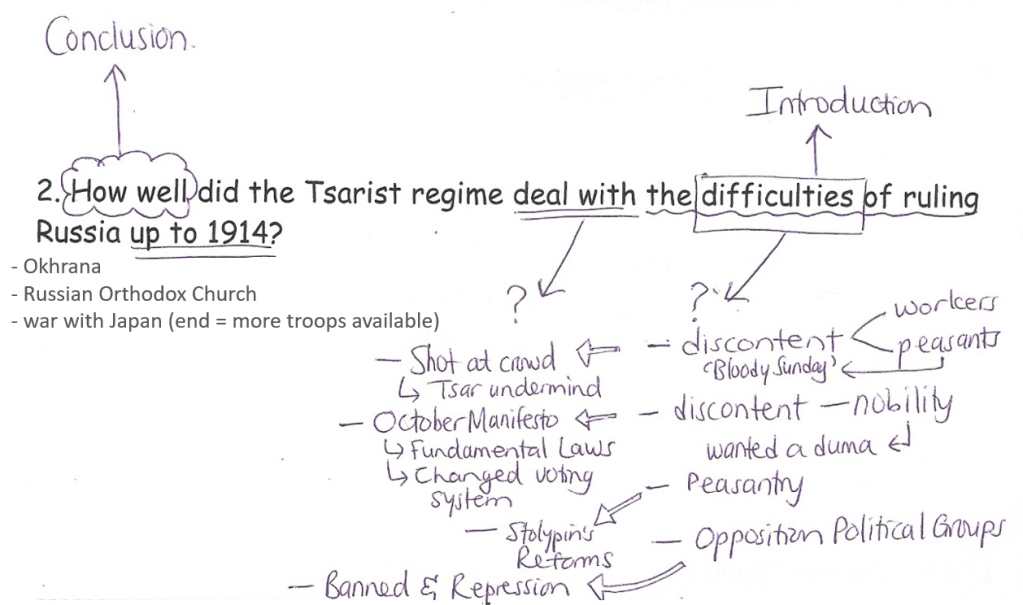
QUESTION 2.
How well did the Tsarist regime deal with the difficulties of ruling Russia up to 1914?
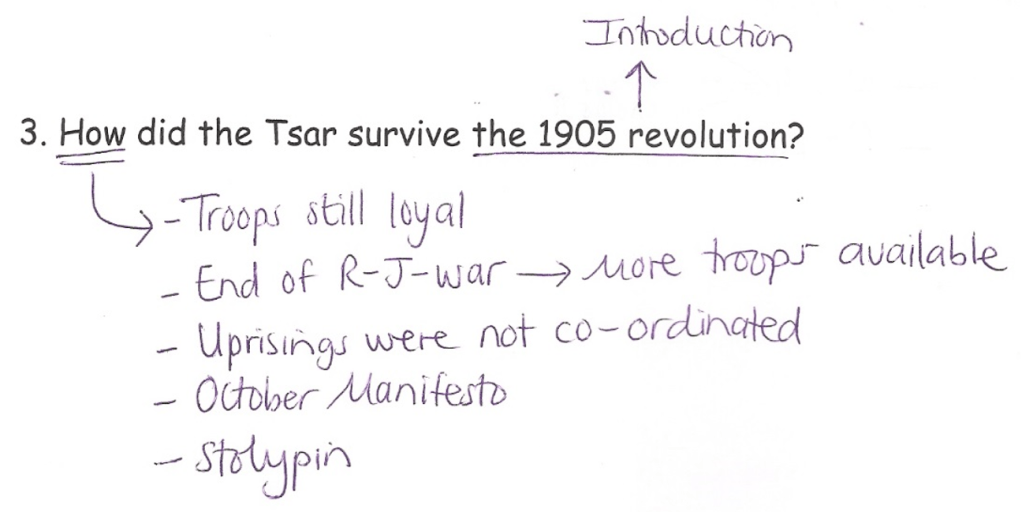
QUESTION 3.
How did the Tsar survive the 1905 revolution?
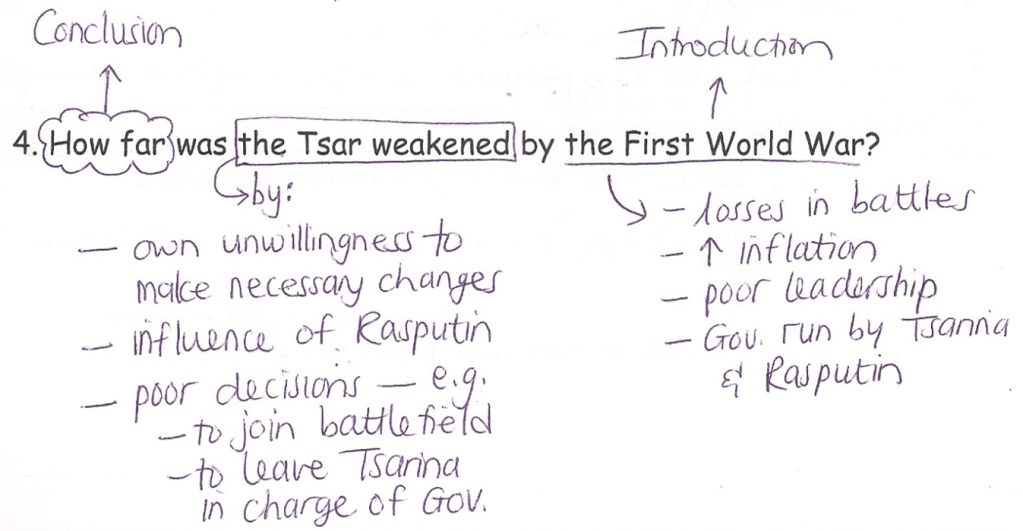
QUESTION 4.
How far was the Tsar weakened by the First World War?
QUESTION 5.
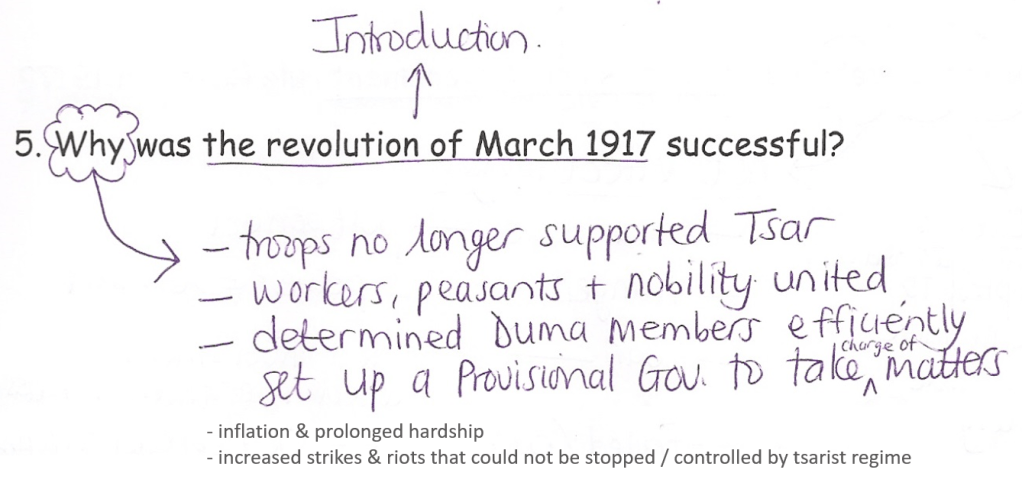
Why was the revolution of March 1917 successful?
The Bolsheviks.
QUESTION 6.
How did the Bolsheviks gain power, and how did they consolidate their rule?

…how did the Bolsheviks consolidate their rule?

QUESTION 7.
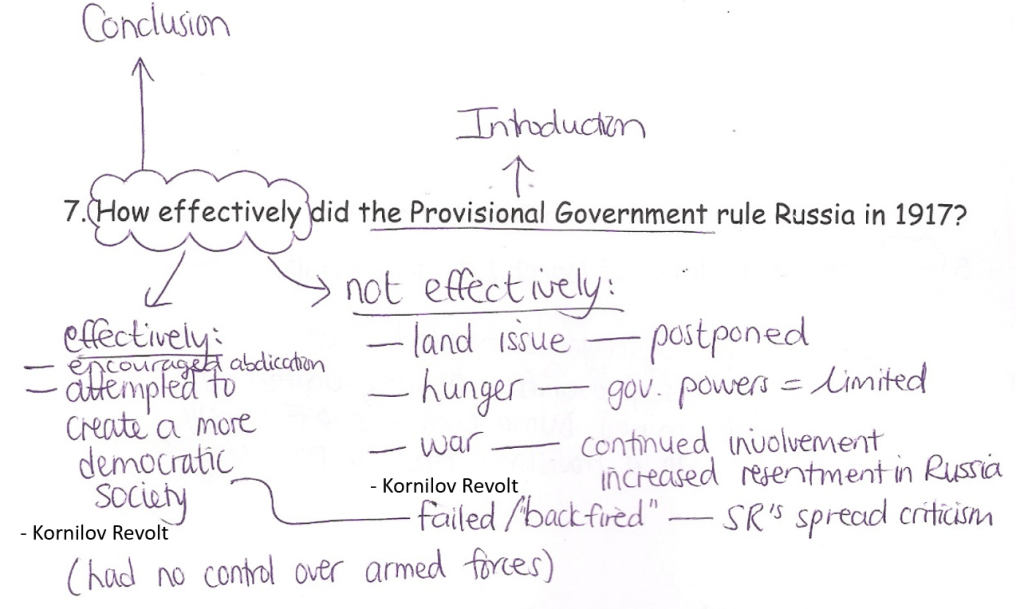
How effectively did the Provisional Government rule Russia in 1917?
QUESTION 8.
Why were the Bolsheviks able to seize power in November 1917?

QUESTION 9.
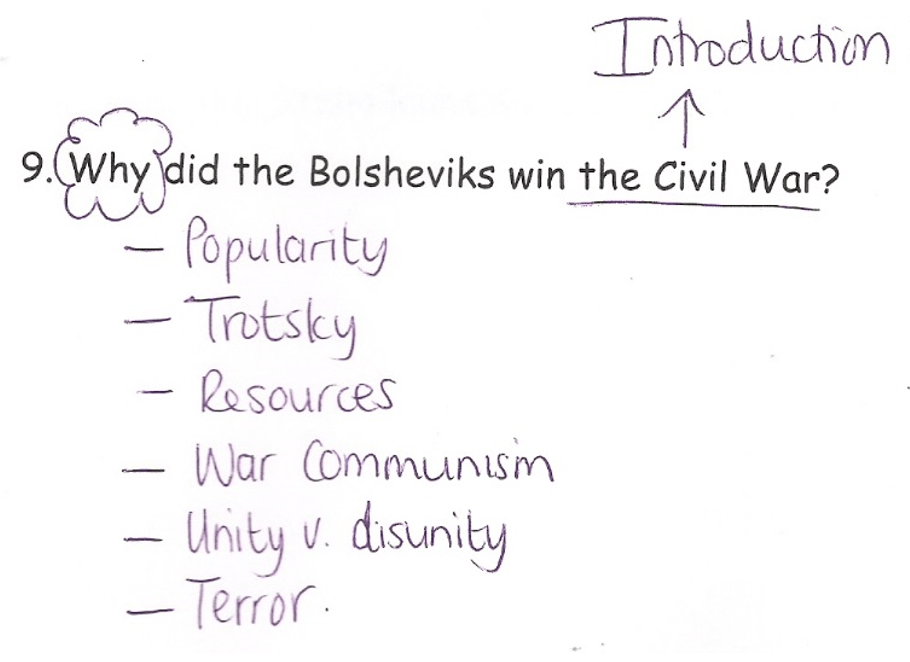
Why did the Bolsheviks win the Civil War?
QUESTION 10.
How far was the New Economic Policy a success?

Stalin’s Rule.
QUESTION 11.
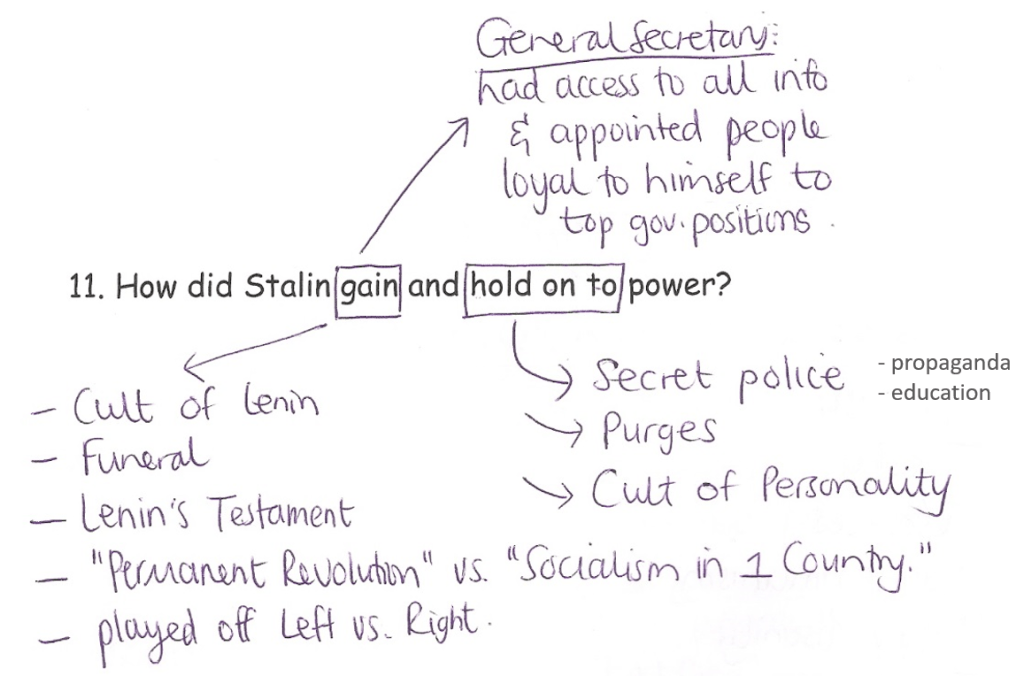
How did Stalin gain and hold on to power?
QUESTION 12.
Why did Stalin, and not Trotsky, emerge as Lenin’s successor?

QUESTION 13.
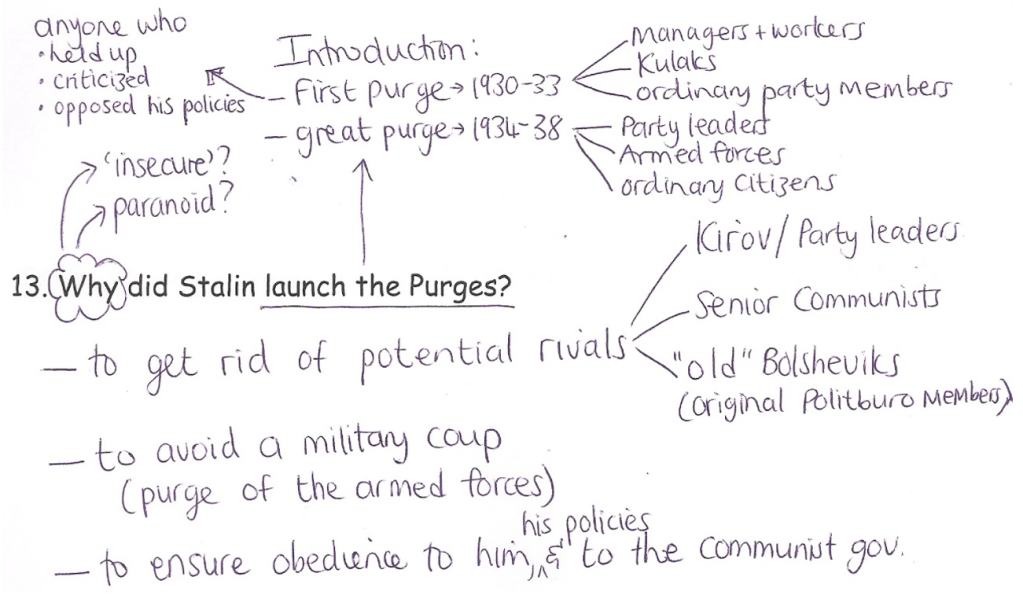
Why did Stalin launch the Purges?
QUESTION 14.
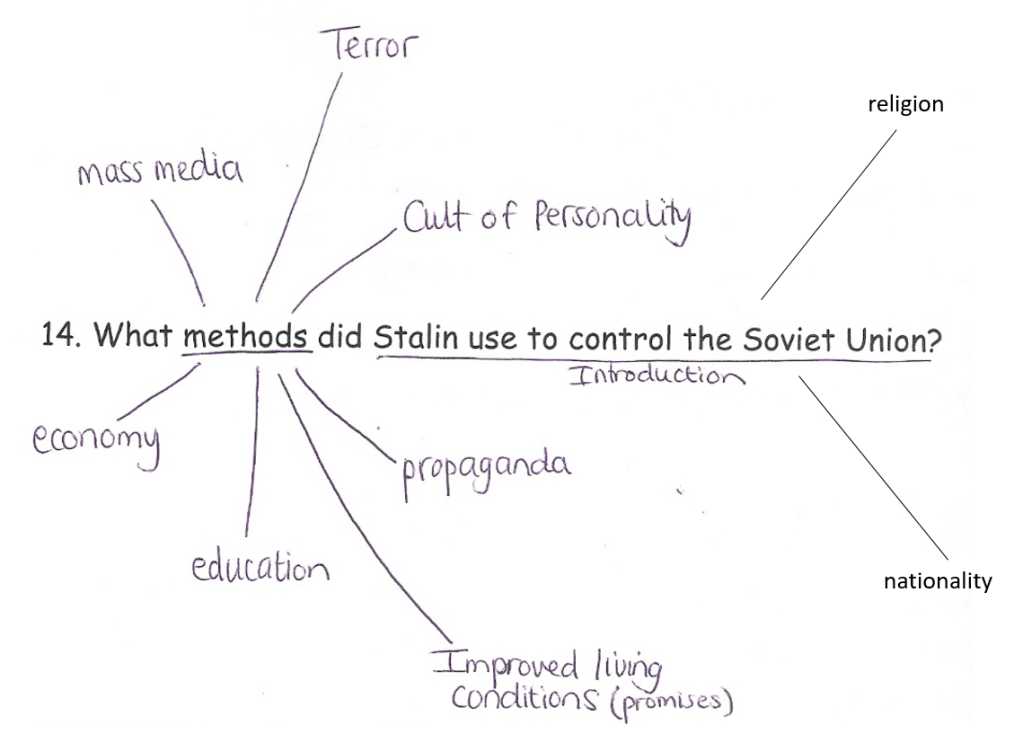
What methods did Stalin use to control the Soviet Union?
QUESTION 15.
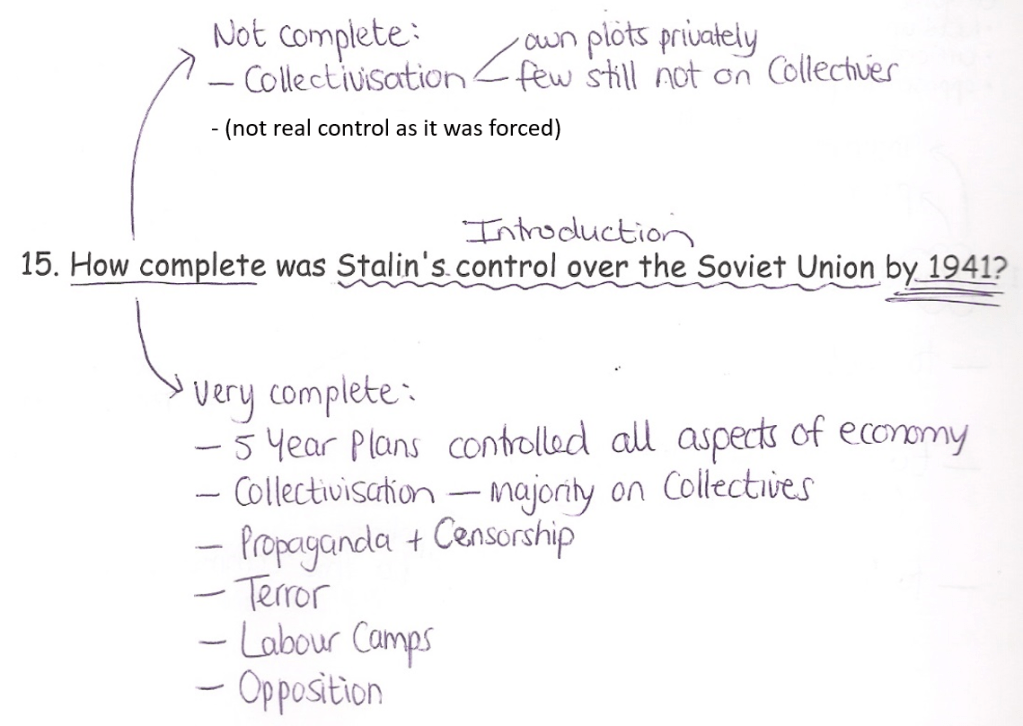
How complete was Stalin’s control over the Soviet Union by 1941?
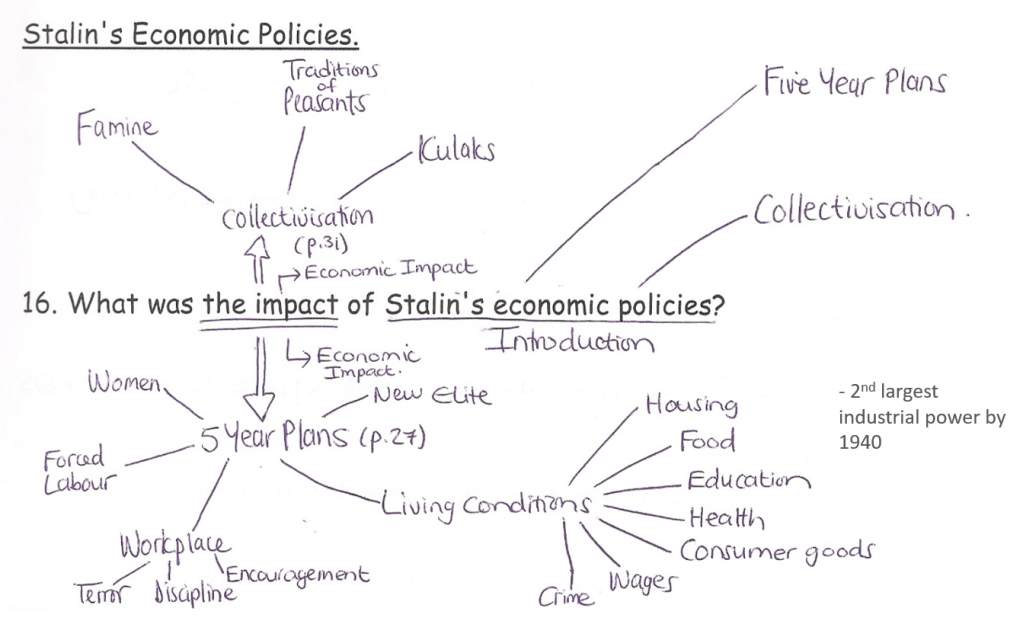
Stalin’s Economic Policies.
QUESTION 16.
What was the impact of Stalin’s economic policies?
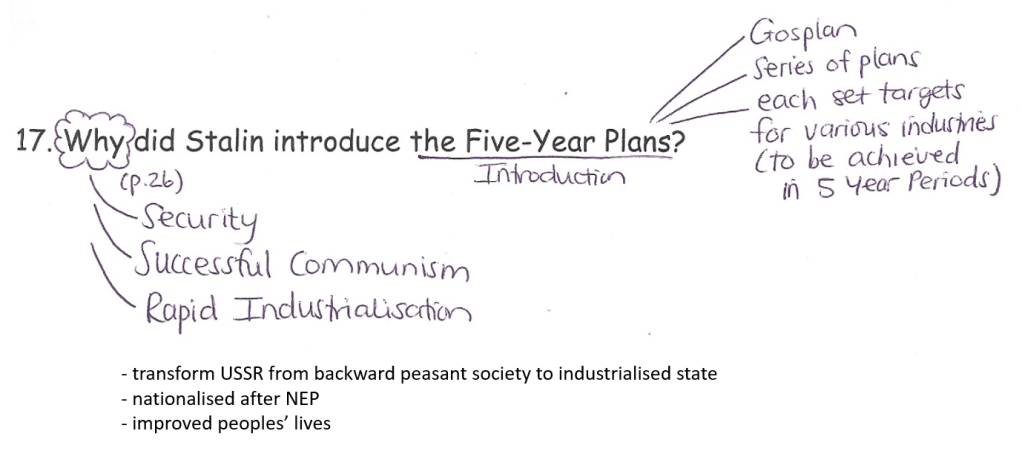
QUESTION 17.
Why did Stalin introduce the Five-Year Plans?
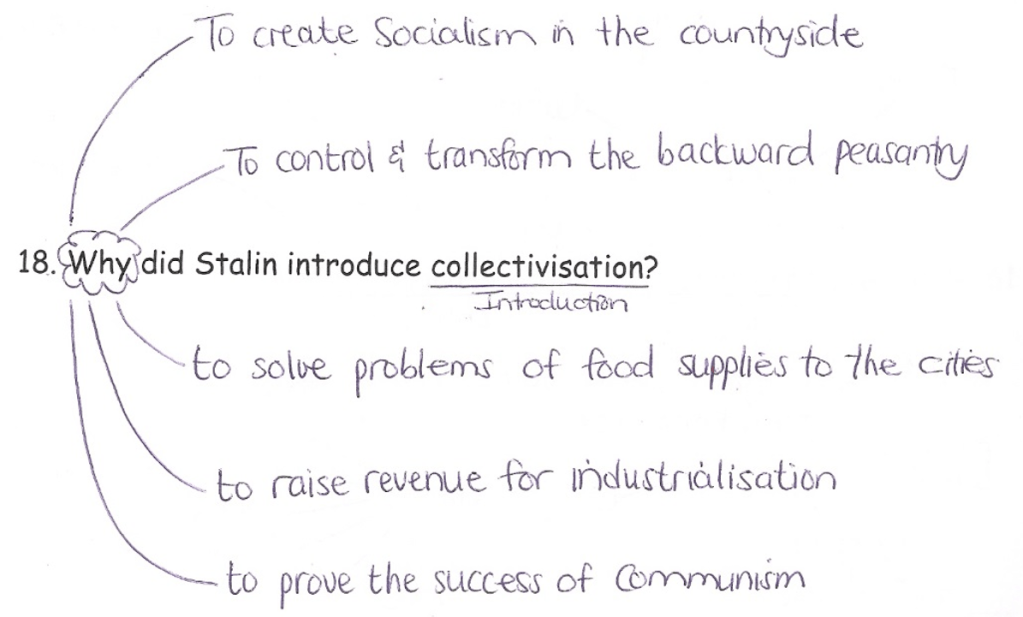
QUESTION 18.
Why did Stalin introduce Collectivization?
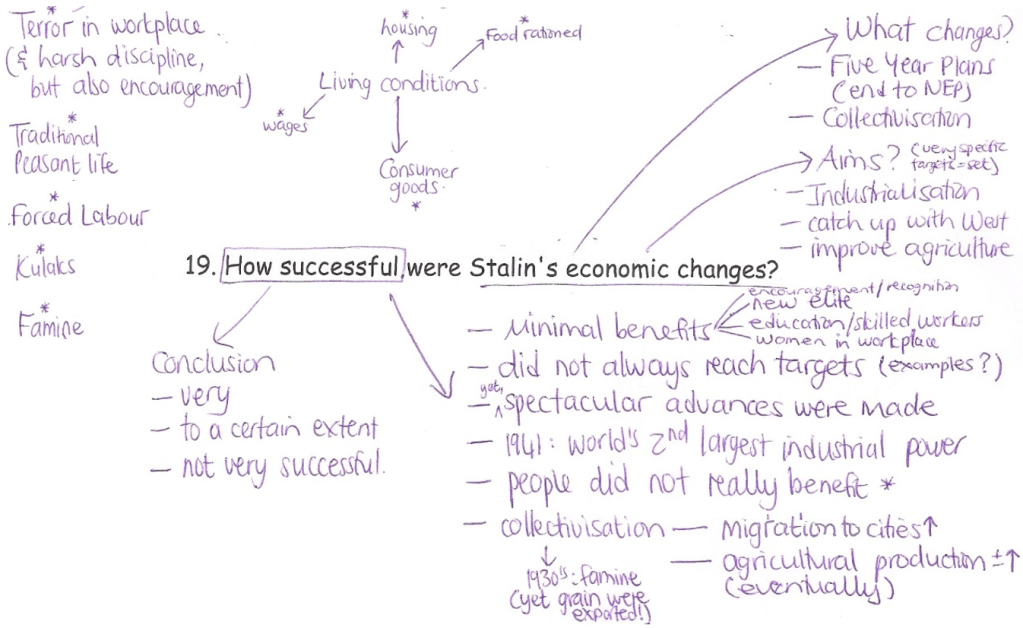
QUESTION 19.
How successful were Stalin’s economic changes?
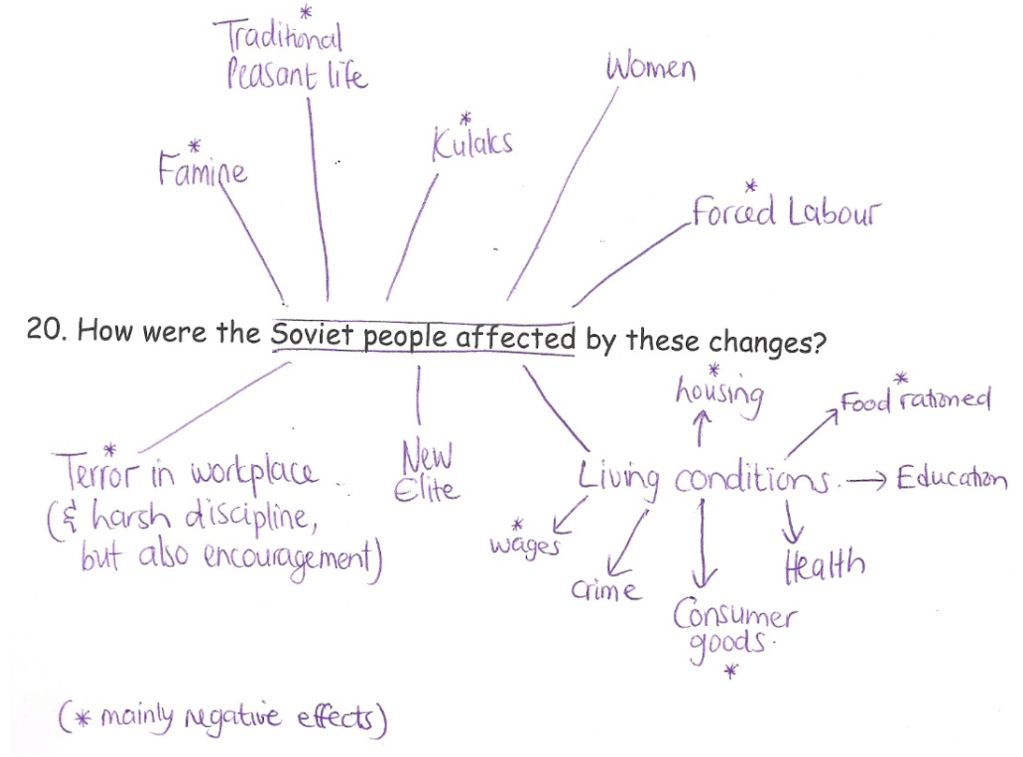
QUESTION 20.
How were the Soviet people affected by these changes?
(WordPress advertisements may appear below.)
Protected: Y7: Ex-24. Final Exams – 2024
Under Construction…

(WordPress advertisements may appear below.)
Protected: Y8-2. Answers to all Tasks in “Cortes & the Aztecs” booklet
Protected: Y9-5. Answers to all Tasks on “Source Analysis”
Protected: Y9-4. Answers to all Tasks on “The Holocaust”
Protected: Y9-3. Answers to all Tasks on “Nazi Germany”
Protected: Y9-2. Answers to all Tasks on “Consequences of WW1”
Protected: Y9-1. Answers to all Tasks on “The First World War”
Protected: Y8-4. Answers to all Tasks on “Slave Trade”
Protected: Y8-3. Answers to all Tasks on “Reformation”
Protected: Y8-2. Answers to all Tasks on “Exploration”
Protected: Y8-1. Answers to all Tasks on “The Renaissance”
Protected: Y7-4. Answers to all Tasks on “The Normans”
Protected: Y7-3. Answers to all Tasks on “The Anglo-Saxons”
Protected: Y7-2. Answers to all Tasks on “Roman Living”
Protected: Y7-1. Answers to all Tasks on “Roman Invasion”
Protected: Roman Invasion: HW-4-Answers
Answers to all Homework Tasks – Y7

1–The Roman Invasion of Britain
2–Roman Living
3–The Anglo-Saxons
4–The Norman Invasion of Britain

(WordPress advertisements may appear below.)
 Best study methods